Integra Resources Corp
Q3 FY2026 · Earnings Call TranscriptNovember 12, 2026
Operator
Good morning. My name is Chrislyn, and I will be your conference operator today.
At this time, I would like to welcome everyone to Integra Resources Q3 2026 results conference call. All lines have been placed on mute to prevent any background noise.
After the speakers' remarks, there will be a question-and-answer session. If you would like to ask a question during this time, press star followed by the number 1 on your telephone keypad.
If you would like to withdraw your question, press star 1 again. Thank you.
I would like to turn the meeting over to Josh Serfass, Vice President of Investor Relations. Josh, please go ahead.
Josh Serfass
Thank you, Chrislyn. I would like to welcome everyone to Integra's 2026 third quarter operating and financial results conference call.
Before we begin, I would like to note that we will be making forward-looking statements during today's call. I will direct you to the second slide of the earnings presentation, which contains important cautionary notes regarding the use of forward-looking statements.
The cautionary notes can also be found on Integra's corporate website. Please note, all dollar amounts discussed today will refer to the U.S.
dollar, unless otherwise indicated. On the call today, I'm joined by Integra's President, CEO and Director, George Salamis; Chief Operating Officer, Cliff Lafleur; Chief Financial Officer, Andrée St-Germain; Vice President Finance, Sean Tyszner; and General Manager of the Florida Canyon Mine, Greg Robinson.
Today we are pleased to provide an operating and financial update for the third quarter of 2026, followed by a live question-and-answer session. With that, I would like to hand the call over to George to kick things off.
George Salamis
Thanks, Josh. Good morning, everyone, and thank you for joining us today to discuss Integra's third quarter 2026 results.
The third quarter marked another period of strong progress for Integra, with continued production growth at Florida Canyon, supported by sustained high mining and stacking rates. This improving operational performance, combined with our strengthened financial position, is providing the foundation to execute on our broader strategy to become a multi-asset, U.S.-focused gold producer.
When we acquired Florida Canyon in 2024, our objective was to establish a producing asset that could support Integra's next phase of growth. Over the past two years, we have gained a much deeper understanding of the operation, made targeted investments, and developed a mine plan that is expected to deliver higher production, lower cost, and stronger cash flow in the years ahead.
At the same time, we continue to advance our DeLamar project in Idaho toward a future construction decision, while unlocking additional value at our Nevada North project. Together, these projects provide a strong pipeline of growth opportunities that complement our producing asset at Florida Canyon.
As we look ahead, our priorities are clear: continue improving operational performance at Florida Canyon, advance our development projects, and maintain a disciplined approach to capital allocation. We believe the progress made this year has positioned Integra for an important next phase of growth, as we work towards becoming a mid-tier U.S.
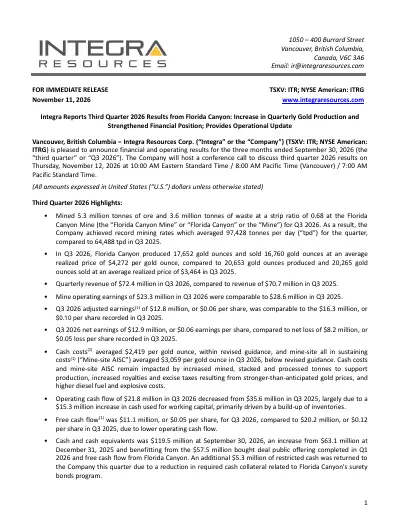
precious metal producer. The company ended Q3 in a strong financial position with $119.5 million in cash and working capital of $159.5 million.
This financial strength positions Integra to execute on its growth strategy at Florida Canyon, advance DeLamar towards an anticipated permit in the second half of 2027, and progress permitting and data collection at Nevada North to support advanced economic studies. Operationally, Florida Canyon has posted its second consecutive quarter of production growth, producing 17,652 ounces of gold in the quarter, an 8% increase quarter-over-quarter and a 40% increase over the first quarter of 2026.
The company mined 97,428 total tons per day, which is a record for the mine, with process grades increasing throughout the year. Florida Canyon generated revenue of $72.4 million and operating cash flow of $21.8 million.
The ore placed on the heap leach pad has increased 25% quarter-over-quarter, as the company focuses on revised annual production guidance. With that, I will hand the call over to our COO, Cliff, to discuss the third quarter operating results for Florida Canyon.
Cliff Lafleur
Thanks, George. Turning to slide 6, we've outlined key operating metrics for Florida Canyon in the third quarter of 2026.
The third quarter showed strong operating results for Florida Canyon, with a record mining rate of 97,400 total tons mined per day. In Q3 2026, the company mined 5.3 million tons of ore and 3.6 million tons of waste, at a strip ratio of 0.68 for the quarter.
Average gold recovery was 52.5% for the quarter, which is down approximately 5%, reflecting the increased placement of run-of-mine ore on the heap leach pad versus crushed ore. Florida Canyon produced 17,652 ounces of gold in the quarter and sold 16,760 ounces, totaling 46,666 ounces of gold produced year-to-date.
Q3 2026 mine site AISC was $3,059 per ounce sold, below our revised guidance, and cash costs averaged $2,419 per ounce sold. Costs are impacted by elevated rates of mining, hauling, and stacking, as well as higher diesel, labor, and explosive costs.
In the quarter, we invested $10.6 million in sustaining capital, focused on mobile equipment leases and refurbishments, as well as exploration drilling on resource growth. The company also continues to invest in a pre-stripping campaign at the Central Pit to access higher-grade ore, which will support the mine plan for the next few years.
Ore from this area will ramp up through Q1 and Q2 of 2027. The company expects investments in sustaining capital expenditures to remain elevated in Q4 of 2026.
The company also invested $1.3 million in non-sustaining capital this quarter, primarily directed towards mobile fleet expansion and heap leach pad expansion to accommodate the longer mine life and increased production profile presented in the updated life-of-mine plan and technical report, which was filed in July of 2026. Exploration at Florida Canyon continues to deliver exciting results.
I'll pass the call to George to discuss recent exploration results.
George Salamis
Thanks, Cliff. Turning to exploration, prior to our acquisition of Florida Canyon in 2024, investment in exploration had not been a major focus.
As we gained a deeper understanding of the operation, we began identifying a number of opportunities to grow the resource base, both within or immediately adjacent to existing mining areas and areas outside the mine gate. In addition, we also developed a new geological model for Florida Canyon, focused on improving our understanding of the geological controls on gold mineralization across the property.
This work has helped us to refine our exploration strategy, identify new targets, and prioritize opportunities that could add meaningful ounces to the mine plan. Our recent drilling results are beginning to demonstrate the potential of this approach.
One of the most promising areas is the Central Pit Radio Tower Saddle target, a 3.9 kilometer by 2.9 kilometer area located between two existing open pits. Recent drilling has delivered some of the strongest results since we've acquired Florida Canyon, including 1.3 grams per ton gold over 62.5 meters and 0.59 grams per ton gold over 167.6 meters.
These results highlight the potential for meaningful resource growth within the existing mine footprint. As you can see in this cross-section of the Central Pit Radio Tower Pit Saddle area, mineralization is near surface, with strong gold grade continuity throughout the drill hole.
The grades encountered in the drilling are consistent with or exceeding those currently being mined at Florida Canyon. Furthermore, given its location between existing pits and close to established infrastructure, this area has the potential to support future mine plans and contribute additional gold ounces to the production profile.
The company has planned an additional 54 drill holes representing 5,400 meters at this target. Exploration drilling has also identified the Madre Shear North target, a new near-mine exploration opportunity located beneath the north dump, whose material was included in the updated mine plan.
The southern portion of the Madre Shear was mined by previous operators, but its northern extension remained largely unexplored due to limited access. Exploration drilling will also continue this year at the Standard Mine, a past-producing mine situated 8 kilometers south of Florida Canyon, and the first target to be tested outside of the existing mine footprint by Integra.
Now, I will hand the call back to Cliff to discuss DeLamar updates.
Cliff Lafleur
Thank you, George. Now on slide 9, DeLamar continues to advance on multiple fronts as we prepare the project for a construction decision.
Our focus has shifted from defining the project to preparing it for execution, with detailed engineering, procurement, permitting, infrastructure projects, and project financing activities all progressing in parallel. This work is designed to reduce execution risk and position DeLamar for a final investment decision following receipt of the Environmental Impact Statement and Record of Decision, which are expected in the second half of 2027.
The public comment period of the National Environmental Policy Act ended in June 2026, and the Bureau of Land Management and its consultants have developed the issue statements that will drive analysis in the Environmental Impact Statement. In addition, by the end of this year, Integra will have collected five years of baseline work at DeLamar, including thousands of surface and groundwater quality samples, air quality samples, and meteorological data.
On engineering, Ausenco and SLR continue to make progress on critical infrastructure, including heap leach pad design, solution management systems, water treatment facilities, and electrical power infrastructure. In parallel, we are advancing procurement of long-lead equipment, including Merrill-Crowe processing plant, crushing facility, and electrical equipment, with principal orders expected to be placed by year-end.
We have also made significant progress on site preparation and infrastructure improvements. In July, we mobilized a crushing plant to DeLamar, which has processed approximately 39,000 tons of historical backfill material from privately owned land on both DeLamar and Florida Mountain to further validate the crushing circuit outlined in the feasibility study.
In addition, we completed upgrades to the project's access bridge and continue to advance refurbishments of the existing truck shop, which will support future mining operations. Another important milestone was the appointment of GenCap Mining Advisory as our project financing advisor.
GenCap is helping us evaluate a range of potential financing alternatives and develop a financing strategy ahead of a construction decision. This is an important step in ensuring that our financing preparations advance alongside engineering, permitting, and procurement.
Overall, we're pleased with the progress at DeLamar. With permitting progressing and engineering, procurement, and financing advancing in parallel, DeLamar is well positioned to become Integra's next producing gold asset.
I'll now pass the call to our CFO, Andrée, to provide an overview of the third quarter financial results.
Andrée St-Germain
Thanks, Cliff. Integra closed the third quarter of 2026 with its strongest financial position to date, with a cash balance of $119.5 million and working capital of $159.5 million.
With the exception of our mobile equipment financing, the company has been debt-free since December 2025. The company reported Q3 2026 revenues of $72.4 million with a cost of sales of $49.1 million, resulting in $23.3 million in mine operating earnings.
This represents a 32% operating profit margin for the quarter. In Q3 2026, Florida Canyon sold 16,760 gold ounces at an average realized price of $4,272 per ounce, compared to 20,265 gold ounces sold at an average realized price of $3,464 in Q3 2025.
Operating cash flows of $21.8 million, or 11 cents per share, in Q3 2026 decreased from $35.6 million in Q3 2025, largely due to a $16.3 million increase in cash used for working capital, primarily driven by a buildup of inventories. Q3 2026 adjusted earnings were $12.8 million, or 6 cents per share, compared to $16.3 million, or 10 cents per share, in Q3 2025.
The decrease was primarily driven by higher cost of sales. Free cash flow was $11.1 million, or 5 cents per share, for the quarter, compared to $20.2 million, or 12 cents per share, in Q3 2025, mainly due to lower operating cash flow.
I will now pass the call back to Cliff to discuss revised guidance.
Cliff Lafleur
Thank you, Andrée. Turning to guidance, we are revising our 2026 production guidance at Florida Canyon from 70,000 to 75,000 ounces of gold down to 59,000 to 62,000 ounces of gold produced.
Recent leaching rates have not kept pace with the higher mining rates we've been running this year as we strip the higher-grade ore body in the Central Pit. To maintain effective blending and protect the long-term performance of our heap leach pad, we're reducing mining rates for the rest of the year.
Looking ahead, once we complete the stripping campaign at the Central Pit, we'll have access to higher-grade ore and expect to support more consistent production. Passing the call back to George for next steps.
George Salamis
Thanks, Cliff. Turning to slide 12, looking ahead, we have several important milestones across our portfolio as we close out 2026 and move into 2027.
At Florida Canyon, we are accelerating construction of the heap leach pad expansion to support the updated mine plan, while continuing our extensive exploration program. These investments are expected to support increased gold production and lower operating costs beginning in 2027.
At DeLamar in Idaho, our focus remains on advancing engineering, procurement, infrastructure improvements, and project financing preparations. We are currently working towards placing orders for long-lead equipment by year-end, while progressing through the federal permitting process, with the Record of Decision anticipated in the second half of 2027.
At Nevada North, exploration drilling is underway as we work toward an updated technical report and advanced economic studies in 2027. Overall, we believe Integra is well positioned for its next phase of growth, with Florida Canyon generating production and cash flow to support the advancement of our development portfolio, and our long-term objective of becoming a multi-asset, U.S.-focused mid-tier precious metals producer.
In close, I want to reinforce why we believe Integra represents a compelling investment opportunity, combining current gold production with a strong pipeline of advanced-stage development projects, all located in the United States. At Florida Canyon, we have established a solid production base, with higher gold production and lower operating costs expected to begin in 2027 and improve over the extended mine life.
At DeLamar, we continue to advance permitting towards the anticipated receipt of the Record of Decision in the second half of 2027. At Nevada North, we are laying the groundwork for the next phase of advanced economic studies, exploration, and permitting.
Across these three assets, we control a peer-leading gold resource inventory and a strong pipeline of heap leach assets in the Great Basin. Combined with our strong financial position and experienced leadership team, we believe we have the assets, people, and financial flexibility to execute on our strategy.
Ultimately, our objective is clear: leverage the production and cash flow from Florida Canyon to advance our development portfolio and build Integra into a multi-asset, U.S.-focused mid-tier gold producer. With several important catalysts ahead of us, we believe we are entering an exciting phase of growth.
To all of you, thank you for joining us today. With that, I'd like to turn the call back to the operator to begin the question-and-answer session.
Operator
We will now begin the question-and-answer session. If you would like to ask a question, please press star 1 to raise your hand.
To withdraw your question, press star 1 again. We ask that you pick up your handset when asking a question to allow for optimum sound quality.
If you are muted locally, please remember to unmute your device. Please stand by while we compile the Q&A roster.
Your first question comes from the line of Joseph Reagor with Roth Capital Partners. Your line is open.
Please go ahead.
Joseph Reagor
Hey, George and team. Thanks for taking the questions.
I guess first thing, on the revised guide, can you give us a little more detail on kind of the rationale behind why it's necessary to reduce the stacking rate? Then do you think this will roll into the potential for production for '27, both on the production side and cost side?
George Salamis
Sure, Joe. Thanks.
Before I pass that question on to Cliff, yes, the guidance revision is largely due to the leach rates that we're experiencing right now, and moving forward. I'm going to let Cliff opine on those.
Cliff Lafleur
Thanks, George. Good question.
I have to provide a little bit of context to maybe add a bit to production guidance adjustment. We were mining in a few areas, and as you note, through Q1, Q2, Q3, our mining rates were coming up.
The grades were lower in 2026 while we're stripping C4 to access better grades in the next few years. We were able to validate that the mining fleet can do that, which we're pretty excited about.
However, these areas not as consistent as say a central pit in fine production, and balancing the blending of fines with the higher production rates as we ramped up became too difficult to maintain the leaching rates. We backed off the mining, which is the reason for the guidance adjustment.
In 2027, we see more C4 coming in Q1, Q2, which will stabilize further the blending rates. That's already baked into the technical report, we're not seeing at this time any major impact to production.
We still need to do some work on the guiding of next year, but that's being done right now to make sure that we can get to those ranges. As for costs, we're also not yet prepared to release costs, but we're not seeing anything that based on the spending this year and what was expected next year without seeing any big surprises there other than what's going on in the world around us.
Joseph Reagor
Okay.
George Salamis
Then— I'm going to just further jump in there, Joe, just with one further thing just to start off with, head back to the leach rates. I'd really like to add that those ounces are on the pad, right?
I hope that's clear to everybody. They are on the pad, they're just leaching slower than we expected, and they will get recovered over the course of time.
Joseph Reagor
Okay. Then, as you think about the step-up in ore with pad in Q2 and Q3 and then realizing you need to back off in Q4, what do you think an optimal quarterly stack rate is?
Or are you guys still working on that?
George Salamis
I think that's a detail question. I'm going to pass back to Cliff.
Cliff Lafleur
It's a question that has a few variables in it, including what your grade is, and I think one of the other learnings from mining at a higher rate is the volume capacity you have on the pad. One of the other variables we've been dealing with and we're working to fix—this is why we've advanced pad expansion into 2026—is we learned pretty quickly that pads at Florida Canyon have historically in the market a few years ago were built very small.
You don't have a lot of room to maneuver, not a lot of flexibility when you're trying to do things like blend. We're fixing that over the next year, call it year and a half, by advancing some leach pad space.
To answer your question more directly, I can't give you a stacking rate. If we're producing 17,000 ounces a quarter, that typically works out to 70, up to 20,000 ounces gives you I think over 80.
We're trying to balance that kind of gold production with how much you can stack, depending on grade and fines you're finding in some of the areas you're mining.
Joseph Reagor
Okay. All right.
Fair enough. I'll turn it over.
Thanks for taking the questions.
George Salamis
Thanks, Joe.
Operator
Your next question comes from the line of Simon Wildsmith with Desjardins Securities. Your line is open.
Please go ahead.
Simon Wildsmith
Thanks, operator, and morning, team. Thanks for taking my questions.
Just two for me. Maybe just to quickly follow up again on the reduced mining rates.
I know that you guys have been talking a little bit about run-of-mine stacking and the trade-off between recoveries. Is it partly driven by that?
Then also I guess how much are you guys guiding to sort of a Q4 stacking rate? Is it driven by kind of crusher capacity?
Anything you can give there would be helpful.
George Salamis
Thanks, Simon. I'm going to pass that to Cliff.
Two questions in there, Cliff, for you to answer.
Cliff Lafleur
Just clarify, the first question was on does the leaching rates have to do with the increase in ROM, and the second question is would extra crushing capacity help? Did I get that right?
Simon Wildsmith
Right on the first one. The second one, yeah, maybe more on is there any sort of measure we can expect in for a mining or stacking rate for the last quarter?
Cliff Lafleur
The first question, we had the increase in ROM and the recovery baked into the plan when we set off with more mining. It has to do with the unpredictability of the fines that we were finding.
Planning for the blending rates in reality turned out to be more difficult to actually execute on when you're dealing with a smallish pad compared to a Bald Mountain where they have lots of room to do blending. On the second question, I don't have off the top of my head the stacking rate we're going to, but I'd say it's more like what we were doing in Q1, Q2.
The question on crushing, in our permit, we have a 14-million-ton crush limit on our crushing, and we only have capacity on site for 8. You'll note in our technical report, one of the large opportunities we've highlighted and we're working on we've done some scoping work in 2026, and now we're advancing that work to more detailed engineering in 2027, is we should be doing more crushing.
That's a no-brainer. We're looking at what that actual cost would be and what the actual crushing system and logistics would be.
We want to validate those capital costs before we would actually make any purchases, but that's what we're doing with that opportunity from the technical report.
Simon Wildsmith
Okay. Thanks.
Then one last question from me. I'm just wondering is that going to impact at all access to the Central Pit area or the higher grades that you're anticipating next year?
That sort of timeline on that still unchanged?
Cliff Lafleur
That's a good question,
George Salamis
Simon.
Cliff Lafleur
We've been able to maintain our stripping rates through all of this. It's one of the things you'll note if you go back into press releases, past ownership of Integra, you'll note the ebbs and flows of where they can be stripping and where they can be mining ore.
With the addition of the new equipment that we've made in 2025, '26, we can maintain the stripping required to get into C4 while also mining the ore. It's been a huge plus for us to stay on track.
You're seeing some of the rates that were in Q1 and Q2, you're starting to see that that's where we need to be. Once the stripping is complete, we can kind of back off again a bit.
Simon Wildsmith
Okay. Thanks, team.
That's it for me, and thanks again.
George Salamis
Thanks, Simon.
Operator
We have reached the end of the Q&A session. I will now turn the call back to George Salamis, President and CEO, for closing remarks.
George Salamis
Thanks very much. No further closing remarks.
Look forward to reporting on the next quarter, exploration results, and everything else to come. Thanks very much, operator.
Operator
This concludes today's call. Thank you for attending.
You may now disconnect.