Invivyd, Inc.
NNASDAQ:IVVDQ4 FY2025 · Earnings Call TranscriptMarch 5, 2026
Operator
Good day, and thank you for standing by. Welcome to the Invivyd fourth quarter 2025 earnings conference call.
At this time, all participants are in a listen-only mode. After the speakers' presentation, there will be a question-and-answer session.
To ask a question during the session, you will need to press *11 on your telephone. You will then hear an automated message advising your hand is raised.
To withdraw your question, please press *11 again. Please be advised that today's conference is being recorded.
I would now like to hand the conference over to your speaker today, Katie Falzone, Senior Vice President of Finance. Please go ahead.
Katie Falzone
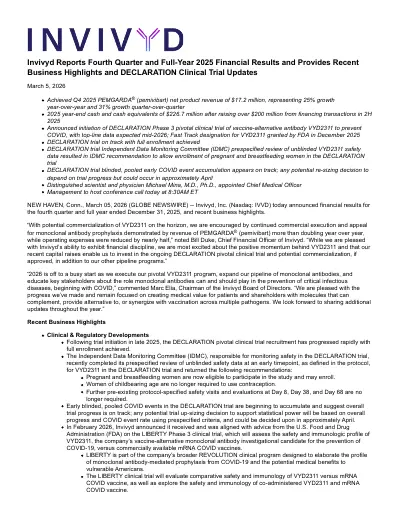
Thank you, operator. A short while ago, we issued a press release announcing our Q4 2025 financial results and recent business highlights.
That press release and the slides that we are being used today on today's webcast can be found in the Investors section of the Invivyd website under the Press Release and Events and Presentations sections, respectively. Today's discussion will be led by Marc Elia, Chairman of Invivyd's Board of Directors.
He is joined by Tim Lee, Chief Commercial Officer, Bill Duke, Chief Financial Officer, and Dr. Robert Allen, Chief Scientific Officer.
During today's discussion, we will be making forward-looking statements concerning, among other things, our corporate and commercial strategy, our research and development activities, our regulatory plans, certain financial expectations, our future prospects, and other statements that are not historical facts. These forward-looking statements are covered within the meaning of the Private Securities Litigation Reform Act and are subject to various risks, assumptions, and uncertainties that may change over time and cause our actual results to differ materially from those expressed or implied today.
These forward-looking statements speak only as of the date of this call, and Invivyd assumes no duty to update such statements. Additional information on the risk factors that could affect Invivyd's business can be found in our filings made with the U.S.
Securities and Exchange Commission, including our most recent Form 10-K, which are also available at our website. I will now turn the call over to Marc.
Marc Elia
Thank you, Katie, and good morning, everyone. I'll make a few quick remarks by way of executive summary, and then we'll discuss our clinical progress.
Of note, this morning you may have seen that we have brought an esteemed physician-scientist, Dr. [Michael Ryan?]
, into the Invivyd fold to serve as our Chief Medical Officer. While Michael is unable to join our call this morning, I'm sure many of you will enjoy hearing from him going forward.
After the clinical discussion, Tim Lee, our Chief Commercial Officer, will review our work with PEMGARDA and some of our pre-commercial preparation for VYD2311. Bill Duke, our Chief Financial Officer, will touch on our financial results for 4Q, and then we will be happy to take your questions.
Now on to the highlights. Our REVOLUTION clinical program is well underway, with the aim of providing Americans with an option for what we believe is needed protection from symptomatic COVID disease.
We know investors have many questions about our progress, and we will provide as much detail today as we can. Our commercial work with PEMGARDA continues, and we were pleased to demonstrate growth in the fourth quarter.
Our commercial activities are establishing an attractive basis for broader commercialization of VYD2311, if approved, by demonstrating the power and durability potential of Invivyd monoclonal antibodies. We are continuing to build awareness and understanding of our work with monoclonal antibodies among HCPs, professional societies, vulnerable populations, and government public health entities.
We believe that the ongoing American experience with COVID vaccination has left an extraordinary, high medical and economic value opportunity to advance standard of care via monoclonal antibody prophylaxis. In the pipeline, we are excited to begin clinical exploration of our antibodies in long COVID and post-vaccination syndrome, as disclosed earlier this quarter.
We are very interested that the Advisory Committee on Immunization Practices, or ACIP, a group which advises the U.S. Centers for Disease Control, have recently announced that they are having a full discussion on both topics.
The ACIP meeting is currently scheduled for March 18th and 19th, and we will be watching with interest. Our collaboration with key academic thought leaders in this space, the SPEAR study group, has yielded a clinical trial design we are moving with all haste to action in light of the substantial unmet need for millions of Americans suffering from long COVID and vaccine injury.
In the fourth quarter, we were pleased to share our identification of a highly potent, potentially best-in-class RSV antibody. As you may know, there are today two RSV antibodies approved and recommended for the prevention of RSV in certain neonatal and pediatric populations, and we believe the properties of our antibody are highly competitive with standard of care.
As we advance our work across multiple infectious diseases, you may notice a special interest in pediatrics. RSV, COVID, and indeed other viruses exert substantial medical burden on both the elderly and the very young, as well as immunocompromised persons.
Finally, as previously guided, we expect to update the Street on our measles program in the first half of this year. In light of the substantial and rapidly growing burden of disease, we are excited to share our progress with you, as well as describing what we see as the potential medical value of such an antibody, which we hope can be both first and best in class.
Slide 5, moving on to our clinical update. On slide 6, we know that there are investors who are new to the Invivyd story, and so we'd like to review quickly the medical and scientific background for our work with VYD2311, which hopefully will add context to the updates we provided on the DECLARATION study in our press release this morning.
First, it's important to remember that SARS-CoV-2 has been an extraordinary, unwelcome, and ongoing medical burden on the human species. As an ACE2 receptor-accessing betacoronavirus adapted for high human virulence and transmissibility, it has exerted medical toll in two distinct phases.
In the initial pandemic phase, the virus swiftly moved through the human population, exerting substantial morbidity and mortality, especially among vulnerable populations such as the elderly and people with relevant comorbidities such as pre-existing cardiovascular and renal disease. After vaccination and mounting seropositivity, we see a predictably less violent mortality, but still extraordinary medical burden from this virus, generally in the same populations.
As a vascular, prothrombotic, immunomodulatory virus that circulates pervasively, we now see accelerated human aging and broad health effects in Americans from acute infection, with attendant risks through the substantial growth in long COVID prevalence. Even American economic data collected by the Fed appears to show an unwelcome, impressive growth in American disability since COVID entered our population.
We must be less tolerant of this burden. Second, given all of the relevant socio-political and medical aspects of this controversial field, we must touch on the evidentiary and regulatory history we have in COVID prophylaxis.
The mRNA-based COVID vaccines were each formally studied in a single placebo-controlled clinical trial in the second half of 2020. These studies assessed vaccine safety and efficacy versus placebo in a seronegative American population against highly immunologically responsive Wuhan derivative virus variants for about seven to eight weeks before unblinding.
These studies demonstrated high short-term protection and short-term safety. However, these original data sets also reflect the last opportunity we had as a species to assess absolute safety in randomized placebo-controlled trials.
Given the broad vaccine mandates and rapid virus spread, we as a human species are now all routinely exposed to SARS-CoV-2 and its spike protein, which we see as a type of toxin, and absent a new medical option, we as a species have no real opportunity to avoid exposure to spike protein chronically going forward. Shortly after those original vaccine studies and vaccine rollout, our entire species became immunologically educated or seropositive, either through the original campaign or circulating virus, all while undergoing excess morbidity and mortality.
Omicron phylogeny virus arose quickly following and as an evolutionary acquisition of population immunity. Omicron viruses are defined by immune evasiveness or the functional avoidance of human immunologic pressure, whether vaccine-induced or natural.
One major consequence of Omicron virus was a natural, predictable, apparent reduction in COVID vaccine efficacy, which has been reliably estimated by epidemiologists at CDC over the past years and was directly measurable in diminished vaccine titers when vaccine manufacturers updated COVID vaccine compositions from Wuhan variant virus to Omicron BA.4/5 virus. These analyses can be seen in the relevant vaccine labels, and we see them as predictive of diminished efficacy.
COVID vaccine boosts have undergone five structural updates since Wuhan virus vaccines just on the basis of immunologic comparison. Ongoing new placebo-controlled vaccine studies should provide us all with more insight into these issues in the coming quarters.
By contrast, Invivyd is now conducting its third randomized placebo-controlled trial for a COVID monoclonal antibody in five years. Our antibodies change one to the next rather like the vaccines to make allowance for virus evolution, although we hope to stay ahead of virus variation rather than chasing it from behind.
On a percentage basis, our antibodies change by about the same tiny amount as vaccine antigens, but in contrast to COVID vaccines, we see our antibodies as a much more natural, welcome approach to prophylaxis than serial exposure to spike protein in vaccine form. To us, given the apparent short duration of vaccine-induced protection and the potential risks of administering spike protein in either mRNA or protein form, it is natural to now move to supplemental immune support via monoclonal antibody to exert protection.
From an evidentiary and regulatory point of view, our Invivyd antibodies have undergone more extensive placebo-controlled characterization than the COVID vaccines, including now multiple placebo-controlled clinical trials and, in our recent CANOPY study, long-term characterization of pemivibart in a modern seropositive population and against Omicron virus variants. That brings us to our latest antibody, VYD2311, designed as an alternative to COVID vaccination.
VYD2311 is much more potent than pemivibart in vitro and has a longer measured half-life, properties which we believe may combine to deliver equivalent protection to PEMGARDA, but in a much more scalable and convenient intramuscular form. You can see on slide 8 a reminder of the initial pieces of the REVOLUTION clinical program.
The DECLARATION study is a triple-blind, randomized clinical trial, once again evaluating the safety of VYD2311 and its ability to reduce the risk of symptomatic disease versus placebo. Our target enrollment for DECLARATION is approximately 1,770 human subjects, randomized 1:1:1 into two active arms and one placebo arm.
We were recently notified that the DECLARATION clinical trial has reached target enrollment and indeed, as is normal in these situations, may modestly overenroll as sites are permissioned to complete any ongoing screening and enrollment before closing. Of note, recently the DECLARATION Independent Data Monitoring Committee, or IDMC, conducted a prespecified review of unblinded safety and tolerability data associated with initial experience of DECLARATION subjects.
While the IDMC is completely separate from Invivyd, we are pleased to relay their written communication to us following that review, which included three recommendations. First, that pregnant and breastfeeding women may now enroll in the study; second, that women of childbearing age enrolled in the study are no longer required to use contraception; and third, that prespecified safety visits at days 8, 38, and 68 post-dosing are no longer required.
Finally, DECLARATION is a study designed to assess the performance of VYD2311 in lowering the risk of symptomatic PCR-positive COVID-19 versus placebo. In every infectious disease prophylaxis study, a sponsor like us faces an unknown so-called attack rate, or the rate of infection observed in the study to power our efficacy assessments.
Because monoclonal antibody technology in COVID has typically involved a very high efficacy hazard ratio, or VE, traditionally it has not taken more than a high single-digit or low double-digit number of events in a study to generate statistical significance. As you may recall, alignment with the FDA on the VYD2311 clinical development pathway included recognition that in our CANOPY clinical trial pemivibart, the placebo-controlled arm demonstrated robust exploratory efficacy with strong statistical support on the basis of nine total COVID events at three months.
America is in the middle of a COVID wave, and we are pleased with the speed of our study recruitment. The majority of our recruitment has occurred only in the past few weeks, and COVID events have begun to appear in our study.
We see DECLARATION event accumulation as on track to date and, on a projected basis, we anticipate suitable for robust assessment of VYD2311 effectiveness if the clinical performance of VYD2311 matches our modeling and prior experience with COVID antibodies. Of course, attack rate in the community and in our study is outside of our control and could change going forward.
As a result, DECLARATION includes a prespecified upsizing algorithm to allow for additional patients in the trial should our event rate projections indicate that DECLARATION would benefit from more statistical power. This resizing feature is dependent on overall progress, and at this point our best estimate is that such an analysis would take place in approximately April.
We will make an announcement to the Street about our next steps one way or the other at that time. However, depending on overall recruitment rates, with which we have been very pleased so far, a modest upsizing to add statistical power may not meaningfully delay our achievement of quote "mid-year" unquote timing guidance for DECLARATION, which we consider as 2Q or 3Q 2026.
Of course, any upsizing would have some level of timing impact, but we would endeavor to stay within our original guidance boundaries. When we get to that point, we will be happy to provide any updated timing estimates.
Irrespective of the overall number of COVID events, we are looking forward to data and believe that it may be a profound next step for our company and for infectious disease medicine if DECLARATION can demonstrate attractive VYD2311 safety, high antiviral titers, and a demonstration, for the third sequential time, of the vaccine-free protection that an Invivyd monoclonal antibody can provide. With that, I'd like to turn the call over to Tim Lee to discuss our commercial update.
Tim?
Tim Lee
Thanks, Marc. It's a pleasure to update you all on our work.
As we see it, more and more clinicians are turning to monoclonal antibodies, and frankly, it's common sense. Thomas Paine once wrote that common sense is often the most powerful kind of reasoning.
In healthcare, when evidence accumulates and risk is clear, the logical course becomes difficult to ignore. Our goal is straightforward.
It's not simple. We want to give people a choice as they seek protection against COVID.
We believe that choice has significant potential because there are still millions of individuals who remain vulnerable and underserved. The medical community increasingly recognizes the importance of antibody therapy, and the long-term consequences of COVID continue to be serious.
From in utero exposure, risk to children, neurological effects, cardiovascular complications, avoiding infection matters. That perspective is reflected in clinical guidelines.
Leading organizations, including the Infectious Diseases Society of America and the National Comprehensive Cancer Network, recommend monoclonal antibodies for prevention of SARS-CoV-2 infection in appropriate high-risk patients. This inclusion of PEMGARDA in the NCCN guidelines for B-cell lymphomas underscores that recognition.
We are encouraged to see growing interest in utilization across hematology, oncology, rheumatology, infectious disease, transplant, neurology, and other appropriate specialties. The adoption curve is expanding, and that momentum reinforces our belief in the long-term value of this platform.
There's a great deal reflected here on this slide, and many of these data points we've discussed on prior calls. I'm pleased that we continue to grow PEMGARDA to serve certain adults and adolescents who are moderately to severely immunocompromised, thus leaving them vulnerable to infection from SARS-CoV-2.
What you're seeing is Invivyd building a category. This category is served to expand upon the foundation that is PEMGARDA.
Nationally, we see continued growth of accounts who have utilized PEMGARDA, clearly understanding the benefits of protection offered by antibody therapy. We've created this durable foundation with a high degree of accounts reordering PEMGARDA at 77%.
We continue to increase available sites of care nationally and across multiple specialties, showing a high confidence through repeat utilization. Our GPO sites of care continue to grow, and the team has been busy providing education at conferences across the nation in hematology, oncology, rheumatology, neurology, pulmonology, transplant, and more.
As a team that is defining a treatment paradigm, we are in the right places, talking to the right audiences, and our position is strengthening after each engagement. We've secured more than 15,000 contracted GPO sites, significantly expanding our commercial footprint.
Taken together, these milestones position us to evolve beyond serving a more limited patient population that we have today with PEMGARDA. With our next-generation monoclonal antibody, we see the potential to redefine COVID prevention, moving toward a vaccine-alternative strategy designed to protect broader populations against viral infection.
Invivyd is proud to partner with Lindsey Vonn because she exemplifies the power of disciplined preparation as the foundation of enduring strength. In her memoir, Rise: My Story, Lindsey writes, "Preparation is the one thing I can control, I've always controlled it to a capital T."
Lindsey prepared in an elite level to always perform at her best, and that requires foresight to minimize anything that can get in her way. That mindset really mirrors our approach.
Invivyd's monoclonal antibody platform is built on the belief that proactive immune protection, preparing the body before viral exposure, is the most effective way to preserve performance, continuity, and long-term health. Viruses should be kept in check to allow everyone to give their best performance.
Staying well helps you continue showing up for the moments that matter, and antibodies can help a person stay well. For this reason, Lindsey is an amazing partner to help educate on the importance of antibodies in all of our well-being.
With that, I'll turn the call over to Bill Duke to discuss our financials. Bill?
Bill Duke
Thanks, Tim. I will quickly review our financials, and then we will open the line for your questions.
Our PEMGARDA net revenues continued to grow in the fourth quarter, up 31% over third quarter 2025 and up 25% over fourth quarter '24. Full net revenues in 2025 totaled $53.4 million, reflecting our continued efforts on driving awareness in the market.
After raising over $200 million in the second half of 2025, we ended the year with $226.7 million of cash and cash equivalents. This leaves Invivyd well capitalized through anticipated pivotal data for VYD2311 in mid-'26 and, depending upon continued PEMGARDA growth and continued operational discipline, potentially well beyond.
With that, operator, please open the line for questions.
Operator
Please stand by while we compile the Q&A roster. Our first question comes from the line of Patrick Trucchio with H.C.
Wainwright. Your line is now open.
Patrick Trucchio
Thanks, good morning, and congrats on all the progress. Just a couple of follow-up questions from us.
Just curious, I think it was mentioned that the potential trial resizing decision in the DECLARATION program could occur around April, depending on event rates. Can you talk a little bit more about that, what the specific statistical criteria that would sort of trigger that decision, and what magnitude of enrollment expansion may be needed?
Then, just separately, I think, beyond symptomatic PCR-controlled COVID, I'm wondering if you're collecting secondary endpoints such as viral load, symptom duration, or healthcare utilization, and how that could help characterize the clinical benefit profile that's emerging.
Marc Elia
Sure. Thanks for the questions, Patrick.
Happy to do my best to enlighten. On your first question, on the resizing, everything we do related to powering is, of course, effectively a 2x2 matrix, right?
You have to understand both the expected VE for which you are powering and then the number of events that accumulate that would allow you to project a final study power. Right now, as we sit here, we feel pretty good about our progress in the study.
All of these algorithms are essentially prespecified, of course, to avoid the potential for bias. I think the way I would look at it is like this.
Again, I'm speaking in concepts because, of course, we're not at that resizing yet, and we don't know what the next few weeks will hold. I think if we were to not trigger the upsizing trigger, it would be because we are highly confident in our ability to statistically assess even a lower-than-anticipated VE or hazard ratio.
If we do, it really couldn't even be read as a concern about underpowering as such. It would be simply because the way the trigger is designed, it would serve to potentially add power in case the target efficacy is lower than we might otherwise anticipate.
We think of it as really a safety mechanism to try to ensure, to the best of our ability, which again is unfortunately subject to the best of our ability, to support the power of the study in case VE pencils out as lower than our modeling would suggest. Now, the good news in all of that is actually related to the speed of our recruitment.
The upsizing target is not particularly onerous, okay? You can imagine in your mind's eye approximately another 30% of the study or so as an upsize target.
Importantly, of course, that cohort would be time-shifted, right, a little deeper into the spring and then into the summer, which you might imagine collectively would add to the probability that you accumulate more cases, for example, in a future COVID wave. While perfect is unavailable here, and we are not endowed with godly insight into the future weeks, what we can confidently say is we are very pleased with what we are seeing, and we truly don't know whether such a resizing would be triggered.
I think what is nice to consider is that if it is, we would simply be in a position to feel better about ultimate study powering. I think, stepping back, way back, to reflect on this endeavor, our goal is to have a successful study if that is what the clinical profile of 2311 allows.
To the extent that such an upsizing might incur a relatively modest timing and overall financial penalty, I think we'd rather, quote, "make the mistake," unquote, of having upsized and then only later find out we didn't need to than do it the other way around. I hope that adds some level of color around the design and thinking.
I think it'll be very difficult for us to elaborate much more because we speak to the Street only periodically, and of course these things occur semistochastically, right? We have just recruited up the bulk of the study.
We just have the most of the exposure out there, and so far things are looking great. We'll make sure to update you as we go forward.
In terms of secondaries, of course you can imagine in a study like this we will be recording all manner of interactions between participants and, for example, the healthcare complexes sort of is behind one of the questions you asked. I'm sure a great deal more will always come from this study as it did from CANOPY.
I think I would caution on expecting meaningful powering of low-frequency clinical events, e.g., hospitalization or death. I think that would be well beyond the intended power of this exercise, but I think that's also for a reason, meaning at this stage in the game, I think we see pretty clear, linear, biophysical truth, if not that sort of a level beyond plausibility, but let's just say it like that, that if you do not get sick from SARS-CoV-2, it is pretty unlikely for you to be hospitalized with SARS-CoV-2 or die from SARS-CoV-2.
Our progress as a species, I think over these last six years, has demonstrated that one of the best ways to stay well is to not get sick, and that is really what we are fixated on trying to demonstrate here. I think that's an evergreen principle.
I think it has been well elaborated in all manner of these studies. I think those relationships are pretty clear in all of the data, even from the vaccines.
Our primary focus is really on I guess a revisit of what was an earlier in the pandemic message: don't get sick. Most good things, we would think, would follow linearly and logically from that.
I think that is the regulatory paradigm in which we're pleased to operate, and I would suspect that if we are successful going forward, there will be many, many opportunities, as our antibodies move into bigger and bigger populations, to demonstrate these kinds of things in classically post-approval registry and other type situations in which we'll all look eagerly to make sure that we're right in effect, that not getting a symptomatic infection following exposure to a virus is just a globally good thing. Again, not trying to be coy or not answer, I think we will collect a lot of stuff.
I don't know how meaningful many of those endpoints will be from a quantitative and powering standpoint, but they will certainly be collected.
Patrick Trucchio
That's really helpful. If I could, I'd just like to ask about the measles antibody program.
I think there's an update expected in the first half of this year. Can you give us a little bit more detail what the envisioned use cases?
Is it outbreak prophylaxis? Is it sort of a pediatric bridge therapy, I suppose, before newborns could get the vaccine?
Or are we looking at more of a broader prevention strategy?
Marc Elia
Great. Thanks for asking, and I hope it doesn't diminish your interest in more when we're in a position to more formally update.
I'll just stay in concept land for a little while. Look, you've hit upon the use cases, I think, quite nicely in large part, right?
One of the things we very much like about this modality is that there is not a pharmaceutical premise that we or use case we prosecute separate from what native human immunobiology prosecutes. Why do we all have antibody suites?
It is to prevent the presentation of symptomatic disease, to treat and knock down viremia once an infection is established. As that means we could use such an antibody theoretically for treating active disease.
By the way, that is, as we've noted in the past, I think, something that sometimes clinicians will use intravenous immunoglobulin, or IVIG, to do. You could imagine, of course, responding to outbreaks with essentially ring immunization via monoclonal antibody, which might be an enhanced way to look at the kinetics and potency of what we're able to put on board relative to vaccination.
Then more generally, you highlighted something there that I think we have been putting a lot of thought into, which is I think you used the concept of bridge to vaccine. We think about it almost more in the sense of vaccine enhancement, meaning I would just observe, and I think this is non-controversial, children, babies are born without a fully developed adaptive immune system, especially the B suite, and so there are data demonstrating that delaying vaccination actually has the ability to improve the profile of vaccination, meaning higher, more durable titers from vaccinating older and older kids and potentially lower possibility of seronegativity or failure to seroconvert after vaccination.
Not to mention the potential benefits associated with allowing for early childhood neurocognitive, motor development, all these other things. Look, we are going to be in a position, we hope, to contemplate a lot of things that really I think the medical complex hasn't been in a position to contemplate before, and that is because, justifiably, absent other tools, I think that pediatric schedule is thoughtfully assembled in order to try to have the least vulnerability possible, beginning with vaccination at an early age.
Certain antibodies, especially nirsevimab, Beyfortus, and others, have demonstrated the benefits associated with passive prophylaxis in the very young. There may be other benefits we can explore going forward, but look, it's premature to say more, although Robert Allen is leaning in, and that usually tells me he wants to add something, I'm going to stop in a second.
I guess I would just say, stay tuned because I think we are really intrigued by the potential for some use cases, as you put it, that just have never been contemplated before. I think our view is there's a potential substantial quantum of medical and potentially economic value to create.
Robert Allen
I would agree with that answer, and I think that the main thrust of this has come from inbound requests from HCPs for something to provide them with a solution in cases where they have a need for treatment or post-exposure prophylaxis for measles. This antibody has been designed with those use cases in mind, as well as some of the potential future use cases that Marc mentioned.
That's really where we're headed with this antibody at this point.
Patrick Trucchio
Terrific. Thanks so much.
Operator
Thank you. As a reminder, to ask a question at this time, please press *11 on your touch-tone telephone.
Our next question comes from the line of Tom Schroeder with BTIG. Your line is now open.
Tom Schroeder
Good morning, and congratulations on the progress. I think you're making positive event comments, and certainly the safety news is fantastic.
We've talked a little bit, Marc, about your ability to sculpt the trial a little bit to try to hit hotspot areas. Wonder if you could talk in broad brushstrokes about how well that has gone, and is that, in fact, self-enforcing that the people who enroll are, in fact, they know they're in areas where this is a big deal?
Then a more specific question on the myocarditis monitoring. Is that going to be clinical myocarditis, yes/no, or is that a more detailed study where you're looking at, I don't know, muscle proteins, things like that?
Is that a deeper study, or is that just the rare clinical myocarditis event? Thanks.
Marc Elia
Hey, good morning, Tom. Thanks for the questions.
Happy to give you some view here. Listen, with respect to DECLARATION study, what we've been discussing is, on the margin, our ability to have sites that are in areas that are, we believe, undergoing some level of community COVID attack rate, right?
Tom Schroeder
Now,
Marc Elia
you can see some of that in the ways that we see it, whether it's clinical sequencing, whether it's wastewater sequencing, or sometimes whether it is, for example, emergency department or sort of what are those things called, the sort of low-acuity walk-in clinic kind of census data on where people are reporting symptomatic positive COVID. Look, we operate a U.S.
study with a relatively broad catchment area because a lot of this was designed in October, November, December timeframe, and we were not in possession of such a map, but we have some ability on the margin to try to place exposures where we see COVID. I think it's also a risk to overinterpret the map because these things move, and they move fast.
For example, over the next few weeks or months, to the extent that air conditioning goes on across the U.S. South, the map can move.
We feel pretty well prepared and pretty well configured to hopefully keep seeing event accrual. Now, is it self-reinforcing?
I couldn't even begin to answer because I've never even contemplated such a thing, I guess I'll leave it as I don't know. We'll see in hindsight whether or not there was any discernible behavioral aspect to it.
On myocarditis, I think at first pass, this is going to be a yes/no exercise, mainly because the LIBERTY study, where we are looking for that, is small. I think the risk of overt myocarditis or pericarditis following vaccination is relatively low.
Now, like all clinical studies, we gather samples, we will look at data, there can always be room for more detailed exploration or follow-up. Again, if we were to see such an event following vaccination, I think we would become very interested.
I wouldn't speak on behalf of the broader scientific or academic community or regulators, but I imagine a lot of people might be interested in that. I just want to double underline myocarditis, pericarditis is not something we see with antibodies, right?
Tom Schroeder
This is a function
Marc Elia
of studying mRNA-based COVID vaccination in our comparative and combination LIBERTY study. Look, we'll see, right?
LIBERTY is certainly not powered or even close to powered to detect events that we would imagine are at that lower frequency, but let's all find out together.
Tom Schroeder
If I can ask a quick follow-up, you apparently have an RSV antibody you like. That would seem to be a high bar.
That's been a very active area for a long time. Can you give us any detail on maybe what you're improving or how hard do you think it would be to have an antibody that was good enough to take on what's a pretty entrenched competition?
Thanks.
Marc Elia
Sure. Now I really saw Dr.
Robert Allen's body language change, I know he's going to have some thoughts to add. I would just say this.
The RSV antibody field goes back, I believe, to 1998 with palivizumab or Synagis, and was really only updated at the molecular level, I want to say, and forgive me if I'm wrong, in 2023 with the arrival of nirsevimab, Beyfortus. Now, nirsevimab is a lovely antibody.
I think ours is a lovely antibody, and I think it has some properties that we see as quite compelling. Typically in the pharmaceutical industry, when we look at a blockbuster, high-growth antibody space, it's hard to sit back and conceive of the fact that that will be the one thing forever and only and always.
Indeed, at the molecular level, we really like what we're seeing and expect to have the ability to compete. I'll let Robert elaborate in a minute, but I would also just note, we look at RSV as a really attractive component of an emerging strategy you might well notice now as we go from COVID to RSV, perhaps to measles, perhaps onward to other viruses, in which having a commercial portfolio and a real presence in pediatrics has the potential to open or expand on a field that is, I would argue, by contrast to your assertion, in its infancy, no pun intended.
Nirsevimab in year three now is early. I think its dramatic commercial success is a function of the quality of the medicine.
To the extent that we feel great about the quality of our medicine, I can say we are very much looking forward to competing. Now that that's a long way off, but we have opportunity in front of us to be clever in clinical trial design, to be clever in some other aspects that might define our overall profile.
Now that Robbie's good and warmed up, why don't you add color there?
Robert Allen
I think what you can know is that we've learned a lot in the era of generating COVID antibodies about trying to be upfront about addressing evolutionary drift and recognizing that while there may not be liabilities to our epitope, drift represents a change in context that deserves to be addressed periodically. When we look at RSV in the time since the screening was done for the two known actives that are in the market now, there's been a considerable amount of drift.
Really the design of our program was meant to address that, and with that drift also address some of the known liabilities for the two known actives and overcome those liabilities by design. This is where we find ourselves with a very high quality antibody that's contextualized by the recent evolutionary past of that virus.
I think that, as we see with RSV, we can depend on it to drift not as much as COVID, but as SARS-CoV-2 rather, but will drift, and so we will continue to address that as it comes up. It's really the overall strategy that we have with our antibodies is to be very upfront about updating antibodies periodically to match the environment that we find ourselves in.
I hope that helps.
Tom Schroeder
That's perfect. Thank you.
Operator
Thank you. I'm currently showing no further questions at this time.
I'd like to hand the call back over to Marc Elia for closing remarks.
Marc Elia
All right. Thank you very much, all of you, for joining us this morning.
We will look forward to having, I'm sure, some follow-up calls throughout the day. Have a great day.
Thank you.
Operator
This concludes today's conference. Thank you for your participation.
You may now disconnect.