JBS N.V.
Q3 FY2026 · Earnings Call TranscriptNovember 10, 2026
Operator
Morning and welcome to JBS' third quarter of 2026 results conference call. At this time, all participants are in listen-only mode.
Following management's remarks, we will open the floor for a question-and-answer session, and instructions will be given to participants on how to proceed at that time. Please note that to ensure all analysts have the opportunity to ask a question, we kindly request that each analyst limit themselves to just one question.
As a reminder, this conference is being recorded. Any statements eventually made during this conference call in connection with the company business outlook, projections, operating and financial targets, and potential growth should be understood as merely forecasts based on the company's management expectation in relation to the future of JBS.
Such expectations are highly dependent on the industry and market conditions and, therefore, are subject to change. Are present with us today Gilberto Tomazoni, Global CEO of JBS; Guilherme Cavalcanti, Global CFO of JBS; Wesley Batista Filho, CEO of JBS USA; and Christiane Assis, Investor Relations Director.
Now, I'll turn the conference over to Gilberto Tomazoni. Mr.
Tomazoni, you may begin your presentation.
Gilberto Tomazoni
Good morning, everyone, and thank you for joining us today. The third quarter was marked by a challenging market conditions across several of our business.
Changing international trade flows, pressure on poultry margins, and a global oversupply of pork affected our results. At the same time, we made progress in important areas of our operations, reinforcing our confidence in the strategy we have been executing.
Our experience in food industry has showed us the importance of understand market cycles, improving efficiency, and making decisions that strengthen our business over the long term. Our important development in the quarter was the return to positive EBITDA in our US beef business.
This is an encouraging result of the work we have been doing to improve competitiveness. There is still more to do, but we are beginning to see the benefit of these initiatives.
Wesley will provide more details of the performance of North America business and the actions underway. Turning to Pilgrim's Pride, as Fabio Sandri highlighted during the company third quarter earnings call, chicken continues to resonate with consumer across its markets, supported by affordability and the strength of its diversify portfolio.
He also emphasized the progress in operational efficiency, innovation, and investment in high-value products. These remain important priorities as Pilgrim's continues to strengthen its business and build resiliency across market cycles.
In Brazil, despite a challenging quarter, our team respond promptly in adapting production and commercial strategy and leverage our global network and distribution capabilities. While exports to China declined sharply, Friboi successfully redirected volumes to other markets and expanded domestic sales.
This performance reflect the strength of Friboi brands, the value of our Friboi+ retail relationship programs, and the effectiveness of our commercial execution. We already see an improvement in October, reflected this adjustment and renewed demand from China as a customer secure volumes under the 2027 27 quota.
Together with seasonality and stronger domestic consumption, this created a more favorable environment for our Brazilian beef business in the fourth quarter. The recovery in export volumes, combined with a stronger seasonal demand in Brazil, give us confidence in a better fourth quarter for Friboi.
Our strong brand, customer relationship, and access to international market remain important competitive advantage, allowing us to respond changing in demand and maximize the value of our products. Friboi is a clear example of how strong brands, close relationship with retail, and access to different markets helped us to respond challenging conditions and strengthen our competitive position.
At Seara, the quarter was affected by higher costs and more challenging commercial environment in Brazil. Despite this pressure, Seara gained market share across the categories and reached the highest ever level of brand preference and consumer consideration.
These results reflect the strength of Seara brand and its position with Brazilian consumers. We are focusing in what we can control, improving efficiency and commercial execution, strengthen the integration between our operation and customers, and increasing the value of our portfolio.
We continue to invest in automation at Seara to improve productivity and efficiency. Seara's strong brand, innovation, and investment in production capability provide a solid foundation for growth.
The gains in market share and record brand indicators reinforce the competitiveness of Seara of the strength of the commercial execution. Internationally, the Middle East remain as an important market, where our investment in local production and distribution are strengthening our presence and contributing positively to results.
In Europe, we maintain production and build inventories during a period of trade restriction, position the business to benefit as sales resume. The fourth quarter is also an important period of Seara, supported by strong seasonal demand in the local market.
Together with the recover international sales and inventories build during the quarter, these support a more favorable outlook for Seara in the final months of the year. Across the global operations, market conditions vary, but the pace of recovery will not be the same across the proteins and geography.
This reinforce the importance of our diversification strategy. We have built JBS as a global multi-protein company with access to different markets and sourcing of earnings.
Diversification does not eliminate industrial cycles, but it strengthen our ability to navigate them, allocate capital, and continue developing our business. Our investment in efficient, innovation, brands, and value-added products support this long-term strategy.
Our people remain fundamental to the execution, with experienced team close to our operation and customers. Cash generation is another important priority.
Leverage increased during the quarter, as expected, reflected the operating environment. We remain focused on working capital management and disciplined capital allocation, maintaining the financial flexibility needed to support our investments.
We have built JBS as a long-term vision, investing consistently and strengthen our ability to compete in different markets and industrial cycles. Our strategy remain unchanged.
We will continue to focus on execution, efficiency, innovation, and develop our people, creating conditions for sustainable growth and long-term value creation. Our leadership transition is progressing as planned, with Wesley Batista Filho gradually take on greater responsibility for JBS operations.
This is a naturally step in the company evolution, supported by our strong management team, consistently strategy, and our culture we have built over the years. Thank you very much.
I will now turn the call over to Wesley.
Wesley Batista Filho
Good morning, everyone. The main highlight of the quarter was our US beef business returning to positive adjusted EBITDA under the US GAAP after two challenging years.
This reflects both both improving market conditions and the operational changes we've been implementing. Earlier this year, we brought our fed beef, regional beef, and case-ready operate business units under one management structure to better coordinate procurement, production, and sales and optimize our operation footprint.
We've also increased our focus on yields, productivity, maintenance, operational reliability, and cost discipline. On the market side, the reopening of the US border to Mexican cattle imports is an important development.
Cattle are arriving heavier and reaching processing weights sooner. We expect approximately 1 million head of imported cattle from Mexico per year.
Cattle prices have declined from recent peaks, while beef prices remain resilient. Although cattle supplies remain tight, Mexican imports and a better balancing processing capacity support a more constructive outlook.
Turning to US pork, market conditions deterio- deteriorated rapidly during the quarter. Higher global supply and weaker demand have pressured prices and margins.
We expect these conditions to remain challenging into the first half of 2027. Our focus is on cost management and operational efficiency.
The US has The US has harvested its second-largest corn crop on record, supporting ample grains availability and stable feed costs. In South America, soybean planting in Brazil has progressed within the ideal window, although it is still early to assess the second corn crop.
Overall, we're encouraged by the improvement of the US beef business. Our focus remains on what we can control: improving productivity, managing costs, and mak- making our operations more competitive.
Thank you, everyone. I will now turn the call over to Guilherme.
Guilherme Cavalcanti
Thank you, Tomazoni and Wesley. Last night, we announced the acquisition of 100% of Flora for the enterprise value of $442 million, of which $367 million for the equity and $175 million in debt assumption.
All the equity will be paid in JBS treasury class A shares. There will be no impact on JBS net leverage given Flora EBITDA.
Flora brings higher margins than JBS, a portfolio of well-established home and personal care brands, and significant synergies. Flora also brings an important strategic advantage to JBS.
It is established B2C platform gives us access to new sales channels in Brazil, particularly drugstore and specialized retailers, which we can leverage to accelerate the growth of our higher-value-added products, including Genu-in, our collagen-based health and nutrition platform. At the same time, Flora is highly complementary to our value chain, as it uses raw materials that JBS already produces.
Tallow is a clear example, with approximately 93% of Flora's consumption already supplied by JBS. This combination allow us to move closer to the end consumer while creating new venues of growth.
We see cost synergies from integrating corporate and commercial functions as well as additional opportunities across logistics, procurement, and tax. Considering only 2027 synergies, Flora acquisition multiple would reduce from 7 times to less than 4.9 times.
Over 10 years, we estimate the present value of total synergies and monetization of tax credits at $422 million, further reinforcing the value creation of the transaction. On page 17 of the 10-Q financial statements, we disclose approximately $800 million in VAT-related tax credits and $2.2 billion in income tax credits.
Additional details including breakdown, further explanation, can be found on page 18 of our 20 2025 annual financial statements. Keep in mind, under Brazil's tax reform, VAT tax, ICMS, will be gradually replaced by CBS and IBS, but we expect the tax credit accumulation to continue to grow.
To establish the synergies, you can use the applicable tax rate, Flora's revenue, and net margins, incorporating a higher capacity utilization and additional capacity expected to come online over the next years. We also announced the acquisition of Canal Rural for the enterprise value of $16 million to be paid in JBS treasury class A shares.
Canal Rural brings us closer to the producer, strengthens our ability to advance traceability across our indirect supplier base, and provides an important platform for engaging with society and policy makers. Let's now move on to the operational and financial highlights of the third quarter of 2026.
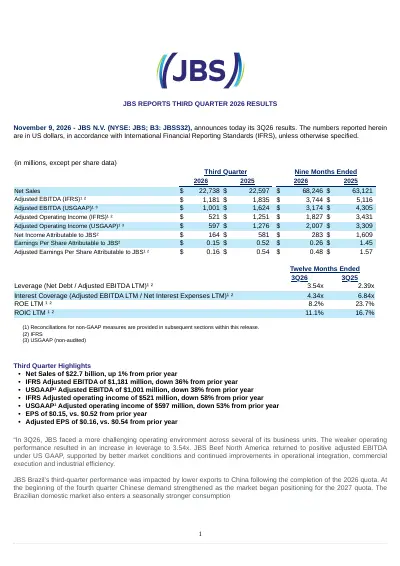
Net sales reached $23 billion for the third quarter. Adjusted EBITDA under IFRS totaled $1.2 billion, with a margin of 5.2% for the quarter.
Excluding mark-to-market adjustments on biological assets, adjusted EBITDA margin would have been 5.5%. This metric is used by some of our peers, which also report under IFRS.
The main impact was the mark-to-market in US pork, given the reduction in the future curve of live hogs. It's important to highlight that there is no cash impact related to that.
Adjusted EBITDA in US GAAP totaled $1 billion, which represents a margin of 4.4% for the quarter. Adjusted operating income was $521 million, with a margin of 2.3% in IFRS, and $597 million in US GAAP, with a margin of 2.6%.
Net income was $164 million in the quarter and an earnings per share of $0.15 15 cents. Excluding the non-recurring items, adjusted net income would be $167 million and earnings per share would be 16 cents in the quarter.
Free cash flow was negative $167 million in the third quarter, with $551 million in decrease year-over-year, explained by $653 million decline in adjusted EBITDA and higher working capital consumption in Brazil, particularly inventories. The increase was mainly reflected higher grains inventory at Seara as well as higher chicken inventories at Seara in Europe.
The company also faced high inventories in JBS Brazil beef products to be sent to China in the fourth quarter 2026 to fulfill the 2027 quota. This offset the quarterly positive working capital contribution of $325 million positive from the US and Australia business units.
Total working capital consumption was 160 106 million in the quarter. Not considering guidance, but simply updating the cash flow break-even EBITDA exercise for the year, we expect $5.5 billion in 2026, driven by $2.1 billion in capex expenditures; working capital, expected consumption of $550 million in 2026, an improvement of $300 million year-over-year; legal settlements of $100 million already realized in 2026; biological assets of $850 million, flat over 2025; interest expenses of $1.4 billion, an increase of $100 million versus the previous estimate due to the higher net debt; leasing expense at $500 million in 2026; and an effective tax rate of 25%.
Another exercise, again, without providing guidance, is to look at the potential for cash flow generation in 2027. In Beef North America, our largest segment, adjusted EBITDA was negative by $309 million year-to-date in US GAAP.
Considering year-to-date working capital consumption of $254 million and capital expenditure of $158 million, the cash consumption of this business unit was $721 million. For every 1% improvement in Beef North America EBITDA margin, this would translate into approximately $300 million in EBITDA.
We are still in the budgeting process, but we expect to reduce capex expenditures by around $500 million in 2027. Considering the closing of Australia's equity sale and cash flow improvement, we expect leverage to be within our target range for the end of 2027.
Debt profile: we continue to strengthen our liquidity position. In August, we announced an increase in our revolving credit line from $3.5 billion to $4.2 billion, while reducing the all-in cost of this line.
Our cash liquidity, combined with the revolving credit line facility, totally approximately $8.2 billion. Our average debt term reached 14.4 years, with an average cost of 5.7%.
Net leverage ended the quarter at 3.54 times. Excluding the mark-to-market of the biological assets, our net leverage would have been 3.41 times.
However, the company maintains a well-balanced debt maturity profile, with no material maturities over the next 5 years. It is also worth noting that more than 95% of our debt has fixed interest rates, 33% maturing beyond 2050, and all the debt up to 2032 has coupons below the equivalent Treasury rates.
On August 18th, we delivered a proposal to the board of Pilgrim's Pride Corporation to acquire the shares of PPC common stock that JBS and its affiliates don't already own, as announced to the market. Given our ownership of approximately 82% of PPC and our pending proposal, we will not take any questions related to PPC.
We appreciate your understanding. With that, I would like to open to Q&A session.
Operator
Thank you. The floor is now open for any questions from investors and analysts.
As previously mentioned, we kindly request that each analyst limit themselves to just one question. Ladies and gentlemen, our first question comes from Mr.
Gustavo Troyano with Itaú. Mr.
Troyano, you may go ahead with your question.
Gustavo Troyano
Hello, everybody. Thanks for taking my question.
My question is on US beef and especially thinking about the profitability levels going forward. I just wanted to hear your thoughts on the pace of the segment's margin recovery as we move into the fourth quarter, especially considering that you disclosed the monthly profitability levels for the segment throughout the third quarter, and it seems that the fourth quarter could be better than what the seasonality would suggest.
I just wanted to hear from you if you think that the third quarter could be a bottom for this cycle when we think about 2027 if these margins should start to recover sequentially from the fourth quarter onwards. Still on that topic, just to follow up on a point that we discussed in JBS Day a couple of months ago when you mentioned that there were some operational improvements to be delivered in this segment if these numbers are starting to show off in the third quarter or if there's a potential for 2027 to incorporate this operational improvements.
Thank you very much.
Wesley Batista Filho
Gustavo, good morning. We had a a a a good third quarter in our opinion.
It started off actually quite tough, more in more in line with what the second quarter looked like, and it ended up a lot better. Q4 is usually a little bit of of, December could always be a little bit of a surprise, but given how it has started in in, the first half of of of Q4 here, we expect that Q4 could be stronger than should be stronger than Q3.
We're we're we're expecting a sequential improvement into into Q3 as of right now, because again, we're in the middle of the quarter here, but so far it looks it looks promising. Again, when we look into next year, based on a couple of things, based on just the market improving overall, the balance between supply and demand for cattle, we think we're going to have a much better year into next year and probably as of right now, we think it's going to be a a market that operates in the low low single digits, but, we could we could have maybe, actually even a positive surprise depending on on how on how things develop.
On top of that, just how the market's going to look like, you said it right, it's a it's a big big focus of ours is this integration that we're having between our business beef business units, and we're seeing a lot of improvements, but we still expect a lot into next year. I I still think that just on on operational efficiencies and and more, some some more synergies in in sales, we could have, around or or even above 2 percentage points into into into next year.
Gustavo Troyano
Thank you very much.
Operator
Thank you. Our next question comes from Mr.
Ricardo Alves with Morgan Stanley. Mr.
Alves, you may go ahead with your question.
Ricardo Alves
Hello. Can you hear me, everyone?
Wesley Batista Filho
Yes. Good morning,
Ricardo Alves
Ricardo. Yes.
Good morning, Wesley, Tomazoni, Guilherme as well. Thanks for the call.
A question on Flora. About 80% coming from taxes.
I missed the very beginning of the explanation on the tax credits, Guilherme. Can you go over the tax credits again just in terms of how much we should expect in the short term, if there's some timing on when you can really monetize those credits?
Then when we're thinking about Flora alone, our understanding is that the net debt to EBITDA ratio was closer to 4 times, is it fair to say that the leverage was also a factor for the transaction, the leverage at the Flora levels? I'm not talking about the leverage of JBS, because maybe in terms of short-term finance, given that long-term rates are in a much more difficult place today in Brazil, maybe you incorporate that into the balance sheet of JBS, maybe you're going to be able to leverage more all the growth that you expect in the personal care, all the discussions that we've had in the past around collagen.
Just to understand how within the JBS portfolio, how you could accelerate the growth potential you see there, if that was also a rationale for the transaction. Just those two two follow-ups from the Flora transaction, please.
Guilherme Cavalcanti
Okay. Thank you, Ricardo.
Beginning with tax credits, the monetization of tax credits is pretty straightforward. As the ICMS, the VAT tax, exporters are exempt of that, but we pay ICMS on the inputs in the states we operate.
When you export the product, we cannot offset the ICMS we paid. This becomes a credit.
Okay? Then those credits at the consolidated balance sheet takes 100 around $800 million in JBS.
When we have Flora inside JBS, with the same CNPJ, we call the same corporate, we can pay Flora's ICMS on the domestic sales with the one credit on the ICMS credits that we have accumulated. Okay?
These ICMS, as I mentioned, will be replaced by CBS and IBS, which will have the same dynamic of credit accumulation. It may be even more.
Then we'll be able to use to monetize those credits with Flora, okay? The last is Flora will start to pay income tax next year.
Bear in mind that we have, as I mentioned, $2.2 billion in income tax credits in JBS balance sheet, which will can also be paid to pay Flora's income tax. Basically, those two are the major parts of the tax credit synergies, as you mentioned.
It's both the most parts of the synergies. Now the net debt to EBITDA, you are looking on the 2026 Flora's EBITDA, but Flora, some segments of Flora operated in 2026 with 49% capacity, which we expect to increase the capacity to 70% next year and so on, because they have some disruptions in 2026, factories renovation, things that decreased our capacity utilization.
We have the expansion capex that's being implemented, and new capacity is coming online in the next years. Because we have all these down times because we have these disruptions and we have the capacity coming online next year, it's better to look at 2027 EBITDA that is around R$420 million, okay, for next year.
Considering this R$420 million, net debt to EBITDA of Flora would be even lower than JBS. As we put more capacity online throughout the years, increasing revenue and EBITDA and monetize tax credits, the net effect on leverage throughout time is even positive with Flora acquisition.
Clear, Ricardo? Now let's talk to the strategic part.
I'll begin and Wesley will help here.
Wesley Batista Filho
What I would say here, Ricardo, is obviously those are the short-term more simple parts of this whole opportunity here, but what we're very interested about is we see this as a more of a continuation of the work we've been doing for the past 5 years, especially when we started our business with Genu-in in Brazil and with Biotech also in Spain and in the south of Brazil. We think that the future of the protein market is going to be obviously in the center of the plate, that's a big part of the business and that continues to be a main focus of ours, but we cannot ignore and we need to be very very much present in all of the nutritional supplements and nutritional part of the business that we think it's a huge value-added part of the business, especially given the production capacity that we have.
We think that starting off in the Brazilian market that we have a lot of strength in the commercial side overall, being able to distribute now with a different, obviously, distribution base for all these dry goods, being able to create a strong B2C business for all this sort of a nutritional market, we think it's a big opportunity and something that will add a lot of value to our co-products, and on top of that, enhance our portfolio on nutrition overall. Going from the center of the plate also to all of this nutrition side.
Again, it's a business that's growing within JBS, and we think that in the future, in the next decade, this will become a huge business globally as a whole, and we want to be an important part of that. It's an important step for us to grow in that direction.
Guilherme Cavalcanti
I also would highlight that it's also an important way for us to monetize our by-products. For example, if you look at Darling, the company in the US, great part of its valuation is for the ingredients that enhance human health and well-being.
Ricardo Alves
Thank you for the very complete answer, Wesley. Thank you also, Guilherme.
Helpful.
Wesley Batista Filho
Thank you, Ricardo.
Operator
Thank you. Now Mrs.
Isabella Simonato would like to ask a question from Bank of America. Mrs.
Simonato, you may go ahead.
Isabella Simonato
Thank you very much. Good morning, everyone.
I want to follow up on the Flora deal. I guess the overall rationale is clear, but I wanted to ask if we can think about this acquisition as the first step of some category that can become bigger over time for JBS, right?
I recall we had the discussion, I think, in the first JBS Day in the US, right, if you could move away from proteins and diversify and become more of a consumer goods, right, company. I wonder if we can interpret this move as a first step of something bigger, right?
I guess that's my first question. Still on that matter, right, when we compare Flora to eventually other targets of acquisitions in that segment, right, if you could just give us a context about their peers, right, and eventually relative valuation and why do this now, right?
My sense is that the implementation of the tax reform also matters and timing, but I just want to understand a little bit better timing and the context for this. I understand that there's no immediate balance sheet impact to JBS, but I wonder if adding complexity here and eventually any type of additional investments that Flora might require in this time, if that makes sense.
Thank you.
Wesley Batista Filho
Isabella, good morning. I'll start here.
Obviously, like I said, this part of nutrition and being able to develop a strong B2C business for all this supplement category is a main target of ours, and it's one of the biggest parts of the vision of this acquisition, on top of all the things that Guilherme mentioned that are very important as well from an integration and synergy perspective, verticalization as well for our core products. Obviously, it's very important for us through all of this to have a complete portfolio, and so we're going to have other portfolios that we are entering as a company right now, and obviously, we're going to do everything we can to be very successful in that and to have a leadership position in those categories within the Brazilian market, and obviously, we'll see what the future holds for that.
If there's accretive ways to grow that business within the Brazilian context as of right now, it's something that we're going to evaluate, but again, we think that there is potential, let's see. I'll let Guilherme mention here about the valuation.
Guilherme Cavalcanti
Hi, Isabella. We have to split into frontier.
If you look at international peers, enterprise value EBITDA for 2027 multiples ranges from 10 to 14 times. If you look at the Brazilian comparables, these range from 5 to 10 times.
In Brazil, multiples are lower than our international peers, but we think that we have potential. That's one of the reasons that we see potential value creation.
Again, as I mentioned, if you look at all the synergies and put the net present value of them compared to the enterprise value we pay, we see that the multiple is very, very compounding.
Isabella Simonato
Thank you.
Operator
Thank you. Our next question comes from Mr.
Henrique Brustolin from BTG Pactual. Mr.
Brustolin, you may go ahead with your question.
Henrique Brustolin
Hello, everyone. Thank you for taking my question.
My question is back to US beef, especially about Mexican cattle imports, right? Wesley, you have mentioned, right, the relevance of cattle imports from Mexico to help rebalance the US industry.
We are seeing imports growing, but still at a somewhat slow pace, right, to get to the 1 1 million head per year. Of course, there's a natural ramp-up here.
Would be great to get your view in terms of how are imports right now shaping up relative to your expectations and how you expect the pace picking up, going into 2027 so we can see this better environment in terms of cattle supply and beef margins. Thank you very much.
Wesley Batista Filho
Henrique, good morning. No, we think that Mexico obviously, when it first opened and it just had one port of entry was below 1,000 head, beginning 1,000 head per day.
Given the volumes that are crossing as of right now, we think it's very relevant. Obviously, there is many variables here, but given what we know right now, we would expect into an annualized basis of about 1 million head.
If you think that we have two the two biggest states of Mexico, right, being open to export to the US, and you're doing 1 million head out of the 1.2 that used to come, I think it's pretty relevant. It's a big deal.
If you think about it also, Henrique, I think a good way to think about it is in the past, again, five the Mexican cattle would account for 4% to 5% of US processing volumes, but if you look at just what that percentage was of the southern states, you're talking about, I don't know, probably 15 around 15% of the processing capacity of the southern plants. It's a big deal and just the amount of cattle that's been crossing, it's relevant enough to make a big difference.
I attribute a lot of the improvement in the cattle situation for us in the US coming from the reopening of the Mexico border.
Henrique Brustolin
Thank you very much. Very clear, Wes.
Operator
Thank you. Now Mr.
Pooran Sharma from Stephens has a question. You may go ahead, Mr.
Sharma.
Pooran Sharma
Good morning and thanks for the question here. Just wanted to focus on US pork.
My first question would be to understand the commentary you alluded to earlier. I believe you said you expected maybe some potential relief in the first half of '27, or at least you expect the conditions to drag on through the first half of '27.
Just wanted to see what gives you confidence or visibility into improvement in the back half of 2027. For my follow-up, I wanted to understand just the differences between US GAAP and IFRS a little bit better for the segment.
We've seen the last few quarters a big divergence in these margins, and I think it's largely due to the biological asset valuation. Given the move we've seen in lean hogs in 4Q, I just wanted to get a sense if you would expect the same type of divergences between US GAAP and IFRS to persist in 4Q for US pork.
Wesley Batista Filho
Sharma, good morning. On the on the pork side, into we we expect that it will continue to be tough at least through the first half of the second year of next year.
What we expect, and we we see the the the USDA number for for, just global production kind of similar, staying in line with what what we believe is, we think that there is going to be an adjustment of production globally. Obviously, countries that are more competitive and more productive are going to be gain a a bigger market share of the global pork supply, and countries that are less less less efficient are going to lose lose lose lose space and competitiveness.
So, the USDA showing a a decrease in next year's pork production globally, similar to the increase we had this year. We already see numbers for something in China, which are the biggest pork producers in the world, reducing.
The they used to hover around 40 million sows that was their their total total herd there of sows. Now they are, close to 36, and, that's almost a that's a that's a relevant increase decrease, excuse me, in a in a very very large country, and we think we're going to see that in in other areas.
Countries that are less competitive are are are going to lose space in the market. I think that globe globally, overall, we're going to see an adjustment.
Obviously, you have to remember that that's that, pork cycle is a lot shorter than the beef cycle. I'm not saying that the beginning of second part second half of next year is going to be great and things are going to be completely changed.
I don't know that yet, but our expectation is is that given the the what we're seeing globally in in especially in some of these countries moving in to reduce to reduce production, we think that there is a good chance that we we have a better better second half of next year.
Guilherme Cavalcanti
Okay. Going to the mark-to-market, you are totally right.
The volatility all comes from the fact that the IFRS inventories are mark-to-market, including the hogs, while in US GAAP it's at cost. How it's mark-to-market, you get all the future curve of hogs to price our inventories, and that's what the big swing was.
Looking at the fourth quarter, it will depend only on this future curve. We think that the future curve, it's already declined, only if it declines even more down, that would have another effect like that.
It's worth mentioning that, for example, WH Group, which reports in IFRS, and because of this hog volatility, EBITDA adjusted is adjusted for the mark-to-market of biological assets.
Pooran Sharma
Okay. Appreciate the clarification.
Operator
Thank you. Next is Mr.
Thiago Duarte with BTG would like to ask a question. Please go ahead, Mr.
Duarte.
Thiago Duarte
Yeah. Hello, everybody.
Good morning. Thanks for the opportunity, as usual.
I want to circle back to Guilherme's exercise in the end of the presentation, particularly when discussing the outlook for 2027. Obviously, you never provided a guidance, but looking at the exercise and trying to reconcile the numbers a little bit you talked, Guilherme, about coming into the end of 2027 with the leverage of the company within what you call the safe zone, if I'm not mistaken, which is up to 3 times leverage, right?
As we try to sort of reconcile the numbers to your EBITDA, the way I'm looking at the math here, it implies a pretty nice improvement in the company's EBITDA into 2027 relative to 2026. My understanding is that the biggest contributor to that in your exercise has to come from the US beef division.
My question to you guys, and obviously, going back into the discussions about cattle imports from Mexico and so on, is, are you comfortable that US beef can approach the sort of historical normalized of low-to-mid single-digit margin into 2027? That would be the question trying to reconcile to the exercise that Guilherme did in the end of the presentation.
Thank you.
Guilherme Cavalcanti
Okay. Thank you, Thiago.
I also read your report last night. You mentioned that at a $1.4 billion EBITDA of the fourth quarter, we would be ending at 3.75.
That's not correct. You forgot the free cash flow generation of the fourth quarter, which kind of sets part of the decrease in the less 12 months EBITDA.
Bear in mind that the last part we have the deferred livestock. We will have the service inventory sales in Europe of Seara, and we have the resume of Chinese purchase from the working capital we consume in JBS Brazil in the fourth quarter.
Therefore, with the 1.4 billion dollars EBITDA that you mentioned for the fourth quarter, we would be ending between 3.5 and 3.55 times net debt to EBITDA, depending, of course, the free cash flow, but I think it's a better estimate. Now for the next year, you're right.
The main assumption here is the turnaround of US beef. Remember, this year, US beef consumed $721 million of free cash flow already because only working capital was $254 million and $310 million of EBITDA.
For next year, if this EBITDA comes to the positive side, whatever that's why I mentioned each 1% is $300 million EBITDA, and the working capital consumption was mainly due to the cattle prices increase in the first semester. If we think of a falling cattle price or even a stable cattle prices, we should release working capital from this business unit instead of consuming working capital.
My assumption for next year, again, bear in mind we have the Australia equity sale of $800 million cash inflow. We have the fourth quarter, as I mentioned, free cash flow generation.
For next year, if we have a turnaround in the beef segment and we end up with an EBITDA between $5.5 or $6 billion, we'll be below 3 times.
Thiago Duarte
That's super helpful. Thank you, Guilherme.
Operator
Thank you. Our next question comes from Mr.
Benjamin Theurer with Barclays. You may go ahead with your question, Mr.
Theurer.
Benjamin Theurer
Hi, yeah. Good morning.
Thanks for taking my question. Actually, I would like to pick up on the exercise and one of the commentary you make, Guilherme, as it relates to capex next year.
If I picked it up the right way, I think you said you're looking into the budgeting to reduce capex by approximately $500 million. Is that against the roughly $2 billion base in 2026?
If so, what would be the areas where you're looking at in terms of cutting capex? Is that cut outright, or is that postponing?
How should we think about that reduction in capex that you've mentioned? Thank you.
Guilherme Cavalcanti
That's a very important point that I also forgot to put in the equation of the previous question that also I added around $500 million of capex expenditure decrease for next year, improving free cash flow. Our $2 billion free cash flow, $2.1 billion of this year, bear in mind that around $1 billion is maintenance capex, which there's not much change of that, but $1 billion is growth capex.
What we'll be doing for next year is that some projects that we already began, and so we will finish it, but we will not start new projects, or the ones that didn't start, we will postpone for the other year or depending on how the year is. That's why we are still in the budgeting process.
In fact, I'm going to Greeley next Friday for budget and capex meetings. We are very confident that we can cut around $500 million of capex.
Remember that in 2023, when our EBITDA was $3.5 billion, we budget $1 billion maintenance capex for 2024 and a $300 million growth capex for 2024. Because 2024 was better than expected, in fact, we ended up with $6.8 billion in EBITDA and at 3.
and $2.8 billion of free cash flow, then we restarted some projects and we end up 2024 spending $500 million in growth capex. That's what we intend to do.
We will start postponing capex, reducing $500 million. If the year is better than expected, we can anticipate the ones that we postponed.
It's clear?
Benjamin Theurer
Yep. Very clear.
Thanks, Guilherme.
Operator
Our next question comes from Mr. Thiago Bortoluci with Goldman Sachs.
Please go ahead, Mr. Bortoluci.
Thiago Bortoluci
Yes. Hey, guys.
Good morning, everyone. Thanks for the opportunity.
I think my question's for Wesley, right? I'd like to stress, again, the demand side in the US, right?
This is just to put in perspective, see all of the information we have so far. We know pork has been under pressure for a while.
It's not the first time you mentioned this in your press release. When I see the numbers for Pilgrim's, you continue to elude to strong demand.
Then, when I see top-line growth, it's pressured within food service, fresh, and retail. Then, I think more importantly, when I see the evolution of the cutout for beef throughout the grilling season, it moved actually downwards and ended the quarter even a little bit below last year, right?
In a context when we have rates in the US potentially higher for longer, inflation potentially higher, how confident you are that demand will remain sticking into next year? More importantly, how confident you are in your pricing power eventually to protect or even expand margins in this context?
Thank you very much, Wesley.
Wesley Batista Filho
Thanks, Thiago. Look, we see demand for protein in general has been pretty strong.
I think the fundamentals are all there. I don't want to be too repetitive and talk about all of them, because it's a something that in all conferences and all meetings, we all talk a lot about, and we all kind of see similar fundamental trends that everybody knows.
When we look at specifically per protein, we see beef demand, when you have such a big increase in prices, obviously, our price follows the price of cattle. When we have such a large increase of cattle prices, and then we have such a large increase of beef prices, sometimes it's even difficult to look at the seasonality, because maybe the price of cattle goes up in the off-season kind of period, right, and then things kind of stabilize afterwards.
It's always a little bit tricky to look at that in that way. The way I would say it is having a cutout that's in the high $300s and still have the strong volume that we're seeing, I think that's a big deal, and it shows that demand in beef is really strong.
When we talk to customers, we hear that the beef demand is quite inelastic. Actually, I would even say, Thiago, much more inelastic than we even expected before all of this a big shortage of cattle that we've had in the US.
In chicken, we're seeing just in the worldwide, we're seeing the same thing. We're seeing demand for chicken being pretty strong, especially food service, and we're seeing a lot of food service chains, QSRs all going into chicken, there is a big trend going there.
Now obviously, inflation overall across the board, especially fuel, have taken a toll in consumers. What we're seeing is that the protein that has had the biggest challenge has been pork.
We're seeing the softness in demand very concentrated in pork. I think it's not necessarily anything against pork that the consumer has, it's just that their preference for beef and chicken has been just so strong that the protein that they have whenever they have to stretch a little bit more their dollar, they're still going to have their beef, they're still going to consume chicken, and maybe they cut back a little bit on pork.
That's what we've been seeing. Overall, the trends are still pretty consistent in our opinion.
Having said that, obviously, when overall inflation is just as that high, it's strong and puts straining consumers, they have to make a choice, and they have made a choice to cut back on pork demand.
Thiago Bortoluci
Helpful, Wesley. Thank you very much.
Operator
Thank you. Our next question comes from Mr.
Andrew Strelzik with Bank of Montreal. You may go ahead with your question, Mr.
Strelzik.
Andrew Strelzik
Hey, thanks for taking the question. Wanted to ask about Seara.
You talked about record chicken exports out of Brazil, but there were also some areas of weakness as well, and the margins were the lowest we've seen in a little while. I'm curious if we should anticipate Seara margins continuing to decline year-over-year in the fourth quarter and into '27, or if you see opportunities for that to recover.
If you do see opportunities for that to recover, what the drivers would be. Thank you.
Gilberto Tomazoni
Hi, Andrew. Thank you for your question.
First, I will be answer direct your question. See, we see improvement in the margin of Seara for the fourth quarter compared to the three the third quarter.
What is the reason for that? First, I think one of the very important reason is the appreciation of the dollar against real.
Seara export 50% of its revenue, and this is means a lot in terms of impact in the bottom line. This is the first.
The second point that the market for the chicken, just to add the explanation of Wesley, we see the demand of chicken globally, very strong. Seara, the reported was the largest volume that sold in one quarter to export, means that the market is very demanding.
This is the point that demand is strong, and dollar is higher. There is another point of Seara.
In Europe, our team anticipated the restriction of Brazilian poultry export, and shipped chicken breast ahead of those restriction, building inventories in this region. We expect to sell these inventories in the fourth quarter, allow us to serve customers even while shipment from Brazil were restricted.
Together with the stronger seasonal demand in Brazil and support the favorable outlook of Seara for this month, we are really expect higher margin than the third quarter of Seara.
Andrew Strelzik
Great. Thank you very much.
Operator
Thank you. Our next question comes from Mr.
Leonardo Alencar with XP. You may go ahead, Mr.
Alencar.
Leonardo Alencar
Okay. Thank you.
Good morning, everyone. Probably a follow-up on the last question.
I understand there are many moving parts going on in Brazil right now. Newcastle in Santa Catarina and now the restriction on pork exports to Philippines, but also this inventory build-up because of the Chinese quota for beef, and Seara's seasonal.
There are too many things in place to get a better view on the Q4. If you could just walk us through on this inventory release, I would expect probably beef and part of this chicken in Europe to be released on Q4, but then pork maybe it would stay for longer.
Then with impacts on exports, how they could play on margins as well? Just some more color on that.
Thank you. Okay.
Did you hear my question? I'm not listening anything from your side.
Operator
Sorry, Leonardo. I think Tomazoni had a problem there with the with the
Gilberto Tomazoni
Oh, sorry. Sorry, I'm back.
Sorry.
Leonardo Alencar
Did you get my question?
Gilberto Tomazoni
Yes, I think I got your question. Let me see if I will start to answer about the Hello?
Hello?
Leonardo Alencar
Yeah. Here.
Gilberto Tomazoni
You are hear me, Leonardo?
Leonardo Alencar
Yes.
Gilberto Tomazoni
Okay. You mentioned the restriction that we have in terms of Philippines.
We do not yet know for certain what is the restriction will be. There is a talk that halting the import for at least 60 days.
It is unclear whether this refer to stopping to issuance of import license or halting shipments. If the decision concerns import license, the impact will be not felt until around January.
If the decision is to halt in shipment, that impact will be immediately. Of course, this will be impact, we not know how is impact yet, but that pork is under pressure globally.
Wesley have mentioned that is not just in US, globally. Of course, we have market to sell with lower price, that will be impact of margin.
We expect pork is really if you consider all of the revenue of Seara, fresh pork is the have a lower impact if you compare the other business that you have in Seara. The other point that you mentioned, I think, is about the quota of China.
I think it's important that to let know that we begin to production for China's market in the second half of September. Anticipated this renewed demand under the 2027 quota.
That production effort starting in the third quarter, while the related sales we are expected to benefit in the fourth quarter. We already seeing improvement on October, and I think will be in an additional revenue that we produce in September, the second half, and we just had the cost of the production and not the revenue.
Now, we are start to shipping to China, that will see the strong improvements on results of Friboi in Brazil. The same will be with Seara.
I mentioned before the other question because Andrew asking about the product that we have in Europe. Europe is close.
We are selling the product. We are expecting that we resume the importation on next year or begin or the late or end of this year, but the product will be around in Europe next year, means that I think the strategy we have done, both in Seara to build inventory in Europe, and the strategy to start to produce early to China in Friboi will be benefit our business in the fourth quarter.
Leonardo Alencar
Okay. Thank you, Tomazoni.
Operator
Thank you. Our next question comes from Mr.
Matheus Enfeldt with UBS. Mr.
Enfeldt, you may go ahead with your question.
Matheus Enfeldt
Hi. Good morning.
Thank you for your time. I wanted to ask a question on US beef.
We've saw peers partnering with cattle suppliers for a while now, but particularly more recently. We discussed in the past whether the current US cattle cycle is going to lead to a structured different supply.
My question is more on your end, what's the way to get closer to the rancher, if there are any alternatives there, if anything that the company's considering or starting to the direction, or if you want to restate the comments from previous calls that it's a business that it's a bit too different from yours. Trying to understand how to get closer to the rancher if that's a strategy that JBS can also follow.
Thank you.
Wesley Batista Filho
Hi, Matheus. No, we see that us entering the ranching business or even the feedlot business is not our focus, is not our core.
We've done that in the past, and I think that our model today, which is to partner up with having long-term commitments with companies that are specialized to do that is the best scenario for us, and we don't see ourselves verticalizing the supply chain in beef. We don't see that as something that we're doing.
Having said that, obviously, we have a very very strong partnerships with a lot of different suppliers, and those are very long-term agreements that are great partnerships, and we see us having that going into the future, not us doing it ourselves.
Matheus Enfeldt
Awesome. Thank you.
Operator
Yeah. Our next question is from Mr.
Lucas Ferreira with J.P. Morgan.
Mr. Ferreira, you may go ahead.
Lucas Ferreira
Hi, guys. Hope you are all good.
I also have a follow-up on the US beef business, which is looking at 2027, obviously, we're going to have more cattle from Mexico and the ramp-up that we've been seeing is looking great. On the other hand, we also expect retentions to increase, right?
That's the expectation for some normalization ahead. We started to see some announcements of more capacity being added back to the system.
I wanted to hear also on the labor side, if there could be more labor available next year. The question is really, how do you see the net net of these things?
More cattle from Mexico, you mentioned 1 million heads, but potentially more retention, and also more capacity being added or more shifts being added as these animals getting into the system. Wesley, what do you see that the net net of the cattle availability in the country?
If you think there is a risk of more supply actually ends up limiting the upside for margins? Thank you very much.
Wesley Batista Filho
Lucas, good morning. Our analysis on beef has always been with the information we have in the public.
I'm not going to talk about individual kind of announcements by our peers, but recent announcement nowadays was I think a little bit of a continuation of what we heard in the past. We don't see like there is any information that changes the way we see the market going forward.
We already expected that, at least there is nothing new from recent announcements. From our point of view, it's more of a continuation of what had previously been announced.
All of this comments that we're making is based on that as a assumption. We think that next year will be again, a much better supply demand for cattle.
Labor, labor hasn't been a problem, at least from our perspective, for a few years now. Even if there is more labor in next year, I don't think it changes.
It's something that has already been the case for this year.
Lucas Ferreira
Perfect. Thank you very much.
Wesley Batista Filho
Thank you.
Operator
Thank you. Our next question comes from Mrs.
Heather Jones with Heather Jones. You may go ahead with your question, Mrs.
Jones.
Heather Jones
Good morning. Thanks for the question.
My question is related to the US pork business, specifically on the GAAP results. It was a sharper than I expected sequential deterioration, and just trying to get a sense of, was that predominantly driven by lower hog production earnings or more of an even split between raising and the processing side?
Wesley Batista Filho
Heather, good morning. We had a sharp decline in hog producing, for sure, and hog producing has been doing great for the past years, and it has been a good help for to our business, and now has been deteriorating faster, it's an important part of the decline.
It's an important part of it, but also just overall, spreads have been tighter, right? If you look at spread between costs and hog costs, and even hog cost and has been kind of compressed on both sides.
Heather Jones
Okay. Thanks so much.
Wesley Batista Filho
Thank you.
Operator
Thank you. Our next question comes from Mr.
Guilherme Palhares with Santander. Go ahead, Mr.
Palhares.
Guilherme Palhares
Good morning, everyone. Question here for Guilherme.
Guilherme, if you could just recap a bit the steps towards the closing of the Dunan deal, when we should see the $800 million flowing through to the balance sheet, and just the overall step-by-step until then.
Guilherme Cavalcanti
Thanks, Guilherme. This depends on the regulatory authorities of Australia, including FIRB.
Generally, it doesn't take so long, but it's something that is out of our control. We don't expect to take a long time.
Guilherme Palhares
Thank you.
Operator
Thank you. Next, we have Mr.
Ricardo Boiati from Safra. Mr.
Boiati, you may go ahead with your question. Sorry, Mr.
Boiati, if you're trying to speak, you might be on mute. We may be having some issues with his line there, we'll go ahead to the next one, which comes from Priya Ohri-Gupta with Barclays.
Mrs. Ohri-Gupta, you may go ahead with your question.
Priya Ohri-Gupta
Hi. Good morning.
Thank you so much for taking the question. Guilherme, I was just wondering if we could dig a little bit into the leverage discussion.
Should we now be expecting after fourth quarter leverage or year-end '26 leverage to be similar to where we are now, and how does that sort of dovetail with some of the stronger free cash flow given the working capital unlock in fourth quarter that's expected? Then as we think about the leverage progression into '27, I think you touched a little bit about sort of the EBITDA improvement that could be needed to get you below 3 times, but should we be thinking of any potential for debt paydown or any possible refinancing activity that could accompany this?
Thank you.
Guilherme Cavalcanti
Thank you, Priya. Basically, the fourth quarter, we will still have the negative impact of probably a lower fourth quarter than it was the fourth quarter last year.
That is always a quarter that we generate a lot of free cash flow. One of the reasons is the deferred livestock, okay?
We postpone payments for the next year as request by the producers. This year, we also have, again, as we mentioned, we produced beef in Brazil in September, but we couldn't sell because of the quotas to China, but in October, we resumed to sell the 2027 quota.
This will also release, and also the Seara chicken inventories in Europe, as I mentioned. All this together, we think that the free cash flow of the fourth quarter may kind of offset this statistical less-12-months effect, and we finish this year with the levels around where we are now.
For next year, then generally first quarter is a quarter that we consume free cash flow, mainly because of the postponement of the deferred livestock. This year, again, we may have two effects that may be also offset this.
First is better working capital, if the cattle prices stay there as it is right now, we will be releasing working capital in the first quarter, and also the EBITDA. Remember that the beef EBITDA in the first quarter this year was negative, and if now we turn around for the positive side, we'll have the opposite statistical effect.
If that, maybe we will start the leverage even in the first quarter and getting to the year-end below 3 times. Again, some moving pieces here, but I think that the statistical effect should work in our favor next year.
Priya Ohri-Gupta
How should we think about the debt movement just on the back of that?
Guilherme Cavalcanti
Okay. Sorry.
No, then remember, we have short-term debt that is mainly trade finance, that is very easy to roll over and cheap as well. For the next 5 years, we don't have any significant maturity, and up to 2032, all the coupons are below Treasuries.
Again, and with the increase in Treasury, that's a few opportunities for liability management, given we have some '34s with 6.75% coupon, some that's the ones that in JBS and PPC, that's the only one that I would say that would be more expensive than what it would be to refinance today. For liability management today, again, given the Treasury curves, there's not much opportunities.
Again, we want to deliver it. As we generate free cash flow and with the income in of the Australia equity sale, we have to look at some debt to be paid.
Probably, the first one will be the Flora debt of the debt assumption. That is the $150 the $175 million debt that we assumed with Flora deal.
Those debts are more expensive than JBS. If they are capital markets debt, but they are more expensive than JBS, probably those ones would be the first to be paid.
Then I would say the short-term debt, the trade finance, would be the second on the list to be paid. I don't see much opportunity for bond repurchase besides those high coupons that I mentioned.
Priya Ohri-Gupta
Thank you so much.
Operator
Thank you. Our next question, we will go to Ricardo Boiati with Safra.
Go ahead, Mr. Boiati.
Ricardo Boiati
Can you hear me now?
Guilherme Cavalcanti
Yeah. Good morning.
Perfect.
Ricardo Boiati
Hi. Good morning, Tomazoni, Wesley, Guilherme.
Thanks for taking my question. Regarding Australia, do you expect a rebound in exports already in Q4, or should we look to shipments to fulfill next year's quota to be more concentrated in Q1 2027 in Australia?
October was impacted by rain, right? How are you seeing November and December turning out to be there?
I'm trying to understand how to think about sales and margins in Australia at Q4 and in 2027. Thank you.
Wesley Batista Filho
Ricardo. We expect Australia to be somewhat stable here into Q4.
Like you said, it's still raining quite a lot. It's incredible what's been going on in Australia in terms of rainfall.
It's been, I don't know, probably 5, 6 years that has been above-average rains in Australia, and as far as we've been in Australia, we haven't seen such a long period of time with such consistent rains for such a long time. That's kind of obviously surprising to all of us, and we expected obviously to be a little bit more on the drier side at some point.
In the fourth quarter, we still see quite a lot of rain in Australia. If anything, if we see an improvement, we're going to see in 2027, not right now.
On the other hand, we see it relatively stable. It's been challenging on the beef side because of this.
On the long term, it's actually pretty good news. There is a lot of cattle in Australia.
The herd is on a healthy side. All of this rain obviously has a long-term effect that should create a more stable business for us into the future, we think.
In the long run, it's not bad that it's raining that much. It's actually good news, and we want good weather for grazing livestock.
Obviously, it creates a short-term pinch that we didn't expect. What we're expecting that it should create a longer more smooth cycle into the future than ups and downs that we've seen in other markets.
Because of such a consistent weather, also I'll mention that in Australia, we've been able to build quite a lot of businesses that are able to complement. Even though beef is in a challenging moment right now, we have other businesses that we've invested in the last years that are able to bring the average of the whole business actually higher and create a good business.
We're very excited about the business in Australia. We think that our business in Australia is one of our stronger businesses within the company, and we think we're going to have a more stable business in the future because of all this good weather that we're seeing.
Ricardo Boiati
Awesome, Wesley. Thanks a lot.
Operator
Thank you. Our next question comes from Mrs.
Carla Casella with J.P. Morgan.
Mrs. Casella, you may go ahead with your question.
Sorry.
Carla Casella
Can you hear me now?
Operator
Yeah. Good morning.
Yeah.
Carla Casella
My question is on M&A opportunities. I was a little surprised by M&A, just given how high the leverage is now, recognizing that even the M&A was not adding to leverage.
Was there a timing issue to do Flora now? Is it better to do now versus later?
Wondering what the catalyst was there. Then also, while leverage is higher, are you still looking?
Are there more potential M&A opportunities? Kind of how are you looking at that today?
Guilherme Cavalcanti
Thanks, Carla. As you mentioned, the Flora deal, the equity was all paid in shares.
We assumed $175 million in debt only, and it's bringing EBITDA. The rationale to do now, as I mentioned, is that we have, as I mentioned in the beginning, $800 million in VAT tax credits and $2.2 billion in income tax credits.
Those credits, the faster you monetize it, the better. Bringing Flora now, it's a way to fast monetize the VAT credits, also in light of the Brazilian tax reform.
That's the reason why to do now, besides, again, the strategic rationale that was mentioned. As I mentioned, great part of the valuation and the potential of Darling company is the ingredients to health and nutrition.
It's something that we want to go more and more with our by-products closer to customer and get those higher margins. Now for general M&A, we just have the closing of the Dunan deal, which is $150 million outflow.
We have the sale of the Australia, it's $800 million inflow. I don't see any M&A that we would be using cash, maybe only very small M&As.
Any M&A to a certain size only if the seller accepts to receive JBS shares, which generally very rare cases. Again, M&As, I would say, on some size, only if the seller accepts JBS shares, again, which is generally very rare cases that this happens.
We are not seeing M&As in the radar in the short term, because we will be focusing really on deleverage.
Carla Casella
Okay. Great.
Thank you.
Operator
Ladies and gentlemen, there being no further questions, I would like to pass the floor to Mr. Gilberto Tomazoni and Mr.
Wesley Filho.
Gilberto Tomazoni
Thank you. To wrap up, this quarter showed the strength of our diversified global platform and the progress we are making across our business.
The return to the positive EBITDA in US beef was an important milestone. We know there is more work ahead, and we remain focused on operational excellence, financial discipline, and creating long-term value.
I want to thank our teams around the world for the hard work and dedication. Their commitment and execution make this progress possible.
To everyone joined us today, thank you for your time, your continued interest in JBS, and your engagement. We look forward to continue to our dialogue.
Thank you, everyone.