ADvTECH Limited
JJSE:ADHQ2 FY2026 · Earnings Call TranscriptAugust 25, 2026
Geoff Whyte
Good morning to everyone in the room and on the call. Just some housekeeping before we begin.
The presentation will be uploaded to our website later today with the webcast and transcript to follow. We'll also take questions in the usual way as per the screen after the slides.
Please also join us for snacks and drinks once the formalities have been completed. Don't forget to collect a gift pack hand-prepared by our Capsicum chefs before you leave.
It will probably add half a kilogram to everyone. Into our results for the first half of 2026.
These are the high-level numbers which I'll unpack as we go through the presentation. Half-year revenue was up 8% year-on-year to 5.1 billion, whilst operating profit grew by 14%, breaking through a billion rand for the first time.
Operating margin improved from 21% to 22% year-on-year, whilst headline and normalized earnings per share both grew by 16%. We're also pleased to announce that we've increased our interim dividend by 18% to 53 cents.
Then this slide captures our current brand structure. Looking at the middle box, the simplification of our tertiary business is now complete and already driving focus and operational efficiency.
Then looking at the block on the left, you might also notice a reduction in the number of schools brands, which is something I'll come back to later. We also continue to gear for growth across the organization.
With that in mind, we recently appointed Onyana Molesane to the new role of Group Business Development Executive, adding capacity and experience to our M&A team. He joins us in a couple of weeks on the 1st of September.
Then taking a look at the current shape of the business. As you can see from this chart, 87% of our revenue and 96% of our operating profit now come from our education business.
Within education, we're also pivoting over time towards our fast-growing tertiary division. Tertiary now contributes 53% of operating profit versus 43 from schools.
Then running through performance at divisional level. Schools South Africa's revenue was up 8% for the period, whilst operating profit was up by 9.
Then the rest of Africa schools, they grew revenue by 8% and operating profit by 11. Tertiary revenue and operating profit continue to accelerate despite rolling over significantly bigger numbers from last year, up 17% and 19% respectively.
Finally, for the reasons shared at our 2025 full-year results, we saw a moderate decline in resourcing revenue and operating profit, down 15 and 12 respectively. Then recapping the 2026 enrollment numbers that we first shared in March, this is really just a reminder.
For the total group, enrollments are up for this year by 13% to just short of 120,000. That is an all-time record increase of nearly 13.5 thousand students in a single year.
That breaks down into increases of 5% in schools and 19% in tertiary, where we continue to see exceptionally strong growth. The compound annual growth rates are also looking strong.
Then looking at a further breakdown of the 5% schools growth. In South Africa, enrollments are up by 1%, and in the rest of Africa, we're up by 14, driven to a degree by the Regis Runda acquisition in Nairobi.
Looking at the compound annual growth rates, we're also seeing consistently strong growth over a 5-year period. Then breaking down the 19% tertiary enrollment growth.
Our contact student numbers were up 17% year-on-year, while in distance, we were up 34%. I think it's worth noting that we've nearly doubled distance enrollments in the last two years in line with our strategy.
Then comparing our most recent numbers to the 5-year trends, you'll see the significant acceleration in total and on both the contact and distance splits. Although we're pleased to report such strong numbers, the outperformance of Rosebank and distance at lower price points continues to have a mix impact on revenue.
Just as a reminder, Rosebank and distance fees are about a third of what we charge for contact in Embury and Vega. Then getting into the financials.
This slide gives the 5-year context for the 8% revenue and 14% operating profit increases I shared earlier. Looking at the CAGRs, I just point out the consistency in the numbers, with revenue and operating profit compounding over 5 years at 11% and 16% respectively.
Then looking at group-level operating margin, we've moved from 21% to 22% year-on-year, driven by operating leverage, efficiencies, and a mix shift towards our higher-margin education businesses, which Hannes will come back to a little later. I'd also just mention that our margin improvement is net of significant investments into people, systems, and facilities, as well as set-up costs for our new university in Ghana, which continue.
Then looking at the high-level margin breakdown between education and resourcing. I'm pleased to report positive movement in both divisions, with education up from 23.8 to 24.3% and resourcing improving from 6.5 to 6.8%.
Then breaking down the 24.3% education margin. Schools improved from 21.8% to 22.2, whilst the tertiary division increased from 25.9 to 26.4, despite that hit from set-up costs in Ghana, which are having around a 0.3% effect this year.
Then further breaking down the schools numbers, South Africa improved from 20.6% to 20.9, while rest of Africa jumped from 29.4, breaking through 30 to 30.1%. Then contextualizing the normalized earnings per share growth of 16% I shared upfront, this chart shows the growth trend over the last 5 years.
As you can see, NEPS is compounding at 18% and has nearly doubled since 2022. Then looking at NEPS in US dollars, we're delivering an increase of 25% year-on-year.
Whilst recent rand strength is clearly helpful, it's worth noting that we're also compounding dollar earnings over the longer term at 18%. Then moving into the schools division.
This slide summarizes our schools business. We're currently in 4 countries with 122 schools and nearly 48,000 students.
On this slide, we cover our 10 biggest brands, but we also have a significant number of single-school brands in the portfolio. Mirroring the simplification work we've done in tertiary, that's something that we're now addressing.
This chart shows the ongoing consolidation of 9 schools into our flagship brands. Charterhouse, Pecanwood, and Glenwood Bay are migrating or have already moved to Pinnacle Colleges.
In Africa, Makini, Flipper, and the Gaborone International School will fall under our new International Schools Group brand. Glenwood House and Tyger Valley are moving under Trinityhouse, and Southdowns College is migrating to Crawford International.
These alignments have been well received by all stakeholders and will significantly simplify our portfolio, driving greater operational efficiency. Then returning to how we are strengthening the organization.
Effective 1st May, we appointed Melt Labuschagne to the new position of General Manager House Schools. This was an internal promotion designed to drive a greater focus on operational excellence and enrollment growth.
Effective 1st August, we appointed Justin Painter to the new position of General Manager, this time in Crawford International. Justin was promoted from the role of Principal at Crawford North Coast, and he's been given a very similar brief to Melt.
In July, we appointed Mthokozisi Lushaba to the new position of Sales Manager for Crawford International. This role has been created as part of a program to strengthen enrollment growth.
Mthokozisi brings some excellent blue-chip experience to the company, having previously worked for Standard Bank and the SA Post Office. Then going back to the numbers.
This chart covers the schools division in total. Revenue was up 8% versus last year at 2.2 billion rand, whilst operating profit grew by 10% to 479 million.
Looking at the CAGRs, over 5 years we're compounding at 12% on revenue and 16% on operating profit. Then the detail on Schools South Africa: revenue was up 8% with operating profit up 9.
Looking at the CAGRs, again we're seeing consistently strong numbers, growing by 11% and 13% respectively over 5 years. Then moving on to Rest of Africa schools: in rands, revenue and operating profit were up a solid 8% and 11% respectively.
It's not on this chart, but the numbers were much stronger in local currency after some significant weakening of the pula, shilling, and birr against the rand. Looking at the picture over 5 years, our international division continues on its strong growth path.
Then moving on to built and ultimate capacity. This slide shows how the numbers have moved across all schools from February 2023 to February 2026, then gives a 2026 SA international split in the last two columns.
Overall, looking across the third row down, if I can bring your eye there, we're maintaining a healthy 84% utilization of built capacity. Looking at the splits, we have reasonable headroom in South Africa, but a lot less internationally where utilization stands at 93%.
This makes our international schools very efficient to operate, but it limits further enrollment growth. We continue to work hard on adding new sites and expanding existing facilities where we can.
Then moving on to real estate. Our newest Pinnacle College, Ridgeview, which opened at the beginning of 2025, continues to perform well.
The next building phase is underway and will be completed early next year. This will increase capacity to 600 students as we add grades to the school.
Pinnacle College Copperleaf, which opened back in 2017, has also performed very well, but was running out of capacity. In a project completed last month, we've added space for 500 more students.
The expansion cost 24 million and included a new dedicated preschool that you can see in the top two photographs on this slide, as well as an additional classroom block for the high school. We'll also be opening a new Abbotts High School in Bordeaux in time for the next academic year.
This will be built on the site of the old Vega Randburg campus at a cost of 22 million. It's in a great location and will have capacity for 550 students from day one.
Then moving into Africa. The Makini Runda school in Nairobi, which we acquired in September last year, continues to perform well.
On the back of investments to improve facilities and systems, enrollments have grown by 21% since acquisition. The high-demand Cambridge curriculum will be introduced next month at the school, which should give us a further positive bump in student numbers.
Then a quick word on Makini State House. This is a school in a prime location in Nairobi, but it was scheduled to close at the end of its lease this year, which would have lost us 280 enrollments.
After some excellent negotiation from our international team, we've managed to secure a new long-term rental agreement that will allow us to completely rebuild the school and increase capacity to 575 students. Then moving on to the Flipper schools in Ethiopia, which we acquired towards the end of 2024.
IT upgrades have just been completed, which will enable the implementation of various support systems and academic training for teachers. We've also successfully negotiated the harmonization of school fees across various historic tiers, which significantly strengthens our commercial model.
I also wanted to share a recent setback that we've managed to turn into an opportunity. Earlier in the year, we heard that the Ethiopian government had bought one of our leased schools via compulsory purchase, giving us only a couple of months to vacate.
Our team on the ground have found bigger, better alternative premises in Addis Ababa's Mexico district, as pictured on the left of the slide. The new site comes with the added bonus of increasing capacity by 450 students and has allowed a seamless transfer.
Then moving on to the tertiary division. This is a snapshot of our recently simplified structure.
We currently run 32 campuses across 5 brands. Student numbers now stand at nearly 71,500, up 11,400 year-on-year, as you saw on the enrollments chart earlier.
We normally only share this high-level view, but I thought it might be useful for this presentation to show you the geographical breadth of our campuses. This slide shows the locations of our 11 Embury contact campuses in South Africa, right across the country.
We have very broad penetration. This one shows the existing Rosebank network in 8 South African cities as well as Accra, Ghana.
We'll add a ninth campus to the brand next year, which I'll come back to in a few slides' time. Getting back to the numbers, tertiary revenue is up 17%, and despite significant investments to increase capacity and to strengthen our brands, operating profit is up 19.
Looking at the 5-year compound annual growth rates, revenue and operating profit are compounding at 14% and 17% respectively. This chart maps the qualifications we offer across our tertiary brand portfolio, spanning skills development to PhDs in a range of delivery modes.
This has been ongoing work for the last few years, but I think we're now in a really good position. Then covering the question: where are we with university status?
This chart shows our best guess at the forward milestones and timing in the absence of final information from government. The restructure of our tertiary division, as I said earlier, is now complete, rebranding the IIE to Embury and creating a second degree-awarding entity in Rosebank College.
We still hope government will publish the final criteria and the application process later this year. When this happens, we understand both brands will immediately be recognized as higher education colleges, which we'll ignore from a branding perspective.
We'll then apply for the interim step of university college status for Rosebank and straight to university status for Embury, given that we're further down the track there in terms of research output and postgrad qualifications. Then moving on to real estate.
As most of you will be aware, our existing Embury and Vega sites in Sandton were relocated to a new mega campus on Grayston Drive at the beginning of this year, doubling student capacity to 9,000. First-year enrollments are up over 20% year-on-year, we've started with a bang in this new location.
In terms of immediate building plans, we are in the process of adding a 200-space parking deck to the site that will open in February next year. We also hope to add nearby accommodation for around 850 students, targeting completion in 2028.
I'd also just share that enrollment interest for the next academic year has been very strong. We also relocated our Embury Nelson Mandela Bay operation to new purpose-built premises in Walmer Park at the beginning of this year.
In many ways, we've mirrored what's been built in Sandton, including the world-class indoor sports center you can see on the bottom right of this slide. We've also increased capacity by 50% to 4.5 thousand students.
Then an update on our KZN university development. We've acquired 10 hectares of land, a huge site southwest of the Cornubia Mall near Umhlanga, to build a state-of-the-art campus with capacity for 10,000 students.
The new location will consolidate our existing tertiary sites in the region and include world-class sports facilities, as well as a sizable amount of student accommodation. Phase 1 will open in 2029, with full build-out due to be completed in 2035.
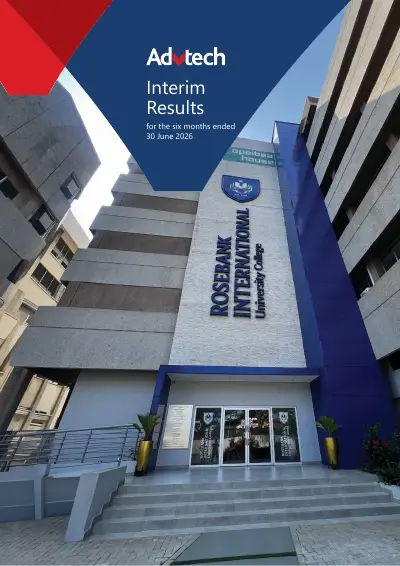
Then moving on to Rosebank. Our rebranding from IIE Rosebank College to Rosebank International is now complete, as you can see in the photograph on the top left of this slide.
The new logo and iconography position Rosebank International as a trusted, aspirational international university with a heritage going back to 1909. I'm also pleased to report that the renovation and expansion of our flagship Braamfontein campus, which is what we're showing here, has now been concluded, increasing capacity from 11.5 thousand to 15,000 students.
Despite adding that extra capacity, we're already running out of space in Braamfontein. We've therefore acquired new buildings near the main campus that will allow us to increase capacity immediately by another 4,000.
Ultimate capacity on this additional site will be 9,000, however, which will give us some very useful headroom. The total cost of acquiring the buildings and Phase 1 of the fit-out is around 120 million, and work to open in time for the 2027 academic year begins shortly, but will be finished by the end of November.
Then moving east, rapid growth in demand also means we're running out of space in our Durban campus. As a result, we'll be relocating to much larger premises in time for the new academic year.
We're creating space for an additional 650 students immediately, with the ability to add 2,000 more over time. We're also seeing strong demand in Polokwane, where we've just added two new buildings to our existing campus.
That's increased capacity by 900 to 4,600 and allowed us to upgrade student facilities at the same time. Then as mentioned a few slides back, Rosebank International will open a new campus in January in Qonce City, which used to be King William's Town.
The brand has acquired leased premises with initial capacity for 600 students, though we have the option to increase that to nearly 4,500 on the same site over time. Then a quick word on our online business.
Whilst contact student growth has been exceptional, we're also very focused on growing distance enrollments. As part of that drive, we've been adding contact centers to our existing campuses.
These provide distance students with access to devices, the internet, and collaboration spaces. So 6 centers are now up and running, with 2 to follow soon in Durban in the new site I just showed you and in Mbombela.
These facilities have proven to be extremely popular, with utilization levels running at around 97%. This initiative is helping us aggressively grow distance student numbers, as shared earlier.
Then a quick update on Rosebank International in Ghana. We're currently in our first year of operation, with enrollments running slightly ahead of business case.
We opened with university college status and are confident that we will become a full university next year. We have plans to expand with contact and distance enrollments from this site, specializing in postgraduate qualifications.
Then moving on to resourcing. The unexpected closure of USAID in February last year continues to impact our Africa resourcing business, which is the bulk of the division.
Having pivoted away from clients dependent on US funding, we expect year-on-year performance to be better in the second half. On the plus side, overall margins in this division improved from 6.5% to 6.8%.
Then, as covered earlier, divisional revenue and operating profit were down 15 and 12% respectively at the half year. Despite this, operating profit is still achieving a compound annual growth rate of 6% over 5 years.
Now I'd like to hand over to our CFO, Hannes Boonzaaier, to take you through some further analysis of the numbers.
Hannes Boonzaaier
Good morning, everyone in the room and those online as well. From my side, a pleasure to present to you the snapshot on the balance sheet for 30 June.
I'll be covering debtors, capital structure, and then we'll move to shareholders, returns, and dividends as well and our investor dashboard. Let's start with the most important forward indicator, and that is whether people want to pay for our services that we deliver on a daily basis, and that is the debtors tracking.
On the slide, as presented before, I'm just going to take you through the slide itself. We've got the group revenue at the top line, then we've got the education revenue, and then the stacked bars of course, the debtors balances and the bad debts provisions for the full years.
Our long-term tracking is indicating to us that we're growing education revenue at 13% and our gross debtors are only increasing by 9%, which already indicates a good debtors, can I say, track record over the period. For this 6 months, we've actually exceeded that expectation, our debtors only increasing by 5%, yet education revenue increasing by 13%.
That ultimately gives you a 11.5% debtors-to-education-revenue, which over the 5-year period is 4% less than what we've had in 2022. I think with that debtors performance, it then starts driving indication of what should the bad debts provision be, and that is sitting at 46.8%, again, a 0.8% differential on what we've had in prior years.
Let's go and have a look at what the rand impact is of all of this. Similar slides in terms of the debtors balance and the loss allowance coverage, but now the credit losses are added.
Just a reminder, the credit losses is a combination of the bad debts recovered, bad debts written off, as well as the movement in the provision. As you can see in the past, the mid-year point is usually two-thirds of the full-year balance.
When you look at '25, 2024, etc., what those mid-year balances were, 190 in last year, 158 full year. At this stage, again we've been tracking quite well with a lower number, 115 million rand on credit losses.
I think that sets us up nicely for the full 2026 year of where we're going to be on the credit loss percentage. This year, this 6 months already, we're sitting at 2.6%.
You'll recall that at the 31 December number, the last year, we already had 2%. Again, the objective is this year to again get to 2% or better on credit losses, which I think is a fantastic number.
For every rand that we bill, we only actually write off 2 2 rand. More importantly is also the patterns in which our clients do pay us, and that is fees in advance, how we receive money throughout the year.
You recall at year end there is always a balance that people have paid upfront for the next academic year, but at mid-year this is actually important to track in line with our revenue. You can see there that that 8% growth is in line with our revenue in terms of how we're receiving the funds throughout the year.
Maybe more importantly is to see what actually hits the bank account in terms of our cash flow. The cash flow determines so much in our business.
It determines the whole investment that we have in capital expenditure, our whole view on capital structure. The cash flow performance is extremely exceedingly important indicator for us.
This year, we've again been predominantly, can I say, for a business that is delivering a service, majority of costs being personnel costs, your operating profit and your performance in your cash should match each other, and that has been 13%. Of course it's running a little bit lower on the CAGR at 15%, but coming off a high base.
How is this cash looking with regards to our debt that we have in the business? Again, just a reminder, a lot of the capital expenditure takes place in the second half of the financial year.
You don't have the biggest capital expenditure in the first 6 months. I think we've made progress.
Had a lot of comments on increasing gearing. As you can see from prior year at a 30 million rand net debt situation at 30 June, we've increased it by about 100 million rand where we're standing now.
Our capital expenditure is mostly pivoted towards additional capacity, as Geoff has noted. We've got a 23% increase on this capital expenditure from prior-year numbers.
The spend on IT, furniture is more of a replenishment and continuous maintenance of our campuses. The existing sites of course is increasing capacity.
As you've seen from the enrollment numbers that we've experienced, we do need to plan for the future. Then in this 6 months, we've also had a cost for the support office relocation, which is the old Embury building in Benmore that we've repurposed for our head office relocation.
The old head office was of course a leased property. This leads me into the impact of the increased spending on our overall debt ratio.
We've been working quite hard in terms of seeing how can we improve our capital structure. Just a reminder again that our debt comprises two major components: the lease liabilities, as well as the bank borrowings.
Lease liabilities fairly flat year-on-year, and then of course bank borrowings increased by 100 million rand. We've been able to just pivot slightly from prior-year numbers from 23 to 24% on our debt-equity in mid-year.
Then I've just added on the full-year numbers that you can see how big jump we see on that debt number comes through to year end. There's a good 15% jump when we get to full year.
At the bottom is also a description of a lot of our major projects that we've been investing in in the past periods and comparable periods. Notably in this period has been the big share buyback and then the expansions that you've seen at the Pinnacle Colleges, as well as Rosebank International campuses.
Our return on equity and return on invested capital, not disclosing a full-year number yet, I think we're still at half year, but I am very positive that the trends that we've seen from '24 to '25 will definitely flow through into our 2026 number. Last year, we've reached the 20% on the ROE, looking very positive to even a bigger number this year.
We also last year incorporated the ROIC metric, which is actually a metric on all capital funds that's being used by the group to measure ourselves on that. Again, looking good for another half or even a percent increase on that metric.
For shareholders, it's all great that we have percentages, but I guess they want to know what hits their pocket, and that is always dividends. This year, we have a dual benefit to shareholders.
We've had the dividend itself, which will be payable in September, and we also embarked on a share buyback program of 1% of the share capital of the group. We are still declaring our dividend within the policy that was agreed in 2024, which is a two-times cover.
That continues. Again, we monitor it consistently with regards to future capital needs.
I think for those that has reviewed the long-form statement can even see the increase in our capital commitments from the March numbers we disclosed to now. Our investment committee quite busy with regards to looking at new opportunities for expansion.
We've been very pleased with the share buyback. Current trading levels definitely much higher than the average price that we were buying the shares up during the April to June period.
Just overall over the long term, where are our shares tracking? I think if you look at the CAGR, significant percentage, but keep in mind the change in policy to a little bit a different coverage that we had in 2024, and that is a 24 to 25% long-term average on the dividend by a dividend declaration.
This period, I've added the effect of the share buyback and what it actually means in cents. I know people would want to maybe get this money in their bank account, but you own 1% more of ADvTECH at the end of the day, and that represents 44 cents that we've added on to the interim dividend, close to 1 rand that we're declaring to our shareholders.
Just a quick wrap-up on the investor dashboard is that where is our profit margins going to move towards in the future? I think one's got to track and see how are various divisions contributing to the profit levels in the group.
SA schools, again, very stable business. I always say you've got a student for 7 to 9 years.
You need that foundation in our group. Resourcing declining a little bit because it's not really our core business.
Then you've got these two significantly growing divisions in the rest of Africa, as well as tertiary, that now makes up nearly 63% of our business. When you just start mapping that against the operating margins that we see in the Africa schools and tertiary, it automatically indicates an increase of the group operating margin over the period.
Just some investor metrics. What has our total shareholders return been from a period back?
So 1 January 2025, which is 19 months, we're up 46%. If you then look back, say 44, sorry, 46 months from 1 January 2023, 181%.
I think that's been a good number that's also come through. Market cap has also been an important metric for us, and again, now comfortably above that billion British pound level, and we also exceeded the 1.5 billion US dollar level, which was also an objective for us.
Liquidity has also improved if we look at the average trading volumes for the 6 months period, '25 to '26, up 19%. Then return on equity tracking quite well.
I'm not going to quote a number, but I saw on the Moneyweb website yesterday, they trued up our half-year numbers, so that 20.6% is currently indicated on the Moneyweb website as 21.6%. Comfortably getting above that 21% level as well.
That's nice. That's it from my side.
Over to Geoff, and I'll see you all at Q&A. Then
Geoff Whyte
to close, I'd just like to take a quick look at how we're progressing against our strategy. This slide recaps our dual ambition as a company: to lead in every market segment in which we choose to operate, and to be the employer of choice in the education and resourcing sectors.
These goals continue to guide us. Then this chart is unchanged from our Capital Markets Day 2 years ago, but I thought I'd just recap how we're doing.
It covers our strategic imperatives, and I'm pleased to say that we're making significant progress on all fronts. We continue to add high-demand tertiary qualifications to both Embury and Rosebank.
Tertiary restructure is complete, with schools following quickly behind. Our brand propositions and marketing, I think, are in very good shape, with major campaigns currently in development.
We've made all the necessary investments to secure university status. We now wait for government.
Our African operation continues to expand through both organic growth and acquisition, whilst tertiary distance enrollments, as I said earlier, have nearly doubled over the last 2 years. We've also made significant progress in building and communicating academic advantage across all our brands, and these imperatives will remain our focus as we move forward, though we still have lots of work to do.
Then relative to optimizing our marketing, I wanted to touch on the major sponsorship that we announced last week. We signed a 3-year deal with Cricket South Africa with some very specific objectives.
We want to build understanding of what ADvTECH uniquely brings to all our brands, which we're calling the ADvTECH Advantage. This comes in the form of superior academic outcomes, industry-leading AI learning tools, African scale and expertise, and our social impact programs.
We'll also use the opportunity to further strengthen Embury as our premium tertiary brand, and to create powerful links to our Crawford and Trinityhouse schools. The sponsorship is wide-ranging, and it covers CSA's national youth weeks from Under-13 to Under-19, as well as the men's and women's test teams.
We're excited about the benefit this partnership will bring, especially with highly anticipated men's test series coming up against both Australia and England. Then to close, I'd like to leave you with our prospects slide.
Just recapping the key points: South Africa's demographic and tertiary tailwinds remain, as does demand for quality education in all our markets. Our position as the leaders in teaching and learning across the African continent is stronger than ever, and our financial strength and scale continue to build, as Hannes just touched on.
All of this places ADvTECH in a strong position to continue on our current growth trajectory. That's it from the slides.
I'd now like to invite Hannes back, and we'll happily take some questions. Yeah.
I've got two questions. The first one is how do you see education in South Africa?
How do you see that developing? Is there a direction?
Where do you fit in? Has that changed?
Second thing is resourcing. Touched on it, but didn't talk much about it.
What's actually happening?
Geoff Whyte
Okay. I think in terms of the forward view on education, demographics continue to drive population growth.
I think the state sector in many places in schools continues to struggle; that helps us. I think the disarray in the public universities, where they're not only capped in terms of places, but the quality of what they deliver from a teaching and learning point of view is deteriorating, also gives us a nice tailwind.
I think we've got some upside to tap into. If you look at how we're responding to that, I think when Curro were still reporting numbers, they were reporting declines in enrollments; we were reporting growth.
I think we're growing share in schools. If you look at our listed competitor in the tertiary space, they're reporting a growth in enrollment of around 9, and as you just saw, we're reporting 19.
I think we're growing significant share in both schools and in tertiary in what is a growing market. We're pretty bullish about the forward picture.
Then in terms of resourcing, I think that's been a good business for us. It's shown some very good growth over the last few years.
We have had the setback of losing 10% of our clients that were attached to US funding, the USAID that I mentioned earlier. That is a relatively short-term hit.
We've pivoted away from US-dependent payroll management contracts—that's the bulk of the business—and as I said in the slides, I think performance will be better in the second half. Don't know if you want to add anything to that, Hannes?
Hannes Boonzaaier
100%.
Geoff Whyte
Happy? Okay.
Thank you. Good question.
Yeah.
Frank Thompson
I need to wait for a microphone.
Geoff Whyte
Sure we can get you one. There we go.
Frank Thompson
Morning, Geoff.
Geoff Whyte
Morning.
Frank Thompson
Congratulations on a very powerful and impressive set of results. This organization has been built far beyond my expectations when I retired.
I have a few observations and questions, however. The first is your distance education enrollment has grown rapidly in the tertiary space and is an exciting opportunity.
What is, in fact, your strategy regarding the mix of face-to-face and distance students? Because it seems to me that there is a much smaller capex requirement per distance student that makes it perhaps easier and less costly in many ways to grow the distance.
I think that is a very exciting opportunity for ADvTECH, and I would like to hear your thoughts on the strategy. Congratulations on the progress thus far.
Geoff Whyte
Thanks.
Frank Thompson
My second comment is on the share buyback. Much was made of it by Hannes, but still it's 250 million rand in the face of a 25, 26 billion market cap.
Is it really material, and perhaps you can comment on the thinking around the value and validity of a share buyback? It concerns me that it potentially shows a negative in the sense that the board and management may not know what to do with the massive cash flow you have control over, and therefore simply opt to give it back to the shareholders in the form of a buyback.
I think you need to give a more positive justification for a share buyback to overcome that concern. In that regard, I note your free cash flow per share, which is a special report, non-IFRS that you have persisted with, shows free cash flow of about 2.3 billion in this period.
The dividend commitment is about 400 million, there's a lot of spare cash lurking around, and what, in fact, is the strategy for that? Then my next comment is—
Geoff Whyte
I'm just moving on to page two of my notes here.
Frank Thompson
That's okay. I thought I'd give them all to you at once, and you can decide whether to answer or not.
My next comment is Embury now has 60,000 students, tertiary students, which represents a behemoth of a university, and one which can no longer, I think, simply peck away at the market share of the state universities.
Geoff Whyte
I think we're doing a little more than pecking away, but anyway.
Frank Thompson
I would like you to comment on the future and the strategic thinking about Embury tertiary. I think the new campus that you've explained to us about in Natal is a very real threat to the Natal universities, and it seems to me that ADvTECH is building for itself and needs to accept perhaps a role that is a strategic building block of the South African education system and can no longer define its strategy in terms of taking market share away from the publics.
It is a driver in and of itself. My next observation is many South African listed companies have caught some sort of disease in Africa that has hurt them badly and caused them to fall flat on their faces, and I don't need to give you the examples, but the latest one is perhaps Absa.
How, in fact, is ADvTECH thinking strategically to avoid the African disease? Given that a significant part of your future seems to lie in Africa outside South Africa, how will you ensure that the growth remains healthy and vigorous and not prone to the African disease of borrowing expensive dollars, but only realizing a revenue in a weak local currency, which seems to be a summary of the major cause of the African disease?
Then finally, I would just like to ask you, you talked about the strength and power of the academic machine you're building. I would like to get an indication of the employment of, let's just use it as a benchmark, PhD graduates in the ADvTECH organization, and how does that compare with a major public university?
Thanks, Geoff. Sorry, that's a bit of a mouthful, but there you go.
Geoff Whyte
Thanks Frank. Those are some great questions.
You spoke about distance and the rapid growth. Our interest in distance is rooted in a couple of areas.
We think that contact and distance are two separate markets. Contact is your average 19-year-old who is looking for the full university experience doing a first degree.
Distance appeals to people who are older, maybe in their 30s and working, and looking to further their career. They're two separate markets; there's very little cannibalization between the two.
We want to maximize both. I don't think we've got a target in terms of the proportion of contact and distance; we want to maximize both.
If our strategy is to lead in all the market segments we operate in, we'd like to be number one in contact and number one in distance. We've nearly doubled enrollments in the last two years.
I think we've made a good start, and we will continue to drive that. I think the Ghanaian university gives us the opportunity to grow both contact and distance, but distance particularly into West Africa, with the credibility of hoping that we get full university status next year.
That's the plan on distance, but aggressive growth and looking to lead in that sector the way that we do currently in contact. In terms of the share buyback, we are a growth stock, and we have a very significant investment program and a very exciting pipeline of opportunities.
We want to address our capital structure and be undergeared, but our preference is to find exciting investment opportunities. As I say, we've got a very exciting program that we're looking at there.
In the interim, to help the capital structure, we felt the right thing to do was to go with what you yourself described as a relatively small share buyback. We're balancing investment for growth and getting closer to our ideal capital structure.
I don't know if you want to comment on that one, Hannes?
Hannes Boonzaaier
Sure, Geoff. If you look at our past performance when we look at total cash generation after capex, after dividends, we were sitting with an excess of about 400, 500 million rand per year, and that drove down a lot of our debt.
That's the starting point. That's the excess cash that we had at the end of the year.
A year ago, we started a lot in terms of looking at capacity, looking at growth opportunities. As you've seen in the capital commitments, we have committed to more than 2 billion rands' worth of projects over the next 3 years, Embury Durban of course being the biggest, but many of the others noted by Geoff.
That's giving us a good 2 billion rand of capex to be invested up to mid-2028, 2029, which starts consuming this 400, 500 million rand that we're generating every year. In the interim, we actually said, well, because we've got a surplus for 2025, let's start getting into the share buyback game.
We're very confident in terms of our projection for the rest of 2026. The commitment to making much larger share buybacks is driven by what is in the pipeline on the capital commitments side.
I think it's been a good start. We're very open to it, and it's a very, can I say, flexible model to give money back to a shareholder in the short term.
It's been positively accepted, and it was a start. We will be considering a bit more on that, but I think the cash generation, future projects is important to consider in the next 3 years.
Geoff Whyte
Thanks. Then you mentioned Embury and the fact that that is becoming very sizable, and what our future plans are there.
The market is a very interesting dynamic. I think we've experienced the tailwind of a cap on state places the last couple of years.
There is a fast-emerging second tailwind, which is the deterioration in the quality of teaching and learning in those public universities. We've got some interesting research on that: 66% of students, two-thirds going to Embury in the first year, now tell us that we are their first-choice institution.
I think we need to continue to build advantage in systems, security, facilities, all of those things, so that we are a better choice. You mentioned the new development in KZN.
I think the KZN university situation from a state point of view is poor and deteriorating. I think it's a big opportunity for us.
I think we'll continue to benefit from the tailwind of a cap on places, but the additional tailwind of deteriorating quality in the state system will also help us. We've got some quite ambitious plans to grow both Embury and Vega.
I don't know if you want to add anything on to that, Hannes?
Hannes Boonzaaier
Nothing from my side.
Geoff Whyte
Happy? Okay.
[unclear] The Embury-Vega sector is very much people graduating from private schools, around the same sort of price as our average private school fee point. For Rosebank, we're much more into the main market.
The average fee price point, 90, 95,000 for Embury, but about 35,000 for Rosebank. [unclear] I think in Embury, we've been heavily invested in degrees and honors and looking forward more postgraduate qualifications.
Historically we've been focused on ordinary degrees in Rosebank. We're adding honors and adding PhDs, and we're looking to expand research in both institutions.
That's the history. Okay.
The LSM profile: upper end for Embury, more main market for Rosebank. Then you also asked about avoiding failure in Africa, which I think is a very good question.
I think we've been very choiceful about the countries that we've gone into, and that's important. I think we've got growing expertise, scale in the markets we're in, which is an insulation against market risk.
I think being in a small number of carefully chosen countries gives us a portfolio, which again is a risk-reducing move. You also talked about funding.
Unless we have a really large capital requirement, we have been funding African expansion with funds generated in Africa. I think just the structure of our business insulates us to quite a big degree from risk.
We operate on higher margins. The teaching costs in those African markets are about 20% lower than South Africa.
You saw the margin numbers in the presentation. We also have local supply chains.
We've got very little in the way of dollar-based costs. About the only thing we buy in dollars are software licenses, and they're very small.
I think we've got high GDP growth, high population growth, and we have high levels of urbanization and less competition than South Africa. It's a big market opportunity, and we've made a number of moves to mitigate risk.
We still see that as an attractive area to pursue going forward. Again, I don't know if you want to—
Frank Thompson
[unclear]
Hannes Boonzaaier
Yeah. Maybe just want to add on to that.
That Africa portfolio is delivering in rand terms about 200 to 230 million rand pretax. After tax, you're looking, say, 150, oh sorry, 160 to 180.
If you recall, last year the Runda transaction was 170 million rands. Again, you know what, the cash generated out of the Africa portfolio is equivalent to buys a school per year.
The demand is of course far in excess of it, and probably the deals are not always as favorable as the Runda transaction that we've had. We've looked at funding as well in-country, but the interest rates in some of these countries are sometimes three times the South African rate.
If required, we can still fund from South Africa. Just our cash flow preservation policy is that we don't utilize the African cash generated in any dividend policy because we're still seeing significant growth in that portfolio.
Geoff Whyte
Yeah.
Frank Thompson
Remittances from the African countries?
Hannes Boonzaaier
Not not a problem in Botswana, neither in in Kenya. Ethiopia is a little bit challenging, but possible, and we've tried it on a small scale.
At this stage, again, looking at the campus that we had to relocate and the IT investments we're putting in, we've been utilizing the cash in-country in Ethiopia. That that will be the most challenging one, but no problem in Botswana and Kenya.
Geoff Whyte
I think, Frank, the last question you talked about qualifications and PhDs, and I think that was also your question, and we are, particularly in Embury, but also PhD programs over time. Okay.
Other questions?
Good morning. Thank you very much for your time, and congratulations on the solid performance.
Mr. Geoff, you did answer a part of my question, it's in relation to the resourcing division.
I just wanted to find out if you guys are seeing any new client wins or contract pipelines that could offset the USAID-related losses. Then my second question is in relation to the Embury Sandton campus.
I saw that you guys are looking into adding student accommodation there. My question is, do you have land or space for that on your existing site, or would you have to acquire additional property?
Then on that, when we last spoke to Mr. Hannes, we were all frantic about the parking situation, and he assured us that this was beginning-of-year issues that would fizzle out, and I believe that's what's happened.
Considering the existing students and staff base, has that parking capacity been factored in relation to adding student accommodation on that campus? Thank you.
Geoff Whyte
Yeah. Maybe taking the first of those questions, and are we picking up new contracts in resourcing?
The answer to that is we're continually cycling contracts. When the businesses that we manage payroll payrolls for become big enough, they would typically take that on and run it themselves.
We are continually adding and cycling out of contracts. The contracts that we've picked up have generally been higher margin than the ones we've lost; that is why the margin has improved.
We have pivoted strategically away from US-funded NGOs and charities after the USAID decision. We have picked up some contracts and are looking to grow those and also pick up more.
That is actually quite a dynamic business. On the student accommodation question at Embury, we won't actually be building that ourselves; we'll work with third parties, and it won't directly be on our campus.
It will be adjacent to our campus. That's quite exciting.
It effectively stretches the catchment area beyond people who are doing a daily commute, it truly it helps drive student numbers. Then on parking, I mean I think the reality is things do settle down after the beginning of term, the beginning of an academic year in a new location.
We've also taken action to to add additional parking and to limit first years parking on site. As I mentioned in the presentation, we've added 200 spaces, or will add 200 spaces by the end of this year.
We currently have 650 on-site spaces, we've already got quite a big capacity. We'll add a sizable amount, I think that's about a 33% increase.
That should set us up to ease the situation in the short term and also prepare us for growth into the future. Okay.
Thank you.
Done for your results. You answered my parking question, but I have two following questions.
One of the slides that stood out to me when you're speaking about the capacities in the, I believe it was the schools or the education facilities, and it seemed to me that the Africa campuses are at higher capacity than the South African ones, which to me seems like a mismatch because it seems to me that Africa, South Africa particularly, the schools division is sort of stagnating in student growth, and Africa is supposed to be your growth engine. How do you deal with that mix, that mismatch?
Geoff Whyte
I'm not really sure that is a mismatch. I think those schools are full because of market demand and because of the growth that we've had historically.
Utilization is a function of demand and success, and I think we've got, for the reasons that I just laid out, a more dynamic market opportunity in Africa, less competition, high GDP growth, greater levels of population growth, urbanization. I think we've got strong brands, huge market demand, and that's led to full schools, and our focus there, as I said in the presentation, is to create extra capacity to accommodate that demand.
I think it it does actually make logical sense if you think about it.
In terms of filling up the South African schools? Because I know it's a tough economy here, GDP is not really growing.
Geoff Whyte
We've had continual enrollment growth in South Africa. It was slightly muted in this last round, but we still grew.
I think in in certain areas, we still have a demand outstripping supply. Some of the developments that I spoke about in individual schools are about increasing capacity.
If you look at the estate in total, we do have some room to growth room to grow, sorry, but that's not necessarily a bad position, and and you can't actually run high schools at 100% anyway. I think No, when you're running multiple subjects, that creates an inefficiency.
In a primary school, where you've got a dedicated class and a dedicated teacher, then you could get to 100 or very close. In a high school, you're never going to get to 100.
So 84 is a pretty good number. 93 is actually slightly uncomfortable in Africa.
Okay.
Hannes Boonzaaier
Once maybe add, I think we've had a lot of questions earlier on not opening up a big school for 2027, but we've looked at a lot of our sites in the various brands building on, as we've shown also in the pictures. There is quite a lot of capacity that's being added on for January in in some of those areas where there's high demand or full schools that we've been able to effectively actually indirectly build a new school on current existing sites.
All right, thanks for answering that question. Then in terms of the Embury campus, I mean the brand, you said it's similar to where your private school students go, I'm assuming your Crawfords, those kind of schools, they want to send them in through to Embury.
I know you do have a campus in Grayston, but to me it seems like these kind of students, they want to go to Stellies, they want to go to UCT, to have that kind of experience. Would it not make sense then to build in these sort of areas so they can live their upper-class student lives, if you want to call it that?
Geoff Whyte
As I showed on the slide, we've got campuses all the way across the country. We're quite well represented.
We are adding sports facilities, recreational facilities to address that imbalance. I'd maybe just pull you back to that stat that I shared where, for first-year students this last year, two-thirds of them had Embury as their first choice, and they would have had all of the state options to choose from.
Okay. All right.
Thank you.
Geoff Whyte
Okay.
Good morning again. My second question, by the way my name's Neo from Mazi.
A lot of your growth in that tertiary division, and I stand to be corrected, comes from the Rosebank International brand, right, which earns lower revenue per student, I believe. How should we think of that medium-term margin trajectory as the mix shift continues?
Geoff Whyte
Yeah. As you point out, the revenue per student is lower.
The percentage margins are actually pretty similar. It really has a revenue impact more than a margin impact, that disproportionate growth in Rosebank and distance.
Building a revenue impact, not so much the percentage margin.
Hannes Boonzaaier
I just want to add on to say, yeah, I think you've been seeing that our tertiary margins been growing for the past 3 years significantly, even with that mix impact. Our our guidance have been that it's been between 3 and 5% in terms of the mix on the revenue.
I think we can now actually start bringing it down to 3 to 4%, and in these actual results, you've seen it, 19% in enrollment, 17% revenue. We're getting closer to to actually the enrollment number on on the revenue mix.
On the margin side, again, the model is based on high volume, you actually get the margin, and that's how that's that's where it works.
Geoff Whyte
The balance over time as we accelerate growth in Embury and Vega is having less of a mix impact on revenue, and as Hannes was saying, our guidance last year and this year is reducing.
Frank Thompson
Do you have a limit on class size?
Geoff Whyte
In schools? Yes, we do.
We keep that to low numbers across all of our SA schools. The numbers are slightly higher in Africa where the model is more about scale, but yes.
20 students, 30 students? We're 25, 26 in South Africa and up to about 34 in the African schools.
Yusuf Moosa
Thank you. It's quite a few online questions.
I'll just go through them one by one. Common theme across all, they've said congratulations on the good results.
The first question is, the SA schools revenue growth was mostly driven not by student growth, but by other factors, probably mix and pricing. They want to know what's the average fee increase in SA schools and how are you balancing that with affordability?
Geoff Whyte
Do you want to take that one,
Hannes Boonzaaier
Hannes? Sure.
Our average fee increase, various brands had different increases and again dependent on which grade, was between 5.5 and 6%. Then if you add the 1.4% enrollments on that, you're getting close to 7, 7.5%.
Then that mix impact is just as we've given guidance that the high school student proportion is much bigger than your primary pre-primary at a higher fee. That that mix impact gives you that extra 1, 1.5% up to 8% revenue increase.
Geoff Whyte
I think strategically we are trying to limit fee increases to the lowest possible level to drive both affordability and value for parents, and that in turn should drive enrollment growth, and that's where really we want to see the commercials benefiting. We're not trying to push pricing; we're trying to make pricing as affordable as possible and then see the benefit of that coming through in enrollments.
Yusuf Moosa
Capacity utilization.
Geoff Whyte
Yeah. Frank, you should come back.
Yusuf Moosa
Can you give us a sense of the property mix between owned and leased, and how do you strategically see the owning versus leasing decision as you accelerate capacity?
Geoff Whyte
I think in schools, we like to have certainty of tenure with specialist buildings, our preference is to own. Most of the schools we we would actually own directly.
We prefer leasing in the main because of the flexibility around growth in tertiary. We have a very sizable property portfolio as a result of that.
I don't know if you want to comment on that one, Hannes?
Hannes Boonzaaier
It's kind of a flip side of each other. On schools, it's about a 75/25 owned versus leased, and in tertiary, it's exactly the opposite, based on our historical model whereby we went into smaller, can I say, nimble campuses that we leased.
As you've seen on some of the real estate changes, a lot of our views are changing on that, whereby we now actually look at mega campuses and rather own those campuses. The tertiary landscape is changing because of the extramural facilities that we're creating and our long-term view on a certain location.
If you look at just the total count, it's a 75/25 mirror split of tertiary versus schools.
Yusuf Moosa
This question is on capacity. Just want to clarify the Rosebank Braamfontein.
You mentioned that that building is almost already full. Does that mean that the increase from 15 to 11,500—to 15 from 11,500 has already been absorbed?
The second part is on Embury KZN: what would be the incremental increase in capacity once on the new site compared to current capacity?
Geoff Whyte
Yeah. Taking the first one, we, through the Braamfontein expansion, have increased capacity from 11.5 thousand to 15,000.
The new buildings that we bought will give us extra capacity of 4,000 immediately, with an ultimate increase of around 9,000 from those buildings. We're not out of capacity at Rosebank Braamfontein this year, but with next year's intake, we're going to be very, very tight on space.
We're planning ahead of the curve, but only slightly ahead of the curve. Embury capacity, if you look at a regional consolidation of our existing sites, it's round about a doubling of existing capacity, that new Cornubia site near Umhlanga.
Yusuf Moosa
Question is on Schools Africa: how much of the revenue growth is organic, and what was the currency impact on revenue?
Geoff Whyte
I think I covered the currency impact, which was quite sizable. Hannes, you look like you're keen to handle that one.
Hannes Boonzaaier
No, no, no problem. I think the only addition that we've had in the '26 period now versus '26 last year, taking into account that Flipper was included from 1 January 2025 already, the only additional, can I say, acquired capacity in these numbers are the Runda campus, which at high level I'd say on the total number is less than 10% of the operating profit, and yet, Geoff also indicated the 24% growth that we've had there.
All growth basically in the Africa schools have been organic. Just to mention, we didn't get to those rates, but some of these, can I say, forex rate differentials from quarter 1 '25 to quarter 1 2026 range between 14 and 30%.
If we didn't have those rate differentials, Africa revenue and operating profit would have been between 20 and 30%. They were quite significant.
We did experience them in the latter part of 2025, and I can at least say that from December till now, we're only seeing a 4% differential. It's been a slow drip on the rand strength against the African currencies.
Geoff Whyte
If you like some water. What else do we have?
Yusuf Moosa
A question on when do you see RIUC in Ghana breaking even?
Geoff Whyte
Do you want to cover that one, Hannes?
Hannes Boonzaaier
Sure. I think all our models on definitely tertiary is when you have a full 3-degree 3-year degree university running.
Our model is indicating that. We're just in year one with 250, 300 students.
We need to be in year three, then actually the university will break even in Ghana.
Yusuf Moosa
I think there's just two more questions. Do you want to comment on the reasons for the loss allowance coverage being reduced?
Hannes Boonzaaier
I don't think it's been reduced. I think it's an effect of looking at our detailed debtors performance.
We're very confident that if we're growing debtors at a far lesser percentage than revenue, we are actually putting a lot of processes in place with regards to debtors control. I think our communication is better, our customer service in assisting our parents to pay, and our prompt follow-up is much better than in prior years.
That has driven a lot of the debtors performance. It is an impact of the actual debtor amounts that we have outstanding.
Yusuf Moosa
This should be the last question. What are the incremental ROICs that can be expected taking into account all the capex that's planned in a worst-case, base-case, and best-case scenario?
Hannes Boonzaaier
Not sure whether I can give forward-looking information like that. I think I've disclosed in our integrated report is that we are aiming to have our ROIC numbers at least WACC plus 6%, which is probably around the 17, 18%.
Most of our projects that we do invest in is currently generating far in excess of those rates, especially tertiary, whereby deployment of capital and profits, the timing between that is much quicker than in schools. I do think with the bigger growth in tertiary, a lot of our projects are far exceeding that target.
Quite positive that in the next few years, ROIC will definitely be increasing at similar if not bigger trends.
Yusuf Moosa
I clicked one last refresh and no further questions, thank you.
Geoff Whyte
Great. Thank you.
I think we'll wrap it up there. Thanks to everyone for attending.
Please join us for some drinks and snacks outside, and don't forget to collect that Capsicum chefs gift pack before you leave. Thanks very much.