Oceana Group Limited
Q4 FY2026 · Earnings Call TranscriptNovember 26, 2026
Neville Brink
Good afternoon, everybody, and thank you for joining us at our annual results presentation, 2026. Agenda will be the normal agenda.
I will give an overview and then we'll look through the various divisions. I'll cover the operational metrics, and then Zaf will consolidate that into the financial numbers, and we'll look at balance sheet, and I will end off with a brief view in terms of the future and what faces us in the next couple of months, and then happy to answer any questions that you may have.
I wanted to start off just by saying the very nature of our business, and it's always has been, of the fishing business is volatility. We always face a lot of challenges which are out of our control: weather, catch rates, political policy, etc.
This year has thrown some additional challenges to us. At the beginning of this year, there was a talk of an El Niño, and as the as the year progressed, it got worse.
As we stand now, that there is talk of a super El Niño. As and all being being part of, the Iranian war started in March, and that had the effect of increasing oil price and and the cost of living and inflation worldwide.
It obviously affected the rand and the and the volatility of the rand. Then just a couple of months ago, we had an unusual event in the sardine resource where we had a die-off of of of pilchards in particular in South Africa and Namibia, which put some challenges.
It's been a a challenging year, but I'm very proud of the team and and the way they've they've handled it and and delivered a a very good set of results. I want to take it take you back a little bit because this journey started 4 years ago.
Where Oceana was 4 years ago and where she is now is very, very different. In 2023, we took a look at this business.
We restructured into three operating pillars. One of the businesses, Commercial Cold Stores, was not core to our business, we took a decision to sell that business.
We've invested capital heavily across from all of our businesses. We've invested in our our core assets, factories and vessels.
At that point in time, we'd just come through a FRAP process, and that FRAP process gave us certainty in terms of our rights and our and the quantum of our rights and the and the duration of our rights. It allowed us to to invest in our factories and vessels, which had unfortunately not been invested to the tune that we were happy with.
We had to get reliable reliability up and and efficiency up. We invested over R1 billion in in our factories both in South Africa, Namibia, and US, and our vessels.
We've further invested in some new business categories, in particular on the Lucky Star side. We invested in a canned meat factory and a canned chicken factory in Graaff-Reinet.
We acquired a a squid business. Unfortunately, that business hasn't really performed, but it is a business that we believe in, and we acquired a business and invested in a new vessel.
We've enter entered some new categories in the Lucky Star side, in in particular noodles, and just recently, we acquired a new dual dual-species vessel that that will be start fishing next year. Then lastly, we invested R1.5 billion in strengthening our balance sheet.
Currently, our US term debt is, for all intents, purpose, expunged, and and our balance sheet is in a strong position. The business now is in a very, very strong position to take us forward.
Very pleased with that that that 4-year journey that we've come through. Just some key performance highlights of the results this year: Lucky Star, very solid performance.
Very proud of Lourens de Waal and his team, of what they've achieved in a challenging environment. We've had some supply constraints in the last couple of months, but overall, that business has achieved a very solid performance, a record year for them.
It could have been better had we not had that the supply constraints, but very pleased with the performance of that team. On the wild-caught seafood side, an exceptional performance.
Inus Burger and her team have really done well, and it's been driven by mainly the horse mackerel and hake, but also the two lobster businesses, smaller businesses, also had a very good performance. Overall, that business has performed well and is well-positioned for going forward.
Our US business also performed well, BeyondQuark and his team. It's not just a function of prices, you know.
We we are we are benefiting from the the shortage of Peru and and the pricing advantage we've we've gained in the market, but overall, that team has delivered in terms of making that factory as efficient as possible and being able to take advantage of an opportunity when pricing goes to the level that it has. Very good, best performance since, or second best performance since we acquired the business in 2015.
In in SA in the fishmeal and oil business, disappointing, through no fault of the team there. Unfortunately, there just simply wasn't industrial fish and and we simply couldn't catch it, and therefore not take advantage of the higher price.
Tough business, tough environment for them to operate in. They've done the best they can, but it certainly has shown in the results.
Then overall, our our balance sheet has been strengthened quite considerably, and and Zaf will talk about it a bit and more in detail later in terms of what we've done with our balance sheet. The key message for me and the key message for for for you in the market is that our diversity strategy has been delivering.
We cannot, and I always say to the team and in the 30 years that I've been in this business, I wish all the businesses fired at the same time, but it never happens. We always have that balance so that when one of our businesses doesn't perform, there are other businesses that do.
Diversity and the and the diversity of of our business in geographies, currency, and and species has certainly delivered this year. I'm going to start off with Lucky Star.
As I said, I I am very proud of this team and what they've achieved in a in a in a difficult year. Operating profit just over R530 million, this is a record for this business, 13.2% up in operating profit.
Margin, nice increase in margin from 9.6% to 11.7%, a little bit flattering because it is a function of, partly, of the lower distribution and and storage costs because we couldn't acquire the right amount of frozen, and also the ability they they bought very cleverly in the in the previous financial year and the carryover of stock was at a at very favorable levels. Still a very good performance, driven mainly in the first half.
Second half was a a a struggle in terms of supply. You can see the the graphs on the top left there: first half, volumes of 5.1 million cartons, in line with the previous year, and then a a real drop-off in the second half when we went into a short supply position, and largely were on allocation mode to our customers.
We couldn't take advantage of the strong demand for the brand. The brand remains very strong, and we had to manage that.
Local can production, this is our two canneries on the West Coast. Last year, we produced over 5 million cartons.
Those canneries can produce in approximately 5.5, they were almost at capacity last year. Unfortunately, this year, with just the lack of frozen product, the production volumes were just short of 2 million cartons.
That obviously had the effect of of under-recovery of fixed overheads and did affect the business. The business could have done a lot better had we had the supply.
Very strong operating margin, 8% increase in volume, decrease in volume driven by the the the the lack of supply, and then obviously a major 64% decline in local production volumes. We had some positive contribution from our cannery in Etosha, we're a minority shareholder there, but because that that resource is starting to recover, we had some some contribution from the the Etosha business.
Just giving you an indication of the two species and what's happened over over the last couple of years in terms of TAC. South African resources has steadily got improved over the last 7, 8 years, TAC of 65,000 tons for the full year.
Then and I'll come back to that now, but and then in Namibia, there's been a moratorium on on pilchard catches for the last 5, 6 years. Then last year, as the resource started to improve, they gave us an experimental quota of 10,000 tons last year, sorry, in 2025, and then 14,000 tons in 2026.
Both biomasses are are showing very, very strong signs. Unfortunately, what happened in October, when we had this this herpes virus, which only affected pilchards the the pilchard species, didn't affect any of the other pelagic species or hake, we saw that that virus result in in dead fish on the beach.
We are currently not sure how deep and how serious that virus has affected the biomass. What has happened is we we have made a vessel available to DFFE to go and do some research.
That vessel left last week Thursday and will do a 45-day research trip to try and understand the the the effect on on all three species, anchovy and and herring and pilchards, but in particular give us an indication of what next next year's quota is. Both biomasses, Namibia almost 1 million tons, which is very, very positive, and South Africa at 600,000 tons, very positive, and we'd certainly be looking for supply out of these two regions going forward into into 2027.
On the right-hand side is the imports of frozen product relative to what we catch in fresh. As you can see, the light blue is the fresh catches, and that has improved dramatically over the last years, and obviously the margin on fresh catch is a lot better than the margin on frozen.
The function of this year of only importing 22,000 tons of frozen fish is a supply constraint, and I'll I'll talk a little bit about later about that, but it has restricted our the ability to obviously produce the kind of volumes that the market demands. This is just a depiction of the stock that we generally like to carry into Lucky Star.
Last year, at the end of September, we had just on 3.8 million cartons of of of Lucky Star pilchards. This year, we've ended at 1.7 million.
We had that stock that we came into the into the new year with was well-positioned in terms of price, and we utilized that in the first 6 months of the year. Then we started starting our our restrictions in terms of supply, and we've ended this year with a fairly low level of stock, and the focus will be on on replenishing that supply.
I just wanted to give you an indication of of the the the effect on the first 2 months, which is severe: last year, we sold 2.3 million cartons in the October-November period; as of yesterday, we'd only sold 1.1 million cartons in the in the same period this year. That's a function purely of supply, not of demand.
We will the focus for this division will really be on resupplying the product and looking at some alternative species to to supplement supply of pilchards. What I thought I'd do is give you an indication of of our main supply regions around the world, and this is where we've we've secured supply over many, many years.
I'm going to start on the right-hand side. For the last 2 years, we have got the bulk of our supply, somewhere between 50,000 and 100,000 tons of imported frozen product, and this depends on what the fresh catch is because that's a supplementary supply push.
The last couple of years, we've bought between 50,000 and 100,000 tons from the Northwest Pacific, pilchards. This year, unfortunately, the supply has diminished to the extent that we have got zero out of that supply that that region.
Interesting, that pilchard supply has almost been replaced with Northwest herring, which we have now ordered in the region of 7,000 tons, which we are going to produce into an equivalent tall can of fish, herring fish in a can with the same sauce, chili and tomato, to supplement Lucky Star pilchards. We've already started on looking at alternative supply of of raw material, and that should hit the market early part of next year.
We've done taste tests and taste profiles, and it is same taste profile, same taste as pilchards, and we and we see that as a as a as a long-term alternative to pilchards going forward. On the left-hand side is Mexico, where we've over many, many years had a a reasonable supply.
It is a small small area, consistent supply of a couple of containers a year. Most of it is caught with vessels that don't give us the quality that we require for a canning for for canning.
It it mainly goes into fishmeal and oil or for the tuna industry for the bait industry. It's a small region, very consistent, but not big in numbers.
Historically, going back 20 years, the biggest region for supply for us was Northwest Africa, Morocco and Mauritania. There's certainly a a substantial improvement in Morocco over the last 6 months, and we'd be looking at Morocco going forward over the next 6 months to to supplement supply, both from a raw material point of view, raw frozen fish, and from they have a number of canneries there to start supplementing our our own canneries' supplying into this market.
Mauritania is slightly behind that that curve. They they don't have the fleet to produce high-quality pilchards, but and mainly goes into into fishmeal and oil, but that is being pushed by government to introduce some additional quality assurance so that a large percentage can come into the canning side.
That that is certainly a a view for the future. Then the two areas where we do see upside potential is South Africa and Namibia.
Both resources, as I said, are recovering. Sorry, let me go back to that slide.
Both resources are recovering, and we depending on the survey, and that is going to be key for our our view in terms of going forward, depending on the survey, is what pilchard TAC is announced in both countries. Obviously, the key component of those two is that generally it is margin accretive because it's own supply and it's a lot cheaper than buying frozen product from the world.
On the on the supply of canned pilchards and the and the next couple of months is going to be tough. Our our procuring team are out there.
We have a very skilled procurement team, and they are out there looking for product to secure, but it will be a tough 6 months, and we'll have to supplement that with alternative species. On the on the extension of the Lucky Star brand and and into the new categories, this has certainly been a success story for us.
We launched in in 20 early 2025 where we bought a canned meat cannery and refurbished the cannery and and established that in St Helena Bay. Over the last 2 years, that that we've added the Graaff-Reinet canned chicken facility.
Over the last 2 2 years, this this category and this contribution to the Lucky Star business has grown exponentially, 51% up in volumes. We're looking at further capacity expansions in '27 in both both facilities.
It is margin margin accretive because the operating margins are certainly a lot better than the canned fish margins. We are focused on this, and and that certainly will make will assist the the business in this in this next 6 months as we've seen a as we see the shortage of pilchards.
The other category which we entered a couple of a year ago was the noodles category. Once again, nice growth in this category.
We really are starting to establish. Currently, we don't have our own packing facility.
This is contract packed for us, and we use the opportunity to understand the market, to grow with and and expand nationally. We've got very strong trial, we've got really strong acceptance of our our brand and and the flavors that we offer.
We've now we started with Boxer as an exclusive arrangement in 2024, and in '25, we've now expanded to all the major retailers and and wholesalers. Certainly in 2027, we'll be looking expanding and and entering in the full value chain with our own operation and our own manufacturing going forward.
Watch this space. We are very excited about noodles going forward.
Then just recently, again, to expand products that that are linked to our consumer base, the Lucky Star consumers who who who who believe in spices and add spices to a a lot of their dishes, we've launched in October a a a spice range in the affordable kind of sector, in particular in the wholesale sector, which is which is prevalent for this particular category. We will be looking at expanding this this category into other flavors and and and pack sizes to grow the thing.
A lot of exciting stuff happening in Lucky Star. Then lastly, there are a number of additional categories that we believe will kind of link into the Lucky Star consumer, likes of sauces, snacks, and cereals.
We're looking at all of those categories next year as we grow the the the demand for for Lucky Star and and the the strength of the Lucky Star brand. A a a very good performance from Lucky Star, some tough challenges, and and going forward, it's going to be tough for the first 6 months, but this this team, I I certainly believe can can pull it through for the full year next year.
Our wild-caught seafood, this is all the the catch that is consumed by humans and is has done extremely well this year. I thought I'd just start this before we get into the numbers, just give you an indication of how big seafood is.
Protein production, this is global protein production, and how big seafood is within the total seafood product total protein production. This is it goes back a couple of years, 2024, but the the numbers are indicative of what's happened.
This was presented at a at a global conference we had earlier this year, the seafood conference, and seafood accounts for almost 34% of total global production. It's bigger than poultry, it's bigger than pork, and it's double the size of beef.
People don't realize how big seafood is in global seafood production. Within that seafood production, there's two two categories: aquaculture, which is big growing exponentially over the last couple of years and now exceeds wild-caught seafood—wild-caught seafood accounts for 47% of total seafood, aquaculture now over 103%—and the key component is wild-caught seafood, sustainable wild-caught seafood is finite.
Over the last 50 years, we've seen the same sort of volumes been produced, but the demand for wild-caught seafood is growing every year. Consumers are becoming more health-conscious, more more conscious about the ecology and sustainability, and are looking for affordable wild-caught seafood.
This is where our business plays. Our hake business is very much in the wild-caught seafood, in the groundfish.
Fallen those are the those are species that you catch on the bottom with a bottom trawl. That's things like monk, kingklip, and and hake, which is where our wild-caught seafood business, and we're seeing prices continue to grow and demand continue to grow.
Our business in the wild-caught seafood is in a very good space for the next couple of years because of the growing demand and the strong price that we expect to come through. Performance: revenue up 7%, operating profit up 44%, and and margin a very healthy improvement in in operating margin to 16%.
I will say last year was was abnormally low, but certainly a very healthy performance from this business. Let's start with the hake business.
Our hake business is a a very well-established business. The TAC and the biomass is very stable, as you can see.
This year, we had a 5% cut in in terms of a normal cyclical movement in hake. Our catch rates showed an improvement of over 3%, and catch rates drive production costs.
It it it certainly has driven this performance. On the top right, I've shown the the fuel pricing.
As you knew, fuel is a a sizable component to the operating costs of this business, and we had, and I wish we could say we knew about the Iran war, but we took a a long-term hedge on this on the fuel prices in early part of this year. Hake benefit to the tune of R23 million operating profit from the from the from the hedges.
As we've just depicted, if we hadn't taken the hedge, you can see what the pricing would have been on fuel. Going forward, we currently don't have a hedge in in hake, and our view is it's too early to take a hedge.
The pricing is too volatile, and we'd be hedging in a long-term price that we believe is is will come off in time. We have we remain open.
It will affect the business going forward because fuel is a big, but we've seen strong in prices, strong prices improve, which should mitigate some of that. On the catch rates and and sea days, our catch costs have have marginally increased by 4.2%.
Sea days have come down, and that's not because the vessels are inefficient, it's because we had three planned maintenance periods for three of the vessels. Going forward, we do it every second year, going forward, we only have maintenance for one vessel, which should benefit the hake business going forward.
Then our volume sales, nice increase in volume sales. A very strong performance for our from our hake business for this year, and potentially for next year, as we're seeing increase in prices, less maintenance periods, and likelihood of a TAC which will remain static or potentially go go up.
Our horse mackerel business, and this is split into two components: we have the South African vessel, the Desert Diamond, which has had a a phenomenal turnaround. Certainly, the resource has rebounded strongly.
The last couple of trips, which in this financial, have been very good for the Desert Diamond, and we've seen a a substantial improvement in in sea days and catch rates. A very strong performance from the Desert Diamond.
We will continue to to operate that vessel until we are complete with our refurbishment of our new vessel, which is a dual-purpose vessel that can catch both horse mackerel and and hake. When that vessel is fully operational and running, which is probably going to be in in about March, April, we will redeploy the Desert Diamond to Namibia and retire one of the aging vessels there.
A good performance from from our from our South African horse mackerel business. Namibia, fairly steady.
The vessel performed reasonably well. Sea days down because of two maintenance periods, planned maintenance periods on both vessels.
Then we saw a very, very strong price increase from both species, South Africa and Namibia, as the demand for affordable protein grow continues to grow in Africa. All of this product is sold mainly in the SADC region, but some a little bit goes up to the West Coast, DRC and and the West Coast of Africa.
A very strong demand for horse mackerel, finite supply. Again, this this drove the performance of our wild-caught seafood business.
Very pleasing performance, and certainly looking forward to a continuation of this going into 2027. The smaller businesses of this of this business unit, and let me first start with the with the two lobster businesses: both performed well, fairly small in the overall context of the business.
Our West Coast rock lobster, the the biomass has rebounded quite strongly. Last year, we had a 58% increase in in TAC, and we caught that product.
All of the West Coast lobster is exported to China in live form. Chinese pricing was fairly static.
Chinese economy is is is under pressure, consumers are under pressure there, but a a reasonable performance from our West Coast and and it made a nice contribution to to the wild-caught overall operating profit. On the South Coast, this is a deepwater lobster.
We catch it off the East Coast of of South Africa, not not affected by poaching. Also a strong rebound in TAC.
All of this product goes to the US. US market obviously has been affected by the uncertainty of tariffs, and we saw an environment where we started with 30% tariffs, that has dropped down to 10%.
We managed to pass some of that back to the consumer when it was 30%, and we absorbed some of the the tariffs. Currently, it's at 10%, and the demand for this product into the US is very, very strong.
Good good increase, and we're expecting TACs on both of these businesses to improve in the 2027 year. Healthy contribution from both lobster businesses in in the wild-caught sector.
Our problem child in the wild-caught sector is squid. As you as I said earlier, we invested in the species.
We bought additional rights and vessels, and we invested in a new vessel. Unfortunately, squid has really not performed.
The new season started on the 23rd of November, a couple of days ago. The vessels have gone out, still early days to tell, but certainly hoping that this this season will be a lot better than it has been in the last couple of years.
The prime catching season is November to February, we'll see whether this the market is certainly hungry for product. The little bit of product that we have produced has been sold at record record prices into Europe, so that'll be But again, it shows the diversity: five different species that we operate in, four of them did well, one didn't do so well, and and wild-caught had a very, very credible performance.
Very very good performance from that team, and looking for a a good 2027 going forward. Just in terms of what they've done: invested heavily in the fleet over the last 4, 5 years across the board.
One of the one of the aspects that we have concentrated is a conversion of our freezing capacity. All of our vessels used to be run on Freon gas, which is being phased out worldwide.
By 2030, it's going to no longer be available, and then your freezing plants simply wouldn't be able to operate. We've converted all of our vessels, and it's cost us heavily.
As part of that conversion, we've upgraded the the capacity of the factories so they're able to produce faster and more efficiently, and that has been and that's certainly been a worthwhile investment. Then, as I spoke about, we have imported bought a new vessel, the Valeria, which is currently in in drydock at the moment with a a major upgrade to factories.
This vessel has the ability to catch in the midwater column and the bottom, it can catch horse mackerel and squid and hake and and the bottom species, and will effectively replace the Desert Diamond in the South African waters with with the horse mackerel and enhance the the hake business in terms of its efficiency and size of factory. Looking for a for a nice addition to the to the fleet in 2027.
Then obviously, in the horse mackerel side, we will move the Desert Diamond across to Namibia, which is a much more effective vessel. We have two aging vessels there.
The oldest one, we're going to retire and replace it with the Desert Diamond, which is had some major refits over the last couple of years, and should enhance the overall catchability of of horse mackerel in Namibia. Some exciting stuff in in in the wild-caught division.
On the fishmeal and oil side, I'm going to start off with just giving you an overview of of what's happening in the world market. Last year, I presented a a Rabobank report which which looked at supply and and demand of the fishmeal industry overall.
They've done an update, and this is this is a public document. It's it's a quite extensive document on the on their website.
I thought I'd just give you the key components of what that report has said, the updated market. They don't see any reduction in demand for fishmeal and oil from the feed industry.
Remember, this goes into feed of aquaculture and feed of of animals, they see strong growth in demand. Supply will remain constrained.
What is different from when when the El Niño effect happened in 2023 and we saw a massive spike in prices, what the feed industry did, in particular the the salmon industry, they became very innovative in trying to remodel their their ingredients that went into their food, and they reduced inclusion rates. What this report is saying, they've reached a level of stability.
They can't reduce the the marine ingredients in their feed any further. The product the the the the fish that they feed need fishmeal and oil to sustain health and growth.
They've got to a point of limitations in terms of what they can do both from an innovation point of view and from an inclusion rate. Given that there's less that they can do in terms of supply, there will be a continuation of the growth in in in price exponentially relative to the last 10 or 15 years where we saw stability in pricing of fishmeal and oil.
Then the other the other component which they they talk about in their report is the the effect of climate change on El Niño and and La Niña effects. Their view is that El Niño effects are going to become more frequent and more severe, which obviously is going to put a put strains on the supply, in particular from Peru, you're going to see these massive fluctuations in in the supply of product, which is going to put upward trends on the price.
Obviously, this is not good for the world, but it's certainly good for our our fishmeal and oil businesses where we see the benefit of pricing when it has these massive spikes. This is a graph, and we always talk about this El Niño and what it does to to the Peruvian anchovy, which is the largest fishery in the world.
They on average produce between 5 million and 4.5 million and 5 million tons a year, and this graph will show you. What traditionally this what traditionally happens is you've got the Humboldt Current, which is going pushing up north.
It introduces nutrients in its in the in the water. Those rise to the surface and stimulate the the production of the the rejuvenation of the anchovy resource.
When an El Niño effect happens, it pushes warm water down further south. It almost creates a lid, and all the nutrients gets forced downwards, and the and the anchovies follow those nutrients, and the nutrients are scattered.
What the effect is that one, purse seiners, which fish with a purse seine net, cannot reach the depths that the anchovies go, they're just not they're not reachable. The second point is that it affects the the strength and the and the and the the ability of the the anchovies to rejuvenate as they normally would be.
They have done sample trials of those those anchovies currently, and they've noticed that they are have less oil content, which they means they're less fat and they're less healthy. Those anchovies haven't died.
They're not gone, they haven't gone away, but they're not as strong as they would be when when there's a normal circulation of of nutrients and and feeding and rejuvenation. The effect will be on the on the next year's TAC and allocation and biomass.
This is a depiction of what has happened in Peru. The dark block on the on the on the left-hand side, the dark bar, is the first season.
Peru always has two seasons, one in in February and one in about July. This year, they they announced a new season, 1.9 million tons against previous first season of over 3 million tons.
Of that 1 million 1.9 million tons, only 0.5 million was caught. Then the super El Niño effect came in, and because of that and because of the lack of of of of anchovy, the Peruvian authorities decided to to not announce a second season, and hence the massive shortage of supply of both pilchard of both fishmeal and oil and and the resultant price effect.
What's going to happen next year, we're not sure. Certainly, they there are obviously the research vessels are out now.
The new season will commence in in in February next year, and we'll we'll wait to see. What has happened and what's different from 2023, when a similar event happened, was the world was reasonably well-supplied with fishmeal and oil.
They had reasonable stocks in their reserves. This, because of that the the short timeframe between the two El Niño events, the world stock levels are are are very low, we expect pricing and and supply to be constrained certainly for the first half and possibly right through to the end of the year, which obviously plays very favorably into into our into Oceana's fishmeal and oil businesses.
I'm going to start with Fishmeal and Oil Africa. They both sell to the same customers and the same markets, and they both produce the same products, as US and Africa.
Our Africa business had a really tough time, and this is no through no fault of their own. Operating profit down R175 million, a swing of almost R200 million, simply because there was no supply.
The industrial fish that was available in South Africa was extremely poor. We catch two species in South Africa: redeye, South Atlantic herring or redeye, which we call it, and anchovy.
Both resources performed very poorly. Last year, there was a a pucker or a anchovy biomass of sorry, a redeye biomass of over 200,000 tons.
They dropped it to 160,000 tons. Last year, we caught almost all of it, 95% was caught.
This year, we only caught 40% of the of the 160,000 tons that was issued. The research showed very little anchovy.
They issued a small quota of 30,000 tons simply so that there was a bycatch limit. If we were catching other species, we need a bycatch of anchovy, otherwise they'd stop us catching pilchards and and redeye.
There was only 2% of that was caught. Very concerning in terms of the long-term sustainability of the resource.
I've put this graph, and I've showed it before, of anchovy and how it's a short-lived species, grows to on average 3 to 4 years, but very volatile and bounces back quickly. I was expecting a bounce-back this year, and when I presented last year, the view was it would bounce back.
Certainly, we believe it it it has to bounce back sometime, but we're going to have to focus in this business on costs. We have to make our factories far more variable because of the volatility of our industrial catch.
The result is the high pricing that that was available for fishmeal and oil wasn't wasn't, unfortunately, we weren't about allowed to take advantage of that because we simply didn't have any stock. A tough a tough environment for these for this team.
As you can see, this is the production and oil yield, very low production from the factories. Oil yield is low, and the oil yield was low because it wasn't only industrial fish.
Remember, when we catch when we import frozen pilchards that supplements as the canning side, we we remove the head and the tail and that goes into the fishmeal production. Because of the low input of frozen product, there was a low input from the trimmings that we and and and the oil content that comes out of those trimmings.
The result was very low sales volumes. As you can see, volumes dropped off considerably despite the very, very price.
Tough business, and and and it will be tough for them next year. The the research vessel which is currently out there will give us an indication of whether that those resources, anchovy and redeye, are starting to make a recovery, and we'll have some indication of that in the early part of next year.
Conversely, on the other side, we had a phenomenal performance from our US business, second-best performance since we bought the business. Operating profit in starting dollars, operating profit of $51 million against last year $30 million, almost a 70% improvement in operating profit.
That translated into almost R840 million operating profit in the US against R500 million last year, 56% improvement. The differential obviously is we had a stronger rand.
You could see in the bottom there the rand went from 17.8 to 16.4, that affected the translation, but a phenomenal performance. Not only from a from a pricing point of view, but also from a catch point of view.
This is the season. This is, sorry, this is the financial year.
Remember, their season runs from April to October, the October month forms falls in different financial seasons for us, but this is the financial performance. In the year the financial year that we that we measure, October last year to September this year, the total catch is 651 million ton fish, they measure it in fish, versus 600, a nice increase.
The fish oil yield still a healthy level, slightly down from 11.7, but a very healthy level. We always expect around 10% oil yield, 11% oil yield still very, very good.
That translated in strong sales volumes, well up on last year: 51,000 tons of fishmeal was sold and 21,000 tons of oil was sold at at very good prices. The pricing effect really only came through in the second half of the year.
Remember, in the first half of the year, the the Peruvian season had just started, they were going out of catches, there was although there was an expectation of lower catches, they didn't realize how severe it was, the pricing that we achieved was prices that were contracted the previous year. We normally contract at the end of the season for the next 6 months, and so that pricing benefit that we saw was really in the second half of this year, and that drove through.
A very good performance. What is positive is is that the business and and the efficiencies that we've driven through that business came through in operating costs, operating costs down 6%, downtime slightly up on last year, but still a very, very credible 1.4%.
That is phenomenal that they the a factory that works 7 months a year, 24-hour in that 7 months, they work 24 hours a a day. They are on constantly, they're producing 120 tons an hour, phenomenal performance.
They it's not just a a function of price, it's a function of a very well-oiled machine that that was able to take advantage of the higher price. What is positive is in terms of the closing stock: so as you see there, we close this year with 13,000 tons of oil and 31,000 tons of fishmeal.
That that product has all been contracted for the next 6 months. Pricing and supply into the market has has really been confirmed, and that certainly will benefit this business going forward for the next 6 months.
Then we move into the new season, all of that product will be sold in the first 6 months of of 2027, and then we go into the new season in April and start building up stocks for the the supply in the second 6 months. A great performance, and certainly looking for a very good performance out of this business going forward.
I just wanted to short end off before I hand over to Zaf in just in terms of what's happened to prices and the effect of El Niño. This is and and when we did when we bought this business, our projections were that there'll be a steady increase in oil and meal pricing as supply and as demand exceeded supply.
In the first couple of years, our predictions were were were not as accurate as we had hoped, and we saw fairly flat pricing of both oil and meal, but that certainly has turned it around since 2022 when you saw a strong increase in oil. Then the El Niño effect happened in 2023, and the and there was a bounce, a strong bounce in oil and and and meal, but to a lesser extent, meal.
Then in the the El Niño which has just happened has seen, and as I said, there was low stock levels, and we've seen a a very, very strong increase in price in oil, and in particular, meal, where the bulk of the volume is. The the key going forward is how frequently those El Niño effects can happen will happen, and obviously our own catch.
The positive thing is El Niño effects don't don't affect the Gulf of of US, it doesn't affect the ability for us to catch menhaden. Certainly positive for for this business going forward.
Then I will hand over to Zaf to take you through the group results and and and consolidate what I've just spoken about.
Zafar Mahomed
Thank you, Neville. I want to cover the highlights for the year.
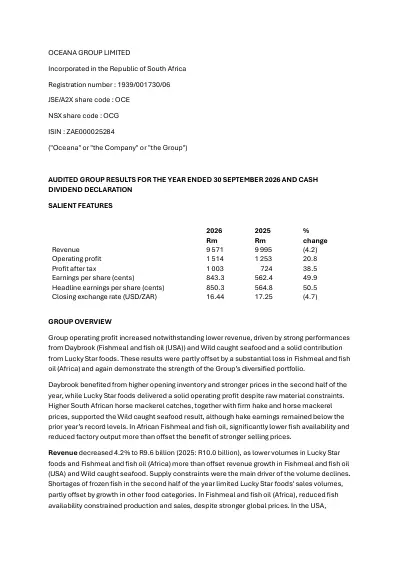
Supply was definitely the defining feature of 2026. El Niño disrupted Peruvian anchovy fishing, and global pilchard and South African industrial fish catches were constrained, while wild-caught seafood catch rates improved.
Once again, our diversified portfolio proved its worth. The group grew operating profit by 20.8%, increased headline earnings per share by 50.5%, and more than halved net debt to EBITDA.
This strong performance was delivered despite lower revenue and a substantial loss in our African fishmeal and fish oil business. Revenue growth at Daybrook and wild-caught seafood helped offset supply constraints in Lucky Star Foods and fishmeal and fish oil Africa.
Daybrook benefited from higher fishmeal volumes and record second-half prices. However, shortages of frozen fish constrained Lucky Star's canned fish sales volume in the second half, while significantly lower fish availability reduced production and sales in fishmeal and fish oil Africa.
As a result, group revenue declined by 4.2% to R9.6 billion. Operating profit increased by 20.8% to R1.5 billion compared to the R1.3 billion achieved in the prior year, supported by improved margins at Daybrook, Lucky Star Foods, and wild-caught seafood.
Headline earnings per share increased by 50.5% to 850.3 cents per share. This was well ahead of operating profit growth due to a 41.7% reduction in net interest expense and a lower share of earnings attributable to minority interests.
The group declared a final dividend of 320 cents per share, bringing the total dividend for the year to 430 cents per share, which is an increase of 50.9%, in line with the increase in headline earnings per share. The group's net debt to EBITDA ratio improved to 0.8 times compared to 1.7 times at the end of September 2025: in the US, to 0.1 times from 0.8 times, and in South Africa, to 1.4 times from 2.2 times, reflecting the stronger operating performance and lower debt levels.
Operating profit for the second half of the year was R849 million, which was 47% higher than the R577 million achieved in the second half of 2025. The increase in total operating profit from R1.3 billion to R1.5 billion is similar to the increase seen from 2022 to 2023, which was the last time that El Niño disrupted supply.
The two halves of 2026 told quite different stories across the business. Lucky Star Foods' record profit was weighted to the first half before frozen fish shortages constrained production and sales volumes, while Daybrook's profit was weighted to the second half when record fishmeal and fish oil prices more than offset weaker first-half pricing.
Group operating margin showed a significant increase from 12.5% in the prior year to 15.8% in 2026, in line with the 16.2% achieved in 2024. Daybrook delivered its strongest result in US dollar terms since its acquisition in 2015.
Operating profit increased by 69% from $30.2 million to $51 million. The operating margin improved to 31.3% from 22.7%, driven by higher opening inventory, catches in line with the historical average, and favorable second-half pricing.
It is worth noting that the average rand to the US dollar in 2026 is the lowest it's been for the past 5 years. The benefits of being a diversified business are again reflected in the operating profit contribution by segment.
Lucky Star Foods increased operating profit by 13% to a record R530 million, with the operating margin improving to 11.7% from 9.6%. This was driven by favorably costed opening inventory, lower freight and inventory holding costs, higher net realized sales value, and a more favorable sales mix, including solid growth in canned meat and other food categories.
Its contribution to operating profit was 35%, in line with last year. The wild-caught seafood segment achieved an exceptional result, with operating profit up 44% to R320 million and the margin improving to 16% from 11.9%.
Horse mackerel was a major contributor, with catch and production from the Desert Diamond in South Africa increasing by 136% and average rand selling prices up 18%. Hake delivered a solid result, although earnings remained below the prior year's record level.
The segment contributed 21% of group operating profit. The segment's result includes a R54 million fair value gain on fuel hedging derivatives.
Excluding this gain, wild-caught seafood operating profit would still have increased by approximately 20%, which underlines the quality of the underlying improvement from the fleet investment and firm pricing. Daybrook's contribution to group operating profit increased from 43% in 2025 to 55% in 2026.
Operating profit increased by 56% to R839 million. In US dollar terms, the underlying improvement was even stronger, with operating profit up 69%.
It is worth noting that this was achieved despite a 7% appreciation of the rand against the US dollar, which reduced Daybrook's translated earnings by R67 million. Fishmeal and Fish Oil Africa reported an operating loss of R175 million compared to a profit of R26 million in the prior year.
Industrial fish landings fell by 70%, pilchard trimmings declined in line with lower cannery output, and the oil yield reduced to 3.4% from 5.7%. The resulting 71% reduction in production volumes led to an under-recovery of fixed costs, which more than offset significantly higher US dollar selling prices.
On a combined basis, the fishmeal and fish oil segments increased operating profit by 17.8% to R664 million, driven by the US performance. As we showed last year, fish oil price movements have a significant impact on Daybrook's performance, and we have continued to quantify this effect by applying the average realized US dollar prices to the previous year's volumes.
Following the price correction in 2025, which had a negative profit impact of approximately R725 million, average fish oil prices recovered by 24% in 2026, generating a positive impact on operating profit of approximately R277 million. This was achieved on fish oil sales volumes of 21,600 tons, 6% lower than the prior year due to a lower oil yield.
The price recovery occurred largely in the second half after Peru's first-season anchovy quota was cut by 36% and only around 25% of it was landed because of El Niño conditions. Neville will cover the outlook, but the cancellation of Peru's second 2026 season has since tightened supply further, and 90% of Daybrook's carried-forward fish oil has already been contracted at prices 150% to 200% above the first-half 2026 average.
From an income statement point of view, revenue decreased by 4.2% to R9.6 billion as lower volumes in Lucky Star Foods and Fishmeal and Fish Oil Africa more than offset growth at Daybrook and in wild-caught seafood. Gross profit increased by 7.2% to R3 billion, and the gross profit margin improved by 330 basis points to 31.1%, driven mainly by strong selling prices for Daybrook and wild-caught seafood and lower costs for Lucky Star Foods.
Selling and distribution expenses decreased by 11.2% to R515 million, primarily due to lower frozen fish holding costs in Lucky Star Foods. Overhead expenditure decreased by 1% to R890 million, mainly due to lower insurance costs, the fair value gain on fuel hedging derivatives, and cost containment.
As a result, operating profit increased by 20.8% to R1.5 billion, and the operating margin improved to 15.8% from 12.5%. Net interest expense reduced by 41.7% from R288 million in 2025 to R168 million due to significantly lower borrowings following the repayment of US term debt and reduced utilization of SA short-term facilities as Lucky Star Foods inventory declined.
The effective tax rate increased marginally to 25.5%. Profit after tax increased by 38.5% to R1 billion, and headline earnings increased by 50.5% to R1 billion.
Headline earnings grew faster than profit after tax due to a lower share of earnings attributable to minority interests in subsidiaries affected by lower pelagic fish availability. Detailed financial statements are included in the appendix to this presentation and the results booklet, which is available on our website.
Net working capital across the group decreased by R779 million to R1.7 billion, largely due to lower frozen fish procurement by Lucky Star Foods. In cash flow terms, this represented a working capital release of R667 million, of which R558 million came from lower inventories compared to an investment of R245 million in the prior year.
Lucky Star Foods' closing stock ended 49% lower than the prior year, which reduced both working capital investment and inventory holding costs. Fishmeal and Fish Oil Africa closing stock was 34% lower, reflecting lower landings.
A large part of the decrease in the net working capital was due to raw material shortages rather than a permanent change in our working capital requirements. Rebuilding Lucky Star Foods inventories is a key priority, and we expect reinvestment in working capital and a seasonal increase in SA short-term facilities during the coming year.
Capital expenditure increased to R466 million compared to R327 million the prior year. This included R194 million for the acquisition and refurbishment of the dual-purpose hake and horse mackerel vessel, Valeria.
Excluding Valeria, replacement capital expenditure decreased by 11.9% from R260 million in 2025 to R229 million in the current year, mainly on statutory vessel maintenance and the ongoing upkeep of our processing facilities. Valeria is due to complete its upgrade and start fishing in South African waters early in 2027, which will allow the Desert Diamond to be redeployed to Namibia to replace the held-for-sale Desert Ruby.
This is another important step in rationalizing the fleet and further reducing operating costs. The group is planning to invest approximately R366 million in capital expenditure in 2027.
The forecast includes R224 million in replacement capex, R104 million in expansion capex, and R38 million to complete the Valeria upgrade. Reducing US dollar debt has been a primary focus for several years, and 2026 effectively completed that phase.
We repaid a further $15 million from surplus cash, and the remaining US term debt was refinanced through a $60 million revolving credit facility. At the end of September 2025, $12 million of the RCF was drawn compared to term debt of $53 million a year ago.
It is worth noting that the US net debt has reduced by $78 million and the group received $85 million in dividends since 2022. Together, these amounts to a positive cash flow benefit of $163 million to the group from the US, which equates to R2.9 billion in rand terms over the 5-year period.
The US net debt to EBITDA ratio reduced to 0.1 times from 2.3 times during the same period. In South Africa, short-term facilities decreased by R748 million, mainly reflecting lower Lucky Star Foods inventories following reduced procurement, and capital repayments reduced term debt by R150 million.
SA net debt reduced by R836 million to R1.2 billion. The SA net debt to EBITDA ratio reduced to 1.4 times from 2.2 times.
This was achieved even though SA EBITDA reduced to R887 million from R939 million in the prior year, reflecting the loss in Fishmeal and Fish Oil Africa. Unutilized SA facilities almost doubled to R1.5 billion compared to R791 million in 2025, which provides comfortable headroom to fund the Lucky Star Foods inventory rebuild and growth opportunities.
The group's total net debt decreased by 47.4% to R1.4 billion from R2.6 billion in 2025, with both US and SA debt reducing. US net debt as a proportion of total net debt has reduced from 60% in 2022 to 9% in 2026, while SA debt now comprises 91% of the total.
On a combined basis, the group's net debt to EBITDA ratio improved to 0.8 times from 1.7 times due to lower net debt and higher EBITDA. The SA ratio reduced to 1.4 times and the US ratio to 0.1 times.
With the US interest rate swap having fallen away, and the US term debt repaid, and the lower interest rate sensitivity, none of the group's debt is currently hedged compared to 26% in the prior year. Looking ahead, the strong fishmeal and fish oil pricing cycle should generate good cash flows, giving the group additional growth capacity.
The group complied with all lender covenant requirements relating to both its SA and US debt. Cash generated from operations increased by 79.3% to R2.6 billion, significantly higher than the R1.4 billion generated in the prior year.
This was due to a higher cash operating profit of R1.9 billion and the R667 million working capital release. The net cash balance reduced from R603 million in 2025 to R207 million in 2026.
The strong cash generation was applied to repaying US term debt and reducing SA short-term facilities, as well as funding capital expenditure, tax, and dividends, rather than holding the surplus cash against higher-cost debt. Free cash conversion improved to 164.1% compared to 103.2% in the prior year, driven by the significant increase in cash flow from operating activities to R1.7 billion compared to R435 million in the prior year.
As with working capital, this year's conversion ratio is inflated by the inventory release. We expect this to normalize as Lucky Star Foods rebuilds its stock.
Higher operating profit, a stronger rand, and lower working capital lifted the group's return on net assets to 14.2% from 10.6% in 2025, its highest level in the past 5 years. The group declared a final dividend of 320 cents per share compared to 175 cents per share, which together with the interim dividend brings the total dividend for the year to 430 cents per share compared to 285 cents per share, an increase of 50.9%, which is in line with the increase in headline earnings per share.
Dividend cover was maintained at 1.98 times. Although the balance sheet has strengthened considerably, we have held cover at this level because of the expected working capital rebuild at Lucky Star Foods, unhedged fuel exposure in 2027, and continued fleet investment.
This also preserves our capacity to pursue growth opportunities. The capital allocation framework remains on track, and we have made significant progress across each priority.
We have substantially reduced US term debt, lowered SA term debt, continued to reinvest in our canneries, plants, and fleet, including Valeria, and expanded Lucky Star into adjacent food categories, such as canned meat. With a modernized asset base, a stronger balance sheet, and improving cash generation, we have greater capacity to grow and diversify the group organically and through acquisitions while maintaining our dividends.
We will remain disciplined in balancing shareholder returns, debt reduction, and capital investment. Thank you, and I hand you back to Neville, who will cover outlook.
Neville Brink
Thank you, Zaf. Very brief slide on outlook, and I have spoken about a number of these issues as I went through my presentation, but let's start with Lucky Star Foods.
As I said, tight supply, it is going to be the key focus going forward: how do we rebuild inventory? Our procurement teams are out there now.
It's a combination of rebuilding the pilchard supply and enhancing that with other pelagic species, which we believe, and I was saying to the team that this in a macabre kind of way is a blessing in disguise. It's forcing us to look at other species.
Pilchards will get back to normal, and when they do get back to normal, we'll have an enhanced supply chain of additional species which can grow the overall Lucky Star brand. The focus will be on getting that supply back to normal levels.
Unfortunately, we're going to have to implement another price increase. The cost of that raw material has gone up substantially.
That has been implemented in November already, so that is going through. Cost discipline in our factories: there is going to be a key focus on our two canneries in the West Coast to try and take some cost out of that business because there's going to be some short-term pain.
The survey is going to be key for giving us an indication of how strong the resources are, in particular on pilchards. Then obviously, a lot of focus will be on the new categories.
Diversity is the strategy of this business: how do we diversify so that we can manage volatility? In particular the noodles category will take thing, and certainly the canned meats will continue to grow.
On the wild-caught side, the new vessel: I'm looking forward to seeing that new vessel operate. Currently, it really is a beautiful vessel.
It will go to sea in March of this year, and then the move to Namibia by the Desert Diamond, and I think that'll enhance the ability to catch at a more affordable rate in Namibia. Then I see a continuation of strong prices for wild-caught seafood across the board because of the finite supply.
Fuel prices, that will affect this business. 30%, 35% of the operating costs of the big trawlers is fuel.
High fuel prices will affect this business, and we're going to have to manage that. The view that we see is not to hedge at this point, but it may come to a point where we will take some hedges out.
Then on the fishmeal and oil side, as I said, Peru have called off the season, there will be supply constraints both in oil and meal. We've opened the year with a very, very strong position, and what is going to be key for South Africa is what this research tells us.
I see a strong performance from Daybrook, and I see a focus on South Africa in terms of managing costs and in improving the variability of our cost in South Africa, taking some costs out of the business. I think we're well-positioned.
Our balance sheet and Zaf has spoken about our balance sheet, our balance sheet puts us in a position that favors us for some enhancements in our business, some acquisitions, and improved allocations of cost into our assets. I think we're in a good position going forward.
I'm going to end there and hand over to questions, and hopefully we can answer those.
Trevor Giles
Thanks, Neville. We got a couple of questions on the system.
First one is from Charles at Titanium Capital: "My understanding is that Lucky Star sources as follows: firstly, fished locally; secondly, procured frozen fish to be canned locally; and thirdly, imported canned product. Is this correct?
Can you give us some understanding of the margins of these three options?"
Neville Brink
Thank you, Charles. Yes, largely that is, obviously, our focus first is our wild-caught catch, our own catch both from Namibia and from South Africa.
Then we obviously supplement that with frozen imports, and then canned production from our other factories in South Africa who also supply us. The margins generally are about half, or double on the fresh-caught catch versus frozen.
That is a moving target. Currently, obviously, because of the high fishmeal and oil prices, the replacement cost for frozen is very, very high, the margins obviously are probably lower than that.
What is encouraging is obviously, as I spoke about, the growth in the local biomasses. That should be, going forward, and I'm now talking longer than just next year, going forward over the next couple of years as we grow a greater proportion of our catch from local catch, that is margin
Trevor Giles
enhancing. Neville, while we are on margins, a second one from Charles is also on Lucky Star: "Can you talk a little bit about the expected operating margins for products other than fish?
Do you expect expansion of other products to produce similar margins to the fish business?"
Neville Brink
Let me talk rather than give you the margin, give you the targeted margin. Generally, canned fish operating margin is somewhere in the region of 10%, and that's the targeted.
It's better this year, but that's a little bit flattering because of the lack of frozen product and cost of freight and distribution and storage. The target margin for canned fish is generally around 10%.
The target margin for the products that we see going forward is somewhere in the region of 15%. The bigger that share will be margin enhancing and for the overall Lucky Star business.
That's the targeted level. Obviously it takes time to get to those levels, but we certainly don't enter a category that would see margin below 10%.
Trevor Giles
Thanks, Neville. Zaf, I think the next one is for you from Marlo Scholtz at Sanlam: "Given the carryover of stock and pricing for fishmeal and fish oil, you have a very good certainty of the profits this business will make in H1.
Add to that much lower debt and weaker currency, is there not already enough certainty that HEPS will be above 20% for H1 next year?"
Neville Brink
Before you answer that, I just want to say something to Marlo. Marlo, I've been in this business for 30 years, and the one thing I've learned about the fishing business, there's no certainty.
With that in context, Zaf, I'm happy for you to answer.
Zafar Mahomed
Thanks, Neville. The point is well made.
I think just to remind everybody, we only in November. We haven't even completed 2 months of the year, and yes, this is fishing.
I just want to clarify that the JSE has put out a circular saying that, yes, you can tick the box to say you're going to be 20% above, but it could be misleading just to tick that box. You've got to be more accurate, and I think we'd rather wait.
We are doing a 5-month trading update in March. Trevor will send out the dates for that.
We will give you an update of where we are in the business. I think that's probably—
Trevor Giles
Thanks, Neville, Zaf. Another question from, I think it's Ian Doyle: "Looking at the Lucky Star supply, with closing inventory 49% lower, continued customer allocations, and constrained global pilchard supply, how much volume downside is embedded in FY '27?
What price increases are required merely to protect the 11.7% margin?"
Neville Brink
That's a very tough question to answer right now. I don't think we have enough information.
It does depend on what the local resource and the local TAC is going to be in January 2027, and we'll only know that number when the research vessel comes back. I expect certainly an increased TAC from Namibia with their biomass, just under 1 million tons.
Even in 2026 and 2025, when they issued those quotas, those experimental quotas, they issued them extremely late. Now, the catching season in Namibia for pilchards is March through to July, August.
We only got issued those quotas late in the year, we didn't really take full advantage of what we were given, and we have been canvassing government there to issue the quotas earlier this year, sometime in February, which will allow us to take a lot of advantage of it. To answer your question, it's going to be too early to tell.
We have contracted a cannery in Morocco. It is currently producing for us.
We've bought over 7,000 tons of herring, half of it is already in the cannery in Ningbo in China, being produced, that'll start coming into the market now; the second half is on its way there, we're going to buy some more. We're certainly not just sitting back and accepting what is happening.
That team is working extremely hard to minimize there is going to be an effect, there's no doubt. We are going to have a lower volume effect in the first half.
What the team is working on is to minimize that. I think price increases are not something we like.
The consumer we're selling to is under strain. Food inflation is high, and we need to be very conscious about the affordability of Lucky Star.
We will try and manage that as possible. Again, a focus on cost containment at our factories.
It's a problem we recognize, and I'm sure that team will tackle it hard.
Trevor Giles
Thanks, Neville. Another question from Charles at Titanium Capital: "Are the tariffs on steel being granted to ArcelorMittal impacting pricing of cans?
Is this cost significant in terms of the cost of the finished product for Lucky Star?"
Neville Brink
Certainly we haven't seen any effect of that. We have a strong relationship with our supplier of cans and pricing has been reasonably priced relative to inflation.
No, I think we haven't seen any effect, and our pricing is fixed for the next couple of months. We have annual negotiations or every 6 months, we have negotiations, and we've worked very closely with them.
Trevor Giles
Thanks, Neville. Another one from Charles at Titanium: "Has the FRAP process, including all appeals, been finalized?
The FRAP process seems to produce a boom-or-bust capital cycle as operators run down capital and limit investment before the rights are allocated, and then experiencing a capex catch-up once rights are allocated. Is there any solution to this, example, quota periods being lengthened?"
Neville Brink
Very good question, and it's something that the industry has battled with for many, many years, and I think there's a new pragmatism in DFFE. There's a revision of the Act that's been currently drawn up.
To answer your first question, largely the FRAP process has been completed. There's some minor challenges in some of the smaller species, but largely it's been completed.
We're approximately 5 years into the 15-year process. Industry, in particular the capital-intensive industry, has written to DFFE and have been lobbying DFFE that we do need a longer period of rights, particularly in the highly capital-intensive, the hake, horse mackerel, where you need large vessels.
Certainly, I think with the current focus on jobs and sustainability and competitiveness of the South African industry, I think there's a new view that I think you'll see a varying of length of termination of rights, in particular the more capital. It is something that we're really focused on, and let's see as that revision of the Act, I think, will be complete sometime next year.
Trevor Giles
Thanks, Neville. I think we've just got one last question also from Charles, and it's really around the fixed costs for Lucky Star.
The question is, the assumption is that Lucky Star does have a high fixed cost base with its vessels and factories. Although the volume reduction this year doesn't seem to have impacted the margin, and can you explain that a little bit more detail, please?
Neville Brink
The combination of opening stock that was purchased into 2025, very reasonably priced stock which was sold in the first half, and in the second half, obviously lower cost of storage and freight when we weren't bringing in 50,000, 60,000 tons of raw material, frozen raw material, which reduced our distribution costs, and those two enhanced the margin up to 11. I don't think that is sustainable.
Our target margins will stay around 10%. It may drop off slightly next year as we're going to have to replace that.
We're putting price increases to absorb some of that cost, but the fixed cost recovery is something that's going to take time as we look at our factories and take some costs out, but we'll see that cost recovery take time to actually implement. It is a focus for that area.
Trevor Giles
Thanks, Neville and Zaf. I think those are all the questions we have at this time.
Neville Brink
Thank you, Trevor, and thank you, everyone, for joining, and enjoy the rest of the afternoon. Thank you.
Bye-bye. Thank you.