Sappi Limited
Q4 FY2026 · Earnings Call TranscriptNovember 6, 2026
Operator
Good day and thank you for standing by. Welcome to the Sappi Q4 2026 results call.
At this time, all participants are in a listen-only mode. After the speakers' presentation, there will be a question and answer session.
To ask a question during the session, you will need to press star one and one on your telephone. You will then hear an automated message advising your hand is raised.
To withdraw your question, please press star one and one again. Please be advised that today's conference is being recorded.
I would now like to hand the conference over to your speaker today, Steve Binnie, CEO. Please go ahead.
Steve Binnie
Thank you, Operator. Good day to everybody.
Thanks for joining us. As always, I'll go through the investor presentation calling out the page numbers as we move through.
Firstly, just on page 2, just drawing your attention to our statement on forward-looking statements, our guidance on forward-looking statements. The page 3 is the key numbers for the the year.
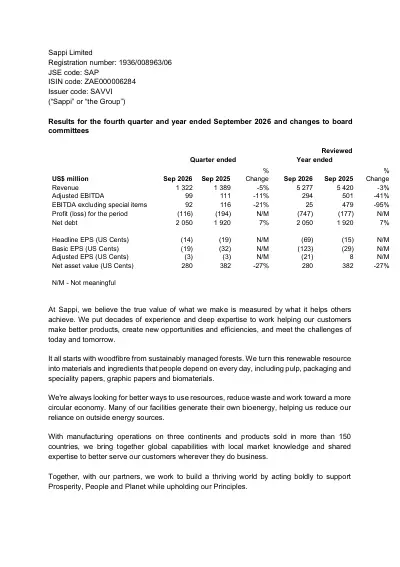
These are annual numbers, and a lot of this we've talked about in in previous earnings call calls. It was clearly a challenging year where we had significant headwinds, markets being under pressure, and a lot of impact coming through from cost inflation, which is, well, a lot of that was linked to the war in the Middle East.
Then we at the same time, we had adverse movements in exchange rates, which had a major impact on the South African profitability. Having said that, there were there were positives, and and they did gain momentum as we moved through the year.
DWP prices, which initially came off, and we'll see it on a later slide, initially came off, but then subsequently strengthened in the latter part of the year. Very pleased with the progress of the ramp-up of the volumes coming out of our Somerset PM2 mill, which was a big investment for us.
Initially, obviously, as started a little bit slow, but picked up momentum, and by the time we got to the end of the year, the machine, at the at the speed it was operating, was full. We didn't, we didn't have to take any any any downtime.
As we move into the new year, we will be speeding up the machine further to give us additional volumes. Packaging volumes increased, and I'm very pleased with that.
One other thing to call out, the the negative movement in the exchange rates, the stronger rand, did have a impact on our forestry fair valuation, which, obviously, has to go through the P&L as well. Moving to slide 4 is our earnings bridge comparing the year to last year.
We've done it in a different format to previously because we we felt this was a a a better way to explain the key the key drivers behind our performance. We've, we focus on the key the key levers or or influences to our results.
You can see, I'm not going to go through every bar, but you can see that the pulp price had a major impact year on year, albeit did recover in the second half of the year. If you look at the year as a whole, a major negative impact.
Similarly, even in the paper segments, both on packaging and graphics, a negative impact. You do get the benefits from the higher packaging volumes coming through, but other negatives, graphic papers would be no surprise to you, it does decline the the volumes each year.
The currency shifts, predominantly, obviously, the the stronger dollar, which had a major impact on our on our rand our rand costs, but but also on the euro as well. It had some impact there.
Then the and then the delivery costs, which is shipping costs, the higher oil prices coming through, and then, similarly, on variable costs, the the the higher chemicals, the impact, once again, linked linked linked to higher oil prices as well. Not just chemicals, in in Europe, we've seen higher wood prices come through, and and energy prices overall globally under pressure.
We did a lot of great work on on saving costs, but clearly not enough to mitigate all the impacts that are that are here, and and that's what gives rise to the the lower EBITDA that you see at the 294. Turning to page 5, the the quarter itself, I'm pleased to say that the quarter was better.
Still many pressures, but the pressures have shifted. Our market conditions, we are starting to see improvement coming through.
Dissolving pulp is better, the packaging markets are better. In the US, in in SBS specifically, market has tightened, less supply, demand going up.
We have seen selling prices increase, and and further increases have been announced. The market conditions for packaging in the US specifically, SBS, are are better, and we're we are more optimistic in the year ahead, and that will obviously be supportive by higher volumes.
It's not just there. Globally, packaging markets are starting to rise.
You've seen containerboard prices in Europe follow the US upwards, and we we think that can have a positive impact here in in South Africa as we as we move through the new the new financial year. I'm I'm I'm optimistic that there can be benefits there coming through.
All in all, packaging is is is better than when we spoke three months ago. Graphics, no surprise, you you do have your your annual decline decline in volumes, but a strong focus on cost discipline to ensure that the margins remain reasonable, and and obviously, proactive management of capacity helps us there as well.
Then slide 6 has the the same earnings bridge, but on the quarter, and you can see the the main drivers that I talked about. You're seeing pricing benefits come through on the pulp, starting to come through, and and then similarly, a little bit on packaging, but clearly more to follow, the volumes coming through, but, offset by the the currency and the the the the higher fuel and and chemical prices.
Good savings on on on fixed costs, ultimately giving us the the the $99 million. To summarize, still still headwinds out there, but it's mainly it's it's predominantly linked now to the the higher costs associated with the the the war in the Middle East.
Market conditions are better than when we previously talked. Just to show you evidence of that, slide 7, the firstly, dissolving pulp, you can see since the the beginning of calendar '26, we've seen a progressive improvement.
Just to remind you, there is a lag impact on that, but market conditions market conditions have improved. There's this healthy underlying demand for for fibers, viscose, downstream inventories are relatively low.
Ironically, the the exchange rate movements do support pricing as well, and we've seen DWP prices continue to to rise. At the moment, it's today it's $924 a ton.
You can see on the right-hand side fiber prices going up as well. Then turning to slide 8, which is another big earnings driver for the year ahead, the Somerset ramp-up, really, really pleased with how things have gone.
We've been able to secure more volume, gain market share, like we promised, and as I said, we ended the quarter with our our machines full. Record volumes, you would expect record volumes as you ramp up, but very proud of what we've achieved.
In the year ahead, as I said, the machine is now full. It's about increasing the speed and getting all the efficiencies associated with all of that.
Then on the pricing side, the first price increase has been realized at the end of the quarter, and and you'll see the benefits in the in the quarter ahead. We've now announced two further increases, not just us, the whole market.
Like like you've seen with the the first increase, it does take a little bit of time to to be realized into into our our our into our numbers, but we are optimistic about achieving those price increases. All in all, and and the other thing I should say is that there has been significant capacity coming out of this market.
We're feeling a lot better in the year ahead, and and you'll get the progressive improvement, higher volumes and higher pricing. Slide 9 has the graphics markets.
US, underlying demand does continue to decline just like Europe, but because because capacity has come out, the market balance is better. You see relatively stable prices coming through.
In Europe, a little bit tougher because of the excess capacity. We did get a a little bit of an increase earlier in the year, and we have announced price increases in recent weeks, but it it's more difficult.
Nevertheless, we are focused on recovering the higher costs. Slide 10 just shows our main categories of costs.
We we have seen the headwinds of the the higher chemicals coming through and delivery costs. In Europe, yes, higher wood costs coming through and the energy as well.
Look, most of that is in the base. The the the one headache, the immediate headache at the moment, as I've talked about, is is in the higher, elevated oil prices, and that's what is we've we've we've put into our outlook statement that we that we will talk about a little bit later.
Slide 11, two specific costs, and it's mainly impacts on on South Africa, has been the the sulfur prices, which have risen dramatically, it's a slide you've seen previously, and, the impact of the the delivery costs. This is just South Africa.
You can see roughly about R400 million each on on the year's earnings, a significant headwind. Slide the next slide, 12, which is our net debt and leverage ratio, obviously, with the lower earnings, our leverage levels do go up.
I I I am pleased with all the initiatives that we put in place that we've managed to keep our debt relatively constant year on year. You look across the last six quarters, there's a little bit of an exchange rate impact on there that does have a negative impact.
Broadly, we've been able, despite having a very low low level of profitability, we've been able to keep the debt relatively constant. As we move forward into the new financial year, and as we drop those lower quarters from last year, that will mean that our our earnings goes up, and it will mean that the leverage ratios will start to come down as we progressively move through the quarters, in addition to the the the debt reduction, the absolute debt reduction.
Slide 13 talks to our liquidity and our debt maturity. We still have substantial flexibility, cash on hand, with our undrawn facilities, RCF facilities.
The major refinancing that we have coming up in the next it was 18 months' time, is our 2028 bond, and that's something that we've we've already begun to think about, and, we'll pinpoint the right time to to refinance that in in in the in the months ahead. Moving to slide 14 is the cash flow, the the lower profitability having an impact on the the cash flow.
CapEx, we we we we did commit to you all that we would reduce discretionary CapEx. We haven't cut back on maintenance.
This is the bare minimum that we we we need to to to ensure that our mills continue to operate optimally. We ended the year, I think the number was 210, and we're estimating 240 for next year.
Turning to the segments, and a lot of these themes I've touched on, I'm going to go fairly fairly quickly. Firstly, on slide 16, the pulp segment, progressive improvements.
We did see the port, the Durban port, giving us significant challenges during the quarter. There there was productivity issues there, and there was a backlog created, and it meant that there was a 38,000 tons spillover into into the new financial year.
It it it causes disruption, clearly, but we, we do anticipate that we will be able to catch that up, hopefully, in Q1, that backlog. Overall, markets better, but the strong rand and the elevated costs linked to the war in the Middle East did impact on margins.
Slide 17 is the packaging segment. Tough year.
Clearly, we we we had the the commencement of the the ramp-up in the in the Somerset mill, and that does impact profitability. Overall, selling prices across all the regions were were were were lower, so that had an impact.
That that that's, why we we are driving now to to get higher selling prices, to recover those lost the the lost selling prices, particularly in the in in the North American SBS market, and and you saw that on an earlier slide. Then in graphics, the volumes down 11% year on year, mainly linked to the structural decline and the fact that we we obviously converted at at Somerset, we took graphic capacity out.
The the margins were reasonable for the year, and, a strong focus on disciplined cost management. Obviously, in Europe, we do have there is excess capacity in that market, and you see that all summarized regionally in in in slide 19.
I don't intend going through that. Maybe the only one just to call out is the the South African volumes, and a big chunk of that is linked to the the port issues at at Durban.
There is that 21% decline that you see in the top right box. Slide 20 has our Thrive strategy, our our core fundamentals.
I've shown you this before. It continues to drive and guide us.
I don't intend going through this, but with our renewed focus on back to basics, this this guides us. Then, slide 21, it's about controlling what we can control.
Firstly, on the on the portfolio side, we've got the ramp-up of Somerset PM2, which I talked about going very well. The UPM potential joint venture, the key the key decision now is lies with the the European Competition Commission, and we we did put out an announcement yesterday that we, hopefully, will get or we will we will know one way or another in the next few weeks.
Then a big focus on on on pricing. As I've indicated many times throughout this presentation, our costs are rising, and we need to, we need to mitigate that impact, and we've been driving these selling price increases to to to mitigate against that.
With a strong, disciplined capital allocation, we we we've talked about CapEx. Working capital, a strong focus.
There was an an outflow in in in Q4, but that that was linked predominantly to the the the delays at the the shipping at the Durban port and a build-up of inventory ahead of the Saiccor shut. The back to basics focus, and we've set ourselves in each of the regions cost-saving targets across variable and fixed.
Our key priority, as I said earlier, is to reduce debt and and reduce the leverage ratio. The next three slides are just what are our key focus areas in the respective regions.
Europe, it's about completing the the joint venture proposal, with a strong focus on on cost savings targets, and, those are those we will continue to work on regardless of the the process with the the potential joint venture. Then in North America, the story there is to execute on the the selling price increases that have been announced and ramp up the volumes further, improve the the product mix to to boost profitability.
Then in South Africa, strong we we we continue to have the strong rand. It's important that we focus on what we can control, a strong focus on operational efficiencies, where we where we can take out costs out of the business and maintain operational efficiencies, all of those contributing to improved profitability in the year ahead.
Slide 25 has the joint venture. Nothing new to report there other than, as we're waiting on the decision from the European competition authorities.
Slide 26 has all our ESG awards, and and many of these we're we're very proud of. Perhaps the most recent one, once again, in the Forbes top global employers, best employers, Sappi, once again, was was was ranked as one of the best employers, one of the few South African companies and one of the few in our industry that has continuously been ranked there.
Equally, or even more proud, that we we we are ranked as one of the world's top companies for women. Turning to the outlook statement, and slide 28, to summarize everything that I've been saying so far, there are green shoots.
Market conditions have improved in our pulp segment, market conditions have improved in our packaging segment. The graphic side of things, no surprises, the the the structural decline continues, and a strong focus on costs.
A focus on getting price recovery that that I've mentioned, through, we we we do have the higher costs, getting that that that that recovery through, but we do have elevated oil prices, and I know we all we all watch the Brent crude prices, they are they are very volatile, but that has an a significant impact on the profitability in the quarter. That's in Sorry, that's taken into account in our earnings guidance.
The we do have shuts in the quarter of $41 million. That's mainly the Saiccor shut, but there is a a smaller shut at at Somerset as well in the in the in the quarter.
Taking that all into account, strong focus on costs, strong focus on productivity, taking into account the current market conditions, which, as I said, are improving a little bit, the scheduled shuts, the elevated oil price, when we take that all into account, that's why we gave the guidance that the earnings would be down compared to Q4 for in the Q1 period. Operator, that's me gone through the presentation.
I'm going to now hand it back to you for questions.
Operator
Thank you. As a reminder, to ask a question, you will need to press star one and one on your telephone and wait for your name to be announced.
Operator? Yes.
As a reminder, to ask a question, you will need to press star one and one on your telephone and wait for your name to be announced. To withdraw your question, please press star one and one again.
Microphone not working. Are our microphones not working?
One moment, please, while we compile a Q&A queue. Did you hear us?
Speaking... Be quiet.
Please stand by. One moment, please.
Your conference will resume shortly. We can hear you now.
Apologies, everybody. No problem.
We will now take our first question from the line of Brian Morgan from RMB Morgan Stanley. Please go ahead.
Brian Morgan
Afternoon, team. Thanks for the presentation.
A couple of questions from our side. Can I start with this one, please?
Could you give us a steer on the energy refunds that you're expecting for the December quarter?
Steve Binnie
Thanks, Brian. The energy rebate is slightly lower than the prior year.
Not by much, but slightly lower, which is linked to lower usage. Marco, if you can hear me, maybe if you want to elaborate a little bit further?
Marco Eikelenboom
Brian. It will indeed for Europe be slightly less.
It depends on the usage. Depends on the pricing mechanism that is being applied by the local authorities.
In some cases, Brian, it's also the structure of the package that slightly changes year on year, and that has led us to believe that for the coming quarter, it will be slightly less than last year.
Brian Morgan
That's very good. Thank you.
Steve, can you dive into the port operations a little bit? We've had 38,000 tons of DWP locked up.
Could you give us an idea of your confidence around whether that'll be cleared through this quarter?
Steve Binnie
Yeah. What I'll do, Brian, I'll let Graeme go into more detail.
He's had some meetings with the port authorities in the last few days. A major headache for us, and not only the fact that the sales flipped into the new quarter, but you can imagine you have to find storage space for this inventory and so on.
Just to make it clear, that it was initially maybe triggered by a software update that was done by the port authorities, but it's not only that. Graeme will go into maybe a little bit more detail, but we are confident that we can catch up in the quarter.
Graeme, over to you.
Graeme Wild
Thanks, Steve. Brian, obviously, the initial event was the software update, which is obviously done in the peak of the citrus season, when the port was already under quite a lot of pressure.
That obviously very rapidly caused a backup in obviously not only ours, but everybody's containers, which then flowed into pressure on warehousing space around the area. The ongoing challenges largely relate around equipment availability and reliability, particularly the gantry cranes.
We've been working with the port authorities and our shipping lines to get additional containers onto ships when the ships can get in, but short sailing has often caused a problem for us and many others. Our most recent interactions, though, with the port authorities and particularly ICTSI on the DGT terminal, which is where all the containers go out, I think are very encouraging.
There's a lot of new equipment arriving from end of December onwards. There's a big program to refurbish the existing gantry cranes that are in the port, because obviously ICTSI have only recently just got operational control over there.
Then I think that, plus the work that we've been doing, both with them, but separately in terms of looking for alternative ways to get the volumes out of the country, gives us, I think, good confidence around our ability to catch up all of those volumes within this quarter.
Steve Binnie
Thanks, Graeme. Back to you, Brian.
Brian Morgan
Cool. That's great.
Thank you, guys. Last question is just on these Eurobonds.
Just maybe if you can chat to us a little bit about the interactions that you've had on that so far. Then also, is it potential to do a secured lending deal here?
Steve Binnie
Look, as you would imagine, you have ongoing dialogue with your banks and your advisors as we do with any bond refinancing, and you try to pinpoint the right time. As part of that conversation, you consider all options.
Clearly, the bond market generally has weakened. It's not just Sappi.
All the bond markets have weakened, and as you evaluate the flexibility and the costs, we'll consider all options. As we get closer to the debt, we'll be able to give a more specific update, but we are confident that one way or another, we'll be able to refinance.
Brian Morgan
Just a follow-up there, Steve. Would you be able to use South African assets against that?
Steve Binnie
Look, we're looking at all options, Brian. Clearly, we've got assets in the US, we've got assets and in South Africa.
We're not at that stage yet, Brian, and prize one would be to refinance in the bond market.
Brian Morgan
Cool. Thank you.
Operator
Thank you. We will now take the next question from the line of James Twyman from Prescient.
Please go ahead.
James Twyman
Yes, hello. Thank you very much, and thank you for the presentation.
First question for me is just back to this DWP inventory in Durban, which was 38,000 tons at the end of the quarter. Could you say roughly where it is now, whether there has been any reduction so far in the quarter?
Steve Binnie
Mohamed, do you want to talk to that specifically?
Mohamed Iqbal Mansoor
Yeah. The 38,000 tons if I look at what we've actually invoiced in October, we have made up about 10,000 tons out of that 38 that we've invoiced.
The plan, as Graeme mentioned, is to try and get through all of the remaining 28 by the end of the quarter.
James Twyman
That's great. Then you mentioned on the call that the EU is going to make a final decision on the joint venture in the next few weeks.
This is the final decision, is it? If so, does that mean you put all your final solutions for their concerns in, and it's now just a waiting game?
Steve Binnie
As you saw from our announcement yesterday, we've proposed certain remedies, and now the next step is that the Commission has to evaluate that, and then they typically go through a testing process with market participants, and ultimately that will influence their final decision.
James Twyman
Okay. Then a couple more, if I may.
In terms of the Somerset mill, given the ramp-up in packaging paper production, what is your estimate of what sort of tonnage increase we could see next year compared with this year?
Steve Binnie
Look, by the time we got to the end of the quarter, as I said, now, we were relatively full. We've got the progressive ramp-up on the speed.
I'll pass you to Mike, and he can talk broadly just about the volumes for the year.
Mike George Haws
James, we're, I'd say, ahead of what we had for a startup curve as far as equipment overall efficiency, and the machine's running very well, and the product's very well received out in the field, and we're essentially sold out. At this stage, we do have a speed ramp-up that was planned, but the exact volume, I guess I'm struggling to give you an exact number, but...
Maybe I can just comment there. I think what we said is that we would reach an operating rate, James, as we talk to the PM1 and PM2 together as a unit because we optimize production across those two, and we reached an operating rate across the two machines by the end of Q4 of about 85% operating rate, and we anticipate, as we've indicated, we'll ramp up to full capacity run rate by the end of the year.
You can phase up that run rate and work out the additional tonnages for the year.
Steve Binnie
You can hear we're pausing giving the exact number because we don't want to do that, but it's at least 100,000 extra for the year.
James Twyman
Thank you very much. Just back to the timing on the EU decision, I think you did say in the next few weeks, whereas I think previously we were expecting it to be end of the year, early next year.
Just good to understand where you see the timing from them and how factual the timing is. Do they give you an exact date when it is, or are they pretty general in terms of when they speak to you?
Steve Binnie
No, it's a specific date, and that date I think it's the 7th of January, right? 8th of January, yeah.
It is a specific date.
James Twyman
Thank you. Then in terms of pricing, containerboard prices move annually in South Africa, and prices for containerboard have moved up pretty dramatically over the last six months or so.
How pleased have you been with the price increases that you've managed to achieve? Because I'm sure it's all in the bag now for the year.
Steve Binnie
Look, one thing I would say to you, James, is that we did change the format of the South African contracts a couple of years ago, and it's 50% fixed and 50% variable. We clearly know the fixed component, and as global prices for containerboard rise, that will support further increases in the quarter ahead.
Graeme, I don't know if there's anything you want to add to that?
Graeme Wild
Obviously, just to reiterate that the format has changed. We have annual volume contracts, and then the pricing component is split roughly 50/50 with quarterly adjustments as we go through.
The price increases that we've seen, particularly in Europe in kraftliner board, we would expect for that to be followed through in roughly 50% of our volume as we move through the year.
James Twyman
Thank you very much. Then just a final one, if I may.
What was the FX impact on your net debt for the year?
Steve Binnie
For the year?
Glen Thomas Pearce
For the year, James, I'll get back to you. I don't know for the year.
Just give me a...
James Twyman
Or the quarter then. The quarter.
Glen Thomas Pearce
You got me there. It wasn't much, because your euro quarter on quarter didn't move much, I can...
James Twyman
No, that's great. No, that's cool.
Glen Thomas Pearce
Euro moved from 1.14 to 1.13, it would have been about $12 to $15 million.
James Twyman
For the quarter. For the quarter.
Operator
Thank you. We will now take the next question from the line of Detlef Winckelmann from JPMorgan.
Please go ahead.
Detlef Winckelmann
Hi, guys. Thanks for taking my question.
Maybe my first one is on this JV. Obviously, you already have secured financing for the JV as things stand today.
I'm just curious, can that be revisited with the fact that graphic paper profitability is worse than it was, let's say, this time about a year ago, and potentially remedies going through the system, or is it fixed in nature? Just curious on that and what that means for you call it $100 million worth of cash inflow on conclusion of the JV upfront.
Thanks so much.
Steve Binnie
Look, the decline in graphics was forecasted and was built into the estimates that we provided to the banks. There was no surprises there, and the underlying profitability was broadly in line with what we discussed with the banks.
That guarantee bridge is in place and will not be influenced by the change in circumstances nor the slight extension on the deadline from the European authorities. We still have that flexibility, and that's not a concern for us.
Detlef Winckelmann
Thanks. Maybe just on the second part of that question, just on the remedies as well.
I presume you don't want to tell us what the remedies are or what you guys have proposed. If the remedies were to exclude, I don't know, certain mills or they were to delay any closures, etc., once conclusion of the JV, would that kick-start any renegotiation on the funding side?
Steve Binnie
No. Clearly, we can't go into specifics, and it's at a very sensitive stage.
If we look at the impact of all the remedies that have been proposed, no, that would not have an impact on the funding that we have in place and the proceeds that we would get from the deal.
Detlef Winckelmann
Thank you.
Operator
Thank you. We will now take the next question from the line of Zenande Meyiwa from UBS.
Please go ahead.
Zenande Meyiwa
Hello. Can you hear me okay?
Steve Binnie
Yes.
Zenande Meyiwa
Hi. Thank you for taking my questions.
Just a couple of questions on my side. Just mainly on the guidance.
You're guiding for EBITDA in the first quarter to be below the $99 million despite an expected recovery in the delayed shipments in DWP, as well as further improvements in Somerset. Beyond the $41 million maintenance impact, what are some of the main offsets that prevent these positives from translating into sequential EBITDA growth?
Steve Binnie
You've obviously counted the maintenance, and it is a big number. The main headwind is the higher fuel price and the higher impact on diesel.
We're a big diesel user here in South Africa. We have to transport the timber from the forests to the mills.
In the US, it has a major impact as well. Diesel prices in the US, I think, $6.40 at the moment.
It's up substantially. When you take that into account, overall, we are estimating incremental costs.
By the way, it's not just diesel. You've still got higher sulfur prices, and linked to the diesel is the shipping cost.
When you take that all into account, and what we did in our outlook statement, we used today's prices. If diesel comes off, the Brent crude prices come off, then there is scope for higher profits.
We're halfway through the quarter. If that pressure could be relieved, that would be a benefit for us to outperform our outlook guidance.
Zenande Meyiwa
Sure, that's clear. Then I guess my second question is on the North America segment.
EBITDA, we saw a sequential improvement during the quarter. I guess my question is how much of the improvement came from Somerset P2 volumes and operating efficiencies versus paperboard price increases?
The next question to that is what is your realistic quarterly EBITDA run rate once PM2 fully ramps?
Steve Binnie
Look, there's a lot of questions there. I think look, in terms of the quarter itself, you saw the bridge on slide where was it?
Slide 6. You can see that the packaging selling price increases that came through, there was a lag, as I indicated earlier.
You can see it was relatively small. There's a big impact from volumes as Somerset ramped up and efficiencies at the mill because of the higher volumes.
A lot of the pricing benefits still has to come. In terms of the realistic EBITDA, I'm not going to give you a specific number, but we have targeted progressive improvement.
You heard from Mike earlier, we're going to see higher volumes over the course of the year. I said to you at least 100,000 tons.
That will benefit you. We're going to see the benefits of the price increases progressively come through.
The 2027 earnings will be higher because of those factors. Then as you move into 2028, as you annualize the higher volumes and annualize the benefits of the three price increases that we've announced, which recover selling prices some of the way back to where prices used to be, you have a significant improvement in profitability both in 2027 and then into 2028.
Zenande Meyiwa
No, that's clear. I'll pass it over.
Thank you.
Operator
Thank you. We will now take the next question from the line of Karl Crises from Morgan Stanley.
Please go ahead.
Chris Hayes
Hey, can you guys hear me okay?
Steve Binnie
Yes.
Chris Hayes
Great. I guess, yeah, just kind of looking on Q1 here.
Given the working capital outflow we just saw in the current quarter, should we be expecting inflow in next quarter, or how do you think about this?
Steve Binnie
I'll let Glen go into detail. Clearly, we're going to see a reversal of the 38,000 tons that we talked about and the build-up of inventory ahead of the Saiccor shut.
Over to you, Glen.
Glen Thomas Pearce
Thanks, Steve. Usually in our quarter one, there is some seasonality impact on the working capital, particularly in South Africa.
Graeme highlighted the citrus season. There's also a build-up of some stocks in North America on the packaging side.
There was an uncertainty of supply on our raw materials, we've locked that in to make sure that we don't impact our production. Overall, we're expecting a relatively small increasing in working capital in this first quarter, but it will reverse later on in quarter two and into quarter three.
Steve Binnie
Maybe just to offset that, exchange rates have moved further in our favor, and that based on current levels, that will offset a small increase in working capital that Glen referred to, and your net debt should be roughly constant.
Chris Hayes
Got it. Cool.
Then quick question about this If I look at the previous reports, €200 million term loan issued in Feb '26. Is that broken out across a couple of maturities?
When I look at your maturity wall, page 13, there's only $142 million in 2031, and then you've got the '29 and '30 stubs. How to think about it?
Steve Binnie
The €200 million term maturity loan that we put in place in February,
Glen Thomas Pearce
yeah, it's a three-year.
Chris Hayes
Yes.
Steve Binnie
Sorry, we're just finding the page 13. Where is that reflected in this graph?
Glen Thomas Pearce
It would be...
Chris Hayes
I guess it's at a five-year tenor, right? Which would be 2031, but it should be a higher bar.
Glen Thomas Pearce
It's in, well, 2030, 2031, yeah.
Steve Binnie
It's spread.
Glen Thomas Pearce
It's spread.
Steve Binnie
You've got the...
Chris Hayes
I guess I'm looking at the 142, and it's just smaller
Steve Binnie
than the 200
Chris Hayes
essentially issued, but you've got other tranches kind of around. All right.
Steve Binnie
Can we come back to you, though, on that one?
Chris Hayes
Sure. Then I guess just staying on the term loans, are these generally provided by the same guys as the RCF?
What's the story there?
Steve Binnie
Yes, there are some of the banks that are in the RCF, yes. We've got 10 banks, I think, in the RCF, and it is a component of that, part of that.
Chris Hayes
Cool. Then I guess on the latest issue, like the one from February, these are obviously pari with the bonds in the structure here.
I guess, do the covenant packages differ massively, or yeah, how does that look?
Steve Binnie
You're talking about the term loan now?
Chris Hayes
Correct.
Steve Binnie
They have the same covenant structure, and they are pari passu, yes.
Chris Hayes
The same as the bonds, basically.
Steve Binnie
Yes.
Chris Hayes
All right, cool. All right, no, that's great.
Thanks very much.
Steve Binnie
Great, thanks.
Operator
Thank you. We will now take the next question from the line of Till Dünnwald from Caios Capital.
Please go ahead.
Till Dünnwald
Hi, good afternoon. Thank you for taking my questions.
The first one is relating to a commentary that you made earlier, and just your sense on how sticky those price increases are, because I think we've seen in the sector a lot of price increase get announced, and then what is achieved is materially less than the headline numbers. Often, they are passing through raw material price increase.
Now you're talking about the hope of lower diesel cost, lower transportation cost, lower raw material cost, but then still pushing through continuous price increases. Can you a little bit speak about that dynamic, if the two can occur at the same time and the sustainability and or the achievability of the full dollar amount of those price increases?
Steve Binnie
Look, you've got to look in the different markets, right? Europe is is is more difficult because there has been excess capacity.
As as we we made one price increase earlier in the year, which was successful, but the second one was not successful. More recently, we've announced another another one, and we're working on that as we speak.
It it it does prove to be more more difficult. The US is very different because the market conditions are are are are very different.
Demand is increasing. The market balance is is more in sync.
You would have seen from that graph that we showed with SBS prices, if you look on what slide is it? Slide 8.
You can see the decline of SBS prices over the last couple of years. The market is very different now.
It's in balance, and we have got higher costs. That's why we are more confident that we can execute on the selling price increases that we've announced in this market.
Very very different to to Europe. South Africa, again, different circumstances, because you have a currency at play here, and and the rand was substantially stronger, which made imports more attractive.
What we've seen in more recent times is that containerboard prices initially rose in in the US, Europe is now rising, and then and then the rand has been everything's relative, right? The rand has been relatively more stable in the over the course of the last six months to nine months.
That gives us more confidence for for selling prices increases in the European markets. Sorry, in the South African markets.
Maybe just one last comment on graphics, same comments. A lot of capacity came out of graphics in the US, and that's why you've seen price stability there.
In in Europe, it it's tougher because you have excess capacity.
Till Dünnwald
Understood. Thank you.
Two regarding cash flows, before I look at movements in debt levels, we're seeing this quarter cash burn of $68 million, I think is the right number to look at. On that basis, is there any limitation to the availability of your RCF given that, I'm assuming current cash levels is probably as low as you want to go, and therefore for the cash burn in the next quarters you'll be counting on the RCF?
With the negotiations on the extension of the covenant holiday, is there any point that the RCF might not be available anymore, or is that fully available to draw, and are there any triggers that would prevent you from drawing on the RCF to fund ongoing cash burn?
Steve Binnie
Look, what I would say, Glen has gone through the Q1 outlook. There's a very small outflow of cash.
Later in the year, we are anticipating improved profitability, and ultimately we will be generating cash for the year. We do expect the debt levels to come down, and as you see, we do have cash reserves there.
In terms of restrictions on our access to the RCF, no, there's not. As I say, leverage ratios will come down, and we will be cash positive later in the year.
Till Dünnwald
Thank you. That is helpful.
Just to be very clear, because it's not guaranteed, and as an analyst, I have to be conservative. Even if the situation were not to improve meaningfully, the RCF would be fully available if it stays more or less where it has been to support further cash burn throughout this year?
There are no limitations around that?
Glen Thomas Pearce
There is a minimum threshold, but we have more than sufficient headroom on top of that. Within the agreement that we have on the covenant suspension, as I say, we negotiated more than sufficient headroom on that.
Till Dünnwald
Understood. Then a comment that you made earlier in response to a question around the Eurobond.
You mentioned that you're speaking to advisors. Have you retained financial or legal advisors regarding your bond refinancing?
Steve Binnie
No. We're talking about the banks.
That's normal practice. You talk to your banks all the time.
We're close to them. You try to pinpoint the right time to refinance.
Bond markets, there've been very volatile globally, and we continue to monitor the markets. Nothing different there to any normal times.
Till Dünnwald
Understood. Thank you.
Then the last question. Maybe if you can give a little bit more commentary, because given the trading price of your bonds generally across the cap stack, the market is making it look extremely difficult to do a normal course bond refi.
When you want to pinpoint the right moment, what are the things that you think would have or should fall in place over the next one or two quarters for you to launch that market bond refi?
Steve Binnie
Look, we can't give you an exact date, right, when we're going to refinance. We monitor, and we'll choose the right time.
Clearly, the bond yields or the interest rates on the existing bonds were lower when we did the initial bond issue some years ago, and we don't want to do it too soon because you're going to have a higher cost. I can't give you an exact time, but we will look at where market conditions are at, we'll talk to our banks, as I say, and we'll pinpoint the right time when to refinance.
Till Dünnwald
Okay. Thank you so much.
I will jump back in the queue.
Operator
Thank you. That's all the time we have allocated for today's conference call.
I would like to hand back over to Steve Binnie for closing remarks.
Steve Binnie
Yes, thank you, Operator. We appreciate everybody joining us today, and we look forward to discussing our results at the end of Q1.
Thank you very much. Bye-bye.
Operator
This concludes today's conference call. Thank you for participating.
You may now disconnect.