LIXIL Corporation
Q2 FY2027 · Earnings Call TranscriptOctober 30, 2026
Kayo Setoguchi
It is time for us to start the earnings call for the first half financial results for the fiscal year ending March 31st, 2027 of Lixil, Lixil Corporation. This briefing is streamed live online.
The materials have been uploaded to our website in the Investor Relations page. I would like to introduce to you our speakers: Director, Representative Executive Officer, President and CEO Kinya Seto; Director, Executive Vice President and CFO Mariko Fujita; Officer and leader of the IR Office, Aya Kawai.
I will be serving as a facilitator, my name is Setoguchi from the IR Office. I'd like to explain how we will proceed today.
First, we will have our CEO talk about the financial results. That will be followed by question and answer session.
The expected time for ending is 3:45. Now, I will invite our CEO Seto to give you the financial results.
Kinya Seto
Hello everyone. This is Seto from Lixil.
I will be explaining about the numbers today. First, I will talk about what has been happening.
In the last earnings call, I explained about the Middle East conflict impact. In terms of the response to the conflict, I think our company did well and worked steadily towards the alignment with our plan.
As for LWT, especially in Japan, we were able to see increase in the revenue and core earnings. The cost increased first, and we had conducted the price optimization.
From around June, we had seen sudden increase in the cost. We increased the price from August, and there was a gradual penetration of that increase.
In LWT, we were able to see increase in both revenue and core earnings. In LWT international, we were able to see increase in both revenue and core earnings.
The price optimization was conducted in July, and also the big factor was that we were able to conduct structural reform in the US, which had been completed. In LHT, the profit has gone down significantly, and that's the biggest reason why the revenue increased, but the core earnings declined.
In LHT, the cost increased in April, and the price optimization was to be conducted in October. Because of that, compared to the last fiscal year, the performance has deteriorated.
However, with regards to the response to what has been happening, we have been able to do well. I talked about what we will be doing in July, and we have been able to do what we had set out to do in July.
The cost increase comes first and the first half deteriorate, but the price optimization will start to take impact, and we will see the impact of that from October. What we are concerned about still is the demand.
In the first half, there were some sluggishness in the demand considering external environment. For Japan, conducting of the price increase, we had been concerned that the demand will be more sluggish.
However, as of October, the demand is not as sluggish. However, what we are slightly concerned about is that the progress for the program regarding the products which are subsidy-eligible, such as windows, the progress is sluggish.
We need to closely monitor how the demand will evolve. The international business is deteriorating more than we had expected.
What we had seen in the first half is that the US and China had seen deterioration in the market environment, but that had been complemented by EMEA and European regions. For the US market, we had expected that the market will improve, however, it has further deteriorated.
As it has been reported, the mortgage rate is now 7.3%, and with that rate, it is difficult for citizens to purchase housing. However, we had started our structural reform activities early compared to other manufacturers.
We are seeing increase in the market share. We are doing pretty well, but the situation in the market is still bad in the US.
China's sluggish situation continues, and also Europe, where we had expected a strong recovery, has seen instability in the political situation. We see that in France, and the impact from France have rippled to Spain and Italy.
Spain was very strong, but now the situation is becoming more unstable. As for the Middle East, the GDP is coming down in a lot of Middle Eastern countries, and also there has been cancellation in the projects.
In this region, we have the production facilities, we have inventory there, and because of that, we are receiving orders, and we have been able to supply our products to our customers. The environment in the market is deteriorating, but we're seeing increase in our market share, we need to closely monitor how we will do in this region.
Due to the conflict in the Middle East, the petrochemical products had gone up. Also, the metal prices has gone up as well, and we had aligned ourselves with increasing our prices of the product.
There is an increase in the fuel cost, and the distribution cost is increasing. For the Middle East route, we need to change the distribution route almost each week, and that is increasing our cost.
In EMEA, in the first half, this had been the biggest concern for us, we need to closely monitor the situation continuously. Overall, we have been able to respond to the biggest issues that has come to us, but we are seeing sluggish demand in the international business, and that causes us concern.
Overall, I believe that there is an increase in the pent-up demand. Now, I would like to go into the explanation of my presentation materials.
Change of the slides, please. Please go to the next page.
I would like to go into the explanation of the materials for today. These are key highlights for today.
I may be repeating myself, but for the domestic Japan business, the cost has increased, but in the first half, we have been able to respond to the situation well. In the first half, there was a time when there was a cost increase, but we have not been able to increase the prices, so that had deteriorated our profitability.
For LHT, the price optimization is to be conducted in October, so that had negatively impacted us. In terms of the new housing starts and the renovation demand, because of the possibility of a shortage in the materials, there was a focus in the industry for new construction.
However, people did not focus so much on the renovation business, and because of that, in the first half, we did not see much growth in the renovation business. However, we are seeing a normalization in this area.
As for the international business, US and China had been sluggish, but that had been complemented by the Middle East. However, the European market is now seeing the instability because of the political situation, so that concerns us a bit.
We have seen increase in the profit year-on-year. The biggest factor that contributed to the improvement is because of the completion of the structural reform that we had conducted in the US.
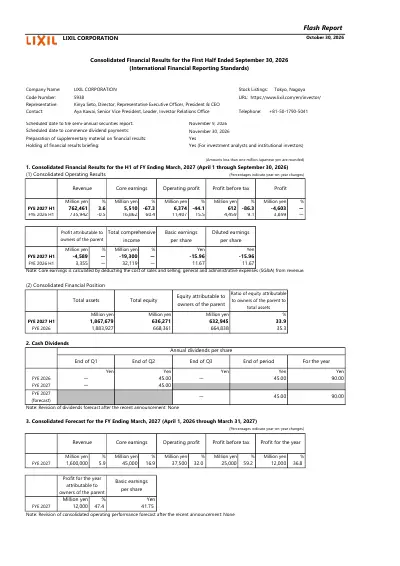
There is no change in the dividend or the forecast for the full year, and we expect the dividend to be 45 yen. There has been some technical issues, and I'm sorry that there has been some slides issue, but I would like to talk about the domestic business now.
Sorry about the concerns that we have caused you. As for the water-related products, we conducted the price increase in August, and metal-related cost increase reflection to the prices was conducted in October.
We were able to see increase in both revenue and the profitability, and the price revision will penetrate into the market, the situation will be better. As for LHT, we are now 31st of October, and the price optimization is going smoothly, and we believe that we can recover in the second half for what we have lost in the first half.
The only concern that we have is related to the window-related business, because the progress of the program for the subsidy-eligible products is sluggish. We have not been able to conduct the promotion for the windows because we needed to secure the raw materials and products in the face of the conflict, and also the program for the subsidy has started later than we had expected.
On the other hand, in the LWT international business, we were able to have successful price optimization in July, and we were able to see increase in both revenue and core earnings. The US, which had been dragging us down, has seen improvement in the business, and the amount of the red ink has significantly decreased.
In the second half, the issues are the economic policies as well as the political instability, and the market overall is becoming more sluggish. In the Middle East, we were able to improve the market share even though the market itself is deteriorating, we would like to make efforts to make improvements in the market that is deteriorating.
What worries us is that increase in the copper prices, it's used in the defense industry as well as in the IT industry, and that has negatively impacted us. Also the fuel cost because of the Middle East conflict, logistics issues have added to the cost.
You see the situation country by country. In the US, the mortgage rate for the 30-year is 7.3%, and President Trump had said that the mortgage rate would go down to 2%, but now it's 7.3%, the situation is very severe.
However, we were able to complete the structural reform in the US at early point, and Grohe and the American Standard have established their own the sales tentacles, and that is working well, and there are months which are in the red ink, but there are some months which are improving to the black ink, we are seeing improvement in the US. As for Europe, the market situation is severe, but the German market is holding up, but there are issues occurring in France, which has a rippling effect to South Europe, and Southern Europe has been seeing the fiscal issues already, and I am worried about the inflation as well as the hike in the interest rate.
As for the Middle East, the situation is as I have explained. Middle Eastern countries have seen decline in the GDP.
However, the population is increasing, and economy is growing. Even if the situation deteriorates for the countries which are facing the conflicts, the conflict-free Middle Eastern countries will continue to grow, overall, I am not worried so much.
As for APAC, excluding Thailand, the situation is getting better. Overall, the revenue increased while core earnings decreased, but what we have set out in July, that in terms of the response to the Middle Eastern conflict has been done as it has been planned, and I think that we would be able to come on par with the plan.
In the past 6 months, the cost increased faster than our price optimization, but in the full year, we would like to be able to improve. The gross profit margin, the cost increase first before the price increase followed, and so it did come down and we were impacted by FX to an extent as well so it deteriorated a little bit, but we intend to catch up in the second half of the year.
Here, and I'm repeating myself, but for LWT, we are seeing profit increase both in Japan and also international, and I feel that they made a pretty good effort given the environment. LHT, and aluminum has increased so much and we were unable to increase the price of October, we have to continue to make effort for the rest of the year.
Living kind of is positioned between the two, the LWT and LHT. For kitchen and the washbasins, the price increase in August, and for interior in October price increase, they're kind of timing coming to the middle of the two other segments, the profit has decreased, but the amount of profit decrease is not as significant as the LHT.
Next, the total assets have come down partly due to FX and we issued corporate bond in the first half, in the first quarter, so that was also a factor. We had to build up on the inventory because of the supply issues.
We had to buy more other materials, and we also had to hold a greater number of inventory of our product. Because of the extended ocean freight period, we had to also secure greater level of safety inventory, and so working capital increased as a consequence.
Interest-bearing debt ratio increased, and the equity ratio came down to 33.9%. This is something that we can recover quite quickly based on the reasoning.
For cash flow, because of increasing working capital and the inventory, and in the first half of the year, the cost increased before the price increase, and that had caused the profits to come down, and as a consequence, free cash flow did come down on a temporary basis, but towards the second half of the year, we tend to fully catch up for the gap. I apologize for the presentation material jumping all over the place, but I intend to recover through the Q&A.
Thank you.
Kayo Setoguchi
Thank you very much, we would like to go to the Q&A session. If you would like to ask a question, please press on the raise hand button.
The facilitator will be designating you one by one. Please ask your question directly using the audio and video functions.
In order to take as many questions as possible, we would like to limit the questions to two questions per person per time, and we would like to go a one question and one answer format. If you would like to ask more than two more than those questions, please raise the hand button after the first questions.
If you have questions, please raise your hand. The first question from SMBC Nikko Securities, Kawashima-san.
Please press on participate as a panelist. Please put your audio on, and video is optional.
Please start your question.
Hiroki Kawashima
My name is Kawashima from Nikko. Thank you very much for your presentation.
I have two questions. The first question is related to full year forecast.
You have not changed the plan, but the market situation is changing, and there is a severe situation for your volume. How would you be recovering for those severe situations?
The price optimization will be helping you?
Kinya Seto
I would like to first respond to that question. Basically, when we created the budget, compared to that, the volume we expected to decrease, but by conducting the price optimization, we believe that we can meet the target.
The revenue is expected to go up, but the volume is not necessarily increasing. Whether it will deteriorate or not is your question, I believe.
Currently, aside from US deteriorating very quickly, even though there are some countries which are seeing some deterioration, overall there is no significant decline. With the price optimization that we have put in place, we believe that we can cover the decline in the areas which have deteriorated, but we do have concerns.
Hiroki Kawashima
Thank you very much. My second question is related to the domestic market.
I would like to hear about the market consolidation, YKK and Panasonic. I thought there would be some activities there, but we don't see it so much.
Maybe there was something that had occurred, but the new housing market, I think that it's very difficult to recover when the costs are going so much. Lixil has already conducted the structural reform, but maybe you need to change more with the change in the demand from the domestic market.
From the manufacturer perspective, what are your views? Do you think that there will be a proactive actions for consolidation, or do you need to wait for the players to go out of the market?
Kinya Seto
I will not be able to comment about other companies, but we are not considering intervening in further market consolidation in Japan. What I believe will change the market dramatically is the penetration of agentic AI.
The past common sense was moving from the new housing to renovation, but when that happened, because the each project will be smaller, the revenue may be going up, but the profitability may be coming down. I don't think that a lot of players had room for pursuing the renovation activities.
The travel, dining out, home appliances, in those industries, the demand has been created by approaching the customers. In the case of our industry, the cost to increase the demand for each product and the profit that would come out of it, that would not match with each other.
I could go on about this, but the frequency of the buying of the product is very low, SG&A tend to grow when we try to sell those small products in the renovation area. Because of that, we were not able to pursue the demand creation arena.
However, using agentic AI, I think that we would be able to dramatically decline this SG&A, and we would be able to spend more for the generation of demand. With the advent of agentic AI, I think that the situation will change for demand creation.
Hiroki Kawashima
Thank you very much.
Kayo Setoguchi
Thank you, Kawashima-san. Next question from Daiwa Securities, Teraoka-san.
Please go ahead. Once the confirmation screen comes up, please click on participate as panelist.
Teraoka-san, please click on participate as a panelist. Please turn on your audio, a video is optional.
Please ask your question.
Hideaki Teraoka
Hi. Sorry for taking time.
This is Teraoka from Daiwa Securities. Thank you very much for explanation.
I would like to ask two questions. First, in regards to domestic market, and you have increased your price quite significantly, did you have a kind of a rush demand prior to the price increase?
That's the first point that I wanted to understand. I'll ask our second question after your response.
Kinya Seto
Of course there was a bit of a kind of the last-minute demand, but based on our experience so far, we did actually a number of things to prevent that from happening. Kind of coming up with the guaranteed period which expanded the order to kind of spread out.
If we have the last-minute surge in demand, we won't not be able to produce to meet that demand, and that's the reason we don't want it. In comparison to the past, it's been rather smooth, but for certain products, we did actually see last-minute demand, particularly for exterior type of products.
Even for the exterior products, in October we did provide some guarantee, and so the order for October has been quite steady. We didn't see a sudden drop after the price increase.
In this industry, apart from toilet, we cannot really build a lot of inventory, I think in that regard, the kind of last-minute orders were quite limited, and so doing the project earlier.
Hideaki Teraoka
The second question: you have continued to maintain the dividend level, but from your financial position, what would be required for you to maintain this dividend level? Conversely speaking, if there is a possibility for you to change the dividend level, what would drive that?
Kinya Seto
Depreciation and profit, I think these are the two key indicators. Or should I say depreciation in investment?
We feel that we are making sufficient investment, but if the depreciation is higher, and so the cash flow being large with the profit level being lower, we have been able to maintain dividend, but we want to also expand our profit. It would look better as well.
That is somewhat we would like to realize by next year. Another point, and so in terms of how we look and in terms of the core, not the profit, the final profit, the tax expenses or the constant at the core earning, and in order to reduce those, and making the structure better with in regards to the international business, we want to also address those aspects as well.
Normally, the tax cost should be between 30% and 40%, and that's the kind of level that we want to settle to as quickly as possible, and that is also quite significant.
Hideaki Teraoka
Thank you.
Kayo Setoguchi
Thank you very much, Teraoka-san. We would like to move on to the next question from Nomura Securities, Fukushima-san.
Please press on participate as panelist.
Daisuke Fukushima
My name is Fukushima from Nomura Securities. Thank you for taking my question.
I have two questions, and my first question is as follows. In LHT, you will be starting to increase the price in October for aluminum construction materials, and at that time, aluminum ingot prices had gone up when you have decided.
Now the aluminum ingot prices are coming down, and so for in LHT, aluminum slash products profitability, do you think that the profitability will be better than you had first envisioned? Or even though the aluminum ingot prices are stabilizing, because of the increase in other costs like fuels, you cannot be that optimistic?
Could you talk about that? That's my first question.
Kinya Seto
As you have said, the aluminum ingot prices are now more stabilized, and it's more stable than we had expected, in the short term, it will be a positive factor for us. However, for aluminum, we cannot have accurate forecast, and aluminum ingot prices may go higher than we had expected, we need to have a buffer in order to control the situation.
I don't think it's too much increase. I don't think that you would be able to talk so much in optimistic manner, but I don't think that the situation is that bad.
Daisuke Fukushima
My second question is that the red ink is shrinking in the United States market because you have been able to complete the structural reform, but the business environment is not recovering so much. For the sanitary ware in the US, what is the competitiveness of it compared to others?
How is it impacting the revenue? There was an discussion about the increase of your share due to the Trump tariffs, but I would like to know more about the competitiveness in the US market of your company.
I think that competitiveness is higher in Toto.
Kinya Seto
They have a very strong product, the Washlet, and they have built that position in the past 30 years, they have competitiveness in the unit price as well as for the profitability. When we go to the showroom, there are customers who would like to have Toto products, and there are not many areas where we can outperform them.
However, Kohler is the biggest competitor for us in that market. We never compare American Standard and Toto, but American Standard is compared to Kohler, and Glacier Bay in the Home Depot, their private brand is compared to our products.
Glacier Bay and in the other private brands, we are doing better than the private brands because they would not be able to supply at cheapest price possible with the materials that they have secured from China. There is no race to the bottom so much anymore.
However, Kohler, the Kohler sales are sluggish outside of the US, and in China there has been decline of sales by 30% to 40%, and also in India their situation is not good, and in Southeast Asia they're losing to competitors. Kohler, compared to American Standard, their position was slightly better than American Standard, there was no competition in the prices.
Before the Trump tariffs, the competition for American Standard was more about competing against the lower-level brands and not the upper-level brands. Now, Kohler is trying to capture the demand in the lower price point products.
Unit-price-wise, we have been able to improve because of the competition that's below us, they are not able to play the race to the bottom. However, we have not been able to get to the level of the more premium brands from the perspective of the competition with them.
It would take a long time at American Standard to significantly improve the profitability.
Daisuke Fukushima
Understood. Thank you very much.
Kayo Setoguchi
Thank you, Fukushima-san. I'd like to go to the next question from CLSA Securities, Mochizuki-san.
Please click on participate as a panelist when the screen pops up. Please click on participate as panelist.
Please turn on your audio, a video is optional. Now
Masahiro Mochizuki
thank you for the opportunity. I have two questions.
The first question is very simple question. The tariff refund from US, I think you had that.
How much did we have that in the first half of the year, and how much can we expect in the second half of the year? That's my first question.
Kinya Seto
In the first half of the year, and there was impact towards improving the loss level at 1.4 [billion?] , and that was booked in the first half of the year.
For the second half of the year, we do have kind of a ballpark figure, but as to whether that will really be refunded or not, we don't know. Please allow me to refrain from making a comment on that.
Masahiro Mochizuki
As an image, is it greater than the first half of the year?
Kinya Seto
Don't know. High likelihood that it will not be greater than the first half of the year.
As for the refund, a large portion is related to what we transport from Asia. We have been reducing what we actually bring into the States from Asia after the counter-tariffs was introduced, in that regard, and it takes quite a long time for the payment to be made until you make the filing.
I don't know how much still remains in the pipeline, but probably not likely to see greater refund in the second half of the year vis-a-vis first half of the year.
Masahiro Mochizuki
Thank you. For the second question, this is more of a broader-based question.
Because of the political changes, inflation and interest rate remaining at high level, these may continue for certain period. Now, when that happens, then Lixil's global business strategy, how do you intend to change that?
Have you already responded to this? You probably will achieve the forecast for this fiscal year, but inflation and higher interest rate, is there any adjustment to the strategy that may be required, and if so, what are you thinking of in that regard?
Kinya Seto
This may be quite a long response. I hope it's okay.
One example, and when we look at the situation, China is probably a good example. The Chinese market for water-related products, the market is divided into two segments: local versus international.
Until 5 years ago, this was clearly a distinguishable international ones being Grohe and Kohler or Toto were the players. For local, Huida, Arrow, or Jomoo, and essentially several hundred companies partook in that part of the market.
The local market, international market, there was clear distinction in terms of pricing. The players at the higher level of the local market, their quality wasn't too bad, when it comes to toilet or showers, then the functions for usage were not all that different, but there was a significant price difference.
From around 5 years ago, as the market in all of a sudden cooled down or shrunk quite significantly in China. Kohler was damaged the most, and Toto as well to a certain extent.
What was the reason for that? The brand equity closer to the local market was damaged a lot, and particularly the case with Kohler.
When the market was shrinking, then so they actually produced a next grade where the local players participating, but the local players, they actually fought in that area, ended up losing out to the local players. For Grohe and Hansgrohe, we saw the volume increase as well, international, for those with high brand equity, even when the market was poor, the sales increased.
We now know that this does happen. Don't know whether this is a good example or not, but in the case of Japan, and so the Japanese imported vehicles had a significant position.
Mercedes and didn't actually see their share come down even when the market overall was poor. It was American brands which has struggled the most.
This type of thing does happen for all sorts of different industries. What is important for Grohe in terms of offense and defense?
In terms of defense, and for Europe, you have the installers and the plumbers, and so they have continued to protect the Grohe. Architects and designers, and when they actually choose the product, they kind of think Grohe is cool, they choose, so that is the offense.
The Middle East, India, China market, where this actually plays out for our benefit. Here, maintaining the margin, changing the market to increase in our market share or sales, in that process, Grohe, the sales growth comes from the region expansion, the project architect or the designers choosing our product, and so we are able to achieve both.
American Standard, in that regard, we have not been able to do that. That's the reason it is kind of struggling.
American Standard, to change it to a brand like Grohe is not something that can be done all that easily, we will take a more lean approach for American Standard, and it does relate to your former question too. We may not be able to generate a significant profit, but this is an area where we would be more on a defense end.
Through influencer, we go to higher level and a premium brand at the higher level to maintain a position like Mercedes-Benz, and to expand upon that. That is the kind of strategy we will adopt.
Masahiro Mochizuki
American Standard, the brand value, is it difficult to enhance that because of competitors?
Kinya Seto
American Standard brand value is most felt by plumbers. Plumbers basically are not really interested in learning about new products.
They want to continue to use the same product. They do have the biggest affinity to the product of American Standard, and so for American Standard, focusing on plumbers will enable us to raise our ranking.
US and the Europe has the difference in terms of market nature. The US is quite a unique market, you buy product as product, but we have installers that the people hire separately.
Consumers can compare product for product, but in Europe, the product and service is sold at the same time by plumbers, and so from the plumbers' perspective, there is no incentive in comparing the price of products, and so they will actually recommend the same product to the customers. The brand equity improvement is difficult in that regard.
If you want to sell more Grohe, if we increase the price, we probably are able to sell more because plumbers are able to generate more profit for higher priced product. Increase in the price of the product to an extent will lead to increase in sales, but American Standard product, if we want to sell large quantity, we need to lower the price, but we have to improve the price if you want to improve the brand equity.
In simple terms, we do have that type of nature. Grohe, in that regard, we have more as opposed buoyancy, but American Standard has the buoyancy and gravity are kind of fighting each other, and that is probably the difficult aspect residing in American Standard.
Masahiro Mochizuki
Understood. Thank you.
Kayo Setoguchi
Thank you very much, Mochizuki-san. We would like to move on to the next question from Citigroup Securities, Miki-san.
When you see the screen, please click on participate as a panelist. Please put your audio on and video is optional.
Please ask your question.
Masashi Miki
My name is Miki from Citigroup. I have two questions as well.
The first question: LHT renovation sales is sluggish. You said that sash is sluggish.
You talked about the impact from the Middle East conflict, but is there an impact from no more subsidy for the window sash? Is the situation same for the other companies, or do you see decline in your share?
Also in the second half, I would like to get your comment about the sales for the LHT.
Kinya Seto
To your first question, there are wins and losses each month for the window sash business, but the other competitors are also seeing sluggish sales. There are several reasons behind this situation.
First, in the past 6 months, everyone was focusing on other things, which is that there is a shortage of materials coming from the Middle East. We needed to secure adhesives because there was a shortage.
In the construction companies, they needed to build quickly because if they are waiting, the costs will be further increased. They were focusing on the new housing rather than the renovation.
Also, on our side, we wanted to do renovation, but other things kept us busy. We were not able to capture the promotion opportunities for this.
Second is that the program changed drastically, and it took a long time in order for the start of the program. It started around June, and the information did not penetrate quickly.
Also another is that the summer was short, there was lots of rain, and people were not using the air conditioning so much. Those were the seasonality factors.
Out of the three, the biggest factor was the first one. We are seeing the stabilization in the situation, and people are eyeing more on the renovation, how well we do in October and November will be very important.
In the longer term, the second factor is very important. In May and June, we tend to start the new program after the previous program finishes.
The program was in the supplementary budget, and going forward, it would be included in the actual government budget, I think there are things that we would be able to change.
Masashi Miki
Thank you very much. I would like to move on to the second question.
On page 12, LWT international business, the first half sales had been lower than the plan, but LWT overall, 31 billion yen core earnings is being planned. With this pace of increase in the top line, do you think that you would be able to catch up to the full year plan?
What are the initiatives that you are going to take in the second half in order to meet the full year forecast?
Kinya Seto
There are concerns about the demand, of course. What we need to do includes increasing market share in each region.
Where we have been able to do well is the color faucets and also smart control products where we are strong in. Through that, we would like to maintain our revenue.
For this fiscal year, the volume may be sluggish, selling higher-end products for improved profitability is what we have been doing and what we have been able to maintain.
Masashi Miki
Thank you very much.
Kayo Setoguchi
Thank you very much, Miki-san. Like to proceed to the next question from Morgan Stanley MUFG Securities, Yagi-san.
When the confirmation screen pops up, please click on participate as panelist.
Ryo Yagi
Mr. Yagi?
Kayo Setoguchi
Please start your question.
Ryo Yagi
Thank you for the explanation. This is Yagi from Morgan Stanley MUFG Securities.
I have two questions as well. The first question is on page 12 related to sales international.
Europe and US and against the full year sales plans, the progress has been somewhat weak. My impression is that demand is likely to grow a little bit more in the second half of the year, but you are increasing price overseas as well.
When you consider the overall situation, inclusive of US and Europe for the growth rate in the first half of the year, the growth rate in the second half of the year, will it increase? Is there a risk for this coming down?
I understand that we are having to compare against the last year, your comment could be somewhat qualitative, but inclusive of the price impact, to what extent can you actually catch up to the forecast?
Kinya Seto
To begin with, the US, the high demand period is October, December, it's when the retail is strong overall. For other regions, March is the biggest demand period.
Why? It is the trade, the people.
Their discount rate for the next fiscal year is determined based on their performance, they tend to place a great emphasis in March. Balance between H1 versus H2, for fourth quarter is quite strong for international market as a general trend.
US, we do see some concentration of sales in November, December. Second is in regards to the price increase.
Where we are emphasizing on the promotion, we are trying to raise the buoyancy, or we want to increase the higher-grade product in order for us to increase the unit price. That is the basis of the plan on this occasion.
Within the plan on this occasion, my biggest concern is to do with the United States. The US for July and September, the market fell quite significantly, Kohler and Masco, their numbers have also come down.
From our perspective, we felt that we did well given the environment, but to what extent can we continue? We have some concerns and anxiety about the US.
For Europe, the current situation centered on France, will that spread or not? That could be a potential concern.
From our perspective, what we can do, and additional thing that we can do, is and that's linked to what I was explaining about the domestic situation, but to what extent can we improve productivity including AI to reduce indirect costs, and this will be means for us to protect our profit in the end.
Ryo Yagi
Thank you. My second question is LWT domestic for renovation, and how you are thinking in the future?
Right now, I think the demand remains to be strong, but after you increase the price of the product, what type of impact can you foresee? Given the inflation environment where product prices are going up, and the demand for LWT could potentially slow after the price increase.
Do you have any countermeasures that you are thinking of?
Kinya Seto
Simply put, like I said before, and we are going to maintain sales by price increase to address the decrease in volume. What we need to do is demand generation.
Certainly not something that you can do overnight, but like others, we do have online showroom. We don't have the restriction of capacity of the showroom, and we are implementing AI in sales activities, and so we are able to accommodate smaller customers in that regard.
By progressing the automation here, we can expect the increase in incremental business. We are starting to see that gradually.
We want to accelerate this more in quite a significant way. We did have concerns, but for now, as of October, we have not seen as significant decrease post the price increase as we had potentially feared.
Ryo Yagi
Thank you.
Kayo Setoguchi
Thank you very much, Yagi-san. We have been able to answer all of the questions that has been posed until this point in time.
It seems that there are no more questions, we would like to conclude the Q&A session at this point in time. We would like to apologize for the confusion that we have caused because of technological issues.
We would like to conclude the financial results briefing for fiscal year ending March 2027 of Lixil Corporation. Thank you very much for your attendance today.