Kimco Realty Corporation (HC)
Q3 FY2026 · Earnings Call TranscriptOctober 29, 2026
Operator
Hello, everyone. Thank you for joining us, and welcome to Kimco Realty's Third Quarter 2026 Earnings Conference Call.
After today's prepared remarks, we will host a question-and-answer session. If you would like to ask a question, please press star one to raise your hand.
To withdraw your question, press star one again. I will now hand the conference over to Dave Bujnicki, Senior Vice President of Investor Relations and Strategy.
Please go ahead.
Dave Bujnicki
Thank you all for joining Kimco's quarterly earnings conference call. With me today are Conor Flynn, CEO; Ross Cooper, President and Chief Investment Officer; Dave Jamieson, Executive Vice President and Chief Operating Officer; Glenn Cohen, Executive Vice President and CFO; as well as other members of the Kimco leadership team who are available for Q&A.
Before we begin, some of our comments today may include forward-looking statements based on management's current beliefs and expectations. These are subject to risks and uncertainties described in our SEC filings, and actual results may differ materially.
We assume no obligation to update any forward-looking statements. We will also reference non-GAAP financial measures.
Reconciliations to GAAP are available in our earnings release and supplemental package, both posted to our IR website, along with an accompanying presentation. The same forward-looking caution applies to those materials.
Following prepared remarks, we'll open the call to Q&A. To allow a smooth and efficient call, please limit yourself to one question and requeue for follow-ups.
With that, I'll turn the call over to Conor.
Conor Flynn
Good morning, and thanks for joining us. I'll start with the quarter and our strategy, and then Dave, Ross, and Glenn will cover operations, transactions, and our financial results and outlook.
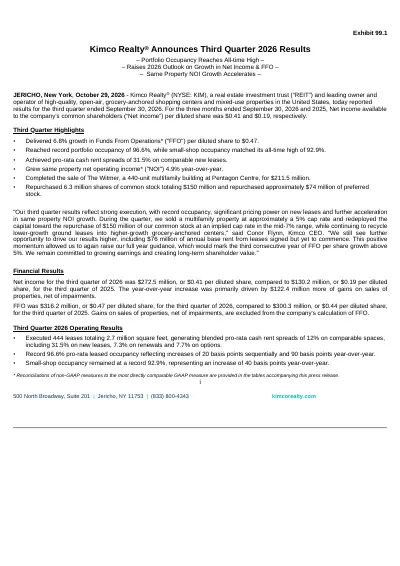
We delivered a strong third quarter and are raising our full year FFO and same-property NOI outlook. FFO per share grew 6.8%, keeping us on track for a third consecutive year of FFO per share growth above 5%.
At the start of the year, we said the first quarter would be the low point for same-property NOI growth and that it would accelerate from there. That is exactly what we delivered: 1.7% in the first quarter, 3.5% in the second, and 4.9% in the third.
We are also seeing early benefits from One Kimco, our unified operating platform, in faster rent commencements and greater cost efficiency. Traffic at our centers remains strong, despite higher rates and pressure on consumer sentiment, up nearly 3% year-over-year.
Consumers continue to prioritize convenience and value, and our centers, anchored by grocery and everyday essentials, sit on their daily path of travel. New supply remains extremely limited, and higher construction and financing costs make new development even less likely.
That has pushed portfolio occupancy to an all-time high, with small shop occupancy at its record. We still have runway as newly signed anchors open and drive traffic to the shops around them.
Retailers' own data shows how much their stores matter to their online business. Stores serve as last-mile fulfillment hubs, and ICSC research found that when a retailer closes a store, its online sales in that trade area fall by more than 11% on average.
That is why retention remains near record levels, and retailers keep reinvesting in their fleets, which supports continued rent growth. That demand drives our operating results.
How we allocate capital is what compounds that, and it works like a flywheel. It starts with our currency: flat-growth assets like ground leases and single-tenant properties, multifamily assets that we've built on our own parking lots, and the free cash flow that our portfolio generates.
Private buyers pay full value for those flat and multifamily assets, with our dispositions this year averaging a cap rate of approximately 5%. With approximately 14,000 multifamily units either built, active, or entitled, this provides a source of additional currency over time.
We put it to work where it earns the most: acquiring grocery-anchored centers with higher yield and stronger growth, redeveloping our own centers at low-double-digit returns, including roughly 28 grocery boxes, and making structured investments that set up future acquisitions. When our stock is the better value, we buy it back.
The higher-growth investments generate more free cash flow, and the cycle repeats, raising our grocery concentration each time. We believe our valuation does not reflect the quality and growth of the business.
Private market pricing for open-air grocery-anchored centers sits in the 5% to 6% range, consistent with where we bought and sold this year, while our share price implies a cap rate in the mid-to-high 7% range. We believe this disconnect creates a compelling opportunity.
Rates may drive the headlines, but over time fundamentals drive value. We are not done.
As we look to 2027, a meaningful part of our growth is already signed. We have one of the largest signed-but-not-open pipelines in the sector, and among the lowest debt maturities next year relative to our peer group, keeping our refinancing exposure minimal.
Glenn will walk through those building blocks. That is why we believe Kimco offers consistent growth and a growing dividend at a discounted valuation.
With that, I'll turn it over to Dave.
Dave Jamieson
Thanks, Conor, and good morning. Demand across our portfolio remains broad and deep.
Leased occupancy reached an all-time high of 96.6%, while small shop occupancy remained at its record 92.9%. Anchor occupancy increased 40 basis points sequentially to 98.2%, within 70 basis points of our all-time high.
Just as important, volume and pricing are moving together. We signed 444 leases totaling 2.7 million square feet at a blended cash spread of 12% on comparable spaces.
New lease spreads were 31.5%, with anchors at 39.9% and non-anchors at 21%, highlighting the meaningful mark-to-market opportunity that remains in our small shop portfolio. That marks our 20th consecutive quarter of double-digit new lease spreads.
Renewals and options were 7.3% and 7.7%, respectively. A meaningful amount of our future growth is already signed.
Economic occupancy increased 30 basis points to 92.7%, narrowing the spread with leased occupancy to 390 basis points. That spread represents over 400 signed leases and approximately $76 million of annual base rent that is yet to commence.
Our focus now is converting that signed pipeline into paying rent as quickly as possible. That is where One Kimco comes in, helping us convert leasing demand into earnings more quickly.
We are seeing meaningful improvements on what we can control. Once a lease is signed, the next step is getting that tenant to rent commence.
By pulling forward rent commencement dates, we now expect $34 million of rent from 2026 commencements, nearly 20% above our original expectations. That is a tangible example of how One Kimco is helping us convert leasing demand into earnings more quickly.
We're also using the scale of the platform to drive operating leverage. Recoveries on retail CAM and insurance have improved 300 basis points since 2024, and we continue to drive G&A efficiency as the platform grows.
We're also deploying AI across the platform to find additional efficiencies. That work is still early, but together these efforts show how One Kimco translates our scale into better operating performance.
The opportunity is straightforward: strong retailer demand, significant signed rent waiting to commence, and a platform turning that demand into revenue faster and more efficiently. With that, I'll turn it over to Ross.
Ross Cooper
Thank you, Dave, and good morning. The third quarter advanced the capital recycling strategy Conor described: monetizing lower-growth assets at attractive valuations and reinvesting where we can earn both higher yields and stronger growth.
Recent market volatility has affected commercial real estate sectors unevenly, but high-quality open-air retail continues to hold up well. Pricing remains competitive, transactions are closing, and there is still significantly more capital looking to invest in the sector than product available.
That depth of private demand reinforces the valuation disconnect Conor described, and it makes sourcing a real differentiator. Our joint venture platform and structured investment program let us find opportunities before they reach a crowded bidding process.
If rates remain elevated, we could see more dislocation, and we are positioned to act where risk-adjusted returns are attractive, whether through core acquisitions from sellers who value certainty of execution, or structured investments for owners of high-quality centers who need flexible capital. We see that as a growing source of opportunity as we move into 2027.
During the quarter, we sold the Whitmer for $211.5 million at an approximately 5.1% cap rate. Together with the Milton last quarter at a 4.9% cap rate, it shows the value we create by developing multifamily on land we already own and monetizing it.
We also completed the previously announced $127 million sale of four Costco-anchored assets with low contractual rent growth, and redeployed the proceeds through 1031 exchanges into Pompano Marketplace and Sunshine Plaza, two grocery-anchored centers in South Florida. Pompano was the third acquisition sourced through our structured investment program.
During the quarter, the program received $115 million of repayments, including Pompano, partially offset by $39 million of new investments. That is the program working as intended.
We earn an attractive return while invested, and in some cases, end up owning the real estate. New investment activity is picking up again, with two investments closed after quarter end totaling approximately $49 million and an average yield of over 10%.
Year-to-date, we have sold $391 million of assets at a weighted average cap rate of 5.1% and acquired $118 million at 5.8%. We are raising our expected transaction volume to $400 million to $500 million, while remaining net neutral for the year.
That includes two grocery-anchored acquisitions in a top 50 U.S. metro market that we expect to close in the coming days.
These are high-quality centers with strong grocery anchors and meaningful growth potential, and they are the kind of real estate our operating platform is built to improve. We look forward to sharing more detail once they close.
Our outlook assumes acquisition cap rates of approximately 6%, compared with disposition cap rates in the low 5% range. The bigger difference is growth.
The centers we are buying should grow approximately 250 to 300 basis points faster annually than the assets we are selling. Put simply, we are trading flat income for growth, and picking up yield along the way.
With that, I'll turn it over to Glenn.
Glenn Cohen
Thanks, Ross, and good morning. FFO was 47 cents per diluted share, up 6.8% from the third quarter of last year, with growth driven primarily by the operations of the business.
Pro-rata NOI increased $12.6 million, led by $10.5 million of higher consolidated minimum rent, supplemented by higher interest income and management fee income, and lower preferred dividends. These benefits more than offset higher interest expense and lower financing income.
In addition, credit loss for the quarter was 45 basis points, and for the nine months was 51 basis points. Same-property NOI growth of 4.9% was led by 3.2% higher minimum rents and 1.3% stronger net recoveries, with an additional benefit from lower credit loss.
Year-to-date, same-property NOI is up 3.3%. One financial result I want to highlight is margin.
Our consolidated NOI margin surpassed 70% this quarter, the first time since we reclassified certain G&A costs to operating expenses almost a decade ago. Three factors drove the improvement: higher recoveries from our fixed CAM program, higher economic occupancy, and better collections.
We are seeing positive operating leverage below the property level as well, with G&A as a percentage of revenue improving to 5.2% so far this year from 5.4% for the full year 2025 and 7.2% in 2019. Revenue acceleration, margin expansion, and G&A efficiency are areas where One Kimco is translating directly into our financial results.
Turning to the balance sheet, we ended the quarter with consolidated net debt to EBITDA of 5 times and 5.3 times on a look-through basis, both at the best level since we began reporting these metrics. Combined with more than $2.5 billion of liquidity, that gives us significant capacity to fund future growth.
Following the repayment of our $500 million 2.8% notes in October, we have no notable remaining debt maturities this year. Looking to 2027, our maturities are modest at just $466 million, with a weighted average coupon of 4%, which limits the impact from the higher interest rate environment today.
Our credit ratings remain A- at S&P and Fitch, and A3 at Moody's, with a stable outlook from each. During the quarter, we repurchased $150 million of common shares at a weighted average price of $23.80, representing an FFO yield of roughly 8%.
We also repurchased approximately $74 million of preferred stock. Both were accretive uses of capital.
We expect to generate $175 million of free cash flow after dividends and leasing and maintenance capital this year, providing substantial capacity to reinvest for future growth. Now to our outlook.
We are raising our full year FFO guidance range to a new range of $1.84 to $1.86 per diluted share, and our same-property NOI growth to a range of 3.5% to 3.8%. We are also improving our credit loss assumption to between 50 to 60 basis points.
This higher outlook reflects continued strength in rent commencements, retention levels, and recovery rates, along with disciplined cost management. As we look ahead, several building blocks are already in place.
Approximately $64 million, or roughly 85% of our $76 million signed-not-open pipeline, is scheduled to commence from the fourth quarter through 2027. In addition, our debt maturities remain modest, and the capital we have recycled this year is being redeployed into higher-growth centers.
We will provide our full 2027 outlook with our fourth quarter results. In summary, we delivered operationally driven earnings growth, expanded margins, and maintained a strong balance sheet.
Combined with the embedded growth already in place, that positions us well heading into 2027. With that, we're ready to take your questions.
Operator
We will now begin the question-and-answer session. Please limit yourself to one question.
If you'd like to ask a follow-up question, please rejoin the queue. If you would like to ask a question, please press star one to raise your hand.
To withdraw that question, press star one again. We ask that you pick up your handset when asking a question to allow for optimum sound quality.
If you're muted locally, please remember to unmute your device. Please stand by while we compile the Q&A roster.
Your first question comes from the line of Michael Goldsmith with UBS. Your line is open.
Please go ahead.
Michael Goldsmith
Good morning. Thanks a lot for taking my question.
You've been very active on the capital recycling piece, and as you sit here today, acquisitions trail your dispositions through the third quarter, and you expect transaction volume to be net neutral on the year. Then I think also structured investment redemptions are outpacing deployment, that's expected to be up materially on the year.
Just I guess the question is, what visibility into both acquisitions and structured investments do you have in the fourth quarter? Just given the macro backdrop, any timing risk associated with that?
Thank you.
Ross Cooper
Sure, yeah, thanks, Michael. We're really excited about the capital recycling that we've been able to execute on, as evidenced by the results.
We were really front-loaded on the dispositions, which we think was really strong for us, particularly as the window was very much open for dispositions at very aggressive pricing, particularly for those single-tenant ground leases that are lower growth and some of the multifamily that we sold at very aggressive cap rates. Feel really good about the execution there.
We do have very good insight into the fourth quarter. As I mentioned in the prepared remarks, we have two grocery-anchored assets that we're really excited about that are going to be closing very soon in the coming days.
Those two transactions alone will bring us back to that plus or minus net neutrality that we talked about for the year. That will sort of close off the pipeline and the transactions on the acquisition side more or less for the year.
On the structured side, as we indicated, we did close a couple of deals or fund a couple of deals already here in the fourth quarter that brings us back to a little bit in the positive on the overall volume for the year. We have a couple of things that are in the pipeline right now.
Timing is always a little bit in flux, one or two of those deals could float over to Q1 next year. I think the important part is that we're seeing a lot of activity in that program, even within the last 30 or 45 days.
What we've seen over the last few years since this program commenced five or six years ago is that in times of increased volatility or uncertainty, that's where we see this program being a real differentiator. We're excited about this program.
We really think that there's going to be increased activity, particularly if the rate environment volatility remains elevated for a period of time. As you've seen and what we indicated in the third quarter that we did acquire our third asset from this program in Q3, and so we anticipate that there will be additional opportunities from within that program to fuel our acquisitions pipeline as we enter 2027.
All in all, the program is really working as intended.
Operator
Your next question comes from the line of Alexander Goldfarb with Piper Sandler. Your line is open.
Please go ahead.
Alexander Goldfarb
Hey, morning out there. Maybe just following up on that line.
We all appreciate the robust demand for hard assets for shopping centers that continues. On the debt and preferred equity, are you seeing a similar ramp-up in some of these private platforms that are competing more for the debt and preferred equity side of the business, or is most of the institutional capital that we hear about really just targeting direct ownership?
I'm just trying to understand, because obviously 10% plus yields on your DPE is pretty attractive, just trying to understand if we should expect that to compress.
Ross Cooper
Thanks, Alex. We've always had competition within the program, but I think that we have a differentiation in that there are very few real operators that are competing with this capital.
It's been interesting to watch the evolution over the last five or six years of this program and what the competition set looks like. I would say earlier in the program, it was more in the debt funds and more the traditional lending sources.
That's sort of transitioned over to competing a bit with more LP capital for joint venture equity capital for our program. At the end of the day, I think we provide a few things that others don't.
One, having us in the capital stack, we've seen has definitely impacted to the positive our borrowers' ability and execution on the senior financing. That's one one differentiator.
The other is while it's a passive program, we do lend a hand and assistance as it relates to tenant relationships. To the extent that our borrower need to utilize our team and our platform to help with a renewal or something related to existing tenants, that's something that we can provide that others don't.
When you factor in all of those differentiators, we've seen that our program has been very much in need and well received by borrowers. You can see that by the groups that we've worked with that have come back for the second, the third, the fourth deal.
We feel really good about where we sit in this program, what we offer in the differentiation. There's always going to be a unique and bespoke aspect to each and every one of these deals and these investments, but we see a pipeline that will continue to build.
Conor Flynn
The only other piece that I think differentiates our program is the ROFO and the ROFR that we get on every single investment. The debt funds really do not value that, and I think that is where the Kimco shareholder really gets the benefit of this program, because in essence, all of these assets would be great assets to own for the Kimco portfolio.
I think that piece of it is a big differentiator for us as we like to say we get paid to wait, and we continue to harvest that opportunity set in the future as well.
Ross Cooper
If I could just also add back on top of that, I think the other factor that is really important is we've seen the quality of the assets in this program continue to improve. Just this quarter, we funded a Trader Joe's-anchored asset in California, a Whole Foods-anchored asset.
We really do see tremendous value in these right of first offers and right of first refusals, evidenced by the three that we've acquired and hopefully some others that will look to acquire in '27 and beyond.
Operator
Your next question comes from the line of Rich Hightower with Barclays. Your line is open.
Please go ahead.
Rich Hightower
Good morning, guys. Thanks for taking the question here.
Just on the changes to the full year guidance here, obviously you had sort of some one-timer effects. I noticed a pretty sizable uptick in what you call non-cash GAAP revenue of about $8 million driving part of that.
Just help us understand maybe the movements in sort of the core and non-core that are driving the FFO increase, please.
Glenn Cohen
I'll start, and then I'll pass it to Kathleen, but from the core part, it's really coming from faster rent commencements that we have, it's coming from the improvements in credit loss, it's coming from the maintaining and discipline around costs, the G&A costs that we're focused on. All those components are definitely helping.
Obviously, doing our convert when we did it again helped on the interest expense side also. Then maybe talk about the non-GAAP.
Kathleen Thayer
Rich, on the non-cash GAAP revenues, it's really driven from straight-line, and there's two pieces to the straight-line. One is just the leasing volume that we're experiencing and how quickly we're able to tender those spaces to the tenants, and then as well as the bumps that are included in those leases.
Then the second part, just like we're seeing the positive results in credit loss, that flows over to straight-line as well from a reserve perspective. We're just not seeing any significant reserves that we're needing to take in that area, which is helping increase that income that you're seeing come through.
Rich Hightower
All right. Thank you.
Operator
Your next question comes from the line of Ronald Kamdem with Morgan Stanley. Your line is open.
Please go ahead.
Ronald Kamdem
Hey, just a quick one on shop occupancy. I know we're at record right now, and if you could just remind us what you think more upside is on that piece of it, and how are you sort of getting more pricing power at these levels through the lease contract, whether it's escalators or co-tenancies or options?
Just would like to hear how those are trending at these levels. Thanks.
Dave Jamieson
Thanks for the question. It's a good one.
Just on occupancy in general, first starting with the small shop side, as we're holding at a record high right now. When you look at our pipeline and the activity and the investments that we're making, that's where we're encouraged and we see further upside.
Having over 28 grocery boxes under construction, redeveloping and repositioning those assets, building better mousetraps only drives value to the adjacent space, which also then converts to that halo effect that we talk a lot about that drives a premium in terms of the rents, right? Higher traffic volume centers drives more interest from small shop retailers, drives more sales, converts to higher rent for us.
We see room to run there. On the anchor side, as I mentioned earlier in the prepared remarks, we're still below our all-time high there.
We have another 70, 80 basis points to gain before we achieve that. We do see room to run, and considering the tailwinds of no supply here and outpaced demand, there's that opportunity to push it further.
As it relates to the contract rents and the negotiated terms, we continue to see improvement. It's really a partnership between both the retailer and the landlord.
They really sort of respect and regard the relationship that they have in the center with us and what we're doing. On the economic side, our big push is on growth, and so we've seen annual escalators not only flow through on the small shop side, but just this quarter alone, we saw 30%, over 30% of our anchor new lease deals actually have annual escalators in it.
This is an initiative we've been pushing for a long time, but we're starting to see that conversion play out. Again, it's all the investments that we've been making at the property level and with the team to drive that.
Operator
Your next question comes from the line of Michael Griffin with Evercore ISI. Your line is open.
Please go ahead.
Michael Griffin
Great, thanks. Appreciate the commentary so far.
Maybe just circling back on the guidance point. I appreciated, Glenn, your comments on some of the line items there, but can you give us a sense of what the offsets are to get to the $0.015 increase?
It looks like same-property NOI is better, bad debt assumptions come down, you're getting the benefit from the accretion from the share repurchases, as well as the higher non-cash revenues. Just what would be the offsets on those?
Is it timing around capital deployment, are there other factors? Then lastly, can you comment were the share repurchases initially contemplated in your guidance, or were they just additive to as the year progressed?
Thank you.
Glenn Cohen
I'll start with your last piece. They were additive.
Again, we look at capital allocation, look at our sources and uses on a constant basis, and with being able to deploy capital from very low cap rate sales that we made on the residential properties, and part of that not being able to be 1031 exchanged, redeploying that capital when the price is, in our view, trading at a pretty decent discount, earning an FFO yield of over 8%, or around 8%, when we're selling stuff at 5.1%, with the balance sheet capacity we have, really made a lot of sense. That was additive to it.
If you look at where we were at the end of the third quarter, our range was $1.83, $1.84. We've bumped the guidance now where the low end of the range was the upper end, with the other $0.02.
We're a penny higher than what we had in our forecast for the third quarter, so that kind of gets you there. Based on the activity we're seeing, the improvement in our expectations for where same-site will end for the full year, our expectations for further improvement in credit loss for the full year, and the speed at which we're seeing lease-up and the pipeline coming online, there's a good chance we could get to the upper end of the range, but we remain very comfortable with the mid-to-upper end of the range in the guidance.
Operator
Your next question comes from the line of Haendel St. Juste with Mizuho.
Your line is open. Please go ahead.
Ravi Vaidya
Hi, good morning. This is Ravi Vaidya on the line for Haendel.
Hope you guys are doing well. I wanted to ask about the acquisitions that are expected to close here in the next couple days.
When did the process start for this, and was the anticipated cap rate for these deals? Maybe going forward, does it make sense to maybe wait or pause on acquisitions as cap rates are likely to move upward from here given the higher interest rate backdrop?
Thanks.
Ross Cooper
Sure, thanks. We have been working on these deals for several months now, but we're very confident in the pricing that we were able to negotiate and the yields that we're going to achieve.
I think most importantly, and I know everybody likes to look at the going-in yield, the growth that we believe that our team can generate from these two assets is significant, as we indicated, a good 300 basis points higher than what we've sold to fund it. Keep in mind that the funding sources were already closed between the Costcos, the multifamily, and some of the other dispositions.
We feel really good about that spread, we feel really good about that growth. Then as we think about the assets themselves, we will provide a little bit more detail in the coming days once we close, and we'll put out some information that we can talk through.
We're extremely excited about that. We think that the demand for product will continue to be strong for assets that are high quality, grocery-anchored, that have growth like this, even as there's some noise in the volatility in the rate environment.
In terms of the yield themselves, as I mentioned, we'll provide more information. However, if you look at where we increase the guidance on the yield levels going from what was a 5.8% to a low 6%, you can sort of back into where the yields are in these two acquisitions, because as I mentioned, these two will be pretty much the bulk or the lion's share of all the fourth quarter transaction activity for us.
That will bring us back to that neutral level and the volumes that we indicated in the guidance, and so you can kind of see directionally where that is.
Operator
Your next question comes from the line of Jamie Feldman with Wells Fargo. Your line is open.
Please go ahead.
Jamie Feldman
Great. Thanks for taking the question.
You tightened your credit loss guidance range. What gave you confidence to do that, and maybe just a bigger-picture question as we think about next year?
Definitely some signposts out there of greater concerns about the consumer or just retailers in certain segments of the retail market. Sounds like you're very confident, and an exciting time to be expanding the investment pipeline.
Just as you think over the next 12 to 18 months, especially as you complete all these investments, what is your base case of the consumer and the economy? Are you having any kind of trepidations or any kind of concerns about where the economy and consumer might be going?
Conor Flynn
Sure, I'm happy to start. Look, coming into the holiday season, it seems like most of the numbers that are projected for the holiday spend range from anywhere from 4% upwards to 9% plus.
It looks like the consumer is ready to spend, as we know, the consumer in the U.S. is very resilient, and they are definitely going to look to take advantage of maybe the holiday season here.
That type of anticipation gives us confidence that this road that we're on continues to be resilient. We clearly see the traffic being a leading indicator for the consumer continuing to gravitate towards Kimco shopping centers.
That being said, we recognize all the macro issues that are up there that you talked about that we see daily. We're evaluating next year already, we're rolling up our budgets, we're trying to get to a point where we feel confident in showcasing that the trajectory that Kimco has been on.
We've been the only shopping center REIT to produce 5% plus growth the last few years, and want to continue on that track record of being really that steady Eddie that can produce regardless of the cycle, to produce growth. The shopper, when you think about the needs, the essential goods and services that we provide, we feel like even if there is a bit of a pullback or a stress point, the consumer will still be buying groceries.
The consumer will still be going to the essential goods and services that we provide. We feel like with the pipeline, the SNO pipeline, the future growth that is just coming online, we continue to have a pretty wide buffer in terms of trajectory going forward.
Kathleen Thayer
I would just layer on the credit loss aspect of your question. We've been consistently below that 60 basis points, and we're definitely seeing the quality of the tenants through that number, as well as the significant effort we've made on the billing and collection efforts with our lease administration reorg that we did about a year ago.
All of those are leading towards that lower credit loss that we're seeing positive results.
Ross Cooper
The only thing I would add is, I made a comment to our team as we were sitting here that when I look at our tenant watchlist, it is the smallest watchlist I've ever seen in the period we've been doing this stuff. Things happen in retail, but right now when you look at it, you've seen bankruptcies have been incredibly slow for this year.
The retailers themselves have fortified their own balance sheets. We just don't see a lot of bankruptcy activity coming.
With all the things that the others have mentioned, it just gives us a lot of confidence about how the tenants are paying and how we're collecting.
Operator
Your next question comes from the line of Juan Sanabria with BMO Capital Markets. Your line is open.
Please go ahead.
Juan Sanabria
Hi, good morning, and thanks for the time. Just a macro question following up on Jamie's and the prior question.
Just given the supply-demand dynamic and the fact that it's probably harder for new supply to pencil, just curious how market rents are trending. Is that accelerating, or is it moderating in any form just given some of the aforementioned strains on the consumer?
Just curious on how market rents are trending. Thanks.
Conor Flynn
It's a good question. I think market rents are very much a local game.
When you look at sort of the Kimco strategy of first-ring suburbs, major metro markets, we continue to see that there's virtually no supply coming online. When you think about where there is potential for new supply or a handful of new developments, it's in those second- or third-ring areas that really don't compete with the Kimco portfolio, where you've seen sprawl and where you've seen new household formations occur.
We continue to monitor market by market and continue to see where there's accelerating market rent growth. Actually, where our two acquisitions are coming online in the next few days, there's significant market rent growth in that trade area that we really like.
That's one of the leading indicators that we continue to watch and see.
Dave Jamieson
Then when you look at our mark-to-market adjustments, like on the new lease, that's where you see the big upside, right? We're hitting 20, 30, 40% on the new lease spreads right now, and that's where you're seeing a meaningful gain.
As we get those boxes back, we can clearly see that more meaningful material lift than just sort of the annual mark-to-market adjustment on the top side of rents. When we look ahead in the '27, we have 56 anchor boxes that are rolling with no options.
We're already seeing mark-to-market spreads upwards 40% on those that are resolved. We're seeing a lot of opportunity there to continue to push northward, which will only help further fuel our future growth.
Conor Flynn
The other piece of upside to market rent growth is our omnichannel retailers that utilize their stores. Even some of the conversations that we've been having with some of our retailers are thinking long and hard about where to place their stores as distribution points to enhance the offering to their consumer.
We continue to think that that halo will allow us to push occupancy costs, to push rents even higher.
Operator
Your next question comes from the line of Greg McGinniss with Scotiabank. Your line is open.
Please go ahead.
Greg McGinniss
Hey, good morning. Looking ahead, transactions in 2027 maybe, can you just remind us what remains from a disposition funding perspective from multifamily, ground lease, lower-growth centers?
Given the continued competitive pricing you talked about, more capital looking to invest and product available, do you actually expect cap rates to move much over the next few quarters? Have there been any early indications of that shift?
Alternatively, might share buybacks just become a bigger focus given Kimco's implied cap rate above where similar quality properties are currently priced?
Ross Cooper
Sure. We're happy to give some color, but we'll be coming out with more specific volume guidance obviously on the next call.
Our plan of capital recycling was not just a 2026 plan; it was a 2027 and beyond plan. We believe that we have enough product within our portfolio that we can continue to recycle accretively.
We're still upwards of 8% plus of our ABR in these long-term ground leases, and we've continued to replenish that as we've done new leases with some of these retailers. There was some low-hanging fruit that we took advantage of this year, and we're able to capitalize on some very aggressive cap rates.
I think the important factor, even if cap rates do move a bit on the single-tenant product, because that is arguably more interest-rate sensitive than multi-tenant shopping centers with growth, that we can still maintain that spread and that growth profile on the reinvestment. Now, whether that comes in the form of new core acquisitions, to your point, we'll continue to monitor where we're trading and where the market is trading.
We see a meaningful valuation gap still, which is what sort of enabled us or prompted us to buy back over $150 million of stock in the third quarter. We'll continue to focus on capital allocation and reinvestment.
On the multifamily side, even with the sale of the Milton and the Whitmer, we still have upwards of 14,000 units either built, under construction, or where we're entitled that has value if we decide that we want to sell it before the development occurs. We will continue to monitor our existing multifamily program.
We have over 3,000 projects that are already open and operating today that at the appropriate time and the appropriate pricing, we could look to monetize and crystallize that value. I think the beauty of it is that the timing and the control is within our own control.
It is intended to be utilized as currency and opportunistic, and when we see those windows where we can get more aggressive pricing and reinvest, that's when we'll capitalize it like we did on the Whitmer and the Milton. It's at our election, and we have the flexibility to time that accordingly.
Conor Flynn
The only thing I'd add on the buyback is, clearly the balance sheet is in the best shape it's ever been. When you look at our leverage levels, that gives us tremendous capacity to continue to, when we see an opportunistic time to buy back our shares, we're going to be able to do it because of the leverage levels we're at.
That's a lever that we continue to see as an opportunistic one, where if we can sell assets, and showcase that spread that we can crystallize, that's a no-brainer in terms of capital allocation for us, and we'll continue to do that.
Operator
Your next question comes from the line of Floris Van Dijkum with Ladenburg Thalmann. Your line is open.
Please go ahead.
Floris van Dijkum
Hey, guys. Love the updates on the capital recycling.
One of my other topics which caught my attention is the improvement of margins. Maybe if you could remind us where you are today in your fixed CAM initiative, what percentage of rents have fixed CAM in them today?
Presumably, all of your new leases have fixed CAM provisions included in them. How quickly do you see that growing going forward?
Then the other part of that question is your ancillary income. Maybe touch upon what you're doing in terms of your billboard charging, your tent tenancy, and other revenue sources, and how much more can that grow, in your opinion?
Glenn Cohen
I'll start, and then I'll pass it to Dave for some of it. The margins exceeding 70%, again, it's driven partially by the things you're seeing us do, right?
Credit loss is better, that helps. Occupancy is higher, that helps.
The leasing and the economic leasing is higher. Those are all building into that NOI number.
Cost containment at the property level is a driver. We're constantly looking at ways to reduce our real estate taxes, searchwear work that we're doing just to drive those costs down, to kind of minimize the leakage that happens.
When you put all of that together, it's just driving the margin higher from where it was.
Dave Jamieson
Then on the fixed CAM conversions, I'll throw out a few stats. Starting first with the entire portfolio, we're just over 50%, around 51%.
It's important to note, though, obviously the conversion is driven by, one, when leases come due. If leases aren't coming due, it's a little more challenging to convert.
Two, lease new signings relative to the total population, so as leases sign, you convert them. Then three, when you own properties.
We tend to like to hold and operate a property for a couple years to build some operating history behind us before we look at a conversion that we feel is a reasonable number that we then sign new leases with and renewals with. Then from that 51%, if you just look at the Kimco legacy, those that we've really owned and operated for an extended period of time, we're over 70%, almost 70% converted on fixed CAM.
Then when you look at new lease conversions, we're just around 90, 90 plus percent for new deals. It's in more or less all the new deals that you do, and then on the renewal side too, we see the opportunity obviously convert over to fixed CAM.
From the outset, it was always a program to drive efficiency and gains on both sides of the house, of which I think it's more than achieved that, and then also helps on the collection side and flows through the margin and the numbers.
Operator
Your next question comes from the line of Samir Khanal with Bank of America. Your line is open.
Please go ahead.
Samir Khanal
Good morning, everybody. I guess, Conor, just maybe broadly speaking, given the strength we see in leasing spreads, right, quarter after quarter, are you seeing evidence that the tenants are becoming more sort of selective on economics, given that they are certainly feeling the cost pressures, right?
You hear that on their earnings calls. Curious kind of what you're hearing on the ground from your retailers.
Conor Flynn
Obviously, every deal is a little bit unique and bespoke, but it's very clear that the store is becoming more profitable as retailers have evolved their strategy to utilizing the store for more than just the four-wall sales. I think that's what's really starting to showcase is they're being thoughtful about how they service their customer in more ways than one.
They're reinvesting in their store fleets, they're continuing to look to see how they can better serve their customer. In a lot of ways, the expansion of stores is the key for them.
They have already built the e-commerce platform, and how they go about distributing it in a more effective and cost-efficient way is really the key, and that's the store base. You're seeing it continue to show up when the economics, as Dave talked about, we've been trying to push economics for a long time at Kimco, and in many years, the retailer has had the upper hand.
That is no longer the case. It is very clear it's a very tight supply, we have multiple tenants bidding on the same space, and we can dictate terms and dictate things that we haven't been able to achieve before, which is great, because you can pick and choose who you want to remerchandise the center with, all while getting better economics and better growth for the future.
Operator
Your next question comes from the line of Omotayo Okusanya with Deutsche Bank. Your line is open.
Please go ahead.
Omotayo Okusanya
Hi, yes, good morning. Again, congrats on the quarter and really solid execution on that front.
Wondering if you could talk a little bit about the sources and uses of capital as we round out the rest of the year, and specifically, again, you have about $545 million in cash, but you did pay down the notes of $500 million, you have this acquisition pipeline that's coming up that you're going to be closing on in a couple of days. Just want to kind of make sure we're kind of clear on sources and uses as we kind of think about the rest of the year.
Glenn Cohen
Again, you kind of hit on most of the points. We did have $545 million of cash to end the quarter.
We did have a $500 million bond that we just paid off, obviously that cash was used to take care of that debt. There's one small piece of debt that remains, it's about $7 million, it's an old MTN from when we acquired Weingarten, but it's got a 6.5% interest rate handle on, we'll use it for that.
As Ross mentioned, we have two sizable acquisitions that we're very close to completing. Then with that, we still have some structured investment program potential investments to make as well.
That's where the capital's focused right now. Then we'll see, again, as we talked about, we have a lot of capacity on our debt metric side.
We'll see where the stock price is, what we're going to continue to watch and try and be really good capital allocators and take advantage of whichever market's presented to us.
Conor Flynn
We have nothing outstanding on our line of credit.
Glenn Cohen
No.
Conor Flynn
We have the commercial paper program that we just implemented that we have a lot of capacity on. When you think about the sources, there's a lot of capacity on the balance sheet side, because we've never been at 5 times net debt to EBITDA before, exciting times.
Operator
Your next question comes from the line of Caitlin Burrows with Goldman Sachs. Your line is open.
Please go ahead.
Caitlin Burrows
Hi, good morning, everyone. I have two questions on guidance, one more specific, one more bigger picture.
Just the quick one, I'm wondering what drove the uptick in lease termination fees. Then separately, you mentioned in the prepared remarks that I think you're realizing $34 million of commencements this year, which is 20% above your original expectation.
I was wondering, as you think about the confidence you have if you think you'll modify your guidance methodology going forward at all, and has your ability to open space more quickly gotten so good that you're more comfortable changing that base case assumption, or not so much? Thanks.
Dave Jamieson
On the lease terminations side, it was just normal course of business stuff. It just happened to hit this quarter versus when it could have hit at a subsequent quarter.
Nothing really major there to look through. On the SNO pipeline, it's a great question.
When you drill into the detail, it's a lot of singles and doubles that help achieve this 20% overage. If you're accelerating over several hundred projects, if you're pulling forward projects one week, two weeks, maybe 30 days here and there, while some might slide, net net, the gain is obviously material once you sum it all up.
It's a direct impact to One Kimco and a direct impact to the effort of the development and the construction team and how well they are aligned, both internally and with our retail partners. When we sign a lease, and we sign package leases with retailers, our head of development then meets with their head of construction, and they get aligned on what the scope and body of work that's required to open the space in multiple spaces across the country.
Although the local teams are executing every single day to get this done, they're there to help triage and get ahead of any issues that may arise that help pull forward these RCD dates. It is painstaking work, it's a real grind, but our relationships due to our scale has really benefited our team and ultimately the retailers' objectives to get through the permitting process, work through utilities and municipalities and rezoning and entitlements.
It is a ton of blocking and tackling. It's One Kimco at its core, and that's what's resulted in the outperformance here.
On a go-forward with '27, we scrutinize all of our budgets and all of our plans. We've been going through that process, obviously, and we'll release guidance, but we've always incorporated this activity into it.
Operator
Your next question comes from the line of Craig Mailman with Citi. Your line is open.
Please go ahead.
Craig Mailman
Hey, good morning. Just want to follow up on One Kimco.
I know you guys have mentioned it a bunch this morning, and it's a big initiative for you. I'm just kind of curious where we are in the lifecycle of this initiative in terms of kind of seeing the fruits of the labor, and also where you are in sort of the expense associated with this.
Just as you look forward, how much of it is the G&A savings, and some of these other efficiencies of getting spaces open on time versus maybe some of the AI investments and other initiatives kind of driving pure revenue?
Dave Jamieson
It's a great and loaded question. I'll break it down in simplest forms, and then I'll pass it over to Will to fill in some of the detail.
We hosted an event obviously earlier or later this summer launching One Kimco that we launched in July. I like to say we're in the third inning, because we've posted some early wins to the board, but there's a lot of work ahead of us, and we're seeing a lot of real promise and opportunity as we continue to transform how we operate.
One Kimco is simply put, it's the alignment of the entire organization to execute more efficiently and cleaner. It impacts both our people, the process, and the platform that we've deployed, looking at each of the individual workflows of how do we modernize how we get the job done every single day, and how AI or other tools can be a complement to that, and breaking through those bottlenecks that have historically constrained some of the optimization that we're looking to do.
When we looked at the early innings from the cycle time, using that as a simple KPI on what we can control within the lease itself, those aspects that are within our control before it gets back to the tenant, we've seen a 30% improvement quarter-over-quarter. Obviously, that's 90 days of work, but it's a benchmark that we'll continue to try to meet and exceed on a go-forward basis.
We're setting ambitious targets for ourselves so that we continue to keep the eye on the ball and find a way forward. All of this translates to the bottom line.
Our core metrics, same-site NOI and FFO, are our key focus. Anything that we do to invest or modernize the workflow force and how we work, all translate ultimately to those two key financial metrics, and we're starting to see that play out.
I mentioned the SNO pipeline already; that's been a clear benefit. Obviously, Will mentioned earlier this year some of the direct AI savings that we've seen, and then I was just mentioning the KPI on the cycle time for what we can control.
We're seeing real tangible results already. With that, Will, do you have anything else you want to share?
Will Teichman
Sure. As Dave said, One Kimco is really an operating model.
It's not a capital investment program, and it's really focused on transforming the way we operate. As Glenn mentioned in his prepared remarks, we have had a significant improvement in our headline operating leverage metric, which is measured as the ratio of G&A to revenue, and has improved by over 28% over the last six years.
That really comes through two things: accelerating revenue at over 10%, while we're bending the G&A curve down between five and at a growth rate of between 5% and 6%. From a technology perspective, obviously that is one component where we're investing to deliver this transformation, it's not the only area.
For every investment that we make from a tech perspective, we're measuring it against the goal of continuing to bend that curve downward as we accelerate revenue. There are some initiatives that are pure-play revenue growth-focused, and there are others that are focused on lowering our overhead and creating more efficiencies from an expense perspective.
A lot of that capability has actually been funded through vendor consolidation, we're sort of harnessing efficiencies to help fund incremental investments in technology. As Dave alluded to, we've already, I think, been one of a few companies out in front sort of talking about some of the real value that we're generating from our AI investments.
Last quarter, we talked about some of the professional services savings that we're seeing. This quarter, we launched three additional initiatives, one of which is a natural language leasing search on our website that is driving improved lead inbound, qualified lead inbound to our leasing team.
We put some additional automations into production this quarter specifically to support the billing and collections effort that Glenn mentioned, and automation is now saving over 5,000 hours a year across our enterprise. Then finally, we've had a particular focus this quarter around building new agentic workflows for transaction underwriting and tenant financial screening, both of which have reduced our cycle times roughly in half.
Those are some of the things that we have going from a tech perspective, and we look forward to sharing more results as the program and One Kimco continues to mature.
Operator
Your next question comes from the line of Linda Tsai with Truist Securities. Your line is open.
Please go ahead.
Linda Tsai
Hi, good morning. Back on the topic of tenant package deals, Kimco completed 10 package deals comprising of 60 leases representing over 20% of new lease GLA.
How do those metrics compare in '26, and then on the '27 pipeline, any color in terms of the retailers where you're having discussions?
Dave Jamieson
It it's I think this quarter is an acceleration of the package program now that we've stood up our national accounts team under our national leasing platform. We can now package, multiple LOIs as one and then transfer it over to the national account team for execution.
This is very much a cornerstone of how we can accelerate the deal flow and build continuity and consistency with the messaging and the negotiation between ourselves and the retailer. Retailers have been very, very supportive of this because it just it it clears the lanes and and gets really down to the the fundamentals of what we want to focus on, which is opening the store and letting them operate their store.
will continue to see that as a trend going forward. I mentioned earlier in in Q&A about the '27 pipeline, just in terms of of philosophy right now, again, we have 56 anchor leases that have no options coming up.
We've right now, we're we're looking at, in the first half of of the year, of those that roll in the first half of the year, almost 75% of those are already resolved or in process of getting resolved at a at a meaningful mark-to-market adjustment. Trend lines are looking very good for for '27 in this environment, because, again, no supply.
These retailers need to continue to hit their their open-to-buy strategies and grab market share. As Conor mentioned, with the omnichannel evolution and how they're continuing to leverage that store to optimize their store their their sales growth, we're seeing that flow through in in terms of our discussions and demand.
Conor Flynn
I would just add, we do a lot of portfolio reviews with all of these major retailers, and being able to do these package deals is a true advantage of our scale. You can't do it if you only own 40 properties, but because of our size and where we're located, it is a true advantage of our scale and a true differentiator.
Dave Jamieson
Mike?
Operator
Sorry, your next question comes from Mike Mueller with J.P. Morgan.
Go ahead.
Mike Mueller
Hi. Sorry, I'm in transit here, bad reception.
For resi capital recycling, it sounds like you're going to obviously pursue some additional sales over time, but just curious, are you also looking at any new starts today, and or just outright entitled land sales as well?
Ross Cooper
Thanks, Mike. We are, and it continues to be an opportunistic program.
We broke ground on the Chester out in California, which we're really excited about. We're looking at another project that we're about to break ground in Connecticut.
We continue to evaluate on a one-off basis. I think we've talked about it in the past, but we look at our decision tree to determine at what point and in what structure makes the most sense to activate these projects.
With the amount of entitlements that we have, upwards of 10,000 entitled units that are not built or haven't broken ground, we can look at each and every one of these projects, determine the market in which it's located, where the projected rent levels are, the demand from a joint venture partner, multifamily developer, to build it alongside us, and ultimately make a determination: is this a project that we want to activate in the near term, do we want to do a long-term ground lease, does it make more sense to sell the entitlements and the dirt rather than build it ourselves? We're looking at each and every one of those projects, and then we figure it out and determine our strategy on a case-by-case basis.
Conor Flynn
It's a very active program, as Ross just laid out, and so we will have another project going active in this next quarter. We look at this whole program really as a form of currency, right?
If you go in our supplemental, you see near-term entitled mixed-use projects, it's 3,500 units, it's 13 projects themselves, and all of that is a form of currency that either we can, as Ross said, sell, ground lease, build to sell, stabilize and sell, and then recycle that into higher-yielding, higher-growth core shopping center assets, and that's our focus. With so many entitled units, and we're still looking to entitle more within our portfolio, we see this as a nice flywheel effect that's just starting to take hold, really in the last two years.
Operator
Your next question comes from the line of Paulina Rojas with Green Street. Your line is open.
Please go ahead.
Paulina Rojas
Good morning. It seems like that cap rates have been relatively sticky, particularly for high-growth assets.
Can you share more detail on the dynamics that you are observing? Are deals in general taking longer to close, or are centers being repriced more often?
More generally, where, if anywhere, are you seeing signs of pricing moving up, given the higher rate environment?
Ross Cooper
Thanks, Paulina. I think that the short and easy response to that is it depends.
We continue to see assets that are institutional quality, primarily grocery-anchored with growth, pricing as aggressively as we've seen, and really have not been impacted whatsoever by the volatility in rates. Now, keep in mind, as rates have risen somewhat dramatically, they've also dropped back down about 30 basis points in the last couple of weeks.
The volatility isn't only going in one direction. I think the important part is to determine what is the source of capital that you're utilizing to make this investment.
All-cash buyers are clearly going to be less sensitive to the rate movements than you have with a more levered buyer. The product and the quality is going to go into whether or not that discussion on pricing is occurring, or whether or not there's capitulation between the buyers and sellers.
I think there will be certain deals that fall out based upon volatility, but we're still seeing a tremendous amount of activity and a lot of deals getting over the finish line, notwithstanding the volatility in the marketplace. As we mentioned, anything that is more rate-sensitive, single-tenant assets in particular, are going to have movement based upon where the rate environment is, but growth assets and high-quality multi-tenant shopping centers continue to be one of the, if not the, most in-demand asset class, and we're seeing just more capital chasing these deals than there is supply, pricing is remaining very competitive.
Operator
Your next call comes from the line of Michael Gorman with US Bancorp. Your line is open.
Please go ahead.
Michael Gorman
Thanks, good morning. Maybe just one more on the investment side.
I'm just trying to kind of triangulate a little bit here. We're in one of the best retail operating environments probably ever, ton of institutional demand for the product, yet on the structured investment program, you're seeing increased quality and increased opportunities.
I'm just curious, what is driving these owners into the orbit of the structured investment program? Is it CapEx, is it development funding?
Kind of what brings them to the table, or brings them in as an opportunity for SIP in this kind of otherwise strong environment?
Ross Cooper
It's a good question, and I think, frankly, that's the beauty of the program. While we refer to it as our structured investment program, we really view it as a capital solutions program.
I think every deal is unique, they all have their own story, the structures that we negotiate are bespoke, there's really no two deals that are exactly alike. To your point, it's a combination of a variety of factors.
Often times, it's the fact that we can provide more flexible capital, whether it be the ability or the willingness to accept a payoff earlier than a traditional lender would and lock in a significant prepayment penalty, some of the differentiations that I think we talked about earlier, whether it be our tenant relationships and assistance there, certainly in an environment where there's volatility in the rate environment and the lending community, I think the fact that we in the capital stack can help the execution with the senior lender is very much a differentiator for us. Then I think just there are deals that are in transition, whether it be a repositioning, redevelopment opportunity, not only do we provide that capital, but I think as an operator that can underwrite those changes and understand what it means and get a good sense of comfort by speaking directly to the retailers that might be under construction or signing a lease but not yet open, all of those factors, I think, play into why a borrower would look to Kimco to participate in that asset or in that investment, because we just do understand this real estate and the process better than a traditional lender, better than a debt fund, or better than a passive investor would.
Operator
There are no further questions at this time. We have reached the end of the Q&A session.
I will now turn the call back to Dave Bujnicki for closing remarks.
Dave Bujnicki
We appreciate everybody that took the time to join our call today. If you do have any follow-up questions, please don't hesitate to reach out.
With that, we hope everyone enjoys the rest of their day. Thank you.
Operator
This concludes today's call. Thank you for attending.
You may now disconnect.