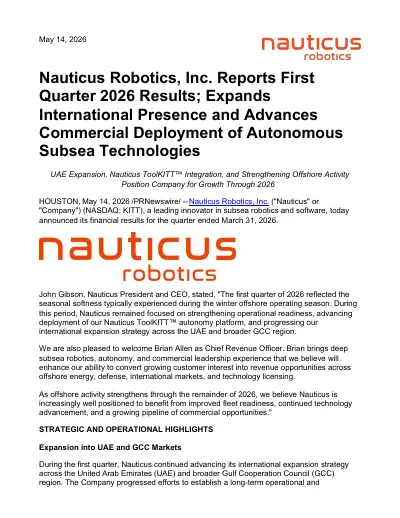
Nauticus Robotics, Inc.
NNASDAQ:KITTQ1 FY2026 · Earnings Call TranscriptMay 19, 2026
Operator
I will now hand the conference over to Kristin Moorman, Corporate Development Lead. Kristin, please go ahead.
Kristin Moorman
Thank you, and good morning, everyone. Joining me today and participating in the call are John Gibson, CEO and President; Jimena Begaries, Interim CFO; and other members of our leadership team.
On today's call, we will first provide prepared remarks concerning our financial and operations results. Following that, we will answer questions.
We have now released our results for the quarter ending March 31st, 2026, which are available on our website. In addition, today's call is being webcast, and a replay will be available on our website shortly following the conclusion of the call.
Please note that comments we make on today's call regarding projections or our expectations for future events are forward-looking statements. Forward-looking statements are subject to a number of risks and uncertainties, many of which are beyond our control.
These risks and uncertainties can cause actual results to differ materially from our current expectations. We advise listeners to review our earnings release and the risk factors discussed in our filings with the SEC.
Also, please refer to the reconciliations provided in our earnings press release, as we may discuss non-GAAP metrics on this call. I will now turn it over to John.
John Gibson
Good morning. Thank you, Kristin, and thank you to everyone for joining us on the call today.
The first quarter of 2026 was a seasonally softer quarter for offshore activity, and that's consistent with what the broader subsea and offshore services market experienced during the winter operating season. We saw similar commentary from larger industry participants, including Helix and Oceaneering, both of which pointed to winter seasonality, lower first-quarter utilization, and expectations for stronger activity in the second and third quarters of 2026.
For Nauticus, the important point is this: we used the quarter productively. While revenue was not where we wanted it to be, our team focused on the work that positions us for improved execution in the second half of the year as the operating season strengthens.
We advanced fleet readiness, completed significant annual maintenance and refurbishment activities across several of the ROV systems, and continued preparing our systems for higher utilization opportunities during the remainder of the year. We also continued advancing Nauticus ToolKITT, our proprietary autonomy software platform.
Nauticus ToolKITT is central to our strategy because it allows us to create value not only through services, but also through software licensing, technology-enabled services, and deployment on customer-owned vehicles. During the quarter, we continued integrating Nauticus ToolKITT across our subsea systems along with new high-definition camera systems and other advanced sensors designed to improve navigation efficiency, data quality, and customer value.
We also made progress with Aquanaut and our autonomous manipulation capabilities. Aquanaut vehicle 1 has now completed more than 500 hours of in-water testing on client-driven workflows and more than 200 successful vertical inspection behaviors on mooring lines.
These are important steps towards offshore deployment, and the data from that testing continues to guide our software and engineering improvements. International expansion also remains another important part of our growth strategy.
During the quarter, we continued advancing our UAE and broader GCC initiative, including work toward a long-term operational and commercial presence in Ras Al Khaimah. That region represents a meaningful opportunity for Nauticus across offshore energy, technology licensing, manufacturing support, and strategic partnerships.
Finally, we're pleased to welcome Brian Allen as Chief Revenue Officer. Brian brings nearly two decades of subsea robotics, autonomy, and commercial leadership experience.
His focus is clear: convert customer interest into revenue opportunities across offshore services, software licensing, hardware sales, defense, and international markets. While Q1 reflected normal offshore seasonality, we believe Nauticus exited the quarter better prepared, more focused on commerciality, and positioned to pursue a strong opportunity set through the balance of the year.
With that, I'm going to turn it over to Jimena to walk you through the financials. Jimena.
Jimena Begaries
Thank you, John, and good morning, everyone. I will now discuss our financial results for the quarter of 20 for first quarter of 2026.
During our first quarter, we remained focused on preserving liquidity, maintaining stockholder equity, and securing financial resources necessary to support the company. Revenue for the first quarter was $0.2 million, which is down $0.9 million sequentially and essentially flat from the same quarter last year.
This performance is consistent with the seasonal trends we typically experience in the first quarter and reflects the overall market John just discussed. Operating expenses for the quarter were $5.8 million, which is down $0.2 million from Q1 2024 and down $0.8 million sequentially.
G&A costs for the quarter were $3.2 million, which is an improvement of $1.2 million compared to Q1 2025. Sequentially, G&A has increased $0.6 million due to the non-recurring legal fee credit received in Q4 2025.
Net loss for the quarter was $9.3 million. This is a $9.9 million decrease in net loss sequentially and a $1.7 million increase in net loss from Q1 2025.
These variations, both positive and negative, are largely related to the changes in fair value of our debt instruments. Adjusted net loss for the quarter was $6.4 million, compared to $10.4 million for the fourth quarter of 2025 and $6.6 million in Q1 2025.
Cash at the end of Q1 2026 was $5.9 million, compared to $7.6 million at the end of 2025. This decrease is related to cash used in operating activities.
As we move into the second quarter, we remain disciplined in our approach to managing the business and preserving financial flexibility. I will now pass the call back to John.
John Gibson
Thank you, Jimena. Now I'm going to turn it over to our leads that are working on international expansion, revenue opportunities.
Jason Close will be first with updates on our UAE expansion. Jason?
Jason Close
Thanks, John. Since our last call, we've been focused on moving from strategy into execution around our UAE and broader GCC expansion efforts.
While the current regional security environment has limited our ability to travel in person, it has not slowed our progress. In fact, we've continued to advance the foundational work needed to establish a presence in Ras Al Khaimah and support long-term growth in the region.
Over the past several weeks, we've been actively engaged in identifying a location in Ras Al Khaimah that can support our long-term operations and commercial goals. We've also engaged a UAE-based marketing agency to support the next phase of our market activation efforts.
That work includes improvements to our website, branding, and go-to-market materials, both for the regional market and more broadly as we continue refining how we position the Nauticus portfolio globally. At the same time, we are seeing that business opportunities in the regions continue to move forward and mature, even with the broader uncertainty.
The current environment has also reinforced the relevance of our solution for government and defense-related applications, particularly where unmanned systems, remote operations, and increased operational safety are a priority. We are being careful and disciplined in how we approach those opportunities, but we believe our portfolio is well aligned with several of the region's long-term needs.
In parallel, we're seeing increased interest outside the GCC region as we continue expanding our international commercial engagement efforts. In addition, we continue to make progress in our collaboration with Forum Energy Technologies around the Olympic Arm platform.
During the first quarter, the team completed a review of the existing design documents, and in the second quarter, we expect to begin collaborative testing activities around the current prototype. This remains an important opportunity to further validate our technology and expand its application through established industry channels.
Overall, we continue to see long-term potential in these international markets, were focused on executing our growth strategy in a disciplined and structured way through 2026. With that, I will now hand the call over to Steve Walsh, our Sales Lead, for an update.
Steve Walsh
Thank you, Jason, and good morning. As expected, Q1 sales reflected the seasonal softness that is traditionally impacted operations across the Gulf of Mexico during the winter months.
Weather conditions limited offshore activity throughout much of the quarter, and lower oil prices contributed to a more cautious operating environment early in the year. More recently, however, we've seen energy markets begin to strengthen, driven in part by geopolitical instability and the ongoing conflict involving Iran.
Despite the slower start to the year, we remain very encouraged by the outlook of the remainder of 2026. We are seeing strong momentum in upcoming offshore activity, with several new contracts recently commencing across both offshore oil and gas sector and the offshore wind industry.
This diversification continues to position us well as demand for subsea services expands across multiple energy markets. In addition, we are continuing to actively pursue project opportunities along both US coasts, throughout the Gulf of Mexico, and in select international markets.
We are also expanding our focus within the defense sector, where we believe our subsea capabilities, operational experience, and technology platforms position us well for future opportunities. To that end, we're excited to be deploying resources in early June in support of a large defense contractor, the first work of this variety in over a year.
Importantly, our team used the slower offshore period productively. During the quarter, we completed major annual maintenance and refurbishment activities across several of our ROV systems.
These efforts ensure that our fleet is operating at peak efficiency and reliability as we move into what we expect will be a significantly more active 2026 operating season. We also continue to make meaningful progress on the technology front.
Nauticus ToolKITT, our proprietary software platform, along with new perception capabilities and other advanced sensor technologies are being successfully integrated across our subsea systems. These enhancements improve operational capability, data quality, and overall client value, while further differentiating us in an increasingly competitive subsea vehicle market.
As the year progresses, we believe these operational improvements, combined with strengthening offshore demand, geographic expansion, continued technology integration, and growing exposure to defense-related opportunities, position the company well for growth and long-term success. Thank you again for your continued support and confidence in our team.
With that, I'll turn it over to Brian Allen, our Revenue Lead, for his thoughts on 2026.
Brian Allen
Thank you, Steve, and good morning, everyone. I'm Brian Allen, the new Chief Revenue Officer at Nauticus, and this is my first earnings call with the company, I want to be straightforward with you about how I see things and what I intend to do.
You've heard about the weather conditions that brought about our Q1 results, and it's going to be my job to broaden our revenue streams across technology, robotic hardware, and services in other global locations that help smooth this and move us to more of a rapid growth profile. Briefly on my background: I spent the last decade building a subsea robotics and AI company called Beam from scratch to around 230 people, growing revenue at 60% to 100% year-on-year and creating a $840 million sales pipeline that brought in $90 million of sales and order book in my final 12 months.
We sold autonomous inspection tech and tech-enabled services into the exact same markets Nauticus operates in. Before that, I spent 10 years at sea, starting off piloting ROVs, then supervising and managing them to build oil fields and wind farms.
I know these customers, I know this market, and I know what it takes to sell advanced autonomy into exactly this industry. People have asked me why I chose Nauticus, and the honest answer is two things I found during my technical diligence that I have not seen elsewhere in any other marine business.
First, Nauticus ToolKITT is the most advanced autonomy software available to purchase today for subsea vehicles. It is the leader in the category that matters commercially: a deployable, supported product that customers can run on their existing vehicles today, and I see several near-term opportunities in the market for this software.
Software sales are our clearest route to smoothing seasonality, as they are not tied to weather. Second, and this is what really changed my mind, the company's work on autonomous manipulator control.
The IP here is potentially five years ahead of the closest competition. When you consider how much of the offshore inspection, intervention, and repair market is constrained by pilot ability and vessel costs, reliable autonomous manipulation represents a very significant commercial opportunity.
Bringing that to market alongside the core Nauticus ToolKITT platform and offering it with Aquanaut is where I see the real step change for this business. On what I intend to do: my first priority is generating early commercial wins that rebuild market confidence, and I've already identified a small number of near-term Nauticus ToolKITT opportunities and potential high-seven, low-eight-figure Aquanaut services tender from my own network that I intend to move on quickly.
Beyond that, I'm building the marketing function and sales infrastructure to drive tech sales, technology-driven services, and Aquanaut hardware sales globally. A key part of my role is generating clear commercial signals from the market that Jimena and the engineering team can use to direct development efforts.
The closer we tie what we build to what our customers are telling us they need, the faster the technology converts into revenue. I operate capital-efficiently.
That is a necessity in this market, and it's how I've always built businesses. I'm already designing systems that use AI to automate parts of our sales and marketing function, which allows us to strengthen commercial capability rapidly at a fraction of what a traditional approach would cost, with fewer head count.
In a company at our stage, every dollar of commercial spend needs to work hard. I want to close with this: I did have other opportunities on the table, and I chose Nauticus because the technology here is genuinely differentiated, which is very rare in this industry.
The team here is strong, and I see an asymmetric opportunity that is worth committing to. I've taken a shareholdings part of my compensation because I want my interests aligned with all of yours, and this isn't spin.
I would not have joined if I did not see a bright future for this business. I'm looking forward to updating you all on our commercial progress over the coming quarters.
I'll hand back to you, John.
John Gibson
Thank you, Brian. We're excited to have you here.
We recognize that Q1 revenue reflects a slower seasonal period, but we're encouraged by the direction of the business. Our fleet readiness is improved.
Our technology continues to advance. Nauticus ToolKITT is becoming a clearer commercial opportunity and gives the ability to offset some of the seasonality, and our UAE and GCC expansion efforts are moving from strategy into execution.
Most importantly, we're sharpening our focus on revenue. With Brian joining the team, a stronger commercial structure, and continued opportunities across software, offshore energy, defense, international markets, software licensing, and the hardware sales, that we believe Nauticus is positioned to build momentum through the remainder of 2026.
We appreciate the continued support of our shareholders, our customers, our partners, and particularly our employees. We look forward to updating you on our progress in the quarters ahead.
With that, operator, I'd like to open up the line for questions.
Operator
We will now begin the question and answer session. If you would like to ask a question, please press star one to raise your hand.
To withdraw your question, press star one again. We ask that you pick up your handset when asking a question to allow for optimum sound quality.
If you are muted locally, please remember to unmute your device. Your first question comes from the line of Peter Gastreich with Water Tower Research.
Peter, your line is open. Please go ahead.
Peter Gastreich
Thank you very much. Good morning, and thanks for taking my questions.
It's great to see the new senior hire with Brian and other talent that's been coming into Nauticus recently, and really looking forward to tracking the team's progress throughout the rest of this year. My first question is just kicking off with the revenue trajectory.
Q1, clearly seasonal softness, which should be expected, but it does look a little bit softer than expected. Could you talk about your strategy to reduce those seasonal swings in your business going forward, for example, how software would play a role in that?
Also in terms of cadence into Q2 in second half of the year, anything you can share about key revenue drivers there would be helpful. Thank you.
Oh,
John Gibson
appreciate the question, Peter. It really straightforward is how we get balance on revenue, and that is we have to begin to do two things.
Number one is we have to sell ToolKITT, and I'll let Brian comment on that just a moment. That eliminates sort of the seasonality in the weather-related risk that you have on revenues.
The second thing we need to do is to have some international exposure so that we're not locked into the seasonality of the Gulf of America or North America. I think those two strategies executed well will cause us to even out and the revenue profile for the company.
It's on the software side, Brian, is there any comments you'd want to make on software and how you think that'll eliminate the seasonality and the softness
Brian Allen
in
John Gibson
North America?
Brian Allen
Of course. I guess the fastest lever that we have is software licensing ToolKITT sales.
The product's mature. It's already deployed on third-party platforms, including the Comanche and VideoRay Defender, and it's outperformed incumbent solutions.
One of the great things with software sales is they're year-round. These devices, they're essentially used year-round.
Licenses are charged year-round. In terms of smoothing profiles, it's the clearest route to generating a year-round revenue source that's smoother than the lumpiness that you see in offshore services type contracts.
John Gibson
I would have also thought we'd have been a little further ahead on activities in the GCC, but the conflict has prevented us ramping as rapidly as we want. It's still going well, and we've got an excellent opportunity there and we're excited about it.
I'm looking forward to going back over to UAE here probably mid, late June and continuing to develop that opportunity. The conflict there slowed that down a bit, but we've lost no momentum there, we're excited about working with them.
Now,
Brian Allen
it's still early stages at this particular point. I've been with the company for less than a week now, but I've got considerable number of contacts already in the industry who I've already reached out to, and there is interest in ToolKITT.
There's calls there for me to make, there's meetings for me to have, and there's a market which we can sell into, which is interested. I think ToolKITT can be pretty good for our future.
It's just a case of how quickly we can convert that pipeline.
John Gibson
Next question, Peter?
Peter Gastreich
Thank you. You have a northeast ROV fleet, which would be a good proof point for ToolKITT.
Has that been helpful for you in terms of your licensing discussions and where do those stand?
John Gibson
That's another really good question. You can hardly sell ToolKITT running on ROVs unless you eat your own dog food and put it on your own ROVs.
We're excited to have it deployed there. That's also the best testing platform so that we know that the quality of the product that we're sending to customers.
We're very optimistic about the proof showing them the work that we're doing so that they can see the productivity enhancements that you would get from deploying all this type of autonomy onto the current and existing ROV fleet. It gives them the opportunity to either get greater utilization out of the assets they have, but it also keeps them from having to buy additional ROVs potentially.
This is a great way to increase the capacity of your fleet. If you have 10 and you can get 20-plus percent, that's two you don't need to buy.
I think it's a great financial opportunity for the ROV commercial operators to improve the utilization of their fleets without having to increase the number of assets. Putting it on our own ROVs going to demonstrate and quantify that for ROV operators, and I think improves our chances to selling the software.
Yes, it's helped in the northeast, and I think we should be posting some things about this success with it there as we go through this quarter and we do this work.
Peter Gastreich
Thanks. Brian mentioned a high-seven, low-eight opportunity.
Sorry, could you please just repeat that, just to make sure I understand, what you mentioned there?
Brian Allen
Of course. Part of my remit is in expanding types of revenue across EMEA, and I'm looking at both technology-enabled services and also ToolKITT licensing and the longer sales cycle Aquanaut hardware sales, which we need to build the infrastructure for to convert that.
The two short-term opportunities are essentially, as I've said before, software licensing and technology-enabled services. To do that, we have to start building a pipeline of potential services contracts in EMEA.
Now, these are similar to the work that's already taking place in North America. The company already has this capability.
It's using similar assets. It's just geographically different.
I'm starting to reach out to my network and bring in tendering opportunities of a similar nature to what the business can already complete in the US, albeit geographically closer to where I work from.
Peter Gastreich
Great. Thank you.
It's kind of a bigger-picture question here. I just want to ask to what extent the budget cycles are important for your emerging customer base.
You have, for example, oil and gas, certainly with government-type work. I would imagine we might be past the cycle for the new work in 2026.
Is that the way to look at it, that we should be focused more on sort of the opportunities for 2027 now, or are there still kind of budgets for 2026 that your customers can work with? Then also, in terms of those 2027 budgets, is there signaling or confirmation for that, timed with your customers' annual budget announcements?
Just curious, broadly, how that works against your customers' cycles.
John Gibson
A lot of questions in that question, Peter. Let's see how we do here.
The first one is I just got back from Washington and was up marketing and doing business development on the government side. We're there and we're doing a really good job, I think, of positioning what we can do and how we can influence a lot of government work, not all I can talk about, but I would tell you that what we have to do is be there right now and marketing in order for us to be successfully included in the '27 and '28 budgets.
It looks as though they're planning out two years ahead, and so you want to be there and be on the ticket for oh 2027, 2028. I think that we are very successful in positioning ourselves for that 2027, 2028 budget.
The '26 budget will require them having probably a vendor default or a vendor issue or an emergency that we can fill in for, and we're positioned to go in and work with them in the event that they have an immediate need. I think the real opportunity for us is to be contracted for the 2027, 2028 work, and we need to be doing that now, and that's what we are doing.
We've finally gotten all of the products ready to go in and just bid commercial work at that level and to be considered a vendor for the 2027, 2028 season, very positive outcome for us. In terms of oil and gas, there's still a lot of opportunity.
There's going to be a lot of transactional and call-out work through the rest of '26. I think oil and gas prices are going to be stable at where they are to higher.
I would not anticipate opening up the Straits of Hormuz to drop the prices, but only for a short period of time until we understand the damage to the infrastructure that has occurred during the conflict. Look for longer-term, higher oil prices.
As a consequence, I think you're going to see the activity continue to ramp in the oil and gas sector, particularly in the Gulf of America and around the world offshore, as those are the least expensive barrels to produce. It's a tremendous opportunity for us.
Brian Allen
May I add to that?
John Gibson
Go ahead.
Brian Allen
I have less history with Nauticus, but I can talk about the industry generally from my previous work doing similar work with similar vehicles in a similar environment. Compared to contracted position from this particular point in the year, you have a certain ability to forecast revenue for the rest of the year, but that never includes spot work and emergency work.
In my previous company, from where we are today, we typically see a 30% to 40% uplift based on forecast revenue. Now, that doesn't directly translate to Nauticus because we're in North America, not EMEA, but you generally see a significant increase in revenue in the latter quarters based on spot work and the spot work market.
John Gibson
Another unintended consequence of this conflict is I think you're going to see a strengthening emphasis on wind energy and the maintenance of the wind farms offshore as people try to offset higher oil and gas prices. Our position in doing the wind work in the Northeast is going to be very advantageous to us, and Steve's got tremendous connections there, as does Brian.
I think we can pursue quite a bit of the offshore wind farm activity, which people will focus on with the price that oil and gas is going to hold for the longer period. These alternative offshore energy producers are going to I think see quite a lot of activity.
Peter Gastreich
Great. Thank you.
I'll just ask one more question here before getting back in the queue. You have cash sitting at close to $6 million and continue to burn.
How should investors think about your funding runway over the next two to three quarters?
John Gibson
Jimena, you want to answer? Right now, Q1 was light on cash flow.
As a result, we look towards Q2, Q3 as to when the revenue picks up and the collections. Cash flow is always an issue for a company like this because collections occur after the work is done.
We probably continue to look at using the ATM lightly. We will also use the ELOC, and we have tremendous support from our current lenders.
We're not concerned about the availability of the cash. We take as little as we can.
As we go forward, our goal here is to get the cash flow break even and not have to use any other method that might dilute shareholders or would give us long-term obligations. The ability to withstand this long-term and to get this company where it needs to be as we go into 2027, 2028 is there.
We're focused on creating great products, great results for customers, customer satisfaction, because this is a long-term company, not a short-term company. I think the funding that we need to get through '26 is available to us, and we need to be self-funding as we go at the end of the year and going into '27.
Peter Gastreich
Great. Thanks very much for taking my questions and the presentation from your team.
I'll get back in the queue.
Operator
Your next question comes from the line of Alex Latimore with Northwind. Alex, your line is open.
Please go ahead. Alex, your line is open.
Alex Latimore
The first one is...
Operator
There you go.
Alex Latimore
Can you hear me?
John Gibson
We can hear you, Alex.
Alex Latimore
Oh, you can hear me? Okay.
I'm not sure how much came through there, but I'm going to wrap two questions into my first one here. I was wondering if you could describe the advancements that ToolKITT provides for subsea vehicles.
This is still part of the first. If you have any metrics that show the autonomy benefits before and after the system is upgraded?
Then the second part is do you need to outfit customers' ROVs, or do they already have the necessary hardware to run ToolKITT?
John Gibson
You're a knowledgeable questioner this morning. First off, let's start with the last part, and then we'll go to the first part.
In order for you to be able to control and navigate the vehicle, we have to install additional equipment on the ROV, typically an INS, so that we know exactly where the vehicle is and we have the ability to control it. Yes, there's additional equipment that needs to be installed on the ROV.
After the equipment's installed, what we have the ability to do then is to actually control the dynamic positioning of the vehicle so that we can get bottom locks and hold the vehicle at a specific height above the sea floor, and we're able to control it in terms of its navigation from point to point. Now, what we have done, which to the first part of your question is, the very first time that we used this, we actually did a quantitative test that I think we posted some short videos up on X, and what we discovered was this: when you're doing autonomy on an ROV in the way that we do it with ToolKITT, you don't know anything about current, but what you do is you optimize the path, and so the thrusters are continuing to operate at different levels in order to maintain a specified line.
It moves from one point to the other very efficiently and in a straight line as it's continually adjusting all eight thrusters in order to maintain connection and fit to that line. When you're an ROV operator and you're still steering it manually, you're trying to overcome the current, you're trying to pull the umbilical behind you and the tether.
Everything is working, and you actually have different currents at different depths, and so it's a pretty complicated operation, and they're using just the thrusters in order to try to move the vehicle from point to point. What we discovered was that there's at least a 20% reduction in efficiency and inability to stay on that line when you're steering it manually.
Now, that has a lot of consequences. One, 20% increase in time as a result of doing it manually.
Just convert that into 20% of a daily vessel rate, which is running anywhere from say $25,000 to $150,000. We'll say in the $40,000 to $50,000 a day range, you're saving $8,000 a day just on vessel time if you're at the $40,000 range.
That leaves you a lot of room for a software license on a day-rate basis to improve the quality of those ROVs. The second thing that happens is when you're moving laterally back and forth and you're moving up and down, your data quality is not as consistent, and you're having to do a lot of post-processing on the data in order to get the data that's wanted and desired and the quality that you want.
When you hold a fixed position above the bottom and you stay in a straight line, you get much higher data quality and a lot lower effort in terms of data processing after that. I think it brings advantages to data, it brings tremendous advantages to cost, the ROV operators themselves are some of our biggest advocates because it reduces what they spend a lot of time doing.
They want to concentrate on the task that they're trying to do in terms of inspection and looking at data and observing the infrastructure as opposed to steering the vehicle. You're bringing concentration back to the ROV on the task at hand.
There's a lot of benefits to it, and I think the adoption of this for the ROV world, I think, is going to pick up dramatically. They have some of these capabilities on the heavy-duty ROVs, but as we're finding, nobody turns those on.
They've never really concentrated on a commercial-quality autonomy system for the ROV world. I think we're going to lead in that.
Alex Latimore
That's a great response. That's amazing color there.
Let's see, I guess while we're talking about the data here, I guess if you could rank maybe the top two or three most valuable data points that you collect? Then is there any customer interest in buying that data?
John Gibson
I can let some of the other guys here comment, too. Typically, we're contracted to collect the data for them, and it's proprietary data.
We don't have a data library. It's something I've pondered is whether or not we could lower the cost of the data and then have a data library, but most of this is proprietary infrastructure.
They pay for it, they own it, they use it to manage their infrastructure. You return it to them, and we don't provide that as a data library like you would with say spec seismic where you collect data and sell it to multiple people.
We don't do that in the industry for most of the work that's done with ROVs. I'll make sure I'm looking at the folks here to make sure I'm not misleading you on this, but the opportunity to do that exists, particularly when you get to the environmental work where you're looking at coral reefs, etc.
Where it's for the general good having that data library, but you still need to have somebody collect that data and pay for the collection of it. Brian, you got any comments you want to make?
Brian Allen
Just in the main part, retaining rights on data and ownership of customer data is difficult, but there are strategies that can be followed there, and we should talk after the call.
John Gibson
It mainly belongs to them, to the customer, and all of the customers have their want to maintain confidentiality of it. To them, it's a competitive advantage, it's difficult to use it for any other purpose other than basically fee for service.
We just deliver the data.
Alex Latimore
Understood. Gotcha there.
I got one more question. I was just curious what maybe some of the biggest technology advancements you expect to release this year and next year are?
Then what are the benefits surrounding those? Would it be adding the new manipulator, adding autonomy to the manipulators, something else?
John Gibson
That's another really good question. I think one of the things is a strategic decision that the company made, unlike some of our competitors, is we're not in the sensor business.
We have 22 sensors on board, and we can choose advances in sensors. Whenever we see one that's got a tremendous advance, but we can plug that in and pull another one out.
We're not locked in on a sensor that might be two, three, four years old. We're seeing some really strong advances in some of the imaging capabilities.
In fact, I'd say we're testing some of the new sensors for some of these companies right now. That's an opportunity for us is to use our platform to test other company sensors and have them pay for us to actually put these sensors in play and compare it to other sensors as well.
We're constantly looking at what's going to give us the greatest differentiation and what's the right way to do the imaging and data collection, whether it be for pipelines, for cables, it doesn't matter. We're going to be a platform for deploying the best technology, not for trying to develop those sensors.
That's a very competitive, high R&D cost model that we're not going to enter into. It exciting.
On the autonomy side, we've got the new generation manipulator. The parts are coming in for assembly, and we're very excited about putting that manipulator on the Aquanaut.
I've been talking to competitors and potential customers. This is an absolutely perfectly targeted manipulator for this market.
I congratulate our team here. It's a mid-range manipulator.
It's not really a small, light-range manipulator like you would see, which are just small arms that can lift maybe 10, 15 kilograms. It's also not one for a heavy-duty work-class ROV where it can lift hundreds of kilograms.
It's going to be in that 50 to 70 kilogram range for operation. It's also really well designed with regard to maintenance.
What we've learned about using other manipulators and building manipulators is that you have to have spare parts, have to have them on board. You want the simplest possible ability to repair and maintain because you're going to be in the parts business as soon as you start selling manipulators.
These guys are hard on them, you need to have the ability to produce replacement parts and have a really good ability to source parts to them as they purchase the manipulators. This manipulator is a 3 to 7 degree of freedom.
If we don't need all those degrees of freedom to do something, we can drop it back to three if you just want to touch something with the cathodic probe or gather a simple sample or cut something. We don't need 7 degrees of freedom.
It doesn't require a human arm to do that. What you want is the least amount of equipment doing the task the simplest way so that you can keep the cost out of the system and also reduce the non-productive time, which is the maintenance that occurs when you've got more joints than you need on the arm.
I think it's a fantastic design. Last thing is all of this is underpinned by autonomy for arms, which I think is incredibly unique here in the whole of our industry and even in the terrestrial industry.
The ability to use an arm not automated where it does the same thing over and over because that's not really possible in the subsea environment because of the position of the Aquanaut, the ROV, etc. You have to have some perception in order to address the object that you're working with, whereas if you're manufacturing an automobile, you can do automated welding with an arm.
You can go to a fixed position, move to a fixed position, pull back and do that repetitively. That's not the world that we live in in maritime.
You need to have the ability to observe the environment and interact with the environment. I think we'll have ToolKITT that comes in several flavors.
One's going to be for the navigation of ROVs. We can strip down some of what's necessary there that we use on the Aquanaut, sell ROV-related ToolKITT, Nauticus ToolKITT.
We'll have the manipulator-related software, and then we'll also have it for the Aquanaut or full AUVs. The whole market for autonomous manipulators looks very, very exciting.
Wow,
Alex Latimore
awesome. That's great.
It seems the tailwinds are blowing in Nauticus's favor here. I'm excited to watch you guys progress.
Thank you.
John Gibson
Appreciate it. We've put two and a half years in getting these products ready, and now we're going to put the next year in getting them to market and really showing the revenue that can come from the investments that have been made.
Appreciate all the shareholders that've put money in this, because it's put us in a great place.
Operator
Your next question comes from the line of Robert Mandrala, a personal investor. Robert, your line is open.
Please go ahead.
Robert Mandrala
Thank you, and thank you for the investor update. Brian, welcome to Nauticus.
I have a two-part question for you. Given your background scaling subsea robotics and autonomy businesses, and to clarify what might have been mentioned in this call, where do you believe you can have the earliest impact on revenue, whether it be services, software licensing, hardware sales, or international partnerships?
As you look at the opportunity pipeline, how should investors think about the potential size and timing of commercial opportunities? I guess without getting into too much formal guidance.
Brian Allen
Great question, and yeah, thank you for the welcome. Let me split that into two parts.
On where I see the earliest impacts, I think about it as three time horizons running in parallel rather than different buckets. This isn't really a services versus software versus hardware play.
They're all interdependent on each other and rely on and bounce off each other. Of all of those, the fastest lever for us to move is the Nauticus ToolKITT software licensing offers.
That can be moved on in a period of months. We already have contacts in the market, they're interested.
We already have stats on how it's outperformed incumbent solutions in head-to-head trials. We're already have it integrated with the Forum Comanche and VideoRay Defender and other vehicles as well, currently working on a few different flavors of vehicle.
That's a product that I can actually sell now, and the team as a whole have identified quite a number of opportunities that we can work on. That's probably where you'll see the earliest commercial signal.
The second lever running alongside it is technology-enabled services, and our services business is the operational engine that proves that technology in the field, and it's there that we expect to see margin expansion happen as we substitute autonomy for vessel time and pilot time as ToolKITT comes into our own systems and used in much, much greater detail now that it's a functional, strong product and commercially hardened. As Steve covered, Q2 and Q3 are the natural seasons for that to start showing improvement as well.
Our third lever that we mentioned is hardware and international partnerships. For conversion at scale, those require a sales infrastructure that doesn't really exist strongly in the company today.
Now, we've got early success there and then early meetings and interest, but we really need a bit more sales infrastructure, which is what I'm going to be putting in place over the next 3 to 4 months. Now, EMEA for the international partnerships, it's a market that I know really well from my previous years, and the operators there are actively looking for this kind of autonomy capability that we've got.
Rather than make promises, I'd rather underpromise and overdeliver on international than the reverse. I caution against framing this as software versus hardware.
The thesis is the services revenues, the development and testing area, Nauticus ToolKITT software demonstrates real market interest in the software, and then that naturally pulls the hardware through behind it as people see the capability. Now, Aquanaut hardware sales are a longer sales cycle, but will generate high tens of millions once that engine is running well in sort of two to four years time.
Right now, the mix shift and my main responsibility is in moving us towards higher-margin software and recurring revenue. That's kind of the direction of travel that I intend to sort of push on at the moment.
No, can't give formal guidance, really wouldn't want to in my first week, but the way I'd frame it is the opportunity set's really large in the serviceable market for autonomy-enabled subsea services software runs into the billions. The consolidation pressure right now on traditional ROV contractors with a lot of those who have created some of their own hybrid solutions creates a window for commercially available autonomy players to take share, and that window is open now.
It won't stay open forever, but we're the first mover in that space when there's already commercial pressure as people are trying to compete with others. The honest framing is that you should expect to see a commercial signal and pipeline growth before you see revenue scale because software licensing recognizes differently than from project services, and the bigger international hardware deals have a longer sales cycle.
What I'd ask for you to track is the leading indicators, mainly quality and breadth of pipeline. After that, look for news about third-party deployments and sort of third-party platforms, partner announcements, and then we'll also be talking about repeat business and framework agreements as those come in.
Those are the things that will tell you the commercial engine is working, and they'll show up in the numbers 6 to 12 months after those sorts of announcements. I'll be up to update you on commercial progress each quarter, but I'd rather you measure me on what we actually book than on what I can project from this seat on my first call.
Robert Mandrala
Great. Thank you.
Here's another revenue question. Referencing growing opportunities in defense-related applications, can you provide additional color on where Nauticus is seeing interest, for example, inspection, surveillance, autonomy, intervention, or subsea support?
Whether you expect defense to become a more meaningful part of the company's revenue mix over time, and also with respect to the Leidos partnership?
John Gibson
Another good area to talk about, Robert, appreciate the question. We are actively engaged in a project that's going to commence shortly, and it is principally related to service-related work working on an AUV.
Our knowledge of hardware is what really is our strength in this particular one. As soon as we complete that, it'll be the software on that piece, and so those two things will be in this project.
I think it's a smaller project, but it's one that can lead to quite a lot of growth with this particular large defense contractor. We spent three days at the Sea-Air-Space Conference in Washington meeting with basically all of the large defense contractors.
I think our product line fits really well. In fact, it was encouraging to walk around the floor there and see how differentiated we are.
You have a lot of people doing USVs. I'd say 70% of the people at the conference were showing unmanned surface vehicles.
You have a lot of well, call it it's an AUV, but Aquanaut really isn't an AUV. It's more of an underwater drone than it is a missile, which an AUV tends to be propped on the back, goes straight.
We saw almost nothing in that space. We saw quite a number of people doing different sizes, different depth ratings for AUVs, which are just the bullets.
Everything was hugely differentiated. Everybody we wanted to speak to, we got senior-level meetings, and all the meetings were really productive.
We have some follow-ups to do with them, and I think the defense sector is really has a lot of demand for the capabilities and the competencies that we bring, and I think we're also ahead of the market in this area. The manipulators themselves, particularly autonomous manipulators, the understanding of how to use those and the demand for those is just now emerging.
We are particularly in emerging markets, and I appreciate the patience that shareholders have had because when you're in an emerging market, it's a little harder to get traction and put it out there, but everything we're doing is an underserved market. We're not in the improving productivity in an existing market.
We really are in underserved markets and with new solutions, and the defense side is a great area for us right now.
Robert Mandrala
Thank you, John. That's very helpful.
I have one last question. Given the company's technology assets, market opportunity, and current capital needs, how is the board thinking about the full range of options to maximize shareholder value, including strategic partnerships, licensing arrangements, commercial alliances, financing alternatives, or other strategic opportunities?
John Gibson
Another good broad question, Robert. How is the board thinking about this?
We have a great board, okay? That's first, absolutely focused on creating shareholder value.
Any proposal that came in on the strategic opportunity side, if you'd see that they would give it a fair viewing because what they want to do is increase shareholder value. Proposals come in, they're going to get reviewed by the board.
There's no filter here on taking things out. It truly is a board review of what should we do that's in the best interest of shareholders.
In terms of the licensing, we've started down that lane with Forum Energy Technology. We're really excited as to how that's developing.
We're learning how to be a good partner there and working with them, and licensing is a phenomenal way for us to work without having to actually put all the capital in to manufacture those, but get the benefit of the intellectual property that we've created. In this particular case, it's our one of our first manipulator generations that will be used on ROVs.
I'm really excited about that. It's a low-capital, high-margin approach to the manufacturing industry.
The same would be true for Aquanauts. While we will build them in Ras Al Khaimah under the agreement that we're working on now, that we would be quite amenable to licensing that technology, too, where that is built and the cost of manufacturing is covered by someone else and we would get a licensing fee on the Aquanauts.
ToolKITT's clear licensing, and so what we have to do overall as a company to get the kind of margins that we would like to have, which is on a blended margin basis, we need to be above 50%. Now, you're looking in the 80 percentile range for the software side of the business.
You're looking in the, 25% to 35% range for the services side of the business. You're looking in that 25%, 30% range for hardware, and I'd like to be in that, 15%, 20%, 25% range without having the cost of capital for the manufacturing.
That's how we're looking at the licensing capability on the hardware side. Software side's going to be 80-plus.
Goal's to have blended margins above 50 in our model. With regard to strategic partnerships, we have a good relationship with Leidos at this point and are enjoying communicating with them about potential projects going forward, and we'll continue to do that, but that's not an exclusive arrangement.
We're talking to many other defense contractors, and we'd be excited to be working in partnership with them on any project that fit what our competencies and capabilities are. We're very open on that, Robert.
Operator
We have reached the end of the Q&A session. I will now hand the call back to John Gibson, CEO, for closing remarks.
John Gibson
Appreciate everybody being on the call. You have an investment in an emerging company.
We've got great products. We've got a great strategy, and I think that the testament to that is the quality of people that we have on the management team today.
It's incredibly strong with incredible commitment to what's possible for this company and wanting it to achieve its full potential. I appreciate your patience with us, and I appreciate the investment that you've made, and we're going to continue to work hard to create shareholder value here.
I'd just like to thank our lenders, our board, our shareholders, our employees, our vendors. There's so many people that play a part in the success of a new company with emerging technology.
We're blessed to have all of you. Appreciate it, and we look forward to updating you when we get through with the quarter.
Take care.
Operator
This concludes today's call. Thank you for attending.
You may now disconnect.