Killam Apartment REIT
Q3 FY2026 · Earnings Call TranscriptNovember 5, 2026
Operator
Good morning, ladies and gentlemen. Welcome to the Killam Apartment Real Estate Investment Trust third quarter 2026 financial results conference call.
At this time, all lines are in listen-only mode. Following the presentation, we will conduct a question-and-answer session.
If at any time during this call you require assistance, please press star zero for the operator. This call is being recorded on November 5th, 2026.
I would now like to turn the conference over to Mr. Philip Fraser, President and CEO.
Please go ahead.
Philip Fraser
Thank you. Good morning, and thank you for joining Killam Apartment REIT's third quarter 2026 conference call.
I am here today with Dale Noseworthy, Chief Financial Officer, and Erin Cleveland, Senior Vice President of Finance, and Robert Richardson, our Executive Vice President, who is joining us from Waterloo. Slides accompanying today's call are available on the Investor Relations section of our website under Events & Presentations.
I will now ask Erin to read our cautionary statement.
Erin Cleveland
Thank you, Philip. This presentation may contain forward-looking statements with respect to Killam Apartment REIT and its operations, strategy, financial performance conditions, or otherwise.
The actual results and performance of Killam discussed here today could differ materially from those expressed or implied by such statements. Such statements involve numerous inherent risks and uncertainties, and although Killam management believes that the expectations reflected in the forward-looking statements are reasonable, there can be no assurance that future results, levels of activity, performance, or achievements will occur as anticipated.
For further information about the inherent risks and uncertainties in respect of forward-looking statements, please refer to Killam's most recent annual information form and other securities regulatory filings found online on SEDAR+. All forward-looking statements made today speak only as of the date which this presentation refers, and Killam does not intend to update or revise any such statements unless otherwise required by applicable securities laws.
Philip Fraser
Thank you, Erin. We are pleased with our operational results for the third quarter of 2026.
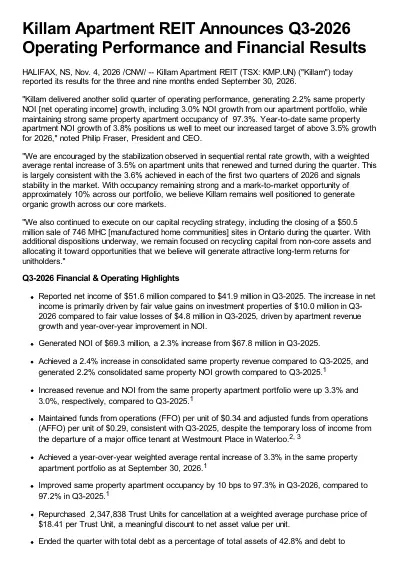
We achieved 2.2% same property NOI growth across the portfolio, which included 3% same property NOI growth in our apartment portfolio, a 9% same property NOI growth in our manufactured home community portfolio, and a -17.6% same property NOI decline in our commercial portfolio due to the expiry of the Sun Life lease. We are on track to meet or exceed the majority of our strategic targets highlighted on slide two.
Through the first nine months of the year, we have delivered same property apartment revenue and NOI growth that puts us on track to meet our increased 2026 target. At the same time, we are advancing our capital recycling program with the objective of completing over $100 million of dispositions and additional $93 million of dispositions to close in Q1 2027.
This will give us the ability to act on opportunities that we believe offer compelling long-term value. Together, these actions are intended to strengthen the quality of our portfolio and position Killam for sustainable per-unit growth over the longer term.
Dale will now take us through our third quarter operating and financial results in more detail.
Dale Noseworthy
Thanks, Phil. Key highlights of Killam's Q3 financial performance can be found on slide three.
During the quarter, Killam generated consolidated same property NOI growth of 2.2% across the portfolio, and year-to-date, consolidated same property NOI was up 3%. The apartment portfolio performed well again in Q3, with the same property portfolio achieving NOI growth of 3%.
Strong demand across the apartment portfolio supported 3.3% revenue growth in the quarter and occupancy of 97.3% compared with 97.2% in Q3 last year. Slide four highlights the weighted average rental increase on apartment units that turned and renewed each quarter, including a combined 3.5% increase in Q3.
The rental rate for units that turned in Q3 averaged 5.6%, up from 5.0% last quarter, reflecting the strength of the summer leasing season. Renewals were up 2.8% compared to 3.0% in Q2.
We continue to use incentives selectively, primarily in markets and at properties where competitive conditions warrant them. Rental incentives have increased compared with last year, but they remain at less than 1% of same property apartment revenue, as shown on slide five.
Slide six shows our current mark-to-market opportunity across our markets. We estimate that our mark-to-market spread remains approximately 10% across the apartment portfolio, consistent with the last few quarters.
This provides a continued runway for rent growth as suites turn, although the pace at which we can capture that opportunity will depend on which units turn. Overall, we believe the portfolio is well-positioned heading into 2027, supported by strong occupancy and a healthy mark-to-market spread.
Turning to expenses on slide seven, apartment same property operating expenses increased 4.3% in the quarter. Utility costs were up 4.8%, due primarily to higher water costs in Nova Scotia, which we had expected following the rate increases approved earlier this year.
Property taxes were up 4.2% and general operating costs were up 4.1%. The increase in general operating costs in the quarter were primarily driven by higher repair and maintenance costs, including preventative maintenance contracts, higher contract services, and increased advertising costs.
Despite those cost pressures, year-to-date apartment same property NOI increased 3.8%, while consolidated same property NOI increased 3.0%. We remain on track to meet our 2026 NOI growth target of greater than 3.5% for our apartment same property portfolio and greater than 2.5% for our consolidated same property portfolio.
FFO per unit was 34 cents in the quarter and 93 cents year-to-date, both consistent with FFO per unit for both periods last year. The gains from same property NOI growth during the quarter and Killam's development program were offset by higher interest expense and the vacancy at Westmount Place.
The changes underway at Westmount reduced FFO by $840,000 during Q3 and $1.7 million year-to-date. Excluding that impact, FFO per unit would have increased 2.2% compared with Q3 last year.
Following an active six months with the NCIB program, Killam's REIT unit count was down 1.8% in Q3 compared to Q3 last year. During the quarter, Killam repurchased and canceled 2.35 million trust units at an average price of $18.41 per unit, making Q3 the most active quarter for NCIB activity in Killam's history.
Turning to the balance sheet on slide nine, total debt as a percentage of total assets was 42.8% as of September 30th, consistent with June 30th. Debt to normalized EBITDA increased slightly to 9.87 times, which reflects the sale of MHC sites, which had a lower loan-to-value, coupled with capital allocated towards the NCIB activity.
Financing costs increased 9.4% during Q3, reflecting higher interest rates on refinancing and lower capitalized interest, and remain a headwind in the near term. However, as we have discussed previously, we see a pathway towards more stable interest expense growth as we move through the current refinancing cycle, as shown on slide 10.
With only 12.3% of our mortgage debt maturing before the end of 2027, our short-term exposure to today's elevated bond yields is relatively small. With that, I'll turn it back to Philip.
Philip Fraser
Thank you, Dale. On August the 4th, we completed the disposition of $50.5 million of manufactured home community assets containing 746 sites.
Proceeds were used to fund the NCIB activity and reduce our outstanding credit facility. We also have another block of MHCs located in Nova Scotia under sales agreement containing 1,354 sites with an expected closing date during the third week of November for $50 million.
Finally, on October 9th, 2026, Killam entered into a sales agreement to sell 3,021 MHC sites for gross proceeds of $93.8 million. This sale is expected to close in Q1 2027.
With regards to our NCIB activity, at the end of October, we had invested approximately $88.7 million to repurchase 4.9 million trust units during the year. Turning briefly to developments, our Brightwood in Waterloo on slide 12 reached substantial completion in June and is 69% leased as of today.
Eventide, our 55-unit development in Halifax on slide 13, remains on track for completion within the next two to three weeks and is 38% pre-leased. We continue to take a disciplined approach to future developments.
We have a significant development pipeline, but new projects must meet our return thresholds and compete with other capital allocation opportunities. More broadly, Atlantic Canada remains our strongest-performing region.
Halifax continues to generate strong revenue growth, with same property apartment revenue increasing 5.6% during Q3 and 6% year-to-date. We believe Halifax remains very well-positioned over the long term.
Our portfolio benefits from well-located assets and rents that remain affordable relative to new supply. The average two-bedroom rent in our Halifax portfolio is $1,646, while much of the new apartment supply is leasing at rents between $2,000 and $2,500 for similar units.
We remain confident in the long-term fundamentals supporting our core Atlantic Canadian markets, especially Halifax. We continue to see significant long-term economic opportunity from defense-related investment and other major projects in Halifax.
These investments should support employment, population growth, and rental housing demand over the longer term. Significant, planned defense-related investment is expected to support job creation across shipbuilding, aerospace, technology, and the broader supply chain, reinforcing Halifax's position as an important defense and marine center in Canada.
For Killam, the expected employment growth represents an important long-term demand driver for rental housing and adds to our confidence in the outlook for our Halifax portfolio. As shown in our results this quarter, one of our other stronger rental markets is St.
John's, Newfoundland, with occupancy at 97.8% and strong rental growth of 7.7% this quarter. It is a market that we are interested in growing.
We have been owners in St. John's for over the last 23 years, and today it makes up 4.4% of our NOI.
We have developed in this market, Bennett House in 2013, Chelsea Place in 2015, shown on slide 15, and over the last three years have started a major capital project to upgrade over 600 units in eight properties with new building envelopes. We have spent approximately $12 million and have an additional $7 million to finish all the work.
This capital investment will reduce our energy consumption and make the buildings more attractive and competitive by replacing a number of the exteriors with new cladding, windows, and balconies. Finally, we believe that the combination of our geographic footprint, disciplined capital allocation, and a high-quality portfolio positions Killam well as we head into 2027.
I would like to thank our employees across Canada for their continued hard work and dedication. Thank you.
We will now open up the call for questions.
Operator
Thank you. Ladies and gentlemen, we will now begin the question-and-answer session.
Should you have a question, please press the star followed by the one on your touch-tone phone. You will hear a prompt that your hand has been raised.
Should you wish to decline from the polling process, please press the star followed by the two. If you are using a speakerphone, please lift the handset before pressing any keys.
One moment, please, for your first question. Your first question comes from Mark with Canaccord.
Please go ahead.
Mark Rothschild
Thanks, and good morning, everyone. Philip,
Philip Fraser
maybe
Mark Rothschild
in regards to the-- Good morning, Mark. Hey, thanks.
In regards to the unit buyback, obviously, you've done a decent amount of that. Is there a point where you think it's too much or more than you want, or with your generally bullish outlook on fundamentals, if you feel that the unit price is just good value, will you continue to do this in an aggressive way?
Philip Fraser
I think the genesis of this was to sort of stop the DRIP, look at doing the buybacks, get ready to sell the MHC portfolio over time and use that money, at the time, for the majority of it was going to be for buybacks. As we sort of finish up the year, we have a clear runway of where we are with the MHC portfolio, and now it's about basically looking at what the first of the year looks like.
I think there's other external factors that will influence a bit, but generally, it's almost every day looking at where should we place our capital. It's not like here it is, close your eyes and do it.
It's got to be an open mind, where the market is, what the share price is, and what the opportunities are in front of us.
Mark Rothschild
Great. Then maybe just on that point you mentioned about MHC asset sales, is that an asset class that you just do not view at this point as core to your business, or is it more that these assets made sense to sell, and would this be an asset class that you would look to invest in again?
Philip Fraser
Obviously the most obvious part of this is that we really haven't grown that side of our business in many years. It's been a good solid piece of business, but over time, I just think naturally it comes to the point where if there is demand, now it's time to take that capital and recycle it.
This essentially is we're not going to grow it, therefore, let's recycle that capital and put it back into our core business, which is apartments.
Mark Rothschild
Great. Thanks so much.
I'll turn it back.
Philip Fraser
Thanks.
Operator
Thank you. Your next question comes from Sairam with ATB Capital Markets.
Please go ahead.
Sairam Srinivas
Thank you, operator, and good morning, everybody. Phil, going to your point on dispositions so far, and obviously dispositions so far have been concentrated in the MHC portfolio, do you see other non-core assets that could be earmarked for dispositions, and could the funds actually even be looked into acquisitions into markets like Saint John where you see significant leasing activity?
Philip Fraser
Previous to our sort of larger push on the MHCs side of our business, we were actually selling apartments and sort of in Atlantic Canada. We sold some in Ontario, sort of the older product.
We've kind of cleaned out a lot of that product. There's always a little bit more to go, but for now, for this year and into the beginning of 2027, the concentration is on MHCs.
The other part of your question is are you looking at small opportunities to grow in some of our stronger markets, and the answer is yes, but there's nothing large. It's just essentially small tuck-in opportunities.
Sairam Srinivas
Thanks, Phil. Considering where rates are right now, has that actually entered the conversation when it comes to buyers looking at assets in stronger markets like Halifax and Atlantic Canada in general?
Philip Fraser
Sorry, that first part of your question was, if you could--
Sairam Srinivas
Just putting rates into perspective, has that kind of come into conversations into other buyers competing for assets in your core markets?
Dale Noseworthy
Sorry, just to clarify, you're asking about when you talk about change in, are we seeing buyers in the markets, additional buyers? You talked about rates.
Are you talking interest rates?
Sairam Srinivas
Yes, has that essentially maybe led to certain buyers not participating anymore, has the competition decreased considering where rates are headed?
Dale Noseworthy
We haven't seen any--
Philip Fraser
I'd say--
Dale Noseworthy
significant change. Those rates have been volatile, but certainly, in Halifax, for example, we are aware, with all the activity that's going on, there are some new buyers looking.
For example, we haven't heard of a change just in this shorter-term increase in rates, I'd say we haven't, no notable change.
Sairam Srinivas
Perfect, thanks Philip. I'll turn it back.
Philip Fraser
Thank you.
Operator
Your next question comes from Kyle with Desjardins. Please go ahead.
Kyle Stanley
Thanks. Morning, everyone.
Philip Fraser
Hi, Kyle.
Kyle Stanley
Maybe just sticking with the dispositions just for a second, maybe asking in a different way. I think coming into '26, you'd provided a roughly $50 million disposition target, and obviously you've been quite successful on the MHC front.
I think over the last little while, you've mentioned that dispositions or capital recycling will make up part of your strategic priorities going forward. Would it be fair to expect that you may be targets an annual disposition or annual dispositions in that $50 million range, or was that earmarked for the MHCs this year, as we think about later in '27 and forward?
Philip Fraser
Again, I don't know why, sorry, my hearing's a little bit off today in terms of listening to that, but you're asking really what is the annual disposition target?
Kyle Stanley
Yes.
Philip Fraser
Yeah. It's a question where I think it's always going to be part of what we're doing in the future, dispositions, as opposed to the first 15 or 20 years where we really never sold anything.
Like a lot of things, even if the question was how are you going to grow, it's always kind of lumpy. It's not all just in one market.
We can be looking at all our different markets for growth. From a disposition point of view, it's very similar to that.
We try to give the best indication of what we can sort of as a target of dispositions a year, but again, the $100 million plus or minus is a pretty good range.
Kyle Stanley
Fair enough. As we were thinking about the fourth quarter now or a month and a bit in, has the leasing environment changed at all versus what you saw in the third quarter?
I think last quarter you did mention expecting relatively stable leasing spreads, and we definitely saw that come through in the third quarter. How's the fourth quarter going so far?
Dale Noseworthy
Far, good. When we look, October numbers are, we're seeing similar activity as we had in September.
There is a decline from the very active summer leasing, I'd say, when we see the number of inquiries, but leasing activity is still robust, and we are feeling good as we look out to Q4 and into '27. Seasonality is in play, but still healthy.
Kyle Stanley
Fair enough. Then just the last one, your same property NOI growth in Atlantic Canada and in markets like Saint John, St.
John's, in addition to Halifax, has been really strong. Do you see enough market rent growth in some of those other markets outside of Halifax to keep the mark-to-market as elevated as it has been?
Then, I guess, I noticed in your slide deck, it does look like the mark-to-market spread in Halifax did come down a bit from the second quarter, could you just talk about that a little bit? Thanks.
Dale Noseworthy
I'd say the first part of your question is yes, I think when we look at Newfoundland continues to be very strong, St. John's, Fredericton, New Brunswick overall.
Those markets, we do feel will continue to perform well. When we look at Halifax, as every market in Canada, affordability is always something that we have to keep in mind, there are times when some unit prices may reflect that.
A little bit of a decline in mark-to-market would reflect just making sure that our units are at the right price for the right unit type. Still healthy,
Philip Fraser
but-- The big question, or the big sort of factor, Kyle, is that every asking rent across the country in new supply, depending on the market, it varies a bit, but it starts with about $2,000 per unit, and it can be up to almost $2,500 to $2,800, depending on the market, of brand new supply. That is what people think about and talk about in terms of the market itself as it grows.
When you look at companies like Killam, if our average rent is $1,646, we still are very, very affordable and have room to grow, not supersized growth like the COVID years, but it's still very healthy. In some of our markets, like I've emphasized on the call here today, our average rent in St.
John's, Newfoundland is $1,263, which is very affordable. Our rents in New Brunswick are very affordable.
Then it skews higher into sort of some of our markets in Ontario, but then again, you have to look at the quality and how new our portfolios are in certain markets in Ontario. Overall, the older apartment companies really had a solid, basically, foundation of growth.
Kyle Stanley
That makes sense. I'll turn it back.
Thanks.
Operator
Your next question comes from Jonathan with TD Cowen. Please go ahead.
Jonathan Kelcher
Thanks. Good morning.
Just going back to the announced MHC sale, once that closes, I guess you'll be down to about 700 or so sites. Would it be fair to assume that those will also be sold off over the next sort of few quarters or a year or so?
Philip Fraser
I think it's fair to say that they have the ability for us to sell them. Some of it, as we've gone through this process, we've got a few little tiny issues to sort of deal with in terms of title or whatever the reasons are.
For now, we're holding on to them. We got one park that we just expanded, and so we're still selling homes in that park and booking the revenue on the home sales.
That's a few quarters out for sure.
Jonathan Kelcher
Okay. Are all the seasonal sites going to be gone, or will you still have some of those?
Seasonal?
Philip Fraser
Oh, through this process, there would be maybe one left, smallest one.
Jonathan Kelcher
Okay. Then just secondly, on St.
John's, it sounds like you're pretty excited about that market. What sort of cap rates are assets trading at in St.
John's right now?
Philip Fraser
My indication is, again, it depends on how new the product is or is it relatively 18, 20 years old, but I think a lot of the product, it's not brand new, and I'm not saying we're looking at absolutely brand new and at high cap rates, but it starts with a five.
Jonathan Kelcher
Okay. Is there a lot of new product in St.
John's?
Philip Fraser
No.
Jonathan Kelcher
Okay. Thanks.
I'll turn it back.
Philip Fraser
Yeah. Thank you.
Operator
Thank you. Your next question comes from Brad with Raymond James.
Please go ahead.
Bradley Sturges
Hey, good morning. Just on incentive usage, I think your comment was it's still selective, but it has picked up a bit.
Would you expect over the next couple quarters still to be kind of below that 1% level of revenue?
Erin Cleveland
I think looking forward, we'd expect it to kind of be around that 1% level. It's still focused mainly in Ontario and Alberta, and it picked up ever so slightly in the Atlantic region, but that's what we'd be targeting.
Bradley Sturges
Okay. Then my other question would be, it sounds like you're still expecting Atlantic Canada to outperform next year from an NOI growth perspective, but there was comments around more contribution from your other markets.
Just how should we think about that gap sort of closing, I think, into 2027 between, let's say, Atlantic Canada and markets like Ontario and BC?
Dale Noseworthy
I'd say when we look at Ontario, we're starting to see more positive rent growth on turns. It bounces around a little month by month, but positive momentum there.
London is the one market, we have a few assets there, London's a little more challenging, but outside of that, our Kitchener-Waterloo markets performing very well, Toronto, Mississauga, and Ottawa all looking good. Looking forward, in the first part of last year, some of those regions carried a little more vacancy, a little bit of rent growth and some improvements in occupancy can make a difference.
Feeling good about that. BC is another one where we're seeing some positive momentum in terms of increases on turns as well.
Alberta, the team's done a fantastic job in terms of improving the occupancy and watching closely on rents, but it's feeling better in that market than it had in the last couple years, so. Go ahead, Erin.
Erin Cleveland
No, I was just going to say, I think in Alberta specifically, we're working our way through the rents that had been leased up at the peak, so, I think you're probably through 75% turn in a few of those buildings, you're going to have the opportunity for more rent growth on.
Philip Fraser
Yeah. Then to sort of finish the conversation, one is that we're happy to see the change at the provincial level in BC.
I think that's positive for all landlords in that marketplace, and that gives us a lot of comfort. Then we have big expectations in terms of Alberta.
They've got an economy that is on fire. There's lots of oil and gas companies making a lot of money.
I think the provincial government's going to have surpluses, and they're growing, and I think in 2027, you'll start to see that trickle down into job creation, and then which will mean that the population will follow for the jobs.
Bradley Sturges
Given that optimism, I know you're looking at sort of tuck-in acquisition opportunities, but would that start to translate into underwriting more deals out west heading into 2027?
Philip Fraser
It's too hard to be pegged to say one area versus all the other areas. We like all our markets, and that's the beauty of being from one part of the country to the other end.
I just think that when you're lined up looking at opportunities, you put everyone, and then you rank it internally, what's the best sort of use for the money.
Bradley Sturges
Makes sense. I'll turn it back.
Thank you.
Operator
Thank you. Your next question comes from Jimmy with RBC Capital Markets.
Please go ahead.
Jimmy Shan
Thanks. You did call out St.
John's a few times, I guess one is what's causing this market to be so strong? Also, it sounds like your opportunity to grow your presence there is going to be really through development.
Is that fair to say?
Philip Fraser
No, I don't think so. We do have land, but that would take about a couple years to three years to do.
Over the last few years, there's always been the odd acquisition potential. What really is sort of driving it, at this time, one is that, again, they are benefiting from the oil and gas pricing and what it's going to do to the provincial economy.
I think there's a lot of optimism with the other types of energy-related projects that are potentially going to happen here in Atlantic Canada because it's such an important part of the economy long-term. Then when we really look at it, as I said, we spent some capital to refresh our portfolio.
In terms of the cycle of rents growing, we see good sort of opportunities for increased revenue over the next few years. It's one of the most stable markets that we have from an operating point of view.
You put it together, and it's been there, we've been happy, the owners in that province for over 20 years, and when the opportunity comes, we're well-positioned to take advantage of it.
Jimmy Shan
Yeah. You estimated the incremental employment on the defense spending, 5,500 to 8,000.
Do you have a sense of the timeframe of that?
Dale Noseworthy
Based on the research that we did to come up with that estimate, the expected peak timing is really expected to be between 2030 and 2032 or three as the shipbuilding further ramps up. A lot of jobs are expected around the construction of the facility to house the subs.
Once the construction is completed, that facility is supposed to house, I believe I read 800 jobs, for example. During the construction phase, are expected to be much more.
That would be the peak. In the next year, two years, it'll ramp up, but that would be what we expect the peak to be, and then it would come down, still healthy growth from where we are, but not to the extent that it would have been during that peak construction.
Jimmy Shan
Okay. Sorry, just last question.
The Halifax mark-to-market spread, it did drop a decent amount from Q2 to Q3. What sort of drove that decline?
Dale Noseworthy
Yeah. It's actually bigger than some other numbers I was looking at.
We do update that every quarter, it's based on what was leased in the last month. As we were leading into the end of September, it could just be the pricing on select assets, the mix of units that were leased.
We could see that tick back up in the next quarter. That could move back up.
I going to do a little more digging, and follow up with you on that one.
Jimmy Shan
Okay. Thank you.
Operator
Thank you. Our next question comes from Mario with Scotiabank.
Please go ahead.
Mario Saric
Good morning. Just on the Halifax mark-to-market, I also noted that the total portfolio estimated mark-to-market of 10% was kind of flat quarter-over-quarter, which seemed a bit challenging given Halifax came down by 50%.
Again, I wasn't sure if there's just a difference in the types of calculation quarter-over-quarter or if there's something else going on.
Dale Noseworthy
I think there might be. I'm just looking at some numbers that look a little bit different than that, so--
Erin Cleveland
Because our increase even in October is higher than that percentage, we'll take a look at that.
Dale Noseworthy
We'll have to take a look at that.
Mario Saric
Yeah. Just on slide four, it seems like, and I think you called this out in your materials as well, it seems like the blended rent growth in the mid-3% range, it's kind of been in that range for the past two to three quarters.
Would you argue or is there enough confidence to say that that's a trough at this point, and you would expect into '27, and I know '28 is a really long time away, but would you think that the 3.5% is as low as it's going to go?
Erin Cleveland
I think 3% to 3.5% is probably the long, because I think '28 is probably a bit far out, but looking to '27, I think in that 3% to 3.5% is probably a reasonable range to look.
Mario Saric
Okay. What would it be Halifax that you think that can bring it down closer to three versus the 3.5%, or what on the margin do you think is decelerating a little bit?
Erin Cleveland
I think a little bit Halifax. I think a couple of the regions have a slightly lower rate from a renewal perspective, from a rent cap perspective, next year as well when you bring those blends in.
Mario Saric
Okay.
Philip Fraser
Higher than 2.8%.
Mario Saric
Thank you.
Operator
Thank you. Our next question comes from Matt with National Bank of Canada.
Please go ahead.
Matt Kornack
Hey, guys. You mentioned acquisition potential, but can you give us a sense as to what the economics look like on some of your potential development projects and whether any of those look like they'd maybe go ahead sooner rather than later?
Also, I guess you did mention that you have Topsail Road and Block 4 in St. John's.
Are the market rents high enough to justify new development in that market at this point?
Philip Fraser
I guess to answer your last question, we have nothing in the drawing board or even planning stages for development in that land right now. It'll be purely acquisitions if we do it.
Again, even from right now, we don't have anything on the development site ready to sort of come out for 2027.
Matt Kornack
Fair enough. Then maybe just a quick update on Westmount, how the leasing's going there on the commercial portion, that would be helpful.
Robert Richardson
Hi, Matt. Robert here.
We took possession on April 1, it's been eight months. We've done a lot of work in the building itself getting it ready to show to a bevy of potential tenants.
We have about 250,000 square feet of interest in the marketplace, and I'm in Waterloo today, actually, to meet with one tenant that's looking at 100,000 feet. We thought we'd be here to take them through.
That's going well. The rest are some professional services, fitness and health, financial.
There's an RFP in the marketplace for the federal government, which goes up to 45,000 feet. Then there's a large one that I spoke to earlier.
We have good activity. We've made some changes to the exterior of the building.
It makes it look a little more modern and improves the sightlines and traffic, so that'll work well for us. The first phase is earmarked to be finished in four months, and we will then move on to phase two.
It's coming along and optimistic that when we speak in 2027, we'll have some good news for you.
Matt Kornack
That sounds good. Looking forward to it.
Then maybe just a very quick last one, Dale, on prospective expense growth on kind of the three buckets of opex, how should we think about that in the next 12 months?
Dale Noseworthy
Looking forward? Property tax, I'd say, unfortunately, more of the same in terms of we are seeing those pressures.
Utilities, I'm hoping for a mild winter, but we know that the water increase that we saw in Halifax will carry through for the first quarter and there is more water increase coming, not to the same extent, but some pressures there. A mild winter could make up for some of that, we'll be watching.
Q1 is always an important one, and it will be again. Those other costs that we have a little bit more control over, we're working hard to manage those.
We would target three to four on those, so. We're working on that closely.
Matt Kornack
Great. Thanks, all.
Dale Noseworthy
I will just follow up. I just pulled our data on the mark-to-market, and we had an error in what was pulled in the slide deck, we will update that.
Clara will send it to the analyst and we'll post it. Mark-to-market is relatively flat.
Not sure where that data was pulled from. Apologies, but we're sitting at about 16% mark-to-market in Halifax based on the most recent data, which would be consistent for the last quarter.
That 10% is based on that 16%, just to clarify.
Operator
Hello, Matt. Are you still there?
Matt Kornack
Oh, yeah. I'm good.
That was my last question. Thanks.
Operator
Perfect. Thank you.
All right, ladies and gentlemen, that concludes today's Q&A session. I will turn the call back over to Philip Fraser.
Philip Fraser
Thank you. I would like to thank everyone for joining us today on the call by either listening or asking questions, and we look forward to our Q4 year-end conference call on February the 11th, 2027.
Thank you.
Operator
Ladies and gentlemen, this concludes today's conference call. Thank you for participating.
You may now disconnect.