Kosmos Energy Ltd.
Q3 FY2026 · Earnings Call TranscriptNovember 2, 2026
Operator
Good day everyone. Welcome to the Kosmos Energy's Third Quarter 2026 Conference Call.
As a reminder, today's call is being recorded. At this time, let me turn the call over to Jamie Buckland, Vice President of Investor Relations at Kosmos Energy.
Jamie Buckland
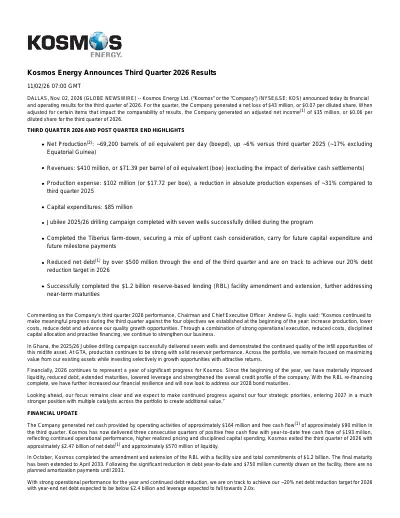
Thanks, Operator, and thanks to everyone for joining us today. This morning we issued our third quarter 2026 earnings release.
This release and the slide presentation to accompany today's call are available on the Investors page of our website. Joining me on the call today to go through the materials are Andy Inglis, Chairman and CEO, and Neal Shah, CFO.
During today's presentation, we will make forward-looking statements that refer to our estimates, plans, and expectations. Actual results and outcome could differ materially due to factors we note in this presentation and in our UK and SEC filings.
Please refer to our annual report, stock exchange announcement, and SEC filings for more details. These documents are available on our website.
At this time, I will turn the call over to Andy.
Andy Inglis
Thanks, Jamie, and good morning and afternoon to everyone. Thank you for joining us today for our third quarter 2026 results call.
I'll begin today's call by reviewing the progress we've made against the four goals we laid out at the start of the year, before giving an update on each of our business units. I'll then hand over to Neal to talk through the financials, before I wrap up with closing remarks and a look towards 2027.
We'll then open the call up for Q&A. Starting on slide three.
When we released our full year 2025 results in March, we laid out four key objectives for Kosmos in 2026, which are shown on the slide. I'm pleased to say through the first three quarters of the year we've made excellent progress against all of them.
We've seen strong year-on-year production growth from our core assets, namely Jubilee and GTA. We've delivered significant absolute and per barrel equivalent cost reductions year-on-year, with a specific focus on operating costs.
We've delivered the majority of our net debt reduction target, and are on track to achieve the 20% reduction target for the year, a target we increased with our first quarter results in May. We've continued to advance our high-quality growth portfolio, particularly in the Gulf of Mexico, with minimal capital input.
By delivering this agenda, we expect to end the year with a more resilient and more valuable company, a company with higher production, lower costs, and lower debt, with significant upside from our hopper of future growth opportunities. We'll also have higher exposure to elevated commodity prices as we enter 2027, which Neal will cover later in the materials.
I'd now like to focus on the progress we're making in each business unit, starting with Ghana on slide four. We've seen a lot of progress in Ghana this year, with an active drilling campaign that's delivered in line with our expectations and highlighted the potential of this mid-life asset.
The key to delivering Jubilee's full production potential going forward is demonstrating operational delivery, in particular, reservoir management in the periods between drilling campaigns. In the third quarter, Jubilee gross production was 84,500 barrels of oil per day, an increase of around 17% versus the previous quarter, reflecting the new wells that came online in late 2Q and during the third quarter.
Specifically, in August, the J-50 producer well came online, and then in September, the J-73 water injection well completed the program. Our annual guidance for Jubilee was 70 to 80,000 barrels of oil per day, with year-to-date production through end 3Q of around 75,000 barrels of oil per day.
With the latest drilling program now complete, the partnership focus is on improving management of the reservoir to mitigate decline. This will require daily focus on operational delivery, namely sustained water injection with voidage replacement above 120%, continued production system optimization, adding gas lift to the west side of Jubilee, and high FPSO uptime of around 98% or above.
As we look ahead, we're pleased to have contracted the Faye Kozack rig from Noble for the 2027-2028 drilling campaign of up to 10 wells, with the rig due to arrive in mid-2027. The first new wells in the program will benefit from the most recent 4D seismic, with the ocean bottom node survey, or OBN, expected to play a major role in planning and high-grading the wells for the second half of the program.
In Ghana, we have a government that wants to get things done. Last month at Africa Energy Week in Cape Town, I shared the stage with the chairman of the African Energy Chamber and Ghana's energy minister to talk about what we're doing as a partnership to help drive energy prosperity in Ghana.
It was a productive and valuable discussion. One of the key takeaways was if companies like Kosmos can help the country win through long-term investment, lower cost associated domestic gas, and transfer of knowledge and skills, then Kosmos will win too.
Ghana is a case study on how a government and a company like Kosmos can work together to get things done for the benefit of all stakeholders. Turning to slide five.
GTA continues to perform strongly. During the third quarter, gross LNG production was around 2.44 million tons per annum equivalent, in line with expectations, with higher seasonal temperatures through the summer months as previously guided.
The partnership lifted 8.5 gross LNG cargoes, slightly ahead of guidance, which brings the total number of gross LNG cargoes lifted through the end of the third quarter to 27. The condensate cargo that was due to be lifted at the end of the third quarter was lifted in early 4Q due to bad weather in the region that prevented an earlier lifting, with Kosmos receiving just under 400,000 net barrels of condensate.
For the year, the strong operational performance means we're on track to achieve the upper end of our 32 to 36 gross LNG cargo guidance. The three gross condensate cargoes for the year have now all been lifted.
Looking ahead to the expansion of the project, Phase 1+ is making good progress, with the construction of the onshore pipeline in Senegal well underway. The bottom image on the slide shows the first piece of the gas pipeline being laid in September.
AGSI, the operator of the gas pipeline, reported that the first phase of the onshore pipeline connecting the GTA hub to the 230-megawatt Ndande power plant is now over 25% complete. Further segments of the onshore pipeline connecting additional demand centers to the south are due to commence construction in 2027, with commissioning targeted for 2029.
As I said in my comments on the previous slide, our focus above ground is just as important as the work we do below ground. It's a core part of the Kosmos skill set as we work with the governments and national oil companies to maximize the value of the projects we undertake together.
The last two months, we've spent time with the presidents of both Mauritania and Senegal to talk about the future, as can be seen in the top image on the slide. I'm pleased to say we have a shared vision for the future that prioritizes lower cost domestic gas alongside the LNG exports from Phase 1 and future phases.
This lower cost domestic gas will replace higher cost imported diesel and LNG, and help both countries achieve their gas-to-power and gas-to-industry goals over the coming years. If the countries succeed in these goals, then Kosmos will also succeed.
We look forward to advancing these goals in the future. Turning to slide six.
Production in the Gulf of Mexico for the third quarter of approximately 14,100 barrels of oil equivalent was in line with expectations, helped partly by the lack of storm activity during the quarter. This reversed in early 4Q, and Neal will talk about this in more detail shortly.
During the quarter, we successfully completed a highly competitive farm-down on Tiberius, bringing Navitas into the project as a 33.33% partner. Following the transaction, Kosmos will remain as operator with a 33.34% interest, with Oxy, owner and operator of the nearby Lucius facility, holding the remainder.
As detailed on our last earnings call, the consideration was a mix of upfront cash, carry for future development capex, and future milestone payments. The carry is expected to cover all of our Tiberius capex through 2026, and fund our share of the development through the first half of 2027.
Tiberius is a low-cost, high-margin development, and we now have an aligned partnership to move forward, with first oil expected in the second half of 2028. Elsewhere in the Gulf, our strategic exploration alliance with Shell is working well.
The partnership is now preparing to drill the Trailblazer ILX well in the first half of 2027, with Transocean's Deepwater Pontus rig contracted. Trailblazer is a four-way structural trap in the Norphlet, on trend with several other discoveries, such as Shell's Appomattox field.
In a success case, the discovery can be tied back to the nearby Appomattox facility, which has available capacity, with Kosmos designated development operator. Beyond Trailblazer, there are several other high-quality opportunities in the Norphlet that we expect to advance as part of the Shell exploration alliance.
We're excited to be getting back to exploration in the Gulf, and doing it in a capital-efficient way that allows us to test meaningful resource opportunities at a relatively low cost. I'll now turn it over to Neal to take you through the financials.
Neal Shah
Thanks, Andy. Turning now to slide seven, which looks at the financials for the third quarter in detail.
It's been another strong quarter for the company, with production higher year-on-year and opex falling sharply, in line with the targets Andy mentioned at the beginning of today's presentation. All of the line items for the quarter were in line with our guidance, except for DD&A, which was slightly higher than our guidance range due to a minor accounting change to the depletion rate in Jubilee for the quarter, with our full year DD&A guidance unchanged.
Also, tax per barrel was lower in the quarter, reflecting the mark-to-market derivatives loss that offset some of the revenue during the quarter. Excluding the mark-to-market, tax expense was in line with our expectations.
Looking ahead to Q4, net production is expected to be lower quarter-on-quarter, driven by a combination of lower Gulf of Mexico and Ghana production. In the Gulf, fourth quarter production is impacted by planned maintenance at Delta House, the host facility for the Odd Job field, a workover at the Kodiak field, and downtime associated with Hurricane Francine.
In Ghana, with the drilling campaign now complete, the partnership is focused on reservoir management to mitigate decline at Jubilee before the next drilling campaign begins in mid-2027. Also in the fourth quarter, there will be financing costs of around $20 million related to the extension of the RBL.
Turning to slide eight. Cost reduction has been a big theme across the company this year, particularly on operating costs, after similar initiatives on capex and G&A last year.
We're making a lot of progress, and the charts on the slide show how far we've come year-to-date. The top left chart shows that absolute operating costs have fallen by almost $150 million in the first nine months of the year, a reduction of around 26%.
Opex per barrel has fallen around $12 per barrel, a reduction of around 37% on a per unit basis. This focus on cost management and a higher commodity price backdrop has seen EBITDAX almost double in the nine months ended September 30th to almost $800 million, which has translated into robust free cash flow, with more expected in the fourth quarter.
We now expect around $300 million of free cash flow in 2026, net of any hedging impact, which is expected to be around $200 million for the year, demonstrating the cash flow potential of the business. As we look forward to 2027, our hedges have been put in at much higher levels than 2026, giving us greater exposure to higher oil prices with a lower cost base.
Turning to slide nine. It's been a busy year for financing, and I'm pleased to report we recently closed the reserve-based lending facility extension to April 2033.
The facility amendment and extension is another demonstration of the company proactively addressing its maturities, and the continued confidence in Kosmos's portfolio from the banking market. I'd like to thank our banks for their continued support, many of whom have been with Kosmos for well over a decade.
On liquidity, the strong cash flow performance in the third quarter meant we exited Q3 with around $570 million of available liquidity. We expect this to strengthen further in the fourth quarter.
On hedging, we continue to be active, adding what are likely to be the final hedges for our 2027 program. As mentioned on the previous slide, we've been able to achieve a higher average floor and a much higher average ceiling on the collars we have put in place for next year, giving us more exposure to the upside in a higher price environment.
On the debt, in 3Q, we utilized our free cash flow to repay $50 million of the 2027 bonds, $15 million of the GoA term loan, and $25 million of the RBL. In Q4, with the RBL now complete, we plan to prioritize our free cash flow towards our bonds, with a view of addressing our 2028 maturities next.
Finally on leverage, with the strong year-to-date EBITDAX performance and significant debt reduction, leverage is moving towards 2x by year end, a significant turnaround in only 12 months. With that, I'll hand it back to Andy.
Andy Inglis
Thanks, Neal. Turning now to slide 10.
As I said in my opening remarks, we have four key objectives for 2026: grow production, lower costs, reduce debt, and advance our quality growth portfolio with minimal capex in 2026. This slide shows the progress we've achieved year-to-date against those goals.
Production for the first nine months of 2026 is up 14% versus the same period last year, without adjusting for the sale of EG. As Neal said, absolute operating costs are down 26% the first nine months of the year, driving a reduction in opex per boe of around 37%.
We've delivered a reduction in net debt of around 17% versus year-end 2025, and are well on track to achieve our 20% target. We're advancing our growth portfolio, with the Tiberius farm-down, continued progress on GTA expansion, and the exploration alliance with Shell in the Gulf of Mexico, which will drill the Trailblazer well in the first half of 2027.
Turning now to slide 11 to conclude today's presentation. We've been clear on our targets for 2026 and are delivering on them.
As we approach the end of the year, we're turning our focus to 2027, where we have a lot to look forward to. We have a deep opportunity set across the portfolio, and in 2027, we plan to continue to invest selectively in our highest quality growth options, while maintaining the capital discipline we've displayed this year.
We're returning to drilling in Ghana with another high-return infill program that is being enhanced with modern seismic to drive better results and higher recovery over time. Jubilee is a world-class, mid-life field, and with regular drilling and excellence in reservoir management to mitigate decline, there is a huge amount of value to chase in the future.
We're making good progress on the GTA expansion, where the construction of the onshore pipeline has started in Senegal. As I said in my earlier remarks, we have an aligned agenda with the government to make this work for the benefit of all stakeholders.
We're returning to exploration with the high-impact Trailblazer well in the first half of 2027, with significant potential elsewhere in the Norphlet. We believe our continued investment in people and technology will make a real difference in growing our resource base.
Finally, we remain focused on enhancing the company's financial resilience, paying down more debt, targeting year-end 2027 net debt of around $2 billion at strip prices, while addressing the rest of our near-term maturities. We're working hard to deliver a stronger, more valuable Kosmos, and look forward to delivering on these plans to support long-term value creation for our investors.
Thank you, and I'd now like to turn the call over to the operator to open the session for questions.
Operator
Thank you. We will now begin the question-and-answer session.
If you would like to ask a question at this time, please press * then the number 1 on your telephone keypad to raise your hand and enter the queue. If you would like to withdraw your question at any time, you can simply press *1 again.
Our first question comes from the line of Charles Meade with Johnson Rice. Your line is open.
Charles Meade
Yes. Good morning or good day, Andy and Neal and to the rest of the Kosmos team there.
Andy like to ask a question about the cargo guidance for Ghana in Q4. I think many of us on the street, and I would be in that number, were looking for four cargoes from Ghana in 4Q, and it seems like exiting 3Q with a 1.1 net million barrel underlift position would be a good starting point to achieve that.
Of course there's other variables too. There's the production rates from Jubilee.
There's how you expect to exit the quarter on underlift or overlift. For those of us who it looks like there's a cargo short of what we're looking for, I wonder if you could talk through that bridge from where you're entering the quarter and what you expect from field performance over the course of 4Q and why three is the number that we should be looking for.
Andy Inglis
Thanks, Charles. Want to start really with sort of back to where current performance is in Jubilee.
As we mentioned in our prepared remarks, we ended the drilling campaign in September. We've had strong performance from that drilling campaign, and now it's all about sort of managing the reservoir before we restart the program in mid-2027.
The big things we're focusing on with the operator is improving the water injection. We need to get that back up above 120%.
I think it's opportunities on production optimization around all the wells. Again, we need to sort of focus on that day-to-day.
On the west side of the field, we've got some planned riser gas lift to install. Again, that will help production.
Then it's about maintaining the high FPSO uptime. All of that is going to drive ultimately where we end up in 4Q.
Our objective is probably to exit the quarter around the mid-70s, something around there, Charles. Ultimately, with the cargo math, you can't be precise because it depends on the lifting schedule for each company.
Yeah? I think it's better to sort of talk about ultimately how we're managing the production and therefore the things that we see now that are going to drive the production.
The cargo math really depends on each party's underlift and overlift. Yeah?
Other people can be underlifted as well. Ultimately, we believe our best view is that turns out to be three cargoes in the fourth quarter.
Ultimately, there's a lot to be done now in the day-to-day operation of the field now to mitigate decline and deliver a good quarter.
Charles Meade
Got it. That's helpful elaboration, Andy.
Thank you. Then turning to the Gulf, I wonder if you could talk a bit about to me at least, it seems you've been generally quiet on your working interest at Trailblazer, although it seems like you entered this Shell JV kind of on a heads-up basis with them.
I wonder if you could talk about how you are thinking about the interest you're going to carry into drilling that well, and perhaps if Tiberius is a good analog for us to think about. I think in that case, you drilled the well and then farmed down after you had a success case.
I wonder if you could just talk about your approach to Trailblazer.
Andy Inglis
I think it's slightly the reverse. I think the alliance with Shell is about establishing the equities up front.
We're pleased to be working obviously with Shell. They're the leading Norphlet player.
They have the infrastructure in Appomattox. We'll be drilling Trailblazer at around a third, Charles.
Yeah. That I think is the right level for us.
With success, it allows us to participate in another high-quality development and do it with, again, a simple partnership. I think one of the things where it's analogous Tiberius to Trailblazer is you're working with essentially the owner of the infrastructure in the area.
Yeah? That's clearly Oxy with Tiberius and it's Shell with Trailblazer.
I think, again, the important thing when you're looking at ILX is to make sure that you've got the ability with success then to quickly tie back, and that's all about driving the economics. I think that very similar approaches, about the same risk exposure, and it's all about making sure that we've got the ability with success to move it forward at pace.
Charles Meade
That's good detail. Thank you, Andy.
Andy Inglis
All right. Thanks, Charles.
Operator
Your next question comes from Bob Brackett with Bernstein Research. Your line is open.
Bob Brackett
Good morning. A bit of a follow-up on Trailblazer.
I'll make a two-part question, one above the water and one below. Above the water, you said about a third working interest and a simple partnership.
That almost makes me ask the question, isn't it exactly a third, and are there any sort of clawbacks or carries in the partnership, or is it just a straightforward working interest split? Then I'll ask a follow-up.
Andy Inglis
Look, to think about it as a straight interest split, Bob. I don't want to give all the details, but think about it exactly like that.
Bob Brackett
Very clear. Then sort of below the water, Trailblazer is fairly far west of some of those thickest of those eolian deposits.
What's the sort of confidence that those eolian dunes extend that far west? Are they imageable?
Is that a key risk?
Andy Inglis
Look, what I'd say again on that, Bob, is we're working clearly, I think, with the company that has very good knowledge of the Norphlet. Shell have clearly high-graded it in their drilling program to bring it on to their rig slots.
I think that we feel good about the partnership in general and working with the leading player, and clearly we bring all of their knowledge as well. I think that's the way you should sort of think about it, and clearly they've created room in their program to farm in to the prospect.
Bob Brackett
Very clear. Thank you.
Andy Inglis
Thanks.
Operator
Your next question comes from Neil Mehta with Goldman Sachs. Your line is open.
Neil Mehta
Good morning, Neal and team. I just wanted to get your perspective on the progress around deleveraging, certainly in this type of commodity price environment.
You guys have done a lot on the balance sheet, just give us a mark-to-market on where we are, how are you thinking about the progress that you've made, and you're happy with how it's shaping up?
Andy Inglis
Good day. Neil, why don't you have a go at that?
Neal Shah
Yeah. Hey, Neil.
Thanks for the question. It's clear, again, we've been clear around what we wanted to do in terms of tackle the near-term maturities, create some space, increase liquidity, and bring down leverage.
Again, I think we're in a good place, particularly with where Brent is at this point to continue to benefit from that, both as we sort of exited 3Q, but also into early 4Q where prices have remained quite strong. We feel good about sort of exiting the year sort of less than $2.4 billion from a debt perspective, and then, as we mentioned on the call, targeting to get to sort of around $2 billion by the end of '27.
I think that sort of squares where we want to get to from a net debt or leverage perspective. I think from a maturity perspective, the next thing we clearly sort of voiced is our expectation is to manage the '28 maturity, and then there's a couple different ways we can tackle that, but once we address that, we basically have, call it, three and a half years without any meaningful maturities.
Again, that'll be a huge amount of progress in a short amount of time. Again, the team's done a huge amount of work on that, and we've got a bit more to go.
I think we're in pretty good shape. The market's been supportive, and things are headed the right way.
Neil Mehta
Yeah. Neal, once you get to that target, how do you think about what you do with the excess cash?
What are the different options that you have? Do you have a long-term debt target in mind?
Are we starting to think about return of capital? Or what is the optimal balance sheet, and what's the approach to excess cash once you hit your target?
Neal Shah
Again, I think in the near term, which again, I think would qualify through '27, is getting to that sort of less than $2 billion first, right? Then, if we're generating anywhere sort of north of a billion to a billion and a half of EBITDA, we're sort of at a one and a half-ish times of leverage area.
Again, I think that remains the first sort of objective. Beyond that, again, I think it'll be a combination of then looking at additional debt paydown, and then either funneling capital towards growth projects or towards capital returns.
That sort of framework hasn't changed. Again, I think that's really a decision probably towards the end of '27 as we get closer to that debt target.
Again, we have a number of growth opportunities, which, again, in a more constructive commodity price environment, they make sense to accelerate forward. If the share price is weaker and we're in a bit of lower environment, we may lean more into the return side of the equation.
Again, I think it's a good question. Again, we're not quite there yet, but after the next sort of 12 months or so, that's certainly the right question to ask.
Neil Mehta
Yeah.
Operator
Your next question comes from the line of David Round with Stifel. Your line is open.
David Round
Thanks, guys. Andy, can I just come back to the priorities before the next Jubilee drilling campaign, or Ghana drilling campaign?
Can you just talk a bit more about how important those four projects are to your production levels? I think uptime probably speaks for itself, but any context on the other three items would be good.
If I do think of these as specific projects, whether there are any sort of timing milestones to look out for.
Andy Inglis
David, yeah, look. I could say it's really just about daily operational excellence.
Ultimately, it's about managing the reservoir pressure, which is about voidage replacement. Our view is probably to have that well above 120% to manage the decline effectively.
We've been a little short of that through 3Q, and it's really about now ramping up the reliability of the water injection equipment and ensuring that we deliver that. It's not really a project, but it's a daily grind of operational excellence.
The second item is really about production optimization. I think some of you will have heard me say there's 168 set points as you look at all of the well intervals across the producing wells and injectors on Jubilee.
It's the constant normalization and optimization of those settings, again, to take advantage of the increased water injection, areas of increased pressure, and therefore maximizing the delivery. Again, as I've said I think on previous calls, AI now is making a difference there, given the number of variables that you're optimizing around.
We're seeing it have quite a significant impact. The final one, which is gas lift on the west, is in your project sort of bucket, I think.
It's reconnecting a riser so that we can introduce gas lift to the west side of Jubilee. That project's ongoing at the moment and will probably come in towards the end of this month.
Altogether, those are the things that are part of our armory now to maximize the production from the field through the end of the year and then exit at the maximum rate, and then continue with that through the first half of '27.
David Round
Understood. Thanks, Andy.
Andy Inglis
All right. Thanks.
Operator
Your next question comes from the line of Christoffer Bachke with Clarksons Securities. Your line is open.
Christoffer Bachke
Good morning, guys. Christoffer from Clarksons here.
Congratulations on a solid and eventful third quarter. I have two questions today, if I may.
The first is on realized pricing in the fourth quarter, and especially given the exceptional strong physical crude markets in West Africa and the significant premiums that we are seeing right now. Could you provide some color on your expectations for realized prices in the fourth quarter, and perhaps also touch upon the actual realized prices achieved from Jubilee in September and October?
The second one is on the refinancing of the 2028 maturity. Congratulations on the successful amendment and extension.
Now naturally the attention turns towards the 2028 maturity. How are you thinking about the timing of a potential refinancing, and what level of leverage or further debt reduction would you ideally like to achieve before approaching the market?
Andy Inglis
Hey, Christoffer. Why don't I ask Neal just to cover those two?
Neal Shah
Sure. On realized pricing, as I mentioned when I was answering Neil's question, we've seen good pricing really continue into October.
Again, I think part of why the cargo timing impacted us a bit in 3Q in terms of just the cargo pricing, but as we exited Q3 and into Q4, pricing has been clearly a lot more favorable. We've had two cargoes lift sort of net around $120 per barrel or better, one in Jubilee and the condensate cargo.
Actually, yeah, timing's been pretty good. Again, I think from a realization perspective, what we'll realize out of the Gulf in October is the highest we've netted year-to-date.
Again, I think pricing has been strong. We've got basically a cargo a month out of Ghana, and dated Brent still as of Friday was right under $120.
Again, I think realizations both on what we're selling out of West Africa and out of the Gulf look pretty good. Clearly today is a volatile day, but we'll see, but generally prices still remain pretty supportive for us to deliver a strong cash flow result in the fourth quarter.
On '28, for me, it's less of an issue around paying off more debt. It's really around sort of ensuring the market's in a good place, and us getting the benefit of all the work that we've put in before we look to other solutions.
Clearly, refinancing the bond is an option. The RBL was an important milestone in terms of getting the balance sheet sorted.
We also would like a bit more progress on the rating side of the equation. In terms of what we're working on to get the ratings moved in the right place.
Then clearly, the yields have improved dramatically year-to-date. I think it still has room to run.
It's something we're going to continue to evaluate on a regular basis, and see how markets move on a sort of monthly basis, and evaluate sort of what is the right option. I think the good part about where we are is, again, from a cash flow generation perspective, we've delivered two quarters of right under $100 million.
We expect Q4 and the early part of '27 looks pretty good as well. We also have an option to just pay down bonds or pay down the RBL, creating more space and liquidity are different ways to address the '28s.
We have more tools available to us, and again, clearly we're in a better shape. We'll continue to evaluate those alternatives.
Christoffer Bachke
Thank you very much. Just as a quick follow-up here on the underlift position that you touched upon, could you quantify how much of this inventory you expect to monetize during the fourth quarter?
Neal Shah
Say that again, Christoffer?
Christoffer Bachke
Regarding the underlift position of 1.1 million barrels going into the fourth quarter, could you quantify how much of this inventory you expect to monetize now in the fourth quarter?
Neal Shah
I won't give you an exact number, but a couple thousand barrels a day unwinds in the fourth quarter, and again, I think from the first quarter looks like, yeah, and again, sort of cargo timings move, but sometime in the first, second quarter of next year, we'll unwind the rest.
Christoffer Bachke
Fantastic. Thank you very much, Neal.
Mhm.
Operator
Your next question comes from Mark Wilson with Jefferies. Your line is open.
Mark Wilson
Yes, thanks, gents. A couple of questions from me.
First just to carry on from that RBL extension. Excellent to see that, and on the '28s, one imagines that you wouldn't be looking to extend the '28s beyond that 2033 maturity of the RBL.
I think previously you had the RBL at '29 versus these at '28. Should we expect something similar in terms of that cadence?
That's my first question, I guess to you, Neal. Then, Andy, I would say that overall in the market, consolidation in various basins has been a theme.
Certainly onshore US, we've seen some in the US Gulf, and obviously a lot in the North Sea, both Norway and UK. We haven't seen much in West Africa.
I'm just wondering how you would categorize the market for further consolidation in that particular basin. Thank you very much.
Neal Shah
Hey, Mark, let me just take your first one, and then I'll hand it over to Andy. Just in terms of a refinancing, again, I don't think we'd be looking at anything out of the ordinary.
Again, generally, the US independents are all sort of in the issuing 5- to 7-year new issues, and so again, I think anything we look at will be within that sort of 5- to 7-year window, which would probably be '33 at the outside and '31 at the inside.
Mark Wilson
Very clear.
Neal Shah
Andy?
Andy Inglis
Mark. No, absolutely.
It's interesting, isn't it, comparing the Lower 48 to the internationals? I'd say one of the big drivers in the Lower 48 is access to inventory.
Companies actually with shorter R/Ps, getting access to higher quality inventory is ultimately what's driving that. Then clearly, the second big issue then is all around the synergies from those matchups.
When it comes to the international space, you look at Kosmos today, the R/P is well over 20, yeah? That's just on a 2P basis, with a relatively modest contribution from the discovered resource.
On a 2C basis, over 30. For us, it's not really about trying to lengthen the portfolio.
Ultimately, any consolidation has to help us create a stronger, more resilient business. Ultimately, it's about synergies.
It would have to be around synergies. It would have to be about value being created through the combination.
I think there are relatively few of those around. Therefore, what are we doing in the interim?
It's all about the organic self-help that actually gets us there today. As Neal's talked about, really every question has been around building the resilience of the balance sheet, and ultimately, it's about lowering the breakeven, taking costs out of the business, and then improving our margin.
The answer is I agree with thesis, but for Kosmos, it has to be around something that genuinely addresses the ability to create a more valuable company because there's another access to costs, and there's a greater cash flow potential. That's the basis on which we would evaluate any opportunity.
Mark Wilson
Great answer. Thank you very much.
Very clear. Hand it back.
Andy Inglis
All right. Thank you.
Operator
Your next question comes from the line of Stella Cridge with Barclays. Your line is open.
Stella Cridge
Thank you. Good afternoon, and thanks for all the updates and the comments on the debt side.
I just wanted to follow up with one question on bonds. Obviously, you noted about the pricing in the market at the moment, obviously interest rates have moved higher and made raising debt a bit more expensive for everyone.
The one bond that has performed quite well has been your GTA bonds, which were issued perhaps before the price rally and Brent. I was just wondering where did they sit within your thinking about the whole capital structure?
Is that a bond that you may think about refinancing at some point to lower the cost of debt, or are you just perhaps a bit more focused on the near-term maturities for the moment? Thanks.
Andy Inglis
Thanks. I'll let Neal handle that.
Neal Shah
Hi, Stella. Clearly we put it in place at the beginning of the year to manage the '27 maturities.
It's got some time on it in terms of it's a 5-year note, but clearly it's at a higher coupon than what we'd like to manage. Again, I think we were at a pivotal point in GTA in terms of it's just starting up.
It's now been online, sort of running at full rate for over a year. We'd expect it to do a pretty meaningful contribution to EBITDAX this year for the company as well.
Again, I think there's been huge amount of de-risking the asset. I've always thought sort of secured debt at GTA makes sense within our capital structure on a long-term basis.
That note, again, I think should be lower priced at a regular time in the capital structure. It's got a 30-month call period, again, I don't think we can call it until mid-'28.
Again, I think it's something we could look at extending or modifying once we get to the end of the no-call period.
Stella Cridge
Super. Thanks for commenting on that.
Neal Shah
Sure. All
Andy Inglis
right. Thanks, Stella.
Operator
Your next question comes from Erik Borthen with Fernley. Your line is open.
Erik Borthen
Good morning, guys, and congrats on a great quarter. Thanks for the update on the bond refi and outlook there.
Just a follow-up on the sort of growth and M&A initiatives. Your partner at Tullow at Jubilee is struggling a bit.
Could you be looking at sort of increasing your stake there come sort of '27?
Andy Inglis
Thanks, Erik. Look, I hope I've been clear today that our primary focus in Ghana is seeing sustained strong performance from the assets, and in particular Jubilee.
I talked in answer to David's question around the things that we need to do to improve the performance of the field, and that's clearly what we're focused on today. If there is a process which creates an opportunity to deepen our position in Jubilee, whether that's sort of directly through a deal or indirectly through preempting a deal, then it's something that we would consider in the future.
Today, we're not getting distracted by that. It's all about a focus on the daily operations, improving the four across the items that we discussed earlier.
If there is an opportunity in the future, as I said, whether directly or indirectly through preemption, we could look at it.
Erik Borthen
Great. Thanks.
Also just on the '28 maturity, you said the GTA bond is priced sort of on the high side, with your 30s 31 unsecured been priced double digits. Is there sort of a threshold we should look at to sort of gauge where it will be an attractive opportunity for you guys?
Neal Shah
Erik, what I'd say is, again, as we reduce the amount of total debt that we have both on the RBL and the bonds, we expect the pricing to come in. We've seen a huge compression in the credit spreads, and while they're still sort of low double digits, we still think there's room to go.
Again, I think, clearly, in my mind, our credit should be a single-digit paper. I think, to the extent we can get there, we know, we've moved the credit rating back to single B, we need to get the credit rating of the issue back to single B as well, and that should open us up to a pretty large financing market, allowing us to issue paper where we want to on a recurring basis.
Again, I think we've got some luxury. We're looking at some options, but again, I think we're going to stay proactive and try to address it as soon as reasonable.
Erik Borthen
Great. Thanks.
Andy Inglis
Thanks, Erik.
Operator
Since there are no further questions at this time, I'd like to bring the call to a close. Thanks to everyone for joining today.
You may now disconnect your lines at this time, and thank you for your participation.