Karman Holdings Inc.
Q3 FY2026 · Earnings Call TranscriptNovember 5, 2026
Operator
will now hand the conference over to Steven Gitlin, Senior Vice President of Investor Relations and Treasury. Steven, please go ahead.
Steven Gitlin
Good afternoon and thank you for joining Karman Space & Defense's third quarter fiscal year 2026 earnings conference call. I'm Steven Gitlin, Senior Vice President of Investor Relations and Treasury.
Joining me today are Jon Rambeau, Chief Executive Officer, Chris Boynton, Chief Financial Officer, Jonathan Beaudoin, Chief Operating Officer, and Mike Willis, our departing CFO. Before we begin, please note that many of the statements made on this call are forward-looking and are based on assumptions as of today.
Actual results may differ materially as a result of various factors including the risks and uncertainties described in today's earnings release and our quarterly report on Form 10-Q filed with the SEC. We undertake no obligation to revise or update any forward-looking statements after this call.
We will also discuss non-GAAP financial measures that we believe help evaluate our performance. These measures should not be considered in isolation or as substitutes for GAAP results.
Our earnings release, available under News and Events on the Investors section of our website, reconciles each non-GAAP measure to the most comparable GAAP measure. We have posted our earnings release and presentation on our website at karman-sd.com.
Now, I'll turn the call over to John.
Jon Rambeau
Thank you, Steve. Good afternoon, everyone.
Thank you for joining us today. The Karman team continues to deliver on customer commitments while expanding capacity to meet rising demand, yielding record third quarter financial results.
As shown on page 3 of our earnings presentation, Karman supplies capabilities to more than 150 prime contractors across more than 150 programs and across the full program lifecycle. We design and produce mission-critical subsystems for our targeted end markets, delivering at the speed and scale required for the demand of today and the missions of tomorrow.
As a merchant supplier, we don't generally compete for prime program wins. We support prime contractors with qualified capabilities that enable their success.
This model positions us to grow profitably within our end markets as demand rises and we gain share. Before I summarize our record third quarter results, I'd like to take a moment to comment on the outcome of Tuesday's midterm elections.
A change in control of Congress could impact the timing and form of defense appropriations. However, what remains clear is that America's strategic deterrence and power projection is built on the munitions, submarine, missile defense, UAS, and counter-UAS programs that Karman supports.
It is also clear that political support for these priority programs is bipartisan. For Karman, exposure to the space economy and international defense provide funding streams that are largely independent of the US political environment.
It may take some time to gain a clear understanding of how and when the US defense appropriations will take place, but to be clear, Karman will remain focused on our customer commitments and partner closely with those customers to ensure maximum support for our priority programs. Today, I'll review our record quarterly performance and the priorities shaping our next phase of growth.
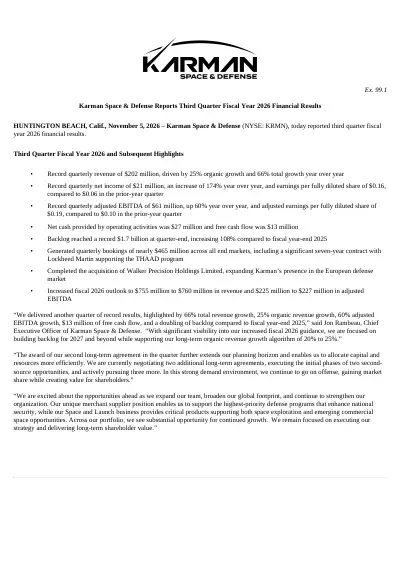
Chris will cover third quarter results and updated guidance, Jonathan will discuss demand, integration, and capacity, and I'll close with our outlook before we open the call for Q&A. Select third quarter highlights summarized on pages 4 and 5 of our presentation include: year-over-year organic revenue growth of 25%, representing growth from businesses we've owned for more than 12 months; sequential revenue growth of 11% from the second quarter; record backlog of $1.7 billion, which is more than double that of year-end 2025, and was driven by strong quarterly bookings of nearly $465 million; $13 million of free cash flow in the quarter, making good progress on our goal of $15 to $20 million of free cash in the second half of 2026, even as we've accelerated strategic CapEx investments in the first 9 months of the year to support growth in 2027 and beyond; implementation of the majority of controls necessary to remediate our material weakness, we continue to track according to plan and expect to conclude testing of all controls by the middle of 2027.
With the completion of our Walker acquisition, we now operate in the UK and the European Union, representing our first increment of international expansion. We executed a second large long-term agreement valued at $218 million with Lockheed Martin for the THAAD program and expect two additional agreements this year.
Those agreements are expected to span multiple subsystems and missile types. We anticipate firm 2026 orders for programs where annual quantities have already been finalized.
For missile types where quantities have not yet been finalized at the prime level, additional bookings are expected in 2027 as our agreements are updated. Customer orders continue to drive strong year-over-year and sequential growth.
Third quarter revenue reached $202 million, adjusted EBITDA was $61 million, and backlog rose to a new record level, providing full visibility to the midpoint of our increased full year revenue guidance. That visibility combines $535 million of year-to-date revenue with backlog expected to convert this year.
As a reminder, our backlog includes only firm, binding customer commitments. Consistent with our strategy of playing offense on second-source initiatives, we continue to pursue opportunities where customers require additional capacity.
Of the four opportunities discussed last quarter, two have now entered qualification with others still being pursued. We've added a fifth second-source opportunity for composite phenolic assemblies and remain engaged on a future lower-cost interceptor program.
In addition to our exposure to high-priority UAS, counter-UAS, and maritime programs, Karman provides subsystems on 10 of the 14 Munitions Acceleration Council, or MAC, programs. These opportunities reflect growing confidence in Karman's ability to scale, innovate, and deliver critical hardware at speed at a moment when generational demand is building.
In our space and launch end market, the demand for our solutions to support robust launch activity and new missions remains strong, but a shift in launch cadence for one particular customer resulted in a modest decline in year-over-year revenue. Chris will provide more details on this shortly.
Looking ahead, we remain focused on the three priorities I laid out last quarter. First, we will seek to deliver record financial performance while capturing a generational surge in demand across our end markets.
This is best illustrated by a recent long-term agreement for THAAD shrouds. Second, we are working to fully unlock the value of Karman, leveraging differentiated capabilities, a growing and well-capitalized development and production system, and a talented workforce.
Jonathan will discuss some examples in his comments. Third, we're making progress on our drive to deliver operational excellence through technology, capacity, and a rigorous operating rhythm.
Strong execution and visibility position us well for another record year while building a stronger platform for 2027. With that overview, I'll now turn the call over to Chris to review our quarterly and year-to-date financial performance.
Chris Boynton
Thank you, John. It's a pleasure to be with you all today.
I'm excited to be part of the Karman story and look forward to meeting more of our investors in the months ahead. Karman's unique position within today's most critical end markets, our diverse product and customer set, combined with a strong and growing culture, embraced by top-tier talent and leadership, is what first attracted me to the company.
What I've experienced and learned over the last few weeks has only reinforced my decision to join this team. Before reviewing our third quarter results, I want to take a moment to thank Mike Willis for his partnership and support during this transition period.
Mike was instrumental in helping build Karman into the company it is today, including establishing the finance organization, systems, and processes that supported our growth, strong profitability, and successful transition to a public company. Many of the capabilities that allow us to execute at a high level and deliver the strong organic growth and margin performance you see today were built under Mike's leadership.
We're grateful for his many contributions to Karman and happy to have him with us today for Q&A. Now, to our third quarter results.
We extended our momentum with another record quarter. Page 6 shows the key year-over-year metrics.
Revenue of $202 million was up 66% and 11% sequentially. Gross profit of $86 million increased by 73% with a gross margin of 43%.
Net income of $21 million grew 174%. Adjusted EBITDA of $61 million climbed 60% with a 30% margin.
Adjusted EPS of 19 cents nearly doubled from last year. Backlog of $1.7 billion more than doubled from the end of fiscal year 2025.
As a reminder, our backlog only includes firm, binding customer commitments. Bookings in the quarter totaled nearly $465 million from all end markets, including a large defense LTA that John described moments ago.
A continued focus on working capital management drove free cash flow of $13 million. Third quarter organic revenue grew 25% year-over-year, supporting our 20% to 25% annual organic growth target.
All defense end markets delivered year-over-year growth on a quarterly and year-to-date basis, illustrated on page 7. Tactical missiles and IDS revenue grew 52% to $68 million year-over-year and 45% to $176 million year-to-date, led by strength in core production programs, including unmanned and counter-UAS and emerging programs transitioning to production.
Hypersonics and strategic missile defense revenue grew 40% to $51 million year-over-year and 28% to $130 million year-to-date, driven by growth in key interceptor production and increased production associated with a new surface-to-surface missile system. Maritime defense systems contributed $45 million in revenue in the quarter, up 30% sequentially and $105 million year-to-date, driven by legacy and next-generation submarine and surface vessel programs.
Finally, space and launch revenue declined 7% to $38 million year-over-year and increased 8% to $124 million year-to-date, supported by content for both legacy and new launch providers. The increase was partially offset by a shift in ULA's Vulcan launch schedule, which is planned to resume this month.
At the same time, we saw increased orders for New Glenn in the quarter. We expect a rebound in space and launch revenue next year, supported by backlog that includes the $250 million LTA that we announced last quarter.
Our third quarter revenue mix was as follows: tactical missiles and IDS, 34%; hypersonics and SMD, 25%; maritime defense systems, 22%; and space and launch, 19%. For the 9 months ending September 30th, 2026, revenue rose to $535 million, up 59% year-over-year.
Gross profit increased to $228 million, up 67% year-over-year. Net income grew to $43 million, up from $10 million a year ago.
Adjusted EBITDA jumped to $160 million, up 55% year-over-year. Adjusted EPS climbed to 44 cents, up from 25 cents year-over-year.
Now turning to our balance sheet and cash flow. As expected for a high-growth company like Karman with growing backlog, working capital is also increasing to support higher volume.
There's a natural lag between backlog, revenue growth, and ultimately cash receipt from our customers. This is most evident in our net contract asset balance.
Other key drivers include inventory, accounts receivable, and accounts payable. We generate revenue and EBITDA when we perform the work, but cash is generated when we invoice our customers and ultimately collect payment.
During periods of rapid growth, contract assets, receivables, and capacity investments contemporaneously consume cash even though the underlying programs are profitable. As Karman continues to scale, we expect cash generation to accelerate through operating leverage and working capital efficiency.
As page 8 shows, net operating working capital has increased in dollars and declined as a percentage of revenue from Q3 2025 to Q3 2026. That improvement reflects stronger operating discipline and cash focus as we scale.
Our increasingly disciplined cash management produced $13 million of free cash flow in the quarter. This result was driven by improvements in both days sales outstanding and days payable outstanding.
We are now targeting at least $20 million of free cash flow in the second half of the year. Cash and cash equivalents totaled $68 million, up $34 million from year-end 2025.
Net cash provided by operating activities in the third quarter was $26.7 million. Turning now to capital allocation.
In order to meet growing demand, we continue to invest in capacity and capability. CapEx was $35 million year-to-date, reflecting a higher pace of investment to support our capacity expansion.
This represents a slightly higher run rate than our 5% target for the year. We continue to invest ahead of our orders to strengthen our ability to respond to the generational demand cycle we expect to persist for a number of years.
Net debt was $791 million at the end of the third quarter, an increase of $325 million from December 31st, 2025. Our Q3 net leverage ratio was approximately 3.2 times adjusted EBITDA on a third quarter run rate basis, the result of acquisitions that have expanded our platform and value proposition.
Given our expected EBITDA and free cash flow growth, we anticipate net leverage declining to below 3 times by year-end and continuing to decrease during 2027, notwithstanding any future acquisition activity. Our $150 million revolving credit facility remained untapped at quarter-end.
Our proprietary M&A pipeline remains active. We continue to pursue opportunities that expand the Karman platform and further strengthen our portfolio with no material change in seller valuation expectations.
Now, I'll provide an update on our full year guidance. Based on strong year-to-date results, record backlog, and strong visibility, we're raising our 2026 outlook as shown on page 9.
We now expect full year revenue of $755 to $760 million and adjusted EBITDA of $225 to $227 million, representing a 29.8% margin at the midpoint. This represents year-over-year revenue growth of 61% and adjusted EBITDA growth of 55% to the midpoint.
Importantly, we continue to expect 20% to 25% annual organic growth with adjusted EBITDA margins of about 30% in 2026. With full visibility for 2026 revenue, much of our growing record backlog supports our plans for 2027 and beyond, including an expectation for 20% to 25% organic revenue and adjusted EBITDA margin of 30%.
Lastly, for 2026 modeling purposes, we expect the following: an effective tax rate of approximately 5%. The decline in tax rate is driven by partial recognition of cumulative R&D tax credits that had not been previously recognized.
We do expect additional tax benefits in early 2027 as well. Converting strong customer demand for Karman's capabilities into shareholder value requires CapEx investments that we now expect to be between 5% to 6% of revenue for the fourth quarter.
We're taking a thoughtful approach to these investments to ensure that we remain just ahead of customer demand. Now, I'll turn the call over to Jonathan.
Jonathan Beaudoin
Thank you, Chris. I'm excited to share the progress we are making on operations and integration at a time when the demand environment remains strong across both legacy and emerging customers.
To ensure that we do everything possible to meet the moment, we are continuing to expand capacity to address growing customer demand. In Salt Lake City, the first set of automated production equipment is on-site and initial production has commenced.
We are onboarding talent and conducting training for newly hired supervisors, manufacturing engineers, and technicians. In Gulfport, after having completed a new logistics facility that we discussed in our first quarter earnings call, we have now broken ground on a new polymer facility for specialized naval coatings, a complementary market for our maritime work.
In Cedar City, we are expanding our facility to support increased demand for UAS propulsion systems from an emerging, privately funded UAS prime contractor that supports international customers. What's important about this capability is that it's a Karman-designed propulsion system that has already been ordered in large quantity.
Opportunities like this one are important because they will continue to scale, independent of US defense budget uncertainties or constraints. Supporting the effective use of our capacity, we are developing the next phase of the Karman Operating System, focused on enhancing the connection between demand and capacity planning, factory execution, and enterprise reporting.
Better visibility into production constraints and more consistent planning will help us use available capacity more effectively and improve delivery performance. As we continue to expand our capacity, we are closely monitoring our supply chain and are aware of no meaningful supply constraints to our growth.
Inorganic growth remains a core element of Karman's growth strategy. The effective integration of newly acquired assets has continued to strengthen the Karman platform, supporting market share increases and growth.
In one example, multiple acquisitions have led to an increase in demand for our capabilities to support a customer's lunar lander program. We are producing products for that customer in our Los Angeles facility.
In another case, our Cedar City operation enabled us to secure the meaningful new contract for UAS propulsion systems that I spoke about moments ago. Outside of the US, our integration of Walker, now Karman Europe, is proceeding well, focusing initially on financial reporting, governance, and pipeline expansion.
Our integration management office is leading the effort, applying learning from previous efforts to continuously improve outcomes. Now for an update on our AI initiative.
Our Project Moonshot has progressed from proof of concept into pilot validation at two Karman locations, applying AI to generate new value from our decades of engineering and program knowledge. Teams are using these capabilities to identify customer requirements, reuse prior engineering work, develop initial proposals, and assess win strategies.
The opportunity is to turn that knowledge into greater capacity and stronger execution. For example, being able to respond to more opportunities, shorten proposal preparation, and free engineers to focus on complex technical work.
Early user feedback is encouraging, and we are validating productivity and quality improvements to guide broader deployment. We are excited about early results and look forward to driving deeper and more meaningful outcomes with the help of AI.
Now I'll turn the call back over to John.
Jon Rambeau
Thank you, Jonathan. We built stronger momentum throughout 2026, and our business is positioned for even greater achievements in 2027 and beyond.
With the congressional midterms behind us, we anticipate renewed attention and progress in Washington on appropriations for the critical defense programs we support. Although the continuing resolution creates uncertainty, our growing backlog for 2027 provides support for continued production during a CR, while increasing allied defense budgets represent important sources of demand and funding.
For the remainder of 2026, we are focused on execution. That entails delivering on our commitments, converting two remaining long-term supply agreements, advancing two second-source qualification opportunities, and finalizing our 2027 planning cycle.
Beyond 2026, we are positioning ourselves for next-generation programs that will drive results in the years to come. Approximately 1/5 of our revenue comes from development programs today.
This mix of business ensures that we are positioned for tomorrow's production programs. Success in the coming years is grounded in a strong manufacturing capability to produce at scale to address our customers' demands.
As much as organic growth remains our top priority, we will also continue to pursue acquisitions that add complementary capabilities in the end markets we currently support. I'm proud of our team and pleased with our progress, and most of all, humbled to serve so many customers around the globe who secure our freedoms and push the boundaries of space exploration.
We have exciting work ahead. Now, let's take your questions.
Operator
We will now begin the question-and-answer session. Please limit yourself to one question and one follow-up, at which point you may return to the queue for another two questions.
If you would like to ask a question, please press star one to raise your hand. To withdraw your question, please press star one again.
We ask that you pick up your handset when asking a question to allow for optimum sound quality. If you are muted locally, please remember to unmute your device.
Please stand by while we compile the Q&A roster. Your first question comes from the line of Peter Arment with Baird.
Your line is open, please go ahead.
Peter Arment
Hey, good afternoon, everyone. Really nice results.
Hey, John, maybe you could give us a little more color on the big 7-year THAAD awards. You've got, I guess, two LTAs to remain.
How does this business scale up in terms of the production rates from here? When and what would you expect to kind of sign up the other two LTAs?
Thanks.
Jon Rambeau
Thanks for the question, Peter. It's an important one, and there's a fair amount to unpack here.
First off, we're pleased with the progress on the long-term agreement negotiations. I think, as we predicted earlier this year, where those would take through the end of 2026 to negotiate, and we are on track, I think, to that expectation.
In terms of the ramp, it's a little steeper than I think we had originally forecast in the sense that the rate of production is looking to go up pretty significantly on at least the missile types that have been defined for 2027, and sort of flatten over a period of time from there. I would say we'll see the most steep acceleration in 2027, and then continue at an elevated rate after that, not growing quite as much year-over-year from that point forward.
In that sense, we like it because the ramp's a little bit steeper. Karman has made the right investments, and we're ready to capitalize on that.
We'll certainly take that into account as we look to our 2027 planning. With respect to the two remaining agreements, those are a bit more complex in the sense that they will each span multiple missile types, some of which have had quantities finalized.
As those have been finalized, the agreements that we sign this year will include part numbers, quantities, pricing by year, and those will be bookings in 2026. There are other missile types that will be, I'll say framed out in the agreement in the sense that there'll be placeholders there for the final quantities and pricing by year to be added in, and I expect that to happen in the first and potentially even into the second quarter of 2027 until the full value of those bookings are realized.
You can expect to see a fairly substantial booking this year on each one of those agreements, and also some additional bookings in 2027.
Peter Arment
That's great to hear. Just as a quick follow-up, Chris, congrats on cash generation and obviously moving that guidance up.
Can you maybe just talk about working capital, the best way to kind of measure how you guys are doing on your progress? You've talked a little bit about that in your opening remarks, but just any more color there would be helpful.
Thanks.
Chris Boynton
Peter. I think, first and foremost, I am pleased to see results in free cash flow in the quarter of $13 million, right, while achieving the 25% organic growth.
That's given us increased confidence to hit the $20 million plus in the second half that we talked about. Ultimately, our cash conversion is a function of growth and ultimately scale.
As we think about working capital, we think about the components of working capital, both contract assets, liabilities, inventory, accounts payable, and receivable, those all represent opportunities for us to get marginally better over time. We see those opportunities.
They're in front of us, they're priorities for us, and so that will ultimately drive our working capital down as a percentage of sales. Now, with our growth, we do expect working capital to continue moving upward, however, lower as a percentage of sales.
That should be a little bit of a tailwind for us from a working capital perspective, and, ultimately, help us deliver increasingly growing free cash flow over time.
Peter Arment
Appreciate all the details. Thanks, guys.
Operator
Your next question comes from the line of John Godyn with Citi. Your line is open, please go ahead.
John Godyn
Hey, guys. Thanks for taking my question.
I wanted to just follow up on the long-term agreements as well on Peter's question. The other dimension to them was I guess some questions about the margin outlook.
You guys are reiterating 30% margins with more conviction now that you have one LTA in the bag. Maybe can talk a little bit about the LTAs and I can appreciate you don't want to disclose all the details, but to the degree they're reinforcing your margin outlook and giving you more confidence, it would be helpful if you could share kind of any color that you're willing to share.
Jon Rambeau
John, thank you for the question. I will reiterate that I feel more confident as we continue through the negotiations that we'll be able to sustain our margins, and that these LTAs will not present a headwind to the overall margin profile for the company.
The reason for that is, as I've said previously, a lot of the conversations we've had with our customers have been almost exclusively about capacity, commitment, the ability to meet some very accelerated production schedules, and do that with the right quality, and within the budget box, which typically has been stated as not to exceed last price paid plus inflation. We are certainly going to be able to do that.
As we look to the future, we feel confident that the deals we've signed so far as well as the ones that are pending will allow us to provide our customers a fair deal that gives them, I think, what they're looking for, and also presents opportunity for Karman in terms of long-term visibility into production rates, the ability to optimize the factory, the ability to work with our supply chain to receive more advantageous pricing. In total, I think it'll be a good deal for our customers and it'll be ample opportunity for Karman to manage our cost profile and achieve the margins that all have come to expect of us.
John Godyn
That's great. It's good to hear that.
Just changing gears quickly on international. Leaning into international, John, I feel like is sort of one of the things that we've heard the last couple quarters.
As we gain more and more knowledge on the international opportunity for Karman, maybe you can kind of share a bit of an update there on demand signals and the shape of that.
Jon Rambeau
Sure. First off, we've had the opportunity to engage with the customers of Walker, or as we've now named the business, Karman Europe, and the reaction to the acquisition has been favorable across the board.
Customers are pleased with our having taken the time to personally engage and sit down with them and understand their priorities. I think we'll continue to see strong support for the programs that the business has been engaged in historically.
There are new opportunities that are being brought forth by those customers, and I can assure you I'm getting a weekly report on what those are, and it's good opportunity to continue to expand the business. We also have opportunities to support some of our current US customers by offering capacity and localized footprint within both the UK and the EU.
That's something that I think would be very attractive to US primes as they look to go further expand their presence in Europe when there's a lot of pressure to produce product locally and contribute back to the local economy. I think from a number of different points of view, this is a positive acquisition for us, and we're excited about the future.
John Godyn
Appreciate the color. Thank you.
Operator
Your next question comes from the line of Ken Herbert with RBC Capital Markets. Your line is open, please go ahead.
Ken Herbert
Yeah. Hey, good afternoon.
Nice results. Maybe John or Chris, I wanted to see if we can dig into the guidance raise a little bit.
Is it possible to parse out better performance year-to-date versus inclusion of Walker now in the guide and how we think about the guidance raise with those moving pieces?
Chris Boynton
Ken. This is Chris.
I think it's a mix of both. Most of the guide range increase is driven by our performance year-to-date in our expectations for the fourth quarter.
There obviously is some Walker in that range, but I would describe most of the upside that we're seeing as a result of our increased confidence, our performance, and how we've been executing.
Ken Herbert
That's great. Thanks, Chris.
If I could, on sort of what you refer to as the offensive opportunities, the four, and it sounds like a fifth opportunity recently added. Can you just update us on timing when you might be able to announce something on those or when we should expect something that could get announced, and anything you can help with framing sort of the scope of those in terms of the opportunity in terms of revenues?
Jon Rambeau
Ken. This is John.
I'd be happy to give a little bit more insight there. I am hopeful that we'll be able to provide some specificity on if at least one, if not two of those, if not by the end of the year, certainly early in 2027 as we're continuing to make some positive progress there.
The relative size and long-term potential of those is varied, I would say. Some are more modest opportunities for long-term presence, expanded presence on existing platforms that we support today.
One in particular has the potential to have much greater long-term value to the company. In both cases, the two that are already in qualification, I would say we're probably, Jonathan, maybe a year out or so from receiving qualification on those, if not a little bit longer depending on the complexity.
Jonathan Beaudoin
To completing qual, yeah.
Jon Rambeau
To complete qualification, right? I wouldn't expect significant financial impact to the company in 2027, but certainly by the time we're hitting 2028, we should see those qualifications come through, and that's when we'll really see the benefit of those second-source opportunities.
We've got a number of others that we're continuing to work and hope to make the list longer by the time we talk to you again next quarter, but right now those are the ones that were selected and are moving along through qual pretty nicely.
Ken Herbert
Great. Thanks, John.
Operator
Your next question comes from the line of Amit Daryanani with Evercore ISI. Your line is open, please go ahead.
Yep.
Amit Daryanani
Thanks a lot. I have two as well.
Maybe just to start with the free cash flow generation that we saw in Q3, which was fairly impressive despite the organic growth. Can you maybe spend a little bit of time talking about what initiatives are really enabling this uptick in free cash flow generation, if it's one-time in nature or something more structural?
Sort of how do you think about your cash conversion cycle as you go forward, assuming that organic growth is in that 25% zip code?
Chris Boynton
Amit. Thanks for the question.
Not one singular driver in the quarter. For us, again, it's driving improvement across all aspects of it: of receipts and disbursements and the timing and the terms that we're agreeing to with our suppliers and with our customers ultimately.
It really is a mosaic overall. We did see a slight uptick in advances in the quarter, and that's good, and we continue to push for that with our customers.
Not one singular driver. As I mentioned, there will be some bumpiness to cash flow, and we do expect there to be over time some lumpiness and seasonality as we look out further.
We do expect it to be favorable, positive going forward, and feel good about the working capital improving as a percentage of sales fairly consistently.
Amit Daryanani
Super helpful. Then if I just look at the backlog number, $1.7 billion, up I think over 100% year-over-year.
Can you just talk about how much of that was perhaps driven by THAAD and the LTA versus everything else? As you look at this backlog today, how much coverage do you have for '27 revenues at this point?
Thank you very much.
Chris Boynton
When we think about sort of the back the backlog, the THAAD is was $218 of that $1.7, right, of of that LTA. There's there's a couple big chunks from from those LTAs overall, Amit.
Sitting here today as we look at the backlog and we look forward to 2027, we're in range in terms of that conversion and and what we'd expect to see, tied in. I think, from our point of view, when we look at some of those LTAs, you have to remember that the backlog will convert over years, further years into the future than maybe a typical historic bookings would convert.
There's a little bit of a longer tail to them. As we get through the fourth quarter, complete our long-range plan and our AOP, I think we'll be able to give you a little bit more insight in terms of that what that conversion looks like, and how that how that backlog will convert into 2017.
For sure, a $1.7 billion backlog for us does does really give us conviction in terms of continuing to hit our organic growth mark, growth marks of 20% to 25%. The mix and composition of what that backlog looks like does does reinforce our 30% adjusted EBITDA as well.
Got it.
Amit Daryanani
To hit or hopefully exceed your organic growth as you go forward, but congrats on the really good set of numbers in the free cash flow.
Chris Boynton
Copy that.
Operator
Your next question comes from the line of Marni Lysaght with Macquarie Capital. Your line is open, please go ahead.
Marni Lysaght
Good afternoon, team. Thanks for taking my question.
I appreciate there's been quite a fair few questions about free cash flow and also the parsing out the upgrade in guidance. My first question basically pertains to I appreciate you've given us a lot of detail about CapEx relative to revenues on a run rate basis.
How do we think about that going into '27? Would any potential timing shifts impact that?
I know that you've called out free cash flow to be subject to lumpiness intra-year. Thank you.
Chris Boynton
Of course. We see free cash flow or working capital and CapEx, the impact of it in the fourth quarter, CapEx running about 5% to 6% of sales.
That's about where we see '27, right in that range overall. Again, as we look at the demand function that we see in the system and look at building out our capacity and our capabilities, that is really driving a rigorous process for us to go evaluate our investments and evaluate our current capabilities, and make sure we're putting investments in the right places.
We're elevated a little bit from where we thought we were at the beginning of the year. I'd say we feel really good about our growth prospects from where we were as well.
We continue to see CapEx in that 5% to 6% range.
Jon Rambeau
This is John. I'll just add on from more of a practical perspective as we look at the business and how things are positioned for the future, you can kind of think about the CapEx investments that we're making this year as positioning us quite well for 2027.
As we look to next year's investments, obviously, getting capability and capacity online by 2028 is our priority. Jonathan has, I'll give him a compliment while he's here in the room with me, did a great job, I think, starting to dig in aggressively this year to look a couple years out on the horizon at what our expected demand signals were going to look like and making sure we're putting the plans in place to make those investments so that we're always staying just a little bit out ahead of demand, not too far, but far enough that we're ready to take on that additional workload when it becomes available.
I'm feeling more and more comfortable as the months tick off here that we've got a good solid plan in place for investment and how we can continue to drive that capacity expansion to support the growth.
Marni Lysaght
That's understood. Thanks.
My second question pertains to, obviously retaining the 20% to 25% annual organic growth outlook. How does Walker potentially impact that once it annualizes and starts to feed into the organic growth outlook?
Jon Rambeau
I think Walker's organic growth outlook is not that different than Karman's. I think as the base business has come into the portfolio, it's perhaps just a bit below, but still well in double-digit territory.
We are in the process of working through a pipeline update for that business, and our anticipation is coming out of that pipeline update when we sort of roll in the additional opportunities we think we can develop jointly between Karman and the legacy Walker team, we'll be able to get the base business to a steeper level of growth that'll be more in line with that full 25% that we're shooting for across Karman. Overall I like the opportunity, and I think it's going to be very much in family with the rest of the company.
Chris Boynton
Maybe just for clarification, for next year, up until the end of the third quarter, Walker growth will be inorganic, right, as we closed in the third quarter of this year. We'll see that pop into our organic numbers as we get into the last month of the third quarter into the fourth quarter of '27.
Marni Lysaght
That's understood. Thanks for answering my questions.
I'll drop back in the line.
Operator
Your next question comes from the line of Anthony Valentini with Barclays. Your line is open, please go ahead.
Anthony Valentini
Hey, guys. Thanks for taking the question here.
The guide for 2027 on the margins seems to be flat year-over-year. You guys are talking about 20% plus growth going forward.
I guess I'm curious if you guys can just help bridge a little bit of what are the offsets to maybe some of the overhead absorption, whether that's giving pricing on some of these new missile deals or the dual sourcing or increased investment. If you can just kind of help us bridge how we continue to be flat, that would be helpful.
Jon Rambeau
This is John. I'll start off, and I'll probably let Chris add a couple of comments after.
The first thing I'd say is that our focus since I've joined the company has been to create financial flexibility. The way I think about that is opportunity to reinvest further in the business, opportunity to offset any pricing pressure we might feel because we might have a strategic reason to want to take a slightly lower margin on a particular job, and we also want to have the opportunity potentially to put more to the bottom line as increased margin performance.
Our priority has been first off that financial flexibility, looking at how we can continue to realize operating leverage as the company continues to grow and scale, and also, as we look across the breadth of Karman's infrastructure, it would come as no surprise that for a company that was put together as a combination of a number of smaller businesses, there are a number of opportunities for us to continue to capitalize on to become more efficient as we continue to integrate the company. Those are the two ingredients there.
It's increased efficiency and operating leverage. The outputs are those three pieces of call it optionality, that we're looking for in the back end with the goal to certainly sustain a 30% margin rate and make sure any dividends that come out of that financial flexibility are reinvested in a way that creates the most value for shareholders.
That's the sort of top-level view. Chris, anything to add to that?
Chris Boynton
I think when we think about margin for us, it really is that mix, right, of high-value product mix and specialized moats that we have in so many places. Then the operational scaling that's enabled by, frankly, the CapEx that we're doing today in the backlog and the pipeline and the growth that we have should enable us to drive those gross margins in a positive direction.
Then SG&A, right? It's about SG&A discipline and leverage, and making sure that as we are scaling, that we're dropping through G&A to the bottom line, but also making sure that we're making the right investments internally to be able to develop the staff and capabilities here to operate as a larger company.
Anthony Valentini
Great. That's super helpful.
Then maybe just another one if I think you guys are mentioning that there's two dual-sourcing opportunities. Are there any on the opposite end of that that are out there that you know of where you're on something today and it might get dual-sourced?
John,
Jon Rambeau
I'll comment on that piece, Anthony. The short answer is nothing of substance, nothing of consequence at this point in time from a second-source point of view.
Having been a prime myself for 30 years and having talked to our customers who are primes, the first priority for them is surety of supply. The dual-source initiatives are generally starting with places where there are pressure points in the supply chain where there is questionable capacity to meet the overall demand for the integrated systems.
Because Karman has leaned in and invested ahead of need, we are not generally the priority for second-source initiatives. We have had, and I've talked about previously, one customer who has a desire to establish an internal insurance policy in the event that for some reason Karman would have a shortage, an inability to deliver at a point in time.
It's a very small percentage of the total annual demand. The net increase for Karman is still substantial year-over-year as we look at the future ramp, and we're working collaboratively with that customer to help them establish that internal, call it an insurance policy.
Other than that, there's really been nothing else that we're aware of in terms of substantive second-source initiatives, and we intend to continue to earn that right to keep that work by delivering, by performing, and being a good partner. I think it's a good news story, and we're much more bullish on the second-source initiatives as more of an opportunity for us to grow as compared to a need to defend.
Anthony Valentini
Great. Thanks, John.
Operator
Your next question comes from the line of Patrick McCarthy with Oppenheimer. Your line is open, please go ahead.
Patrick McCarthy
Great. Thank you.
Thanks for taking my question. Chris, thanks for touching on your year-end leverage expectations.
That's very helpful. My question is on the tactical missiles business, and I was wondering if you could share with us how that breaks out between your UAS-focused products, your counter-UAS focused products, and then some of the more traditional missiles like MLRS and AIM-9X and those guys?
Jonathan Beaudoin
Do you want to--
Chris Boynton
Go ahead, Jon.
Jonathan Beaudoin
We're seeing strong growth drivers from all of those product lines. Those that are MAC, or sometimes we call MAC-adjacent programs where stockpiles have been depleted and they're increasing production rates, we're seeing demand for those systems, as well as the proliferation of UAS systems and then correspondingly counter-UAS systems are all providing really strong growth drivers for us within that market segment.
Patrick McCarthy
Thank you.
Operator
Your next question comes from the line of Clarke Jeffries with Piper Sandler. Your line is open, please go ahead.
Clarke Jeffries
Hi, thank you for taking the question. John, I just wanted to understand this aspect of 2027 volumes and where they may not be solidified in the ecosystem and just how that's concentrated within the programs.
Is that primarily within the MAC priority programs where you'd see a substantial bookings event in 2027 when there's more clarity? Do your customers ever commit to just a minimum level even if they don't know the full sort of uptake or upside scenario?
Do they still make a quantity decision at this time at a minimum level? Any context would be helpful there.
Jon Rambeau
I don't anticipate that we'll be booking any speculative minimum quantities this year. What we've done historically and what we'll continue to do is we'll book the firm, binding commitments that are coming in.
There are some references made in the draft agreements that we're still negotiating to the additional missiles that have not yet been finalized, right, at the prime level, and that there would be an expectation, for example, that those volumes will come through at least as what they've been historically. Of course, we believe those are probably floor or below floor kinds of numbers, but we're not anticipating any bookings on those numbers at this point in time.
We'll get as much detail as we can, but realistically speaking, we've certainly got a number of additional missile types that will continue to roll on to those contracts and show up as bookings in 2027.
Clarke Jeffries
Just one follow-up to that is: are the ones that are the most secure the ones that have already gotten multi-year procurement authority? Is that true?
Then just on the maritime segment, I wanted to ask how that performance was versus your plan? It seems like a little bit higher than we were estimating.
Thank you.
Jon Rambeau
On the first question, the answer is yes.
Chris Boynton
Secondly, Clarke, that maritime is performing really well ahead of our plans year-to-date and a really strong outlook.
Clarke Jeffries
Great. Thank you very much.
Operator
Your next question comes from the line of Louie DiPalma with William Blair. Your line is open, please go ahead.
Louie DiPalma
John, Chris, Jonathan, and Steve, good afternoon.
Jon Rambeau
Hi, Louie.
Chris Boynton
Hello.
Louie DiPalma
Hey. John, you announced how you established the framework agreement for the THAAD system, and on the earnings call, you mentioned how you're on over 150 programs, including 10 of the 14 MAC programs.
I was wondering, what was so unique about THAAD that resulted in the framework agreement for that program versus the other 9 MAC programs that you're on, or even the other 140 plus programs that you're on? In that, do you have, would you say less visibility or less confidence in your long-term positioning for the other programs that didn't result in framework agreements, or are you still negotiating framework agreements for the other MAC programs?
Jon Rambeau
Thanks. Thanks for that, Louie.
It's a very simple and very straightforward answer to a very good question. The reason we announced THAAD with Lockheed Martin is because that is a relatively rare instance when we are under contract directly to Lockheed Martin as the prime missile integrator.
That long-term agreement was for the shroud that goes on the front end of the missile. The large majority of what we do across the MAC programs is more at the back end of the missile as parts of the solid rocket motor, typically the nozzle that goes on the back of those motors.
Those agreements are being negotiated with the solid rocket motor providers, and I'm sure you know who those primary providers are. For each of those companies, we have a number of missile types we support with similar products that go at the back end of the missile.
We're negotiating those as a bundle. That's why the Lockheed Martin agreement came out first, because, A, they had their prime contract before the solid rocket motor providers had theirs, and also because the other two contracts are a bundling of a number of different part numbers across a number of different missiles, those are naturally going to take a little bit longer.
Very very good question, and that's the reason why.
Louie DiPalma
Thanks. Are there expectations to establish multi-year agreements with the solid rocket motor providers for the other programs, or should the agreements continue to be like the traditional annual agreements that you've had historically?
Jon Rambeau
The agreements will be 7-year agreements. They're already drafted and we're in the process of negotiating up to even this morning, having a chat with one of my counterparts.
We're working through both of those, and as I said, expect to have the agreements signed this year and be able to book the missile types that are already well-defined from a price and quantity point of view. It's looking good, and we're expecting full 7 years on both of those, Louie.
Louie DiPalma
All right. Thanks, John.
Thanks, everyone.
Operator
Your next question comes from the line of Michael Leshock with KeyBanc Capital Markets. Your line is open, please go ahead.
Michael Leshock
Hey, good afternoon. I wanted to ask within space and launch, what do you view as the biggest growth opportunities there outside of maybe just traditional launch or rockets?
You mentioned the Vulcan dynamics and the lunar lander customer, and just as we look to 2027, is it primarily rockets and propulsion systems that would drive the vast majority of growth within space, or are you finding new opportunities outside of just launch that might be newer programs for Karman that could become pretty meaningful over time just as the broader space industry continues to evolve?
Jon Rambeau
Michael, I'd love to talk a little bit about that with you. First off, I would say the mix today is pretty heavily skewed, as you suggested, toward more of the launch, think about the launch vehicles and the engines that propel them, right?
As time goes on, we anticipate the mix will shift a bit as we see more and more opportunity, whether we're talking about space vehicles, lunar landers, other applications that'll be stationed in space versus the things that get them there. We are looking at all opportunities to continue to grow our space and launch business, that includes organic as well as some inorganic opportunities we're continuing to evaluate.
I think you'll continue to see some acceleration in space as we transition into 2027 and start to capitalize on that larger addressable market that we're seeing continue to unfold quite favorably.
Michael Leshock
Great. Then shifting to the second-source opportunities, what has the competitive environment looked like when you're pursuing those opportunities?
Is it kind of a competitive process with multiple players, or is it more so focused on having proven capabilities that are necessary for the customer and in qualifying those, and is price a big differentiator? Just any color you can provide on how that process looks would be very helpful.
Jon Rambeau
Sure. It is a mix.
First off, I would say that price is a discriminator certainly to the extent that they don't want somebody more expensive than what they're paying today, but overall not necessarily the driver. The price is not the driver, it's more about capacity and the surety of supply.
In some cases, we've gotten phone calls from customers who have said, 'Look, we've seen from Karman previously a proposal for this capability. Is this something you can still provide?
How would you be able to provide that? On what timeline?'
There were some where we got phone calls and were asked to bid because of prior work we had done with those customers and they knew about our capabilities. There were other cases where we were asked to bid competitively on opportunities to establish a new source, and one of the cases that we were selected was exactly that, it was a competitive process.
Again, price was a consideration, but it was more about confidence in Karman's capabilities and ability to deliver to support the demand increase. Whether it's an instance of us going and talking to a customer to explain our capabilities and to look for opportunities, or sometimes picking up the phone, it comes from multiple sort of avenues, and the processes vary each to the next.
Michael Leshock
Great. Thanks for all the detail.
Operator
As a reminder, if you would like to ask a question, please press star one to raise your hand. To withdraw your question, please press star one again.
We ask that you pick up your handset when asking a question to allow for optimum sound quality. If you are muted locally, please remember to unmute your device.
Your next question comes from the line of Hrishi Kumbhojkar with Guggenheim. Your line is open, please go ahead.
Hrishi Kumbhojkar
Hi, good afternoon. Quick question on maritime defense: how should we think about the long-term trajectory of that segment and or as a percent of the total end market?
Thank you.
Jon Rambeau
This is John. I'll offer a little bit of thought there.
Certainly, maritime defense is an area where we continue to see very strong demand. It's a place where Karman has established a very strong position on manned submarines, and as you're aware, there've been some very substantive orders in that space not in the not-too-distant past here that will continue to push volumes through the shipyards at an accelerated rate, and we're well-positioned to capitalize on that growth trajectory.
The other area that we're continuing to see some traction in the maritime defense area is with unmanned systems, both surface and subsurface. As with the Karman model across other end markets, we are continuing with our strategy of being a merchant supplier to multiple providers of unmanned surface and subsurface vehicles.
That's another vector for growth for us. It's an area where I think particularly the US Navy strategy is somewhat unclear still in terms of where the real volume is going to come from, but the overall commitment to unmanned naval systems continues to grow, and that's an area where I think as a merchant supplier, we'll continue to see demand.
Certainly I would see long-term growth in the double digits, perhaps not growing quite as fast as say tactical missiles or unmanned systems, but certainly strong growth projections for maritime as well.
Hrishi Kumbhojkar
Appreciate it. Thank you.
Operator
There are no further questions at this time. I'll now turn the call back to Jon Rambeau, CEO, for closing remarks.
Jon Rambeau
Thank you. Before we close, I just want to offer three points to summarize today's call.
First, we again delivered record quarterly results and remain positioned for 20% to 25% annual organic growth. Second, we're strengthening the Karman platform through international expansion, new capabilities, deeper customer relationships, and a continuing focus on cash generation.
Third, we continue to focus on operational efficiency and operating leverage to sustain adjusted EBITDA margins of about 30%. I remain grateful to our employees for their dedication to serving our customers and delivering strong results for our shareholders.
Thank you for joining us and for your interest in Karman Space & Defense. Our SEC filings and company news are available at karman-sd.com.
We look forward to speaking with you following our next quarter.
Operator
This concludes today's call. Thank you for attending.
You may now disconnect.