Karat Packaging Inc.
Q3 FY2026 · Earnings Call TranscriptNovember 5, 2026
Operator
Ladies and gentlemen, thank you for standing by. Hello, and welcome to Karat Packaging's third quarter of 2026 financial results conference call.
All lines have been placed on mute to prevent any background noise. Now, I would like to turn the call over to Roger Pondel of Investor Relations.
Please, go ahead.
Roger Pondel
Thank you, Operator. Good afternoon, everyone, and welcome to Karat Packaging's 2026 third quarter conference call.
I'm Roger Pondel with PondelWilkinson, Karat Packaging's investor relations firm. It'll be my pleasure momentarily to introduce the company's Chief Executive Officer, Alan Yu, and its Chief Financial Officer, Jian Guo.
Before I turn the call over to Alan, I want to remind our listeners that today's call may include forward-looking statements within the meaning of the Private Securities Litigation Reform Act of 1995. Such forward-looking statements are subject to numerous conditions, many of which are beyond the company's control, including those set forth in the risk factors section of the company's most recent Form 10-K, as filed with the Securities and Exchange Commission, and copies of which are available on the SEC's website at www.sec.gov, along with other company filings made with the SEC from time to time.
Actual results could differ materially from these forward-looking statements, and Karat Packaging undertakes no obligation to update any forward-looking statements, except as required by law. Please also note that during today's call, we will be discussing adjusted EBITDA, adjusted EBITDA margin, adjusted diluted earnings per share, and free cash flow, which are non-GAAP financial measures as defined by SEC Regulation G.
A reconciliation of the most directly comparable GAAP measures to the non-GAAP financial measures is included in today's press release, which is now posted on the company's website. With that, it is my pleasure to turn the call over to CEO Alan Yu.
Alan?
Alan Yu
Thank you, Roger. Good afternoon, everyone.
We delivered solid top-line growth in the third quarter, with net sales increasing more than 8% to about $135 million. We experienced continued strong momentum in our e-commerce business, where online sales grew nearly 38% compared with the prior-year quarter.
While increased import costs, higher domestic shipping costs, and elevated resin prices pressured margins, and contributed to the results below our expectation, we remain encouraged by the resilience of demand across our business. We continue success in new account wins, and the strength in our pipeline.
We are confident in our long-term growth prospect. In October, we began shipping select products to the four new chain accounts that we secured in the second quarter.
Notably, we expanded these relationships during the third quarter, winning additional business across multiple product lines, such as paper bags, bagasse trays, and others, with shipments expected to begin in early 2027. Building on these wins, we recently secured four additional chain accounts, further expanding our distribution footprint.
We believe these new relationships underscore the appeal of our broad product offering, flexibility, and outstanding service, as well as our reliability as a value supplier. These new business wins support our continued focus on deepening Karat's market penetration on the East Coast and Midwest.
Sales on the East Coast grew 19% year-over-year, while Midwest sales increased 22% compared to the prior-year quarter. Beyond these new accounts, we are testing phases with other large chains across different product categories.
We are also building inventory to prepare the shipments in the first and second quarter of 2027. Our new 47,000-square-foot distribution center in Orlando, Florida is expected to be fully operational in November 2026 to serve customers throughout the Southeast.
The facility is expected to strengthen fulfillment capabilities for our growing e-commerce business, help reduce delivery time, and provide additional infrastructure to support future growth. To address elevated oil prices and ongoing cost pressures, we continue to realign and optimize Karat's global supply chain, and diversify sourcing for regions with more favorable trade conditions and freight costs, including Indonesia, Malaysia, and South America.
We have also implemented price increases on select items this month, and we expect to implement additional price increases early next year to help offset higher costs. Aggregate purchases from Indonesia, South America, and Malaysia increased to 19.4% of total sourcing, while sourcing from Taiwan, China, and the U.S.
accounted for 39.1%, 14.4%, and 16.7%, respectively, of total purchases. We believe our expanded distribution capacities, together with our supply chain and pricing initiatives, along with the continued strength of our online channel and new chain account wins, will position Karat to accelerate revenue growth and improve operating performances and profitabilities in the quarters ahead.
I will now turn the call over to Jian Guo, our Chief Financial Officer, to discuss the company's financial results in greater detail. Jian?
Jian Guo
Thank you, Alan. I'll begin with a summary of our Q3 performance, followed by an update on our guidance.
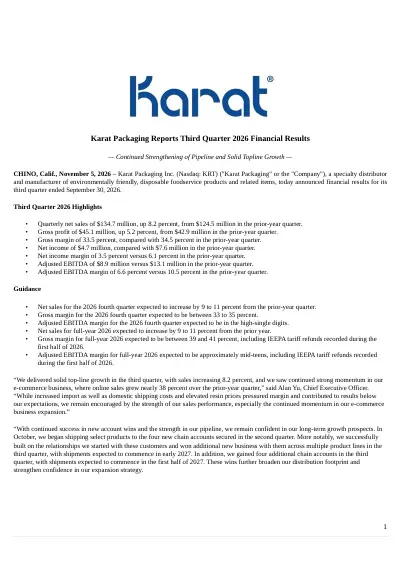
Net sales for the 2026 third quarter increased to $134.7 million, up 8.2% from $124.5 million in the prior-year quarter. The increase primarily reflected $10.7 million in volume growth and product mix, and a $0.4 million favorable impact from pricing, partially offset by a decrease of $0.8 million in shipping and logistics revenue.
As Alan mentioned earlier, online sales rose 37.7% in the third quarter of 2026, compared with the prior-year quarter. Sales to chains and distributors, our largest sales channel, increased 3.9% year-over-year, and retail channel sales declined 18.4% from the third quarter of 2025, primarily due to lower logistics service revenue.
Cost of goods sold for the 2026 third quarter increased 9.8% to $89.6 million from $81.6 million in the prior-year quarter. This increase was primarily driven by higher product costs of $7.2 million due to higher sales volume and resin prices, as well as higher import costs.
Ocean freight costs increased $2.4 million, including a 17.0% increase in average container rates and an 11.7% increase in the number of containers imported versus the prior-year quarter, partially offset by a decrease in duty and tariff costs of $1.1 million compared with the prior-year quarter. Gross margin for the 2026 third quarter increased 5.2% to $45.1 million from $42.9 million in the prior-year quarter.
Gross margin was 33.5% in the 2026 third quarter, compared with 34.5% in the prior-year quarter. The decrease was primarily driven by higher product costs, which represented 50.6% of net sales, compared with 48.9% in the prior-year quarter.
The increase in product costs was partially offset by lower depreciation expense to 1.0% as a percentage of net sales, from 1.3% in the prior-year quarter. Operating expenses in the 2026 third quarter increased 17.2% to $40.3 million from $34.3 million last year.
The increase primarily reflected higher shipping and transportation costs of $2.8 million, mainly due to the increase in online shipping costs of $2.1 million, platform fees of $0.9 million, and online marketing expenses of $0.7 million. Additionally, salaries and benefits increased $0.9 million, warehouse expenses increased $0.4 million, and stock-based compensation expense increased $0.4 million.
Operating income in the 2026 third quarter was $4.9 million, compared with $8.6 million in the prior-year quarter. Other income, net, for the 2026 third quarter was approximately $1.0 million, compared with $1.3 million in the prior-year quarter.
The decrease was primarily due to a $0.5 million decline in the gain on foreign currency transactions. Net income for the 2026 third quarter was $4.7 million, compared with $7.6 million for the prior-year quarter.
Net income margin was 3.5% in the 2026 third quarter, compared with 6.1% for the prior-year quarter. Net income attributable to Karat for the 2026 third quarter was $4.4 million, or 22 cents per diluted share, compared with $7.3 million, or 36 cents per diluted share, in the prior-year quarter.
Adjusted EBITDA for the 2026 third quarter was $8.9 million, compared with $13.1 million for the prior-year quarter. Adjusted EBITDA margin was 6.6% of net sales for the 2026 third quarter, compared with 10.5% for the prior-year quarter.
Adjusted diluted earnings per common share was 24 cents for the 2026 third quarter, compared with 37 cents per share in the prior-year quarter. As of September 30th, 2026, we had working capital of $87.0 million and $37.0 million in financial liquidity, with another $10.0 million in short-term investments.
During the third quarter, we generated operating cash flow of $9.7 million and free cash flow of $9.1 million. We paid a regular quarterly dividend of 47 cents per share to shareholders on August 28th, 2026.
Additionally, Global Wells, our consolidated variable interest entity, fully repaid the remaining balance of $11.2 million on one of its term loans that matured on September 30th, 2026, further reducing our consolidated leverage ratio going forward. During the third quarter of 2026, the company did not repurchase any of its common stock under its previously announced share repurchase program.
For the first three quarters of 2026, the company repurchased a total of $2.0 million of its common stock. As of September 30th, 2026, approximately $10.0 million remained available for future repurchases under the program.
On November 3rd, 2026, our Board of Directors approved a regular quarterly dividend of 47 cents per share, payable on or about November 27th, 2026 to stockholders of record as of November 19th, 2026. Alan outlined the initiatives that we are implementing to support our long-term growth and enhance profitability in the quarters ahead, while navigating significant pressure from resin products and oil prices.
Against this backdrop, I'll provide an update to our guidance. For the 2026 fourth quarter, we expect net sales to grow by 9% to 11% from the prior-year quarter.
We expect gross margin for the 2026 fourth quarter to be within 33% to 35%, and adjusted EBITDA margin to be in the high single digits. For the full year of 2026, we expect net sales to grow by 9% to 11% over the prior year.
We expect gross margin for the full year 2026 to be between 39% and 41%, and adjusted EBITDA margin to be in the mid-teens. Both margin expectations include IEEPA tariff refunds recorded during the first half of 2026.
Alan and I now will be happy to answer your questions, and I'll turn the call back to the operator.
Operator
Thank you. A quick reminder before we start the Q&A: if you'd like to ask a question, please press star and number one on your telephone keypad to raise your hand and enter the queue.
If you'd like to withdraw a question, simply press star one again. We would like to advise that you pick up your handset when asking for optimal sound quality, and if you're muted locally, please remember to unmute your device.
We will take our first question from Ryan Meyers from Lake Street Capital Markets. Please go ahead.
Ryan Meyers
Hey, guys, thanks for taking my questions. First one for me, can you just walk us through what you saw on the revenue side of the business during the quarter, and where the delta was for the growth rate, where it actually came in at versus where you guys had guided to?
Alan Yu
Sure. For the third quarter, we missed that revenue by $2.5 million.
One thing is we expected some of the chain accounts to start pulling the orders, they have been delaying for testing purposes. They will be pushed forward into the fourth quarter.
That's why we were looking at the guiding the fourth quarter to be in the 9% to 11%, because they were supposed to take in their third quarter, they move forward into fourth quarter. At the same time, we have been adding additional new chain account that has signed up to start in the first quarter of 2027.
We will be ramping up inventory in the fourth quarter for them to start taking in the first quarter. It's one of the common practice for the chain account is they, even though they committed to buying from us, pull from us, they have to deplete their inventory from the previous vendors.
Often that kind of push us away in terms of guidance.
Ryan Meyers
Makes sense. Then thinking about where gross margin came in at, a little bit below the prior guidance, can you just break out how much of that was driven by the resin costs versus ocean freight versus domestic shipping, and if there was any other factors, and then how we should think about the impact there in the rest of this year, and then maybe what cost pressures you think could persist into 2027?
Alan Yu
I can give a kind of a idea on the ocean freight side first. Ocean freight, our contract rate is about $2,500 that we signed in the second quarter, was supposed to start in May 1st.
During the third quarter of the year, because of oil price increase and the Iran war issues, the carriers have been raising their peak season charge, adding bunker fees and additional fees, and shorting on the containers, we have to pull additional containers not from the traditional contracts. Our rate have been basically averaging about $4,500 to $6,000 a container.
We were expecting about to pay $3,500 based on normal peak season surcharge, and normally the peak season is for a couple months only, and this year it extended even longer period of time. Also, the carriers didn't remove the peak season and the bunker.
They added bit additional fees, claiming that the Iran war has raised the price of the oil gas, and delaying the shipment, there's a overdemand. We're fortunate paying $4,500 to $6,000.
We're seeing other non-contracted people paying, our competitors have been paying, $7,000 to $10,000 for the East Coast. For us, we happy to competitive on the ocean freight compared to other people.
Now, going forward, we're seeing that the containers cost did not reduce during the month of October. It kind of slowly dropped a little bit.
We're hearing that the costs should be coming down in the fourth quarter, the last month, December of this year. As yesterday, we knew that the midterm election was over, and a lot of these carriers are looking like they will reduce the bunker fee and peak season earlier.
We're waiting for to see when they will start.
Ryan Meyers
Got it. Thank you for taking my questions.
Thank you.
Operator
Thank you. Our next question comes from the line of George Staphos from Bank of America.
Please go ahead.
George Staphos
Hi, everyone. Good evening.
Thanks for taking my question. Congratulations on the progress.
I guess my first question, Alan, to the extent that you would have a view on this two days after the fact, does the election outcome change what you think the buying preferences might be over the next year and how are you positioned for it? Do you need to worry at all, or do your customers have to worry at all?
Does it mean the likelihood of more fiber versus plastic? How would you have us think about that, to the extent that you might have a view?
Second question, retail was down 18%. You might have mentioned in your remarks and I missed it, but what was driving that?
Then the pipeline, you talked about adding the new retail outlets and having new products, help us understand how that might add to your revenue base for '27.
Alan Yu
Sure, George. Now, first to go to the question for the election.
Now, well, with the election, first of all, originally that we were wondering if the Iran war was going to continue, because there were threats from the president that after the election he was going to go all out with the war and bomb Iran, which we would expect the oil price go even higher, that will basically raise the price of all the resin and costs. We actually, in the third quarter, we did not actually take any step into raising prices to our customer, passing the costs to our customer.
We were anticipating the war to end, because every time there's a peace talks, I'm sure you heard the peace talk during the third quarter, that it was going to end. We thought that it was going to end, but it didn't.
After the election, it seems like the war is going to end. We did not account for the war to be ended two a week ago.
We actually made a price increase announcement. In October, we added a fuel surcharge to kind of offset some of the costs on delivery.
November, we actually announced a price increase, which we started two days ago, a price increase across the board for most of our client, except for some chain account. Some chain account, we did add price increase.
We also just last Friday, we announced another price increase, a bigger price increase, January 1st of 2027, 3% to 13% price increase. Because we feel that we can't rely on the fact that the war is going to be over, that the resin costs is going to come down, the cost of the delivery.
One key thing that impacted our margin is online shipping. We use UPS for online shipping.
Actually, it was FedEx. Okay.
We use FedEx for online shipping. They have a fuel surcharge scale that go up and down.
With the diesel price going up, the fuel surcharge was up as much as 40%. We're paying more, the more we sell online, we're paying more.
We can't pass on this to online customer, because a lot of these are the prepaid online orders or we actually have a fee to it. With the anticipation now that the war is going to end, and the gas prices come down earlier in the fourth quarter, we feel that with our price increase and the decrease in the diesel prices, delivery costs, that is definitely going to help our margins to normalize, and we see not our margin deteriorating even further down.
I feel that with the midterm election result, is going to have a favorable effect on the cost of the oil prices. That's one.
Second, with the Democratic Party winning the election, there will be, most likely, the states will be pushing more further into compostable, more biodegradable products, eco-friendly items, which we have been gaining traction in terms of the bagasse products, fiber products, and also the paper products. As I mentioned earlier in our calls, now we have a few additional pipeline.
Most of these additional pipeline are related to the fiber products and the paper-related products. Some are plastic cups, but mostly are the fiber products that we wanted to push forward.
We feel that in 2027, our fiber, paper growth can grow as much as double. That's how we feel for the 2027 year.
The margin is actually a little bit higher on the fiber side, because our competitors has been enjoying a higher margin as we come in. Even though we're being competitive, we're still seeing a better margin than selling traditional paper or plastic cups.
George Staphos
Okay?
Alan Yu
Did that answer the two the questions?
George Staphos
Alan, that's great. I just want to ask, just point of clarification, I think you said your fiber, paper sales can double?
Alan Yu
Just want to make sure it wasn't a
George Staphos
double digit, you expect it would double.
Alan Yu
Then
George Staphos
can you give us rough sizing? Is paper half your portfolio, 5% of your portfolio, just size it relative to the whole of Karat?
Double.
Alan Yu
Right now, currently, we have a revenue in terms of calculating a bagasse sales monthly, it's around $850,000. We don't have a big base of the fiber product line.
Now, doubling that will be $1.6, $1.7 million total in revenue per month, basically it will get that. Our paper shopping bag business, I think Jian might have a better idea in terms of what is our current paper shopping bag in terms of winning additional Because on our pipeline, we're seeing more and more paper companies coming toward us for the paper shopping bag, mainly chain account.
When we mention about the four pipeline, five pipeline, these are all national chain accounts that we're converting into the fiber and also paper products. That's why we are more confident in terms of 2027.
Actually, this election is going to be and also the ending of the war, and also, recently, there will be a shortage, a major shortage of the products that I'm seeing just as bad as 2022 right now for the next couple months. Inventory-wise, yeah.
Got it.
George Staphos
Of everything, or just the paper?
Alan Yu
Everything.
George Staphos
Okay.
Alan Yu
Because of the container. One of the ways that the shipping company have been able to raise their prices and gouge all these importers is by reducing shipping space.
They cancel almost 40% of the shipping coming to North America. They can create a kind of a shortage and raise their price.
Container coming out of Indonesia, most of the importer can get 50% out of the 100% buy 50 out of 100 containers they want. Out of Vietnam right now, they can probably get 30 containers out of 100 containers they need.
Fortunately, we have more experience in terms of dealing with the situations. We're getting about 70% to 80% what we need for our product.
We will at least have product in our warehouse. We have been seeing shortages.
We're having shorting customers. We try to fulfill as much as we can, but during the latter part of the third quarter, we have to started shorting customers.
The fourth quarter, we're seeing shortages, that's why the price increase is necessary.
George Staphos
Understood. I want to turn it over to the others to be fair, but just on the last question, just on retail being down 18%, what was driving that?
Thanks, Alan.
Alan Yu
No problem. Jian, can you answer that question?
Jian Guo
Because
Alan Yu
I know that our online sales is up, but the retail side down 18%, I wasn't aware of that.
Jian Guo
Yeah. Yeah.
Retail, I'll take that question. Hi, George.
On the retail side,
George Staphos
the decline was [part?] [laughs]
Jian Guo
The decline was primarily in the logistics services. That's a really small piece of our revenue stream, is we have our own fleet provide logistics services to some of our customers.
Almost the entire amount of the decline in retail channel is logistics sales revenue.
George Staphos
Okay. I will turn it over.
Thank you very much.
Operator
Thank you. Our next question comes from the line of Michael Francis from William Blair.
Please go ahead.
Michael Francis
Hi, Alan, Jian. Thanks for the questions.
This is Mike on for Ryan. Wanted to start with the new chain accounts.
Can we get a sense how quickly it takes those to ramp from the first shipment to sort of a full bore?
Alan Yu
Some of these chain account, they'll actually do a regional test, and then full blown. Majority of the chain that we deal with, they would actually start when we have all the inventory available to ship in all of our distribution centers.
What we normally do with the chain is, for instance, example, a chain with 500 stores, they need us to ship to eight of their different locations, distribution centers. We have to put product into California, Texas, South Carolina, or Washington.
A lot of times, we get our product into California, then we transfer them into Texas and other places. At the same time, we ship directly from overseas into Washington, and New Jersey, and South Carolina.
To us, it's just ramp up. First, we have to tell them we have the inventory, approximately when, and when will they be depleted their inventory from the previous vendor.
Sometimes they're accurate, sometimes they're a little bit off. Sometimes the previous vendor will tell them, "Hey, they found extra one-month inventory."
They ask us to wait for extra months. Normally, it will be 90 days to start shipping for the first shipment into the DCs, if basically everything's okay.
Michael Francis
Okay. Then on the gross margin side, you gave the drivers.
It seems like the container rates is a big piece. What were the things that caught you off guard the most there?
Then as we think about 2027, you talked a little bit about what recovers, but what do you think might be the first sign of a recovery if that starts to improve?
Alan Yu
The resin costs increased the most. In most years, most cases, resin costs, the raw material costs spike up for a couple months, and come back down.
This year, everybody, not just ourselves, anticipated the war to be ended quickly, no more than three months. This war has started since March, and basically it didn't end until the day of midterm election.
That part of it was the biggest part that caught us off guard. Because when we thought that the war end, the oil price would come down sharply as well as the raw materials.
That's one thing. Also, with the war going on, the oil prices continue to rise with the diesel price going beyond $6.50, $7.50 a gallon, our delivery costs went up.
Majority of our contract are delivered price. We actually added the cost of the delivery into the product itself.
When the oil price is high, we have to absorb that cost. Once we began realize this war is not ending, we finally announced a price increase and fuel surcharge in October 1st, November 1st.
That's where we see that we cannot rely on from what we were hearing from the government that the war is ending. Basically we wanted to help our customer to see that if this is going to end, we wouldn't have to raise the price.
It was to a point that we had to raise our prices for our customer. Initially, we raised a nominal number basically on October, and a different number in November.
Then we just made an announcement that we have to go even higher in January 1st, because now it's not only the oil prices is causing the price to go up. The disruption in ocean freight is going to cause a disruption in the supply chain throughout not just us, for every importer, manufacturer that purchase from overseas in Asia, is going to see a major supply chain disruption in the upcoming months.
We are prepared for it, basically. I'm sure that we will be benefiting additional revenue.
At the same time, with us raising the prices, our customers not going to be complaining, because you can't find product out there in the market in the next two months.
Michael Francis
Okay. Then last one for me.
Are the chain accounts you're winning, is there a difference in the profitability of those and some of your existing business or sort of your overall business profile?
Alan Yu
The chain account likes to have that stability in prices. It's more of a kind of a business relationship that if we can absorb the price costs.
Passing the chain price mainly on a yearly basis, unless there's a major issue. In this case, we did kind of tell the chain that, "Hey, the war is more like a force majeure situation."
We did increase a nominal increase in the fourth quarter, the latter part of the third quarter starting, in some chain. Some other chains, in the first part of the fourth quarter.
Other chains, we made announcement that first month of the year, January 1st, is when their price increase take place. Because we know now that basically the raw material might not come back down to normalization anytime soon.
The chain understood, because they know they themself are getting the price increase notice from every vendor out there, from their food supplier, from the distribution center that help them distribute the product to the store, like Sysco and US Foods. Everyone's putting a fuel surcharge, not 5%, but more like 15%, 20% fuel surcharge, on top of the normal delivery fees.
It's become a norm that if you don't raise your price, you're just taking a hit on the margin side. We are taking action in terms of protecting our margin in the fourth quarter and first quarter ongoing.
Jian Guo
On that, I just wanted to Uh-huh. also add a couple data points just maybe to help qualify, help us quantify thinking about really the pressure on the margin side.
I know we talked about Alan talked about the resin price, the ocean freight, just some additional data point here is over the past couple of years, our average product cost as a percentage of total net sales is about 47%. That's our average.
Q3 2026, we were at if a little over 50%. That's so obviously just the majority of our product costs, it's it's our imported finished goods.
Very closely correlated to resin price. Then on the ocean freight, our average is about 11% over the past couple of years.
Q3 2026, we were at 14.2%. Just wanted to add some data points there.
I know Alan also talked about the price increases that were implemented in Q3, sorry, in Q4, as well as that were the increases we're planning to implement into Q1 2027 to help offset some of the pressure that were was facing on our mar- margin side.
Michael Francis
All right, very helpful. I'll pass it on.
Thank you.
Operator
Thank you. We have reached the end of the Q&A session.
I will now turn the call back over to Alan for closing remarks.
Alan Yu
Thank you, Operator, and thanks to everyone for joining us today. We're encouraged by the positive sales momentum and geographic expansion.
We remain focused on executing our growth strategy, and look forward to keeping you updated on our continued progress. Have a nice day.
Operator
The meeting has now concluded. Thank you all for joining, and you may now disconnect.