Lear Corporation
Q3 FY2026 · Earnings Call TranscriptOctober 30, 2026
Operator
Good morning, and welcome to the Lear Corporation Third Quarter 2026 Earnings Conference Call. All participants will be in a listen-only mode.
Should you need assistance, please signal a conference specialist by pressing the star key followed by zero. After today's presentation, there will be an opportunity to ask questions.
Please also note today's event is being recorded. This time I'd like to turn the floor over to Tim Brumbaugh, Vice President, Investor Relations.
Please go ahead.
Tim Brumbaugh
Thanks, Jamie. Good morning everyone, and thank you for joining us for Lear's third quarter 2026 earnings call.
Presenting today are Ray Scott, Lear President and CEO; Jason Cardew, Senior Vice President and CFO; and Jared Fedele, Vice President of Finance for Seating and E-Systems, who will succeed Jason as CFO starting in March. Other members of Lear's senior management team have also joined us on the call.
Following the prepared remarks, we will open the call for Q&A. You can find a copy of the presentation that accompanies these remarks at ir.lear.com.
Before Ray begins, I'd like to take this opportunity to remind you that, as we conduct this call, we will be making forward-looking statements to assist you in understanding Lear's expectations for the future. As detailed in our safe harbor statement on slide 2, our actual results could differ materially from these forward-looking statements due to many factors discussed in our latest 10-K and other periodic reports.
I also want to remind you that, during today's presentation, we will refer to non-GAAP financial metrics. You are directed to the slides in the appendix of our presentation for the reconciliation of non-GAAP items to the most directly comparable GAAP measures.
The agenda for today's call is on slide 3. First, Ray will review highlights from the quarter and provide a business update.
Jason will then review our third quarter results, and Jared will provide an update on our full year guidance. Finally, Ray will offer some concluding remarks.
Following the formal presentation, we would be happy to take your questions. Now I'd like to invite Ray to begin.
Ray Scott
Thanks, Tim. Before I begin, I want to touch on the upcoming important change to the leadership of our finance organization.
After more than 34 years of dedicated service to Lear, Jason Cardew has elected to retire. I want to thank Jason for his leadership, his commitment, and his many contributions to Lear.
Jason and I have worked closely together for many years. Not only has he been a trusted partner, but he is also a dear friend.
Jason, your next chapter is incredibly well deserved, and I wish you and your family all the best. Jared Fedele will succeed Jason as the CFO effective March 1st.
Jared has been with Lear for 23 years and has a broad global financial and operational experience. He has been working closely with Jason and me for many years, and is more than ready to assume the role.
Jared, congratulations. I look forward to continuing to work closely with you, and I know you will continue to execute our strategy to deliver improved financial performance and value to our shareholders.
Okay. With that, please turn to slide 5, which highlights our key financial metrics for the third quarter.
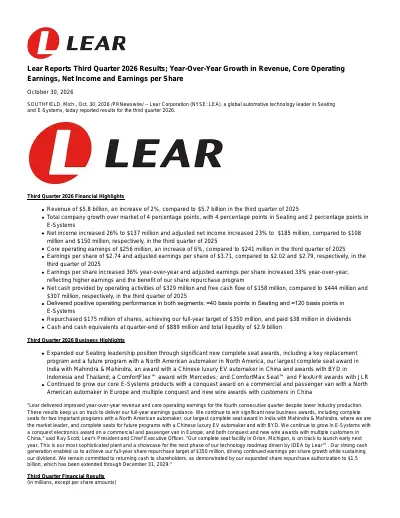
Lear continued delivering meaningful year-over-year improvements across all metrics in the third quarter. Sales increased 2% to $5.8 billion, despite global industry production declining by 2% on a Lear-weighted basis.
Core operating earnings were $256 million, a 6% increase, and the fourth straight quarter of year-over-year improvement. Adjusted earnings per share reached $3.71, a 33% increase from the third quarter of 2025, accelerated by our robust share repurchases this quarter.
We generated operating cash flow of $329 million and free cash flow of $158 million in the quarter. Slide 6 summarizes our key business and financial highlights for the quarter.
Our four strategic priorities continue to drive our focused execution: extending our global leadership in seating, expanding E-Systems margins, growing our competitive advantage in operational excellence through IDEA by Lear, and supporting sustainable value creation with disciplined capital allocation. During the quarter, we continued our momentum of winning key awards in both segments, generating approximately $3.9 billion of net business awards year to date, with approximately $3.1 billion in seating and approximately $800 million in E-Systems.
This represents an increase of $1 billion during the quarter, with E-Systems on track for another year of over $1 billion of business awards. Key seating wins in the quarter include the complete seat, foam, and heat for two programs with a North American automaker.
One award is the replacement of a program we currently supply, and the second is a new award for a future program to support this customer's expansion of their product portfolio for the North American market. Our IDEA by Lear capabilities were instrumental in winning these awards.
Lear is the number one seat supplier in India. During the quarter, we were awarded the largest complete seat program in our long history with Mahindra & Mahindra.
The award includes both replacement and incremental new business. Our new awards for ComfortFlex, ComfortMax, and FlexAir applications this quarter bring our modular and innovative seat product total to 47.
Program with Mercedes is a conquest award, replacing current lumbar and massage components with a ComfortFlex modular solution. Awards with Jaguar Land Rover include a FlexAir application as well as a ComfortMax solution, integrating heat into the trim cover.
Five modular products launched during the third quarter, and seven additional programs will be launching during the fourth quarter, accelerating the adoption of our modular solutions in the marketplace. Our momentum with the Chinese automakers continued in both segments.
In seating, we were awarded an upcoming program with a Chinese luxury EV automaker, projected to launch in 2028. This program is currently projected to be sold in China and exported to other markets.
BYD also awarded us two key programs as they expand their production in Thailand and Indonesia. We currently supply those programs in China.
In E-Systems, we won a conquest award with JMC-Ford joint venture, new wiring business with FAW-VW, and two non-consolidated wire awards with BAIC, all in China. We continue to drive growth in our core E-Systems products by securing electronics and wire conquest awards.
The electronics awards is for power distribution box on a commercial and passenger van in Europe with a North American automaker. An additional conquest wire award is with Honda in China.
As we continue to grow with Japanese customers, we also retain an important wire program with Jaguar Land Rover in Europe. During the quarter, we released our annual sustainability report, providing an update on our IDEA by Lear initiatives, as well as progress towards achieving our environmental, stewardship, social responsibility, and governance goals.
Our strategic focus continues to drive improved financial performance despite challenging industry conditions. Total company revenue increased 2% compared to the third quarter of 2025, reflecting growth over market of approximately four percentage points.
Both segments outperformed the market despite headwinds from the rolloff of programs such as the Escape and Corsair, and the wind-down of our non-core E-Systems products. With seating growing approximately four percentage points above market, and E-Systems approximately two percentage points above market, excluding the impact of the wind-down business, E-Systems growth over market was five percentage points.
Operating margins expanded 20 basis points year-over-year for the total company, with E-Systems margins expanding 60 basis points, driven by another strong quarter of 120 basis points of net performance. Seating margins grew 20 basis points, driven by 40 basis points of net performance, keeping us on track to deliver our full year target.
Our strong free cash flow generation allowed us to further accelerate our share repurchases. We repurchased $175 million of shares in the third quarter, completing our full year repurchase target of $350 million.
As a result of our strong earnings growth and accelerated share repurchases, our third quarter EPS increased 33% year-over-year. With our current authorization set to expire in three months, we increased our share repurchase authorization to $1.5 billion, and extended it through 2029, reinforcing our commitment to returning capital to shareholders.
Slide 7 provides a further breakdown of our progress on delivering long-term revenue growth and margin expansion, providing confidence we will achieve our full year targets. Over half of our year-to-date seating awards have been for new or conquest programs, providing a strong foundation of future growth.
In the quarter, we were awarded conquest programs with Stellantis in Europe and with Honda in Thailand, as we continue to build our relationships with Japanese customers. In E-Systems, approximately 70% of our year-to-date business awards have been for new or conquest programs, continuing the trend from the first half of the year.
During the quarter, wire conquest awards included programs in China with JMC-Ford and Honda. The rollout of our thermal comfort modular solutions continues to gain momentum with the modularity and FlexAir wins in the quarter.
The pace of business awards with Chinese automakers continues to accelerate. In seating, our year-to-date awards are estimated to generate over $600 million of average annual revenue, up almost 90% from where we were tracking at the end of the second quarter.
This reflects the growing momentum of our global wins with Chinese automakers, including BYD in Thailand and Indonesia, following our second quarter award with Leapmotor in South America. In E-Systems, approximately 25% of our year-to-date awards are with Chinese domestic automakers, up significantly from 2025.
We remain on track to deliver $75 million of IDEA savings this year, with approximately $55 million achieved year to date, accelerating through the end of the year, and are on track to significantly exceed our targeted restructuring savings. Our net performance continues to drive increased adjusted operating margins in both segments.
Despite rising commodity and other input costs, seating has generated 30 basis points of net performance through the first three quarters, and we expect a step-up in the fourth quarter to deliver our full year target of 40 basis points. In E-Systems, we delivered a very strong 105 basis points of net performance through the first three quarters.
We expect E-Systems to deliver positive net performance in the fourth quarter despite increasing copper and launch costs, a testament to our team's ability to execute. I want to spend a moment on slide 8, which provides an overview of our Orion, Michigan facility that will support three of GM's most important nameplates: the Cadillac Escalade, Chevrolet Silverado, and the GMC Sierra.
The Orion facility, which represents a critical milestone in the execution of IDEA by Lear technology roadmap, is the most tangible demonstration of how our strategy is redefining JIT seat assembly, reinforcing Lear's position as the clear leader in seating and creating a path to future market share gains and sustainable profitable growth. IDEA by Lear is our framework for reimagining how we operate, embedding innovation, digital tools, engineering, and automation into every layer of the processes.
We've been building towards this facility, which integrates the technology and talent we've compiled through our targeted acquisitions and significant internal development to deliver something that, quite frankly, doesn't exist in the seating world outside of Lear. Production in the state-of-the-art just-in-time seating facility begins next year.
This facility is designed from the ground up with a digital foundation and automation embedded throughout from day one, not retrofitted. The financial impact is meaningful and immediate.
We expect automation to reduce the conversion cost requirements by 10% to 15%. The more important story is what this represents strategically.
Orion is the blueprint we intend to scale across our global seating footprint to support our future key programs, such as the Ford Super Duty. Each of the key technologies we are developing reflects a deliberate capability we've built or acquired, and together they tell the story what IDEA by Lear looks like in practice.
The first is what we call integrated intralogistics. I want to be precise about the term, because it goes well beyond traditional automated warehousing.
Intelligent intralogistics is the connected intelligence layer of the entire factory. It ties together inventory, material management, storage, and real-time decision-making from the moment a component arrives at our dock to the moment a finished seat leaves our facility.
We think about it across three dimensions. The first one is connected.
This is about end-to-end visibility and control. Nothing moves without us knowing about it.
At Orion, that means our overhead suspended material storage and delivery system is fully integrated into the production floor to track parts in real time. Our automated guided vehicles, or AGVs, keep the lines continuously fed with complete traceability.
Our automated trailer loading sequencing closes the loop, connecting finished goods all the way through to the customer shipment with precision, and without manual intervention. From inbound components to outbound delivery, we see everything.
The second dimension is intelligent. Visibility alone isn't enough.
The system has to think and react. Advanced analytics are continuously driving decisions around inventory positioning, replenishment, and flow.
Our 4D four-directional storage system utilizes autonomous mobile robots, or AMRs, that navigate dynamically within the racking structure itself to optimize in real time based on production demand. Our raw component automated storage and retrieval systems, or ASRS, manage foam and trim storage, while our finished goods ASRS are both continuously informed by analytics and anticipating needs before they become disruptions.
Both of these ASRS systems were developed internally by our ASI team, which is the company we acquired. We own the IP, we control the roadmap, and we can scale it across our global footprint.
That is a genuine competitive advantage that cannot be easily replicated. Not only is our material handling intelligent, but so is our balancing of human capital.
We are utilizing proprietary tools like cycle time deviation and dynamic line scheduling to make real-time adjustments to optimize the efficiency of our employees. The last one is autonomous.
This is where the financial impact becomes most tangible. We are moving towards automated execution, meaning our people are focused on solving problems, not performing routine tasks.
Robotic part loading is actively in production today, feeding our lines and installing components with a level of consistency and repeatability that manual processes simply cannot match. Our AGV network operates without human direction.
Our ASRS systems retrieve and position material without manual intervention. The factory increasingly runs itself, allowing our teams to focus on more value-added adjustments.
Our automated smart ovens, robotic finesse, and in-line testing improve our process consistency, cycle time, and quality. They also improve the job satisfaction of our team.
Interconnectedness is what is new at Orion. We've been adding independent systems in our existing locations, but the interconnectedness across multiple processes driven off demand will improve efficiency and inventory management due to real-time monitoring, analysis, and adjustments.
Built by Lear's team and leveraging historical knowledge, our systems don't just reduce cost. They create a factory that sees everything, decides intelligently, and executes autonomously.
What we built at Orion will become the blueprint for scaling productivity across our complete seating footprint. With that, I'm going to turn the call over to Jason and Jared for the financial review.
Jason Cardew
Thanks, Ray. Slide 10 shows vehicle production and key exchange rates for the third quarter.
Global production was down 2% compared to the same period last year. Production volumes declined by 5% in North America and 7% in China, while volumes in Europe were up 1%.
The U.S. dollar strengthened against the euro, but weakened against the RMB.
Turning to slide 11, I will highlight our financial results for the third quarter 2026. Our sales increased 2% year-over-year to $5.8 billion.
Organic sales were also up 2%, primarily reflecting the addition of new business in seating. Core operating earnings were $256 million, compared to $241 million last year, driven primarily by strong net operating performance.
Adjusted earnings per share were $3.71, as compared to $2.79 a year ago, reflecting higher earnings and the benefit of our share repurchase program. Third quarter operating cash flow was $329 million, compared to $444 million last year, due to higher tooling and engineering investments and the timing of working capital.
Year to date, operating cash flow is higher compared to 2025, driven by improvements in inventory management through our IDEA by Lear initiatives, as well as the timing of tariff payments and recoveries. Slide 12 explains the variance in sales and adjusted operating margins for the third quarter in the seating segment.
Sales for the third quarter were $4.3 billion, an increase of $76 million or 2% from 2025. Organic sales were also up 2%, reflecting the addition of new business, including the BMW iX3, Mercedes GLC, EQ, and Audi Q7 in Europe, the Seres M6 in China, and the Jeep Cherokee in North America, and higher volumes on JLR platforms, which were negatively impacted by the cybersecurity attack during the third quarter last year, partially offset by lower volumes on Lear platforms in China and North America.
Adjusted earnings were $274 million, up $13 million or 5% compared to 2025, with adjusted operating margins of 6.3%. Higher operating margins were driven by strong net performance and our margin-accretive backlog, partially offset by lower volumes on other platforms.
Slide 13 explains the variance in sales and adjusted operating margins for the third quarter in the E-Systems segment. Sales for the third quarter were $1.4 billion, an increase of $17 million or 1% from 2025.
Organic sales were up less than 1%, driven by higher volumes on Lear platforms, including several JLR programs in Europe, partially offset by the buildout of the Ford Escape, Focus, and Lincoln Corsair, reflected in our backlog, as well as the wind-down of discontinued product lines. Adjusted earnings were $69 million or 4.8% of sales, compared to $60 million and 4.2% of sales in 2025.
Higher operating margins were driven by strong net performance and higher volumes on Lear platforms, partially offset by the buildout of the programs in our backlog and the wind-down of discontinued product lines. Jared will now provide an update on our full year outlook.
Jared Fedele
Thanks, Jason. Slide 14 provides global vehicle production volume and currency assumptions that form the basis of our 2026 full year outlook.
Our production assumptions are based on several sources, including internal estimates, customer production schedules, and Mobility Global Forecast. At the midpoint of our guidance range, we assume that global industry production will be down 1% on a Lear sales-weighted basis compared to 2025, a slight improvement from down less than 2% in our prior outlook, primarily due to higher volumes in Europe, particularly offset by lower production assumptions for China.
We have adjusted our currency estimate, which now assumes an average euro exchange rate of $1.15 per euro and an average Chinese RMB exchange rate of 6.80 RMB to the dollar. Slide 15 provides an update to our full year 2026 outlook.
Our current outlook assumes no changes to current tariff policies or significant industrywide disruptions. In recent weeks, we have seen reductions in production schedules across several customers, particularly in China.
We have reduced our full year 2026 outlook for net sales to reflect these changes. However, our strong operational execution, savings from our additional restructuring actions, and anticipated resolution of ongoing commercial negotiations are expected to offset the impact of lower volumes, as well as rising costs from commodities and other inputs.
Therefore, we are maintaining our full year outlook for core operating earnings. We increased our outlook for restructuring costs by $25 million, reflecting additional actions we are taking to further optimize our cost structure and position Lear for stronger long-term profitability.
We adjust our outlook for operating cash flow and free cash flow to support this investment. As we move through the remainder of the year, we will continue to monitor the China domestic market, where consumer demand and production schedules continue to deteriorate.
Slide 16 compares our October 2026 outlook to the midpoint of our prior 2026 outlook. We reduced our revenue midpoint by approximately $225 million, driven by lower production volumes on Lear programs, particularly in China, and the impact of foreign exchange, partially offset by increasing supplier pass-through due to the rise in commodity costs and commercial recoveries.
We maintain our core operating earnings outlook as savings from our restructuring actions and improved net performance is expected to offset the impact of lower production volumes on Lear platforms. Moving to slide 17, we highlighted our balanced capital allocation strategy.
Our balance sheet and liquidity profile continues to be a significant competitive advantage for us. Our cost of debt is low, averaging less than 4%, and our debt structure has a weighted average maturity of approximately 11 years.
In addition, we have $2.9 billion of available liquidity. Our capital allocation priorities remain consistent.
We are focused on generating strong cash flow, investing in the core business to drive profitable growth, and returning excess cash to shareholders. During the third quarter, our strong cash flow enabled us to take advantage of our undervalued share price and repurchase $175 million worth of stock.
This brought year-to-date repurchases to $350 million, achieving our increased full year target ahead of schedule. Since initiating the share repurchase program in 2011, we have repurchased $6.3 billion worth of shares and returned over 85% of free cash flow to shareholders through repurchases and dividends.
In September, Lear's board increased the share repurchase authorization to $1.5 billion and extended the authorization period through December 31st, 2029, reinforcing our commitment to return cash to our shareholders. Now, I'll turn it back to Ray for some closing thoughts.
Ray Scott
Nice job, Jared. Sounds great.
Jared Fedele
Thank you.
Ray Scott
Q3 was another strong quarter, continuing our track record of consistent execution and progress. Despite a global production environment that contracted 2% on a Lear-weighted basis, our team delivered $5.8 billion in sales, expanded margins in both segments, and grew core operating earnings for the fourth consecutive quarter.
Our resilience is the result of a focused strategy and a team that knows how to execute. The breadth of our business wins in this quarter demonstrates our global reach and competitiveness.
From our largest complete seat award in India to BYD programs in Thailand and Indonesia, and modular seating solutions with Mercedes and Jaguar Land Rover, we are winning in the markets with the customers that matter the most for our long-term growth. Our year-to-date net business awards now stand at approximately $3.9 billion, and the pipeline of new opportunities remains very robust.
In E-Systems, the transformation of our portfolio is evident, with approximately 70% of our year-to-date awards coming from new or conquest programs, and Q3 margins expanding 60 basis points year-over-year. We are demonstrating that our focused portfolio strategy is working.
The wind-down of our non-core products is nearly behind us, and what remains is a stronger business with a significant runway ahead. Perhaps the most exciting development this quarter is what we shared about our Orion facility.
This is IDEA by Lear in action: not a pilot, not a concept, but a fully integrated, purpose-built manufacturing environment that reduces the conversion cost requirements by approximately 10% to 15% and sets a new standard for what a seating facility can be. The technologies we are deploying at Orion, from intelligent intralogistics to autonomous material handling to AI-powered quality inspection, are proprietary, scalable, and represent a genuine competitive moat that will be difficult for others to replicate.
We continue to return meaningful capital to our shareholders. Completing our $350 million repurchase target ahead of schedule and expanding our authorization to $1.5 billion through 2029 reflects both the strength of our cash generation and our conviction in the long-term value of this company.
As we head into the fourth quarter, we recognize the challenges ahead, from commodity pressures to softness in the China market. These are dynamics we've successfully navigated throughout the year, and our team has the tools, talent, and track record to continue to execute.
We are maintaining our full year outlook for operating income and remain confident in our ability to finish the year strong. Now we'll go ahead and open up the call to questions.
Operator
We will now begin the question-and-answer session. To ask a question, you may press star and then one on your touchtone phones.
If you are using a speakerphone, we do ask that you please pick up the handset before pressing the keys. To withdraw your questions, you may press star and two.
Once again, that is star and then one to join the question queue. We'll pause momentarily to assemble the roster.
Our first question today comes from Dan Levy from Barclays. Please go ahead with your question.
Dan Levy
Hi, good morning. Thank you for taking the questions, and Jason, congratulations.
Jared, congratulations to you as well.
Jason Cardew
Thanks, Dan.
Dan Levy
Want to start with a question on the sales outlook and particularly with what's happening in China. There's been a number of quarters now where you've underperformed, and I think this is similar to some of your other peers out there.
Maybe you can give us a sense of, within China, what the path is to finally starting to see growth in line with the market. I know you're saying that you're targeting 50% domestic mix, but the issue is industry is at, call it, 75% plus.
I know you talked about winning some programs here, but at what point do you finally start to have China be in line? Maybe you could just unpack the underperformance.
Is it just this customer mix? Is it competition?
What's going on in China and how is this fixed?
Jason Cardew
Thanks, Dan. First, I think it's important to point out that as we look out to next year and beyond, the strategy that we put in place over the last several years will really improve the profile of our business in China and with the Chinese OEMs globally.
In terms of what happened in the third quarter, there's a couple factors that weighed on that growth or growth under market in China. A significant portion of our revenue in China with the Chinese OEMs is in our non-consolidated joint ventures.
If you account for that, that business actually grew in the quarter, and that would eliminate more than half of the negative growth over market in the quarter. There are parts of the business there that are performing in line or even better than the market.
I think the other point that's weighed on our business in the near term is the level of exports out of the China market as the domestic demand has weakened this year. We've talked about this in the past, we're underindexed on exports.
That's primarily because the exports to date have really focused on primarily the lower end of the market where we're underrepresented. We have a very strong business particularly in luxury in China in the higher ends of the market.
I think over time as the export mix shifts to higher ends of the market, it will better reflect the market overall in terms of the ratio of exports in our business. I think that there's a lot of evidence that we've shared this year that, again, our strategy for growing with the Chinese automakers and in China and globally is working.
We had $900 million of our $3.9 billion of new business awards this year, 23% of the new business awards this year are with the Chinese automakers. Only 8.5% of our revenue today consolidated and non-consolidated is with the Chinese OEMs.
We are clearly seeing a growth inflection point with the Chinese automakers that will benefit the business longer term. We've talked about this year and last year our share of revenue within China that's with the Chinese OEMs 44%.
Yes, we're underindexed there. That grows to 50% or a little bit above that next year.
We see a path to 55% and beyond if you look out two or three years and include the benefit of the new awards that we've announced this year. All signs point to our business more closely reflecting the mix that is represented in the market in China.
I think that there are some regulatory changes that are coming over the next several years that will encourage more localization for the Chinese, and we're seeing good performance in terms of our wins with the Chinese OEMs as they localize. We had Leapmotor in South America we announced last quarter, and then we had the two wins with BYD this quarter.
Jared, why don't you talk about some of those regulatory changes that we think will change the composition of exports going forward?
Jared Fedele
Sure, Jason. You're correct.
There are a few factors and potential regulations that have come up that we look at favorably from our standpoint. First is a potential regulation, we've talked about it, on the Industrial Accelerator Act, that's the IAA, and something we've been monitoring closely.
This is that Made in Europe Act, and that's being discussed in the EU that would potentially put a threshold on local content rules. Second, there's that hybrid export cap in Europe, where China and the EU are expected to agree to limit hybrid exports out of China up to 350,000 vehicles annually starting on December 1st of this year, which could help aid in the acceleration of the localization with these OEMs in Europe.
Finally there's one more starting in April 1st of 2027. China's going to lower the value-added tax export rebate for new energy vehicles to 9%, down from the 13%.
In simple terms, China's lowering the rebate in which they give to the OEMs for exporting NEVs. All these regulations, it plays to our favor, and mixed with our strategy in China, winning with the OEMs and the relationships we've built over the last 30 years, it's going to be a positive as we continue to grow and gain market share within and now outside, as Jason mentioned, with Leapmotor and BYD already outside of China.
Dan Levy
Just the net of that, do you feel confident that given everything that we're seeing in China that eventually, when your larger backlog comes online, that you can eventually return to a more meaningful growth? I know 2027 you've sort of talked that down, but in the 2028-2029 period, I think you've given some upside numbers there.
Jason Cardew
As we said on the last call, we see in 2029 this business returning to significant growth above market with both segments, getting back to the historical targeted range, 3% to 4% in seating and 4% to 6% in E-Systems. One of the updates we wanted to provide today is on the backlog, just this continued progress we're making with new business awards is increasing the confidence level we have in the strength of that three-year backlog.
Jared, why don't you provide an update on that?
Jared Fedele
Sure, and you're correct. We do feel good about the trajectory of our backlog.
Now, obviously, we're not giving official backlog update on the call, but the recent wins we've communicated, it really reinforces our confidence in the long-term growth outlook, and I'll shed some color on this. In seating, the most notable awards include significant conquest awards.
We've talked about it: Audi in Europe, North America with the Ford Super Duty, along with complete seat awards. We just mentioned Leapmotor in South America, and additional wins with the Chinese OEMs, and awards in India now with Mahindra.
Over half of those year-to-date awards have been for new or conquest programs in seating, providing kind of that foundation for future growth. Then in E-Systems, we've secured important awards with Renault, Stellantis, BAIC, General Motors, and multiple Chinese automakers.
More importantly, over 70% of our year-to-date E-Systems awards come from new or conquest business. Based on what we know right now, knowing that the timing of launches can move, and more importantly, new awards can be sourced from now until when we report, our three-year core backlog is about $2.25 billion.
The key is, with our backlog, we've been very, very selective on the profile and the quality of the business we're going after and winning. Every program has been scrutinized to make sure it's returning in excess of its cost of capital, and we're not chasing business to win business.
If you look at the Ford Super Duty JIT and wire business, the Audi JIT business, the T1SUV wire, the JIT in Orion, just this handful of programs taken together, Dan, between seating and E-Systems, it makes up more than 70% of our backlog that's rolling on over the three years. These are programs has a long history of success in the market.
We have a high degree of confidence that those are going to launch on time at the volumes that we've embedded in our backlog. The momentum's building, and more importantly, the quality of the awards is there, and the pipeline remains robust as we sit here today.
The team's doing a really good job.
Ray Scott
Let me weigh in on this, Dan, because this is important. I know we're focused on China, but we've laid out a plan, and we've talked about it for some time now.
We've been looking at the domestic Chinese and what was going on with market share gains throughout the world. We said, listen, we can still win with the traditional OEMs as they're shrinking, and we've done that.
It's remarkable. I sit here, and I have an enormous amount of confidence when I hear from the team, both Nick and Frank, the conquest wins we're getting.
To Jared's point, how we're being very selective after, I'll say, high-quality wins, programs that we have a high confidence in that they're going to run. They're not a one-and-done program that we've all experienced over the last several years, but that high confidence that the OEs, the customers, are putting a tremendous amount of effort and energy and money in, and that's where we're betting and then putting our dollars.
The second thing is, I was just in China last week. It was incredibly and remarkable different in respect to what's going on on the ground in China.
They're looking for companies that are and have profitability, technology, innovation, are taking the next step. They're concerned about some of the domestic Chinese around their profitability, and because they Operator: Good morning, and welcome to the Lear Corporation Third Quarter 2023 Earnings Conference Call.
All lines are in a listen-only mode until the question-and-answer session. Today's call is being recorded.
If you have any objections, you may disconnect at this time. I would now like to turn the call over to Tim Brumbaugh, Vice President of Investor Relations.
Tim Brumbaugh
Thanks, Michelle. Good morning, everyone, and thanks for joining us for our third quarter 2023 earnings call.
Presenting today are Ray Scott, Lear President and CEO, and Jason Cardew, Senior Vice President and CFO. Also in the room are other members of Lear's senior management team, including Jared Fedele, who was recently named Vice President of Finance for Seating and E-Systems.
Review slides for today's presentation are available on our Investor Relations website at ir.lear.com. Following prepared remarks, we will open the call for Q&A.
Before we begin, I'd like to remind you that during the call, we will be making forward-looking statements that are subject to risks and uncertainties. Some of the factors that could impact our future results are described on slide two and in the risk factors section of our 10-K and other filings with the SEC.
In addition, we will be referring to certain non-GAAP financial measures. Additional information regarding these measures, including reconciliations to the most directly comparable GAAP measures, can be found in the presentation materials on ir.lear.com.
Now, I'm pleased to turn the call over to Ray Scott.
Ray Scott
Thanks, Tim, and good morning, everyone. Moving to slide three, Lear delivered another quarter of strong financial results, driven by our continued focus on operational excellence, new product innovation, and expanding customer relationships.
Third quarter revenue was $5.8 billion, up 10% compared to the prior year. Core operating earnings were $267 million, and adjusted earnings per share were $3.16, an increase of 28% and 36%, respectively, compared to the third quarter of 2022.
Operating margins improved by 70 basis points year over year to 4.6%, despite continued macro headwinds and the initial impact of the UAW strike against the Detroit Three automakers. In Seating, we continued our impressive track record of outperforming industry production, driven by our market-leading product portfolio and expanding our wallet share with customers.
In E-Systems, we saw strong revenue growth and significant margin improvement, driven by higher volumes and our restructuring actions. Turning to slide four, Lear's operational performance continues to be a key differentiator.
In the third quarter, we demonstrated our ability to navigate a challenging macro environment, including the impact of the UAW strike, while continuing to execute on our strategic priorities. We also continued to return capital to shareholders, repurchasing $40 million of shares in the quarter, bringing our year-to-date share repurchases and dividends to $253 million.
Slide five highlights our thermal comfort systems business, where our vertical integration strategy and innovative product offerings continue to drive market share gains. Thermal comfort is one of the fastest-growing categories in automotive seating, with a projected market size of $6.5 billion by 2030, representing an 8% CAGR.
Lear is uniquely positioned to capture this growth through our comprehensive suite of thermal comfort solutions, including seat heating, ventilation, and pneumatic massage systems. Our recent acquisitions of Kongsberg Automotive's interior comfort systems business and I.G.
Bauerhin have enhanced our product offerings, increased our vertical integration, and strengthened our competitive advantage. Turning to slide six, we continue to see tremendous opportunities for our modular and configured seating architecture, which we call Re-Con.
Re-Con reduces part count, tooling costs, and weight, while providing OEMs with greater design flexibility and faster time to market. Customer interest in Re-Con is strong, and we are actively quoting several high-volume programs across global platforms.
Moving to slide seven, in E-Systems, we are well positioned to capitalize on the megatrends of electrification and connectivity. Our award-winning battery disconnect unit, or BDU, continues to gain traction with global automakers.
In the third quarter, we secured a significant new BDU award with a major global automaker, further strengthening our position as the market leader in this critical component. Our product leadership in power distribution, high-voltage wiring, and battery management systems provides us with a clear pathway to achieve our target of $1.3 billion in electrification revenue by 2025.
Now, I'd like to turn the call over to Jason Cardew for a deeper dive into our financial performance.
Jason Cardew
Thanks, Ray. Turning to slide eight, third quarter revenue increased 10% year over year to $5.8 billion, driven by higher production volumes and the rollout of new business.
Growth over market was positive 2 percentage points, driven by our thermal comfort acquisitions and new conquest business. Core operating earnings for the quarter were $267 million, up $58 million or 28% from the third quarter of 2022, primarily reflecting higher volumes and favorable pricing, partially offset by the initial impact of the UAW strike.
Adjusted EPS was $3.16, up 36% compared to the prior year. Free cash flow in the quarter was $112 million, compared to $96 million in the third quarter of 2022.
Moving to slide nine, in Seating, third quarter revenue was $4.3 billion, an increase of 7% compared to the prior year. Growth over market was positive 1 percentage point.
Segment operating earnings were $264 million, up 17% compared to the prior year, with an operating margin of 6.1%, an improvement of 50 basis points year over year. The increase in earnings was driven by higher production volumes and our restructuring and cost reduction initiatives, partially offset by the impact of the strike.
On slide 10, E-Systems revenue was $1.5 billion, up 17% year over year, with growth over market of positive 7 percentage points, driven by new conquest business and volume growth on key platforms. Segment operating earnings were $78 million, or 5.2% of revenue, up 180 basis points compared to the third quarter of 2022.
The margin expansion reflects strong operational execution, favorable volume and mix, and benefits from our restructuring programs. Turning to slide 11, we are updating our full-year 2023 financial outlook to reflect our third quarter performance and our current expectations for the fourth quarter, including the estimated impact of the UAW strike through the end of October.
We are now projecting full-year revenue in the range of $23.1 billion to $23.3 billion, and core operating earnings in the range of $1.06 billion to $1.10 billion. Adjusted EBITDA is expected to be between $1.655 billion and $1.695 billion.
Free cash flow is expected to be in the range of $460 million to $500 million. Capital expenditures are forecasted to be approximately $650 million.
Our full-year tax rate is projected to be approximately 22%. Now, before we turn to Q&A, I would like to invite Jared Fedele to say a few words.
Jared Fedele
Thanks, Jason. I'm excited to take on this expanded role leading the finance organizations for both Seating and E-Systems.
Having spent over 15 years at Lear across various finance and operational roles, I look forward to working closely with Ray, Jason, and the executive leadership team to drive further operational efficiencies, accelerate our growth initiatives, and deliver value for our shareholders. With that, I'll turn it back to Ray for closing remarks.
Ray Scott
Thanks, Jared. Congratulations on your new role.
In summary, our third quarter results demonstrate the strength of our product portfolio, our operational agility, and our disciplined approach to capital allocation. Despite the near-term challenges presented by the UAW strike, Lear is uniquely positioned to drive profitable growth and generate strong cash flow over the long term.
With our leadership in thermal comfort, modular seating, and electrification, we are confident in our ability to continue delivering value to our customers and shareholders. With that, we'd like to open the call for questions.
Operator
Thank you. We will now begin the question-and-answer session.
If you would like to ask a question, please press star one on your telephone keypad. If you would like to withdraw your question, please press star two.
Our first question comes from Dan Levy with Barclays. Your line is open.
Dan Levy
Hi, good morning. Thanks for taking the questions.
Ray, maybe to start, if we could talk about the strike. Obviously, a fluid situation, but with the tentative agreements starting to come through, can you walk us through what the ramp-up looks like?
How quickly do you think production gets back to normal levels, and what are the operational friction costs that you might see during the restart?
Ray Scott
Thanks, Dan. First, let me say we're encouraged by the tentative agreements that have been announced.
Our teams did an incredible job managing through the shutdowns, flexing costs, and supporting our workforce. As far as the ramp-up, because our just-in-time facilities are located in close proximity to the OEM assembly plants, we can ramp up almost immediately once they begin building vehicles.
In terms of friction costs, we've kept our facilities ready, our workforce is prepared, and while there might be some minor inefficiencies during the initial days of restart as supply chains rebalance, we do not expect significant friction costs. Our operational footprint is agile, and we are well positioned to meet customer demand as production resumes.
Jason Cardew
Dan, the only thing I'd add to that is that we had estimated the impact of the strike in our fourth quarter guidance based on the shutdowns through the end of October, which was roughly $130 million of revenue and about $35 million of core operating earnings. As the plants resume production, we anticipate that the impact will be contained within that window, and depending on weekend shifts or overtime that the OEMs might schedule later in November and December, there could be an opportunity to recover some of that lost volume.
Dan Levy
Great, that's very helpful color. As a follow-up, looking at China, obviously a lot of headlines around domestic OEMs gaining share versus the legacy multinationals.
Could you talk about your exposure to domestic Chinese OEMs in both Seating and E-Systems, and how you see your market position evolving there?
Jason Cardew
Sure, Dan. In China, domestic OEMs currently represent about 40% of our revenue in the region, and that number continues to grow.
We've had great success winning conquest business with players like BYD, Geely, NIO, and others. In Seating, our vertical integration and modular architectures allow us to deliver cost-competitive, high-quality solutions that appeal to the fast-moving domestic OEMs.
In E-Systems, our BDU and wire harness capabilities are seeing strong demand. We feel very good about our competitive position in China.
Ray Scott
Dan, I'd just add that our localized engineering and rapid development capabilities in China are second to none. We can design and launch seating systems on domestic timelines, which are typically much shorter than Western OEMs, without sacrificing quality or safety.
They're concerned about some of the domestic Chinese around their profitability, and because they are aggressively competing, they value suppliers that can deliver speed, innovation, and cost certainty, which Lear delivers consistently.
Operator
Our next question comes from Joe Spak with UBS. Your line is open.
Joe Spak
Thanks. Good morning, everyone.
Jason, on E-Systems margins, 5.2% in the quarter is a nice step up. Can you talk about the trajectory from here?
Do you see further runway for margin expansion into 2024, and what are the main drivers of that bridge?
Jason Cardew
Thanks, Joe. Yes, we're very pleased with the 5.2% margin in E-Systems, up 180 basis points year over year.
The improvement was driven by higher volume, conquest award launches, and the realization of our restructuring initiatives. Looking ahead to 2024, we continue to see a clear path toward our long-term margin target of high-single digits for E-Systems.
The key drivers will be the continued ramp of our electrification backlog, particularly BDUs, further operational efficiencies, and the full annualized benefits of our footprint restructuring.
Joe Spak
That makes sense. Then on capital allocation, you did $40 million of buybacks in the quarter.
With cash flow expected to remain strong in Q4, how are you thinking about share repurchases versus M&A or debt paydown as we head into next year?
Jason Cardew
Our capital allocation priorities remain consistent. First and foremost, we invest in organic growth and technology that enhances our core capabilities.
Second, we are committed to returning capital to shareholders through dividends and share repurchases. Year to date, we've returned $253 million.
With our strong balance sheet and leverage ratio at 1.5 times, we have ample flexibility to continue opportunistic share buybacks while maintaining our investment grade rating.
Ray Scott
Joe, regarding M&A, our focus right now is really on integrating the acquisitions we've made, specifically Kongsberg and I.G. Bauerhin.
Those integrations are going extremely well, and we're seeing the synergies materialize both on the cost side and in cross-selling opportunities. Our hurdle rate for any additional M&A remains very high.
Joe Spak
Got it. Thank you.
Ray Scott
Thanks, Joe.
Operator
Our next question comes from James Picariello with BNP Paribas. Your line is open.
James Picariello
Good morning, guys. On the Seating business, can you touch upon the thermal comfort backlog?
How much of your forward backlog is tied to thermal comfort, and are you seeing higher content per vehicle as these systems become more integrated?
Ray Scott
Good morning, James. Thermal comfort continues to be an incredible growth vector for us.
As we look at the transition to electric vehicles, cabin comfort and energy efficiency become paramount. By integrating heating, ventilation, and pneumatic lumbar and massage directly into our seat architecture, we can increase our content per vehicle significantly—in some cases by $100 to $200 per vehicle compared to a standard seat.
With the acquisitions of Kongsberg and I.G. Bauerhin, we now control the key components, the electronics, and the software, which gives us an unmatched value proposition.
It's driving substantial win rates in our backlog.
James Picariello
That's great. Jason, on free cash flow, you guided to $460 million to $500 million for the year.
What are the key working capital assumptions embedded in that fourth quarter cash flow?
Jason Cardew
In the fourth quarter, we typically see strong seasonal cash generation driven by working capital inflows as year-end inventory normalizes and receivables collections align with customer shutdown schedules. Even with the disruption from the UAW strike, we anticipate strong fourth quarter cash generation of roughly $350 million to $390 million, which supports our full-year guide.
We feel very comfortable with our working capital position and our cash flow conversion.
Operator
Our next question comes from Rajat Gupta with J.P. Morgan.
Your line is open.
Rajat Gupta
Hi, thanks for taking the question. On commercial recoveries and inflationary pass-throughs, how are negotiations progressing with OEMs for 2024, particularly around wage inflation and energy costs?
Jason Cardew
Thanks, Rajat. We've had constructive discussions with our customers.
Over the last couple of years, we've established indexation mechanisms and commercial agreements that cover the majority of our raw material exposure. When it comes to wage inflation and other non-commodity cost increases, our approach is twofold: first, drive internal productivity and operational efficiencies to offset as much cost as possible, and second, partner with our customers to negotiate fair commercial sharing.
We expect commercial recoveries in 2024 to remain aligned with historical levels, and we do not see significant margin erosion from these factors.
Ray Scott
Rajat, I would add that our customers appreciate our operational reliability and quality. Throughout the supply chain disruptions of the last few years, Lear didn't shut down a single customer plant.
That performance gives us a lot of credibility in our commercial discussions.
Rajat Gupta
Understood. That's very helpful.
Thank you.
Jason Cardew
Thank you.
Operator
That concludes our question-and-answer session. I would now like to turn the call back over to Ray Scott for closing remarks.
Ray Scott
Thank you, everyone, for joining us today. I want to thank the entire Lear team globally for their hard work, dedication, and resilience this quarter.
We look forward to updating you on our continued progress during our fourth quarter call. Have a great day.
Operator
This concludes today's conference call. Thank you for participating.
You may now disconnect.