Liberty Latin America Ltd.
Q3 FY2026 · Earnings Call TranscriptNovember 5, 2026
Operator
Good morning, ladies and gentlemen, and thank you for standing by. Today's call is being recorded.
I'll now turn the call over to Enrique Vivas, Chief Customer Officer of LLA.
Enrique Vivas
Good morning, everyone, and welcome to Liberty Latin America's third quarter 2026 investor call. Please notice that at this time, all participants are in listen-only mode.
Today's formal presentation materials can be found under the Investor Relations section of Liberty Latin America's website at www.lla.com. Following today's formal presentation, instructions will be given for the question and answer session.
As a reminder, this call is being recorded. Today's remarks may include forward-looking statements, including the company's expectations with respect to its outlook and future growth prospects, and other information and statements that are not historical fact.
Actual results may differ materially from those expressed or implied by these statements. For more information, please refer to the risk factors discussed in Liberty Latin America's most recently filed annual report on Form 10-K and quarterly report on Form 10-Q, along with the associated press release.
Liberty Latin America disclaims any obligation to update any forward-looking statements or information to reflect any change in its expectations or in the conditions on which any such statements or information is based. In addition, on this call, we will refer to certain non-GAAP financial measures, which are reconciled to the most comparable GAAP financial measures, which can be found in the appendices to this presentation, which is accessible under the Investor section of our website.
I would like now to turn the call over to our CEO, Mr. Balan Nair.
Balan Nair
Thank you, Kike. Welcome, everybody, to Liberty Latin America's third quarter 2026 results presentation.
I will run through our group highlights and an overview of our operating results before Chris Noyes, our CFO, reviews the company's financial performance. We'll then get straight to your questions.
As always, I'm joined by my executive team from across our operations, and I will invite them to contribute as needed during the Q&A following our prepared remarks. As a point of housekeeping, we will both be working from slides, which you can find on our website at www.lla.com.
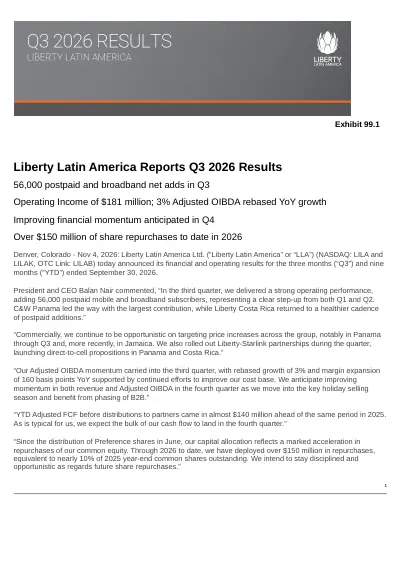
Starting on slide 4 and our highlights. Third quarter showed accelerating operational trends across the business.
We added 56,000 postpaid mobile and broadband subscribers in the third quarter, an improvement on both the first and second quarter. Noticeable this quarter was the strong performance from C&W Panama, together with a healthy return to postpaid adds in Liberty Costa Rica.
Commercially, we remain focused on opportunities to take price increases while using AI-enabled target offers with sharper consumer insights in order to provide better churn outcomes. This quarter, we also rolled out two Liberty-Starlink partnerships, offering direct-to-cell in both Panama and Costa Rica.
We have been the first mover on DTC in these markets, with rural and out-of-footprint connectivity serving to both enhance our brand and provide for further and future opportunities to take price. Our financial performance remains very robust, registering another quarter of solid adjusted OIBDA year-over-year growth.
This adjusted OIBDA growth comes from margin expansion that is supported by both growing our higher contribution margin products as well as driving cost savings in every area of our business. This performance flows through to adjusted free cash flow, registering a $140 million improvement year-to-date versus the same period last year.
Excluding Puerto Rico, we would have generated over $130 million of adjusted free cash flow before distributions to partners year-to-date. As is typical for LLA, we also anticipate Q4 being the strongest quarter for adjusted free cash flow.
Turning to capital allocation, after the distribution of the preferred in June, we have been focused on share repurchases, seeing this as the best use of our cash over this period. We have now deployed over $150 million to date this year, with a considerable portion of this in Q3, resulting in us buying back nearly 10% of our common shares outstanding as of 2025 year-end.
This reflects the continued conviction that our stock trades at a meaningful discount to the intrinsic value of the business. Both John Malone and I have been buyers of both our common and preferred equity.
Turning now to our operations. On slide 5, we review our Liberty Caribbean segment, which reported another strong quarter.
Liberty Caribbean added about 3,000 postpaid and 4,000 broadband subscribers in the quarter, with mobile contributions coming from Barbados and across the smaller markets, while broadband additions were supported by Jamaica. In Jamaica, we were recognized by Ookla as both the fastest fixed and mobile networks in the first half of 2026, a clear endorsement of the superior experience we are delivering to our customers.
We would anticipate continued B2C and B2B subscriber increases as we have deployed 5G and given continued rebuilding of the fixed network with fiber to the home. Our market-leading fixed mobile convergent offers continue to help drive postpaid growth across the region as we increase penetration of our fixed base.
To further support our customer value propositions and reinforce an always-on experience, this quarter, we launched Unbeatable Internet across the majority of our markets. As a reminder, Unbeatable Internet provides a mobile dongle backup to ensure always-on connectivity in case of outages affecting the fixed network.
Elsewhere, we're excited by the recent launch of our completely redesigned Flow mobile app across Liberty Caribbean, giving customers a single, simple digital front door to manage their services and engage with us. Besides the improved look and feel, the app now provides a truly seamless end-to-end digital purchase experience, allowing for real-time activation, zero back office, and an additional sales channel for cross-selling to our existing base and increased FMC penetration.
The combination of innovative CVPs, fastest networks, and continuously improving service, resulting in superior customer experience, providing opportunities to take price. Across Liberty Caribbean, we see no material pricing differential between the front book and back book, atypical across global telcos, which we believe will minimize spend-down risks.
As a consequence, early in the fourth quarter, we have, for example, moved up price by 10% on both fixed broadband and postpaid mobile in Jamaica for virtually all of the base and continue to see opportunities across other markets in the region to initiate similar pricing moves. In most cases, even after our price increases, we are the lowest-cost bundled service provider.
On the B2B front, our business registered one of the strongest quarters for some time, with 6% year-over-year growth on the back of major project wins in the Bahamas and Curaçao and increased mobile adoption across the region. B2B is still largely a connectivity business today in the region, providing significant opportunities to increase our share of ICT and managed services going forward.
Our recent announcement of AWS partnership is beginning to yield new customer interactions, and we have built a solid pipeline, which reinforces the interest in ICT and public cloud in the region. On slide 6, we review our Cable & Wireless Panama segment, which reported very strong residential performance this quarter.
Panama was the largest contributor to broadband and postpaid adds across the group, adding about 10,000 broadband and 16,000 postpaid subs in the quarter. FMC adoption continues to climb, supporting postpaid mobile adds, while we have also managed to keep growing the prepaid base year-over-year.
As highlighted, we very recently launched our direct-to-cell proposition, Más Starlink, in Panama. Early indications point to strong usage.
During the quarter, we applied selective price increases across fixed broadband, postpaid, and prepaid while maintaining our positive subscriber momentum. The combination of a healthy price environment with consistent volume growth over the course of 2026 helped drive the strongest residential revenue performance for some time, with 6% mobile subscription revenue growth year-over-year with contributions from both postpaid and prepaid, and 3% fixed year-over-year growth in the third quarter.
Turning to B2B, we've registered strong sequential growth in B2B this quarter, though given the phasing of project revenues through 2025 and a resultant tough comparable, year-over-year growth in B2B was softer in the third quarter of 2026. This took the edge off our year-over-year segment growth as well as significantly impacting LLA group revenue growth on a year-to-year basis.
B2B, and specifically government revenue, tends to weight towards the end of the year, and we continue to envisage a strong end to the year for B2B. On slide 7, we review Liberty Networks, where underlying positive drivers remain in place.
In our wholesale business, we continue to see healthy demand for leased capacities from international and regional carriers as well as hyperscalers. However, this quarter, we face a tougher year-over-year comparison as Q3 2025 benefited from higher non-cash IRU accelerations.
We continue to deliver on plan for our El Salvador subsea cable build on behalf of the government of El Salvador. This project and the resulting milestones are expected to result in timing mismatches between revenue and cost recognition.
This quarter, there was no revenue to recognize, though we did book direct costs on the build. This cadence of revenue and costs will more than even out over the life of a project, which is anticipated to deliver an attractive IRR once completed.
In enterprise, meanwhile, we delivered a strong performance this quarter and 6% year-over-year rebase revenue growth driven by strength in IT as a service in both Colombia and the Dominican Republic. Liberty Networks remains a strong, strategically important asset, a mesh, resilient set of systems that we are carefully expanding along new and value-accretive routes.
Being partway through the build on Manta, we look forward to delivering future high-margin revenues and adjusted free cash flow from 2028. On slide 8, we review Liberty Costa Rica, where revenue continues to hold firm in a dynamic market, and we saw another quarter of strong cost reduction delivery.
On the residential mobile side, Costa Rica returned to a more normalized level of postpaid adds after a softer second quarter, adding 19,000 postpaid subscribers. As we had highlighted at the time, Q2 was impacted by change in our sales model, which temporarily dented gross additions.
This recovered quickly into Q3. As in Panama, we launched Liberty-Starlink direct-to-cell during the quarter, further differentiating our mobile offer alongside that of our burgeoning 5G network.
The DTC service is presently included in postpaid customer packages, though it is a charged add-on service for prepaid users. Another factor behind postpaid subscriber growth was our creative commercials and the favorable customer response they generated.
On the residential fixed side, in a dynamic market, we managed to add a small number of broadband customers as well as a higher number of video and voice subscribers. ARPU, however, remains under some pressure from competitive forces in the market resulting from an excess number of providers.
Following a strong performance in Q2, our cost reduction programs continue to progress well, which improved adjusted OIBDA margins. Chris will touch on that shortly.
On slide 9, we review Liberty Puerto Rico. On the mobile side, the business delivered positive postpaid net adds for four consecutive quarters, adding 6,000 subscribers in the quarter, supported by an innovative SIM-only offer, Liberty Simple.
Sequential postpaid revenue increased again, as it did in the second quarter, driven by the higher subscriber base and a slight improvement in postpaid ARPU. Since late September, we have seen positive momentum related to the new iPhone 18 launch, supported by better commercial execution and more disciplined subsidy allocation, alongside signs of promotional rationalization in Puerto Rico.
The residential broadband base continued to show signs of stabilizing while continuing to register positive video subscribers. As across other LLA markets, Liberty Puerto Rico continues to look for opportunities to take price increases.
Following the increase in video prices in the second quarter, late in the third quarter, prices were increased on the broadband offer, and discounts were reduced in postpaid. These initiatives will support ARPU in the future.
In summary, all our operations are clicking. Contribution margins are growing.
Employee satisfaction is high. Management is motivated, and the fourth quarter is shaping up quite well.
With that, I'll pass you over to Chris Noyes, our Chief Financial Officer, who will take you through our financial performance before we move on to your questions. Chris?
Chris Noyes
Thanks, Balan. Beginning on slide 11, Q3 2026 revenue was $1.1 billion, broadly flat on a reported basis and down 2% on a rebase basis, driven by declines in residential fixed and B2B.
Residential mobile service revenue expansion continues to be a key strength across LLA as we capitalize on FMC and prepaid-to-postpaid migration strategies. Adjusted OIBDA was $454 million in the quarter, reflecting 3% rebase growth over Q3 2025.
Focused savings initiatives across the group on both direct costs and OpEx are contributing to the expansion of our consolidated adjusted OIBDA margin to approximately 41%, an improvement of 160 basis points year-over-year. Importantly, both consolidated revenue and adjusted OIBDA grew sequentially over Q2 2026 levels, and as Balan highlighted, we are carrying operating momentum into Q4 and expect to post improved results next quarter.
P&E additions were $170 million for Q3, or 15% of revenue, and $459 million year-to-date, or 14% of revenue. We still expect full-year P&E additions as a percentage of revenue to be in a similar envelope to 2025 levels.
Moving to adjusted FCF before distributions on the far right of the slide, year-to-date adjusted FCF before distributions to partners was slightly positive. This includes a negative impact of about $120 million related to Liberty Puerto Rico.
The 2026 year-to-date result was close to $140 million higher than in the first nine months of 2025. As our cash flow remains heavily weighted to Q4, we expect to finish the full year comfortably ahead of our 2025 results.
Finally, compared to our prior expectations of $100 million of full-year negative free cash flow headwinds in Jamaica, we now expect this to come in comfortably below this level. Slide 12 recaps our Q3 results for the C&W credit silo.
Starting with Liberty Caribbean, in Q3, LC reported $366 million in revenue and $172 million in adjusted OIBDA, with rebased revenue down 1% and adjusted OIBDA broadly flat year-over-year, resulting in an adjusted OIBDA margin of 47%. On the revenue side, B2B and residential mobile service each grew 6% year-over-year, which was more than offset by declines in residential fixed, due in large part to the impact of last year's hurricane in Jamaica.
Next, moving to Panama, CWP generated $189 million of revenue and $72 million of adjusted OIBDA, with revenue down 5% and adjusted OIBDA up 1%. The year-over-year revenue decline was related to B2B, principally driven by the phasing of government projects.
Encouragingly, residential fixed and mobile subscription revenue grew 3% and 6% respectively, supported by underlying postpaid and fixed subscriber momentum as well as recent pricing actions. Turning to Liberty Networks, LN delivered $122 million in revenue and $56 million in adjusted OIBDA.
Revenue was broadly flat on a rebase basis as enterprise growth was offset by a tougher wholesale comparison on lower IRU non-cash amortizations. Adjusted OIBDA declined 16% rebased, including the mismatch in timing of recognition of revenue and direct cost related to the El Salvador build.
Aggregating all three operating segments within the C&W credit silo, the silo generated $657 million in revenue and $301 million in adjusted OIBDA. Moving to slide 13 and the Q3 results for our other two credit silos.
On the left, Liberty Costa Rica. LCR delivered Q3 revenue of $173 million and adjusted OIBDA of $69 million.
On a year-over-year basis, rebased revenue was broadly flat as residential mobile growth was offset by declines in residential fixed and B2B. LCR delivered rebased adjusted OIBDA growth of around 8% and margin expansion of roughly 300 basis points to approximately 40%, reflecting in large part the positive impact of our cost out and efficiency program.
Concluding with Liberty Puerto Rico on the right, LPR posted Q3 revenue of $289 million, a rebased decline of 3%, resulting from declines across residential and B2B. Adjusted OIBDA was $103 million, up 8% year-over-year on a rebased basis, with margin expanding to approximately 36%.
Next to slide 14. Given recent moves in our credit instruments, it's worth reiterating our financing principles.
First, we operate separate ring-fenced credit pools: C&W, LCR, and LPR are independent capital structures with no cross-guarantees or cross-defaults, each is a discrete silo that stands on its own fundamentals and balance sheet. Second, we aim for sustainable leverage, with C&W net leverage at 3.8 times and LCR below 2 times, comfortably around or below our target level and consistent with the risk profile of the businesses.
Third, consistent with our long-dated debt principle, we have proactively termed out and extended our maturities at C&W, with the weighted average tenor of almost 5 years; at LCR, the weighted average tenor is over 4 years. Fourth, we maintain a hedged balance sheet, with the substantial majority of our debt fixed-rate or hedged to maturity at C&W, which insulates us from near-term rate moves.
Finally, we hold a robust liquidity position between our cash on balance sheet and undrawn committed credit lines. Taken together, these principles leave C&W and LCR with strong credit metrics, limited refinancing risk, and ample flexibility to address upcoming maturities and on our own timeline.
We remain disciplined on the balance sheet and confident in the credit quality of the C&W and LCR silos. LLA ended the quarter with $8.5 billion of total debt, 4.5 times consolidated net leverage, together with cash of $579 million and with $860 million of borrowing capacity.
Excluding Liberty Puerto Rico's net leverage, group consolidated net leverage would be roughly a turn lower than the 4.5 times reported. On capital returns, we have significantly ramped up our buyback spend since the June preferred stock distribution and have now repurchased over $150 million of common stock so far in 2026 to date, representing nearly 10% of 2025 year-end common shares outstanding.
Going forward, we intend to be opportunistic and disciplined buyers of our equity. Moving to our final slide.
Firstly, fresh commercial initiatives continue to advance our future revenue growth prospects. With FMC a key focus, we are furthering its appeal through the rollout of Unbeatable Internet.
We are also leaning into AI to support more effective price initiatives and have rolled out two new Liberty-Starlink partnerships in the third quarter. Secondly, with the year's most commercially active season ahead, stronger B2B momentum given the typical timing of project revenue, and with our efficiency efforts progressing as planned, we are well positioned for a strong Q4.
This momentum should carry into 2027. Thirdly, full-year free cash flow remains on track to outperform 2025.
Year-to-date adjusted FCF before distributions to partners was meaningfully higher than in the first nine months of 2025, and consistent with prior years, our adjusted FCF remains heavily weighted to the fourth quarter. Finally, we remain highly focused on capital allocation.
Since the preferred distribution in June, we have been very active repurchasing common shares, reflecting our confidence in the prospects of our business and conviction on the discount to our intrinsic value. Our value creation priorities remain unchanged: deliver improved top-line performance, realize operating leverage through cost and CapEx optimization, drive free cash flow, and optimize our asset portfolio.
With that, operator, let's open it up for questions.
Operator
The question and answer session will be conducted electronically. If you would like to ask a question regarding the company's operations, please do so by pressing star one to ask a question, or star zero for operator assistance.
If you are using a speakerphone, please make sure your mute function is turned off to allow your signal to reach our equipment. We'll pause for just a moment to give everyone an opportunity to signal for questions.
Your first question comes from the line of Leonardo Olmos with UBS. Your line is open.
Please go ahead.
Leonardo Olmos
Hi, everyone. Good morning, good afternoon.
I got a couple of questions. The first one on subscriber and growth momentum.
We notice stronger net adds in Q3, but not yet on revenue growth. What factors will help translating subs growth into revenue growth and better ARPU and churn figures?
My second question is on free cash flow and working capital. If you could discuss why working capital weighted on cash generation in Q3 and what drove the outflow, and you definitely underscored that it should have an improvement in Q4, and if you could discuss how that improvement will work out and what to expect for 2027 for working capital and total free cash flow.
Thank you.
Balan Nair
Good morning. Thank you, Leonardo.
I'll ask Chris to take through the second question on free cash flow working capital. Clearly we're quite bullish, both Chris's and my comments on where the fourth quarter is going to land.
To your question on subs, our consumer business is actually performing really well. When you look at the revenue mismatch, it's mostly driven by phasing in our B2B revenues, partly the subsea build that's coming out of El Salvador, partly our Panama business, which is heavily weighted into the fourth quarter.
There were a number of contracts that we were supposed to get in the third quarter that would have landed, but as you recall, there was a couple of weeks of non-action in the government services just because of the earthquake that Panama went through, and so some things just got moved out, and so we'll see some of that landing in the fourth quarter. On the consumer side, you're seeing that our growth is coming in from our postpaid and our fixed broadband, and in many ways, it kind of offsets some of the other parts of our revenues, which is more voice, video.
It's a big driver as well, as I indicated, on our margin expansion because these products actually carry a significantly better margin. If you look at our postpaid, as we work really hard on FMC to move from prepaid to postpaid, the prepaid business, every time somebody renews it, we have leakage because there's commissions, etc., whereas in postpaid, it just kind of drops.
A lot of what we've been trying to do is really work on products that improve our margins, and you're going to see, and you're already seeing, in our consumer business, if you break it out, the consumer business is doing really well. Really, the headwind in the revenue is really mostly phasing.
It's not even like a missed revenue. That's going to the situation, that's why we see margins continue to improve.
Fourth quarter is going to be good because some of the phasing of the third quarter drops in the fourth quarter. We feel really good about it.
On the free cash flow working capital, I'll pass it on to Chris.
Chris Noyes
Yes, hi. Thanks, Balan.
On the second quarter call, we did have obviously through the first half of the year, we had a very strong free cash flow number that included improved working capital and positive vendor financing phasing. We did indicate a couple months ago that we expected the second half wouldn't be as robust as last year's second half, in part if you recall, last year in the fourth quarter, we did get a pretty significant weather derivative payment.
Put that aside just to kind of level set, in the third quarter, the real delta between our performance versus last year's, we had a significantly more kind of vendor financing paydown in the quarter versus last year's. It's a little bit of, let's call it a working capital unwind.
As we look at the fourth quarter, and if you look back over time, it typically is a pretty strong free cash flow generation quarter for us, in large part just because of working capital phasing, which then unwinds in part in Q1. We feel quite bullish on the fourth quarter.
We have good fundamentals, and it also depends on just timing of large government and B2B, call it project collections, which typically kind of land in the fourth quarter. As it relates to '27, I think we'll give more color on the year-end call in February, but we feel good about the outlook.
We obviously have been repurchasing shares in light of what we think is going to be a really good performance as you look out in '27, '28.
Balan Nair
Thanks, Chris.
Leonardo Olmos
Understood. Quite clear.
There's phasing in B2B explaining Q3, there's an improvement in revenue mix in the consumer side, and there is some projects and government revenues coming in in Q4 and better free cash flow dynamics. I think all positive factors to my questions.
Thank you very much.
Balan Nair
Thank you.
Operator
Your next question comes from the line of Matthew Harrigan with StoneX. Your line is open.
Please go ahead. Oh,
Matthew Harrigan
thank you, and congratulations on the results and the outlook. I was curious, we really had the blue tsunami a few days ago, and clearly it affects the outlook for emerging market, frontier market economies, and I know your business is pretty durable in a downturn with the cost discipline you've instilled, but nonetheless, it's nice to have more robust economies, particularly for something like networks.
I'd just like to get your thoughts on that. Thank you.
Balan Nair
Hey, Matthew. We really haven't linked too much the recent election results with our business and the outlook for our business.
We've kind of tried to insulate ourselves from a lot of the political things that go on, actually domestically in the United States, or even in some of the countries that we operate in. We work with almost everybody, and we're kind of completely neutral in all local politics as well.
I try to run the business that way so we're not dependent on the things we can't control. I suspect the elections in the United States will make a difference to a lot of the US operators, but to us, it's not going to be as significant.
Matthew Harrigan
In terms of something like tariffs, where you might well have changes in policy, would you see something there? I know you're not trying to take a political hole standing across the schism.
Balan Nair
On the tariffs, it did impact us in Puerto Rico. The rest of our businesses, we import most of our goods outside the United States, it really did not impact us as much.
The issues around the challenges with pricing comes from the tariffs, and we've been working with our vendors to split some of the costs. The bigger issue really is on supply chain of like memory chips and power supplies and a whole bunch of other things that are really driven by the AI demand in the United States.
Now, to some degree, if that demand slows down, clearly that'll put a lot less pressure on supply chain. I suspect the politicians that come in will study that and they may come to the same conclusions as the last politicians, I guess.
Matthew Harrigan
Do you have any further thoughts on Starlink V3? I know you regard it more as a frenemy than some of the US guys do.
Balan Nair
On Starlink, version 3, actually there's many nomenclatures for that, listen, these guys are going to be good operators. They're going to be a good competitor as well.
Right now, they're a good friend and a good customer. A large customer of ours in our B2B across the Caribbean and in Puerto Rico, where they have landing stations.
I'll tell you, it's been a great partnership with them. Now, will we compete with them in the future?
We probably will. I suspect everybody will.
We have a lot of good things going for us. One, in our markets, remember the ARPUs are actually quite low, and it's a lot of prepaid.
While we're working really hard to migrate to postpaid, the solutions they provide is really not really great for prepaid, very low ARPU, lots of recharging, etc. Secondly, on fixed broadband, if I move from mobile to broadband, we've pretty much upgraded a lot of our homes to fiber to the home with great symmetrical speeds.
Even our HFC, we've upgraded them with very high uplink speeds and very high downlink speeds. I'll tell you, yeah, they'll be a competitor, but we have I think a much superior product, a lower price, and we have people on the ground.
Our customer care is on the ground, our technicians are on the ground, our shops is on the ground. I think we feel pretty good where we stand.
Certainly in our region. I don't know if it applies to other regions, but in our region, I think we feel pretty good.
Matthew Harrigan
Great. Thanks for your answers.
Operator
Your next question comes from the line of David Lopes with New Street Research. Your line is open.
Please go ahead.
David Lopes
Hi. Thanks for the opportunity.
Couple of questions, please. The first one is on the price increased in residential that you mentioned in the release.
If you could add some color, and maybe especially in Puerto Rico, and have you seen any spike in churn in early Q4 following this price increases? Then one on the Puerto Rican KPIs.
It's encouraging to see mobile net adds positive again. I was wondering if you could share some comments on the Net Promoter Score evolution lately in Puerto Rico.
Thank you.
Balan Nair
Hey, David. Let me see.
On the price increases, so far this year, all of our price increases, we've not seen the kind of churn we've seen before in price increases. I think that's two reasons.
One, we are better at targeting our price increases. I think two, consumers are also understanding that with inflation, some of these prices come through.
By the way, our competitors are doing the same thing, we're not an outlier in this process. By the way, if you recall, if you're an investor with us for a while, for the longest time, we've not taken price increases.
We focused on volume growth, and this shift in the last two years is we feel really comfortable with where we are on volume, we started to do some price increases. Now, we've taken in addition to price increases, another good way to drop cash to the EBITDA line and free cash flow line is to remove some of the discounts.
We've had some really excessive discounts that we've given our customers, whether it's on autopay, whether it's on we absorb the regulatory fees. Some of these things we've now passed back to our customers, and clearly, some of our customers, when they go compare with our competitors, they find that our competitors actually don't have some of these discounts in place.
Even with that, we don't see at least it's early days, but we're not seeing the kind of churn that you would expect with changes in pricing. Going forward, as we look at where our competitors stand, where we're at, and relative to the region, our ARPUs, there's still room for more price increases.
If I look at our 2027 budget, there are price increases built into our 2027 budgets as well. We feel really good.
As I indicated in my comments earlier, with AI, we are doing a much better job in targeting our price increases. As an example, if you've called into our customer care center and complained about our service in the last quarter, two quarters, we're not going to try to give you a price increase.
That's a sure way to get churn. There's a lot of things that we're trying to do on that front.
Q4, when we look at churn, at least in our projections right now, from all the price increases we've done, we're not planning some massive churn in the fourth quarter. Your other question on mobile net adds.
I think mobile net adds, as we go more and more FMC, you'll start seeing more and more postpaid net adds improving. In Puerto Rico specifically, we've launched some very innovative products.
One of the products that we've launched is Simple product, where our management team on the ground, I think we're very excited by this product. For two reasons.
One, it is literally very simple for our customers to buy it. Two, there's a lot less subsidy, and no handset, just bring your own handset to the party.
There's a lot of things that makes one of the drivers for our margin improvements as well. We were thinking about the margin improvements in Puerto Rico, some of these drive those margin improvements as well.
We feel really good about mobile net adds. FMC is rolled out everywhere.
In Costa Rica, mobile net adds have come in really nicely, and also on the backs of our Starlink partnership. Lots of good things happening there.
On NPS, our NPS continues to improve, both in our mobile and our fixed, and I think your question was specifically to Puerto Rico. Our NPS continues to improve, but we have still a lot of work to do.
We were coming out from a period where our service quite frankly was below our customers' expectations and ours. Now that's more than 18 months ago.
We've done a lot of work to fix it, and it's month-over-month steady improvement, and we're sitting really quite good right now. Between our good service, our innovative products, both our mobile and our fixed, I think we'll continue to see growth there in Puerto Rico.
David Lopes
Very clear. Thank you.
Operator
Your next question comes from the line of Roberta Versiani with Citibank. Your line is open.
Please go ahead.
Roberta Versiani
Hi, good morning. Two questions for me.
One is a follow-up on satellite. I just wanted to understand a little bit better how customers are using the Starlink service so far.
Is it primarily to fill coverage gaps with world regular connectivity? As the capability is improved, do you expect that satellites will remain complementary to your terrestrial network, or could it eventually change how much you currently invest in your network?
Then a second question for me is on Costa Rica. We saw some good margin improvement there, and just I wanted to know how much of that is sustainable going forward, and what exactly drove that margin improvement?
Thank you.
Balan Nair
Sure. On the Starlink satellite usage, it'll continue to be complementary, certainly for our business.
The the use cases usually in our markets are in if you live on a on an island where we haven't upgraded the fiber to the home, and there are a number of islands in the Bahamas especially, very wealthy enclaves, there is a lot of Starlink penetration in in those areas. I'll tell you, and that's actually good for those customers because it is really expensive for us to go out and build fiber and then run subsea cables to some of these small islands where there's only like, 20 homes or 30 homes.
There are niche use cases where actually Starlink is is better, and sometimes we tell our customers you should get that because, it'll be a long while before we run. We're very disciplined in our capital expenditures, in areas where it makes no sense for us to go build, I think Starlink is a good alternative for those individuals living there.
Also understand this has really only worked in a few markets where, like the Bahamas I indicated, these are not like 20, huts, these are like 20 multimillion-dollar homes in enclaves. There is a very different ARPU-type expectations for some of these customers.
In most other places where ARPUs are very low, our fiber to the home ARPU is actually quite low, like say Jamaica as an example, it's not as obvious for somebody to move to Starlink because the upfront cost is high, the monthly cost is high, versus the product that we get you get from us, which is higher bandwidth, upstream, downstream, and a lower cost. I think, to some degree, we don't see that in in those markets.
There is a niche use case for sure, a lot of wealthy people in remote areas. That I think that's a product that makes sense.
On Costa Rica, the margin improvements, you'll see that a number of reasons the margin improvements, one, our postpaid business is growing really well in Costa Rica, and it's a very high margin product for us. Our broadband is also recovered there, and and some of our lower margin products like video is is slowing down, and so so that's kind of a shift.
This year, good news, bad news, our B2B, a lot of our B2B business that we were counting on also got, phased out in one of our big projects with the government has moved from third quarter, fourth quarter, and I think some of it may even bleed into the first quarter of next year. Those are lower margin products than our traditional consumer business.
There's a shift in our products as well. Then finally, cost take-out.
We have been doing some significant cost take-out in every part of our operations, whether it's in the Caribbean, if it's in Costa Rica, Panama, in Denver, in Miami, every part of our operations, we are working really hard to take cost down, and that has also contributed to margin improvements. In Costa Rica specifically, our general manager there, together with the leadership team, have done a really good job in the first two quarters of this year in taking some cost out, and we still have more to go on that.
Roberta Versiani
Very helpful. Thank you.
Operator
Your next question comes from the line of Ernesto Gonzalez with Morgan Stanley. Your line is open.
Please go ahead.
Ernesto González
Hi. Thank you for taking our questions.
It's two, and both are on Puerto Rico. The first one is, how much upside do you see on margins?
Can we still see further expansion in the coming quarters? The second one is, any updates on a potential spin-off of the unit?
Thank you.
Balan Nair
Okay. I'll answer the second one first because it's an easier answer.
We're not commenting too much on timing of any changes in the structure there. Just know that we continue to be very open to having discussions with the debt holders on that business, and there may be a solution or may not, but we are going to be very constructive in having those discussions.
The business is improving. To your questions on the margin, the business is actually doing quite well.
You can see the margins in this quarter has improved, and it will continue to improve. There is of course a ceiling on the margins where we can get to, but part of the improvements are driven by one, cost reduction, we've been very diligent on that, and two, as you see, the revenue actually did decline in Puerto Rico, but it declined in favor of higher margin products, there is a mix shift as well.
Like I indicated earlier, our mobile products being less and less dependent on subsidies also improves our margin. I can tell you, going forward, with price increases and some of the discounts going away, certainly our free cash flow will improve, and it will drop into our margin lines as well.
Some of those take a little bit of time. Our accounting guys can give you better insight to do that because there's a lot of the ways we amortize our devices and amortize the revenue, some of it from an accounting standpoint may not show up as fast, but certainly from a free cash flow standpoint, it's going to drop.
Ernesto González
Really clear. Thank you.
Operator
That will conclude today's question and answer session. I'd like to hand back to Balan Nair for any additional or closing remarks.
Balan Nair
Thank you, operator. Thank you, everybody, for joining the call and those questions as well.
Good questions. We are quite bullish.
Things are coming around really nicely, and the fourth quarter, as Chris indicated and I've indicated as well, is going to be a good quarter, we feel. Clearly, you can see that from the buybacks as well as some of the purchases by not just John Malone and myself.
I think at least half of my board have been buying equity in the business, whether it's the common or the pref, which reflects not only the confidence in the business today, but also the future, and we feel really good about that. I do thank you for your support.
Have a great day.
Operator
Ladies and gentlemen, this concludes Liberty Latin America's third quarter 2026 investor call. As a reminder, a replay of the call will be available in the Investor Relations section of Liberty Latin America's website at www.lla.com.
There, you can also find a copy of today's presentation materials.