LANXESS AG
Q3 FY2026 · Earnings Call TranscriptNovember 5, 2026
Claus Zemke
A wonderful good morning, ladies and gentlemen, dear colleagues. My name is Claus Zemke, and I would like to welcome everyone very cordially on the press conference call on Q3 2026.
We've got Matthias Zachert, our CEO, and our CFO, Oliver Stratmann, with us, and they are going to give you the information on the quarter and the outlook for the entire year. Some housekeeping remarks: we are holding this event in German, but there is simultaneous interpretation into English, and you can decide which virtual room to choose.
After Mr. Zachert's presentation, you can ask questions, and when we start our Q&A session, I will explain the technicalities.
Please do note that this event, including the Q&A session, will be broadcast on the internet. Mr.
Zachert, we're looking forward to your presentation.
Matthias Zachert
Thank you, Mr. Zemke, and a cordial welcome to all those participating here in our LANXESS press conference call.
We can say that the economy in the European space, and in particular in Germany, continues to find itself in a challenging environment. At the same time, we must say that there is some stabilization to be felt, and there is even some slight momentum, albeit there are still some considerable challenges in many of the classical European industries, and you're all reporting about that.
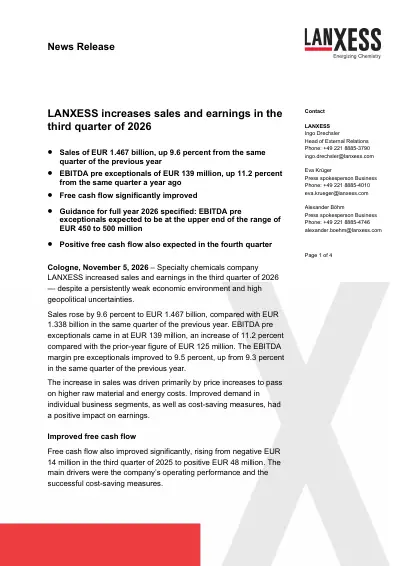
Now, taking a look at LANXESS, and I'm on slide 3 of your documents, we can say that in the third quarter, we were able to move clearly into the right direction. Sales and earnings increased, and it's very positive that our cash flow was further improved, visibly so.
This is the basis on which we were able to specify our outlook for the full year 2026, and I'm going to give you more details on that later. Sales and earnings on slide 3: increase in a double-digit way, 10% increase in sales and even more in EBITDA, and in the third quarter we are reaching €139 million EBITDA.
This is characterized by different developments in the three segments, and I'm continuing on slide 5. Consumer Protection was able to increase sales, and that was very positive also on the price side, although EBITDA as compared to the previous year is slightly declining.
Last year, we already pointed out that in Q3, in this segment, we had one-off effects that accounted for 10 million. Operationally speaking, this segment was luckily improving as well.
Slide 6: this gives you the details on Specialty Additives. They fared best in this quarter, but I must say this year this is the segment which we actually enhanced through acquisitions, and the footprint is very much in the US, and the site factors in the United States are clearly more competitive than the sites in Europe, talking about energy, talking about bureaucracy, all of which is at a much lower level there.
The individual federal states that we are represented in are very focused on industry and very supportive when it comes to industry. This is not the case in Europe, I'm sorry to say.
Against that backdrop, it doesn't come as a surprise that it's not only sales-wise, but also EBITDA-wise that we were clearly on the increase. Plus 58% EBITDA speaks volumes.
The segment that actually picked up on the sales side very well, but which is very much depending on Germany, is Intermediates, the division Intermediates. There are two business units, our main unit Advanced Industrial Intermediates and the second business unit in Uerdingen, Inorganic Pigments.
These are our two business units, together with Saltigo, that have the most pronounced footprint in Germany, and it is here that we encountered a substantial increase of energy costs, and in Q3, but also in Q4, they are on the increase. We are navigating against this on the price side.
We have an increase in sales of 7%, which is mainly driven by the prices because we have to compensate for the increase in energy costs. Looking at the EBITDA, you see there is a slight decline there, and we continue to be in heavy waters because the framework conditions and the local factors actually do not allow for a stronger business.
Slide 8: cash flow. It is clearly one of our focus points in management and also for the entire organization.
When we started the year, we said we would do our very best to manage costs much better, and we were successful in doing that. These are functional costs, which on a yearly basis are clearly declining, but it was also the strict cash management that now brought us some progress and success.
In the third quarter, we were able to generate a good cash flow, and on the nine-monthly basis you see we have visible successes to account for. The results go to show that with consistent cost discipline and a clear focus on cash flow, despite weak business activities, we are faring very well.
This is not all about saving, but let me talk about slide 8 and then transition to slide 9. The focus of LANXESS and the chemical sector is focused on the necessity to open up new markets, and for this purpose, we are developing new products on an ongoing basis so that our customers can also benefit from our developments and resolve problems.
On slide 9, you see an overview of different products that are new, subject to our innovation initiatives. In the second half of the year, we communicated that, and I was quite pleased to see that one or the other newswire and news media took it up.
We are talking about cosmetics and hospital hygiene, more sustainable tires, flame protection or retardants, and also products for road building. The first product here is called CosmeLin.
It is a biodegradable ingredient for cosmetics, and it is a new product range for creams, hair care, sun protection, and make-up. The ingredients ensure that a cream spreads easily and feels pleasant on the skin.
In addition to that, as I've said a minute ago, it is biologically degradable. That, of course, is a tremendous improvement over and above the products that we've had before.
Disflamoll Advance, this is the next product you can see here, this is a flame-retardancy product, and this protects plastics and also leads to a greater flexibility for plastics. Then the next one, Rely+On.
That product from the period of COVID. At the time, we had a product that we launched as a part of the Rely+On family, and that made a contribution to disinfection solutions, and we have developed this product further, and now it is a highly effective disinfection agent for hospitals and medical practices.
We are all aware of the fact that in these environments we have got greater germ loads, and therefore we need effective disinfectants. We believe that over the next couple of years we will be able to offer good solutions to fight bugs.
Then Vulkanox 4060, this is an aging protection for tires with an improved environmental profile, and it's more friendly to the environment and offers solutions for customers. Then we've got Adipave WM 23.
This is used in road construction, and it means that the asphalt does not have to be heated that much, you can reduce the heat by 40 degrees, and it goes without saying that this will save energy, i.e. be more environmentally friendly.
I've mentioned these examples to say that we are not simply waiting for things to pick up again, but we are actively developing new products to save energy, meet environmental requirements, and improve the products. This will be the basis for future business because at the end of the day, we cannot really influence the general conditions that much, but we can focus on the things that are within our control, be it costs or cash flow or our own innovative power, in order to offer our customers solutions for their businesses.
Now let me talk about the future. At the end of the day, the economic environment remains tense, and it's all and everywhere an uphill battle.
The building and construction industry is not where we would like to see it, and the automobile industry is having a rough ride, and the macroeconomic conditions have not improved. For Germany, it is really a major burden that the energy costs skyrocketed again over the past six months.
Of course, all the different industries are being impacted by that, but even more so the chemical industry, which requires more energy, and therefore it is an environment where we really have to fight hard. On slide 11, you see our outlook refined.
We are now talking about a range of 450 to 500, €450 to €500 million, and we can now specify the guidance for the full year, and we believe that we will end up at the higher end of the range, of the corridor. Cash flow in the fourth quarter is going to be a major focus of ours, and if we were to optimize our cash flow, which will of course also have a bearing on the P&L, particularly when you're destocking, then profitability will come in second, and that goes without saying, doesn't it?
This is the target we are fighting for and working for. Ladies and gentlemen, this is what I wanted to share with you, and I'll throw it open for questions now.
Claus Zemke
Thank you, Mr. Zachert.
Dear colleagues, should you want to ask a question, please use the raise hand function under response, and we will then give you the floor, and do remember to unmute yourself, and you have to push the unmute button in the center of your screen. The first request for the floor is from Annette Becker from Börsen-Zeitung.
Good to hear you. Annette Becker?
Ms. Becker, can you hear us?
We do not hear you. Let's see what the reason is that from the technical side.
Now I hear some sound. Can you hear me?
Annette Becker
I can hear you. Can you hear me now?
Claus Zemke
Now we can hear you.
Annette Becker
Good morning. I'm so sorry.
I had to click twice, and I didn't understand that I had to do that. Two questions.
Mr. Zachert, looking at the portfolio, you reported in detail that Advanced Intermediates is very much relying on Germany, and there are considerable difficulties because of the energy intensity level.
Do you check whether further closures will become necessary, and where do you look in particular? Then I'd also like to know whether you can give us your assessment on what BASF did and with respect to Evonik takeover.
Matthias Zachert
To answer your first question, Advanced Intermediates quite clearly are experiencing a very difficult competitive environment. Energy costs were mentioned, but at the same time also those costs to be spent on bureaucracy.
Let me just say that over the past 12 months, the European Union introduced anything but fewer bureaucracy, it's rather more. It's paid directives, time recording, a new packaging directive, the ETS system is being made more difficult for implementation, and new industrial emissions directive is in the making and in the implementation phase.
Just mentioning those topics goes to show that Europe needs to understand what competitiveness is all about, and that this is ever so important, and that further directives and regulations will be detrimental to competitiveness rather than supportive. The environment for German enterprises in the international competition, or for the German industry, remains difficult, and this is something that our three business units, Saltigo, IPG, and AII, have to fight with.
Over the past 12 to 18 months, we tried whatever was possible to reduce costs, and of course, we continuously check all operations to see whether they can make it structurally speaking or not. This is an ongoing process which we are going through every year, and we keep revisiting this throughout the year.
This is my answer to the first question. Evonik, BASF, my advice would be please do contact those two players.
I'm not surprised that the consolidation is continuing. Consolidation is taking place at product level in the European industry, as you can see when looking at what happened over the past 12 months.
There's a clear increase in this field. This being reflected at group level doesn't come as a surprise.
In Europe, we've always seen in crises of the industry that the actors find new routes or merge to become stronger, and of course that this is happening not only in Europe, but elsewhere, also at group level. I'm referring to the US as well, because such merges have also taken place there.
As I said, it's not a surprise, and I wouldn't be surprised either if this were to continue in the coming 1 to 2 years. Does that answer your question, Ms.
Becker?
Annette Becker
Yes, it does. Thank you very much.
Claus Zemke
Patricia Weiss from Reuters is next. Hello, Ms.
Weiss.
Patricia Weiss
Good morning to Cologne. I hope you can hear me.
Claus Zemke
Yes, we can.
Patricia Weiss
Three questions, if I may. I would like to know one thing: of course, you can see more specifically what's happening now in November, but why is it that for EBITDA you have capped the upper end of the range for EBITDA by €50 million?
What is the dampening effect in specific? The net loss was reduced below the bottom line.
What does that look like going forward? When can we expect positive figures at LANXESS?
I would also like to come back to the consolidation. Of course, you can't comment on other companies, but specifically, what's your take on Germany as a foothold, and how dangerous do you think maybe the situation for German players?
Covestro was already taken over by another company. What about the consolidation of the entire industry?
Matthias Zachert
The latter question is a wider one, and one could spend a couple of hours talking about it. I will try to summarize it.
Let me start with the first two questions. Ms.
Weiss, in the beginning of the year, we had chosen the range of 450 to 500, €450 to €500 million, and we communicated that at the annual press conference in March. Of course, going on in the year, you can rein it in the less is left of the year, and now we can reduce the range.
Operationally speaking, we are totally on track as we expected to be at the beginning of the year, but mainly there are two points to be mentioned. One being that we didn't see any pick-up in the second half of the year, and in inverted commas, the valley of the tears and the trough was overcome.
There's a slight increase at a low level, but there is some increase. The countervailing effect on the cost side is the energy price situation.
In the first half of the year, we were at a clearly lower level, and during the past 3 to 4 months, based on geopolitical tensions, and I'm just saying the Iran conflict, we saw that the energy costs increased tremendously, and that, of course, keeps swallowing up of the EBITDA. We can't really cushion it off, the guidance had to be reduced by 50 million, and that was the reason for specifying the guidance.
Now, that answers the first question, I hope. Second question, net income: we will keep working on that.
However, there's also a technical effect to be mentioned because it led the net income to the loss range is the consolidation of our joint venture share in Envalior. That's a joint venture or a company which, as is a predominantly private equity-owned company, and private equity companies make sure that high depreciation is effected wherever possible, and we have higher debts and higher interest load, and the consolidation of Envalior leads to a burden.
Should Envalior leave the conglomerate of groups, then the net income will substantially improve. Now let me talk about the main question of consolidation in Germany, LANXESS.
A crisis such as this one for the chemical industry in Germany is a phase where consolidation does take place, and we saw that during the past crises as well. This is the most pronounced crisis for our export-oriented German industry, but there's also a much exacerbated crisis, at least the strongest one I ever saw in my career in the chemical industry, which I think can be seen by looking at all the European countries reducing their capacities.
Cefic and VCI have commented on that, and they have capacity reductions of about 10% for the entire chemical industry. That's significant, and we'd never saw that during the past 10 to 20 years.
This goes to show the difficult environment that the chemical industry is fighting in, and they are fighting and struggling for their competitiveness vis-à-vis other regions that either have much less bureaucracy or much lower energy costs to grapple with. To consolidate at group level in such an environment is something that seems logical because it helps achieve energy scale effects and synergies.
That's what's happening in some places, and LANXESS as well wants to re-enter a position of strength. At the moment, we are clearly focusing on navigating the company through the crisis, and the Q3 figures show that this becomes positively visible.
Should we be able to go on like that, we believe we ourselves will be able to also go actively into the consolidation phase. That's our declared goal.
Does that answer all your questions, Ms. Weiss?
Patricia Weiss
It does. Thank you.
Claus Zemke
There are no further requests for the floor. Can I just check whether there are any more questions?
No, this is not the case. Thank you for joining.
Have a good day, stay safe, see you next time. Goodbye.