LPL Financial Holdings Inc.
Q3 FY2026 · Earnings Call TranscriptOctober 27, 2026
Operator
Good afternoon, and thank you for joining the third quarter 2026 earnings conference call for LPL Financial Holdings Inc. Joining the call today are Chief Executive Officer Rich Steinmeier and President and Chief Financial Officer Matt Audette.
Rich and Matt will offer introductory remarks, and then the call will be opened for questions. The company would appreciate if analysts would limit themselves to only one question.
To ask a follow-up, please re-enter the queue. The company has posted its earnings press release and supplementary information on the Investor Relations section of the company's website, investor.lpl.com.
Today's call will include forward-looking statements, including statements about LPL Financial's future financial and operating results, outlook, business strategies, and plans, as well as other opportunities and potential risks that management foresees. Such forward-looking statements reflect management's current estimates, or beliefs, and are subject to known and unknown risks and uncertainties that may cause actual results or the timing of events to differ materially from those expressed or implied in any such forward-looking statements.
For more information about such risks and uncertainties, the company refers listeners to the disclosures set forth under the caption "Forward-Looking Statements" in the earnings press release as well as the risk factors and other disclosures contained in the company's recent filings with the Securities and Exchange Commission. During the call, the company will also discuss certain non-GAAP financial measures.
For a reconciliation of such non-GAAP financial measures to the comparable GAAP figures, please refer to the company's earnings release, which can be found at investor.lpl.com. With that, I will now turn the call over to Mr.
Steinmeier.
Rich Steinmeier
Thanks, operator, and thank you to everyone for joining our call. It is a pleasure to speak with you again.
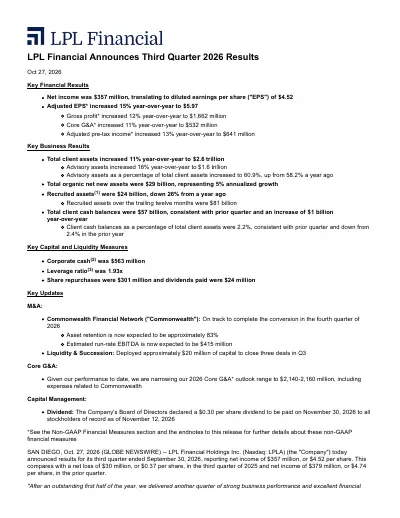
After an outstanding first half of the year, we delivered another quarter of strong business performance and excellent financial results while continuing to advance key initiatives. We delivered improved organic growth during the quarter.
We advanced our preparation to onboard Commonwealth Financial Network later this quarter. We began the phased rollout of our proprietary AI agent, Scion, to advisors.
We continued to deliver strong operating leverage. Now to highlight some of our Q3 results.
In the quarter, total client assets were $2.6 trillion, up slightly from Q2, as continued organic growth was largely offset by modest market headwinds. We attracted organic net new assets of $29 billion, representing a 5% annualized growth rate.
Prior to large institutional wins, this was our best organic growth rate in over a year. Our third quarter business results led to strong financial performance with record adjusted EPS of $5.97, an increase of 15% from a year ago.
Turning to our strategic plan. Our vision is clear: we aspire to be the best firm in wealth management.
To do that, we remain focused on three key priorities. One, preserving the client-centricity the firm was built on.
Two, empowering our employees to deliver exceptional outcomes for our advisors and institutions and their clients. Three, delivering improved operating leverage.
Effectively executing on these focus areas will help us sustain our industry-leading growth while advancing the efficiency and effectiveness of our model. With that as context, let's review a few business highlights from the quarter.
In Q3, recruited assets were $24 billion, bringing our total for the trailing 12 months to $81 billion. The vast majority of recruiting took place in our traditional markets, where we added approximately $23 billion in assets during Q3 and again captured an industry-leading share of advisors in motion while maintaining strong recruiting pipelines.
Turning to overall asset retention, it was 97% for the third quarter and 98% over the last 12 months. This is a testament to our continued efforts to enhance the advisor experience through the delivery of new capabilities and technology and the ongoing evolution of our service and operations functions.
Now let's turn to Commonwealth. Final preparations are underway, and we are on track to onboard Commonwealth advisors in mid-November.
Following 18 months of collaboration with our Commonwealth colleagues, we have established the integrated operating model that preserves the core of Commonwealth's industry-leading approach to serving advisors. From an operational standpoint, the technology and capability builds that underpin this conversion are complete.
The householding architecture, advanced case management platform, and the single relationship agreement we have discussed on prior calls are built and in final testing. While each was scoped to enable the Commonwealth conversion, each also benefits every advisor and institution already on our platform.
As we approach the transition, our focus has shifted to supporting Commonwealth advisors and their staff with their preparation and training. Our teams are deeply engaged with Commonwealth advisors to ensure that they can serve their clients without interruption from day one on the LPL platform.
With only two weeks until conversion, we have increased clarity on final asset retention, which we now expect to be approximately 83%. As for our broader work to continue elevating the experience for all LPL advisors, during the quarter, we soft-launched our proprietary AI agent, Scion.
The initial pilot for Scion Assist included several hundred advisors, and the early feedback has been overwhelmingly positive. We're on track to expand access to Scion Assist to all advisors by year-end, with additional high-impact capabilities planned for early next year.
In closing, the third quarter was a solid one for LPL, and the final one before the largest conversion in our history. I want to take a moment to thank our teams at both LPL and Commonwealth for their tremendous hard work and dedication in getting us to this point and positioning us for a successful onboarding next month.
We are building something special, and I am incredibly proud of the passion and dedication our teams bring to supporting our advisors. As we look ahead, we remain well positioned to serve as a critical partner to our advisors and institutions, to continue delivering industry-leading organic growth, and to maximize long-term value for shareholders.
With that, I'll turn the call over to Matt.
Matt Audette
Thanks, Rich. It was another productive quarter as the team continues to deliver exceptional results.
To reiterate some of those highlights, we delivered solid organic growth, further advanced our advisor experience through investments in our service organization, drove improved operating leverage through ongoing efficiency gains and better monetization of the value we deliver to clients, progressed our preparations to onboard Commonwealth in mid-November, and executed on our capital allocation strategy, where we remained active with our liquidity and succession capability and returned approximately $300 million to shareholders through share repurchases. These efforts resulted in strong third quarter business and financial performance and position us to sustain that momentum through year-end and into 2027.
Now turning to a few highlights from our Q3 business results. Total client assets were 2.6 trillion, up slightly from Q2, as continued organic growth was largely offset by modest market headwinds.
Total organic net new assets were 29 billion and approximately 5% annualized growth rate. As for our Q3 financial results, the combination of top-line growth and expense discipline led to an adjusted pre-tax margin of approximately 38.6% and record adjusted EPS of $5.97.
Gross profit was $1 billion 662 million, up 44 million sequentially. As for the key drivers, commission and advisory fees net of payout were 496 million, up 10 million from Q2.
Our payout rate was 88%, up approximately 50 basis points from Q2, driven by reductions to our corporate advisory pricing, as well as the typical seasonal build in the production bonus. Looking ahead, we expect our payout rate will increase by approximately 40 basis points in Q4, driven by typical seasonality.
With respect to client cash revenue, it was 472 million, up 15 million from Q2. Overall client cash balances ended the quarter at 56.6 billion, down 300 million from the prior quarter.
Within our ICA portfolio, the mix of fixed rate balances ended the quarter at roughly 65%, within our target range of 50% to 75%. Looking more closely at our ICA yield, it was 352 basis points in Q3, up 16 basis points sequentially, primarily driven by the updates to our client cash sweep rate methodology we discussed last quarter.
As we look ahead to Q4, we expect our ICA yield to increase by approximately 20 basis points as we benefit from the full-quarter impact of the methodology change, as well as the September Fed rate hike. As for service and fee revenue, it was 218 million in Q3, up 9 million from Q2, driven by revenues from our annual focus conference.
Looking ahead to Q4, we expect service and fee revenue to decrease by a few million. Moving on to Q3 transaction revenue, it was 79 million, down 4 million from Q2, due to lower trading volumes.
As we look ahead to Q4, we expect transaction revenue to increase by a few million. Now turning to our acquisition of Commonwealth.
As Rich mentioned, we are on track to onboard advisors in mid-November. To ensure we deliver a great transition experience, our collective teams are engaged with advisors and their staff to assist with preparation and training, and we've added resources to handle expected increases in activity around the onboarding.
As Rich mentioned, with only two weeks until conversion, we have increased clarity on final asset retention, which we expect to land at approximately 83%. As for the financials, accounting for our updated retention expectations and current market levels, we now estimate run-rate EBITDA of approximately 415 million once fully integrated.
This works out to a purchase price multiple of roughly 8 times EBITDA, which remains a compelling use of capital. Next, let's move on to expenses, starting with core G&A.
It was 532 million in Q3, up 13 million sequentially, but below the low end of our outlook range, primarily reflecting the timing of expenses that we expect to shift into Q4. For the full year, given the efficiency gains achieved throughout the year, we are narrowing our core G&A outlook range.
We now anticipate 2026 core G&A to be in a range of $2 billion 140 million to $2 billion 160 million. Turning to TA loan amortization, it was 150 million in Q3, up 8 million from Q2.
As we look ahead to the fourth quarter, we expect TA loan amortization to increase to approximately 160 million. As for promotional expense, it totaled 88 million in the third quarter, up 9 million from Q2, driven by our annual focus conference.
Looking ahead to Q4, we expect a similar level of promotional expense. Turning to interest expense, it was 106 million in Q3, up 4 million sequentially.
Looking ahead to Q4, we expect interest expense to increase by approximately 11 million from Q3. Turning to depreciation and amortization, it was 117 million in Q3, up 7 million sequentially.
Looking ahead to Q4, we expect the increase in depreciation and amortization to be more pronounced than typical, given the recent deployment of several new capabilities related to Commonwealth. As a result, we expect depreciation and amortization expense of roughly 130 million.
Regarding capital management, we ended Q3 with corporate cash of 563 million, up 133 million from Q2. As for our leverage ratio, it was 1.9 times at the end of Q3, slightly below the midpoint of our target range.
Moving on to capital deployment. Our framework remains unchanged, focusing on allocating capital aligned with the returns we generate, investing in organic growth first and foremost, pursuing M&A where appropriate, and returning excess capital to shareholders.
In Q3, we deployed capital across our entire framework as we continued to invest to drive and support organic growth, remained active with our liquidity and succession capability, and returned capital to shareholders. Specific to share repurchases, we bought back roughly $300 million of our stock in Q3, in line with the plan we outlined last quarter.
As we look ahead to Q4, we plan to repurchase another $300 million. In closing, we delivered another quarter of strong business and financial results and are prepared to onboard Commonwealth in mid-November.
As we look forward, we remain confident in our ability to execute, continue to drive growth and operating leverage, and create long-term shareholder value. With that, operator, please open the call for questions.
Operator
At this time, I would like to remind everyone in order to ask a question, please press star one one on your telephone keypad and wait for your name to be announced. To withdraw your question, you may press star one one again.
As a reminder, please limit yourself to one question. To ask a follow-up, please re-enter the queue.
Our first question comes from the line of Steven Chubak of Wolfe Research. Your line is open, Steven.
Steven Chubak
Hi. Good afternoon, Rich and Matt, and thanks for taking my question.
Matt Audette
Yep.
Steven Chubak
Hey, Steven. I was hoping to double-click into the NNA outlook.
Rich, you noted that this was the strongest quarter of organic growth that you've seen in more than a year on a core basis. Admittedly, NNA has struggled to break above 5% sustainably.
We saw it moderate further in September below 4%. Recognize one month does not a trend make, but was hoping you could speak to what you're seeing in the recruiting backlogs across both the enterprise and IBD channels, and how that informs your confidence level around getting back to a mid-single-digit plus NNA growth rate consistent with your longer-term targets.
Matt Audette
Thanks, Steven. Good to talk with you.
As you noted, organic growth in the quarter improved to 5%. When we look at the advisor recruiting activity, it has largely returned to normalized levels.
You see that in the performance in the quarter, but we also see that in the pipelines, most notably in the progression of the pipelines, where we may have noted quarters earlier where we were kind of front-loaded into the beginning of the pipeline. You see a pretty even distribution across the entirety of the pipeline.
As we continued progress in advisor recruiting, we see that as we join more onto the platform, we actually see them being replaced with new opportunities that are entering into the pipeline and progressing at the normal cadence that we've seen at historical levels. When you think about our expectation for normalized organic growth and getting it to the higher end of our mid- to high-single-digit range, this is generally predicated on contributions from large institutional onboardings in addition to the individual advisor recruiting.
Specific to the institutional recruiting, we continue to feel great about the opportunity. We have more active dialogues than we've had in the past.
Those dialogues are increasing, and we have a growing pipeline of diverse potential partners. I would remind you that in this segment, this is a complex decision for leaders of those firms, and that will take sometimes quarters and possibly as long as years to make the decision to move into that partnership.
From an outsourcing agreement once we've gotten to that and announced it, because of the complexity of the needs and sometimes the technology builds that we have on our end, it can take several quarters before the assets transition to our platform. We expect to continue winning institutional opportunities, but with the timing of those onboardings likely increasingly benefiting our 2028 growth.
Maybe that's how I'd take them together across the advisor and institution pipelines.
Operator
Thank you. Our next question comes from the line of Alexander Blostein of Goldman Sachs.
Your question please, Alexander.
Alexander Blostein
Hey, good afternoon. Thank you, guys, as well.
Maybe on Commonwealth, now that we see the exact sort of retention numbers of 83% and the updated EBITDA guidance of 415, Matt, maybe help us just kind of walk through the puts and takes of how this will get phased in into your P&L over the next several quarters? How do you think about sort of both the upside and downside risks to that 415?
Thanks.
Matt Audette
Alex, or I'll call you Alexander, it seems so formal. Look, maybe just quick walk on the 415.
I think as probably not lost on you, that was where we started with our original expectations for run-rate EBITDA. Lots happened over that time period with macro moving up and down, retention obviously coming in below that 90%, but synergies coming in better.
All in all, not that you usually nail it, but I think we're right on top of where we would expected. I think for your point on timing, really no change in what we've been talking about for quite some time.
Which is, the ramp to that run-rate EBITDA by Q4 of 2027, and clicking down into that, once you get on the other side of conversion, it's usually those revenue synergies that will come quicker. Things like sponsor-related agreements, cash sweep economics as it comes into our program.
Then the expense side is just more gradual over time as a general point, and it'll probably be more gradual in this instance because we are taking our time. We're things like we are intentionally retaining the entirety of their service organization.
That is a big part of their value proposition and their model. Then the other areas will be steady throughout 2027 to ramp up to that 415.
I think to the last part of your question on puts and takes or risks to that, it's really the same things that I just talked through. You've got your typical macro environment items, but I think outside of that, it's really just us executing on implementing the target operating model, which I think we feel really good about.
I think you then get back on the other side of that integration, I think I can and maybe Rich will want to jump in here, but I think I could probably speak for all those Commonwealth advisors that are excited to get on our platform and move beyond learning the new tools and integration and get back to what I think they do best, which is growing and serving their clients. I think that's the probably the opportunity in front of us there.
Rich Steinmeier
Maybe Matt, I'll jump in there for a second. Last week, Wayne Bloom and the entire Commonwealth leadership team hosted the Commonwealth National Conference.
There were roughly 1,000 advisors, home office staff, as well as sponsor partners. I would say that the overwhelming sentiment across the entire resort was eager anticipation, an acknowledgement that we are keeping what has made Commonwealth Commonwealth—the service, the supervision, the support, etc., the community, especially—and augmenting that with what makes LPL LPL, which is exceptional technology, the ability to continue to invest at scale, quickly delivering incremental capabilities.
I think the combination of those two firms is not one firm getting bigger, but two firms getting better together. Overwhelmingly, that's the sentiment we had at the national conference.
Now listen, there's work to do, and obviously to go through a conversion, there's a little bit of work. We feel good about when we get to the other side of that, how we'll support advisors, making them successful, driving their practices, and keeping Commonwealth intact.
Operator
Our next question comes from the line of Daniel Welden of Wells Fargo. Please go ahead, Daniel.
Daniel Welden
Hi, good afternoon. I wonder if you could elaborate a little bit on the institutional pipeline.
It's been a couple years now since the successful Prudential onboarding. What are those conversations like, and just kind of elaborate on your prior comment about the lead time in terms of signing and the quality of the pipeline you see here?
Thank you.
Rich Steinmeier
Of course. I appreciate the question.
Like I said, we feel good about that large institutional channel pipeline. Look, if you take a step back for a second and you look at firms that are thinking about a partner in that institutional segment, what you have are folks who are looking to take advantage of a world-class platform, capability set, and when you're going through that full assessment with a full partnership model, we're the market leader and have been the market leader for several years.
We support over 600 billion in client assets in wealth business with our partners on the institutional channel, and that 600 billion is multiples greater than those of our next closest competitors. When we get into those conversations, more often than not, the conversation is talking about helping those firms accelerate the organic growth of their wealth platform by utilizing our industry-leading tools and our services in support of their advisors.
Think about that as planning, high-net-worth capabilities, broad access to product, etc. We also help them improve their margins because we run more efficiently more often than not than how they're currently running their wealth management business.
A material component of the decision is often around reducing the regulatory and compliance risk, when you think about that for firms that are largely governed and regulated by a different governing body, regulatory oversight that they may be more familiar with. As they move into a FINRA-SEC environment, sometimes they're not as familiar, and obviously we're very familiar.
You put that all together with our proven ability to transition large-scale opportunities—think Prudential, think First Horizon, think Wintrust, think M&T, think BMO. We've been able to demonstrate that we can go through those transitions, do them close to seamlessly, and allow those firms to move their business forward in a material way, and we show up continually with them to add value to them to drive growth together with joint growth planning cycles, support of their advisors as well as their leaders in the wealth side.
I would tell you that as we come out of the backside of those large transitions that we've seen, we have quite a bit of advocacy in this segment as well. What happens is as we get into more conversations, we have reference clients who feel really good about the advance in what I told you: their growth, their margins, as well as a reduced risk environment.
We feel full-throated endorsement from our current clients. Again, I mentioned we're in more conversations than I could ever remember us being in, and those conversations are across a number of different types of firms.
Not just banks, community, credit union, national, regional, but you're talking about insurance product manufacturers as well, retirement record keepers. As we broaden those discussions, we see a robust pipeline, but I'd hearken back to one of the things I said.
It is a complex decision for them. It takes a long time to work through the financial modeling, the operational modeling, and then to get into conversion planning.
While we see a robust pipeline, we see advance across multiple segments. I would tell you that as we look forward, more often than not, as we get into contracting, it will take several quarters for them to get those over.
I would anticipate thinking about that growth that we may see from the continuing wins more benefiting a 2028 time frame. Thanks for the question.
Operator
Thank you. Our next question comes from the line of Craig Siegenthaler of Bank of America.
Please go ahead, Craig.
Craig Siegenthaler
Hey, good evening, everyone. Hope you're doing well.
Hey, Craig. We had a question on your pricing strategy.
We're curious, how do you feel about pricing across cash sweep, asset manager rev shares, and your ability to charge platform fees? Could we see a change over the near term?
If you do consider raising your cash sweep rate, do you think it would enhance your recruiting effort and also your ability to grow cash sweep albeit at a lower net yield? Thank you, guys.
Rich Steinmeier
First, Craig, I like your use of the first-person plural, I give you kudos. I'd like to know who the rest of we is, but I presume you represent a broad community.
Seriously, I would underscore what we've said previously. Look, this is a big body of work.
We're taking this work very seriously, and we're doing the work today. We need to make sure that any of those actions that you outline are well-considered, evaluated against the opportunities and risks, in line with our long-term strategy.
That would be creating value for advisors and clients and shareholders. I feel good about the progress we're making on that evaluation.
We expect to have more to share in the first half of next year.
Operator
Thank you. Our next question comes from the line of Dan Fannon of Jefferies.
Please go ahead, Dan.
Dan Fannon
Thanks. A couple just questions on expenses.
You're not seeing I guess from the guidance the typical 4Q slowdown in promo, and then curious about that in terms of the sequential increase. Then also just in terms of the TA loans and the growth, as we think about that on a longer-term basis, as you're recruiting, as you're growing NNA, we should assume that is going to grow in tandem, or is there some step function or decrease as we think about over a longer time period?
Matt Audette
Dan, I think on promotional, I think that we typically did see a decline in Q4. It's largely driven by our conference spend.
I think a little something that's a little bit different this year is our national conference was in Q3, and Commonwealth happened to have their national conference in Q4. That's probably the biggest thing that's new.
Marketing seasonally picks up in the fourth quarter. That's picking up a little bit more than typical.
It's probably those two things that are new, versus the prior trends. All planned, but just a little bit of a different seasonality.
I think your point on TA, over the long term, there's really isn't anything that I would highlight that would be different from short-term trends, which is all driven by volume in the level of TA rates. I'd highlight as we've talked about the last few quarters, TA rates have been quite high, given the recruiting environment's been quite aggressive.
How long that sustains itself is hard to know, but I think that's one thing that if you think about over the long term, you could think could moderate at some point, but that's just hard to predict when. I think the shorter answer I'd give you is just TA in line with our volume and level of recruiting is probably the best guide on where that heads from here.
Operator
Thank you. Our next question comes from the line of Michael Cho of J.P.
Morgan. Please go ahead, Michael.
Michael Cho
Hi. Good evening.
Thanks for taking my question, Rich and Matt. I just want to touch on recruiting one more time, just on NNA.
You talked through the kind of the timing piece for the institutional segments, but outside of that segment and kind of more normal course recruiting, I was wondering if you could give a little bit more color on the pipeline as it sits today or pipeline growth relative to maybe six or seven months ago and how we should think about the pace of improvement of NNA from here given the uplift from the normal cadence of recruiting that's coming back. Any comments on October would be helpful, too.
Thank you.
Rich Steinmeier
I'll take the kind of shape and contours of the recruiting pipeline relative to six months ago. Maybe I'd take back as we had conversations in previous quarters, we've mentioned that 18 months ago, as we announced the transaction, and we moved into the recruiting environment with Commonwealth, we mentioned that we had to ring-fence what was in the beginning a subset of our recruiters, and then what became much more material component of our recruiting force, to make sure we were educating Commonwealth advisors.
Given the deployment of capital and the strategic import of Commonwealth, is absolutely the right decision for this firm to make sure that we could educate Commonwealth advisors as strongly as we possibly could. We mentioned as we reached towards the end of last year, we began to see those recruiters coming back onto the field.
There were still quite a bit of questions. As you've seen, even in the continuing movement of Commonwealth retention, we continued to have to educate the advisors as they have a number of questions.
Largely, as we got through and certainly now, we got through the course of this year, there was still a subset of our recruiting team that was working to continue to stay engaged with Commonwealth to educate them and work through their diligence as well. Relative to six months ago, I think you saw us largely having that recruiting team back on the field.
As we mentioned last quarter, what that means is we're going to begin to feed into the first stages of the pipeline. What we saw six months ago was what you might see is the python swallowing the pig in the first couple stages of our recruiting pipeline being outsized relative to the later stages, as you might expect.
What we've seen over the course of this year is a normalizing of a movement through the pipeline of more of those to more of a steady-state-looking pipeline that is healthy across all of the phases of the recruiting pipeline. That's what I would expect to see going forward is that we continue to feed at the levels that we were in the first half of the year and have continued over the second half with a continued progression into later stages of the pipeline and then enhanced joins.
As we reflected, we feel good about what this quarter recruiting looked like relative to historical norms. We feel that this firm's value proposition is still the strongest value exchange in the marketplace.
We still have more advisors in motion choosing to join LPL than any other firm, and we expect over time that continue to strengthen. You want to talk about October?
Matt Audette
Yeah. Hey, Michael.
I'll hit October update. I'll do cash sweep as well as organic growth.
On the cash sweep side, headline is October is shaping up a bit better than expected given the typical seasonality. I think you know it well, but advisory fees hit primarily in the first month of the quarter.
That reduces cash. Advisory fees for October were 2.6 billion.
That reduces cash. Outside of that timing impact, cash balances are actually up 1.4 billion in the month.
Continuing that build that we saw in September. You put that together, and for October, we're sitting around about a 1.2 billion decline to roughly just under 55 and a half half billion.
On the organic growth side, as you know well, if those same advisory fees hit organic growth in the first month of the quarter as well, month one is typically the lowest month of growth in the quarter. Then second, we have a little bit of a larger attrition item coming through in the month.
Not unlike you saw in August where we had a larger join in an individual month, which, I would caution not to extrapolate. That was quite good in August.
You just see a little bit of the offsetting effect of that in October. Outside of that, retention levels are consistent with the strong levels we've seen recently.
Put all that together, we would expect October organic growth to be in the zone of 3%, which is not unlike what you saw back in Q3 with July, which was also in the zone of 3%.
Operator
Thank you. Our next question comes from the line of Brennan Hawken of BMO Capital Markets.
Please go ahead, Brennan.
Brennan Hawken
Good afternoon. Thanks for taking my question.
Was tempted to go with some kind of funky pronoun just for you, Rich, but we'll just jump straight into it.
Rich Steinmeier
I would just maybe agitator. That's a joke, dude.
Brennan Hawken
All right. In line with that adjective, on Commonwealth, you guys assumed the 90% in the 199 that you hadn't acquired, right?
I just want to kind of make sure I understand the mechanics. Does that mean that we'll get a reversal of some of the acquired when you guys onboard in the fourth quarter?
Does it go through that acquired line, or is it somewhere else? Is that some of the attrition that Matt just spoke to in October, or would that be a different thing?
Matt Audette
Brennan, that attrition I was speaking to was core LPL. I think we'll update the Commonwealth once we onboard it to that 83%.
I think we've given you the disclosures of the numbers at 100%, you can kind of do the math on what the 83% will be. We'll update that when it comes on the platform.
The attrition that we've spoken of is really core LPL attrition, not Commonwealth.
Brennan Hawken
Okay. Thank you.
Yep.
Operator
Thank you. Our next question comes from the line of Mike Brown of UBS.
Your line is open, Mike.
Mike Brown
Great. Thanks for taking my question.
I wanted to ask on client cash here. Client cash at 2.2% of client assets, it's stable, but well below the historical levels.
At this point, the cash sorting's played out. Buying activity seems to be the kind of main culprit keeping it at these low levels.
You've been spending a lot of time analyzing cash, and so I just wanted to hear your latest thinking on maybe the right level, how you think about that floor here relative to historical periods. Then with the AI tools, in theory, it makes it easier to manage cash levels or identify some of that excess cash.
Perhaps that's more in places where people manage the balances more directly versus in the advised channels. Are your advisors getting inbounds from clients that are kind of observing that they would like to run their cash levels even lower in this higher rate environment?
Just kind of curious what the latest pulse check there.
Matt Audette
Mike, I think when you look at cash balances, and I think as I'd point you to, which is what we look at, when you're getting these periods where cash is at the levels it's at, and you've got a fairly robust market where the denominator continues to grow, it's really about the cash balances themselves. We look at that per account, and the cash has come down to about 5,000 per account quite some time ago.
I'm sure you recall us talking through that, and it has remained roughly in that place. It'll bounce a little over 5, a little under 5.
From our perspective, cash has really reached the levels necessary to manage the account, right, for rebalancing, paying advisory fees, facilitating withdrawals. That percent of AUM decline you see is more about the overall asset levels growing.
I think that's where we see the floor. I think your point on AI tools and advisors, I would just underscore advisors are the ones managing the cash.
It is not a challenge, there's not a lot of friction for them to manage that today. I think when you look at the amount of cash that we have in cash sweep versus your more investment-type cash, whether it be money market funds, Treasury bills, short-term bond funds, you have a lot more cash in there, nearly double the amounts already in there.
The headline for you is it's not hard to manage today. Advisors are doing this.
From our standpoint, it's not some AI tool that's necessary to take some next leg there. We provide those products, advisors are using them, and what you see in cash sweep is really that operational cash necessary to manage the account, which we're now a couple years into seeing that around 5,000 per account is kind of where it settles in.
Operator
Thank you. Our next question comes from the line of Ben Budish of Barclays.
Your line is open, Ben.
Ben Budish
Hi. Good evening, and thanks for taking my question.
I wanted to come back and curious if you could share any more thoughts on the close of Commonwealth. I know last quarter you indicated you were trending closer to 90%, and I'm kind of curious, I guess, one, what sort of changed between then and now, maybe it's just some sort of a accounting and sort of wrapping things up.
I think there's another question around the competitive environment. There's definitely a perception that your acquisition of Commonwealth spurred a material increase in sort of competition.
I'm curious if that was a factor recently or if that's, Rich, you kind of alluded in I think a question earlier that it's hard to say what causes TA to normalize or competition to normalize, but is that something you've seen picking up and then maybe slowing down? I know there were kind of a few things in there, but any color on that would be great.
Thank you.
Matt Audette
I'll just start on the landing at 83. I think we started at the deal underwriting to 90%.
I think if you look at where we were last quarter, we were right around 85% for folks that had signed. We just had a small number of advisors that had signed decide not to stay, right?
It's as simple as that that brought us down to 83. Not too much of a decline.
Maybe just to underscore with just being a couple weeks out, that's why we feel fairly clear on how much is going to join around the 83% 83% zone. To your broader questions and points, maybe I'll let Rich jump in there.
Rich Steinmeier
Ben, I think you've noted it right. I think as we moved into the Commonwealth recruiting event and the announce, what you saw was a pretty aggressive move in the marketplace, specifically around TA.
You saw TA move up pretty dramatically, call that the April time frame through the summer of last year, and sustained at those similar levels. I think we're in so many deals in the marketplace today, and we see that that sustained level of competitive intensity specifically around TA has persisted those TA levels.
Now, I would reiterate as we're in those conversations, that is while TA grabs attention and it is a headline rate that you see in the marketplace, and you've got to be within the area code of the TA rate to make sure you get into those initial conversations, more often than not, when advisors make a decision, they're making a decision about the capabilities, technology, and support and service environment that the firm that they're going to join is. That's usually their number one decision-making criteria.
The second is the ongoing economics, and then third is TA. I can tell you across one and two, we feel like we are incredibly strong in the marketplace with our supportive environment, our capabilities, the continued advance of our capabilities, the service environment, and our support.
We also feel that our ongoing economics are really at the top end, and it is where you see us recognizing that that is the third most important decision criteria, but we've had to make sure that we're in that competitive range. We stay disciplined on our underwriting criteria, but recognize we've got to be close.
I think that's what you see going on is a sustained elevation in market TA rates from competitors who have decided to stay aggressive in the marketplace.
Operator
Thank you. Our next question comes from the line of Jeff Schmitt of William Blair.
Please go ahead, Jeff.
Jeff Schmitt
Hi, thank you. We've seen some competitors introduce retention bonuses to keep advisors from leaving.
Is that affecting advisor movements at all, or maybe the recruiting environment more broadly or causing any of your advisors to sort of seek the same? Thanks.
Matt Audette
Hey, Jeff. Headline is we haven't seen any meaningful change in the environment around retention.
I would just say, broadly speaking, it really is not a standard industry practice. We'll use it.
We have a small budget for tactical situations, like when you have maybe a poor service experience or some unusual operational issue or onboarding issue. I think what you're referring to, the concept of almost re-recruiting existing advisors with retention loans is not something we generally see or do.
Our focus, as you could imagine, is on our value prop, right, making sure that we deliver a day-to-day experience that is the reason to stay and grow with us, and so that's where we focus our attention.
Operator
Thank you.
Rich Steinmeier
Maybe I'll add just one small thing. Go ahead.
I think we've been on the other side of firms that write those large retention bonuses, and listen, that's a decision for the firm to make. We make no judgment call on that.
We have seen that we've seen advisors now that have gone through that, as they begin to get long in their new retention agreement with their firm, they're still misaligned with the firm. We've had a nonzero number of advisors who got re-recruited with large retention packages, they're still misaligned with their firm, and they're still aching to move.
The reasons, again, to go back, the impetus for action that existed that led to the discussions in the first place and led to the decision that sometimes gets reversed with a retention bonus, that doesn't mean that they're long-term stable. It often means that that's just buying some time to stick with the firm.
Operator
Thank you. Our next question comes from the line of Bill Katz of TD Cowen.
Please go ahead, Bill.
Bill Katz
Thank you very much for taking the question this evening. Just wanted to come back to something you said during your prepared comments that you sort of being a little more deliberate in terms of the service side of the equation with CFN and how that might inform the impact of synergies.
Can you just remind us or remind me, when you're going to get to fully run-rate synergies in terms of the 415? Then unrelated, but if I could squeeze a second question in, can you unpack the organic growth between what you're seeing in the advisory side versus the brokerage?
If I look at your brokerage business for the last several quarters now, you've been sort of in a net runoff mode, and yet you're seeing prolific growth in brokerage accounts in some of the retail platforms out there like Robinhood or Schwab and others. I'm just sort of wondering if there's a new competitive dimension that might be arising.
Thank you.
Matt Audette
Hey, Bill. I think on the timing of synergies, it is by Q4 of 2027.
I covered it a little bit earlier, but a typical path for an integration for us, which is shortly after onboarding, you get the revenue synergies earlier, which is typically when you're moving the cash onto our custodial platform, as well as the sponsor agreements. Then the expenses come through over time.
My point on service a little bit earlier was one, there are not synergies in service because we're retaining that group in its entirety. Then we're going to be deliberate about a deliberate pace on the rest of those areas to make sure we are protecting their overall experience.
That was why I was just underscoring that. It's all nested within that timing point of by Q4 2027.
On that brokerage versus advisory, I'll just give a data clarification, and maybe turn it over to Rich for the broader point. Just keep in mind, I suspect you do know, but keep in mind that brokerage to advisory conversions, which is a longstanding and continued trend, when you look at the growth rates, I think you're looking at for brokerage versus advisory separately, that'll be an outflow in brokerage and an inflow in advisory.
I think that that's a big reason that you see in some quarters some outflows from brokerage. It's really staying here, it's just going over to advisory.
Just want to make sure you have that context, and maybe Rich can hit broader.
Rich Steinmeier
I think maybe I hit it from two angles around that brokerage. You're going to see that draw down on our side as you continuously see the growth in advisory.
You see advisors, on balance, committed to an advisory construct to a fiduciary construct. I think that is generally run unabated over decades.
We are the beneficiaries as our advisors are continuing to move in that advisory pathway. Now, you mentioned some market dynamics, and I think those market dynamics are right.
I think, Bill, I'd probably angle you a little bit towards that's largely sits on the self-directed side. I don't want to be too much of a prognosticator here, but you are seeing some growth in prediction markets, crypto, etc., and alternative investment vehicles that are driving some of that self-directed utilization.
I think you'll have to look at that, and we'll continue to look at how we think about emerging new asset classes and investment types. I think, on balance, what you would see through an advisor relationship, you continue to see that shift from brokerage to advisory, and we feel that that reflects the health of the business as well as where the center of gravity is headed in a financial planning-centric world.
Operator
Thank you. Once again, to ask a question, please press star one one on your telephone.
Our next question comes from the line of Wilma Burdis of Raymond James. Your line is open, Wilma.
Wilma Burdis
Hey, good afternoon. We heard a couple competitors have added platform fees both in the wirehouse and IBD channels.
Realize this is something maybe you've thought about in the past, but if there's any updates or any additional thoughts you could share there? Thanks.
Rich Steinmeier
I think we're as well familiar with some of those platform fees that have been added. I think over the years they've been added in different constructs, you've seen custodians add them as optional.
I think in the wirehouses you've seen that largely on sponsor-based revenue and looking at that in a different construct as well as a platform fee. As I mentioned, we're doing work to consider all the alternatives as we think about pricing.
We historically have challenged convention as well in pricing. We're in the middle of that work, and so we're assessing all alternatives as well, and are well aware of some of the changes that have gone in the marketplace and explored what the impact of those have been as well.
Operator
Thank you. I would now like to turn the conference back to Rich Steinmeier for closing remarks.
Sir?
Rich Steinmeier
Thank you, operator, and thank you to everyone for joining us, and we look forward to speaking with you again next quarter. Have a great night.
Operator
This concludes today's conference call. Thank you for participating.
You may now disconnect.