NCR Voyix Corporation
Q3 FY2026 · Earnings Call TranscriptNovember 5, 2026
Operator
Hello, and thank you for standing by. My name is Andy, and I will be your conference operator today.
At this time, I would like to welcome everyone to the NCR Voyix Q3 2026 Earnings Conference Call. All lines have been placed on mute to prevent any background noise.
After the speakers' remarks, there will be a question-and-answer session. If you would like to ask a question during this time, simply press star followed by the number 1 on your telephone keypad.
If you would like to withdraw your question, press star 1 again. Please limit your questions to one question and one follow-up.
Thank you. I would now like to turn the call over to Sarah Jane Schneider, Vice President of Investor Relations.
Please go ahead.
Sarah Jane Schneider
Good morning, and thank you for joining us for our third quarter 2026 earnings conference call. This morning, we issued our earnings release reporting financials for the quarter ended September 30th, 2026.
A copy of the earnings release that we will reference during this call is available on the Investor Relations section of our website, which can be found at www.ncrvoyix.com, and has been furnished with the SEC. With me on the call today are Jim Kelly, our Chief Executive Officer; Darren Wilson, President; and Brian Webb-Walsh, our Chief Financial Officer.
This call is being recorded, and the webcast is available on the Investor Relations section of our website. Before we begin, please be advised that remarks today will contain forward-looking statements.
These forward-looking statements are subject to risks, uncertainties, and other factors, which could cause actual results to differ materially from those expressed or implied by such forward-looking statements. For additional information on these factors, please refer to our earnings release and our other reports filed with the SEC.
We caution you not to place undue reliance on these statements. Forward-looking statements during this call speak only as of the date of this call, and we undertake no obligation to update them.
In addition, we will be discussing or providing certain non-GAAP financial measures today, which we believe will provide additional clarity regarding our ongoing performance. For a full reconciliation of the non-GAAP financial measures discussed in this call to the most comparable GAAP measure, in accordance with SEC regulations, please see our press release furnished as an exhibit to our Form 8-K filed this morning and our supplemental materials available on the Investor Relations section of our website.
With that, I would now like to turn the call over to Jim. Jim?
Jim Kelly
Good morning, and thank you for joining us to review NCR Voyix's third quarter financial results. Before turning to our results, I'd like to spend a few moments on the organizational update we announced this morning: Darren Wilson's promotion to President of NCR Voyix.
Until today, I've held both the CEO and President titles. As we continue to bring our existing customers along with new customers onto our Voyix Commerce Platform applications, I've decided to centralize the retail and restaurant businesses under Darren's leadership.
Last year, I brought product development under a single leadership structure headed by Nick East. Darren's appointment represents the next step in aligning our sales and operations teams to accelerate our software, services, and payments growth strategies across both segments.
Further, this change reflects the growing overlap between retail and restaurant operations. Many of our grocery customers operate cafes and prepared food businesses, while convenience stores manage increasingly complex combinations of kitchens, drive-thrus, and pickup options.
Bringing these businesses together allows us to draw on the strengths of each to better serve our customers. Darren has been with NCR Voyix for nearly 3 years, and we have worked together for more than 2 decades.
He brings a distinguished career in payments and banking. At NCR Voyix, he and his team have been the primary drivers behind our early momentum in the growth of RCV.
As President, Darren will have full responsibility for sales, customer operations and support, product development, deployment, and payments. I will retain responsibility for our corporate functions, and Darren will report directly to me.
We will continue to work closely together to execute the company's strategic priorities. Alongside Darren's appointment, we also announced that Brendan Tansill will join the company as President of Retail and Payments, reporting to Darren.
I've known and worked with Brendan for over a decade, beginning at EVO Payments, where I witnessed firsthand the operational leadership and expertise he brought to successfully grow the company. With a distinguished background in software and financial technology, Brendan brings a unique combination of experience and perspective to NCR Voyix.
We look forward to welcoming him to the team. Turning to our results, revenue and EBITDA were in line with our expectations for the quarter.
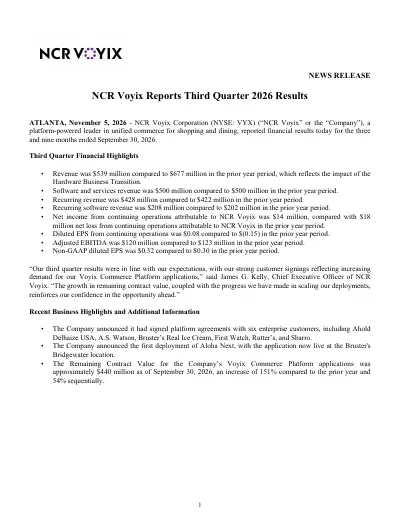
I'd also like to highlight the signing of 6 enterprise customers for our VCP solutions, which also drove remaining contract value to increase 151% year-over-year to $440 million as of the quarter-end. Clearly, this was a strong quarter from a sales perspective across both retail and restaurant businesses, and I expect this momentum to continue.
Customers are choosing to modernize with NCR Voyix, leveraging our industry expertise and market-leading positioning in enterprise. Our global scale remains a key differentiator, reinforced by the recently published 2026 Datos Insights Global POS Software Study, which again named NCR Voyix the world's largest POS software provider.
We also recently reached an important milestone with the launch of Aloha Next at Bruster's Real Ice Cream, our first live site. This moves our restaurant business from product development to live operations.
Darren will discuss how we are actively preparing for broader deployments later on the call. Our priority now is to translate this commercial progress into consistent execution and long-term growth across software, services, and payments.
With that, I will turn the call over to Darren.
Darren Wilson
Thank you, Jim, and good morning. I'm very excited to assume this expanded role, bringing greater alignment across retail and restaurants, and, most importantly, accelerating sales of our VCP solutions to new and existing customers.
Both businesses now share the same platform for all new applications, with specialized features supporting each market's needs. We are aligning our sales organizations around that common foundation and building more efficient, repeatable processes from contracting through deployment and ongoing support.
For the first time in the company's history, we have modernized the software applications supporting our 5 distinct vertical markets. We've formalized internal processes to help our sales leaders clearly articulate the benefits of these next-generation applications, including lowering total cost of ownership, identifying enhanced revenue opportunities, and accelerating delivery of new capabilities that meet their customers' needs.
A centralized operating structure will better connect what we sell with what we are ready to deploy and support. Applying lessons from implementations across global verticals and channels will improve execution and consistency as deployments scale.
The NACS Show in October marked the first anniversary of our Voyix POS for CFR application. When we first showcased it last year, customers were excited and curious, particularly because we had introduced it without a prior public announcement.
This year, conversations with new and existing customers centered on deployment timing and pricing, a significant shift from the year before. On the Tuesday before the show began, we hosted Pilot Travel Centers, one of our largest commercial fuel customers.
Nick East, our Chief Product Officer, led a fireside chat with Andy Lupo, Pilot's Chief Commercial Officer, discussing Pilot's ongoing efforts to modernize its stores and infrastructure. More than 500 convenience and fuel store operators attended to hear Andy's views on Pilot's strategy and their industry's future.
He highlighted operational resilience, continued innovation, and the importance of evolving technology to meet customers' needs. Building on our NACS momentum, we look forward to January's National Retail Federation show in New York, where we will showcase a full line of software, services, and payment solutions.
Turning to the contracts announced this quarter, these agreements span all 5 of the vertical markets we serve: grocery, convenience and fuel retail, specialty retail, restaurants, and food distribution. Beginning with retail, we are very pleased to have signed agreements with 4 high-profile customers with operations across the US, Europe, Asia Pacific, and Latin America.
First, we expanded our long-term agreement with A.S. Watson, the world's largest international health and beauty retailer, serving markets across Europe and Asia.
Next, we announced an expanded VCP contract with Rutter's, a long-time convenience and fuel customer. This multiyear agreement includes commercial fuel payments and restaurant capabilities to serve its in-store customers.
In Latin America, we signed a VCP agreement with Cencosud in Argentina, one of the region's largest grocers and home improvement retailers. Lastly, and most notably, we renewed our first VCP agreement, originally signed in 2021, with Ahold Delhaize USA.
With more than 1,000 live trading lanes today across over 100 stores, ADUSA is continuing to roll out Voyix POS for grocery and fuel across its 29,000 lanes spanning 5 separate banners. These customers have long relied on NCR Voyix software and services.
Their multiyear commitments extend those relationships well into the future. Next, I'd like to highlight the significant progress we made in restaurants this quarter.
We're very pleased with the VCP contracts we signed, including 3 existing enterprise customers and 3 new mid-market customers. As mentioned on prior calls, development of our VCP applications for retail began years ahead of those for restaurant.
Our restaurant engineering and product teams have worked diligently to close that gap, and Aloha Next is now live and trading at Bruster's corporate-owned location. This is a significant step as we accelerate sales of Aloha Next to both our existing Aloha installed base and new customers.
On the enterprise side, we announced Aloha Next contracts with 3 customers: First Watch, a Florida-based restaurant chain with nearly 600 corporate-owned locations in the US, specializing in freshly prepared breakfast, brunch, and lunch; Sbarro, an Ohio-based restaurant chain with more than 850 locations across 35 countries, specializing in New York-style pizza by the slice; and Bruster's Real Ice Cream, a Pennsylvania-based chain with 230 stores, specializing in premium ice cream made fresh daily in each store. I am pleased with our early traction across retail and restaurants and the opportunity to expand those relationships through payments and services.
Aloha Next is now live in the market, and our store-in-a-box offering remains on track for launch by year-end. Our Q4 demo calendar is filled with customer visits as we highlight the VCP market-leading capabilities and the notable changes across the company.
With that, I will turn the call over to Brian.
Brian Webb-Walsh
Thank you, Darren, and good morning. For the quarter, total revenue decreased 20% to $539 million, reflecting the transition of the hardware business.
Excluding this impact, total revenue decreased 3%, primarily driven by anticipated declines in hardware and related installation services, partially offset by recurring revenue growth of 1%. Within recurring revenue, software increased 3% and services was flat.
The growth in recurring software revenue reflects our payments initiatives and new product sales. For the third quarter, we added 10 contracts for our embedded VCP applications, bringing our total customers to 35.
These contracts represent $440 million of remaining contract value, up 151% year-over-year and 54% sequentially. Payment sites decreased 1% to 8,400, reflective of the restaurant SMB performance, partially offset by the growth within the retail business.
Adjusted EBITDA of $120 million decreased 2%, as expected, due to higher corporate expenses versus the prior year period, which benefited from the transition service agreements for Candescent and Atleos. Adjusted EBITDA margin expanded 410 basis points to 22.3%, reflective of the hardware transition.
Excluding the hardware impact, adjusted EBITDA margin was essentially flat. GAAP diluted EPS for continuing operations was 8 cents per share, compared to a loss of 15 cents per share in the prior year period.
Non-GAAP diluted EPS of 32 cents per share increased 7% year-over-year due to lower share count and tax rate. Turning to our segment results, reported retail revenue decreased 19% to $377 million, which reflects the hardware transition and a one-time government hardware sale in the prior year period.
Excluding these impacts, retail revenue was flat. Recurring revenue increased 4% year-over-year, driven by 8% growth in recurring software revenue.
Retail adjusted EBITDA increased 19% to $107 million, driven by software revenue growth coupled with our cost initiatives. Adjusted EBITDA margin increased 910 basis points year-over-year to 28.4% due to a combination of the hardware ODM transition, software revenue growth, and our efficiency actions.
Excluding the hardware ODM impact, retail margin increased 490 basis points. Turning to restaurants, reported revenue declined 23% to $162 million, reflective of the hardware transition.
Excluding this impact, restaurant revenue declined 5% in the quarter, driven by lower one-time installation services and continued pressure in our SMB business. Based on the early success we are seeing with Aloha Next, we expect broader sales of our VCP solutions to improve performance in 2027 and beyond.
Restaurant adjusted EBITDA decreased 1% to $73 million, driven by lower revenue. Adjusted EBITDA margin was 45.1%, an increase of 990 basis points year-over-year due to the hardware transition.
Excluding this impact, restaurant margin increased 180 basis points, driven by our cost initiatives. Corporate expenses were $60 million for the quarter.
Q3 adjusted free cash flow was $62 million before restructuring. This quarter benefited from working capital improvements, including cash inflows related to the hardware transition.
Restructuring outflows were $43 million, as expected, including the previously mentioned $24 million one-time litigation payment. We invested $37 million in capital expenditures during the quarter.
In September, we completed the sale of our Japan banking business, which generated $32 million of gross proceeds. During the quarter, we repurchased approximately $8 million of common shares.
We ended the period with $275 million in cash and a net leverage position of 2 turns. Turning to our full year outlook, we reaffirm our adjusted EBITDA and free cash flow guidance for the year, and now expect revenue to be at the lower end of the previously issued guidance range, reflecting delayed hardware purchases and related installation revenue.
I'll now turn the call over to the operator for Q&A.
Operator
We will now begin the question-and-answer session. If you are dialed in and would like to ask a question, simply press star then the number 1 on your telephone keypad to raise your hand and enter the queue.
If you would like to withdraw your question, press star 1 again. Please limit your questions to one question and one follow-up.
Thank you. Your first question comes from the line of Matt Summerville with D.A.
Davidson. Thank you, please go ahead.
Matt Summerville
Thanks. Couple questions.
As we think about your payment sites still declining, albeit marginally, what do we need to see for that to inflect more materially and begin to compound, number one? Then number two, we've seen now a huge rise sequentially in RCV, which is very encouraging.
What's the outlook for that metric from here as we get into the end of the year and early '27? Thank you.
Jim Kelly
Thanks, Matt. I think on the payment sites, you're still seeing, the impact of the SMB, which we've talked about in the past.
What we've succeeded in having the next the Voyix POS, sales where we're going to where payments is attached to it, and those are only going to start showing up once the the systems go live. They'll that'll be well into '27 would be my guess.
I think you'll also see on the SMB piece, as we announced the the live, first live store, which was a Bruster's store in, Pennsylvania, which is, which is also payments. On the restaurant side, we'll probably see a faster uptick both on the SMB side as that product matures into the first and second quarter, that we'll be able to start selling, Aloha Next into the SMB market.
I think that'll help stabilize it. The real growth will come out of the retail side, as we mentioned with some of the announcements this quarter, this last quarter, that, the sites that will be increasing will not be limited to restaurant, which is what it where it has been in the past, but it'll encomp- it'll encompass both retail and restaurant.
On the on the RCV, yes, it's a really strong quarter. We had, excellent execution on the sales, from the sales team.
Remember, we only just announced this at the start of last year. There's a cycle to engage with our customers, explain the the the capabilities of the application, which is completely different than what they currently have today.
The cycle in my feeling is, as we do more and more, demonstrations here in Atlanta, and also as we're building CECs in other locations, the customers get exposed to it. Again, we we have our schedule, which is to show them the product.
They have their own, objectives in any given year. We're trying to meet the two.
Far, the feedback has been I think phenomenal in terms of customers, customers have come in and and seen the product. It's still early days, I I don't expect every quarter to be of this magnitude.
In terms of opportunity, we're only, roughly less than 30% of the base, has been accessed. There's a few new customers in that 30%, but in the 30 or so that we've already signed.
I think it's a very good indication of, the balance of this year and into next year that the product is well-received. You saw with ADUSA, that's a renewal.
They were the first customer to take the product back in '21. Their product their contract matured, in the spring.
We worked through a a renewal, and that's a multiyear, long-term, relationship. They're now over a 1,000 store-, 1,000 lanes live over 100 stores.
Sainsbury's is well over 100 stores live today. As as the market has more proof points on the product, it makes the sales cycle shorter, and, I think you'll see the RCV just continue to grow over the next few years.
Matt Summerville
Thank you. Maybe just a follow-up maybe for Brian on capital deployment.
Has your thinking on capital deployment evolved any differently than what you've sort of been saying in the past? It looked like in the third quarter you were pretty conservative on share repurchases despite pretty significant volatility in the stock.
Maybe can you talk about how you're thinking about go-forward share buybacks and how you may or may not be thinking about M&A? Thank you.
Brian Webb-Walsh
Yeah. Our focus is still investing in the company and the product mostly through software capital.
We're spending about 160, $155 to $160 this year, so that'll continue. Then, opportunistically, looking at share repurchase, both the preferred and the common.
We were able to repurchase shares through October, about $38 million of shares through October at about $7 a share, just under. We'll continue to look to do that opportunistically when we can.
Matt Summerville
Thanks, guys.
Jim Kelly
Thank you.
Operator
Thank you. Your next question comes from the line of Kartik Mehta with Northcoast Research.
Thank you, please go ahead.
Kartik Mehta
Hey, good morning, Jim. In the past, you've talked about customers weren't happy with the product, and you've invested a lot in deploying the product and getting the product to where it is.
When you talk to existing customers, what's the biggest hurdle today in terms of getting them to sign up for VCP? Is it simply that you need to show the product, or are there other hurdles that you're encountering?
Jim Kelly
I don't think there's hurdles. I think the first is, as I was mentioning earlier, we have our agenda, they have their agendas.
They have their own IT spend for the year, and we kind of came out of nowhere with this modernized capabilities that give them, at least for the existing customer base, like-for-like capabilities, which is a big deal for an enterprise customer. They don't have to retrain, etc.
One of them, it is just getting on the same cadence. I think if you want to call it a hurdle, it is who's going to be the early adopters?
We have a number of early adopters, Pilot, for example, on the CFR, Rutter's now has signed up, ADUSA, Sainsbury's, Morrisons. There's a lot of very prominent retail, and now, especially on the restaurant side, starting with Chipotle, which will be going live in the first quarter, and now I think we had 3 or 4 this quarter, last quarter.
Some of it is just getting over the hurdle of being first, even though for existing customers, they're accessing essentially, if not exactly, the same capabilities that they've had before. It's still new, and there's a pattern of do you want to buy the first one, or do you want to know that somebody else has confirmed that you can confirm with?
I think that is something we've experienced thus far this year. I think that's starting to dissipate, but I would say not entirely.
I think the only other hurdle is they're running on applications that are going to stretch anywhere from 10 to 25 years old. Actually, one of the customers I saw at dinner a few months ago on supply chain, their product dates back to the 1980s.
Overcoming a application that's been in the market has had challenges from time to time trying to modernize and meet all the needs. Remember the way NCR used to sell is they would sell a core application, and then they would utilize a team of professional services in-house to make customizations that were specific to the customer, but continuing to then update it and upgrade over time was increasingly challenging.
Some of our challenges is just past reputation that's associated with an old product. I will tell you for every customer I've met with, and we've had probably 40 or so come through the CEC in the last year, maybe even higher, they've all left with a completely different view of our capabilities, our potential.
They love the product, and it's evidenced by what you saw in this quarter.
Darren Wilson
Just adding to that, Kartik, hi. I think it has been a journey of getting customers to understand they can genuinely have like-for-like capability that they have today on the new product, because, as Jim said, historically, it was probably a fundamental change in kind of product design or product architecture.
This is an architecture upgrade for them, but having the user interface for their employees and their customers on a like-for-like basis is a fundamental change in understanding, and it's been a game changer, as Jim says, from the demonstrations we've been doing at the shows and also through our customer experience centers. I think, finally, all of our customers are continuing to seek to sweat their hardware longer and longer, as you've seen with some of the results we've announced over the previous quarters in terms of customers elongating hardware's life cycle management cycles.
I think now the confidence that they understand our product can run on legacy hardware and that we can help them continue their life cycle upgrades, but on a staged and managed basis has also been a differentiator in helping the product land in terms of resonance with their strategies. That I think has been historic, but we're getting over the hurdle on that as well.
Jim Kelly
I'll conclude on this. I do think there's an inflection point here.
Kartik Mehta
Yeah.
Jim Kelly
Last year was the first time we showed the product, and we had early success, more success coming into the start of this year. It's not going to be every quarter the exact same, but yeah, I definitely believe that this is an inflection point.
Our sales organization is getting more comfortable with the product. Our product team is looking into the future as to what other add-ons.
While we talk a lot about the existing base, we're just as interested in accessing new customers. It's just our customers have been with us for a long time.
We know them very well, and they're excited about the journey to move to the new product.
Kartik Mehta
Hey, Jim, just a follow-up. One real interesting opportunity I think you've talked about is commercial fuel payments.
I'm wondering if you could just discuss what you've done, some of the integrations you've done, and the potential opportunity for the company.
Jim Kelly
Payments is a huge opportunity. I've said this multiple times across both commercial fuel and retail restaurant.
We estimated at $1.4 trillion. That's not a number even with my payments background that I'm familiar with saying, something that starts with the letter T.
Of that $1.4, I would say commercial is at least $500 billion of opportunity. Now, it's at a very thin margin.
You saw with Rutter's that they're our first commercial fuel company, our first CFR company to take commercial fuel. We have integrations now, live integrations with all the majors, and we'll continue to expand that with more of the smaller niche players.
It's as much as it's a positive to us financially, because we have all the infrastructure in-house, we're not using a third party for the authorization system, settlement, we have sponsorships. We look like any other company I used to work for in terms of structural capabilities.
The real opportunity is for the customer because if it's not us doing it in-house, we're having to switch to a third party, either a processor, in some cases, an intermediary that then switches to a processor. Every time you switch transactions around, unless everything's lined up, if somebody makes a change overnight, then you have a failure.
Typically, those failures, when they happen, they call us anyway. This is likely a financial savings for our customer, a benefit for us.
This is convenience for our customer because they know we handle the transaction from not just the point-of-sale standpoint, but also from the payment standpoint. Now, this is resident here in the US.
We do have the ability through gateways that we own to switch transactions to partners internationally, outside the United States. Maybe one day we'll take on a bigger role internationally, but for right now, our primary focus is to access our enterprise retail and restaurant customers and offer this capability.
Kartik Mehta
Perfect. Thank you very much.
Appreciate it.
Jim Kelly
Thanks, Kartik. Yep.
Thanks.
Operator
Thank you. Your next question comes from the line of Jack Evans with Goldman Sachs.
Thank you, please go ahead.
Jack Evans
Hey, good morning, and thanks for the question. I believe last quarter you mentioned restaurant segment was impacted by lower than anticipated hardware, and I believe some delayed refreshes into next year.
Could you just provide an update on how these are shaping up against your expectations, and whether or not that's still the case?
Jim Kelly
I think the comment last quarter was localized to I wouldn't say the customer name, but one or two sizeable enterprise customers. These are predominantly hardware and services customers where, as they purchase hardware, we would install the hardware.
I think we've seen a couple of things. As Darren mentioned, customers, whether it's economic-related or otherwise or just their own strategy, have been a little bit more, I don't know, delayed on refreshes, maybe based on what would have been our expectation and communications with them at the start of the year.
I don't see it as a seismic issue. It's just from quarter to quarter, numbers may move around a little bit.
I think the other is just the restaurant industry's, whether, again, it's just economic, has seen somewhat of a pull-back on the services side.
Jack Evans
I'd
Jim Kelly
also just add on the software side, I don't see any of that. Engaging with our customers, showing them the capabilities of the new products, they're all very excited about it.
I have not seen anyone who's walked in here who said, "Yeah, I'm not really interested in this," because they're all using legacy applications, and they need the capabilities. I just had dinner last night with Darren and a customer, and we were speaking restaurant customer, sizeable one, and we had a conversation about the capabilities that they're going to see this morning after this call versus what they've been using, and what they're using is a product that goes back from its origin almost 30 years.
They want to modernize because they want to meet your needs as a consumer, and they can't do that with the current stack.
Jack Evans
Got it, very helpful. Then just as a quick follow-up, of course, great to see the deployment of Aloha Next at Bruster's.
I guess could you provide some details on how you're approaching the go-to-market strategy for the product and how that differentiates between front book and back book, just in terms of how you guys are kind of thinking about that from a management perspective?
Jim Kelly
I wouldn't say it's limited to Aloha. I would say for all our products, my direction is to ensure that all our existing customers, where we have 348 customers that use our software across today 65 applications.
The message through Darren organization now is, through Benny, etc., is to make sure that our customers understand exactly the new capabilities, what we can offer them, and when possible, we get them in so that we can spend a day taking them through the architecture, together with capabilities and how you can add AI very easily, etc. That's primarily because that's the base of customers that we've supported for over 20 years.
In parallel, we would not walk past an RFP or the opportunity to sign up new customers in parallel, and we're doing that as active. The primary right now is to solidify the base and make sure that the base understands our capabilities both on the retail and restaurant side.
We're doing that really through direct interaction, as opposed to a marketing campaign. It's more to invite them in.
Darren Wilson
Jack. It's classic go-to-market as you'd expect.
Certainly at the enterprise level, firstly, in terms of the direct marketing engagements, but most importantly, engaging directly with the critical stakeholders and decision-makers in our customers and our prospects. The shows are critical for us, and I think we talked about NACS and the successes and highlights that we had from that.
I think one of the real highlights was 70% of the engagements that we had with customers at NACS was actually new prospects rather than existing customers. They remain a very important channel or go-to-market strategy, but that doesn't detract from equally our continued channel partner strategy and our SMB strategy.
There are go-to-market differences according to the channel, the segment that we're supporting or focused on. It's all the expected marketing and sales behaviors you'd expect aligned with the respective channel.
I think the key thing is we've got one platform now, and that story is starting to resonate as in CFR where fuel retailers are now diversifying into food and kitchen. The single platform strategy and similarly the retailers diversifying into food as well.
The merging of the product solution on a single platform is really where the messaging is focused and resonating strongly as a differentiated play. That's a core focus.
Jim Kelly
One more piece, I think just given that NCR has gone through a lot of changes since '23 when the company split and we sold digital banking and we sold Japan banking asset, and we sold another asset in Brazil, that I spend a lot of time with our customers. I've seen almost 40% of our 348 customers personally, almost 50% of them, domestically and internationally, Darren the same, Nick East from the product side spends a ton of time with many of our enterprise customers, as does Benny.
One other approach to this is it's not just the sales force directly, but we want to support that organization, and we do that by getting a chance to meet some of the more senior people within the organization because there's a lot of history. Some of the history is good, some was probably not as good, and I think it's an opportunity for us not just on the product side, but on the relationship to reset and let them know what we are today: a SaaS company as opposed to what NCR was, 5 years ago, 4 years ago, a conglomerate.
I think that has been helpful, and I think that's one of the reasons why you see the numbers that you do on the RCV.
Jack Evans
Got it, great to hear. Congrats on the results.
Jim Kelly
Thank you.
Operator
Thank you. Your next question comes from the line of Parker Lane with Stifel.
Thank you, please go ahead.
Hi, good morning. This is Jack on for Parker.
Thanks for taking the questions today. I wanted to touch on the restaurant market.
You all had given some commentary around some SMB headwinds here. This isn't the first time we've heard this, but I'm seeing a sequential decrease in the platform sites here.
I'd be curious to hear, particularly on the SMB segment, are you seeing SMB worsen, or does it remain just as challenged as recent quarters? Do you think that product enhancements like Aloha Next are enough to stabilize the group, or do you think you just have to get to a smaller base before you start seeing growth here again?
Jim Kelly
That was a long question. The base of SMB restaurants go back to the retail Radiant acquisition where Radiant's model was using dealers.
Then over the course of I don't know exactly what years, those restaurant dealers were bought out, and those customers, the SMBs predominantly, became the customers of NCR. That in and of itself's not a fantastic model because that's a complete change from what those customers were used to: having somebody directly down the street that they knew, and aided the restaurant to a centralized structure.
I'm guessing that's been under pressure for a number of years. More recently, the announcement last year of Aloha Next was not helpful in selling to SMBs or others.
SMB is a quick sale. They're happening in a matter of days or a month, as opposed to an enterprise sale.
I think some of this was self-inflicted by announcing Aloha Next together with Chipotle last November, a year ago. In terms of stabilization, it is doing better than it was, but I don't expect it to start to improve until our product is out and selling in the marketplace.
I think once that occurs, it's a fantastic product, and we're not looking to invert the company from an enterprise, probably 80% of our business is enterprise, invert those numbers. Yes, I think the first order of business is to stabilize that.
I'm pretty confident that'll get stabilized during next year, as the product gets into the marketplace. Then I don't think there's any reason why it can't grow.
I don't think it'll become the predominance of our organization, but it is very important to us. It's probably the biggest component of payments right now is our SMB because we generally see 100% acceptance of payments when we sign up even today existing customers.
Retail has a similar small footprint on retail sales, and that business continues to do extremely well. I think we're well-positioned to support all ranges of customers.
I think the challenge is we announced a new product for enterprise. We didn't have a product for the SMB ready.
Now with Bruster's, we're very close to being able to launch into the start of next year, and I think you'll see that decline start to slow.
Thanks for the color, Jim. I wanted to ask, last quarter, you had talked about AI agents automating migrations and getting remote installations, I believe you said under an hour per store.
Just curious to hear where you are on deployment speed, and how you feel on services capacity here as you work through your VCP deployments over the remainder of this year and into '27?
Jim Kelly
I'm not going to talk about specific customers, but I'll give you two examples. One, maybe we would have done last year, one a month.
Some of that, it was still early days. Now they're doing 50 a week.
There's no limit on this. The limit is internal to the customer.
While it is like-for-like, they still like to train and show their cashiers, in the case of a CFR or grocery. They want them to at least experience the new product before they just light it up.
Then once the training is over, overnight, our deployment team or, in some instances, they can do it themselves, deploy the product across as many estates as they'd like. We've got the same in Europe, where some of our big grocers are moving at a pace.
I think we explained it, I think Nick did last call, that we did a deployment one night with no one in the room. It's the first time ever that that had happened.
We had people stationed just in case it didn't work, and now that's just commonplace. That's going to continue to be commonplace.
Just as an aside, our contractual relationships with the customers are not dependent on the speed at which they roll out. It used to be the model here.
It is no longer the model. The speed is entirely at their pace.
It's in our best interest that they go fast because it's more of a proof point to the marketplace, but financially, it's does not have a negative impact on us any longer for the new product.
Operator
Thank you. That concludes our question-and-answer session, and I will now turn the call back over to Jim Kelly for closing remarks.
Jim Kelly
Thank you, operator, and thank you all for your continued interest in NCR Voyix.
Operator
Ladies and gentlemen, that concludes today's call. Thank you all for joining.
You may now disconnect.