GSK plc
Q3 FY2026 · Earnings Call TranscriptOctober 28, 2026
Jeff McLaughlin
Welcome everyone, and thanks for joining GSK's Q3 2026 results. Today's call will last approximately 1 hour, with the presentation taking around 30 minutes, and the remaining time for your questions.
Before we begin, this slide is our usual safe harbor statement. We will comment on our performance using constant exchange rates, or CER, unless otherwise stated.
I will now hand over to Luke Miels, CEO.
Luke Miels
Thanks, Jeff. I'm joined today by Tony Wood, who'll give an update on the pipeline; Nina Mojas, who'll cover growth drivers; Julie Brown, who'll cover financial performance; and David Redfern will join for Q&A.
First, let's review the company performance. Next slide, please.
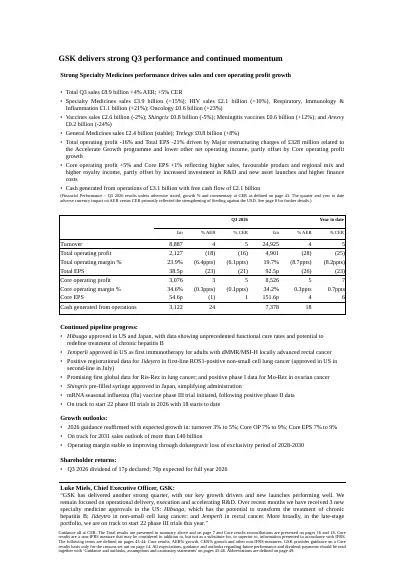
Q3 was strong, and we have continued operational momentum, with sales up 5% to £8.9 billion. As expected, specialty is driving our momentum, including launches in respiratory and oncology.
Core operating profit grew 5%, and core earnings per share were up 1%. Our cash generation remains very positive, at £7.4 billion year-to-date.
Our Q3 dividend is 17 pence, and we're on track with our responsible business rating. Given our operating momentum and launch progress, we're pleased to reconfirm 2026 guidance today.
Next slide, please. This slide is a reminder of our key priorities to drive value for the business and our shareholders.
To start, we're focused on maximizing launches. This quarter, we've made good progress on Blenrep, where repeat prescribers are growing as physicians and patients get comfortable using the medicine; and Exdensur, where we're seeing momentum building with prescribers, patients, and access, all increasing in the quarter.
We've now also had our first launch in non-small cell lung cancer with Jidaitro for TKI pre-treated ROS1-positive patients, which has already delivered £3 million; and our oncology portfolio continues to grow, with a further indication for Jemperli in locally advanced rectal cancer. We also received approval for Hepsago in the US and Japan, the first finite treatment to offer a functional cure for patients with chronic hepatitis B.
Each of these products will meaningfully contribute to near-term growth as we continue to build momentum in our specialty business. At quarter two, we outlined clear plans to accelerate R&D, and we're now delivering on those plans.
We're recruiting in 18 of the 22 Phase 3 trial starts for 2026, including two new Phase 3 studies for flu, and the rest on track to start recruiting before the end of the year. We also presented data for several of these assets, including Jidaitro, Rizrez, Morez, and Jemperli, demonstrating significant progress in our oncology pipeline and proof points for our approach to BD.
Finally, on simplification, we made progress on the Accelerate Growth program, helping to reallocate resources to invest in R&D and accelerate our late-stage development pipeline. Fundamentally, this will align our cost base with our evolving portfolio and help us accelerate growth and deliver value for patients and shareholders.
With that, I'll now hand over to Tony to cover our pipeline momentum in more detail.
Tony Wood
Thanks, Luke. It's been a busy period for R&D, with a number of recent approvals and pivotal data readouts.
Jidaitro and Hepsago approvals were received ahead of their FDA PDUFA dates, and Jemperli received accelerated approval for rectal cancer. These, together with the strength of the data presented at recent medical congresses, demonstrate the value of assets in our late-stage pipeline, where the majority have potential to be best-in-class, and where we've added 12 new Phase 3 study starts this quarter, bringing us to 18 for the year.
Next slide, please. Moving to new products and indications: Jidaitro for ROS1-positive and neladalkib for ALK-positive mutations in non-small cell lung cancer have the potential to meaningfully improve on standard of care.
These mutations represent 3% to 5% of all non-small cell lung cancer. Here, patients are often younger, in their 40s and 50s, and remain on therapy for years while experiencing high rates of central nervous system side effects and often developing brain metastases.
Importantly, Jidaitro is the first and only ROS1 TKI to address both selective targeting of ROS1 resistance mutations and CNS activity, thus aiming to improve treatment for patients with brain metastases while minimizing drug-related CNS adverse events. Similarly, neladalkib is a once-a-day medicine designed to avoid off-target adverse events which can be treatment-limiting for patients.
We anticipate FDA approval in November, supported by the ALKO study, which showed a median progression-free survival of 14.5 months in a previously TKI-treated population. Also in oncology, approval for Jemperli in locally advanced rectal cancer is based on the AZUR-1 data, which showed 68% of participants with no detectable signs of cancer one year or more after treatment.
Current standard of care achieves complete clinical response in around 20% to 25% of cases and can have lasting consequences, including bowel and urinary dysfunction and secondary cancers. Finally, for Hepsago: Nina will cover our launch plans for this important medicine in a moment, but I want to reiterate how transformational Hepsago will be for those living with chronic hepatitis B.
These patients are at an increased risk of death from cirrhosis and liver cancer, and current treatment options involve lifelong therapy. Hepsago is the first finite treatment for chronic hepatitis B which provides the potential for a functional cure.
We plan to share additional data from the development program at AASLD in November. Now moving to our development plans for Jidaitro and neladalkib in TKI-naive patients: Jidaitro data were presented at the recent World Lung Congress.
The overall response rates are amongst the highest ever reported in this patient population, with a 94% overall response rate and a 15% complete response rate. The median duration of response has not yet been reached, but 86% of patients have a duration of response of greater than 12 months.
Data on brain metastases in this TKI-naive population showed no CNS progression events observed in patients without metastases at baseline and a 100% response rate in those with brain metastases at study entry. The emerging clinical profile for Jidaitro suggests it has the potential to deliver meaningful outcomes as a best-in-class therapy for TKI-naive patients.
Neladalkib is also in development for a TKI-naive population, and here the Phase 1/2 ALKO study shows an 86% overall response rate. Median duration of response has not yet been reached; however, 91% of patients have a duration greater than 12 months, as you can see on this slide.
The corresponding Phase 3 TKI-naive study, ALKOZAR, is more than 50% recruited, and based on available data today, we believe neladalkib could have the potential to drive years of progression-free survival. Next slide, please.
Next to Rizrez, where emerging data demonstrate robust and consistent outcomes across a range of solid tumor types. In small cell lung cancer, the Chinese Phase 3 ARTEMIS-08 data, presented at World Lung by Hansoh, showed a 54% reduction in risk of death and a median overall survival of 18.5 months.
The global pan-tumor Phase 1/2 EMBOLD-101 study has now enrolled with more than 550 patients. Data from the small cell lung cancer cohort of this study were presented last weekend at ESMO and showed a 61% response rate, consistent with the 58% overall response rate observed in ARTEMIS-08.
The global Phase 3 trial, EMBOLD-SCLC-301, is also recruiting well, and we anticipate preliminary data by the end of 2027. Next slide, please.
Also for Rizrez, data from the Hansoh Phase 3 ARTEMIS-11 study, which looked at Rizrez versus standard of care in Chinese patients with relapsed, refractory osteosarcoma, was selected for the Presidential Symposium at ESMO this week. Osteosarcoma is a rare tumor, and relapsed patients have few treatment options.
The current standard of care delivers around 2% response rate and 1.5 months of progression-free survival. In this trial, Rizrez demonstrated a 67% reduction in risk of disease progression or death in patients with relapsed disease.
A global GSK Phase 2 trial, EMBOLD-Sarcoma-202, started earlier this year and is recruiting well. The global EMBOLD program has now over 1,000 patients who've received Rizrez, with more than half of those enrolled in the past 8 months.
Over the next 12 months, we anticipate data readouts across multiple indications, and we look forward to sharing these as they mature. Next slide, please.
For Morez, new data presented at ESMO from the global Phase 1 BEHOLD-1 trial confirms the potential for best-in-class activity in ovarian cancer, with median progression-free survival of around 11 months in a non-biomarker-selected population. These data compare favorably with current standard of care, which delivers around 6 to 8 months of PFS.
As promised at the Accelerate Growth event in July, we've now started recruitment for five Phase 3 trials in ovarian and endometrial cancer. Over the next 12 months, alongside Hansoh, we will continue to generate longer-term data to demonstrate the durability of response and safety profile of this novel ADC.
Next slide, please. Also at ESMO, we presented interim pivotal results from AZUR-1, which looked at Jemperli in the treatment of patients with dMMR locally advanced rectal cancer.
The current standard of care for these patients achieves a complete clinical response in around 20% to 25% of cases, but involves chemotherapy, radiotherapy, and surgery, and is associated with significant morbidity. In AZUR-1, over two-thirds of patients achieved a complete clinical response, and after a two-year follow-up period, no disease recurrences were reported amongst patients who responded.
The study continues to generate data and offers an important, potentially curative option for patients with locally advanced rectal cancer. Next slide, please.
Turning now to vaccines: last season, over 700,000 people, mostly older adults, were hospitalized with flu in the US. Currently, flu vaccines, which generally focus on hemagglutinin, protect unevenly.
Our mRNA flu vaccine candidate, which has achieved Fast Track designation from the FDA, targets both hemagglutinin and neuraminidase. Neuraminidase changes more slowly, protection may be more durable when strains mismatch.
Targeting both has the potential to offer broader immunity and better, more consistent protection. In Phase 2, our candidate produced stronger immune responses against both targets than a high-dose comparator, supporting our decision to start a large Phase 3 study in more than 50,000 adults aged 65 and over.
The study started in September, and more than two-thirds of this season's enrollment target has already been recruited. The study will run over two seasons, and we anticipate preliminary data next year, pending a sufficient number of cases.
Next slide, please. Across R&D, we continue to make fantastic progress in accelerating our late-stage pipeline.
At Q2, we described our plans to start 20-plus Phase 3 studies in 2026. We've now started 18 Phase 3 studies, with a further four on track to start before the end of the year.
These studies have been accelerated based on our confidence in the differentiation and benefit to patients of our late-stage assets. I'm pleased with the continued hard work of our teams to deliver this previously unmatched pace of acceleration across a broad and growing portfolio.
Next slide, please. Before I close, I momentarily want to share this slide, which we presented in July.
It demonstrates the expansion of the late-stage portfolio, and from 2028 onwards, we expect to build further as we progress Phase 1 and 2 studies and continue to pursue external opportunities. I'll now hand over to Nina to cover commercial performance.
Nina Mojas
Thanks, Tony. Commercial momentum continued in the third quarter, driven mainly by specialty medicines, up 15%.
Our top-performing product was Cabenuva, which grew 35% in the quarter. More than 75% of switches continue to come from competitors in the US, and Cabenuva remains the only long-acting injectable regimen for HIV treatment, establishing a strong foundation with patients who prefer to take medicines less frequently.
This is setting us up for success as we move closer to 2027, when we will have data for our three-times-a-year formulation for HIV treatment. In prevention, Apretude is performing strongly, with 21% growth in the quarter and holding market share.
Nucala was also a very strong contributor, up 18%, driven by the successful launch into COPD, while Exdensur continues to expand the biologic opportunity in severe asthma. In oncology, we've also now launched our first medicine in non-small cell lung cancer, Jidaitro.
Blenrep is continuing to build, as expected, while Ojjaara and Jemperli again delivered strong double-digit growth for the quarter. Vaccine performance was down 2%, with the drag from Shingrix China de-stocking, partly offset by growth in the US.
We had significant growth in our meningitis portfolio, up 12%. This was driven by strong growth from our meningitis B-containing portfolio in the US, including new contributions from the first full back-to-school season for Penbraya.
We now have over 90% share of the MenB market globally. General Medicines was flat in the quarter, with Trelegy performance offsetting the decline of the established portfolio.
In the US, Trelegy returned to growth, up 8%, as patients reached their Medicare deductibles and adjusted to coinsurance. In the triple inhaler class, we maintained market leadership in COPD and asthma; however, the overall US inhaler market and single-inhaler triple therapy class continues to face price pressure.
Globally, the single-inhaler triple therapy class remains the fastest-growing inhaler class, and Trelegy continues to grow double-digit internationally, up 11% in the quarter. Next slide, please.
Starting with Blenrep, now approved in 52 markets, we continue to launch globally. As we are launching more broadly, we continue to see that the hands-on experience is the clearest predictor of future use, frequently changing the pre-existing beliefs.
In the UK, Blenrep is now the market leader in second line for NICE-approved regimens. In the US, HCPs are getting more comfortable with Blenrep, and repeat prescribers account for about one-third of sales so far and are building.
Recently updated NCCN guidelines recognize the full breadth of Blenrep data and include both DREAMM-7 and DREAMM-8 data in the second line plus patient population, significantly beyond the US label. Prescribers are getting more familiar with dosing.
This is leading to an improved experience with Blenrep while also extending the period between prescriptions. This extended dosing is similar to what we have in DREAMM-10 first-line study, expected to have MRD data in 2028.
Next slide, please. Moving to respiratory, we have two key launches that have enabled GSK to gain IL-5 market leadership in a class that's up 12% versus last year.
The importance of reducing exacerbations that lead to hospitalizations is the highest unmet need among physicians, and the success we're having with Nucala in COPD continues to have a halo effect across all five of its indications. New-to-brand patients in the US is up 19%, with COPD driving a majority of the growth, and significant room to continue growing as only 6% of COPD patients are on a biologic.
International growth continues, up 21% in the quarter, with now achieved market leadership in China. The success we've had with Nucala and the relationships we've established with these providers has been key as we launch Exdensur.
Exdensur sales were £27 million in the quarter, with the majority of sales coming from bio-naive patients. Third quarter was a pivot point following the availability of the J-code in July and then rollout of the average selling price as of October.
As a result, new prescribers in the US were up 68% in Q3, and new patient starts were up 74% when we include those who received the free first dose through our Fast Start program. Access continues to build, with more than two-thirds of insured patients now being covered.
Significant growth opportunity remains, as around 70% of patients who could be on a biologic for severe asthma still are not. Next slide, please.
Finally, I wanted to share further details on our launch plans for Hepsago. In Japan, chronic hepatitis B is a government priority, and there are already established processes in place and guidelines that support functional cure.
Since approval, we have received a very positive reimbursement decision, and physicians have already identified patients to receive therapy. In the US, chronic hepatitis B is very concentrated, with a majority of patients in five states.
We have launched with a focus on patients with surface antigen level lower than 1,000, where the opportunity to have a positive experience leading to functional cure is the highest. The US, Japan, and China represent around 80% of the potential value for Hepsago.
Following the approvals in Japan and the US, we look forward to hearing from regulators in China, where managing chronic hepatitis B is a national priority and where we have established a strategic collaboration with Sino Biopharmaceutical, a recognized leader in hepatology in China. I'll now hand over to Julie.
Julie Brown
Thank you, Nina. I will now cover financial performance with growth rates at CER, unless otherwise stated.
Next slide, please. Starting with the income statement for the quarter, sales grew 5%.
Gross profit was up 7%, supported by product mix and efficiencies. SG&A increased 1%, including Nuvalent costs, demonstrating smart resource allocation and improved ROI.
R&D grew 22%, in line with our Accelerate Growth agenda outlined at Q2, with a further 12 Phase 3 trials initiated this quarter. Growth was driven primarily by accelerated oncology spend on Rizrez, Morez, and volasertib, as well as further investment in felzartamab and efavaleukin alfa.
Operating profit grew 5%, with the margin broadly stable, as increased R&D investment was broadly offset by cost of goods and SG&A productivity, as we further match our cost base to the evolving portfolio. EPS was at 1%, with the differential due to increased interest costs following the Nuvalent acquisition and a higher tax rate in the quarter.
Turning to total results, the quarter was impacted by £0.3 billion Accelerate Growth charge, with the program to simplify and reallocate spend towards R&D now well underway. We're moving at pace and ahead of schedule, and since July, we have initiated a series of changes across the organization to streamline support services, simplify our supply chain, and reallocate resources.
We now expect charges of up to £1 billion in 2026. Next slide, please.
Moving to cash generation, year-to-date performance has been strong. CGFVO was £1.1 billion ahead of last year, underpinned by business performance, with increased operating profit and favorable working capital movements.
As a reminder, the year-on-year comparison was impacted by £0.7 billion Zantac cash outflow in 2025 and a net headwind of £0.2 billion from the CureVac settlements. Turning to free cash flow, it was up £1.8 billion year-to-date, including $650 million from the out-license of linerixibat and the special dividend received due to the ViiV shareholding change.
Looking forward to the full year, we remain on track to deliver our target of around £10 billion sterling CGFVO at constant rates. Next slide, please.
Over the past years, we have significantly improved cash generation, conversion of profit to cash, and the strength of the balance sheet. This has enabled targeted business development to strengthen our late-stage pipeline, and most recently with the acquisition of Nuvalent, whilst retaining capacity within a strong balance sheet with net debt to core EBITDA at 1.8 times.
Next slide, please. Looking ahead, we remain on track to deliver our full-year 2026 guidance.
Sales are expected in the upper half of the range, driven by specialty performance. Core operating profit is also expected in the upper half of the range, and margin remains on track to be more than 31% at constant rates.
This is enabled by SG&A, which is projected to be broadly stable. Cost of goods benefits from product mix and efficiencies, and royalties, which are now upgraded to around £900 million for the year.
Whilst R&D is expected to grow significantly ahead of sales for the year, as we more than double the number of Phase 3 starts from the 10 expected at the start of the year to now 22. EPS growth is expected to be in the lower half of the range, with full-year interest expected to be £700 to £750 million, including around £160 million relating to the acquisition of Nuvalent.
With respect to currency, we now expect foreign exchange headwinds of -1% on sales and -3% on operating profit. Finally, looking ahead, we remain committed to our long-term outlook, and in the appendix, you will find modeling considerations to the end of this year and into next.
Thank you, and with that, I'm pleased to hand back to Luke.
Luke Miels
Thanks, Julie. To close, we remain focused on executing our strategy, which is built on driving top-line growth, building and accelerating the late-stage portfolio, and actively reallocating resources to where they can create the largest value for patients and shareholders.
We'll now open for Q&A.
Jeff McLaughlin
For the Q&A, please use the hand raise feature in the virtual meeting if you would like to ask a question. We will go with James Gordon from Barclays for the first question.
James, you're unmuted.
Luke Miels
Hi, James.
James Gordon
Hello, hi. James Gordon from Barclays.
Thanks for taking two questions. First question was on HIV and next-generation injectables, and also more broadly what's going on in HIV or ViiV.
I read there was an update about cabo 4-monthly PrEP and that you've got the data in-house and PK analysis is still underway. How should we read that?
Does that mean you've got to do a bit more work on the PK equivalence? Are there questions there?
Could that delay the launch? I think there was a comment about the data next year, but do you still think you can launch on the same timelines?
Is there any read-through, because I believe it's the same tech for 4-monthly Apretude as 4-monthly Cabenuva, could there be a delay or any extra work you've got to do there? The broader question in HIV: there's been quite a few management changes, ViiV's CEO and CFO, and fairly recent R&D head change.
Is this at all connected? Is there a trend there, any implications?
Is there any sort of reboot going on in HIV since Luke became CEO? Then the second question was just on new launches, Exdensur and Blenrep.
I've heard comments about you've now got the J-code, I think it was from the beginning of July. Was that the key thing that was holding up the launches, and do you now think we're going to see a big acceleration, a big inflection into next year, or might we need to wait a little bit longer because there's some other things you also need to really see those products accelerate?
Luke Miels
Right. Thanks, James.
I think you've done your colleagues a favor because I suspect we'll be able to capture a number of themes there. Why don't we do the ViiV questions first?
I'll just say something quickly, then we'll go to David, and then Nina, if you can cover Exdensur and Blenrep. Look, I think firstly, no connection to management changes.
The fact is that Deborah got a promotion to be the CEO of CSL. These things don't come along every day, and I think that's great news for Deborah.
Actually, I just want to personally thank her for her years as GSK as a peer and a team member. As an Australian, I hope she does very well at CSL, just not too well on the vaccine side.
Lynn Baxter—just as background, Lynn Baxter, who stepped in, it was a very quick process, pretty much as soon as I got the phone call from Deborah, I called Lynn. Lynn ran the US ViiV business, and she launched the long-acting products, and she has been on the ViiV board during this time.
She's very much up to date. It was an easy decision, and I've known Lynn for a long time since my Roche days.
Kim, remember, retired, and Charlotte stepped in, and she remains the head of ViiV R&D. Charlotte worked with Tony at Pfizer, and as I think you all saw at Q2, she knows what she's doing.
Feel very comfortable there. I think more broadly, operationally, I want ViiV to be closer, and so there will be more intensive interaction and supervision there, but that's not a bad thing.
Secondly, before I hand to you, David, I just wanted to make a broader point about how we want to communicate with the owners of the company and you as analysts, and I guess the market more broadly. Look, we're going to call things as we see them.
We're not going to park crap on page 41 of a press release and hope nobody notices it. We'll tell you as much as we can.
We will have a plan to address it. Please just adjust your parameters on that because that's how we want to operate.
All right? With that, David, over to you.
David Redfern
Thanks,
Luke Miels
Tony, feel free to add anything.
David Redfern
Thanks, Luke. The first thing I want to do actually is just echo what Luke said around Deborah.
She led ViiV incredibly strongly through almost 10 years, obviously drove a huge amount of growth through that time, not least this year where ViiV is up 10% in the quarter and for the year. As Luke said, Lynn Baxter may not be particularly well-known to the investment community, but she's very well-known inside GSK, very distinguished leader with experience on both sides of the Atlantic, led ViiV North America for 6 years, very connected in the HIV community in America.
Obviously during that time, introduced the long-acting medicines to the US market. As Luke said, Lynn plus Charlotte Hannant plus Sean Van Bael, who's the Chief Medical Officer and very well-known in the HIV community, I'm very confident in the strength right through the ViiV management team.
James, in terms of the pipeline, not much more to say at this point on Extend 4M. We have the data in-house, the analysis is ongoing, we look forward to sharing with the regulators, and obviously we will update the market once that analysis is complete.
What I would say is we're very pleased with the progress we're making with the treatment pipeline in parallel. The first thing I'd call out actually, Cabenuva is the Phase 3b CROWN study, where we've shown the headline that showed superiority of Cabenuva in an unsuppressed viremic population compared to daily oral standard of care.
That's important because in the US, there's probably about 40% of the market is unsuppressed, over 400,000 people living with HIV. That's a significant growth opportunity.
We will show that data at a future congress, and we will also update the regulators and apply for a label expansion on that. Just to remind you, that's actually the second superiority study of Cabenuva.
We had LATITUDE earlier in patients, people living with HIV with adherence challenges. Great progress with Cabenuva.
Then with the 4-monthly formulations of cabotegravir and rilpivirine, pleased to say the Quattro study recruited very fast over the summer, ahead of our expectations. It's been fully recruited now for a number of weeks.
The readout is at month 11. Just to remind you, it is an efficacy study comparing 4 months with 2-monthly Cabenuva, but that's obviously now very much on track to read out next year.
We continue to make progress with the 6-monthlies, 184 and 499, that are progressing as planned through Phase 2. We still intend to start a pivotal study with that combination with 6-monthly, which we're very excited about, in 2028.
Luke Miels
Right. Thanks, David.
I'm sure we'll get some more questions. Anything you wanted to add?
Tony Wood
Just a couple of very quick points. Look, first of all, Charlotte is a very experienced pharmacokineticist in R&D.
You saw that at Q2. I just want to underscore, we see no read-through to the treatment portfolio.
Luke Miels
Thanks, Tony. Nina?
Nina Mojas
Exdensur and Blenrep. Exdensur very specific question: J-code, has that been a milestone or a change?
For Exdensur, I'm actually pretty confident yes. Just for background, we got the J-code 1st of July.
Maybe a little bit more technical, usually with J-code, the team gets something that we call the ASP document, which is average selling price document that can be shared with the physicians so they're aware of what is the price that will be reimbursed to them. That document became available only 1st of October.
All of that said, the numbers that we shared in Q3, we have seen significant increase in the new prescribers, 68% new prescribers and then 74% new patient starts that includes the totality of both sold volume and the free goods volume that is part of our Fast Start. Another piece to remember, Q3, because of the summer, tends to be the quarter that has the lowest number of patient visits.
As that ASP document became available as of 1st of October, obviously you don't see the sales after that, I can just maybe mention every week since then has been the highest week of sales for Exdensur, one after another, with the last week being the high sales. Yes, definitely for Exdensur, this has been a milestone kind of moment, and we do expect to see a change in trend from now on.
All of that said, it still remains, it's the first long-acting and there has to be adjustment to that, but definitely very very positive moments. Maybe just to add, this is the time when we start seeing patients coming back.
It's 6-monthly, you would start seeing patients after 6 months receiving again another shot, which is our whole benefit of Exdensur that patients remain on therapy for a long time. It's very small number of patients that is reaching that point, but the numbers that we see are actually very encouraging.
Let's see if that holds as more and more patients get to 6-monthly mark. Blenrep: the way I would describe Blenrep, you have seen now that about half of the sales are coming from ex-US, and that reflects again that more experience existing ex-US both in the clinical setting and in the commercial setting.
The previous experience is the most relevant factor when it comes to prescribing Blenrep, and that's reflected ex-US, a lot of learnings ex-US that can be moved to the US. We are intensifying peer-to-peer exchange in the US, those who have experience to potentially impact the perceptions.
I would probably say that the pre-existing perception of Blenrep is the biggest challenge rather than anything else, and we have a number of activities that are hopefully going to change that.
Luke Miels
Right. Thanks, Nina.
Next question, Jeff.
Jeff McLaughlin
Next question is from Simon Baker at Redburn. Simon, you'll be unmuted.
Simon Baker
Thank you, Jeff. Good afternoon, everyone.
Hi, Luke, and thanks for taking my questions. Two, if I may, please.
Firstly, on Shingrix, I wonder if you could just dig down a little bit into the pushes and pulls within the various regions. We do see quite a divergent performance across the world.
Related to that, perhaps you could give us an update also on the potential accelerants for Shingrix growth going forward. Firstly, the MACE opportunity, and then beyond that, the dementia potential indication.
Then second question on Hepsago: given this is the first treatment for a very long time in that indication, perhaps Nina, you could give us an idea of how we should think about the trajectory, and also the initial prescriber reaction to the profile of the product in the label. We've had a few people questioning the monitoring.
I'm wondering, in the real world, is that really a barrier to adoption? Thanks so much.
Luke Miels
Yeah. Thanks, Simon.
What we'll do, and thank you, I'll cover the Shingrix component, and then Tony, you can cover the acceleration, and basically MACE and dementia, and then Nina, after that, we'll come back to Hepsago. Simon, how about I go region by region and call out if I confuse you.
For the US, the IZ rate's 46%, which is up 3 percentage points, which is in the middle of the 2% to 4% range that we said that we would get in a year. TRxs are okay, and we've got slightly stronger NBRx.
The key thing is we're seeing stronger penetration now in the healthcare system. This is the comorbid population, we're getting some traction there.
We do need to balance that with the fact that the adult market overall, adult vaccines market overall, is still challenging. Now, Shingrix is doing a little bit better in relative terms, the adult market's down about 18% versus this time last year, but Shingrix is down about 14%.
Inventory is usually a question we get. Wholesalers are steady at 0.4, same as last year, but the pharmacists have been buying, and so the stock level is higher right now in pharmacy.
It's around 2.3 versus 1.7 million doses this time last year. That's likely driven by the fact that we've got a later flu season, we'll get a clearer picture in Q4.
That's the US. China is I think it's steady improvement, is how I'd describe it.
The key is in-arm demand. We're doing about 300,000 shots a month, and that's up 60% versus last year.
I would say that's steady growth over time, and it seems to be pretty resilient despite the structural CDC ordering and stock management challenges. Remember, we called this early when it was slowing down in 2024.
Look, we're basically doing what we said we would do, which is to work off the volume in the pipe. The inventory has dropped, summer last year was around 4.3 million doses, and now we're down to 1.4 million doses as of August.
There's about 1.5 months of demand. That's about as low as you would want it, I would expect, ideally next year, we do a reorder, but again, we're not doing mass shipments.
We want to sort of match the demand, knowing it's got quite a long time frame between shipping and actually being distributed in China that we also need to manage. The rest of the world is again, it's about 60% of sales, again, solid.
For the EU, it's really expansion in new countries, broader coverage. Private demand also is starting to increase, which is encouraging.
We did have a bit of a softer time in Germany and France in summer. We think that's partly due to the heat, but also there's some parallel trade impact.
Then on the rest of international, it's very much expansion and really driving access in markets like Brazil, Turkey, other markets like that, and Saudi. Tony, sorry, Simon, long answer, but a broad question.
Did you want to cover the dementia and MACE, and then we'll go to Nina? Sure, Nina.
Tony Wood
You bet. Thanks for the question, Simon.
Look, we've got a broad range of work going on looking at both the MACE and dementia aspects for for Shingrix, including mechanistic studies and pragmatic RCTs. There are two of those going on, Simon, in Finland and Denmark, looking to enroll about 200,000 adults, and we're expecting initial results from those two studies in 2029.
We'll have a first readout on the CVD data at the end of 2027. These are Finland, where we're evaluating the effect of Shingrix on dementia in greater than 76-year-olds, that's with a registry-based diagnosis; and Denmark, where we're evaluating the effect on risk of MACE and dementia in that case in 65-plus population.
For MACE standalone, we're at the moment expecting to be able to start a study by the end of the year. We're on have ongoing discussions with regulators at this point in time, but we'll this will be a very broad study in 28 countries, and we've selected already 750 sites, well underway.
Luke Miels
Thanks, Tony. Nina, Hepsago?
Nina Mojas
Hepsago. Hepsago was approved in Japan and the US.
Regulatory discussions are ongoing very intensely in China, so that's the next one to come. Japan, we got a reimbursement, I think one of the testaments to Hepsago uniqueness is reimbursement in Japan was justified by the regulators with 50% usefulness premium, which is a number that you hardly see in Japan, and then additional 10% premium for orphan designation.
Very, very happy with that conversation. In the US, and again in Japan, we have actually patients already on therapy, physicians have actively asked for it as we were going through the pricing discussions.
In the US, we got the approval. Price is available.
Product is going to be on the market, I think available actually within the next I think 10 days or something like that, very soon. Questions on monitoring, did we expect it?
Yes, because that monitoring, exactly as described, was part of the study protocol, we couldn't expect anything different. Monitoring is there for two reasons: one is ALT elevations, liver enzyme elevation, and the other one is thrombocytopenia.
Now, both of those happen relatively quickly. Thrombocytopenia, specifically I think it's even quoted in the USPI, there were two cases of severe thrombocytopenia that happens quite quickly after the initiation of therapy.
The ALT elevation is also, as described in the label, linked actually to the reduction of the surface antigen. Patients who see the reduction are definitely more likely to see ALT elevation.
Now, how that monitoring is going to evolve, as I mentioned, it's quite important in the initial periods, and we do expect that physicians will monitor early, seeing if their patients are by any chance one of those who have early elevation of ALT or severe thrombocytopenia. Then following that, we expect that physicians and patients will find some kind of balance of when and how frequently they do monitoring.
Luke Miels
Thanks, Nina. I think also the feedback that we're getting from experts is that sort of mentally gating the first 12 weeks and then reassessing it.
Essentially the language to the patient is, look, okay, there are frequent blood draws, and we've said that to you guys in past meetings, but look, if we can get to 12 weeks, we'll reassess where you are and then continue on from that point.
Nina Mojas
Maybe it's important just for you to think how it's going to work. The first dose is administered in the physician's office, and then patient gets a pack of four doses that they will self-administer at home, and they will need to obviously arrange the monitoring within that period.
Luke Miels
Good. Anything you want to add, Tony?
Tony Wood
Just worth while just underscoring a few things. In terms of thrombocytopenia, as Nina mentioned, only two patients with severe cases; 8% had lower platelet counts that's easily managed through dose holding.
Then on the ALT flares, more than half of the functional cure patients had a flare, it's a really important sign of potential response. You're going to hear more from us on Hepsago at AASLD, I might as well just give you a quick summary of that now, which is the long-term sustained data out to 48 weeks, the surface antigen measurements at 12 weeks as a predictor of functional cure, retreatment modeling for future approaches, and then lastly, continued description of surface antigen loss versus health outcome, worth emphasizing that this is a disease with significant morbid and mortality outcomes.
Luke Miels
I think from memory, Tony, what, it was over 60% of patients who were below 1,000 at baseline could get to below 100 of surface antigen for at least a year post-treatment?
Tony Wood
That's right, more on that analysis at AASLD.
Luke Miels
Yeah. Okay.
Good. Thanks, Simon.
Next question, please.
Jeff McLaughlin
Next question is from Michael Leuchten from Jefferies. Michael?
Luke Miels
Hi, Michael.
Michael Leuchten
Hey, thanks for taking the questions. Two, please.
One for Julie: it sounds like there was inventory in the top line around Shingrix. Were there any other items in the third quarter we should take into consideration?
Then as we think about the guidance for the full year, you beat very nicely on SG&A in particular in the third quarter, but the guidance doesn't go up. Just the pushes and pulls on why not, given you do have some slight help from the royalty income and also lower net financials into the end of the year.
Then a question, I guess, for Luke or maybe Tony and or David: I understand there's limited amounts you can say about Q4 treatment as in CAB treatment and the read-across from the PrEP dose, but it's the same tech, it's the same product. You clearly had an outcome with the PrEP data, the PK/PD study that didn't exactly tell you what you were hoping for, and you're saying there's no read-across into treatment.
How can you make that statement? How can you give us confidence that there isn't any read-across?
Thank you.
Luke Miels
Yeah. Yep.
Tony, did you want to—well, Julie, you can go with inventory, and then David and Tony—well, David, you go on the PrEP answer, and then Tony, feel free to add anything technically if you want.
Julie Brown
Yeah. Okay.
Specifically on Shingrix, I think Luke's covered some of this, but in terms of sort of quantifying the US inventory build in the third quarter, in the quarter, it amounts to about two percentage points of global growth. You do get these swings, as you know.
Very confident, though, in the overall picture for Shingrix. I think China, Luke has touched on this, it's all about injections in arms, and we anticipate shipping again in 2027.
I think that covers Shingrix. In terms of the third quarter and the beat versus consensus, first of all, we appreciate it was difficult to forecast the third quarter, many moving parts, including the acquisition of Nuvalent.
There are a few things to to flag about the third quarter: sales were higher than our original expectations, and this included some phasing between Q3 and Q4. As we've mentioned, we had the US Shingrix inventory build, meningitis ordering patterns, and we also had Ventolin impacting the quarter.
The operating profit in Q3 was impacted by SG&A phasing, better royalties, as you mentioned, partially offset by the phasing of R&D, which was very high, it was a peak growth in R&D in the third quarter of 22%. If we move now, obviously we're comfortable with the overall guidance for the full year.
We do expect sales growth to to moderate slightly, partly the HIV pricing, partly we've talked about Shingrix, because last year we had a shipment going out in the fourth quarter to China. Then we're also lapping some of the French and Japanese launches outside the US.
Then I think finally, when you think about SG&A, we're going to have the launches to support for Exdensur and Hepsago and Nuvalent, but at the same time, there was a charge last year in SG&A of about £0.2 billion that will not repeat in the fourth quarter of this year. Okay?
Luke Miels
Thanks, Julie. David, Michael's second question?
David Redfern
Yes. I think what I can say, Michael, is Extend, which is the PrEP study, and Quattro, which is the treatment study, are very different studies.
Extend is a PK bridging study where we're looking at drug substance levels at steady state, no earlier than month 13, as well as safety and tolerability. The Quattro study is an efficacy study comparing the 4-monthly formulation of cabotegravir and rilpivirine with 2-monthly Cabenuva.
They're very different studies. We're very confident in the formulation that we've got.
I'll probably leave it at that.
Luke Miels
Yeah. I think the key thing here, Michael, we don't want to front-run discussions with the regulator.
That tends to backfire. Again, as I said earlier, we're telling you as much as we can at this point.
In the interest of long-term value creation, I'll limit it to that at this point. Appreciate your understanding.
The second we can update you, we will. Next question, please.
Jeff McLaughlin
Next question is from Kerry Holford at Berenberg. Kerry?
Luke Miels
Hi, Kerry.
Kerry Holford
Hello. Oh, thank you for taking my questions.
I'm sorry, just a very quick follow-up on Apretude Q4M. Just interested to know whether you do have a date scheduled to review that data with the FDA, whether you can share that with us.
Ultimately, when can we expect more clarity on the issues here and the next steps? Then if we think into next year, and I appreciate you won't be wanting to give guidance at this point, but just given the commentary you made, Julie, on the opex in Q4, in the context of those Phase 3 starts this year and at least I think you highlighted six additional Phase 3s starting next year, how confident are you that the necessary incremental R&D spend moving into next year can be offset by SG&A savings and COGS savings in 2027?
Thank you.
Luke Miels
Yeah. Thanks.
David, you want to go first,
David Redfern
and
Luke Miels
then we'll go to Julie?
David Redfern
I think what I can tell you, Kerry, is we reached steady state for the last patient only a few weeks ago, not very long ago, the analysis, as we've said, is ongoing. I think we are confident we will be sharing the data with the regulator before the end of the year.
Obviously, post-regulatory discussions, we will update appropriately. That sort of timing, but I can't be more specific than that.
Luke Miels
Thanks, David. Julie?
Julie Brown
Thanks. Thanks, Kerry, for the question.
As we've got a really good track record of delivering margin accretion, and at the same time investing more and more in R&D, and this is part of the program around Accelerate Growth. We've also got, as the business pivots more towards specialty, you do get a natural margin lift, because the SG&A costs associated with a specialty sale is considerably lower than it would be if you were in primary care.
Both of these are major factors. We do expect R&D to continue to grow ahead of sales.
You'll be pleased to know not to the extent of Q3, which was obviously very high, but as demonstrated, we can deliver profitable growth through the efficiency in both the cost of goods, and we've talked about the specialty pivot, together with the SG&A. The Accelerate Growth program is all about removing cost from what you might call support services and some of the manufacturing network, and it's moving it towards the front line of R&D.
Luke Miels
Right. Thanks, Kerry.
Thanks, Julie. Next question?
All right.
Jeff McLaughlin
Next, we're going to go to Sachin Jain from Bank of America. Sachin?
Luke Miels
Hi, Sachin.
Sachin Jain
Hi, there. Thanks for taking my questions.
A couple on some drivers into next year, if I could. First, I wonder if you could just comment on the Trelegy IRA impact you call out on the 27 driver slide, Julie.
I'm assuming this is already heavily rebased, any color on additional IRA pressure? The second, I wonder if you can just touch on Dovato.
You talk about DTG tender impact in the quarter. Should we expect that to grow into next year?
Then just one follow-up for Nina on Hepsago China: very clear on approval timelines, could you just run us through run-up to reimbursement? I assume this requires NRDL listing, etc., just any color there.
Thank you.
Luke Miels
Sure. David, do you want to do Dovato first, and then we'll come back to Nina to do Trelegy and Hepsago, I think, then?
David Redfern
Sure. I can be quick.
I think, Sachin, Dovato, there are some international markets, notably Brazil, where the patents on dolutegravir expired this year, and that's had some marginal impact, although obviously overall we're very pleased with the commercial performance of ViiV growing double-digit and dolutegravir overall. There was some impact in Brazil.
Actually, as the composition of matter for dolutegravir in the US is '28. Next year, we don't really have any other significant markets where we lose patents, expect most of the trends to continue.
Luke Miels
Right. Nina, do you want to start with
Nina Mojas
Hepsago,
Luke Miels
and then we come to Trelegy if we've got time?
Nina Mojas
Yeah. Hepsago China, as I said, discussions are ongoing.
I'm not sure I want to commit to a specific timeline, because what we have seen is a huge desire from the Chinese authorities to make the drug available. I expect it's going to be sooner than what we planned.
Let's leave it with that. We are going to launch immediately.
We will launch in the private market in China as it becomes available. Then with the next round of NRDL discussions, it will be included.
I hope by the end of next year we should be there.
Luke Miels
Yeah. I think on Trelegy, we just have to rebase it.
As it was added to the list for CMS in I think November '25. The negotiated price for 30 days is now $175, which is a 73% discount to the '24 list price.
There will be a one-off impact in the US. We'll rebase that.
Then positioned beyond that. Again, we've been thoughtful in terms of how we resource this product in the US.
Julie, anything you wanted to add on that?
Julie Brown
Thanks, Luke. Obviously, just to say that the Part D price reduction, clearly this is a product in its more mature phase, there are rebates and returns associated with it, net-net, not quite as significant as Luke's indicated, totally included in our guidance.
We judged it fairly well a number of years ago, and it was built into the long-term forecast. We've also got Breo alongside Trelegy impacting in 2027, together with the Biktarvy royalty stream that comes off in October in '27, which is a headwind of around £70 million a quarter.
Those are the main things. We've actually included a slide to help, we know you'll be focused more and more on 2027, we've included a slide on modeling considerations in the appendix for those who haven't seen it just yet.
Luke Miels
Right. Thanks, Julie.
Should we keep going, Jeff?
Jeff McLaughlin
Yeah. Yeah.
I'm
Luke Miels
sure we've got people with questions. If you guys are happy to keep running, we can run for another, say, 10 or 15.
Jeff McLaughlin
That's great. We have a number of questions.
Let's go with Zain Ebrahim from J.P. Morgan.
Zain?
Luke Miels
Hi, Zain.
Zain Ebrahim
Hello. Thanks for taking the questions.
Just a follow-up on the previous question in terms of if we think about the totality of the IRA headwind for both Breo and Trelegy, is the consensus outlook for General Medicines in the right sort of place for next year? I know you said it's broadly in line with your forecast, but just if you could clarify that, that would be helpful.
Then on Hepsago, noticed you mentioned that you've got some clarity on the pricing, how does that compare versus your initial expectations for Hep C-like pricing in the US, that is? Just remind us on what proportion of the population here is Part D, and when we can expect Part D inclusion?
Luke Miels
Sure. On pricing, it's about £50,000 in Japan, just over £100,000 in the US.
Just actually, I'll give you some epi because I think it would be helpful. US is about 1.7 million patients, 400,000 diagnosed, 120,000 treated.
Japan is 1. sorry, 0.9 million, of those 600,000 are diagnosed and 120,000 are treated.
Sort of similar, and China, about 6 million treated. It's in a category of its own, but obviously access and pricing is different there.
Julie, did you want to cover anything beyond what we can say on that, because it is forward-looking? Yeah.
The only thing,
Julie Brown
I think, at this stage, we'll concentrate on giving you comprehensive guidance at the end of the year, certainly, by product area or product category, we'll come back to that.
Luke Miels
Yeah. Anything you wanted to add on Hepsago, Part D split?
On commercial, Nina?
Nina Mojas
Most of these patients do have commercial coverage. There is no competition, which is relevant for this, which extend the pricing, the discounts go, there is just no alternative, which definitely helps.
Luke Miels
Yeah. That, the cost of these patients, obviously, is the disease progresses.
Look at the market research, and it makes sense, I think physicians are going to concentrate on the younger patients initially and build that experience there with them. As Nina said, I think 2031 is the earliest entrant, excluding China, that we would expect for that.
Of course, there's a history of combinations, and failure in this area, let's see how these combinations evolve over time. Thanks, Zain.
Next question, please.
Jeff McLaughlin
Next question will be from Matthew Weston at UBS. Matthew?
Luke Miels
Hi, Matthew.
Matthew Weston
Hi, Luke. Thank you.
Two questions, please. I hear your confidence in Exdensur, but Nucala was also weak in 3Q as well.
Can I understand if you've offered rebates on Nucala to gain the additional access you're talking about on Exdensur, or whether or not it's pressure overall in the IL-5 category as physicians prefer Tezspire? Then secondly, Julie, it's a Joe Walton pro memoria question on 2027 net financial charge.
You've highlighted the strong cash flow, but obviously the cash out for Nuvalent and for the restructuring program, do you think that consensus has next year's net financial charge modeled correctly, or we need to sharpen our pencils?
Luke Miels
No worries. Thanks, Matthew.
Just quickly on Nucala, if you look at the numbers in the US, volume I think was up nearly 40%, but in NBRx, price is down 15%, there is some pressure there. I would be cautious about reading that across to Exdensur.
One of the things we've been quite deliberate on, which is holding the line on Exdensur pricing. We want to take a long-term view here, we've got a long-acting T-cell, we've got a long-acting IgE, we've got a long-acting IL-33.
If you look at coverage, in terms of commercial parity, say Nucala or Benralizumab, we've gone from 18% in Q2 to 43% in Q3. Overall, we've got 71% of lives covered, with the difference being some step-throughs.
That's been deliberate there. I think there is clearly competitive pressure from Tezspire overall on the class, but that is also being offset to a degree with COPD, and COPD is helping us within the IL-5 class capture business.
Nina, anything that you want to add on that? No?
Nina Mojas
Again, just remember Q3 for patient visits is the weakest quarter in the year.
Luke Miels
Yeah. Julie?
Julie Brown
Yeah. Just in terms of the interest charges that are coming through, and you're right, obviously we've had some considerable cash outflows, particularly in the second half of the year with the Nuvalent acquisition, and Accelerate Growth, the good news is it's moving at pace.
We're anticipating charges this year, we originally guided 0.7, we're expecting now charges in the order of a billion, this is P&L, and obviously that's going to affect the cash flow going into next year. In terms of the financial charge, we guided for the second half of this year that Nuvalent will be 160, it gives you an idea about how much it will cost us next year in terms of interest, it's going to be over £300 million.
Then in terms of the overall interest charge, I'll guide this at the end of the year, but it is going to be in the order of 900 to maybe a billion. Rates are adverse at the moment as well, the team did a great job of financing Nuvalent when we did, but the rates are getting harder.
Luke Miels
I guess with the topic of Nuvalent, can I make a request, Jeff? If people have got questions on oncology, we've just had I think a remarkable ESMO.
I don't know, Jeff, hopefully someone's got a question on oncology next.
Jeff McLaughlin
Yeah. Next up, we'll go with Graham Parry.
Luke Miels
Graham,
Jeff McLaughlin
I've put you on the spot. You're up next.
Luke Miels
You ask what you want, Graham, but
Graham Parry
Great, thanks for taking my questions. I asked my oncology questions yesterday, I'm afraid.
I'm just going to go back to the Extend 4M and just if you can help us understand what it is that needs fully characterizing about the new formulation. Can you just remind us, I think this was the study the 4-monthly dosing was actually determined from PK simulations from the Phase 1 CAB LA study that you presented at CROI in 2024.
Is it really just that the PK isn't matching what your simulations were showing, or is this an issue of tolerability, because I think you just had sort of single-administration tolerability data on that. Then can you also clarify that it is the same formulation in Quattro?
I think there's a bit of confusion about that based on your comments that this doesn't read through to Quattro. Although they are different studies, and one's an efficacy study, if there's a PK or tolerability issue with Extend 4M, why wouldn't that then translate to Quattro?
Then my final question is just thoughts on the Naptis bio litigation update. You've now had the post-trial hearing.
Are we heading towards a negotiated settlement here, or are you waiting for a ruling? Thank you.
Luke Miels
Thanks, Graham. I think on the second question, I would direct you to their share price on the day, and I can't say much more than that at this point.
David, again, I'm not sure you can add too much more. We would love to tell you more, but again, we don't want to prejudice other discussions with regulators,
David Redfern
but I think that's right. I think we need to do the analysis, and then we need to talk to the regulators, I'm not going to go into much detail.
What I can say, Graham, is you're right on the PK levels were set based on the pivotal study that we did for 2-monthly, and you're right that it's the same formulation in both Extend and Quattro. We are very confident in that formulation.
Luke Miels
I think we've said it several times, there's no read-across.
David Redfern
No.
Luke Miels
Okay. Thank you.
Did we cover every one of Graham's questions? We did.
Jeff McLaughlin
I think we guided, Graham.
Luke Miels
Yeah. Thanks.
Maybe time for one more?
Jeff McLaughlin
Time for one more question. Let's go with Trung from RBC.
Trung?
Luke Miels
Hi, Trung.
Trung Huynh
Hi, guys. Unfortunately, no oncology question here either,
Luke Miels
but
Trung Huynh
a couple of pipeline ones, though. You answered them all yesterday.
On food allergy, you've got the Exdensur Phase 2 data next year. How are you thinking about the opportunity here?
The competitive landscape does seem like it's evolving somewhat. There's perhaps more Xolair generic entry.
Remi is moving into Phase 3, just what's your view on how that market develops, and where Exdensur can differentiate there? Then the second one is just on the agreement with Hengrui.
One of those assets is a PDE3/4 in COPD. Just can you provide a bit more detail on some of the other targets that you're evaluating in this collaboration?
When can we expect the next programs to be optioned, and how can we think about milestones economics as these progress? Thank you.
Luke Miels
Sure. Thanks, Trung.
I'll let Tony cover the the collaboration in a second. I'll just give you I I assume you mean osigpropart, IgE, not Exdensur for food allergy.
Basically, well in in '27, we'll get a 2b readout for food allergy, and the aim is to start the Phase 3 in the second half of next year. Look, this is a huge opportunity.
There's about 17 million people in the US that have some form of food allergy, and about 1.6 million of them have what we term as clinically relevant disease. You're all very familiar with the growth that Roche has seen.
When we did this deal, we actually modeled that there would be up to four biosimilars entering, in our calculations. Again, there are structural limits.
It's about a quarter of patients on Xolair where essentially, the Xolair, the maximum approved Xolair dose just can't bind enough IgE to be effective in these heavier and larger individuals. We've got a product that's essentially twice the potency of Xolair, and yeah, could be a you know a 3-monthly 3-monthly shot with, either three doses or an upside scenario of one one dose.
Look, I think we've covered the BTK, it's two two two tablets a day. You've got the tox heritage of BTKs.
You XL111, it's Phase 1, it's the end of the year, I think you need to risk-adjust that, and it's it's really a long way behind. I I I think we've run a very, very nice asset here.
We've got a very deliberate development plan. It It It, it's properties, it behaves the same way, binds the same way as as Xolair, factor that in, and that again is part of our BD BD strategy.
I think we're encouraged with with the profile that we see. Anything you wanted to add on that, Tony, before we go to Hansoh Hengrui?
Tony Wood
No, I think you've covered it well. Xolair was all about the nomogram simplification and getting to the higher-weight patients as well as Luke said.
Then on Hengrui, the PDE3/4 is in early clinical development. This is very much looking for a metered dose inhaler opportunity for that particular approach, and you'll be aware of the early clinical data in the area from competitors that suggests that it's an effective mechanism.
We were very careful to look for a molecule that had a similar profile. We've got 11 other targets in the collaboration.
They haven't been disclosed, but it's fair to say that we're engaged very actively with Hengrui on selecting the next range of those for disclosure. I'm very pleased with the options that we have in front of us.
Luke Miels
Right. Thanks, Tony.
I think we should conclude. We're 11 minutes over, and thank you everyone again for very thoughtful questions.
I appreciate you dialing in.