Halfords Group Plc
Q2 FY2027 · Earnings Call TranscriptNovember 26, 2026
Henry Birch
Good morning everyone, and welcome to the Halfords Group interim results for the 26 weeks ending the 2nd of October 2026. I'm Henry Birch, the Chief Executive of Halfords, and joining me today is Jo Hartley, our Chief Financial Officer.
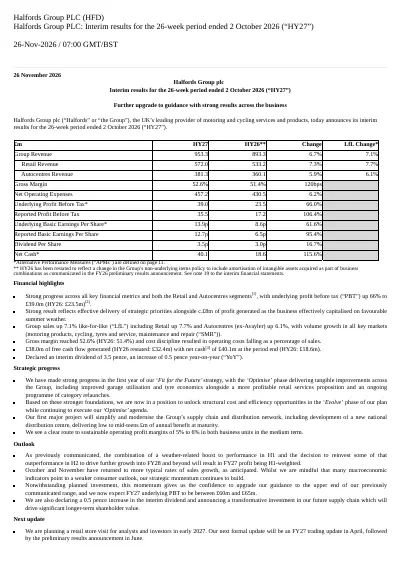
I'm pleased to be announcing a very strong set of results today. We've seen fantastic progress across all our key metrics across both our divisions, with like-for-like sales up over 7%, margin accretion, customer growth, market share growth, and excellent cash generation, all culminating in 66% growth in underlying PBT.
We've had the positive benefit of an early and warm summer reflected in our trading, and we've tried to be as transparent as possible on this point throughout this presentation, but it's important to note that as a business, we were set up to succeed and capitalized on the opportunity, and that even without the weather benefit, we've made really positive underlying progress. It's the combination of that strong underlying progress and our expectations for the remainder of the year that give us the confidence to increase our earnings guidance for the year, to increase our interim dividend, and to move into the evolve phase of our strategy with a major investment in a new national distribution center for our retail business.
Turning to today's agenda, Jo will take us through the detail of our H1 performance, I will talk to our strategic progress and the start of our evolve phase, followed by our outlook, and then Q&A. With that, I'd like to hand over to Jo.
Jo Hartley
Thank you, Henry, and good morning, everyone. Starting with the headlines, I'm very pleased with our performance in the first half.
We delivered like-for-like sales growth of 7.1%, with good growth across both retail and Autocentres. Underlying operating margin increased by 140 basis points to 4.6%.
Underlying PBT increased by 66% to £39 million, and return on capital increased by 530 basis points to 18.9%. We also generated strong free cash flow and ended the half with a materially increased net cash position.
A very strong set of financial results across the board. As Henry mentioned, the early and warm summer clearly benefited our performance, and I'll now move on to separate the benefit of weather from the underlying progress we've made.
Our best estimate is that the weather in the first half added approximately £8 million to underlying profit, although inevitably, there's some judgment involved in that assessment. We can't assume we'll see the same favorable weather conditions again or that we'll see the same level of incremental profit if we do, but as this slide shows, even after adjusting for the seasonal benefit, like-for-like sales grew by 5.6%, underlying operating margin increased by 60 basis points to 3.8%, underlying PBT increased by 31.9% to £31 million, and return on capital was 16.9%, remaining well above our cost of capital.
While the weather clearly contributed to a very strong headline result, the adjusted numbers also demonstrate substantial underlying improvement across the business. Let me now provide a little more detail on the shape of the results.
Revenue increased by 6.7% to £953 million, with growth across both retail and Autocentres. The difference between reported revenue growth and like-for-like growth largely reflects store and garage closures completed last year.
Gross margin increased by 120 basis points to 52.6%, reflecting effective pricing and promotional activity, support from foreign exchange, and favorable mix into seasonal categories. It's also worth noting that the half one margin is yet to fully reflect the impact of increased oil prices, and as such, we expect margin growth to moderate in half two.
Operating costs increased by 6.2%, slightly below revenue growth and therefore reduced as a percentage of sales. This reflects the benefits of operating leverage and continued cost discipline, despite wage and fuel inflation, a higher provision for incentive payments, and continued investment in the business.
As a result, underlying operating margin increased to 4.6%, and underlying PBT increased from £23.5 million to £39 million. Reported PBT was £35.5 million after £3.5 million of non-underlying costs, including initial expenditure relating to our new distribution center as we begin to move into the evolve phase of our strategy.
This bridge shows the key drivers of our year-on-year profit improvement. There are three important messages from this bridge.
First, we're seeing real benefits from the improvements we've made to the business. Stronger trading, Fusion, and operational efficiencies are all contributing to profit growth.
Second, we're delivering that improvement despite some significant cost pressures. Inflation remains a headwind, although at more moderate levels than in recent years.
We've also recognized substantially higher incentive costs. Our strong first-half performance has led to a higher annual bonus provision than at the same point last year, and the higher share price has resulted in higher costs associated with our long-term incentive awards due to vest over the coming years.
Alongside this, we've continued to invest in the business, supported by the strength of our performance. Third, we've been very deliberate about separating out the weather benefits.
Excluding the estimated £8 million benefit from the exceptionally warm summer, underlying PBT grew by 32% to £31 million. Including weather, profit increased by 66% to £39 million.
Weather has undoubtedly helped, but I think this bridge gives a good indication of the underlying progress we're making through our Optimize strategy. Turning to retail, revenue increased by 7.3% to £572 million, with like-for-like sales growth of 7.7%.
The performance was broad-based, with motoring like-for-like sales increasing by 7.3% and cycling increasing by 8.3%. Retail benefited most directly from the warm and dry summer, particularly in cycling, camping and touring, and car air conditioning services.
We're also seeing encouraging results from our category management work and improvements to the online customer journey, supporting stronger sales growth. Gross margin increased by 130 basis points to 50.6%, reflecting more effective pricing, less promotional activity, growth in higher-margin retail services, favorable foreign exchange, and the timing of cost price increases in oil-related categories.
While we're really pleased with this result, as we flagged at the prelims, following significant gross margin expansion over the last two years, we are not assuming further increases in the gross margin rate as we look further forward. Operating costs increased by 6.9%.
Despite wage inflation, higher incentive costs, and continued investment in brand, technology, and capability, cost growth remained below revenue growth. As a result, underlying operating profit increased by 46.1% to £30.1 million, and operating margin increased from 3.9% to 5.3%.
We estimate that the warm, dry summer added around £6 million to retail operating profits. After adjusting for the seasonal benefit, operating margin was approximately 4.3%, an encouraging step towards our medium-term ambition of a sustainable 5% to 6% retail operating margin, which Henry will cover in more detail later.
It's worth noting here that we shouldn't expect progress to be entirely linear. We'll need to absorb further inflation and continue investing in the proposition, but the weather-adjusted result gives us confidence that category management, services, digital improvements, and more disciplined trading can deliver sustainable growth in sales densities and operating margins.
Moving now to Autocentres, where performance was also strong. Excluding Avayla, revenue increased by 5.9% to £380.2 million, with like-for-like sales growth of 6.1%, driven by both consumer garages, supported by a stronger tire market, and commercial fleet services.
We continued to grow the amount of additional work identified and sold on each vehicle that came into our garage, gained tire market share, and increased income per tire through better attachment of services such as wheel alignment and warranties. Gross margin increased by 110 basis points to 55.5%, reflecting improved pricing and a more favorable sales mix.
Operating costs increased by 5%, below revenue growth, despite labor inflation and continued investment in the brand, in the estate. Importantly, labor costs as a percentage of sales reduced by more than 200 basis points year on year, reflecting better garage utilization and our continued focus on having the right technician doing the right job in the right location.
Fusion and more targeted investment in equipment, technology, and garage leadership are also supporting this progress. As a result, underlying operating profit increased by more than 60% to £16.1 million, and operating margin increased from 2.8% to 4.2%.
Seasonal services, particularly air conditioning, contributed approximately £2 million to that performance. Excluding this benefit, operating margin was approximately 3.7%, an important step towards our medium-term ambition of 5% to 6%, which Henry will cover in more detail later.
Finally, on Avayla, revenue was broadly stable, and the operating loss increased to £2.3 million as we continued to invest in the platform. Avayla remains an important technology platform for Halfords, particularly as we modernize the systems supporting our garage and mobile operations.
That said, revenue from external customers has been slower to materialize than originally anticipated. In light of the continued losses being generated by Avayla, a review of the business is being performed in the second half of the year.
Turning now to cash and the balance sheet, we ended the half with net cash of £40.1 million, a significant increase both year on year and from the FY26 year-end position. The principal driver was strong profit generation, supported by effective underlying working capital management.
We generated £38 million of free cash flow in the period while continuing to invest in the business and fund the dividend. Cash capital expenditure was £25.6 million, and cash on non-underlying items was a small credit in the period.
Including lease liabilities, net debt reduced to £207 million from £228.7 million at the end of FY26. We retain significant flexibility in our lease portfolio, with the average lease length now 2.2 years and the average garage lease length now 4 years.
We also retain access to our £180 million revolving credit facility, which runs to April 2029 and was undrawn throughout the period. The strength of the balance sheet provides considerable financial flexibility.
It allows us to fund attractive organic investment, maintain an appropriate dividend, and begin the next phase of our strategy while remaining comfortably within our leverage guardrail. This slide brings us back to the four financial outcomes we committed to when we launched Fit for the Future.
We've delivered strong sales growth, improved operating margins, increased profitability, and importantly, significantly improved returns on capital. We've deliberately shown the weather-adjusted numbers alongside the headline results.
Weather has undoubtedly helped us, but even excluding that benefit, we've delivered 5.6% like-for-like sales growth, 60 basis points of operating margin expansion, and 32% growth in underlying profits. Our return on capital at 16.9% excluding weather is comfortably above our cost of capital.
These are first-half results, and we expect some moderation in the second half, particularly as we continue to invest to drive continued momentum. The underlying progress we're making is really encouraging.
We're beginning to see the benefits of the changes we've made through Optimize, with stronger sales, better productivity, and improved operating leverage. When we launched the Fit for the Future strategy this time last year, we set clear financial guardrails, committing to an annual cash investment envelope of £55 million to £65 million, covering both capex and non-underlying project costs.
At that point, we assumed we'd lease or externally finance the capital investment in our new distribution center. Given the strength of our balance sheet, we've looked again at that decision.
Funding the assets ourselves delivers significantly better returns than leasing them, creating greater value for shareholders. With that clear focus on returns, we've decided to fund the £40 to £50 million of capital investment directly over the next three years and outside our existing £55 to £65 million annual investment envelope.
The associated non-underlying operating costs of £35 to £45 million will remain within the guardrails previously set. We expect the new distribution center to deliver low to mid-teens of millions profit benefit at maturity, and therefore return significantly above our cost of capital.
Importantly, we can fund this investment while remaining comfortably within our leverage guardrail throughout the evolve phase of our plan. This is a deliberate decision to fund the new distribution center ourselves given the superior returns while maintaining financial discipline across the rest of the business.
That brings me to our capital allocation priorities, which are outlined on this slide and remain unchanged. We're focused on maintaining a strong balance sheet, investing where we see attractive returns, and delivering a sustainable dividend to shareholders.
In that context, the board is declaring an interim dividend of 3.5 pence per share compared with 3 pence last year. That reflects our strong first-half performance, cash generation, and confidence in the outlook.
Stepping back, I'm really pleased with the progress we've made in the first half. Better execution is helping us attract more customers, grow volumes and sales, and generate more profit and cash, even after allowing for the benefit of weather.
That, in turn, gives us the capacity to reinvest in the business and support further growth. It's that combination of stronger performance and a healthy balance sheet that gives us the confidence to upgrade our profit expectations for the year, increase the dividend, and commit to significant investment as we move into the evolve phase of our strategy.
We'll continue to do that with discipline and a clear focus on returns. With that, I'll hand back to Henry, who'll take you through the progress we're making against the strategy and our priorities and outlook for the rest of the year.
Henry Birch
Thanks, Jo. Turning now to our strategic progress.
A year ago, badged as Fit for the Future, we set out the three phases of our strategy: Optimize, Evolve, and Scale. We're really pleased with our progress, and I wanted to update on actions we've taken within our Optimize phase, and then talk about the start of our Evolve phase and what that entails.
You may remember that at our prelims in June, we had a greater focus on our strategic progress in our garages business, and similarly today, there'll be more focus on our retail business, but to briefly cover our garages, I wanted to start by reminding you of the key components of our Optimize plan. First, we said we would grow garage-level contribution through our Fusion program: increasing capacity in our existing garage footprint, optimizing our operating model, and making better use of the referral opportunities between our retail car park and garage within a local area.
Second, we would drive utilization by better matching the supply of labor to customer demand for services in our garages, and focusing on having the right technician doing the right job in the right location across the estate. Third, we would prioritize our garage workforce: deploying technicians more flexibly, improving retention, and growing the next generation of talent with our market-leading apprenticeship program.
We've made some great steps forward across all of these areas, which have cumulatively resulted in the 3.7% weather-adjusted operating margin we're reporting for H1 2027, as Jo has already outlined. More specifically, we have 121 Fusion sites now trading, and are on track to complete the program by the end of the financial year.
Fusion has been a hugely effective force in driving sales and profitability, and demonstrates our ability to deploy capital in our estate to good effect, driving a typical payback within two years. Moving on to utilization, we've continued to make good progress on reducing labor costs as a percentage of sales, which is down more than 200 bps year on year, even with the backdrop of a 4% increase in the living wage.
Finally, we've seen really good progress on additional work identified, or AWI, which now represents around a quarter of revenue in our consumer garages. We've also delivered strong growth in tires.
Although the overall tire market continues to be subject to volatility, volumes grew in the first half. Beyond that, we've grown our market share, including through strong growth in fleet, following the exit of a major competitor.
Although slightly lower margin, fleet work provides a reliable and recurring source of revenue that can complement our consumer garage business, and help us to manage supply and demand more effectively to achieve better levels of utilization. Alongside this, we have further grown income per tire through high-value services such as wheel alignment.
We've talked previously about how alongside other chains, our garages business competes both with dealerships and single independent owner-operator garages. From a price and proposition point of view, Halfords offers a branded service with expert technicians at a significant discount to dealerships, and slightly more expensive than the independents.
To differentiate further, we have recently introduced a two-year guarantee on parts and labor and a year's free breakdown cover on any car that we service. To my mind, that is a pretty compelling proposition and a real reason to switch to Halfords.
More broadly, we've got a clear view of the levers that improve garage profitability, and confidence that we are able to pull them effectively to drive further operating margin gains in the future. Which brings me to the medium-term operating margin target of 5% to 6% that we've talked about previously.
Recent performance gives us even more confidence that this is eminently achievable, and we're making good progress towards it as I've just described. Looking ahead, the biggest lever continues to be further progress on utilization, with further benefit from the maturation of Fusion and continuing to drive AWI and optimize our tires business.
These levers apply equally across both our consumer garages and our commercial fleet services business. Our garages business is in good shape, with over 6% sales growth and improving operating margin, with a clear pathway to our target, and over the longer term, a real opportunity to scale up efficiently.
As Jo outlined, retail had an exceptional H1, and we're both really pleased with performance and excited about what more we can achieve. Our retail trading benefited from the weather, but crucially, we were able to seize the opportunity and capitalize on it, and in doing so, take market share.
That is the sign of a retail business on its game. Yes, we've had some benefit from the weather, but much of our momentum comes from self-help initiatives and our Optimize program.
First, we're rolling out a program of category management driving sales densities and improved margin. At the heart of this is a forensic focus on pricing and promotion, on ranging, customer trends and preferences, own-brand development, and channel and marketing mixes.
We're building new capability within our business, and it is starting to pay off in terms of results. Secondly, the vast majority of customers who cross the threshold of one of our stores is either looking for advice or a service attached to one of our products, such as a battery or wiper blade fitting, a new headlight, or the attachment of a roof box.
In our categories, we are unique in our ability to sell a product with an attached service, giving us a differentiated competitive advantage and a higher overall margin. We're developing how we improve and expand the services we offer, and developing training for our colleagues.
Third, a large proportion of customer journeys begin online, but are fulfilled in store or in our garages. 80% of our online orders are collected in store, and many of our store sales start with research on our website.
Our digital platform helps our customers to get the right solutions and brings our unique touchpoints and assets closer together. Digital is an important feeder of store and garage performance, but it is also a transactional channel in itself.
To pull all of this together, we're now going to show you a short video.
Halfords is the UK and Ireland's leading specialist retailer of motoring and cycling products and services, from car batteries, wiper blades, and tools, to bikes, e-bikes, and components. Our Optimize plan is designed to drive profitable sales growth through our uniquely scaled combination of physical stores and digital capability.
We're focusing on three areas: we're making our ranges more customer-led and giving a clearer reason to visit; we're unlocking the value of our differentiated, higher-margin services proposition; and we're improving our omnichannel proposition to drive higher share online. One of the ways we're driving top-line growth is through category management.
We start with the customer and the job that they're trying to do. We look at our product range, the price points we offer, relevant promotions, the customer journey both online and in store, and our point-of-sale signage to make sure that the choices are easy to navigate for our customers.
We're adopting a test-and-learn approach to find out what works online and in stores. We're moving through our ranges a few categories at a time to make sure we tailor each to the unique shopping missions of our different customers.
12 months in, we're already seeing significantly positive results: we're driving like-for-like sales growth, stronger margins, and more engaged customers and colleagues, allowing us to generate more value from our digital and physical footprint. We're taking the same approach in cycling.
We already sell over half of the bikes sold in the UK, but we're always looking for ways to improve our customer offer. Our new flagship cycling format seeks to give customers clearer layouts and product labeling, with ranges shaped around the needs of every customer, whatever their ride.
In these stores, we've also tested and are now rolling out the Tredz premium click-and-collect service, Tredz customers have the convenience of picking up their premium bikes and accessories from a Halfords store network. We've unveiled significant product innovation in our new e-bike ranges.
We'll continue to work on evolving our bike and accessory ranges, and enhancing our premium and e-bike servicing offering so that we grow our cycling business and build longer-term relationships with all of our cycling customers. Our services make the Halfords customer proposition truly unique.
From simple fits to safety inspections and repairs, either on demand or by appointment in our retail stores, these retail services complement the full range of services we offer across the group, at either a customer's home or workplace through our network of Halfords Mobile Expert vans, or through to tires, MOTs, and more complex vehicle servicing through our garage network. The scale of services we provide in retail is significant.
In fact, 80% of the service jobs at Halfords take place in our retail store car parks, just like the battery fit our customer booked today. Our store colleague has tested the customer's battery to confirm it does need replacing, and can fit and test the new one, reconfiguring the vehicle battery management system if required.
Services are what differentiates us. They meet a significant and growing customer need, they are margin-rich, and are something that only Halfords can offer in a retail setting.
Our opportunity and ambition to grow from here is huge. Our foundations are strong.
Halfords leads the market in both motoring and cycling. We have more than 12,000 expert colleagues across the group who love to help and advise customers, with an unrivaled physical and digital footprint in the UK and Ireland.
Optimizing our retail business is about leveraging these strengths to deliver a better customer proposition and sustainable top-line growth. Category management is already driving improved sales and margin through our existing asset base.
A slicker and more extensive services model will fuel more resilient and margin-accretive growth in the future. Next, we will focus on making our offer more visible online, with a more intuitive digital journey, making it easier for customers to find, choose, and book with Halfords.
That's how we ultimately become fit for the future.
Henry Birch
Turning to category management, the proof of the pudding is whether our efforts are actually delivering results. The short and longer answer is yes.
We are at the beginning of our category management journey. A full category relaunch takes up to 18 months to execute, but we've seen a 5%+ sales and margin uplift in the categories we've trialed in stores as part of wave one, which covers about 15% of retail sales and includes workshop, flagship cycling, and cycling parts and accessories.
There is still more to do in these and other categories, with a plan to have relaunched around 60% of our ranges by the end of FY28, with associated benefits building from there. It's premature to extrapolate wave one's success across the whole program, but early signs are very encouraging, and we're getting real traction and creating momentum.
In retail services, we've taken steps to drive services growth and profitability ahead of expanding the range of services on offer in our car parks. These small changes have already had an impact, with services growth ahead of product sales and a marked increase in profit per job.
We saw particularly strong growth in bike servicing and repair as well as dash cam fitting in H1, and we're now moving into trials on new service offers, including security and diagnostics. On the digital side, we are a genuinely omnichannel business with a website which is a transactional channel, a booking platform, and a research tool, and it's unusual for a customer journey not to touch both our digital and physical channels.
Our online channel is starting from a lower level of maturity than our physical operations, but we're continuing to strengthen our foundations, improving customer journeys, and driving increased conversion, and group online sales growth in the period was just under 6%. Similar to garages, we want to set out a target operating margin for our retail business.
Over the medium term and based on both Optimize and the new distribution center we're announcing today, we believe we can also take this to between 5% and 6%. Key building blocks include scaling our category management approach to around 60% of our range, expanding an optimized services offer, and critically, investment in a simplified retail supply chain operation, which I'll talk more about shortly.
Today, we have a very well-run retail business, but we feel there is more to go at and are confident we can get there. Finally, turning to group initiatives, where I'm going to focus on our investment in the Halfords brand.
A year ago, when we set out our strategy and plans, we identified a need to invest in the Halfords brand. Our brand is well-recognized, but research data showed that because of a lack of investment historically, it was losing relevance and resonance.
We have a powerful brand with a lot of touchpoints with emotional connection: from a baby seat to a first bike for a child, to rescuing a school run or holiday trip that has faltered. We also know that many people don't recognize the breadth of our offer, the services that we offer, and that we can meet so many different customer demands, particularly for those with a "do it for me" mindset.
We've started investment in our brand with a new brand platform, and it will help underpin our medium and longer-term growth aspirations. TV is a much smaller part of the marketing mix these days, but video remains important, and we wanted to show an example of some of the work that we're doing.
Oo,
Henry Birch
Halfords! We're here for that!
Here for fitting in my stuff. Here for seasonal car safety checks, and storage solutions.
Shh! Here for car seat consultations.
Here for bulbs, batteries, and wipers, fitted same day. Tralala!
Here for repairs, service, and MOTs, booked online when you've got places to be. Here for sick accessories.
Here for tires, sorted on my drive. A two-year guarantee?
That's ages! Thank you.
Here for servicing done on my drive, just in time for kickoff. Here for EVs, bikes, scooters, and runarounds.
We're here for all wheel kinds. Guess we're just getting started.
Halfords sponsors high-stakes drama. Finally, we got him.
Halfords sponsors high-stakes drama. I just need some space.
Halfords sponsors high-stakes drama. Thanks.
It's ITV drama. It's sponsoring ITV drama.
It's the ident at the beginning of any ITV drama program, which should have a real impact and cut-through. When we set out our Fit for the Future strategy last year, we made the observation that there were areas where we could drive structural efficiencies and attractive returns on capital, underpinning what we termed our evolve phase to drive growth over the medium and long term.
Our assessment was that before embarking on any capital program, we needed to demonstrate improved performance in our core business, and we needed to exercise discipline and transparency in deploying capital. As we've previously highlighted, we feel there is a transformative and attractive opportunity to recast our retail supply chain by consolidating our warehouse footprint, shown on the slide, into a single purpose-built distribution center.
This is a significant project, but one which will have very clear and traceable returns on investment, and is a well-worn path for many retailers. Indeed, at a former company, we undertook a very similar project, driving clear and positive returns.
We've identified our site and signed a new lease for a distribution center in Coventry, which we expect to open in FY30. It will drive an improved customer proposition, it will deliver a better colleague experience, and it will generate significant shareholder value, with low to mid-teens millions of pounds benefit annually at maturity.
Finally, I wanted to summarize our performance and turn to our outlook. We are very pleased with progress so far this year.
We've executed against our strategic priorities very effectively, driving positive change in all our key financial metrics. We've benefited from weather, but we've shown that we are a business on its game, capable of taking opportunities as they present themselves, and it is the confidence in our momentum that has driven the upgrade in our underlying PBT guidance for the year to between £60 and £65 million.
Having delivered £39 million of PBT already, this means we're expecting FY27 profit performance to be H1 weighted. Sales growth has returned to more typical levels in October and November, and we are planning to reinvest some of that first-half outperformance into H2 to drive sustainable future growth.
We are clear on the path to a 5% to 6% operating margin in both our business units. Importantly, our strategic momentum is giving us confidence to make the right decisions for the longer-term success of the business, including the investment in our retail supply chain I've just described.
Over the last five or six years, Halfords has been subject to volatility in its trading, whether from weather, the consumer outlook, or industry or market dynamics. Over the next few years, we may well experience periods of such volatility, but we are building a business that is structurally more efficient and profitable, that is more resilient, and delivers a higher quality of earnings.
Our results today are an early indication that our mission is working. Halfords is performing better, the structural improvements are working, the earnings potential is greater than we've seen historically, and we have the confidence and discipline to invest for the next phase of growth.
We definitely have much more to do, but we are encouraged by progress so far. Thank you for listening today, and we'd now be very happy to take any questions that you may have.
Jonathan Pritchard
Thanks, yeah. Jonathan Pritchard at Peel Hunt.
Two, if I may. Could you just put a bit more skin on the bones on current trading?
I know you said it's normalized a little bit, but just anything you could add on consumer feel. Obviously, the sort of received wisdom might have been that higher fuel prices lead to less miles driven, but clearly that's not been a factor in the first half, as that's started to be a thing.
Then second, a sort of pet topic of mine really, the Mobile Expert. Any thoughts, comments, evolution of that business?
Henry Birch
Thanks very much, Jonathan. On current trading, we said that trading is kind of returned to more typical kind of levels.
What we've seen actually is our retail business continues to do really well, as you would expect actually going into Black Friday and Christmas, and actually we've seen kind of strength across our motoring and cycling. All in all, we're feeling kind of good shape.
We've got good momentum, and a lot of the actions that we're taking are continuing to deliver growth. You made the point on the miles driven.
It's interesting that there was data out that showed that the 12 months to June, actually miles driven in the UK has actually increased 2% year on year. If you think about diesel prices at two quid a liter, actually people aren't driving less, and I think that bodes quite well for our garages business in as much as what you're not seeing is people abandoning their cars.
I think the fact that our tires business has actually been in good, not just our own business, but the market overall actually, if you look in H1, that's been in growth. I think there are some good positive indicators there.
I think our only kind of note of caution that we sound is that when you look at the more kind of macroeconomic indicators, and particularly the commentators out there, they are sounding a kind of note of caution, but what we're seeing in our business at the moment gives us confidence going into H2, which is why obviously we've done the profit upgrade. On the mobile side, that continues to be our most popular customer proposition.
If you look, it's five-star rated in terms of Google, we get loads of positive feedback, and frankly, what is not to like about a technician coming to your house, servicing your car on your drive, or changing your tires? You can sit at home and have a cup of tea, do your email, whatever it may be.
Customers absolutely love that. Frankly, the issue that we've had really is actually getting that message out there.
It is a great service, it's doing well, it continues to grow. We've got what, 250 mobile vans at the moment doing that.
We see the scope to grow it. It's more complex operationally than a garage, because we've got to go to customers, but I think over the long term, that is going to increase in profitability and become a more important part of what we do.
Jonathan Pritchard
Great, thanks. Your Mobile Expert, I guess if he point-to-points, is he part of the family?
Yes, I contribute to that as well. Do you think you could just flesh out maybe a little bit on the capex spend for the distribution centers and when the benefits come through?
How we should sort of think about the shape of when that comes through?
Jo Hartley
Do you want me to cover that one? Look, the capex spend on the new distribution center will be around £40 to £50 million.
You'll see we'll spend about five of that in this year, and then the remainder will be split reasonably evenly over the following two years. The non-underlying opex costs, which really are the costs of transition and the dual-running costs as we move from the old DC to the new DC, will continue through to the new DC going live in FY30, with the peak year for that being in FY29, which is when we'll be very much in sort of dual-running and transition timing-wise.
As Henry described, we expect to deliver low to mid-teens single-digit millions of benefit on the project, and really attractive returns that will beat our cost of capital.
Then just in terms of the second-half outlook for opex, you sort of mentioned that the gross margins potentially going to moderate a bit in the second half. Sounds like sales might moderate as well.
What's the sort of outlook for opex? I guess to hit sort of higher end of the numbers you've given today, it sort of seems it needs to moderate a bit in the second half.
Any color around that, really? Just in context about incentives that you had in the first half.
Jo Hartley
Look, in terms of the opex in the second half, we're continuing to invest as we said, particularly in the brand. The brand creative that you saw this morning was actually done in the first half, but will be really executed in the second half of the year.
The advertising campaign started in September, there's an acceleration of that investment through the second half, as well as continued investment in technology, data, and particularly strengthening our AI foundations as we move through the second half. We do expect a slightly higher level of investment in the second half than that which we saw in the first half, which is why our sort of second-half profit won't be quite as strong as our first-half profit, even excluding the benefit of weather.
All of those investments are designed to drive continued momentum into FY28 and FY29 as we look further forward.
Mark Photiades
Hi, yeah, Mark Photiades from Canaccord. Just a quick one on the scaling of category management.
I think you said you'd seen 5% margin uplift. Is that at the gross or the operating level, just tying that back to your thoughts around not seeing...
Henry Birch
Gross.
Mark Photiades
I guess just you kind of indicated you didn't expect to see any further retail gross margin advancement. Presumably though, as you continue to drive these category management phases, that's going to be a driver of gross margin going forward?
Jo Hartley
The sales and margin have gone up by the same amount, around 5% sales growth and around 5% quantum margin improvement, the gross stays reasonably similar as we move forward. Look, really, we've seen very significant gross margin increases over the last two years, supported by better buying and FX.
As we look forward, we do expect that to be sort of slightly flatter than it has been in the past.
Mark Photiades
Fine. Then just Avayla H2 losses similar to H1, is that the expectation?
Jo Hartley
Similar, yeah, similar, very slightly higher, but yeah, broadly similar. Then
Mark Photiades
finally on the non-underlying DC charges, are they all expected to be cash?
Jo Hartley
Yes, in time the non-underlying DC costs will be cash. There'll be a bit of a phasing thing, though.
We've taken a little bit of dilapidations provision, for example, in the first half of this year. The cash cost of that will come a bit later.
Mark Photiades
Thank you.
Manjari Dhar
Thank you. It's Manjari Dhar, RBC.
I just had a question on the fleet market share gains. I guess how do you guys think about the opportunity in fleet versus what you still have to go for in consumer?
Henry Birch
It's currently about 20% of our garages business comes from fleet. We know that comparable businesses to ourselves are achieving more like 30%, we look at that differential and say actually, you know what, as a scaled, branded operator with presence throughout the UK, there's no reason why we shouldn't be up at those levels.
We see that as an opportunity, and B2B is about 30% of our business today, and we see that broadly as a growth area. That obviously helps not just in terms of growth, but in terms of kind of resilience of earnings as well, because typically those are kind of repeatable, reliable earnings.
There's definitely opportunity, we think, in fleet.
Manjari Dhar
Thank you. Just on the motoring loyalty club, could you give us an update on where that's got to, and maybe the paid versus the then...
Henry Birch
We're up at 7.2 million on the free and 435,000 on the premium. That continues to be really strong.
Premium members are worth four times as much as a non-member, and just a free member is more likely to visit Halfords more frequently and to spend more, but the real differential is with the premium members, and that continues to be really popular. Just to remind people that premium membership, you get a free MOT, and the beauty of an MOT is that by law, you have to have your MOT done every year, it should be kind of nicely recurring.
We see that actually in terms of our retention rates there, they're pretty high for a loyalty club.
Kate Calvert
Thanks very much. Kate Calvert from Investec.
Just two for me. First on the retail side, what proportion of your sales is services at the moment, and kind of where do you think that could get to as a percentage of the sales mix going forward?
Again on retail, as far as the category management's concerned, you've sort of set out the phasing, the timeline, but when should we sort of expect the peak benefit? Would that be second half of FY28, or would it be really '29 in terms of that benefit, the phasing and the flow of it?
Henry Birch
Jo, I don't know if you've got a stat on overall services or just May, but one thing I will say is that if you look at retail growth in the half, our overall sales were at what, 7.7%, services were at 12%, what we're seeing is that actually services are growing faster than retail. Where our real kind of sweet spot is where we have a product plus a service, it's a roof box plus a fitting, or a stop-start battery where we're charging £50 for that fitting, but we're also selling the product and getting a margin.
We're probably less...
Jo Hartley
I'll come back to you on the precise retail stat. Across the group, it was 55% service-related sales combining products and service, and slightly up on the same period in the prior year, really strong performance, but I'll come back to you on retail service-related sales.
Henry Birch
Yeah. We've got 25 different services that we offer in retail, and 80% of service jobs that we carry out are actually done in our retail car parks.
You think services around your car, you go to a garage. Absolutely, we do that brilliantly, but actually there's a lot of stuff like re-gassing your air conditioning, where we've seen sales up 48% year on year, a lot of that was actually done in a retail car park.
Our sweet spot, as I say, is where you've got kind of product plus service. In terms of the category management rollout, in terms of when that will hit, latter half of FY28 probably.
It is a rollout. There will be an element of kind of calibration and kind of optimization, but I think the important thing there is that the trials have been really successful, they've shown a decent uplift.
We're a little bit nervous about saying to kind of analysts, go ahead and extrapolate, because obviously, not every single trial will kind of end up with those numbers, but the direction of travel is kind of really positive, which is why we've got the confidence to give that retail operating margin number. We think there's a lot more to go at from category management.
Kate Calvert
Can I just ask a quick question on the autocenter side? Similar thing in terms of phasing.
Obviously, you had a big benefit from the labor utilization in the first half, that started coming through in the second half of last year. That presumably will build over a couple of years as you get better and better at it.
Should we expect another quite big increment next year as well, or would it be more smaller increments going forward?
Jo Hartley
Look, I don't think we'll see another 200 basis points increase next year. I think to your point, it's going to take a little bit longer to see the continued progress on labor costs as a percentage of sales.
As you saw from the bridge, that is by far the biggest lever in driving the operating margin in garages into the medium term that we're looking forward to.
Kate Calvert
Thank you.
David Hughes
Hi, David Hughes from Shore Capital. A couple of questions from me.
Just on your estate of retail and Autocentres, obviously there was a small number of closures kind of year on year. Are you broadly happy with the estate now in terms of the outlook on it?
Are there more white space areas you think you can go after, or do you think this is kind of roughly it for the time being? Then secondly, just on cycling, you kind of talked at the full-year results around the launch of an expanded electric bike range.
I was just wondering if there's any color on how you're seeing that performing and what's the trends looking like there.
Henry Birch
Yeah. Look, on the retail store estate, we have got now 366 stores.
We've closed a couple in the course of the last 12 months. Those have been because of lease expiry or landlord plans, not because we kind of actively were trying to close them.
All of our stores are profitable, they are all actually on short lease lengths, I think the average is 2.2 years, there's a lot of flexibility there. Our view is actually we've got the right number of stores, and actually it's kind of important for us that we've got national coverage.
We say 85% of the population is within 15 minutes drive of a Halfords, and I think that's a pretty compelling and difficult to replicate estate that we've got. We don't see any significant change on the retail side of things, and we definitely don't have a kind of program of closures that we're planning.
On the cycling piece, e-bikes are doing really well, and they're about what, 30%, 25%, 30% in terms of value of our current cycling sales. I think what's exciting about e-bikes is that, for a lot of people, they're a kind of entirely new product.
You can have a mechanical bike, and whereas before you'd think about a kind of replacement cycle of a mechanical bike, an e-bike is a different beast. It means we've also got different types of customers being introduced to cycling.
The price is coming down. Our entry-level e-bike at the moment, very good offer, £420 on our website, reduced from £600, you can get an e-bike for £420 on Halfords right up to kind of thousands.
Now they're much lighter, the batteries are much more efficient and give you a longer range, they look much better, and they're much cheaper as well. We think e-bikes will continue to give our cycling business a real kind of shot in the arm.
Jo Hartley
They were really strong in the first half, about 40% like-for-like sales growth in Halfords stores in the first half. They were flying, and the new ranges have been super, super popular, a standout success for us in the first half of the year.
David Hughes
Right, I'll just extrapolate that forward for 5 years, then, Henry.
Jo Hartley
Maybe not. Go, go,
Henry Birch
go for it, David. Knock yourself out.
Jo Hartley
He doesn't mean that.
Henry Birch
I don't think there are any further questions today. Thank you, everyone, for listening and for attending, and we look forward to seeing people at our preliminary results in June of next year.