QinetiQ Group plc
Q2 FY2027 · Earnings Call TranscriptNovember 12, 2026
Andrew Carter
Good morning, everybody. I'm Andrew Carter, the Group Investor Relations Director for QinetiQ.
Welcome to our interim results for financial year 2027. Thank you, everybody, for the interest in the company and for taking the time.
Without any further ado, I'll hand over to Steve. Thanks, Steve.
Steve Wadey
Thank you, Andrew, and good morning, everybody. Thank you for joining us for our half-year results this morning.
I'd like to start by thanking our highly skilled employees for their continued dedication and hard work, as well as our customers and our partners for their ongoing support. The first half has been an important period for the company.
We've delivered solid operational performance and taken a strategic decision to focus the group on higher-growth markets following this morning's announcement of the sale of our US business. This will create a stronger, focused company built for sustainable growth.
Our agenda for this morning is as follows: I'll start by giving you our half-year in review, Martin will then provide a commentary on our financial results and our full-year guidance, I will then come back and give you an overview of our strategic outlook, and then we'll open up for questions. Turning to our highlights.
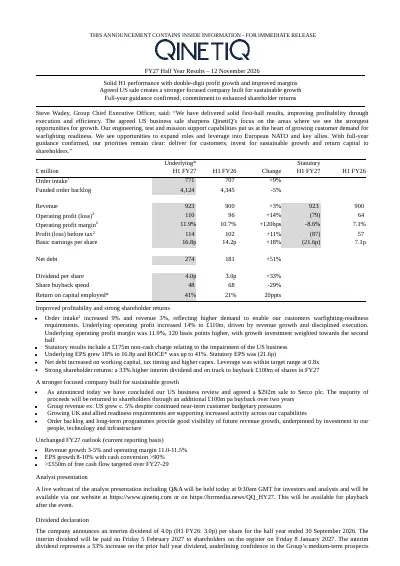
We have delivered solid performance in the first half driven by disciplined execution across the group against a backdrop of near-term customer budget pressures. Revenue for the half increased 3% to £923 million with operating profit of £110 million, an improved margin of 11.9%, and a strong operating cash flow of £113 million.
Orders increased 9%, and we also maintained a strong backlog of £4.4 billion, providing good multi-year visibility. Alongside this performance, we have agreed the sale of our US business to focus the group on the UK, European NATO, and key allies, and allocate capital to higher-return opportunities.
Our core business excluding the US delivered 5% revenue growth in the first half, and we are strongly positioned to drive further opportunities for growth in these core markets. We're confirming our guidance for the full year and increasing investment to capture these growth opportunities.
Finally, following completion of the US sale, we also expect to return a further £200 million to shareholders through additional share buybacks over the next two years. Let me now turn to the agreed sale of our US business and what this means for our strategy.
As I said at the full-year results in May, we were actively reviewing all options for the US business within the group strategy to enhance shareholder value. This review was in response to tough trading conditions for the US defense services market, including the impact of DOGE and margin compression in services work.
We moved quickly and took decisive restructuring actions to reduce the cost base, exit non-core and lower-return contracts, as well as simplifying our operational footprint. Our review has now concluded that the US market has changed, and whilst we have a smaller, better business, we do not have the scale to meet our growth and returns expectations relative to the rest of our portfolio.
Having considered all the options very carefully, we believe the agreed sale of the business to Serco offers the best option to create value for our shareholders. Serco does have the scale and market position to support the long-term development of the business, and we believe it will be a good owner for both our customers and our employees.
The sale of the US business is a strategic decision for the company. It enables us to focus our resources and capital on the UK, European NATO, and key allies, where we have stronger positions and see more attractive opportunities for growth and returns.
The transaction remains subject to regulatory approvals, and we do expect it to complete in the first quarter of 2027. Following completion, we intend to return the vast majority of the proceeds to shareholders through the additional share buyback that I just mentioned.
At the same time, the transaction will leave us with a strengthened balance sheet and the capacity to increase investment in executing our strategy. Overall, this creates a stronger, focused company built for sustainable growth and delivering attractive shareholder returns.
At group level, throughout the half, we have continued to focus on improving the quality of earnings through three areas. First, as I've just mentioned, the US sale will create a focused portfolio and a simpler group aligned to higher-growth markets and attractive returns.
The portfolio will have more visibility and more predictability. Second, strengthening execution.
Our core business excluding the US is strong and performing well. We've also continued with the rollout of our digital infrastructure upgrade to improve productivity and efficiency.
Our focus on execution has improved margins and earnings quality. Third, driving growth.
We are targeting investment towards higher-return markets and opportunities where our capabilities give us a clear right to win. This includes strengthening our position as a strategic partner of the UK government, including Project Safari, a major new program launched by the UK Defense Minister just last month to transform and modernize test and evaluation to drive overall defense innovation in the UK and the rapid deployment of new capabilities faster than before.
Beyond the UK, we have increasing opportunities to leverage our capabilities by building on strong government-to-government relationships within European NATO and key allies. Together, these actions will deliver more visibility, more predictability, and sustainable profitable growth.
I'll now hand over to Martin to take us through our financial results.
Martin Cooper
Thanks, Steve, and good morning, everyone. The results presented today include our US operations, and as usual, I will start with the financial highlights before moving on to the key financial metrics at a group level and capital allocation.
I'll finish with guidance, which will include an assumption of a full year of US performance. I'll additionally give a pro forma view of FY '26 and FY '27 guidance for the group excluding the US business.
Turning to the results for the half, and for reference, the US dollar rate for the half averaged $1.33, in line with last year. This is a solid set of financial results against the backdrop of near-term budget pressures in our key markets.
I'd like to thank our teams, customers, and supply chains for all they do in delivering this set of results. Order intake for the half was £771 million, which drove a closing order backlog of £4.4 billion.
Revenue was 3% up at £923 million, tracking in line with guidance for the full year. Underlying profit at £110 million was up 14% with margin at 11.9%, underpinning our year-end outlook and creating the headroom for enhanced investment in growth planned for the second half.
Cash conversion was in line with our expectations for the half. It was lower than last year due to the year-end 100% conversion levels and the higher levels of working capital.
Dividend in the half is up 33% to 4 pence as we move to an EPS payout from last year end, and this reflects the usual one-third at the half based off an expected full-year EPS and dividend level. Turning now to the financial highlights.
As usual, I'll cover orders, revenue, profit, and cash in depth in the coming slides. We remain very focused on driving a long-term double-digit EPS algorithm.
Performance in the half saw us deliver against that objective with underlying basic earnings per share up 16%, driven by the higher profit and enduring benefit of the share buyback program. First-half free cash flow reflected expected payments related to prior exceptional charges, working capital, and tax timing impacts.
These were, however, though, consistent with the three-year cash flow outlook we outlined in May. ROCE was again very strong at 41%, up from 21% from last half, reflecting the capital allocation and portfolio actions to drive a stronger, more focused business.
Moving to the key group financials and starting with orders. Total orders excluding the LTPA award were up 9% at £771 million, and this drove a book-to-bill of 1x.
This was a good result given the near-term customer budget pressures, which continue to impact the timing of certain awards. EMEA Services was up 6% with awards across our engineering services framework and tasking under the LTPA framework leading the way.
Global Solutions was up 14% with increased award levels on the Space Development Agency contract in the US and in our aerial and maritime targets business. We closed the half with an order backlog of £4.4 billion, which includes £0.3 billion of US unfunded backlog, providing good visibility for predictable future growth of our core long-term UK business.
Moving to revenue, where we delivered 3% growth to close the half at £923 million. EMEA was up 4% on strong growth across our UK defense operations in engineering services, test and training, and tasking revenue.
This was partially offset by the by the expected lower H1 performance in our UK Intelligence business following the loss of the ACE contract last year. We do expect a stronger H2 as new business wins ramp up to offset that.
Global Solutions was stable. Our targets business had a good half on orders and revenue, reflecting the high demand for warfighting readiness amongst our customer base.
The US business was lower, reflecting the fed IT divestment and exiting some business lines. The US operations are tracking in line with our guidance for the full year for the second half with the weighting driven by growth in the Space Development Agency work and the strong orders in the half.
Focusing on the second half, while there are still market headwinds prevailing in the UK, US, and Australia, we started the half with 84% revenue cover, good visibility, and a strong pipeline of opportunities to drive the continued growth in line with our guidance. Moving now to profit at the half year.
Operating profit at £110 million was up 14%, providing a strong underpin to the full-year guide. Margin at 11.9% was driven by good execution against our backlog, especially in EMEA Services, which allowed for a number of risk retirements, alongside our continued drive on cost control to deliver value for money for our customers.
As planned, the second half and coming years will see a number of investments to drive enhanced growth, which Steve will cover shortly. Global Solutions margin at 9.5% was up significantly, but in line with expectations set out at the start of the year, and that was driven by improved profitability in the US.
As usual, we have detailed the table reconciling underlying operating profit from segments to statutory profit. The income from RDEC and intangible amortization are standard reconciling items.
Our digital investment is now entering its final stages, and as mentioned at the full year, new digital investments will go through underlying from next year. Following the announcement of the sale of the US business, we have booked a non-cash impairment of £175 million on the carrying value of the US operations, reflecting the expected closure economics of the transaction.
Whilst there are a number of moving parts to cash, as already stated, they align to the three-year free cash guide issued back in May. Operating cash flow at £113 million was down against last year due to working capital movements in our UK Intelligence and Australia businesses.
CapEx at £42 million was up on last year, and £17 million of that related to the LTPA contract. We would expect a higher spend in the second half as we continue to invest in driving growth and enhancing our customers' military readiness.
Of the other major movements to free cash flow, exceptionals-related cash flow was high as it included a planned one-off commitment from the sale and leaseback of the Cody site back in 2024 and a number of rationalization payments made following the restructuring activity last year. Higher H1 tax payments are timing driven, based on enhanced profitability last year.
Shareholder returns were as expected at £107 million, as we progressed through the multi-year buyback program and paid an enhanced full-year dividend as we moved the EPS payout ratio basis. Net debt therefore closed at £274 million at a 0.8x leverage.
In the second half, this will reduce due to the around £30 million RDEC credit receipt, the usual enhanced conversion ratio, and lower exceptionals, leaving leverage before any cash proceeds from the disposal within the expected 0.5 to 0.8x range and delivering free cash flow in line with our three-year cash guide. Turning to capital allocation, which is unchanged and supported by a strong balance sheet.
Our focus remains consistent on organic growth and shareholder returns. We're increasing investment in our people, sites, technology, and R&D to drive growth from our core and realize opportunities, which in part led to the timing impacts on the cash at the half as just covered.
Our new dividend policy is now embedded through a cycle, and we are progressing as planned through our buyback program that has 2.5 years to run. On completion of the transaction, as mentioned by Steve, we will plan to uplift the remaining two years of the buyback by £100 million per annum to £200 million per annum in FY '28 and FY '29.
We maintain a rigorous and disciplined approach to the deployment of our capital, scrutinizing organic investments against shareholder returns and ensuring we have a balanced deployment of capital for long-term value creation. Pulling all that together and moving to guidance for the full year.
We wanted to reaffirm our guidance for FY '27, together with giving you a shape to the business excluding the US both for last year and this year. Firstly, as shown on the left-hand side of the chart, the shape of the business in FY '26 against what we reported would have seen orders at £1.6 billion, revenue also at £1.6 billion, having grown 3% against the reported flat number, margin at circa 12% against the 11.3% reported, cash conversion at 100%, and order backlog at £4.2 billion.
Our full-year our FY '27 guidance for the full year is unchanged and includes a full year of of US performance. Excluding the US business and against the FY '26 numbers just detailed, we would expect revenue to grow circa 4% to 6%, margin to be in the 11.5% to 12% range, cash conversion to remain at around 90%, and EPS growth to be in the 8% to 10% range.
Our three-year free cash flow guide remains at the £550 million level. We shall give give guidance in May for the FY '28 year, but this transaction gives us a higher-quality earnings business with a more predictable business growth outlook, strong backlog cover, and is highly cash generative, underpinning our unchanged three-year cash guide.
In summary, this has been a solid half. We remain on track for our full-year guidance, and we have driven stronger foundations for the near and longer term.
As usual, to help you with your models, we've included additional guidance in the backup slides. With that, back to you, Steve.
Steve Wadey
Great. Thank you, Martin.
To our strategic outlook for the company post the US sale. I'll start with the growth opportunities ahead and how we translate our strengths into shareholder returns.
Our role is clear. We develop, test, deploy, and sustain critical defense systems, helping our customers improve their warfighting readiness.
We help get capability into service faster. As a sovereign integrated defense and technology services company, we bring together the expertise and infrastructure needed to support our customers across the life cycle.
Our strength is not just in individual capabilities, but how we combine them to solve complex customer problems. We have trusted customer relationships, established long-term programs, and unique national infrastructure.
Together, these give us a strong platform to grow as customers prioritize warfighting readiness. Our strategy will turn these strengths into high-quality growth and attractive shareholder value creation.
Our customers are clear. They need to accelerate warfighting readiness now.
That means deploying new platforms and technologies faster, upgrading existing systems to deliver more operational impact, and increasing the use of affordable mass, autonomy, and artificial intelligence. They also need greater interoperability and a resilient sovereign industrial base.
These customer priorities play directly to our strengths. Our differentiated capabilities address those needs: developing advanced technologies, engineering complex systems, testing and evaluating their performance, and supporting live defense operations.
Together, they help customers introduce capability faster and keep it effective throughout its operational life. These trends create increasing demand for our expertise, both now and over the longer term.
Let me now turn to our core markets and how defense spending is growing. The urgent need for warfighting readiness is backed by significant, committed, and growing customer funding across our three core markets.
The UK Defence Investment Plan, known as the DIP, has committed £68 billion of defense spending this financial year, growing at 5% over the next three years. However, near-term pressures continue as our customers strive to deliver increasing demand within this budget before an acceleration of defense spending in the years ahead.
Defense spending for European NATO and key allies is also rapidly increasing to counter the threat, creating opportunities for our capabilities. Across these markets, we have a clear right to win, based on three strengths.
First, our deep technical expertise and unique infrastructure help customers solve complex problems and deliver critical capability. Second, our strategic relationships across government and industry give us close understanding of their customer priorities.
Third, our embedded role in critical programs positions us to support customers as their requirements evolve. These are strengths built over many years.
They give us a strong position to compete for the increasing defense spending in the years ahead. Let me show you how this translates into our growth opportunities.
Our position as a national champion gives us a strong platform to grow in the UK and expand internationally. Following the recent budget, the UK DIP is now committed and funded.
The table shows how our capabilities are well aligned to the DIP, including nuclear submarines, Typhoon, and the UK's next-generation fighter known as GCAP, drones, weapons, ammunition, and the digital targeting web. That breadth gives us increased visibility for our future pipeline, underpinned by deep customer relationships and long-term contracts.
The map on the right shows how our experience on UK programs can also be leveraged into European NATO and key allies. Countries operating the same platforms or participating in shared programs need many of the same engineering, test, training, and operational support capabilities that we already provide to the UK.
We are building on that experience, supported by strong government-to-government and industry relationships, to develop and pursue new opportunities beyond our current customer base. Across the UK, European NATO, and key allies, we see an addressable market for our capabilities of £13 billion per annum, £6 billion of that in the UK alone.
Over the next two slides, I will highlight four examples that demonstrate the relevance of these capabilities and show our growth strategy in action. Starting with engineering services, where we help customers bring complex capabilities into service faster and support them throughout the platform life cycle.
Our specialist engineering expertise and trusted position with customers allows us to play a vital role as platforms and technologies are developed and brought into service at pace. These major programs are often multi-decade, creating long-term opportunities with through-life upgrades providing opportunity for further growth.
A recent example is our role on the next-generation fighter, GCAP, where we are providing engineering services to support the acquisition and entry into service. Turning to mission support and operations, where our expertise is in delivering mission-critical programs at pace and scale to customers that need digital advantage for operational effectiveness.
We use our deep expertise in systems integration and defense networks to develop and assure key elements of the UK's digital backbone, a vital element of the future battlespace. These programs already generate more than £100 million of annual revenue, including our role as the TACNET resource partner.
Additional growth opportunities, including the UK's digital targeting web, where our customer is seeking to accelerate decision-making by investing in digitally connected sensors and effectors. In test and training, the drive for warfighting readiness is increasing demand for our specialist expertise and unique sovereign capabilities.
We're already seeing higher utilization by the UK and allied customers, with trials revenue up 50% in the first half of the year. Through Project Safari, we're also transforming test and evaluation to improve access to our unique sovereign capabilities for primes, disruptors, and small-to-medium enterprises, as well as speeding up and increasing the capacity through the adoption of digital technologies.
Safari will bring the agility and pace needed to deliver capability into service faster. By expanding our customer base, we build upon the existing long-term revenue visibility that we already have, provided by the LTPA.
Finally, in research and development, we continue to see significant potential in disruptive laser technologies for counter-drone and air defense. Working with partners, including MBDA and Rheinmetall, we have a clear route for our laser source products into UK and international markets.
In addition, we are investing more than £20 million in further development and production capability for our laser product family, known as Haling. Our investment drives smaller, more powerful lasers that will create new opportunities for mobile and redeployable systems in the land domain for battlefield and critical national infrastructure protection.
These examples show the growth we are delivering today and how we are investing in creating opportunities for the future. Bringing those four capabilities together, we have a stronger, focused company built for sustainable growth.
Our revenue base is balanced across engineering services, test and training, mission support and operations, and research and development. Each capability is supported by long-term programs with embedded customer positions, and each has opportunities to grow, providing multi-year revenue visibility.
Following the sale of the US business, our revenue from sole source and long-term contracts, including EDP, the LTPA, and NCSIS, increases to 70%. We also have a strong backlog of secured work at £4 billion and are leveraging our differentiated capabilities to drive growth within a five-year pipeline worth more than £12 billion.
Our growth is underpinned by increasing investment in our people and engineering skills, product development and manufacturing, workplaces and secure facilities, and digital and AI technology to drive greater value for our customers. That combination of embedded positions, long-term visibility, and targeted investment gives us confidence in our ability to deliver sustainable profitable growth.
The execution of our strategy is building a stronger company with more predictable financial performance, allowing greater capacity to invest for our customers' warfighting readiness and deliver returns for our shareholders. By focusing on the markets and opportunities where we have a clear right to win, we expect to drive higher long-term growth by prioritizing organic investment.
This will deliver more predictable revenue, profit, and earnings per share from our highly cash-generative business with high returns on invested capital. We have a disciplined, value-accretive capital allocation policy, and as you heard earlier, we'll be returning the vast majority of the proceeds from the US sale to shareholders.
This clear strategy will deliver sustainable growth, higher-quality earnings, and attractive shareholder returns through dividends and buybacks. In summary, we've taken clear strategic decision to improve the quality of our company.
We delivered a solid first-half performance, have clear focus on the UK, European NATO, and key allies, and are integral to accelerating warfighting readiness for our customers. Looking ahead, we are a stronger, focused company, and I'm confident in delivering sustainable profitable growth and compelling shareholder value creation.
Thank you. We'll now be ready to take your questions.
David Holmes
Hi, guys. Good morning.
It's David Holmes from Bank of America. Thanks for your presentation this morning.
Just a couple of questions. Martin, I think you showed us the pro forma financials ex-US, and I think it was around a 12% margin in FY '26, and the guidance was for 11.5% to 12% this year.
I just wanted to check if the pro forma business's margins are declining in 2027. It's question one.
I guess question two is you flagged the UK intelligence drag on growth in H1, which seems to be subsiding in H2. Could you give us any color on the magnitude of that drag, and is it logical to assume that growth accelerates in H2 at the group level?
Martin Cooper
I'll take those, David. Look, on the margin, I think hopefully I've explained that we've had a really good first half in profitability and other things.
We just want to temper expectation a little bit because we do want to invest as Steve says in some of those areas. We'll probably be at the high end of that range.
We are going to invest in AI. I think I want to reiterate to everyone that, as we've been putting a lot of digital expense through exceptionals on the one-off program.
All the digital expense we have going forward now on AI and other things will go through underlying, so that will bring that down a little bit. Our long-term view is that this business will be at 11.5% to 12% margin.
We'll continue to do all we can on margins, obviously, but we also need to invest and drive up the top-line growth. Then you will see EPS progression next year as well sort of follow on because of the buyback and the impact.
Overall, as Steve's outlined, we think this is a net-net good thing around reliability of earnings and margin. Perhaps just on the UK intelligence, and Steve may want to add a little bit more, then the ACE contract that was referred to was quite a high volume revenue, but throughput contract at quite low margin.
The margins have stayed high, which again is another of these dynamics, as those have moved through. The impact in the half was between £15 million and £20 million.
The rest of the business showed modest growth underlying that. We won a number of contracts at the back end of last year that are now starting to ramp up on things like maritime collective training, a couple for the special forces and things.
We do see that, and we see a really good pipeline. Our expectations is that the UK intelligence at a reported level will be, yeah, modest growth this year, but the EMEA Services will be really fueled by the strong performance in UK Defense as outlined as well.
Hopefully that answers your questions, David.
Steve Wadey
I don't know if you... I'll just add some comments about the UK Intelligence business.
I think Martin's covered the sort of timing of the dynamics. The business is actually positioned very well.
If you take out the effects that Martin just said, UK order growth was actually very good half on half. Yes, we do expect that to pick up in the second half.
As Martin's just alluded to, the UK Intelligence business is very well positioned with its pipeline. A few areas that I would pick out that I think we've talked about before, the work on mission data into a number of the European key allies, we've got three opportunities that we're working on that are quite material to leverage some of the capabilities from the UK into those core markets that I've just mentioned.
I also mentioned very specifically digital targeting web. It's a major part of the new UK Defence Investment Plan that is funded.
It's critical for the UK to accelerate its overall UK warfighting readiness. I'm sure Richard will ask, UK intelligence is a part of the business that we don't have the ability to disclose a lot of what it does, but it's very well positioned.
I've mentioned we deliver already well over £100 million of revenue in that category of work. Given the unique sovereign capabilities that we have, we've got a great opportunity to cohere and partner with a number of other companies in the UK to help accelerate the program called digital targeting web.
Strategically, the business is doing well, well positioned. We see good growth going forward.
David Holmes
Thank you.
David Farrell
Hi, thanks. David Farrell from Jefferies.
A couple of questions. Just picking up on that digital targeting web, I know you've got a consortium including Northrop Grumman and Accenture.
Is that the only opportunity in the digital targeting web, or does it extend beyond that project you're going for?
Steve Wadey
There are many projects within what's called the digital targeting web program. What you're referring to is Zodiac, where we recently put a public announcement on where we've built a really strong team.
That's more around the land-based coherence around digital targeting web. There's a sister program for the maritime domain that we're also involved in, and then you've got the overall defense cohesion through what is called Cyber and Special Operations Command.
Digital targeting web, as described in the Defence Investment Plan, you can think of a collection of programs that all need to be cohered. We're looking that as a very strategic opportunity to not just address Zodiac, but cohere a much broader consortia of companies.
David Farrell
My second question is you talked a lot about capital allocation with reference to disposal of the US. As far as I can see, you spend £200 million going back to shareholders, that leaves about £20 million going back into the business in terms of further investment.
Is that purely around kind of the AI and the digital infrastructure, or is there more to be done here? Presumably, could you have not done that anyway, irrespective of selling the US?
Steve Wadey
Do you want to pick up capital allocation first, and I'm happy to build out on the investments maybe?
Martin Cooper
Sure. After sale proceeds and various other things then, I think the number at the current FX rate is about £210 million, David.
I'm not going to argue around £10 million. We felt it was the best route to do that and most effective around consistency, to get that EPS progression as we've said.
Also, as Steve outlined, then there are some investments that we do want to make around AI and other things. That's what, in essence, the other £10 million will be spent on in the near term.
Steve Wadey
Maybe just to sort of build a little bit, David, on some of the investment priorities that I pulled up. This strengthens the balance sheet.
It gives us more flexibility. We will be increasing investment, as Martin said, within the guidance that we've shared in all the areas that we described.
They're all important and they're all exciting, but if I just pull out maybe two areas: products. We've discussed several times about how the company can focus on differentiated products by really looking to exploit the value we create in R&D.
One of those clearly is our focus on laser-directed energy weapons, where we're seeing significant pipeline growth and particularly exploiting that capability into the land domain, as I pulled out. That's very exciting, and we've committed investment this year.
We're also looking at what are the other differentiated capabilities where we could really focus on product? One of them that we have determined in the first half is actually in the area of warheads.
I think anybody that's commentating or understanding defense will understand the importance of energetics, driving munitions and warheads. Actually, as a company, we have over 100 real experts in the field of energetics and warheads.
That's principally used in design and test, but we've chosen strategically to look at moving that into volume manufacture of small form factor warheads, which aligns very much with the strategy of the country in terms of establishing more sovereign warhead and munition capability. We're really strategically looking at where we can take unique and differentiated capability and generate value.
That's the type of area that we're starting to invest. If I may, a particular exciting area is the application of artificial intelligence, and we're really looking at how we can invest to create value for our customers through our key programs and really bring competitive advantage.
We're progressively looking at how we build an AI engine that drives and strengthens the capabilities that we have. We've recently entered in agreement with a British AI SME to start to really accelerate the application of AI technology to give more competitive advantage and strengthen our programs.
They're some of the areas that we're looking to invest in.
Martin Cooper
I think, David, to just perhaps also rebuild on the capital allocation, and so everyone's clear, we've now got £450 million of committed buyback in the next two 2.5 years, which is a significant amount of our market cap as we sit here today, having already done over £250 million as well, sorry, £300 million already. As I said, we'll continue to evaluate the buyback's the best use of capital versus organic growth.
That's what we evaluate on a weekly basis across all our investments. So...
Yeah.
David Farrell
Thanks.
Afonso Osório
Hi. Good morning.
It's Afonso Osório from Barclays. Thanks for the presentation, for the new disclosure.
One for Martin, one for Steve, if I can. First one to Steve.
There's been so much debate on the budgets, priorities from governments shifting allocation from traditional systems to more AI, more like defense tech parts of the market. We had the budget here in the UK a few weeks ago.
We had the DIP in June. Just curious to hear how conversations with the government in terms of order intake expectations for next year as well.
I know that the spending review is going to be next year. I think it's important for everyone.
Just a bit of feedback as to how the conversations are going. Is the 3.0% by 2030 still a realistic assumption for everyone?
What does that mean for you in terms of order intake in next few years? That's number one.
Number two, Martin, if I can. In terms of the new buyback kicking in in 2028 and 2029, can we assume double-digit EPS growth FY '28 and FY '29, or is it still too early to say?
Thank you.
Martin Cooper
First, just a bit quicker. See?
I think on that, it's obviously I'd be giving an early profit forecast. I think what I'd be happy to say is that we see EPS progression next year from what will be reported this year.
Then we would expect from there to see double-digit growth. What next year will be, you'll have to wait till May, but we do expect to see progression, but then we expect to see that strong algorithm come through as we continue to drive the top line, the margin, and the benefits of the buyback.
As you saw this year, it's going to be a good EPS year this year.
Steve Wadey
I think on your second, let's talk about the UK market. If we reflect on our performance this half compared to last half, we've clearly had good orders progression in the UK.
You can see the UK performing, and we're winning more work than we did this time last year. Clearly, the sequence that went through the SDR all the way through to the DIP in June and now the budget in October, putting the funding and committing that funding is a really positive step.
It's why in the presentation I drew out effectively the Defence Investment Plan, the priority capabilities, the four-year commitment to investment, and showed the alignment with our capabilities, because beyond that fiscal commitment, it shows the clarity of our strategy. It shows the alignment of our capabilities, and I think that positions us very well.
Let's remember, we're an absolute strategic partner to the UK government. We're operating at a very high level, deeply embedded into these programs.
That's why the strong position that we have in the UK and the pipeline that we have does gives us a real solid platform for growth, not just in the UK, but also internationally. We're very confident in where we are.
We're building momentum as we come through the first half into the second half and next year.
Afonso Osório
Thank you.
Sash Tusa
Sash Tusa from Agency Partners. Two questions.
Firstly, slightly backward looking, but just to understand some of the rationale for the US sale. Has the cost of being a US company with an SSA risen in absolute terms in recent years, or is it just that as the business got smaller, that overhead became less bearable as a percentage of your overall costs?
Then, hopefully looking forward, there's been some talk in the UK about increasing the requirement for contractors to be perceived to be British and onshore. That shouldn't be a problem for you, clearly, but do you see a proposed tiering of contractors, either by various metallic colors or whatever, and a requirement for guaranteed levels of investment as shutting out any contractors who currently operate in the UK, or is this just political flimflam?
Steve Wadey
I think I'll do both, Martin, and you can build on the first one as well if you want. Of course.
Thank you. Sure.
Sash, I think the clear rationale we've covered in the presentation, and it's not really about the cost of running a US SSA. It's exactly as I said.
The market for defense services we saw as very tough. The market changed, the impact of DOGE, the margin compression.
When we looked at our scale, despite all of the restructuring actions, and you know what we've done, and we've built a smaller, better business, it's got good alignment to national priorities. We took a very objective, dispassionate view through the review, and we did a real careful comparison of retaining and investing, partial divestment, and full divestment.
It was really clear to us that the best way to focus on higher-growth, higher-return markets was to take this objective decision that we've communicated today. I think that's in the best long-term interests of our customers in the US, our employees in the US, and also our shareholders.
Serco, I think is going to be a great home for that business. It's a $2 billion revenue business, and they fundamentally have a different scale that will allow them to really nurture and develop that business going forward, whilst we, in line with our capital allocation, prioritize on the core markets that I've described.
That's the rationale. We've taken a very objective view, and we're very confident in the way forward for QinetiQ, and we wish all of the team huge success in the US within the new Serco family when we get to completion.
Do you want to...
Martin Cooper
No, you've covered it.
Steve Wadey
Okay. On the next one, I think, look, we're clearly in a world where the threat is very serious, and that's why our customers and our countries are talking very openly about the need to increase warfighting readiness.
Of course, that does have an impact, and I've brought out in one of my slides the importance of sovereign industrial resilience. I think therefore the government is being really clear about the tiering that it's exploring, to your reference of metallic descriptors of what sovereign capability means.
I think, look, from our perspective, we welcome that. As I've mentioned, we're a strategic partner to the government.
We're the fourth largest defense and security company here in the UK, deeply embedded, deeply trusted, very aligned capabilities to help the country with its mission right now. Therefore, we're really looking to strengthen that relationship, build upon the positions that we have.
That's why I answered Alfonso's question the way I did about our confidence in future growth. Then given that strong relationship with UK, that's how we can leverage into wider aspects of our growth strategy now with European NATO and key allies, so...
Sash Tusa
Thanks. If I can just follow up with one point from that.
Do you think that talking about having a right to win might be seen as being, by some customers, as being slightly arrogant? It's a presumption that is sometimes, particularly MOD doesn't like from contractors.
Do you think that your right to win has been enhanced by the fact that this government has a real focus on UK sovereignty and UK presence?
Steve Wadey
I think you make a good point in terms of terminology, and of course we're trying to make it clear that our shareholders understand the value that we bring to our customers. I think, when we get into our customer relationship, and I've already mentioned it a number of times, that's why we're a strategic partner.
That's why 70% of our revenue is on single source, long-term contracts. That's a high-quality business that is very predictable, it's got very good visibility.
Of course, in no shape or form do we take that as a luxury. We absolutely are focused as an intelligent strategic partner on how we continuously improve, invest, add value.
Whilst we describe it as a right to win to make sure that we communicate well to our shareholders, we're very clear with our customers about really listening and engaging with their problems, their challenges, how we can support them, how we can invest, and how we can add value.
Richard Paige
Thank you. Richard Paige from Deutsche Numis.
I think three questions for me. I'll start with the easy ones, hopefully quite simple.
My math is just a maths check. Global Solutions, the remaining business, I assume it's just over £100 million of revenue, looks like margins might be about 15% plus.
Could I just check, a, that, and, b, the extent to which target systems is a constituent of within that, please?
Martin Cooper
Yes, yes, and yes. Your numbers are pretty close there, Richard.
The QTS business I referenced, the targets business a couple of times, aerial and maritime. We also have a facility in Canada that does the maritime targets.
That's remaining with the business, clearly. It's the facilities we have down in Ashford for the aerial targets, and then the Canadian business as well.
Plus, also, we have other products that sit within the Global Solutions business. Your numbers are about right.
Richard Paige
Brilliant. Thank you.
Then secondly, EDP, just in terms of the timeline of the contract, what due to run, I think the current one, to March '28. When should we be hearing more from you on that front, do you think?
Steve Wadey
EDP, it's actually October '28 is the current length of the contract. The key priorities, in fact, as I was just saying to Sash, is make sure that we're delivering, adding value.
EDP is a good example of a program where we're seeing significant throughput at the moment with the UK drive for warfighting readiness. In fact, in terms of the comment I made on UK order intake, EDP did exceptionally well in the first half of the year, a number of significant orders placed, including a major role for us on the GCAP program, which is the start of a multi-decade program.
EDP very good. We're focused on making sure that we deliver clearly operational performance, add value.
Part of our wider role and part of our wider responsibility on EDP is nurturing the wider SME base in the UK to make sure that we're breeding real innovation into the way that we're adding value across a whole multitude of programs. Of course, the best way to ensure that you're adding value and then have continued continuity is delivering exceptional performance.
I would expect you'll hear something in 2028 about the next phase, and in the meantime, we're focused on delivery, we're focused on adding value and increasing the benefits to our customer.
Richard Paige
Thank you. Then maybe as the last one, just a sort of age-old question on what growth you should be generating in the UK.
Obviously strong track record of growth over the last 10 years. Budgets are up 5%.
What should QinetiQ be delivering, and is there any risk that given your activities, there's a slight back-end loading to that growth?
Steve Wadey
That's a guidance question, Martin.
Martin Cooper
It's a reasonable try, Richard, trying to get guidance out of us. Look, I think you've seen the numbers.
We sort of with the remaining business, we would have done about 5%. You saw we would have done 3% last year versus the reported flat.
You'll know historically we've done much higher than that, and we're obviously pushing to do much higher. We're not going to commit to a number yet, but again, I think you'd expect to see progression next year from the base outturn this year.
I think is as far as I'm prepared to go.
Richard Paige
Cool. Thank you.
Charles Armitage
Charles Armitage, Citi. First, a micro question, and then a macro question.
The micro question is that digital investment, £12 million in the half. Did you say it would disappear in the second half or next year?
Or rather, it will go into underlying, and how much of a headwind will that be next year?
Martin Cooper
That's quite a straightforward one. The whole digital program, what you see in exceptionals, the £12 million in the half, it'll be about the same in the second half, but it all goes through exceptionals.
This is a discreet program. It will then be zero next year.
We do have some ongoing other digital programs and investments and things that we talked through. That will all go through underlying.
I think as we've sort of narrated, we're trying desperately to make sure we have very limited use of exceptionals and very close alignment between reported and statutory profit. If you look forward to next year for your models, we'll have very little intangible amortization because the US business will have been, yeah, disposed of.
The digital will have gone. You should see a very close alignment.
Going forward, all digital investments will either go through CapEx and the amortization in that aspect or just underlying expense.
Charles Armitage
Excellent. The macro question sort of it comes back to Alfonso's and Richard's.
To me, you've talked about growth a lot, and to me growth is growing faster than your markets. If the UK gets to 3%, and you've got 1% real, 2% inflation, I'm struggling to get much below sort of 6%, 7%, 8% growth in the UK budget, and your 5% target doesn't seem to be very growthy, particularly then you add in digital targeting web, you add in mission data to Europe, there are lots of great things coming through, that 5% sort of seems to be going backwards.
Steve Wadey
Another guidance question.
Charles Armitage
No, well, and I would say, is it a question of flimflam from Sash that we're not going to get any money out of the UK until the back end, hockey stick, etc.? It's kind of a budget question there as well, the positioning of the budget as well.
Steve Wadey
Maybe I start about budget, and maybe examples where we're starting to see good performance, and then you can build back on, Martin. Let's start with what's going on the world.
Warfighting readiness is real. It's real.
The budget, the funding, and the commitment is real. That is really starting to enact and flow out in the UK.
I briefly mentioned, and I think Martin did too, Project Safari is about a fundamental transformation about how we manage test and evaluation in this country and the company, which will also leverage into key allies. In fact, there are two drivers in what we've seen in our performance.
If we measure our activity in our test and evaluation capability financially through revenue, in terms of the tasking activity on top, we saw 50% growth, 50% growth in the last 12 months, and we've seen about 10% growth in the non-tasking, which is the underlying capability. What you're seeing is right at the front line of how the country's building warfighting readiness.
You're seeing more activity. Major programs where the UK is looking to innovate in next-generation cruise missiles, or one-way effectors, Project Brakestop, Project Goshawk, these are live activity and they're making greater utility of our capabilities in test and evaluation.
Project Safari, changing the way that UK drives innovation and brings capability in faster, is a tangible example where budget, DIP, are turning into real practice. Then I think you did make the point, Charles, that some of the strengths that we have in the UK are then creating opportunities into European NATO: mission data, digital targeting web, leveraging some of our engineering services into countries like Turkey with the Typhoon sale, Norway with Type 26 sale.
These are all opportunities, but we need to put that in a balanced and prudent perspective of how we provide guidance, because that's what, Martin, you can finish off on.
Martin Cooper
I think again nice try, Charles. Look, I think where we've got to is, and there are always lots of moving parts, but as Steve articulated, the UK Defense business, which is around 60% of our business, is growing very strongly here, the high single-digit level.
We've had this slight nuance in UK intelligence in the first half, but that will start to show growth, and a lot of the areas Steve outlined will show growth going forward from there. All I will say is we don't lack ambition to grow at much higher levels, and we think we'll have the opportunity pipeline to do that, so...
Charles Armitage
Final addition, if I may. So 3% growth in the half, everything's growing well.
Is it just purely that UK intelligence part that's holding you back?
Martin Cooper
I think what we reported in the half obviously includes a decline in the US operations.
Charles Armitage
Oh, was it 5% excluding?
Martin Cooper
So
Charles Armitage
5%
Martin Cooper
Core was 5% including the US, which is one of the strategic rationales as to why we've done this. The US declined $28 million in the half with accounting for the disposal, exiting some of the business lines, and some of the organic pressures they've done.
Now, they are going to do better in the second half because we had a very strong order flow, but, yeah, it was 5%.
Charles Armitage
Very, very final question then, if I may. Can you sort of try and give us the profile as you see it of UK defense spending?
Steve Wadey
I've given you transparency of the DIP. It's on our slides.
That's the sort of the baseline, £68 billion for this year. The profile looks at 5% growth over each of the coming three years.
That is the notional assumed profile that we will be tracking and delivering to support.
Charles Armitage
Thank you.
Steve Wadey
Have any more questions? We'll wrap there.
Thank you for your time. We'll be hanging around in the room for any questions.
Anybody online has questions, please do send them to Andrew, and we'll be pleased to engage. Thank you very much.