Manhattan Associates, Inc.
Q3 FY2026 · Earnings Call TranscriptOctober 27, 2026
Operator
Good afternoon. My name is Sachi, and I will be your conference facilitator today.
At this time, I would like to welcome everyone to the Manhattan Associates Q3 2026 earnings conference call. All lines have been placed on mute to prevent any background noise.
After the speakers' remarks, there will be a question-and-answer period. If you would like to ask a question during this time, simply press star then the number one on your telephone keypad.
If you would like to withdraw your question, press star and then the number two. As a reminder, ladies and gentlemen, this call is being recorded today, October 27, 2026.
I would now like to introduce your host, Mr. Michael Bauer, VP of Investor Relations of Manhattan Associates.
Mr. Bauer, you may begin your conference.
Michael Bauer
Thank you, Sachi, and good afternoon, everyone. Welcome to Manhattan Associates 2026 third quarter earnings call.
I will review our cautionary language and then turn the call over to our President and Chief Executive Officer, Eric Clark. During the call, including the Q&A session, we may make forward-looking statements regarding future events or future financial performance.
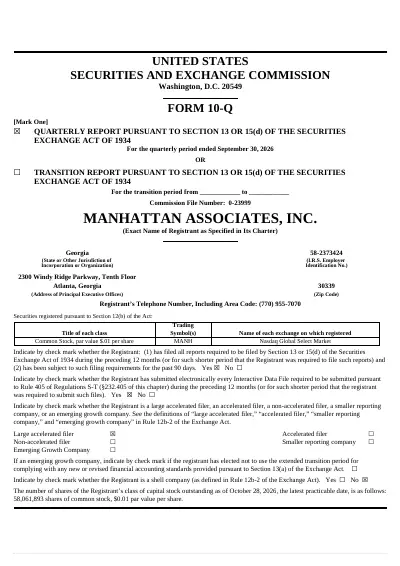
We caution you that these forward-looking statements involve risks and uncertainties, are not guarantees of future performance, and actual results may differ materially from the projections contained in our forward-looking statements. I refer you to Manhattan's SEC reports for important factors that could cause actual results to differ materially from those in our projections, particularly our annual report on Form 10-K for fiscal year 2025 and the risk factor discussion in that report and any risk factor updates we provide in our subsequent Form 10-Qs.
Please note that turbulent global macro environment could impact our performance and cause actual results to differ materially from our projections. We are under no obligation to update these statements.
In addition, our comments include certain non-GAAP financial measures to provide additional information to investors. We have reconciled all non-GAAP measures to their related GAAP measures in accordance with SEC rules.
You'll find reconciliation schedules in the Form 8-K we filed with the SEC earlier today and on our website at manh.com. Now, I'll turn the call over to Eric.
Eric Clark
Thank you, Mike. Good afternoon, everyone, and thank you for joining us as we review our third quarter results, discuss our increased full-year 2026 outlook, and provide some color on 2027.
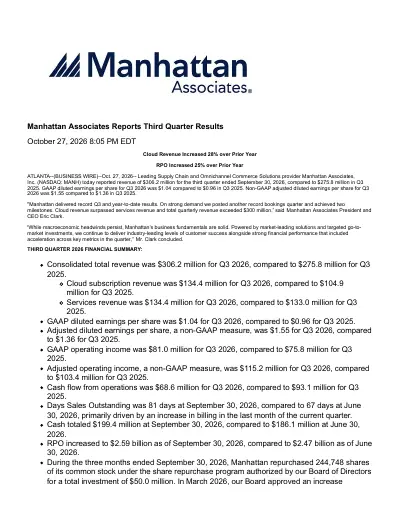
Manhattan delivered record Q3 and year-to-date results. Our performance was highlighted by 28% cloud revenue growth, RPO increasing 25% to $2.6 billion, and our fourth consecutive quarter of record bookings.
We also achieved two milestones with cloud revenue surpassing services revenue, and total quarterly revenue exceeding the $300 million watermark as total revenue growth of 11% was better than expected. The steady acceleration of our business momentum continues to be powered by two primary drivers.
First, Manhattan's commitment to innovation and driving speed and simplicity across our best-in-class supply chain solutions. Second, the strategic investments in sales and marketing are unlocking a growing number of opportunities across our large and expanding addressable market.
As we've previously communicated, these investments include building product-focused sales specialist teams to drive new logo growth and cross-sells, a dedicated conversion team to move on-prem customers to the cloud, a dedicated renewal team to focus on expansion, maturing our partner ecosystem to create additional pipeline channels, building seamless agentic AI capabilities driven by Manhattan Forward Deployed Engineers, and most recently, the introduction of Editions to make the Manhattan Active Platform available to customers of all sizes. These investments have contributed to the acceleration of our year-to-date bookings growth, as our year-to-date deal volume has already surpassed our total deal volume for the full year of 2025.
In addition to strong Q3 deal volume, which included both enterprise and essentials editions transactions, we also experienced healthy growth in new logos, upsells, and renewals. Specifically, new logos were about 35% of new cloud bookings, and our win-rate metric remained consistent at above 70%.
Our AI offerings, which are built directly into our Active Platform, continue to be a meaningful differentiator, contributing to our Q3 deal flow, including an AI upsell through the Google marketplace as well as new pipeline growth. In summary, we continue to experience strong and diversified bookings momentum for the quarter and year-to-date.
Our fourth consecutive record bookings quarter was a key contributor to our growth acceleration in cloud revenue, total revenue, RPO, and next 24-month RPO. From a vertical sales perspective, our end markets are diverse, and we have healthy established footprints across numerous subsectors, which include retail, grocery, food distribution, life sciences, industrial, technology, airlines, third-party logistics, and more.
For example, Q3 deals included a multinational home improvement retailer that increased their existing Active Order deployment and expanded to become an Active Warehouse, Active Transportation, and Active AI customer; a leading US grocer became a new logo Active Warehouse and Active AI customer; a global medical technology developer and manufacturer is converting from on-prem to Active Warehouse; one of the largest consumer cooperatives renewed their Active Warehouse subscription and expanded to become an Active Transportation and Active AI customer; a lifestyle and fashion brand that is an existing Active Order customer expanded to become an Active Warehouse and Active AI customer; and an energy transmission and distribution company became a new logo Active Warehouse and Active Transportation customer. In addition to several other impressive Q3 deals, we continue to make solid progress on monetizing our AI opportunity.
As a reminder, our Active AI offering consists of two primary elements: a set of base agents ready to be activated immediately, and then our Agent Foundry, which enables our customers to quickly build and deploy their own agents. Because we build all of these agents directly into the Active Platform, our customers don't need to implement costly and complex external data lakes.
Our unified, cloud-native, API-first architectures enables us to deploy agents with almost no configuration or additional upfront effort, embedding AI agents directly into the workflow. No data lakes, no latency, deployed in minutes, not months, and maximizing value and ROI in real time.
This is driving impressive market-leading adoption of our agents from our install base. While it remains early, we're maintaining our 100% conversion success from AI pilot to AI subscription.
To help demonstrate the broad use cases and the operational benefits provided by our Active Agent technology, I'll provide three brief customer use cases from the quarter. First, a 3PL with multiple agents deployed at several of their sites reduced wave planning by 50%.
Agents also lowered appointment booking clerical time by 80% and wave failure investigation time by almost 70%. These are labor-intensive processes that require highly specialized resources.
Together, on an annualized basis, these efficiency gains will return thousands of man-hours back to the business. These agents also increased on-time departures, with one site experiencing approximately a 20% increase.
Next, a retailer that is also deploying multiple agents was able to reduce invoice write-offs by almost 20% and cut invoice resolution time by over 70%, increasing the company's revenue and cash flow. Finally, a manufacturer with multiple agents live is using an order fill agent that automatically fills order from inventory available from other sales channels when their specific channel's inventory is depleted.
This prevents lost sales, lowers freight overspend, and improves vendor status with key sales channels. Once these agents are implemented across all sites, this customer is forecasting to achieve seven figures worth of increased sales and cost savings.
Now, we're excited about the growing use cases and the increasing number of new and existing Active customers that are finding great value in their agentic journey with Manhattan. Now, I'm going to turn to some product updates.
During last quarter's call, I described the upcoming launch of a new way to buy Active products called Editions. We launched Editions in Q3 to make our market-leading technology available to a much wider array of customers.
Starting in Q3, our sales teams started engaging with prospects using our new Editions-based packaging: the Essentials Edition for the lowest-complexity supply chains, the Enterprise Premier Edition for those customers with the most complex and sophisticated supply chain needs, and the Enterprise Edition for those in between. As a reminder, Editions is an important program for both Manhattan and our customers because it ensures that all customers are able to use Manhattan solutions built on our market-leading Active Platform.
By bringing customers of all sizes and complexities onto the same platform, we can make solution unification, extensibility, and agentic AI available across our entire customer base. We're off to a solid start with Editions.
In Q3, we closed a number of deals on Active Warehouse Enterprise Edition. Historically, we would have sold and deployed Active Scale to these customers.
Now, with Editions, these customers will have the opportunity to take advantage of our leading embedded AI capabilities, access adjacent Manhattan solutions like Active Transportation and Active Order and Active AI, and will be able to easily move to Enterprise Premier Edition when they're ready for our most advanced capabilities. Our sales teams have transitioned seamlessly to Editions, even converting opportunities that originally we pursued with Active Scale into Active Warehouse Enterprise Edition wins within Q3.
We also closed our first Essentials Edition of Active Warehouse. This opportunity wasn't even in the pipeline at the beginning of Q3.
This customer reached out to us when we announced Editions, and we closed the deal within the quarter. Both Essentials and Enterprise Editions will unlock an expanded addressable market, faster deal cycle times, and opportunities for partners to drive more deal flow to Manhattan.
Speaking of partners, last quarter, I mentioned the increased deal flow coming from our partner community. That momentum has continued in Q3, and our year-to-date partner-sourced deals are up more than 4x over last year.
One of our core strengths at Manhattan has always been innovation. We continue our strong innovation focus across all of our Active products.
Within Active Order, we continue to enhance our market-leading position by introducing features that customers can only get from Manhattan. For example, we recently introduced a new fulfillment optimization simulation capability in Active Order.
Using this breakthrough feature, customers can experiment with new fulfillment network models, inventory positioning strategies, labor plans, and algorithm configurations. What makes this new capability so interesting is that we allow our customers to replay an entire day or even an entire week of order processing against these potential changes.
We can show them concrete terms how this alternate reality will affect their customer service levels and fulfillment costs, all within a simulation sandbox using their real production data. Many of our larger Active Order customers are now beginning to use this new capability, and the initial findings have been eye-opening.
As these customers begin putting their findings into production, I look forward to sharing the measurable operational improvements they achieve. Now, switching gears to our B2B customers.
One of the most critical operational KPIs in supply chain and logistics is OTIF or OTIF. It stands for on-time in-full.
It measures whether a customer receives the exact order in the exact quantity at the correct location and within the agreed-upon time window. If you're shipping to a customer with any size and scale, it's safe to assume they'll be measuring and holding you accountable to a published OTIF goal.
Failure to meet these goals often results in chargebacks running into the tens of millions of dollars for larger shippers. The enterprise promise and fulfill, or EP&F, capabilities within Active Order help our customers comfortably meet their OTIF goals.
For example, a leading global manufacturer recently activated EP&F and was able to reduce their critical order cycle time by more than half, increase their first-time fill rates by 50%, and shift 25% of their customers from manual ordering to digital ordering. They did all of this while exceeding their inventory turn targets.
For third-party logistics providers looking to expand their offerings and become so-called 4PLs, Active Order is proving to be a vital tool. Working together, Active Order and Active Warehouse are helping one of the world's largest 3PLs provide 4PL services to many leading brands, increasing their strategic competitiveness and driving customer satisfaction for end customers.
The growing importance of B2B capabilities is also reflected in the current Gartner and Forrester order management system evaluations, both of which place significant emphasis on B2B requirements. Finally, earlier this month, we held our European customer conference in Milan.
During the event, we showcased our latest advancements with Active agents. During the keynote, we demonstrated how our Active agents can continuously monitor whether any shipments are tracking to depart behind schedule or with insufficient fulfillment levels.
These agents not only detect the issue, they also proactively remediate the process and data issues that put the shipment at risk. The agents resolve some issues autonomously while bringing others to a human for review and final decision-making.
We also showcased a number of other key agentic capabilities through our Active Order and Active Transportation applications. Similar to what we've done in the distribution center, our order and transportation agents live in the workflows that our contact center, fulfillment analysts, and transportation planners use everyday.
We remain committed to delivering agentic AI capabilities right to our users, making it easy for them to benefit in real and measurable operational terms. Now, I'll hand it over to Linda to report on our financial performance and outlook, and then I'll close our prepared remarks before we open it up to Q&A.
Linda, over to you.
Linda Pinne
Thanks, Eric. Our Manhattan global teams continue to execute well in a challenging macro environment.
For the quarter, we delivered better-than-expected financial performance on the top and bottom lines. This includes strong performance across RPO bookings, cloud revenue growth, and gross and operating margin expansion, all contributing to our Q3 and year-to-date results exceeding the Rule of 40.
FX did not have an impact to year-over-year total revenue growth for the quarter. It was also less than a million-dollar headwind to sequential RPO growth and was an $8 million headwind to year-over-year RPO growth.
Now to our results. Our growth rates are reported on a year-over-year basis unless otherwise stated.
For the quarter, total revenue was $306 million, up 11%. Excluding license and maintenance revenue, which removes the compression driven by our cloud transition, our total revenue was up 12%.
Cloud revenue increased 28% to $134 million. Our better-than-expected performance was driven by the combination of strong execution, upsells, and AI.
Services revenue increased 1% to $134 million and was a bit better than expected. We ended Q3 with RPO of $2.59 billion, up 25% compared to the prior year and 5% sequentially.
Year to date, we are tracking ahead of the bookings plan we communicated on our Q4 call for both new bookings and renewals, and we now expect renewals to be in the mid-20% range of our added RPO for full year 2026. Contract duration in the quarter was between 5 and 6 years.
At the end of Q3, we expect 40% of RPO to be recognized as revenue over the next 24 months, which is up from 39% at the end of Q2 and 38% at the end of Q1. This reflects the combination of strong deal volume and faster deployments.
Q3 adjusted operating profit was $115 million, with an operating margin of 37.6%. Our better-than-expected performance was driven by strong cloud revenue growth, which offset the increased go-to-market investments and higher bonus accruals.
Turning to EPS, we delivered better-than-expected adjusted earnings per share of $1.55, up 14%. GAAP EPS of $1.04 was up 8%.
Moving to cash, operating cash flow was $69 million, with the timing of collections driving the year-over-year change. This resulted in 22.1% free cash flow margin and 38.2% adjusted EBITDA margin.
Regarding the balance sheet, short-term deferred revenue increased 18% year-over-year to $348 million. We ended the quarter with $199 million in cash and 0 debt.
Accordingly, we leveraged our strong cash position and invested $50 million in share repurchases in the quarter, resulting in a record $325 million in buybacks year to date. As such, we have $175 million remaining in the share repurchase authority that we announced in March.
Moving to our 2026 guidance. As we have previously highlighted, our long-term and longstanding financial objective is to deliver sustainable double-digit top-line growth and top-quartile operating margins benchmarked against enterprise software comps.
These are drivers to our best-in-class return on invested capital as we maintain a balanced investment approach to growth and profitability. As noted on prior earnings calls, our goal is to update our RPO outlook on an annual basis.
Also, as previously discussed, our bookings performance is impacted by the number and relative value of large deals we close in any quarter, which can potentially cause non-linear bookings throughout the year. With all that said, and acknowledging the volatile macro environment, given our strong year-to-date performance and solid pipeline, we are increasing our RPO outlook to 21% year-over-year growth, up from our prior target range of 18% to 20% growth.
Moving to the P&L. We are raising our full-year total revenue, operating margin, and EPS outlook.
This guidance is also provided in today's earnings release. For total revenue, we expect $1.176 billion to $1.178 billion, with the $1.177 billion midpoint comparing favorably to our prior outlook and representing 12% growth excluding license and maintenance attrition or 9% all in.
For Q4, which accounts for retail peak seasonality, we are targeting total revenue to be about $291 million, as we now target cloud revenue of $136 million, services revenue of $122 million, maintenance revenue of $26 million, and hardware revenue of $6 million. For full-year adjusted operating margin, we are increasing the midpoint to 35.3%, up from 35.1%.
Accounting for retail peak seasonality, we are targeting 36.1% for Q4. Our full-year adjusted EPS is increasing to $5.54 to $5.56.
For Q4, we are targeting $1.38. Our GAAP EPS midpoint is increasing to $3.63, and we are targeting Q4 GAAP EPS of 92 cents.
Now moving to our preliminary commentary on 2027. While the global macro environment remains volatile and we are in the early stages of our 2027 budget cycle, given our solid business momentum and visibility, we believe the consensus 2027 estimates are generally appropriate for RPO and the P&L.
This includes 20% cloud revenue growth, low-single-digit services revenue growth, and continued operating margin expansion while we simultaneously invest in the business to drive future growth. We intend to provide our initial annual guidance that will continue to include all of the familiar line-item transparency on our Q4 call.
In summary, solid year-to-date execution by the Manhattan team, and we are looking forward to ending the year strong. Thank you, and back to Eric for some closing remarks.
Eric Clark
Great, thank you, Linda. Before we move to Q&A, I'd like to start by welcoming Juan Perez to the Manhattan board.
For those that don't know Juan, he has tremendous and relevant experience. Most recently, he was the EVP and CIO of Salesforce.
Prior to Salesforce, Juan had a 30-plus-year career at UPS where he was the Chief Information and Engineering Officer. We're looking forward to Juan's future contributions to Manhattan as he joins the board effective January 28th.
With that, we're very pleased with our strong year-to-date results and our continued business momentum. Manhattan's business fundamentals are very solid as our team remains focused on delivering market-leading innovation and exceptional results to our customers.
These are key drivers to our four consecutive quarters of record bookings and acceleration in cloud revenue growth, total revenue growth, RPO growth, and current RPO growth. Thank you to everyone for joining the call and thank you to our global team for the continued execution.
That concludes our prepared remarks, and we'd be happy to take any questions.
Operator
Thank you. We will now be conducting a question-and-answer session.
If you would like to ask a question, please press star one on your telephone keypad. A confirmation tone will indicate your line is in the question queue.
You may press star two if you would like to remove your question from the queue. For participants using speaker equipment, it may be necessary to pick up your handset before pressing the star keys.
One moment please while we poll for questions. The first question is from Terry Tillman from Truist Securities.
Please go ahead.
Terry Tillman
Hey, good afternoon, Eric, Linda, and Mike. Thanks for taking my questions, and it is great to see the strong bookings.
I thought it was supposed to be a seasonally slower quarter, but anyways, it was a great job there. My first question is on agent uptake.
Eric, you gave some examples and some of the returns being seen. Then, Linda, you actually mentioned it as part of the third quarter cloud subscription revenue execution.
I don't recall hearing that actually in that line item before. I was hoping to get a little bit of perspective on how this is starting to kind of manifest in the actual revenue, and thoughts into 4Q or just generally going forward on materiality.
Thank you.
Linda Pinne
As far, Terry, as the the P&L for the quarter, we don't at this point intend on breaking out revenue by product on a quarterly basis. AI did definitely contribute to our results this quarter, and we'll provide more color on that when we get into our discussion on 2027 on the Q4 call.
Terry Tillman
Got it. Maybe just a follow-up question.
Y'all did kind of change the typical methodology, and you did raise full-year RPO. I think you said 21% year-over-year growth if I'm not mistaken.
Last year in the 4Q, and I know last year there was a couple quarters that maybe there was a little bit more kind of movement quarter to quarter or variability, but the 4Q was especially large. I guess based on your assumption for ending RPO, are you assuming a little bit more of a measured, kind of budget flush or seasonal strength in bookings?
Or just what's informing that 4Q RPO add? Thank you.
Eric Clark
Terry, we've got a strong pipeline for Q4. I think the pattern that we've seen throughout this year with increased deal volume and strength in bookings in every quarter, you know our policy here.
We always try to underpromise and overdeliver. Typically, we don't update RPO at all during the year.
Since it was pretty evident that we were going to exceed the range, we felt like we needed to say something about it.
Terry Tillman
Got it. Thank you.
Operator
The next question is from George Kurosawa from Citi. Please go ahead.
George Kurosawa
Great. Thanks for taking the questions here.
I wanted to start on the renewal side. You mentioned it's trending ahead of expectations.
Maybe if we could just unpack that. What exactly is doing better than your initial assumptions under the hood?
Is it on the cross-sell side, attach rates or pricing or anything else? How much would you attribute to the dedicated renewals team?
Eric Clark
It's all of those things. It's the cross-sells, the upsells, the pricing, all of those things that we're doing at the time of renewals.
I give a lot of credit to that dedicated renewals team. Just the discipline and the structure that they've put into all of these conversations.
I'll point to some of the examples that I gave of Q3 deals. You heard several examples of multi-product deals and several examples of adding at the time of renewal.
That's just becoming a structural change that's becoming a very well-exercised muscle for our team to have those conversations and really explain the value of the unification, multi-product, and adding AI at time of renewal.
George Kurosawa
Great. Then I was really interested in that customer example that was landed in-quarter on the Essentials Edition.
Maybe if you could give some detail on maybe that customer's profile. Was it something outside of the norm of what you would typically see if we consider a scale customer for example, and how prescriptive might this type of motion be going forward?
Eric Clark
Maybe I'll start with you mentioned scale and I said in the prepared remarks that we had several deals close that came into the quarter as scale opportunities. By the end of the quarter, we had moved them to Enterprise Edition and closed them as Enterprise Edition.
That's pretty much what we intended. We thought Enterprise Edition would be a good fit for our scale customers, and Essentials was really created for the customers that are not quite even at that level.
In the past, maybe they were buying products that were far inferior to the cloud products that we offer, and now they've got the opportunity to get directly onto the Active Platform and just move up subscriptions as they grow. That's kind of exactly what that customer recognized.
It was a customer that was aware of Manhattan, but never thought they could afford or fit into Manhattan. When we announced Editions, they made a quick decision, and we closed the deal.
George Kurosawa
Great. Thanks for taking the questions.
Eric Clark
Yep, thank you.
Operator
The next question is from Brian Peterson from Raymond James. Please go ahead.
Hi,
Brian Peterson
thanks. Congrats on the really strong quarter.
Eric, if I look at the third quarter numbers over the last few years, we definitely did see a little bit more seasonality. There's just a lot of things you guys are doing from a product and a go-to-market perspective, and clearly that's working to kind of offset that.
If you had to stack-rank those factors, what do you think were kind of the biggest factors for you to kind of offset that seasonal softness in the third quarter?
Eric Clark
Great question. I think I'm not throwing out seasonality.
[chuckle] I think Q3 is a seasonally tougher quarter, but I think the things that we've done over the past year-plus to increase that deal volume, and not only that, but we've increased that deal volume in all of our regions. That was another important factor in our results in our bookings in Q3.
We had great participation from every region. I think that discipline that we've put in the sales team, I mentioned last quarter, our sales team has found a new gear in the way that they're operating and the way that they're finding opportunities and closing opportunities.
We had a lot to work with in Q3, and the team executed at a very high level.
Brian Peterson
Understood. Linda, maybe one for you.
I know you mentioned that the next 24-months RPO expanded up to 40%. Given that we're seeing accelerated implementations and we have some, I guess, lower price point products coming in line, how should we think about that number over the next year or two?
Should that increase, stay the same, any color on that? Thanks, guys.
Linda Pinne
Again, we're not really going to provide formal guidance on that percentage, but if we think about it logically, as we mentioned, our deal length was around 5 to 6 years, probably closer to 5. Just given that metric, you would think somewhere around the 40% ballpark would be a reasonable place for it to stay.
Then, again, what's driving it though is, in addition to the duration being maybe just a little bit shorter, is also just the volume of deals increasing.
Eric Clark
Maybe I'll add one thing to that, because it kind of ties into this. I've talked in a couple of different forums about as our mentality on the sales team a couple of years ago, we were very well positioned to win all the big deals in the market, but maybe weren't as well set up to win some of the mid-sized and smaller deals.
Now that we're positioned to win all of those deals, if you compare a 50 $150 million deal to 50 $1 million deals, both have the same impact on RPO and both have the same impact on ramped ARR. The 50 $1 million deals, each one of those can ramp a whole lot faster than that one big one.
That drives a whole lot more current RPO at that next 24-month RPO. This focus on more deals and more deals of all sizes is giving us a whole lot more momentum in the near term.
Brian Peterson
Great. Thank you.
Operator
The next question is from Joe Vruwink from Baird. Please go ahead.
Hi,
Joe Vruwink
great. Thank you.
Hope that you can hear me okay. I want to go back to this idea of 3Q seasonality, and I guess is the migration pipeline, is it going to end up changing the seasonality if migrations are accelerating?
Should we start to maybe think about a different cadence for the time being? Maybe therein, can you give us few updates on migrations like what it represented as a share of bookings this quarter?
Then is some of the recent success really follow-through from all the hard work over the past year, thinking about the 60 60 time line packages or even the new product tearing and in moving the scale of customers. Is that all contributing to this higher migration activity?
Eric Clark
Thanks for that. As you correctly said, all of our focus, including fixed-fee conversions, all of that's driven more activity and more pipeline around that conversion.
I wouldn't point to that as the reason that we were able to get past Q3 seasonality, but all of these things contribute to it. I think, again, I talked about Editions.
Over time, it's only been in the market for one quarter now, but over time, I think that will also unlock more of those migration conversion opportunities, because we've got a lot of companies that have been on on-prem products for decades, and not every one of those companies was going to go to Enterprise Premier. Now we have multiple paths for all of those companies.
We see big opportunity to continue to increase the deal volume with Editions. I think all of this just plays together.
Again, put partners in the mix as well as we've continued to mature that partner ecosystem. All of these things are driving increased deal volume and driving more opportunities in the pipeline.
From a mix perspective, we always say that over a elongated period of time, it's going to kind of go to thirds, 1/3 new logo, 1/3 conversions, and 1/3 expansion. If you look year to date, we're pretty close to that.
New logos is still the largest, but we're getting meaningful contribution from all three.
Joe Vruwink
That's great. Thank you.
Then on the in-period upside in cloud subs, just focusing on the upsell piece, is that taking sites live faster and ahead of schedule, and if so, is that related to AI also and AI tooling helping customers roll out faster?
Eric Clark
Yes and yes. That's exactly it.
As we deploy faster, people are getting the ROI faster, but they're also getting into higher tiers and ramping their subscriptions faster. A key way that we're able to do that is by leveraging AI in that deployment cycle.
Yes, that's exactly right.
Joe Vruwink
Thank you.
Operator
The next question is from Chris Quintero from Morgan Stanley. Please go ahead.
Hi. Can you hear me?
Eric Clark
Yes.
Hi, this is Beatrice on for Chris Quintero. Congrats on the quarter, by the way.
One of the key pieces of feedback we received from investors following our recent upgrade was around the sustainability of the recent cloud outperformance. This Q3 acceleration is a great proof point for that sustainability, but how much of that outperformance do you think reflects structural improvements in bookings and faster implementations, and how sustainable are those benefits going forward in fiscal '27 and beyond?
Linda Pinne
I think as far as the quarter goes, if we think about it, probably about half of the beat within the quarter was tied to the upsells that we've mentioned, which are directly attributable, like you said, to, a, we have more customers, and b, with our focus on speed and simplicity and helping them to deploy faster, that's helping them to pull their ramps forward. That's a big part of the outperformance.
When we think about our forecast and our guidance for Q4 and beyond, we typically don't include a significant amount of upsells in those numbers, just because they do tend to vary both in terms of timing and amount. We usually take a conservative position on those, so that's why you're seeing what we've projected so far for Q4.
Got it. Then, maybe just one more question.
You mentioned a customer purchasing one of the new Editions offerings despite not even being in the pipeline. Given the potential for shorter sales cycles and faster deployments, how should we think about the timing of when Editions momentum shows up in cloud revenue versus RPO, and what do you think the TAM is for Editions?
Eric Clark
I think kind of as we stated when we launched this a quarter ago, I think it takes a year to really build it up. When we announced some of the structural changes and investments around sales and marketing in July of last year, it took three or four quarters to really see all of those come to fruition.
I think the same will be similar for Editions. Now, that being said, I think we'll start to see some additional wins in Q4 and Q1, et cetera.
Look to the second half to really have the material impact coming from Editions.
Great. Thank you so much.
Operator
The next question is from Dylan Becker from William Blair. Please go ahead.
Dylan Becker
Hey, Eric, Linda, Mike, appreciate it. Really nice job here.
Maybe a question on agents. Really helpful use cases and kind of value prop ROI you've called out across kind of a multitude of the agentic base.
Are you seeing, or to what extent are you seeing, any shift in kind of that proof-of-concept momentum as that ROI becomes more explicit and tangible? Are customers or is appetite maybe skipping that POC stage, and maybe what are the broader implications?
We talked about accelerating deal volume, but on land sizes, as maybe they are more willing to take agents upfront without kind of the 90-day POC period?
Eric Clark
We are seeing more of that, and that started in Q2, continued in Q3. We've got a meaningful number of customers that have skipped the pilot phase and gone straight to subscription.
Now, of course, when they do that, we still spend time with them, and take many of the steps that would be in the pilot in terms of training and educating them on how to use the base agents and how to build the custom agents. That has been an effective way to grow the AI business as well.
Dylan Becker
Fine. Thanks.
Eric Clark
I mentioned some of those in the prepared remarks. On some of those deals I mentioned, you can tell those were straight-to-subscription deals.
Dylan Becker
Right, okay, perfect. Thank you.
Then I think you did call out 4x year-over-year growth in the partner channel. I know it's been more of a kind of direct emphasis as well, too.
What are you seeing and hearing there from an opportunity perspective, and how those partners are allocating capital and deploying and building teams as kind of a contribution to that ramped partner motion?
Eric Clark
We're seeing a lot of partners really lean in and invest in terms of hiring talent and training talent. I didn't give the stats this quarter on the increase in number of trained and certified professionals, but the quarter-on-quarter increase this quarter was even higher than last quarter.
We continue to see a very rapid pace of customers truly engaging with us. The way that we're measuring and monitoring them and kind of comparing them to each other is also creating a competition structure where all of them want to be top-tier partners.
We're seeing a whole lot more activity and investment from all of them.
Dylan Becker
Great. Thank you.
Eric Clark
Thank you.
Operator
The next question is from Mark Schappel from Loop Capital Markets. Please go ahead.
Mark Schappel
Hi, thanks for taking my question and nice job on the quarter. Eric, maybe you could just talk a little bit about how the bookings and pipeline conversion are just comparing across your main product solutions, WMS, TMS, OMS?
Eric Clark
I would say we continue to have strong momentum across all of our product set. It varies quarter to quarter of which ones lead the way.
If you take a multi-quarter view, we're getting strong input from all of our products. I would say, as we announced Editions, that also has an increase in cross-product as well, because it opens up more opportunities for companies that maybe were willing to go in on one product, but not multiple.
Now they've got the ability to go on multiple products with Editions. That pipeline continues expand across the product set.
Mark Schappel
Great. Thanks.
Then how has the the services friction that was discussed in prior quarters kind of evolved here? Maybe what evidence are you seeing of just improvements and things like implementation times, customer satisfaction, project ramps, things like that?
Eric Clark
One of the things that we've been saying for the past few quarters and it continues to be true is we continue to do services projects faster than we did them a year ago, but we're doing more of them, and that's why our revenue is growing. We're comfortable that we can continue to have that kind of success with that low-single-digit revenue growth in services, because we see a healthy pipeline of new deals that are booked and new deals in the pipeline to have that deal volume continue to grow.
I would say, from a customer standpoint, you've got more and more customers in the market that are recognizing that the cost of action is decreasing, right? The cost of doing something is decreasing.
AI is driving a lot of that, we're able to deploy a whole lot faster and get them to ROI faster. Then they're also recognizing the flip side, that the cost of doing nothing is increasing.
Those that are doing nothing are getting farther and farther behind. We're seeing a lot of activity and a lot of customers that are trying to figure out how to accelerate what they've got going with Manhattan.
Mark Schappel
Thank you.
Eric Clark
Thank you.
Operator
Our last question will be from Lachlan Brown from Rothschild. Please go ahead.
Lachlan Brown
Hi Eric, Linda. Congrats on the strong quarter.
With the average contract duration closer to 5 years now compared to that usual 5 and 1/2 to 6 years, appreciate there are now smaller, shorter deals in there with Editions, but are you also seeing some success with customers shortening terms upon renewal? If so, if you could just provide some color on the execution here.
Eric Clark
You're correct. A couple of quarters ago, I made a comment that we would start our renewal conversations by talking about three-year renewals, but I mentioned last quarter, and it's still true this quarter, the bulk of our renewals continue to be five years.
We are comfortable with three-year renewals. We would love to have the opportunity to talk every three years about expansion and price increases.
We're seeing our customers that really do love to have that five-year, more set duration and protection from price increases. That continues to be the norm on renewals.
Lachlan Brown
That's helpful. Thanks.
Maybe I missed it, but what was cloud conversions as a percent of new cloud bookings in the quarter? Further to that, you have several, I guess, newer catalysts at play here for conversions, agentic AI incentivizing the transition, dedicated conversion programs, maturing the partner channel, and now you've got Editions.
I know it's a combination, but if you had to call one out, which of these drivers is currently moving the needle the most for those on-premise customers? Thanks.
Eric Clark
I would say, right now, the thing moving the needle the most for those on-prem customer conversions is that the fixed-price conversation, because we've had that in market for a while now, and that's been driving a lot of the conversations. Just in the past quarter, when we've been able to add to that the Editions conversation, it opens up more doors and opens up more opportunities, and I think accelerates some of the timelines.
We do expect that we will see continued increase in conversion. We've got a strong pipeline around conversions for the rest of this year and into next year.
That's something that we've always said that this is something that's going to take many, many years to convert all these customers, and that is still true. We do see the pace picking up.
Lachlan Brown
Thanks.
Operator
There are no further questions at this time. I'd like to turn the floor back over to Eric Clark for closing comments.
Eric Clark
Yep. Just wanted to thank everyone.
As I mentioned, we're really pleased with what we accomplished in Q3. To go through the past three quarters like we've had with 24% cloud growth in Q1 and 26 in Q2 and 28 in Q3, the team is really firing on all cylinders.
We're pleased about where we are and excited about where we're headed. Thank you for joining.
Operator
This concludes today's teleconference. You may disconnect your lines at this time.
Thank you for your participation.