Mapletree Logistics Trust
Q2 FY2027 · Earnings Call TranscriptOctober 28, 2026
Lum Yuen May
Hi, good evening. Welcome to MLT's results presentation for the quarter ended 30th September 2026.
To kick off the session, Charmaine will take us through the key highlights.
Charmaine Lum
Hi, everyone. Thank you for joining the call.
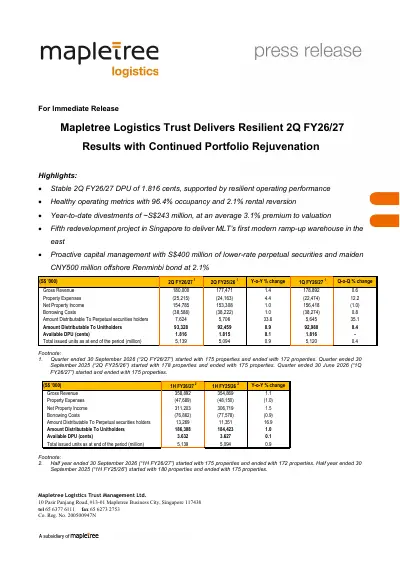
For first Q-- sorry, for 2Q year-on-year, our gross revenue and NPI are higher by 1.4% and 1% year-on-year, respectively, mainly driven by contribution from our Singapore AEI, contribution from the India acquisition that we completed end of last financial year, as well as organic growth, offset by absence of contribution from divestments. DPU is at 1.816 cents, slightly higher than last year.
Operating metrics-wise, our portfolio occupancy is at 96.4%. Portfolio rental reversion, a positive 2.1%, and WALE is stable at 2.5 years.
On the capital management front, our aggregate leverage is at 37.5%, lower than 1Q, mainly because we have temporarily pared down our borrowings with our perps proceeds raised in August. We will be drawing back the loans to repay and redeem our existing tranche in early November.
If we remove the effect of this temporary repayment, our gearing would have been 40.4%. Debt hedged into fixed rate, about 90% 90%, and our average cost of debt is at 2.7%.
74% of our income for the next 12 months has been hedged into Sing dollars. On the capital management front, we have two initiatives that we did in 2Q.
One would be the $400 million perps raised in August. That is at a coupon of 3.5%.
Intention is to use this to redeem the $400 million that's coming due in November, which had a coupon of 3.725%. We also had our maiden CNY 500 million offshore renminbi bond issued at a coupon of 2.1%.
In terms of portfolio rejuvenation, we will be embarking on our AEI in Changi South. We have also executed $243 million of divestments at a 2.1% premium over valuation, and also deferred our sponsor's call option at 201 Keppel Road, which is the Prima property within the portfolio.
Moving on to slide six. Gross revenue, as mentioned earlier, is higher by 1.4%, mainly due to contribution from our Jurong AEI, India acquisition, as well as organic growth in Singapore, and currency appreciation of the renminbi and Aussie dollar, partly offset by absence of revenue contribution from divestments.
Property expenses increased mainly due to higher property taxes. Consequently, NPI is higher by 1%.
Borrowing costs increased due to the interest incurred on incremental borrowings to fund our India acquisition, capex, and land premium in Singapore, as well as higher rates for JPY loans and replacement hedges, partially offset by lower base rate on unhedged Sing dollar loans, as well as interest savings from the temporary repayment of loans with perps proceeds. Our amount due to perps, coupon to perps securities holders, is higher, mainly due to the overlap of the early raise, and consequently, our DI to unit holders is at $93.3 million versus $92.5 million last year, and our DPU is slightly higher, 1.816 cents versus 1.815 cents.
The reasons behind our first half this year versus first half last year results are largely the same as 2Q year-on-year. Gross revenue, higher by 1.1%, and NPI, higher by 1.5%.
Borrowing cost decreased slightly by 0.9%, mainly due to base rates on unhedged Sing dollar borrowings, interest savings from temporary repayment of loans with perp proceeds, offset by interest incurred on incremental borrowings to fund India acquisition, capex, and land premium. After taking to account the higher perps distribution and the enlarged unit base, our distribution DPU for the first half is 3.632 cents versus 3.627 cents.
Moving on to quarter-on-quarter results. Gross revenue increased by 0.6%, mainly due to organic growth from our existing portfolio, mainly in Singapore, as well as appreciation of renminbi and Korean won.
Property expenses increased mainly due to higher property taxes and absence of one-time adjustment to utilities expenses in 1Q. This resulted in lower NPI, $155 million versus $156 million in 1Q.
Borrowing costs increased mainly due to interest incurred on incremental borrowings to fund capital expenditure, as well as higher base rate for Sing dollar unhedged loans and JPY loans. This is partly offset by the interest savings from the temporary repayment of loans with perp proceeds.
After accounting for higher perps distribution, other adjustments, and the enlarged unit base, DPU is the same as last quarter at 1.816 cents. Moving on to the balance sheet, our NAV is at $1.27, which is slightly higher than the $1.26 last quarter.
Leverage, 37.5%. If we exclude the impact of the perps temporary repayment with perp proceeds, that's at 40.4%, comparable to last quarter.
Borrowing cost, 2.7% versus 2.6% last quarter. Our debt maturity profile remains well-staggered.
We have about $90 million or 2% of loan that is expiring in this financial year. We have about $1.15 billion of available committed credit facilities on hand, which is more than sufficient to refinance our debt due this year.
Moving on to our interest rate, as well as FX hedging. 90% of our total debt has been hedged into fixed rate.
If we exclude the impact of the lower borrowings due to the temporary repayment of loans, the percentage hedged would have been closer to 83%. If you look at the currencies that remain unhedged, our unhedged currencies are mainly denominated in Sing dollars and JPY, which are of the lower cost as compared to the other currencies.
I think where we are looking at is we will continue to be impacted by higher borrowing costs. It's now currently at 2.7%.
We expect this to increase to about 2.8% by the end of the financial year. On the income hedged portion, about 74% of our DI has been hedged into Sing dollars.
I'll pass the mic over now to James.
James Sung
Good evening, everyone. James here.
I'll update our operational performance. This slide shows that 70% of MLT's portfolio by AUM and revenue is anchored by developed markets, providing a stable earnings foundation and maintaining exposure also to faster growing emerging markets.
Next. Our diversified tenant base of 900-over customers are mainly engaged in handling consumer-related goods.
Around 85% of our revenue is derived from tenants serving domestic distribution, with the balance 15% catering to exports. Next.
Occupancy in 2Q remained healthy, high occupancy rate of 96.4% in 2Q, reflecting healthy demand across our portfolio. China occupancy improved to 94.4% in 2Q amid continued challenging market conditions.
India occupancy decreased due to transitional downtime, with occupancy expected to backfill in the next quarter. Next.
In terms of our portfolio rental reversions, we registered 2.1% positive reversion in 2Q, as compared to 0.9% in the last quarter. Excluding China, the portfolio reversion improved 4.2% in second quarter.
Going by countries, in the second quarter, Singapore's rent reversion improved against first quarter, is 5.3%. Going down the list, Hong Kong, 0.5%.
China, -1.7%, which is a slight improvement from first quarter's reversion of -1.8%. Japan, 1.8%.
Korea, 6.3%, much stronger than first quarter. Malaysia, 2.8%.
Vietnam, higher compared to first quarter at 5.3%. India, 3.3%.
Next. We continue to have a diversified tenant base supporting our income resilience.
Our low tenant concentration and a well-staggered lease expiry profile provided visibility of income and reduced renewal risk. In FY 26/27, we have 34% of our leases due for expiry.
This increase came mainly from shorter one-year leases coming from China. Our average WALE is 2.5 years by NLA.
19.9% of our total gross revenue contributed by our top 10 tenants. More than 900-over tenants are serving our consumer-related sectors, giving us a stable tenant demand base.
Next. Changi South redevelopment is our ongoing redevelopment project.
It will give us a MLT Singapore's growth, a guide for Singapore's growth and portfolio rejuvenation strategy. It transforms two mature assets into a five-storey ramp-up logistics facility, increasing our GFA by 34% to half a million square feet.
It's designed for sustainability and resilience. It's going to be earmarked for Green Mark Super Low Energy certification.
The TDC is estimated to be about $141 million. Construction is expected to commence in 1Q 26/27 and complete in 2Q 28/29.
I will now hand over to Man Leong to share the divestments year-to-date.
Mun Leong Chow
Thanks, Jim. Hi, this is Man Leong.
For the financial year, FY 26/27, we have executed divestments about $243 million and at an average 2.1% premium to valuation, right? As a recap, earlier on, we have actually sold two Wuxi assets to our sponsor's first renminbi fund, and then during the quarter, we have also completed 39 Changi South and also Dandenong in Australia.
Both of these assets are older assets with outdated specs. Recently, we have also announced that we have sold to a third party another asset in China, Mapletree Northwest Logistics Park.
Also to add is that we have also managed to sell two strata units in Grandtech Centre in Hong Kong in this FY as well. With this, I hand over to our CEO, Jean, to wrap up the discussion.
Jean Kam
Thank you, Man Leong. This is Jean here.
Hi, good evening, everyone. For second quarter, it has been a busy quarter for us as you have heard from our team in terms of the few corporate activities that the team has presented earlier on.
Just let me quickly recap the key highlights. MLT has delivered a resilient performance, very much supported by a healthy leasing demand.
We continue to be very disciplined in our asset and a prudent capital management. Our results reflect the underlying strength of our diversified portfolio anchored by Singapore, our largest core market.
We continue to rejuvenate the portfolio through disciplined capital recycling. Like what Man Leong has mentioned, year-to-date we have done around $240 million, average premium to valuation 2%, and the deferment of the sponsor call option at 201 Keppel Road for Prima also preserve our ability to unlock further value from the asset over time.
These transactions demonstrate our ability to unlock capital from mature assets, giving us greater capacity to pursue attractive investment opportunities when they arise. The sponsor continued to lend and provide strong support for MLT.
The sponsor-led renminbi fund has given us an additional revenue to unlock value from two mature assets in Wuxi, while enhancing our financial flexibility. We will continue to explore similar opportunities with the sponsor going forward.
More broadly, the sponsor established logistics platform gives MLT the visibility over a potential pipeline across the emerging growth markets such as India, Vietnam, and Malaysia. Any acquisition will remain subject to our investment criteria, due diligence, and must create value for unit holders.
Singapore remains our largest core market and key anchor for MLT. Through acquisitions and redevelopments, we have grown our presence significant over the years, locked up over $300 million of divestments, establishing MLT as the largest logistic space provider in Singapore.
We continue to see opportunities to strengthen and rejuvenate our Singapore portfolio. The new Changi South redevelopment is the latest example of this and our fifth project in Singapore, and this will further reinforce our market-leading position.
To wrap up, looking ahead, the operating environment remains uncertain, with geopolitical tension, inflation, currency volatility, and elevated borrowing costs will continue to present headwinds. Our priorities are to sustain healthy occupancy and rental stability, maintain prudent capital management.
At the same time, we will continue our portfolio rejuvenation, strengthen our presence in Singapore, and leverage sponsor regional platform where it can create value for MLT. With a strong Singapore base, a diversified regional portfolio, and the support of an established sponsor, MLT remains well positioned to navigate the near-term challenges and deliver long-term value for unit holders.
With that, I wrap up my remarks.
Lum Yuen May
Okay. I think now we would like to open the floor to questions.
Derek from DBS, would you like to start first?
Derek Tan
Hi, good evening. Can you hear me?
Lum Yuen May
Yes, please, Derek.
Derek Tan
Hey, hi. Hi, Jean and team.
Congrats on a very resilient set of results. My two questions are, first one is on Singapore, right?
Could you give us a sense on the return on investments for Changi South? Also for Prima, right, it's a significant opportunity of value unlocking for the group.
Just wondering whether is it going to be more near-term or do we have to wait for 2028 before we can look at you unveiling this Christmas present? Just wondering.
My second question, yeah, my second question is on, I think you have done a lot of developments. I think that I felt to be something unique to MLT, lah.
You get a lot of additional return apart from buying in income. Are you going to extend this redevelopment expertise to your other markets?
If any, which markets? That's all.
Jean Kam
You have about three questions for me, Derek. Firstly on the AEI returns, like what we have achieved in the past, just like our 5A Toh Guan, we have achieved about around close to 6.5%.
Similarly, we are expecting similar 6% to 6.5% returns for this Changi project.
Derek Tan
Okay. Then
Jean Kam
as to the Christmas present, it's going to be more a medium-term because firstly it depends on the Prima expiry, we have mentioned it's 2028, and at the same time, the sponsor is also looking at some redevelopment opportunities in the southern waterfront region. That will take some time because it involves various planning scenarios as well as taking into consideration the conservation guidelines as required.
More likely a medium-term, closer towards 2028 or 2029 where we will have a more clearer visibility in terms of the repricing.
Derek Tan
Okay.
Jean Kam
Okay. The AEI expertise extending beyond Singapore, if you recall, we had done one in Ouluo, China a few years back.
We have announced the Malaysia one. The Malaysia one, it's progressing on track, but very slowly, but I think in terms of the amalgamation process, it should be probably by next year, and then we could look at commencing the project.
As to the other countries, there are also potential opportunities, we are also reviewing existing assets in Australia and Japan. There are some pockets of assets where we are either able to do an extension to create an additional uplift in the GFA, or we could actually do some phased development over time.
There are still some assets where we are able to unlock value from our existing portfolio.
Derek Tan
Sounds good. Sorry, Prima, you will sell with the new type of development, right?
Not current value, right? Just to be very clear.
Jean Kam
For Prima, under the call option, it is to sell based on the change of use to commercial or residential development, so that's in the terms of the call option.
Derek Tan
Okay. Excellent.
Jean Kam
Based on the current, yeah, URA, yeah.
Derek Tan
Okay. Thank you very much.
That's all for me. Thank you.
Lum Yuen May
Okay. Next, we have Rachel.
Please go ahead.
Hello, good evening. Can you hear me?
Jean Kam
Yes, Rachel.
Great. Yeah.
Congrats on the, yeah, very stable set of results. Just maybe if you didn't have that timing issue with the perps, potentially your DPU would have been higher, right?
Jean Kam
Yes, of course.
Can. Then my first question is, yeah, quite excited on the Changi redevelopment, but just to understand a little bit further, how much does it contribute to GRI now?
Would we see any earnings drag with the redevelopment?
Jean Kam
Okay. I think if you look at from the occupancy perspective, right now, these two assets are not fully occupied because it is under planning over time, and over time, we have also tried to transit our tenants to other assets within our portfolio as much as possible.
Right now, in terms of the occupancy, one of them is less than 50%, the other one is around 70-over percent. The NPI impact to the portfolio is not significant.
Okay.
Jean Kam
It'll
be less than 1%, lah?
Jean Kam
Less than 1%? Yes, correct.
In terms of NPI. In fact, much less, yeah.
Charmaine Lum
Rachel, maybe I just want to add on the question that you had earlier on on whether our DPU have been higher. The coupon on the perps is at 3.5%.
We are temporarily paring down unhedged loans. That's about two low 2%, there is that negative carry for that two and a half months.
I think on the longer-term basis, we are replacing a 3.725% perps with 3.5%, there will be longer-term benefits.
Sounds good. Okay.
Then maybe just my second question is on the divestments. I know you have worked very hard.
Congrats hitting the $243 million of divestments. Your target was $200 to $300 million.
You are almost there, I guess the next question is what's next? Is it time for you to look at acquisition already?
Or no, you still want to do some more divestments here?
Jean Kam
It will be a combination of both. Based on what we have on hand so far, definitely we are looking to redeploy this recycled proceeds to growth opportunities.
Right now, the markets where we are looking at, we are evaluating deals in Singapore, and similarly, in the emerging growth markets like Vietnam, India. For the immediate term, these are the as well as Japan.
These are the markets that we are having more focus in terms of our capital allocation. Divestments will continue because we still have some more that we have identified that we would still want to roll out.
In terms of getting prospective tenants, we have some traction, so that will continue. In the meantime, with this $240 million of recycled capital, we will look to redeploy as well.
Okay. The remaining divestments, are they mostly coming from Hong Kong, China still?
Jean Kam
Okay. I think for China, we are more or less there, probably one or two more.
Hong Kong, we have some strata units, so as you see, we sold two units, and it's something that we will want to continue selling because the strata units have no strategic value, so as and when there are interest, we will want to continue our divestment pace in this strata units. Ideally, we will want to sell an en bloc, but I think realistically, the buyers out there are more the some are the existing tenants, some are the more on the owner-occupiers, so that will continue.
In terms of the other remaining pipeline, we still have a handful coming out from Singapore, Australia, and Japan. I think that will be the other pipeline that we are still working on.
Oh, okay. If let's say I add everything together, it could be more than the $300 million, right?
If everything is successful, yeah.
Jean Kam
Yes. Correct.
That means I am now working on next year, because it will take some time for us to generate leads for advanced negotiation and, looking about next year.
Sounds good. All right, I'll let others ask questions.
Thank you.
Jean Kam
Thank you.
Lum Yuen May
Thanks. Next, we have Mervin.
Mervin?
Hi, Jean and team. Congrats on the very strong reversions.
Can we get some commentary on China? Are we expecting low single-digit sort of negative rental reversions over the next few quarters, or are we getting closer to hopefully zero soon?
Any guidance also in terms of reversions for the portfolio outside China? Then finally, cost of debt, do you have a guidance for next year, FY 27/28?
Thanks.
James Sung
Hi, Mervin. James here.
For China, yes, the rate of decline in the negative reversion has slowed down, so that's that's a good sign. In terms of how fast we can hit flat, I think we still are watching very closely to the market situation, because they are there are certain spots of China in terms of regional dynamics whereby the some of the reversions are bottoming out.
For example, west side of China, the reversions have bottomed. That that's a good sign.
In terms of other regions, right, we see East China stabilizing, because there's less supply coming upstream in the next one, two years. Demand has outstripped supply, and there's a positive net demand absorption in the East China region at the moment for the last few months.
That's a good good sign, but the reversions hasn't turned positive yet, all right? North is the rate of decline in terms of reversion are showing signs of bottoming out, so that that's a good thing.
In South, the supply is still quite There's still excess supply in the South. The rents are expected to decline further, all right?
Vacancy rates are expected to increase, but for MLT, our exposure in the South is still very limited. That's that's for China.
I think--
Net-net, what, -1%, -1.6% next few quarters, or what should we be thinking about it?
James Sung
We'll be still trending around this this range, I believe.
Jean Kam
Similar range, like -1% to -2%. Then
next year, any chance of zero or still like -1%?
Jean Kam
It's still early to say at this juncture, because the our our lease duration in China, it's it's pretty short, about a year, the visibility right now is quite limited. Perhaps maybe closer to the end of the financial year, we have better visibility to give that indication.
Cool. If you can just run through the rest of the countries,
Jean Kam
yeah. Run through the rest of the countries.
James, I'll leave it to James.
James Sung
All right. For Singapore, the demand continues to be strong in terms of demand, and that's driven by the strong economy, export growth, and also the export growth is driven by manufacturing activity.
Overall, we expect the reversions to be still very healthy, in the range of 3% to 5%. Hong Kong, we experience a positive net absorption, all right, in the market.
Market vacancy has dropped slightly to 9.5%, and rent declines are expected to moderate in the latter half of this year. Okay.
China already spoke already spoke about. In Japan, leasing demand continued to be strong in core markets like Greater Tokyo and Osaka, and the the vacancy rates have declined also in in these two core markets, Tokyo and Osaka.
However, the leasing activity in Greater Nagoya is still muted because of excess supply situation. South Korea is experiencing, I would say, a recovery, right?
There's less supply coming onstream, leasing demand and leasing demand has remained robust. There will be expectations of rental growth and stabilizing vacancy.
Australia is still fairly resilient, even though economic situation is uncertain. Why why I say that is the rising inflation is dampening the a bit of a demand, all right?
The demand for large spaces of warehouse, I would say, in terms of more than 10,000 square meters and above, at the moment, is fairly muted. Overall, the underlying demand is still still stable in Australia.
For Malaysia, Vietnam, and India, they are still going through these are emerging markets for us. Consumption demand is definitely outstripping supply, and we will see positive reversions between 3% to 5% going forward in these three markets.
That's all for my update.
Over next few quarters, is there like some monster reversion to be expecting from leases like signed like 10 years ago that that could be a positive surprise?
James Sung
I wish there will be, but unfortunately, at this stage, I don't think so.
Okay. All right.
Thanks. I think anyway, just can we move on to the cost of debt for next year?
Thanks.
Jean Kam
On the cost of debt, we're looking at 2.9%
to 3%. Sounds good.
Hand it over to the rest.
Lum Yuen May
Okay. Brandon, please go ahead.
Hey, hi. Hi, good evening.
Can we talk a bit about your Hong Kong divestment of the nine assets, right, that you have right now? How many are strata-titled, and and for Grandtech itself, how much more of that of its NLA can you further divest?
Jean Kam
Our strata assets besides Grandtech Centre, we have the Shatin ones are also strata units, but it is not, in terms of the unit size, the Shatin ones per unit sizes are a little bit larger. The Grandtech ones are the really the very smallish kind of unit configuration.
In terms of the number of strata units, we have about 140 units. That and and that that is the extent that we have for the strata units in Grandtech, and that is close to about half of that building area for that project.
The the the other stratas, like I mentioned, is the Shatin one where where it's in terms of the strata ownership, it is not it doesn't cut so thinly. It is a bit larger unit sizes.
Brandon, did that answer your question? Hope that answered your question.
Okay. Okay.
You say the the Shatin one, right, is it 2, 3, 4, yeah, 2, 3, 4, 5 are they all strata is it?
Jean Kam
Correct. It's more 1, 1 2, 4.
1, 2, 4. Not 3.
1-- 1, 2, 4. Oh, is there a 1?
I thought it was only 2, 3, 4, 5. [laughter] There's a 1, huh?
Okay. Can, can, can.
It's just 1, 2, 4. Okay.
Just just just going back to the to the China reversion, right. If I look at it on a quarter-on-quarter basis, is it correct to say that the outlook has worsened?
Jean Kam
Which one? Sorry, I didn't get that.
China reversions. Just judging from the the guidance that you gave Mervin earlier, and compared to what you said three months ago, does it is it is it telling us that the outlook has kind of like worsened?
Because now it seems that you are less certain about giving us guidance until maybe six months later.
Jean Kam
No, not that on the ground conditions it has worsened. To me, from what we are seeing on the ground, it remains the same.
It's just that I think in terms of when we will turn neutral, we think it is more prudent to actually give a view later. If you look at some of the tenant retention rate, the occupancy In fact, occupancy for this quarter in China, it has improved.
Tenant retention has also consistently remained high. It's it's more of, we are just conservative at this point, but it doesn't mean that the leasing ground conditions has worsened.
To me, it is still about the same as about the six months or three months ago kind of market conditions.
Okay. Okay.
Oh, and just one last question about your acquisitions, right. Is it likelier to come from the the pipeline on your deck?
Jean Kam
The sponsor pipeline?
Correct.
Jean Kam
There is the sponsor pipeline. There are a few countries, but I think in terms of the the opportunities, we would be more focusing on the emerging growth markets, Vietnam, India, for completed projects.
Australia right now, I think, where the interest rate outlook is versus the cap rates, I think the yield spread is not there, so that's not something we are looking at in the current as a current focus. More on Vietnam, India from the ROFR.
Third-party, we are also exploring opportunities other than Singapore. We are also exploring Japan as well as India third-party as well.
Okay. Thank you so much, Jean.
That's all for me. Thank you.
Jean Kam
Brandon, I'm sorry, to clarify, I think the team just told me, in terms of the strata units other than GTC, it's Shatin 2 and 4. Oh,
okay, lah. There's no there's no 1, right?
Okay.
Jean Kam
I think, not this change, yeah. It is 2 and 4.
Okay. Can, can.
I I thought it was Shatin 1, number 1, or something. Yeah.
Can, can. Thank you.
Jean Kam
Thank you. Okay.
Thank you, Brandon.
Lum Yuen May
Okay. Next, we have Geraldine.
Hey, good evening, Jean and management team. Maybe just on the acquisition, I think you have shortlisted, I think, four countries.
Are you able to share, with the rate-hike environment, which is still giving you the best in terms of yield spread?
Jean Kam
Okay. Like what I emphasized earlier, Singapore will be the core market.
In terms of the where the wider margin of yield spread, that should be the largest yield spread that we are looking at in Singapore. That will remain our core market that we will continue to want to pursue.
For Japan, although the interest rates in is on the upward trend, structurally, it is also a tight market with low vacancies in in markets like Osaka and Greater Tokyo, the vacancies tapering down, and and we are still seeing resilient demand that is supporting the steady rental growth. We will also look out for deals with strong rent growth potential.
That's Japan. The three markets, Vietnam, Malaysia, India, which is more the prime beneficiaries of the China-plus-one strategy.
That that that is the growth momentum that we are looking at. Structurally, in terms of the supply, it is relatively undersupplied for modern logistics specs as compared to the developed economies.
Like I mentioned, Australia, not really. There's there's a negative yield spread, likewise for Hong Kong and Korea.
I hope that answers your question, Geraldine.
Okay. Thank you for the color.
Given that supply is tight and rents are still climbing, we should not expect you to actually acquire at a higher cap rate even with the rate-hike environment. Is that right to say?
Jean Kam
You are talking about which market?
The three. Vietnam, Malaysia, India, the China-plus-one trio.
Jean Kam
It has to be also provide that positive yield spread before we would want to look at acquisition, because accretive acquisitions is important as well. We will factor that in, in our evaluation criteria and the accretion that's going to be generated up from that opportunities.
Okay. May not have caught this, yeah, are you able to share the yield-on-cost for the Changi South redevelopment?
Jean Kam
I was sharing earlier on, like our past projects, typically like the recent one that we just completed, we are generating about the 6.5% yield-on-cost. For the Changi one, we are also looking at around a similar range, 6% to 6.5% yield-on-cost.
This will be the benchmark for future Sing redevelopments, huh?
Jean Kam
Future benchmark. I think if we look at the the projected kind of rents versus the construction cost, in the recent years, that has been the case, huh?
It really also depends on the construction cost element. It's very hard to really set the benchmark.
Of course, the higher yield-on-cost, the better. It really depends on the cost environment, lah.
Based on what we see, yeah, we are looking at around similar level.
Understand. Both climbing, lah.
Just see which one is climbing faster.
Lum Yuen May
Okay. Yeah.
Yep. Okay.
Any more questions, Geraldine?
No, that's it from me. Thank you.
Lum Yuen May
Okay. Let's move to Dale.
Thanks thanks. Hey, hi.
Hi, Jean and team. Congrats on the strong results.
Just a few follow-up questions from me. With regards to the redevelopment, right, I'm assuming that the land tenure will be topped up?
Jean Kam
Yes.
James Sung
Yes.
Okay. Okay.
Got it. With regards to this redevelopment also, how how should we be looking at your your your financing of this?
I guess it's progressively paid down, but, should we be expecting, you to to ramp up your divestments to to fund this redevelopment?
Jean Kam
Earlier on, I had mentioned that we have also we are working towards the next financial year pipeline. We need to, start start now so that, we are able to generate sufficient pipeline to to translate the the the leads into execution.
That is something that we are continue working. Definitely, divestment continues in terms of the momentum.
If we look at in terms of the actual spending, the capex spending for the AEI, it is progressive, and it is generally more backloaded towards the end of the completion. We are looking at commencing in quarter one in the new financial year with TOP about two years later.
We think with that timing versus the divestment pipeline and opportunities that we are right now doing, we should be able to manage that in terms of the from the gearing perspective. Which has been the case.
If you look at what we have done for 5A Toh Guan, progressively, we have been incurring the capex, and and simultaneously, we have also been selling. That that is how we have been able to execute and manage our gearing over time.
Okay. That's clear.
Over in China, right, I just wanted to check, are things, versus maybe a few quarters ago, last quarter, in terms of the lease renewals or even new leases signed, has the the terms changed, for example, in terms of the the length of the leases, or or I don't know if there's any so-called incentives or or fit-out period? Has any of these terms actually changed?
James Sung
Far, we don't see any material changes, but there are cases whereby the in general, it's still about one year or less, but there are cases whereby we see there's more than one year, even two, three years. It it could be a sign that the tenants are want to lock in at the current rates, what the market is they are expecting to to go up.
No material changes at this stage. It's still a one-year leases in general.
The the the incentives or rent-free periods has has not changed also?
James Sung
In terms of rent incentives, for certain markets which are, bottoming out and and also recovering, like the West, we see lesser incentives are given. In that in those cases, there are less incentives, yeah.
Other cases like in the North, it's still remains to be, still within see the incentives are being reduced for competitive reasons.
Sounds good. Sorry.
Last one, I wanted to also slip in is I saw your management fees in units for first half 26/27, it seems lower compared to a year ago. Should this be the the the new rate we should be expecting going forward?
a statutory infrastructure to support a basic constitutional principle. Now, some are trickier than that.
Look at pardons. They have utterly corrupted the pardon power.
As everybody knows, he pardoned more than 1,500 Proud Boys, Oath Keepers, violent insurrectionists. Looking at the individual case of what they did, what their criminal record was-- Sorry, Dale, can you mute your line?
--without--
Jean Kam
Hi, Dale, where did you get that piece of information from?
Oh, I was just looking at your your financial statements, just just purely looking on the the six months this year versus last year, as the as the management fees in units actually came off.
Lum Yuen May
See, not that to our knowledge, but we'll come back to you while we look for the specific piece of information.
Jean Kam
Shall we move to Vijay?
Can. Thank you.
Lum Yuen May
Vijay, would you like to post your question?
Hi. Hi, evening, management team.
Three questions from me. Maybe I'll just post it one by one.
In terms of second quarter property expenses, it jumped a bit between first quarter and the second quarter. Is there any one-offs quarter-on-quarter or something that should take note of?
Jean Kam
I think on the property expenses, in 1Q, it is lower than usual, because we had a one-time adjustment on utilities. We had previously, before 1Q, overaccrued, and then there was like a one-time reversal of overaccrual in 1Q.
Then in 2Q, we have higher property expenses because there is another one-time of adjustment for prior period's underaccrual of property taxes, now that we have received the assessment from IRAS. Your 2Q is much higher mainly because of a double effect from the lower adjustment in 1Q and the higher adjustment in 2Q.
Basically these are one-offs, and safe to say
Jean Kam
that
there is no specific changes to margins, okay?
Jean Kam
That's-- You're right.
Thank you. My second question is, I noticed that there was one-off adjustments of $8.7 million to distributable income this quarter.
Is there any anything specific to take note of?
Lum Yuen May
Sorry, which page is that in the SGX announcement?
In the quarter, under non-tax deductible items and other adjustments of $8.7 million.
Lum Yuen May
No, you broke off. Can you repeat your question?
One-off adjustments in the distributable income for this quarter was significantly higher than the previous quarters, like $8.7 million. Is there any anything specific, one-off adjustments for this quarter, to be taken note of in distributable income?
Charmaine Lum
No. Are you referring to page eight, right, of the SGX announcement?
Right, it's not anything unusual from the norm, mainly arising from rental amortization adjustments, as well as other non-tax, other tax adjustments, but nothing exceptionally to note or to note. Okay.
My last question is your loss on disposal of subsidiaries of $6 million versus your divestment gains typically on your assets which you report, especially on China, how should we reconcile this? Is this because of entity unwinding in China?
Lum Yuen May
Are you referring to the $6.8 million? On which page?
Yes.
Lum Yuen May
We'll come back. Oh, I think, okay, CFO has just located the number.
Charmaine Lum
For the loss on the the disposal of subsidiaries, this relates mainly from our China divestments where the two China assets were divested via the the the divestments of the onshore entities rather than a sale of asset itself. It relates to the divestment of the Chinese assets.
These are taxes on the Is that how we should look at it?
Charmaine Lum
Not really taxes. It's It relates to FX, divestment costs, and everything in there.
Okay. Thank you.
That's all, yeah.
Lum Yuen May
Okay. Next, we have Oh, Mervin, you have another question?
Yeah. Sorry, did you have a chance to calculate the expected rents for the Changi South redevelopment?
What would What would be the target rents? Thanks.
James Sung
In terms of square feet, looking--
Assuming 6% to 6.5% yield-on-cost, yeah.
James Sung
Oh, you'll be typically looking at close to $2.50, $2.60. Sorry, about between $2.30 to $2.50.
Second question I have is in terms of overall strategy, I don't know if Joy joined you guys. I don't know whether she's advised you in terms of how we can drive improved performance or cause a rerating, because obviously sponsor is looking to do a listing next year, they need to demonstrate AUM growth.
Any thoughts on how we can, drive DPU and a rerating of the stock? Thanks.
Lum Yuen May
Maybe should pose a question to Joy [laughter], or we should invite her to this call [laughter]. Jean, anything anything you share?
Jean Kam
No, I think in terms of the rerating, we have been trying to execute our portfolio rejuvenation strategy, right? Once we have the recycled proceeds, really we want to look to redeploy the recycled proceeds to the growth markets which I've mentioned earlier on.
We want to continue to have Singapore as our anchor, our core market, which is why, I think, we will continue to look to improve and enhance the specifications of our assets in Singapore via whether organic growth or inorganic growth. Right, then in terms of our market focus, we have always been maintaining it's the 70/30 kind of capital allocation, where 70% is on developed markets and 30% is emerging markets.
I think the other thing is on the sponsor support. In terms of the recycling to the renminbi fund, it is something, like I mentioned earlier on, if there are opportunities, and it is something that we will want to continue to look to explore.
Sure. Just in terms of acquisitions in Vietnam, Malaysia, India, are any of these coming from a sponsor?
If it is, yeah, I'm just curious why is it taking so long, yeah.
Jean Kam
There are combination of the third party as well as sponsor. If we look at the quantum, it is pretty sizable.
Right now, the priority, it's focusing more on the third parties, whereas on the sponsor side, they can afford to wait a bit.
Look forward to improved performance going forward,
Lum Yuen May
yeah. Any more follow-on questions?
Oh, Wilson.
Hi, good evening, Jean and team. Can you hear me?
Lum Yuen May
Yes, but can you speak a bit louder?
Yeah. Is this better?
Lum Yuen May
Yeah. Good.
Hi, just one quick question on occupancy. At a portfolio level, I think it's at 96%.
Do you expect that to be broadly stable moving forward? Specifically for China, I think last quarter, you guys were looking at maybe having it at 93%, 94%.
The outlook for China's occupancy looking a bit better than you're expecting?
James Sung
For China itself, we're looking at around this range of about 94%, and because going forward, we will be looking selectively to increase rents for those higher occupied properties, pushing for rents, because in the past, we have been trying to sacrifice of rents for the sake of occupancy, because we want the tenants to remain sticky with us. We are looking at a range of 94% going forward.
In terms of portfolio-wise, we don't see any major changes to this range around 96% at portfolio level.
Got it. Thank you.
Lum Yuen May
Looks like no more questions. Shall we end the call, unless somebody raise hand now?
If not, okay, thank you, guys. Thanks for joining us the call.
Any more questions, you can always email me. Thank you.
Bye. Thank you.