Matson, Inc.
Q3 FY2026 · Earnings Call TranscriptNovember 4, 2026
Operator
As a reminder, today's program is being recorded, and now I'd like to introduce your host for today's program, Lee Fishman, Vice President, Finance. Please go ahead, sir.
Lee Fishman
Thank you, Jonathan. Joining me on the call today are Matt Cox, Chairman and Chief Executive Officer, and Joel Wine, Executive Vice President and Chief Financial Officer.
Slides from this presentation are available for download at our website, www.matson.com, under the Investors tab. Before we begin, I would like to remind you that during the course of this call, we will make forward-looking statements within the meaning of the federal securities laws regarding expectations, predictions, projections, or future events.
We believe that our expectations and assumptions are reasonable. We caution you to consider the risk factors that could cause actual results to differ materially from those in the forward-looking statements in the press release, the presentation slides, and this conference call.
These risk factors are described in our press release and presentation, and are more fully detailed under the caption Risk Factors on pages 12 to 23 of our Form 10-K filed on February 27th, 2026, and in our subsequent filings with the SEC. Please also note that the date of this conference call is November 4th, 2026, and any forward-looking statements that we make today are based on assumptions as of this date.
We undertake no obligation to update these forward-looking statements. I will now turn the call over to Matt.
Matt Cox
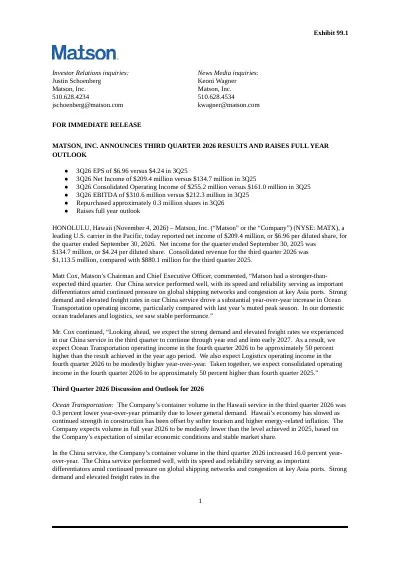
Lee, thanks, and thanks to those on the call. Starting on slide 3, Matson had a stronger than expected third quarter.
Our China service performed well, with its speed and reliability serving as important differentiators amid continued pressure on global shipping networks and congestion at key Asian ports. Strong demand and elevated freight rates in our China service drove a substantial year-over-year increase in ocean transportation operating income, particularly compared with last year's more muted peak season.
In our domestic ocean trade lanes and logistics, we saw stable performance. Looking ahead, we expect the strong demand and elevated freight rates we experienced in our China service in the third quarter to continue through year-end and into early 2027.
As a result, we expect consolidated operating income in the fourth quarter 2026 to be approximately 50% higher than the result achieved in the fourth quarter of 2025. Joel will go into more detail on the outlook later in the presentation.
I'll now go through the third quarter performance of our ocean trade lanes, SSAT, and logistics, please turn to the next slide. In our Hawaii service, container volume in the third quarter decreased 0.3% year-over-year, primarily due to lower general demand.
For the full year 2026, we expect volume to be modestly lower than the level achieved in 2025, based on our expectations of similar economic conditions as 2025 and stable market share. Please turn to slide 5.
According to UHERO's third quarter 2026 economic report, Hawaii's economy has slowed, as continued strength in construction has been offset by softer tourism and higher energy-related inflation. Tourism has been impacted by rising jet fuel prices as well as several significant storms in the quarter, with UHERO forecasting a return to modest visitor growth arrivals in 2027 and 2028.
Moving to our China service on slide 6, container volume in the third quarter increased 16% year-over-year compared with a muted peak season last year. Please turn to slide 7 for additional commentary on our current business trends.
Freight demand progressively strengthened over the course of the third quarter, reflected a combination of peak season activity and stronger demand across primarily e-commerce, garments, and e-goods customers. E-commerce demand was particularly strong as customers filled inventory in advance of the holiday season.
At the same time, weather-related disruptions, blank sailings, and port congestion at key ports in Asia constrained effective transpacific trade lane capacity, contributing to elevated demand for our China service. Our speed and reliability served as important differentiators during this period of increased pressure on global shipping networks.
Together, the combination of strong freight demand and constrained transpacific capacity created a favorable rate environment, with freight rates remaining elevated throughout the quarter. Please turn to the next slide.
The peak season strength from the third quarter has extended through October and is lasting longer than expected. In October, we experienced continued strong demand from our e-commerce customers, driven by the resumption of cargo flows after Golden Week and late-stage inventory builds ahead of Black Friday, Cyber Monday.
Air freight capacity was also tight entering the fourth quarter, with elevated demand from AI-related products as well as ocean recovery shipments due to the weather-related disruption and port congestion. We expect the air cargo market to remain tight through year-end.
Meanwhile, the effective transpacific trade lane capacity remained constrained in October as carriers worked through lingering weather-related disruptions, blank sailings, and accumulated cargo backlogs, even as port congestion at some key Asia ports began to ease. As the carriers are in the process of recovering, they continue to address the elevated demand and disruption issues with temporary measures, such as extra loader sailings and selective schedule adjustments.
Additionally, we've observed that the global network carriers have been aligning vessel capacity with market demand levels. Please turn to slide 9.
The favorable market conditions we experienced in October are expected to remain through quarter-end and into early 2027. We expect freight demand to remain strong across all our key verticals, especially e-commerce.
Given the favorable market environment, we expect strong freight demand for Matson's China service, with freight rates remaining elevated. We also expect our China service volume in full year 2026 to exceed 2025 levels, with our ships full or nearly full throughout the fourth quarter.
As a result, we expect ocean transportation operating income in the fourth quarter to be approximately 50% higher than the results achieved in the year-ago period. Please turn to the next slide.
In Guam, Matson's container volume in the third quarter increased 4.3% year-over-year. In the near term, we expect Guam's economy to remain stable.
For the full year 2026, we expect volume to be modestly higher than the level achieved last year. Please turn to the next slide.
In Alaska, Matson's container volume in the third quarter decreased 4.8% year-over-year. The decrease was primarily due to lower southbound seafood volume and an additional northbound sailing in the year-ago period.
In the near term, we expect Alaska's economy to remain stable, supported by a low unemployment rate, a steady job market, and continued oil and gas exploration and production activity. For the full year 2026, we expect volume to be modestly lower than the level achieved last year.
Please turn to slide 12. In the third quarter, our SSAT terminal joint venture contributed $7.4 million, representing a year-over-year decrease of $1.9 million.
The decrease was primarily due to lower lift volume. For the full year 2026, we expect the contribution from SSAT to be lower than the $32.5 million achieved in the full year 2025.
Turning now to logistics on slide 13, operating income in the third quarter came in at $16.1 million, or $2.5 million higher than the result achieved in the year-ago period. The increase was primarily due to higher contributions from transportation brokerage and freight forwarding, partially offset by a lower contribution from warehousing.
For the fourth quarter 2026, we expect logistics operating income to be modestly higher than the level achieved last year. I will now turn the call over to Joel for a review of our financial performance.
Joel?
Joel Wine
Thanks, Matt. Please turn to slide 16 for a review of our third quarter results.
For the third quarter, consolidated operating income increased $94.2 million year-over-year to $255.2 million, with higher contributions from ocean transportation and logistics of $91.7 million and $2.5 million, respectively. The increase in ocean transportation operating income was primarily due to a higher contribution from our China service and a higher fuel-related surcharge revenue, partially offset by higher vessel operating expense, primarily due to higher fuel-related costs.
As Matt noted, the increase in logistics operating income was primarily due to higher contributions from transportation brokerage and freight forwarding, partially offset by a lower contribution from warehousing. We had interest income of $5.1 million in the quarter compared to $7.6 million in the same period last year.
The decrease was due to a reduction in the CCF balance in the last 12 months as construction milestones on our new Aloha Class vessels have been achieved. Net income increased 55.5% year-over-year to $209.4 million, and diluted earnings per share increased 64.2% year-over-year to $6.96 per share.
Lastly, diluted weighted average shares outstanding decreased 5.3% year-over-year. Please turn to the next slide.
We continue to generate strong cash flows. For the trailing 12 months, we generated cash flow from operations of $637.5 million.
We returned capital in the form of dividends and share repurchases of $302.2 million, and we had maintenance CapEx of $129.6 million. Our cash flow from operations exceeded the aggregate spend on maintenance CapEx, dividends, and share repurchases by $205.7 million.
Please turn to slide 16 for a summary of our share repurchase program and balance sheet. During the third quarter, we repurchased approximately 0.3 million shares for a total cost of $59.8 million.
Year-to-date, we repurchased nearly 1 million shares for a total cost of $182 million. Since we initiated our share repurchase program in August of 2021 through September of this year, we have repurchased approximately 14.9 million shares, or approximately 34% of our stock, for a total cost of approximately $1.4 billion.
Turning to our debt levels, our total debt at the end of the third quarter was $331.2 million, a reduction of $10.1 million from the end of the second quarter. With that, let me now turn to slide 17 and walk through our outlook, starting with the fourth quarter of 2026 at the top of the page.
Based on the outlook trends Matt mentioned earlier, we expect ocean transportation operating income in the fourth quarter to be approximately 50% higher than the $136 million achieved in the fourth quarter of 2025. For logistics, we expect operating income in the fourth quarter to be modestly higher than the $7.7 million achieved in the fourth quarter of 2025.
Taken together, we expect consolidated operating income in the fourth quarter to be approximately 50% higher than the prior year. We also expect an effective tax rate of approximately 20% in the fourth quarter of 2026 compared to last year's 5.2%, which benefited from a one-time tax adjustment of $18.5 million, or 59 cents per share, related to the company's deferred tax assets and liabilities.
In addition to our outlook for the upcoming quarter, we expect the following for the full year: depreciation and amortization to approximate $205 million, including approximately $35 million in dry-docking amortization; interest income to be approximately $20 million and interest expense to be approximately $6 million; other income to be approximately $10 million; and dry-docking payments of approximately $45 million. Moving to slide 18, the table shows our capital expenditure projections for the full year 2026.
For the full year 2026, we expect vessel construction milestone payments and related costs of $375 million. We expect maintenance and other capital expenditures of $130 million for the full year.
This is approximately $30 million lower than the midpoint of the range we previously provided due to the timing of capital spending on several projects and new equipment deliveries slipping into 2027. In total, we expect capital expenditures of approximately $505 million for the full year.
In the third quarter, we paid approximately $50 million in milestone payments from our Capital Construction Fund. Looking ahead, we expect to make approximately $110 million in remaining milestone payments in the fourth quarter, and approximately $197 million in 2027, and approximately $25 million in 2028 and beyond, for a total of approximately $332 million in remaining payments.
As of September 30, 2026, we had cash and cash equivalents of approximately $222 million and approximately $299 million in our Capital Construction Fund. Our CCF covers approximately 90% of our remaining milestone payment obligations, and when combined with our balance sheet cash, exceeds our remaining milestone payments.
Therefore, we continue to be in a strong funding position on the newbuild program. Please turn to the next slide.
Our targeted delivery schedule for the new Aloha Class vessels remains unchanged. In October, we held a christening of our first new Aloha Class vessel, Makua.
We continue to expect delivery of Makua in the first quarter of 2027. Our second and third new Aloha Class vessels remain on schedule for delivery in the third quarter of 2027 and second quarter of 2028.
With the delivery of the first vessel within sight, we are updating our estimate of the incremental container capacity from the new Aloha Class vessels in the China service. Based on the current CLX fleet configuration and expected mix of freight from China, we now expect the three vessels in aggregate to provide incremental annual capacity of approximately 12,000 containers.
This is lower than our original estimate of approximately 500 containers for each vessel, or 15,000 containers annually, because we expanded our weekly capacity by moving the larger Kanaloa Class vessels into the CLX service to meet market demand. As we mentioned on our prior call, Makua is expected to be in service during next year's peak season, but the second vessel, Malama, is expected to be in service after the 2027 peak season.
With that, let me now turn the call back over to Matt for closing remarks.
Matt Cox
Thanks, Joel. Please turn to slide 20, where I'll go through some closing thoughts.
We delivered strong financial results through the first three quarters of 2026. We expect strong demand in our China service through year-end and into early 2027, with freight rates remaining elevated.
We observed the following as we're nearing the end of 2026 and beginning to think about 2027: the US economy remains resilient, although we expect some moderation in growth, with consumer spending continuing to support economic activity; fundamentals across the US transportation and logistics sector are expected to continue improving; and e-commerce is expected to continue growing, supporting demand in our China service. While some of the current capacity constraint in the transpacific trade lane may normalize, the demand trends we're seeing, combined with Matson's differentiated China service, support a constructive outlook as we enter 2027.
We'll provide more information on our outlook for 2027 on our fourth quarter earnings call. The current environment reinforces the importance of speed and reliability to our value proposition.
Our ongoing investments in our network, fleet, and operations support our ability to deliver on those commitments, particularly when supply chain networks are under pressure. While current demand and capacity conditions are favorable, we recognize they may change.
We remain nimble in responding to near-term market conditions while maintaining a disciplined long-term approach to investment and operational decisions. Regardless of market condition, our focus remains on reliable execution, operational discipline, and delivering the high service standards our customers expect.
With that, I will turn the call back to the operator and ask for your questions. Thanks.
Operator
Certainly. Ladies and gentlemen, if you do have a question at this time, please press *11 on your telephone.
If your question has been answered and you'd like to remove yourself from the queue, simply press *11 again. Our first question for today comes from the line of Jacob Lacks from Wolfe Research.
Your question, please.
Jacob Lacks
Hey, Matt. Hey, Joel.
Thanks for your time.
Matt Cox
Sure, Jake. Sure.
Jacob Lacks
How do you think about expedited ocean pricing into next year, just given the context of broader ocean capacity set to come to the market through both deliveries and the Red Sea sailings? Maybe just a sword tack onto that, there were some reports about one of your competitors adding another expedited string starting in December.
Does this change how you think about pricing discipline into expedited market, or is it more reflective of just the environment that we're in today? Thanks.
Matt Cox
Thanks for the question. Let me answer it indirectly, but briefly.
I think the way that we see and believe the market has developed is within the expedited segment, we consider ourselves, our CLX and our MAX service, the premier go-to expedited carrier. Then there's a second tier which are the second-tier expedited carriers, and those are primarily companies like ZIM, like Hede, like CMA, who also offer their own services, which are not as fast and not as reliable and not as good, but are still yet faster than the more generic ocean services.
The way we think about it is that—and you've heard us say this before, Jake, but our premise is simple: if we can be the fastest and second-fastest two services in the world, we're going to get an outsized portion of the expedited market. We typically see with this year, given how strong demand was in the third quarter and going into the fourth quarter, customers will come to us first.
Only when we can't carry that cargo, because we're multiple times oversubscribed, do these cargoes flow into these other second-tier expedited carriers. Typically our rates are priced where we set them that we think are appropriate, and then the other second-tier expedited market will price somewhere between the generic ocean capacity and our rates, and that's kind of how the market has shaken itself out.
We continue to expect strong demand for our services as we move—we saw it strongly this year. We don't expect anything effectively to change those fundamental dynamics.
To get to your second part of your question, when we see ZIM, who's introduced a third service, is actually reintroducing a third service that they've had before. All of the second-tier expedited carriers don't have their own effective terminals, they have limited chassis abilities, and so I would say we keep an eye on them, but it doesn't inform our own pricing strategy, nor do we think it really affects our ability to pick up the cargo that we think we need.
We think that will remain unchanged. Anyway, maybe I've overanswered your question, but that's how we think about it.
Jacob Lacks
No, that's really helpful. Then turning to the demand side, do you have a ballpark estimate for what portion of your China volumes are directly tied to data center?
Then more indirectly, do you hear other customers getting squeezed out of the air freight market just with hyperscaler demand?
Matt Cox
I would say there are really two factors. I think the majority of the AI and data center demand still uses air freight.
I think on the margin, what we've seen is that that demand has pushed some other commodities out of the air. E-commerce is a good example of that.
E-commerce happens to be our largest segment of carriage, followed by our traditional garments, and then electronics. Within electronics, the data center movement that we're carrying on our ship, we consider a subset of our overall electronics, but those include lots of components that are traditional electronics and not data center-specific.
There's also an indirect segment not directly related to data center, but it's related to electricity generation and plumbing and other fixtures. Depending on how you define the category of data center, there's quite a bit of cargo moving.
To answer your question, we do see AI data center commodities or materials that are flowing through our network. The majority continue to flow through air freight.
I would say at this point, it's an important part of our third-largest component, but it's measured in its size, I guess is the way I'd answer that.
Jacob Lacks
That's helpful. Then just one on the guide as it relates to the sequential earnings decline implied in your guidance.
Is there any slowdown in late 4Q that you're assuming in China, or is this all just seasonality as it relates to the Jones Act trades?
Joel Wine
It's more the latter, Jake. We expect that the strength, as we talked about, in the China trade to continue through the end of the year, it's normal seasonality across the rest of the different business lines.
Jacob Lacks
All right, thanks for your time.
Joel Wine
Thank you.
Matt Cox
Thanks, Jake.
Operator
Thank you. Our next question comes from the line of Reed Seay from Stephens Inc.
Your question, please. ):
Reed Seay
Hey, guys, thanks for taking my questions. I'll start off on the fuel side since that is topical right now.
To the extent that you can help us out here, you mentioned both fuel helping out on the revenue side, fuel hurting on the operating expense side. Is there any way you could give us some framing of whether that was a positive or a negative in the quarter on the ocean side, and if you're willing to, maybe give us what that would do to margins as well, if it was positive?
Joel Wine
Sure, Reed. As a backdrop, virtually this year, fuel has obviously been quite volatile.
We've always talked about how, on an annual basis, our fuel surcharge collections and our fuel costs really offset. On an annual basis, there's really very minimal impact on a year-over-year basis.
This year was different because of the volatility, and so we did comment at the end of the last quarter, therefore through the first six months of this year, we were behind a little bit on our overall collections, and it was in the low low teens, low double-digit numbers on a year-over-year basis, and relative to what we expect to therefore be on a year on a full-year basis. That was the backdrop on June 30th, and the answer, Reed, is that we more or less collected all of that in in the quarter itself by September 30th.
The quarter itself had a little bit of favorable, more so than you normally see relative to the year before, but we're now neutral, and where we expect to be by the end of the year. Overall, it shouldn't have an impact on our full-year guide, and the impact to answer your questions on margins and all that is is not is not great in aggregate on a on an annual basis.
):
Reed Seay
Got it. Very helpful.
Then if we can get an update on the mix of the China volumes that are coming from the broader catchment basin as opposed to directly from China, just so we have a feel for what that mix looks like within that container number?
Matt Cox
Sure, happy to do that. We said at the end of the second quarter, we were in the 20% to 25% of our total lift was coming out of Southeast Asia, primarily Vietnam, but also Cambodia and Thailand, and to a lesser extent, the Philippines and Malaysia.
That percentage did not change significantly in the third quarter, and we're at a point now where, given the current geopolitical and our commercial objectives, we think that's a pretty good percentage that we would use moving forward. Obviously these are important locations, and in many cases, these are where our long-time customers continue to migrate their operating locations and assembly locations, and so we're going to be moving with our customers, who've asked us, given our larger network, to continue to carry their cargo, it remains important.
China also remains important. We don't really have a target with respect to do we want to get to this percentage or that percentage.
We think it was really important from our perspective to move with our customers to reduce somewhat our concentration of China-only lift, given the political considerations. We like where we are now, and we'll continue to move as our customer cargo moves.
I wouldn't expect moving forward unless geopolitically or economically or something else were changed, that we're going to be much off of that. While I would say we continue to see steady progress in Thailand and other locations where we extend with our partners, where we can make a significant improvement over the ocean carriage from more traditional ocean carriers, but we feel like we're about where we want to be subject in this current environment.
):
Reed Seay
Understood. Then lastly on capital allocation, you've been maybe a little more vocal lately on openness to doing some mostly within the logistics segment.
Is this something that we should expect that you're looking at now, or would this be once you've kind of digested the delivery of the new ships and you start to move on to the next thing? Just how should we think about that in terms of cadence?
Joel Wine
Reed, thanks for asking that question, because what we try to communicate is that we've been continuously looking for acquisition opportunities in the logistics landscape. Even though we haven't announced a deal in many years, it doesn't mean we haven't been looking, and that pursuit hasn't really gone up or gone down.
It's been steady. We have our criteria.
We really try to stay disciplined on what fits our model and what kind of businesses we'd like to acquire, as well as the price to pay. I would say we really haven't done more or less in that area over the last couple years based on any kind of performance or even going through COVID.
Therefore, and also, I'd say next year with respect to the vessel deliveries, we feel great about our balance sheet. Everything's prefunded, there's no real timing element to the way we think about that.
It's really opportunities that fit our criteria that we can get at an appropriate price, and when all that happens, we'll pull the trigger, and we're ready to execute, and our logistics team would be ready to execute if the stars aligned for that. Thanks for asking that question, and let me just clarify that we're always looking, even though we necessarily haven't found something.
Matt Cox
Reed, this is Matt. I would add to Joel's comment, we continue to feel good about looking for organic growth opportunities throughout our network.
We continue to look at growing in Mexico. We're growing in the Western Pacific as the US government invests more in that region of the world, for which we have a longstanding business.
We're continuing to look for opportunities in Alaska, in the oil and gas sectors. There are a number of organic initiatives we don't talk about, and they produce steady returns, incremental returns in the businesses.
We do have businesses, and we find organic growth to be inherently less risky than a large acquisition, although as Joel said correctly, we continue to be on the lookout for a good business that is acquired at the right price that fits a cultural and strategic initiative. We're on the look, but in the meantime, we're continuing to deploy capital in organic ways.
Thanks. ):
Reed Seay
Got it. I would agree on the organic front.
Thanks, Matt. Thanks, Joel.
Joel Wine
Thanks, Reed.
Matt Cox
Thanks, Reed.
Operator
Thank you. Our next question comes from the line of Tomohiko Sano from JP Morgan.
Your question, please.
Tomohiko Sano
Hi, hello, everyone.
Matt Cox
Hi, Tomo.
Joel Wine
Hi, Tomo.
Tomohiko Sano
Thank you. Looking ahead to 2027 for China service trends, could you give us more color on how you're distinguishing underlying demand strength from temporary factors, such as port congestions and capacity disruptions?
Matt Cox
Yes. We hinted at that, Tomo, in some of our prepared comments, but there are two things we observed that, because likely of El Niño, there were much more significant numbers of named storms in the Pacific this year, and larger, causing disruption to really much of Asia in various ways and causing commercial disruptions there, and also indirectly with the Panama Canal drought and draft limitations caused by what we think is still connected to that El Niño.
Some of that El Niño phenomena is expected to last into calendar 2027, but there are other factors that will likely be changing on the macro demand front, including a new large container ships that are going to be delivered that are on order for the international ocean carriers, potential normalization of the Red Sea, other political factors that will impact global supply and demand and also transpacific supply and demand. We observe where those go, but we also feel really confident in our core premise, which are electronics, the continued growth of e-commerce.
We think the data center element is got three to five years of legs in some way, both absorbing international air cargo and also in support of our expedited model. I think when we look at it, we continue to be focused on the consumer and the economy as fundamental drivers of demand for consumer goods and other electronics, for which we carry a large percentage.
It's at this early stage, it's a little hard to separate. We do acknowledge that at least some of the factors that have been favorable are ones that could be considered temporary, but we keep looking for the new normal, and we haven't found it.
That is, there are other congestion, other elements. Supply chains have become more bifurcated and regionalized, and it really underlines in our minds, and when we talk to our customers, the importance that our customers place on our reliability as a trusted supply chain partner.
Some of it will likely change, but that fundamental activity, we remain very confident about.
Tomohiko Sano
Very helpful. Thank you.
Maybe just one more on logistics side. Logistics delivered strong revenue growth in the third quarter, but its operating margin was lower year-over-year.
Where do you see the greatest opportunity to translate revenue growth into stronger profit growth here?
Joel Wine
Tomo, I'll take that one. The margin compression came a little bit really because of our warehousing business, which is the one segment that was down.
The other businesses actually have experienced good, strong margin improvement on a consecutive basis and also on a year-over-year basis. To answer your question in terms of the future, we continue to feel really, really good about our freight forwarding, Span Alaska business, well-positioned in the market, excellent operating team and assets, we think there's continued margin potential there.
Our transportation brokerage business, with the market turning a little bit here, both for truckload brokerage and intermodal brokerage, and have a little bit better supply-demand characteristics broadly for the brokerage universe, as well as our focus on enduring value-added small, medium-sized customers, we feel good about the margin potential, sustainability there on that business, too. Then the third business, the supply chain business that we talk about, really a significant piece of that is tied into our transpacific ocean piece as well, there's continued growth and margin potential there.
We feel really good about all of them. We feel like the warehousing business is going to go through a little bit of reset period and then continue on a growth, profitability trajectory from here.
That gives you a little bit of color on each of the sub-businesses.
Tomohiko Sano
Great. Congrats on the quarter.
Mahalo.
Matt Cox
Thanks, Tomo.
Joel Wine
Thanks, Tomo.
Operator
Thank you. This does conclude the question-and-answer session of today's program.
I'd like to hand the program back to Matt Cox for any further remarks.
Matt Cox
Thanks for your attention today. Wish everyone a safe and enjoyable holiday period, and we'll look forward to connecting with you into the new year.
Aloha.
Operator
Thank you, ladies and gentlemen, for your participation in today's conference. This does conclude the program.
You may now disconnect. Good day.