Mayville Engineering Company, Inc.
NNYSE:MECQ4 FY2025 · Earnings Call TranscriptMarch 4, 2026
Operator
Hello everyone, and thank you for joining us today for the Mayville Engineering Company fourth quarter and full year 2025 results conference call. My name is Sammy, and I will be coordinating your call today.
During the presentation, you can register a question by pressing star followed by 1 on your telephone keypad. If you change your mind, please press star followed by 2 on your telephone keypad to remove yourself from the question queue.
I would now like to hand over to your host, Stefan Neely with Neely Advisors to begin. Please go ahead, Stefan.
Stephen Neely
Thank you, operator. On behalf of our entire team, I'd like to welcome you to our fourth quarter and full year 2025 results conference call.
Leading the call today is MEC's President and CEO, Jag Reddy, and Rachele Lehr, Chief Financial Officer. Today's discussion contains forward-looking statements about future business and financial expectations.
Actual results may differ significantly from those projected in today's forward-looking statements due to various risks and uncertainties, including the risks described in our periodic reports filed with the Securities and Exchange Commission. Except as required by law, we undertake no obligation to update our forward-looking statements.
Further, this call will include the discussion of certain non-GAAP financial measures. Reconciliation of these measures to the closest GAAP financial measure is included in our quarterly earnings press release, which is available at mecinc.com.
Following our prepared remarks, we will open the line for questions. With that, I would like to turn the call over to Jag.
Jagadeesh A. Reddy
Thank you, Stefan, and good morning, everyone. The fourth quarter represented a transitional period for MEC.
While demand in our legacy end markets remained muted during what is typically a seasonally softer quarter, our team remained focused on positioning the business for successful execution and growth as we enter 2026. Over the past six months, we have experienced robust and sustained demand momentum within our data center and critical power end market.
In response, we have proactively reallocated available capacity and resources to support successful project launches and meet the evolving needs of our OEM customers in this market. As a result of these actions, our fourth quarter margin performance was pressured.
We incurred and retained costs that would typically be flexed with softer demand, reflecting deliberate investments to support program readiness and execution. Importantly, this margin pressure is primarily driven by early-stage project inefficiencies and project launch costs as we prepare for higher volume programs rather than pricing or structural cost challenges.
As these programs ramp and utilization improves, we expect margins to normalize in line with our long-term expectations. These margin dynamics are transitory in nature and importantly, position MEC to deliver profitable growth in 2026 and beyond as we capture demand in the rapidly expanding data center and critical power market.
In addition, we remain focused on executing our MBX operational excellence framework, driving disciplined process improvements across our plants. We're also advancing initiatives to optimize and rationalize our manufacturing footprint, which we expect will further enhance operating leverage as end market demand recovers.
Now, turning to a review of our key markets and their respective end market outlooks. Starting with commercial vehicle, we continued to see softness with net sales to this end market declining approximately 19% versus the prior year period.
In their most recent report, ACT has revised its full year 2026 outlook upwards, now projecting a 3.4% increase in Class 8 production in 2026. This improved outlook reflects greater clarity surrounding the 2027 EPA emissions standards, resulting in anticipated pre-buy activity and improved macroeconomic conditions.
In contrast, our construction and access market revenues increased approximately 13% year-over-year during the quarter. This is supported by the Accu-Fab acquisition and strong nonresidential activity.
Organic net sales growth in this market were approximately 11% in the quarter. In the power sports market, net sales grew approximately 20% year-over-year driven by the impact of incremental volumes from new business wins and stabilized customer production schedules as dealer inventory levels are now in line with current demand.
This was partially offset by a decrease in sales within the marine propulsion market. Net sales in our agriculture market were approximately flat year-over-year amid signs that demand is reaching a cyclical trough.
Within our data center and critical power end market, our business saw growth of approximately 13% year-over-year supported by legacy OEM demand growth and early project launches on Accu-Fab related cross-selling opportunities. Overall, demand from OEM customers in the data center and critical power market remains strong.
Our qualified opportunity pipeline now exceeds $125 million, and the value of projects scheduled to launch in 2026 is approximately $40 million to $50 million. Combined with organic growth from our legacy OEM customers, we expect data center and critical power to represent more than 20% of our revenues in 2026.
Looking ahead, we expect this end market to remain a consistent growth opportunity for MEC. Based on recent market studies, we estimate our serviceable addressable market to range from $115 million to $185 million per gigawatt of new data center capacity installed.
Given the number of new data centers expected to come online in the US in 2026, this represents a total market opportunity of approximately $3.2 billion. We expect this market to grow at a compound annual rate of approximately 16% from 2026 through 2030.
Please note these estimations exclude server racking opportunities, which represents additional incremental upside. While we will continue to take a balanced approach to allocating capacity to this end market, the robust demand growth allows us to proactively manage our commitments.
This approach ensures us to maximize footprint utilization, deliver consistent profitable growth through the cycle, and continue to invest in growth initiatives that unlock long-term value. Before turning the call over to Rachele, I want to highlight several areas of commercial momentum that gives us confidence in our growth trajectory for 2026 and beyond.
Across all of our end markets, customer engagement and bidding activity remains strong. During the fourth quarter, we secured approximately $15 million in new project awards with data center and critical power customers.
Year-to-date total awards across our legacy markets were more than $108 million, exceeding our annual target of $100 million. Looking ahead to 2026, we expect total bookings across our end markets to be approximately $140 million, supporting profitable growth as our legacy markets move toward a cyclical recovery exiting 2026.
Within our legacy end markets, we have continued to expand our share with our commercial vehicle customers as they launch new products heading into the 2027 EPA regulation changes. These products support future growth and are scheduled to begin production in late 2026 and 2027.
In addition to the future expansion in commercial vehicle revenues, we secured new agriculture business on new model introductions and additional service business for a military customer. Within the data center and critical power market, the approximately $15 million of awards secured in the fourth quarter were primarily driven by demand from major Accu-Fab customers.
These substantial scopes of work span power distribution units, static transfer switches, busway components, and data center cooling. Turning to capital allocation, we closed 2025 with strong free cash flow generation.
While we expect free cash flow to be softer in the first quarter, we continue to anticipate full year free cash flow conversion of approximately 50% to 60% of adjusted EBITDA. As we progress through the year, our primary use of free cash flow will remain focused on debt reduction.
As we progress toward our long-term target of 2.5 times leverage, we expect to become increasingly opportunistic in deploying capital towards M&A with an emphasis on further diversifying our end market exposure and supporting consistent profitable growth. In the meantime, our priority remains disciplined capital deployment, ensuring that growth investments are targeted, return-driven, and fully aligned with maintaining balance sheet strength.
With respect to guidance, to provide investors with greater visibility into our business trends, we are introducing quarterly financial guidance in addition to our full year outlook. This is due to the fast-moving data center and critical power environment and developing improvements within our legacy end markets.
Rachele will cover our guidance in more detail, but I would like to highlight a few key elements of our expectations for 2026. Inclusive of a full year of Accu-Fab and the associated data center and critical power cross-selling synergies we expect to realize in 2026, we anticipate full year net sales to increase relative to 2025 along with margin expansion and improved free cash flow.
These expectations assume an improvement of our legacy end markets primarily during the second half of the year. In summary, MEC is entering an important transitional year, one that is shaping the next phase of our growth and value creation.
While we are intentionally investing both capital and operating resources ahead of anticipated demand, we believe the foundation for sustainable growth and improved profitability is firmly in place. With disciplined execution and a clear strategic focus, we are well positioned to deliver long-term value for our shareholders and our customers.
With that, I would like to turn the call over to Rachele.
Rachele M. Lehr
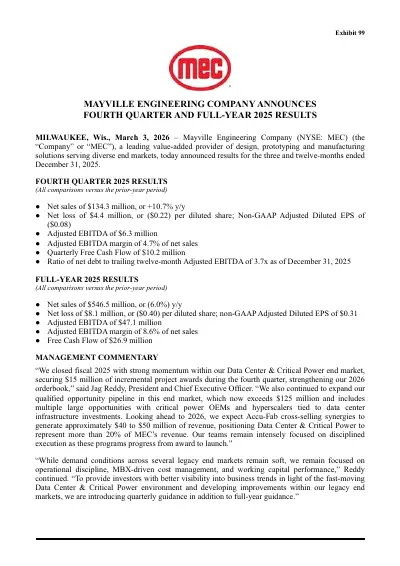
Thank you, Jag, and good morning, everyone. Total sales for the fourth quarter increased 10.7% on a year-over-year basis to $134.3 million.
Excluding the impact of the Accu-Fab acquisition, organic net sales declined by 5.3% compared to the prior year period. Our manufacturing margin rate was 6.6% for the fourth quarter of 2025 compared to 8.9% for the prior year period.
The decrease in our manufacturing margin rate was due to $1.2 million of data center and critical power related project launch costs and $1.7 million of early-stage project inefficiencies on a commercial vehicle project. This was partially offset by higher margin net sales contribution from the Accu-Fab acquisition.
Excluding these temporary launch phase dynamics, our manufacturing margin rate would have been approximately 9% during the quarter. Other selling, general, and administrative expenses were $9.7 million or 7.2% of net sales for the fourth quarter of 2025 as compared to $7.9 million or 6.5% of net sales for the same prior year period.
The increase in these expenses primarily reflects $0.2 million in nonrecurring costs and $1.1 million in incremental SG&A expense, each associated with the Accu-Fab acquisition. Interest expense was $3.8 million for the fourth quarter of 2025 as compared to $2 million in the prior year period.
The increase was driven by higher borrowings resulting from the Accu-Fab acquisition, partially offset by lower SOFR base rates relative to the prior year period. Adjusted EBITDA margin was 4.7% for the quarter compared to 7.6% in the prior year period.
The decrease reflects lower legacy market volumes and $2.9 million of project launch costs and early-stage project inefficiencies, partially offset by the benefit of the Accu-Fab acquisition. Excluding these items, adjusted EBITDA margin would have been approximately 7%.
Turning now to our cash flow and the balance sheet. Free cash flow during the fourth quarter of 2025 was $10.2 million as compared to $35.6 million in the prior year period.
The year-over-year decline primarily reflects the receipt of $25.5 million in settlement proceeds in the fourth quarter of last year related to a former fitness customer dispute. Excluding this item, free cash flow was approximately flat year-over-year.
During the fourth quarter, we used available free cash flow to repay approximately $10 million in debt, resulting in net debt at the end of the quarter of $205.3 million, up from $82.1 million at the end of the fourth quarter of 2024. Our increased debt resulted in a net leverage ratio of 3.7 times as of December 31st.
Now turning to a review of our 2026 financial guidance. As Jag previously mentioned, we are introducing quarterly guidance in addition to full year guidance.
For the first quarter of 2026, we currently expect net sales for the quarter of between $137 million and $143 million, and adjusted EBITDA of between $5 million to $7 million. Our first quarter outlook reflects continued project launch costs and margin pressure ahead of the majority of data center and critical power project ramps, which begin in the second quarter.
Additionally, free cash flow is expected to reflect normal seasonal working capital usage, incremental working capital investment to support the data center and critical power ramp-up, and planned capital expenditures of $3 million to $5 million. For the full year, we expect net sales of between $580 million and $620 million, adjusted EBITDA of between $50 million and $60 million, and free cash flow of between $25 million and $35 million.
This outlook reflects a full year of Accu-Fab ownership, $40 million to $50 million of incremental cross-selling revenue, and a gradual improvement in the legacy end market demand, primarily in the second half of the year. Additionally, embedded within our 2026 adjusted EBITDA guidance is $2 million to $3 million of cost improvements driven by our MBX operational excellence and strategic value-based pricing initiatives, net of inflationary pressures.
As it relates to free cash flow, we expect our free cash flow conversion for the full year to be between approximately 50% and 60% of adjusted EBITDA, coupled with full year capital expenditures to be between $15 million to $20 million. Given this outlook and our priority of repaying our debt, we expect to achieve a net leverage ratio of 3 times or lower by the end of 2026.
Again, 2026 will be a transitional year for us. We believe that our cost structure and working capital discipline will position us for profitable growth, strong free cash flow yield, and improved adjusted EBITDA margins as we enter a phase of cyclical recovery and growth across our legacy end markets, supported by elevated growth in our data center and critical power end market.
With that, operator, that concludes our prepared remarks. Please open the line for questions as we begin our question-and-answer session.
Operator
Thank you very much. To ask a question, please press star followed by 1 on your telephone keypad now.
If you change your mind, please press star followed by 2 on your telephone keypad to remove yourself from the question queue. When preparing to ask your question, please ensure your device is unmuted locally.
Our first question comes from Michael Shlisky from D.A. Davidson.
Your line is open, Michael. Please go ahead.
Jagadeesh A. Reddy
Morning, Michael.
Thank you. This is Linda for Mike.
Hi. My first question starting with commercial vehicle market in your remarks, Jag, you noted revised ACT outlook.
From the data we got overnight shows that Class 8 truck orders for February were one of the top 10 months of all time. Does this change your view on 2026, and do you think any of it pulled from 2027 orders if this is just an emission-related pre-buy?
Jagadeesh A. Reddy
Great question, Linda, and I was expecting that question this morning. I didn't see the ACT report until I got up this morning, right?
Obviously it's fresh off the press. I was not surprised by the increase in orders in February, but obviously we were surprised by the magnitude of increase of orders in February.
We have seen signals from our OEMs in the last month or so inquiring us and other suppliers about capacity, utilization, and we have seen signals from them of potential build rate increases. What I can tell you is we have not seen any of those signals translate into demand yet.
Having said that, again given this morning's news, we expect some of this demand to accelerate the build rate increases from our CV customers, and we expect that to start showing up in mid to late Q2. Usually for most suppliers, it's a six-week lead time, and hence we haven't seen that yet in our EDI feeds, but we do expect that.
With that in mind, we came into this call expecting approximately a 230,000 build rate. We'll have to wait and see if that estimate changes in the coming quarters.
That's one of the reasons why we came out with our quarterly guidance, which is new for us. These are fast-moving developments in our legacy end markets.
We're seeing similarly green shoots in construction and small ag as well. With all of that, we wanted to be more nimble not only internally, but also externally how we're communicating with our shareholders.
Great. I appreciate the color.
That's very helpful. Then switching to ag, we keep hearing about ag getting better, whether orders from John Deere or other suppliers getting a little more bullish.
Do you see any light at the end of the tunnel on that end market?
Jagadeesh A. Reddy
As some of our customers have indicated, large ag will still be down this year double digits. That is our customer forecast, what they have publicly communicated.
We are seeing signs of improvement in small ag, lawn care, turf, and forestry equipment. We do see some green shoots, as I mentioned, in the ag business.
Also I want to remind you that our ag business is close to 5% of our overall sales, as much as it used to be much larger piece of our business with our data center business and other end markets continuing to grow and ag continuing to stay down in the last 18 to 24 months. It is now a much smaller piece of our business.
Got it. Then yeah, my last question would be on critical power.
You mentioned some launch costs in critical power providing margin headwind in 2026. Do you think that would be complete by 2027, and what kind of margin tailwind might that be next year?
Rachele M. Lehr
Hey, Linda. This is Rachele.
Just as we look ahead into 2026, we really see that being ahead of the program launches, and we really expect and anticipate most of that to start taking place to be at full run rate at the end of the second quarter. We really expect to be at full run rate for the second half of the year.
We expect to incur more of those costs having the margin pressure in the first half. We do anticipate a little bit trailing into the second half of the year, but it's really going to be a first half impact.
Got it. Thank you so much.
Thank you for your time this morning.
Jagadeesh A. Reddy
Thank you, Linda.
Operator
Our next question comes from Greg Palm from Craig-Hallum. Your line is open, Greg.
Please go ahead.
Greg Palm
Yeah. Thanks.
Good morning, everybody.
Jagadeesh A. Reddy
Morning, Greg. Good
Rachele M. Lehr
morning.
Greg Palm
You incurred more costs and recognized lower margins than expected back from the November call. I guess looking back, what surprised you relative to that outlook, and then maybe you can just help unpack the EBITDA guide specifically for Q1 and maybe more specifically how that margin progression looks in sort of the Q2 to Q4 time period.
It sounded like there's going to be some costs that you incur in Q2, and those mostly trail off in the second half, just wanted to be sure we understood that right.
Jagadeesh A. Reddy
Let me start first, Greg. The headline really for us is we have won more business in data centers than we anticipated coming out of our November call.
We expect our Q1 we're not obviously talking about Q1 bookings here, but our Q1 bookings for data centers will be significantly higher than what we have seen in the second half of last year after the acquisition. In preparation for those launches, we're in the middle of many of those launches already for the business we have won in Q1.
We had to bring on significant resources online not only in December, but also in Q1 as we sit here. That's the primary reason why we were showing the margin profile that we're showing in Q1.
Rachele M. Lehr
I would add, our legacy business, we always had product launches, but we were doing that over 12 to 18 months, a much longer time, and we were able to do that. This business is 8 to 12 weeks, and so we've had to expedite that and really make investments.
We have a product launch team specific focus to this more than we've ever had before because of the speed and the intensity of which our customers are asking for things. Again, as Jag mentioned, this really did exceed our expectations in what we're winning.
When we first acquired this business, we've said, "Hey, it's going to be $1 [million?] to $2 million in cross-selling synergies in 2026," and here we now are at $40 [million?]
to $50 [million?] .
We've just had to invest more, and we're seeing that continue into Q1 Q1 and Q2, as a lot of these won't be at their full run rate until the end of the year. We want to nail it, and we want to make sure we hit it out of the park with these new customers in our locations.
Jagadeesh A. Reddy
We are retooling six of our legacy plants, MEC plants. That's a significant effort to put data center work, not only what we have won so far year-to-date and last year, but what we are anticipating in 2026, right?
It's great news obviously for rest of the year and long term that we're able to quickly convert six of our facilities for cross-selling synergies.
Greg Palm
That's great color. You already mentioned you're expecting that end market to represent more than 20% of revenue.
I'm just curious, as we sit here today, what kind of visibility do you have into that, call it $125 million revenue number if you want to use that? There's a sentence in the press release that talks about pipeline and multiple large opportunities.
Are these multiple large opportunities in that $125 million number or is that something separate?
Jagadeesh A. Reddy
I would say with very good confidence that we have good line of sight to that $120 million worth of data center business for the year. That's number one.
Number two, very little of the significantly large opportunities are in that qualified pipeline number we put out.
Greg Palm
Sorry, say that one more time?
Jagadeesh A. Reddy
Some of the significantly large opportunities that we are pursuing, it's 1 or 0, right? We didn't want to inflate our pipeline with those large opportunities, right?
When we talk about the $125 million of qualified pipeline, most of that is visibility and greater than 50% confidence that we could win those opportunities. We're excluding some significantly large opportunities in that qualified pipeline.
Greg Palm
Okay. Just to be clear, when you talk about expectations for the year, if you were to win more small business or win one or a few of these large, is that something that could translate into more revenue this year above and beyond that 120 number or what should we think of that more like a 2027 event?
Jagadeesh A. Reddy
It's possible, Greg, and hence our effort at quarterly guidance here. This is a fast-moving end market and though we laid out $40 [million?]
to $50 million of cross-selling synergies, our expectation is that if we continue to win at the existing win rates in this end market, right, there could be upside to that number.
Greg Palm
Perfect. All right, I will leave it there.
Thanks.
Jagadeesh A. Reddy
Thank you.
Operator
Our next question comes from Ross Sparenblek from William Blair. Your line is open, Ross.
Please go ahead.
Sam Carlo
Good morning, this is Sam Carlo on for Ross. Thanks for taking my question.
Jagadeesh A. Reddy
Hey, morning, Sam.
Sam Carlo
I guess maybe starting with Rachele, can you help us parse out some of the moving pieces within the EBITDA guidance? How should we build to just an $8 million year-over-year step-up considering 2026 includes a full year of Accu-Fab and an incremental $40 [million?]
to $50 million of margin-accretive cross-selling?
Rachele M. Lehr
Sure. I think there's a couple of things to take into account here.
One is our legacy business. The volumes continue to remain muted as we've budgeted today.
Now, of course, we just talked a little bit about what we learned on CV overnight that there's some upside there, but as we look through the year, our guidance is saying that we expect most of those to start to rebound sometime in the second half of the year. We have that pressure continuing on that piece of our business.
We have a high fixed costs, 55% of our costs are fixed, and so when we have that lower utilization, we really have ongoing underabsorption associated with that. The other piece is preparing for that legacy rebound where carrying some talent that we continue to hold on to because it is coming.
Then the third piece is those launch costs. We, like I said, really want to make sure we hit it out of the park.
The speed is faster. We're ramping up talent.
We're learning as we go with this, and it is exciting to see the growth that we have with that, but we really need to be focused on delivering that. First half is really pressured by the absorption, the launch costs, and then getting ready for the rebound.
Sam Carlo
Got it. Have you given kind of what those launch costs are expected to be for the full year, or just any sort of range there would be helpful?
Rachele M. Lehr
Not full year, but we expect the first quarter to be very similar with the fourth quarter of launch costs for data center, critical power, $1 [million?] to $1.5 million.
We expect that to taper down through each of the quarters of the year.
Sam Carlo
Got it. I guess switching gears then, the $40 [million?]
to $50 million of in-year revenue synergies sounds like that's back-half loaded. It seems like that implies a pretty healthy exit rate exiting '26.
I don't know if you could kind of help us size that ramp and kind of what that means as we enter 2027 of the business you guys have already won?
Rachele M. Lehr
I think we're saying for 2026, data center and critical power could be 20% of our total business, so that's significant. The adjusted EBITDA margins on that business are between 20% and 22%.
When you take that into account knowing that the majority of that 40 to 50 is going to come in the second half of the year, we will be exiting with margins in excess of our historical. If our historical business continues to come up, that will only additionally be upside.
Sam Carlo
Okay. From a revenue perspective then, if we say call it $20 million in the third quarter, $20 million in the fourth quarter, something like that, that implies an exit rate of call it $80 million.
Is that the right way we should be thinking about it into 2027?
Jagadeesh A. Reddy
I think that's a pretty good assumption, Sam.
Sam Carlo
Got it. That's what I thought.
That's helpful. I will leave it there.
Thanks, guys.
Jagadeesh A. Reddy
Thank you.
Operator
Our next question comes from Andrew Kaplowitz from Citi. Your line is open, Andrew.
Please go ahead.
Hi, good morning. This is Natalia on behalf of Andy Kaplowitz.
Jagadeesh A. Reddy
Morning, Natalia.
Maybe just first question on data centers, right? As data centers and critical power segments grows and it represents more than 20% of revenue, should investors expect more customer concentration to increase as well, or is the opportunity pipeline diversified across multiple customers within that end market?
Jagadeesh A. Reddy
Within that end market, it's reasonably diversified. Not only we're working with some of the blue-chip names in the critical power end market, we also are working with the next tier of OEMs within that end market.
I don't expect a significant concentration in that end market for us.
Got it, that's helpful. Then just maybe switching over to your construction and access end market and then the recovery as well.
You're expecting a modest recovery driven by infrastructure spending and potential rate cuts, but are you already seeing early signs of improvement in customer order patterns or conversations, or is that recovery more of a second-half expectations at this point of time?
Jagadeesh A. Reddy
In the construction portion of that end market, we are already seeing the build rates increasing. You have seen public comments from our customers that are bringing back capacity online, bringing back employees online, right?
We're seeing that already hitting our demand and EDI rates. In access, there were some starts and stops, if you will, with particularly the rental houses increasing their demand in Q4, but then some softer commentary from our customers on the access side of the end market.
We'll have to wait and see and watch and how access develops, but in general, we are positive on the construction and access end market.
Great, thank you. Appreciate it.
That's all on my end.
Jagadeesh A. Reddy
Thank you.
Operator
Our next question comes from Ted Jackson from Northland Securities. Your line is open, Ted.
Please go ahead.
Ted Jackson
Thanks. Appreciate it.
I came in with 10 questions to ask and checked every one of them off. [laughter] So, anyway, here's a couple for you, Jag.
With regards to the 20% of revenue for '26 that could be coming from data center and power, are you going to be turning down any legacy business to be able to ramp and hit that, or is that just on top of what's going on within the footprint that you have for a lot of your legacy businesses? Then going even a little further, it's if we do see a stronger turnaround in say commercial vehicles, which my personal opinion is that we will, what precludes you from being able to get any additional business?
I've got a couple more behind that.
Jagadeesh A. Reddy
At this stage, Ted, we believe we have enough capacity to be able to ramp up data center business while we see improved run rates within our legacy business. It's not a question for 2026, I believe.
It's really for us to figure out a way to continue to expand our capacity as we go into 2027. Our teams have been working feverishly for the last couple of quarters using our MBX framework to increase throughput, increase productivity.
We're bringing on additional shifts in some of our plants. We're hiring more employees in some of our locations.
We're planning accordingly, and at this point, we're not going to have to turn down any of our legacy customer business. That's something that we will continue to watch.
It also presents us some choices as we're going to 2027, not necessarily for capacity reasons, but perhaps for margin and pricing reasons, right? We will continue to evaluate those opportunities as we're going to 2027.
Ted Jackson
Adding shifts is interesting to me, and obvious employees too. That I recall in the past, some of your locations you only were running at one shift and I'd say adding additional shifts was kind of difficult because of labor constraints.
Where are you in terms of kind of current utilization? Where are you in terms of kind of adding production shifts and what are some of the hurdles that you're having to overcome to make that happen?
Jagadeesh A. Reddy
Without the two Accu-Fab facilities, right, if you exclude them for a second, I would say we're still around 55% on a 24/7 equipment capacity basis. Right, so as we ramp up some of these volumes in our legacy factories, we're looking at automation, we're looking at extending our shift schedules.
Not all, but many of our plants coming out of COVID went to a two 10-hour shifts for four days a week, right? That's 20 hours a day, four days.
What we're doing is standardizing our shift schedules across the company. Now we're going to a three shifts three eight-hour shifts, five days a week.
That's one way we can immediately increase our run capacity in these plants. We're looking at automation, as I mentioned, we're looking at weekend shifts, we're looking at third shifts in some of our plants.
It's a mix of different strategies we're employing depending on where we see capacity needed and then where we see demand coming in.
Ted Jackson
Okay. Going over to when you talk about having to put resources to ramp up and hurting margins, we're kind of dancing around all this stuff.
It's people, more labor cost. What other things go into the resources needed to position yourself to capture this growth that's impacting margins beyond obviously
Jagadeesh A. Reddy
labor
Ted Jackson
and additional shifts?
Jagadeesh A. Reddy
Right. As we mentioned earlier, right?
Our traditional program launches would have taken 6 to 18 months in many cases. Now we're having to launch these new programs on a 6 to 12-week basis.
I'll give an example. We have one data center customer that in January came to us and then essentially quadrupled their demand for one of the product lines we used to make in Raleigh.
We had to ship that product line to Defiance, Ohio, one of our traditionally commercial truck plants, and we went in full force. I was part of a 15-member kaizen team.
I was on the plant floor for full week figuring out how do we quadruple our output through that plant for that customer. We're rethinking how do we assemble components, we're rethinking how do we do product flow through the factories, we're rethinking logistics, right?
We're having to rethink everything from scratch than what we used to do in any of our previous operations, right? That needs project management resources, that needs engineering resources, that needs MBX resources.
All of this, we're trying to do this at six different locations, as I just mentioned, right, as we ramp up data center work, right? That's initial investments we're making.
We're obviously having to put in some additional capital to improve productivity. We have most of the capital needed to produce these parts, but sometimes additional capital, new type of machines or automation, improves throughput and productivity, right?
We're also thinking about how do we get more volume out of our factories as well for these customers. Those are all the things that we're doing and all of that is investments we're making up
Ted Jackson
front. Then my last question, which is kind of a silly one, but I want to make sure I understand what the term revenue synergies mean.
When you say that you're going to have $40 [million?] to $50 million of net revenue synergies in 2026, can you just give me a quick definition of what that
Jagadeesh A. Reddy
is? Anything from a data center customer that is going to be made in a legacy MEC plant, that's how we define that.
As we mentioned, last year, the two Accu-Fab plants we acquired were at capacity when we acquired them. Of course, we're trying to drive additional throughput through those two plants and that's not considered in the cross-selling synergies.
That's just productivity improvement at those two plants, but anything we're moving out, increasing volume, and new programs from data center customers they're putting into MEC plants, that's what we consider cross-selling synergies.
Ted Jackson
Thought I had it right, just wanted to make sure. That's it for me.
Thanks a lot, Jag.
Jagadeesh A. Reddy
Thank you, Ted.
Operator
We currently have no further questions, I'd like to hand back to Jag for some closing remarks.
Jagadeesh A. Reddy
Before we conclude, I want to again thank our employees for their continued strong focus and execution, and our shareholders for their ongoing support. While we recognize the near-term challenges in several of our legacy markets, we are confident in the progress we are making to position MEC for durable, higher-margin growth in the years ahead.
We look forward to sharing our continued progress with you. Thank you for joining us today.
Operator
This concludes today's call. We thank everyone for joining.
You may now disconnect your lines.