Magna International Inc.
Q3 FY2026 · Earnings Call TranscriptOctober 30, 2026
Operator
Hello, everyone. Thank you for joining us, and welcome to Magna International third quarter fiscal year 2026 financial results conference call.
After today's prepared remarks, we will host a question-and-answer session. If you would like to ask a question, please press star one to raise your hand.
To withdraw your question, press star one again. I will now hand the conference over to Louis Tonelli, Vice President of Investor Relations.
Please go ahead.
Louis Tonelli
Thanks, operator. Hello, everyone, and welcome to our conference call covering our Q3 2026 results.
Joining me today are Swamy Kotagiri and Phil Fracassa. Yesterday, our board of directors met and approved our financial results for the third quarter of 2026 and our updated outlook.
We issued a press release this morning outlining both of these. You'll find today's press release, conference call webcast, the slide presentation to go along with the call, and our updated quarterly financial review all in the Investor Relations section of our website at magna.com.
Before we get started, just as a reminder, the discussion today may contain forward-looking information or forward-looking statements within the meaning of applicable securities legislation. Such statements involve certain risks, assumptions, and uncertainties, which may cause the company's actual or future results and performance to be materially different from those expressed or implied in these statements.
Please refer to today's press release for a complete description of our safe harbor disclaimer. Please also refer to the reminder slides included in our presentation that relate to our commentary today.
With that, I'll pass it over to Swamy.
Swamy Kotagiri
Thank you, Louis. Good morning, everyone, and thank you for joining us today.
We appreciate your time and interest. Let's get started.
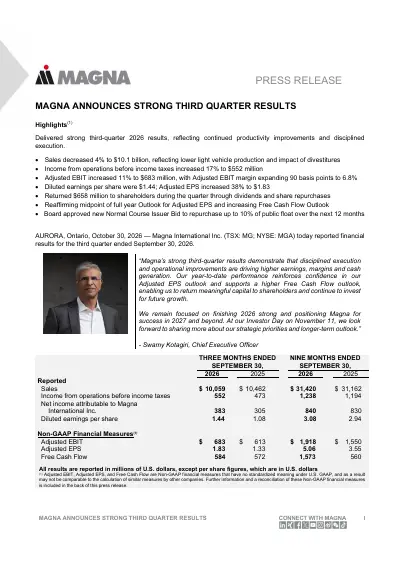
I am pleased with our performance this quarter. We delivered another strong quarter with continued margin expansion, reflecting disciplined execution and progress across a number of areas.
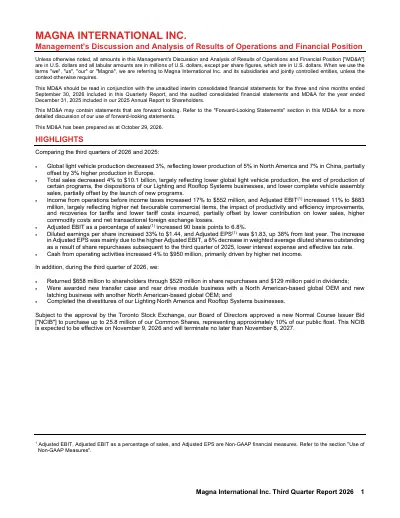
In the quarter, sales were down 4%, reflecting lower light vehicle production and our previously announced dispositions. However, weighted organic growth over market was positive.
Adjusted EBIT was up 11%, while adjusted EBIT margin expanded 90 basis points to 6.8%, and adjusted EPS rose 38% to $1.83. These results reflect continued progress in our operational excellence initiatives and success in resolving commercial items, including some pulled forward from Q4.
Most notably, we continue to see improvement in the underlying operating performance of the business. Our strong free cash flow is further evidence of the continued improvement in our operating performance and the cash-generating capability of the business.
During the quarter, we generated $950 million in operating cash flow and $584 million in free cash flow, and we ended the quarter with leverage well within our targeted range and $1.4 billion in cash on hand, which provides continued financial flexibility. Supported by our strong year-to-date performance, we updated our full year 2026 outlook.
We lowered our sales expectations to reflect reduced vehicle production in China and unfavorable program mix, and narrowed our range for adjusted EBIT margin. However, we maintained the midpoint of our outlook range for adjusted EPS.
In addition, we raised our outlook range for free cash flow, again reflecting our year-to-date momentum and confidence in our cash flow trajectory. Together, these updates demonstrate our ability to absorb lower production and still deliver improved profitability and cash generation.
We remain steadfast in executing our proven capital allocation framework. We continue to invest in our business to support further profitable organic growth while returning significant capital to shareholders.
During the quarter, we returned $658 million to shareholders, including $529 million through share repurchases. We completed our existing buyback authorization in October, repurchasing the remaining 1.3 million shares, and our board approved a new NCIB for 25.8 million shares.
Lastly, we closed on the sales of our roof systems and North American lighting businesses in Q3, and expect to complete the remaining divestitures in the fourth quarter. I would like to take a moment to highlight our Complete Vehicles segment, which is ramping up business globally and demonstrating the value of our flexible vehicle manufacturing model.
In Mesa, Arizona, we are launching and ramping up two new vehicle programs for Waymo in our existing outfitting facility. In Graz, Austria, we assemble six vehicles in total for XPeng and GAC.
We are launching the G9 EV, our fourth model in Graz, supporting XPeng's European localization strategy. We also produce two GAC models, including the Aion UT, launched earlier this year.
In China, our joint venture is ramping up production of all-new Alpha T7, the fifth Arcfox model produced by the joint venture. These programs demonstrate our ability to support new and established customers across regions through flexible, state-of-the-art manufacturing.
They are also generating discussions with additional customers and creating opportunities to bring more Magna systems content to new vehicle programs. We also continue to win new business across our core product areas.
We were awarded a transfer case, rear drive module, and front drive unit for a North American-based global OEM. This new program, which launches in 2028, adds to our leading market position in four-wheel drive.
We were also awarded incremental actuator content for a smart latch system we currently supply to a North American-based global OEM. The global program launches in 2027, spans our three key markets, and supports new global regulation requirements.
The wins reinforce Magna's strong technology position in leading product areas. Lastly, our commitment to innovation continues to be recognized by the industry.
Three of our technologies are finalists for Automotive News PACE Awards, and two are finalists for PACEpilot Awards. Winners will be announced in November.
These finalists span a number of our capabilities, demonstrating our strong position across our portfolio. With that, I'll turn the call over to Phil.
Phil Fracassa
Thanks, Swamy, and good morning, everyone. I'm going to begin on slide 15 with a summary of our strong third quarter results.
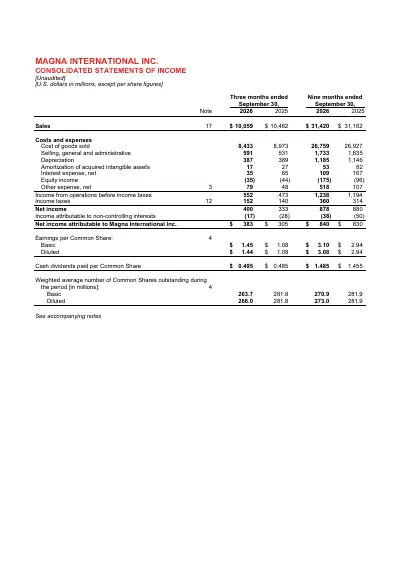
Sales were $10.1 billion in the quarter, down approximately 4% from last year. Adjusted EBIT margin improved 90 basis points to 6.8%.
Adjusted earnings increased 38% to $1.83 per share, and free cash flow was strong at $584 million. Each of these metrics exceeded our expectations and continued the momentum we saw in the first 6 months of the year.
Now, I'll take you through some of the details. Let's start with sales on slide 16.
As I mentioned, third quarter sales were down about 4% overall compared to last year. Excluding divestitures and foreign currency translation, sales declined 2.1% organically.
By comparison, global light vehicle production declined about 3% in the quarter. On a Magna-weighted basis, we estimate light vehicle production was down 2.6%.
This translates to positive growth over market for Magna of about 0.5% on a consolidated basis, and 1% excluding complete vehicles. Looking at the sales walk, volumes, launches, and other reduced sales by $150 million.
The decrease mainly reflects lower light vehicle production, the end of production on certain programs, including the Ford Escape, and normal course customer price concessions. These factors were offset partially by new program launches, including the Jeep Cherokee and the Mercedes-Benz GLB and GLC.
Complete vehicle sales declined $74 million organically, despite higher unit volumes. The higher volumes were driven by new programs with XPeng and GAC in Graz, where sales are recognized on a value-added basis.
Volumes with other customers, where sales are generally recognized on a full-cost basis, declined year-over-year, including end of production for the BMW Z4 and Toyota Supra. This mix shift resulted in net lower assembly sales dollars, but at higher margins.
Engineering revenue was also lower, in line with our expectations. The roof systems and completed lighting divestitures reduced sales by $165 million in the quarter.
Lastly, foreign currency translation reduced sales by $14 million, reflecting a net stronger U.S. dollar.
Now, let's move to EBIT on slide 17. Third quarter adjusted EBIT was $683 million, an increase of $70 million, or 11%, versus last year.
Adjusted EBIT margin was 6.8%, an improvement of 90 basis points. Operational volumes and other contributed about 120 basis points to margin in the quarter.
The improvement mainly reflects net favorable commercial items and the impact of operational excellence initiatives, net of normal course customer price concessions. We also benefited from prior restructuring actions, as well as the divestitures, which were running at margins below Magna average.
These factors were offset partially by lower earnings on reduced organic sales volumes, unfavorable net foreign exchange impacts, and higher profit sharing and incentive compensation. In addition, lower net tariff costs contributed approximately 30 basis points to margins.
Costs were slightly lower, and we're getting recoveries faster than we did last year. While the tariff situation continues to evolve, we currently expect that our full year net tariff headwind will be similar to what we experienced last year.
Higher commodity costs reduced margins by about 50 basis points. As we have noted in prior quarters, we continue to experience inflation across several key commodities.
While this was a headwind in the quarter, we do expect to substantially mitigate or recover these increased costs over time. Lower equity income reduced margins by around 10 basis points.
This mainly reflects the impact of lower sales, unfavorable product mix, and higher income tax expense at certain affiliates accounted for under the equity method. Looking below the EBIT line on slide 18, interest expense was $30 million lower than last year.
The improvement was driven by some discrete interest expense last year that did not recur, as well as reduced seasonal short-term borrowings, supported by our strong cash flow. Our third quarter adjusted tax rate was 22.4%, an improvement of 410 basis points versus last year, and better than our expectations.
For the full year, we now expect an adjusted tax rate of approximately 22%. Third quarter adjusted EPS increased 38% to $1.83, reflecting the higher net income and a 6% reduction in diluted shares outstanding from share repurchases completed over the past 12 months.
Next, let's take a brief look at our business segment performance, which is summarized on slide 19. We were impacted by lower global light vehicle production across the business.
In Power & Vision, reported sales also reflect the roof systems and completed lighting divestitures. Excluding divestitures and foreign currency translation, P&V sales increased approximately 2% organically in the quarter.
In Seating, sales were negatively impacted by a major changeover at Ford's Louisville plant, as well as retooling at BMW's Spartanburg plant for upcoming planned program launches. In Complete Vehicles, sales declined 8% as expected, despite higher unit volumes, as lower sales on full-cost programs and lower engineering revenue were only partially offset by new value-added programs and higher margins with Chinese OEMs in Graz.
Turning to EBIT, Body Exteriors & Structures, Power & Vision, and Complete Vehicles all posted notable year-over-year improvements in adjusted EBIT dollars and margins, reflecting strong operational execution. P&V also benefited on the margin line from the divestitures, and Complete Vehicles benefited from favorable mix.
In Seating, margins were down as expected, mainly reflecting the decline in sales for the program changeovers I mentioned earlier. Now, let's look at cash flow on slide 20.
In the third quarter, we generated $950 million in cash from operations, an increase of $38 million from last year, driven by higher earnings and improved working capital. Investment activities in the quarter included $307 million in capex, and $75 million for investments, other assets, and intangibles, offset partially by proceeds from normal course asset disposals.
Netting everything out, we generated free cash flow of $584 million in the quarter, which was slightly above last year and ahead of our expectations. We continued to return cash to shareholders in the third quarter, with $129 million in dividends, along with $529 million through share repurchases.
During the quarter, we repurchased 7.9 million shares under our current NCIB buyback authorization, which left us with just over 1 million shares remaining at the end of September. As of today, we will have repurchased all remaining shares.
That's a total of over 25 million shares over the past 12 months. As Swamy mentioned, yesterday, our board approved a new NCIB buyback authorization, which is expected to take effect in November.
Turning to slide 21, our balance sheet and capital structure remain strong. At the end of September, we had close to $5 billion in total liquidity, including $1.4 billion of cash on hand.
This is despite the significant return of capital during the first 9 months of the year. Looking at leverage, our net debt to adjusted EBITDA was under 1x, and our rating agency leverage was 1.4x at quarter-end.
These are both within our targeted ranges, which provides significant financial flexibility and puts Magna in a great position to continue investing in the business and returning capital to shareholders. Next, let me cover the macro assumptions underpinning our current outlook on slide 22.
Compared to our July outlook, we've reduced our China production estimate by 800,000 units. We also updated our foreign currency assumptions to reflect recent exchange rates.
Our full year outlook now assumes a slightly stronger Canadian dollar, euro, and Chinese yuan relative to the U.S. dollar.
Moving to slide 23, we are revising our full year sales outlook primarily to reflect our assumptions for lower vehicle production in China and unfavorable program mix compared to our previous outlook. Despite the lower sales outlook, we continue to expect strong year-over-year margin expansion.
We are narrowing our outlook for adjusted EBIT margin to a range of between 6.3% and 6.5%. Our midpoint of 6.4% represents an improvement of 80 basis points from last year on slightly lower sales at the midpoint.
We are also narrowing our adjusted EPS outlook to a range of between $6.85 and $7.15 per share. The midpoint, which is unchanged at $7 per share, represents an increase of 22% versus last year.
Finally, we are raising our free cash flow outlook to between $1.85 and $1.9 billion, an increase of $75 million at the midpoint, mainly reflecting lower planned capital spending. The updated outlook represents free cash conversion of approximately 100% of adjusted net income.
With respect to other key assumptions, we expect capex to be approximately $1.5 billion, compared to our previous range of $1.5 to $1.6 billion. We're planning for slightly lower interest expense, and we expect a lower adjusted tax rate of approximately 22%, compared to 23% previously, reflecting a more favorable mix of earnings.
Finally, our assumptions for equity income at the midpoint and diluted shares remain unchanged. That's it for the financial review, and now I'll turn it back to Swamy to wrap things up.
Swamy?
Swamy Kotagiri
Thank you, Phil. Before we take your questions, let me summarize.
We delivered a strong third quarter with meaningful growth in adjusted EBIT margin and adjusted EPS. Just as importantly, we generated strong free cash flow, reinforcing the quality and sustainability of our earnings.
These results reflect the continued progress we are making through disciplined execution and operational excellence across the company. Looking ahead, our updated 2026 outlook reflects our confidence in Magna's ongoing operating performance.
We remain focused on sustaining our momentum in margin expansion, earnings growth, and free cash flow, while continuing to execute our disciplined capital allocation strategy. We completed our previous share repurchase program, and the board has approved a new authorization.
This positions us to continue returning significant capital to shareholders while investing in the business. Overall, we believe Magna is well-positioned to deliver continued margin expansion, EPS growth, and attractive shareholder returns.
We hope to see many of you in November at our investor event in New York City, where we will go into detail on our strategy, key initiatives, and long-term financial outlook. Thanks for your attention.
Now, operator, let's open it up for questions.
Operator
We will now begin the question-and-answer session. If you would like to ask a question, please press star one on your telephone keypad.
To withdraw your question, press star one again. Please limit yourself to one question and one follow-up.
We ask that when asking a question, you pick up your handset. If you are muted locally, please remember to unmute your device.
Please stand by while we compile the Q&A roster. Your first question comes from the line of James Picariello from BNP Paribas.
Please go ahead.
Phil Fracassa
James, you're on the line. You may need to unmute.
Let's move to the next question, operator, please. Thank you.
Operator
Thank you. James, we will return momentarily.
Your next question comes from the line of Dan Levy from Barclays. Please go ahead.
Dan Levy
Hi. Good morning.
Thank you for taking the questions. First, just wondering if you could unpack maybe some of the items within the quarter.
You said there was timing of commercial recoveries. Maybe you could just outline a bit more the magnitude of those, and maybe just give us a little more sense if those were for commodities, if those were for vehicle programs, and then what's one-time versus maybe the right sort of on a run rate basis going forward, the right way to think of it.
Swamy Kotagiri
Yeah. Good morning, Dan.
Maybe I'll start off with the high level, and Phil can jump in with some of the details. The commercial and tariff recoveries benefited Q3, and some favorable commercial items moved forward from Q4.
I would say that's not the full explanation or the full improvement. We delivered meaningful productivity and efficiency gains, operational excellence benefits, and restructuring benefits, which helped absorb significant commodity pressures.
If I had to summarize it, I would say timing helped the quarter, but the underlying operating performance is what held the improvement and will serve as a trajectory going forward.
Phil Fracassa
Yeah. The only thing I would add there, Dan, is the operational volume and other bucket, if you will, added 120 basis points overall to margins.
The two biggest positives would have been commercial and operational excellence. Swamy talked about the operational excellence.
As we've said many times, we're still in the early innings there and expect that momentum to continue. On commercial, I would say in that particular bucket was probably a combination of volume-related commercial and some commodity-related commercial, although commodities was a net headwind in the quarter.
We actually show that in the different buckets. It was mainly commercial-related or volume-related commercial, some pull ahead from Q4.
The only thing I would say is we still expect margins in Q4 despite the pull ahead into Q3. We still expect margins in Q4 to step up from Q3, despite lower volume, despite commodity costs, despite actually commercial probably flipping negative on us in Q4.
We do believe the margin performance, when you peel it all back, is sustainable. As we've said before, we think the midpoint of the full year guide, when you look at 6.4% at the midpoint, we do believe that is a structural jumping-off point as we head into 2027.
Dan Levy
Great. Just to clarify, within that, the commodity cost that you said was a net headwind, is the view, I assume, over time is that you should get full recoveries to make it EBIT dollar neutral?
It's just a matter of the timing. Is that correct?
Phil Fracassa
That is correct. We signaled that probably last quarter.
It was modest impact in Q2. It stepped up in Q3 to the 50 basis points that you see.
We're expecting probably a comparable headwind, maybe even a little bit higher in Q4. It is a timing issue.
Think of DRAM and related electronic components. You can think of resins and some aluminum that we buy in from Tier 2s and the like, that's embedded in components, if you will.
That is where it does take some time to get recoveries from customers. I would tell you we've gotten some.
That 50 bps you see is sort of the net headwind for the quarter. Conversations, I would say, are constructive.
What we don't recover this year, the plan would be to substantially mitigate or recover in 2027.
Dan Levy
Great. Thank you.
As a follow-up, one of the automakers mentioned on their call that for one of their new vehicles, they want to bring castings in-house. We've heard this from others as well, this idea to do sort of gigacasting.
BES, obviously, you've got some big customer relationships there, and it's pretty chunky content. Maybe you could just talk about the trend by some of the automakers to bring some of the casting in-house, and whether that's at all a risk to you.
Swamy Kotagiri
The simple answer, Dan, no. The reason I say that is, as we continue to have conversations with various customers, actually, in all regions of the world—North America, Europe, and China—if anything, we are continuing to see more interest in our capability and bringing forward some inventive or innovative ideas on doing castings on a pretty large scale, right, in the 6, 7,000-ton type machines.
Some of the technologies we are bringing, which we got PACE Awards last time in terms of the alloy development, in terms of joining technologies, and so on. We're able to show some solutions there where two or three castings, which bring together significant consolidation of parts, but at the same time, take into account repairability and maintenance, and so on and so forth.
All in all, a lot of interest. We are not seeing any negative influence.
We are actually pretty enthusiastic about that process and product.
Dan Levy
Great. Thank you.
Look forward to seeing you at the investor day.
Phil Fracassa
Thanks, Dan.
Operator
Your next question comes from the line of James Picariello from BNP Paribas. Please go ahead.
James Picariello
Hi. Good morning, everybody.
Can you hear me?
Phil Fracassa
Yeah. Morning, James.
James Picariello
All right. Second time's a charm.
Sorry about that. I know we're going to get all the detail we want in just two weeks at the investor day, but as we think about free cash flow and consider the strength in Magna's free cash flow and buybacks commitment, can you confirm the amount of EV recoveries in the free cash flow outlook for this year, and just high level, how are you thinking about the puts and takes for the trajectory into next year?
Thanks.
Phil Fracassa
Sure, James. We talked in the first quarter that we had a large EV recovery from a North American OEM.
We had talked at that time that it was north of $450 million. We got probably a little bit more in Q3, so as we're sitting here today, I'd probably round the number to about $500 million in the year.
Again, that would have been sort of cash received. We do have some go-forward impacts as well.
As we look at the free cash flow, it's been very strong on strong earnings, very good working capital management, and then, obviously, capex coming in at the full year guide at around kind of 3.6-ish percent of sales. Feel really good about the free cash flow not only in 2026—I'll talk about go-forward in a moment—but balance sheet's in great shape.
We ended the quarter with great liquidity, the balance sheet's in really good shape. We renewed the NCIB, we feel really good about the cash generation of the business and the ability to continue returning significant capital to shareholders moving forward.
As you step forward to 2027, obviously, those recoveries won't repeat, but the combination of stronger earnings, again, continued focus on working capital and capex, we do believe the free cash flow will remain strong, and will continue to be supportive of everything we want to do.
James Picariello
Got it. No, that's great to hear.
Then Power & Vision, the growth over market was a clear positive again this quarter, with the full year guide implying another strong showing for the fourth. Can you speak to any key factors driving this improvement, either from a product or favorable customer mix perspective, or is the growth mainly driven by new business backlog contributions?
Just any color on the Power & Vision growth inflection would be helpful. Thanks.
Swamy Kotagiri
Yeah. Good morning, James.
I think you summarized it. Power & Vision, as you saw, declined 2% in the sales side of things, including the divestiture effects, and the margin improved about 150 basis points and standing at 6.6%.
The improvement in this case, or in this segment, definitely was less about commercial recoveries and more about strong operational execution. I would say it's continued traction from our operational excellence initiatives, and it's truly becoming foundational, and we're starting to see that.
It's definitely a trajectory going forward. I don't think there is any one particular product that stands out.
Definitely, the launches of some of the programs that we've been working being at normal cadence and normal run rates definitely helps. The discipline and engineering and launches is the other part.
All in all, I would sum it up as the different headings under the operational excellence is what's giving us the jump in there, the profitability.
James Picariello
Yeah. No, it's great to see that low to mid-single-digit core growth.
Appreciate it.
Phil Fracassa
Thanks, James.
Operator
Your next question comes from the line of Tamy Chen from BMO Capital Markets. Please go ahead.
Tamy Chen
Hi. Good morning.
Thanks for the questions. First, just want to start on the seating side.
Can you remind us again, in North America, I think there's the fairly sizeable replacement or refresh program that will come. When do you launch that?
When we think about overall seating margins as we go towards that launch, is this refresh or renewed program meaningful enough to potentially move those segment margins back to pre-pandemic? Is that how we could think about it?
Swamy Kotagiri
Yeah. Good morning, Tamy.
I think the couple of things, right, the program changeovers at Ford Louisville and BMW Spartanburg are the ones that are having impact. As they come back online, you'll see the seating come back to what I would call the normal cadence.
If you look at it from last year to how we've been progressing, we are satisfied and seeing what we expected there, other than the program changeovers. The October full year margin outlook is 3.1% to 3.3%, right, if you take the midpoint 3.2%, that's in line with what we've been talking about.
With the program launches coming in play, and the one big program that you mentioned will be fully launched by this time next year. It started now and it's phasing, right.
We feel pretty confident in how the launch is going, how the economics are working out. When all of this comes back, I would say I kind of go back to what I always said about seating, good returns business.
We are seeing the trajectory we wanted. This quarter seems a little bit off, but that's because of the changeovers.
All in all, it's following the trajectory we had in plan.
Phil Fracassa
Tamy, the only thing I would add is that, we'll feel we'll feel more the impact of the of the BMW, because that's sort of launching kind of as we speak. We'll feel it more in 2027, whereas Ford Louisville would be sort of mid next year.
That'll be kind of a mid-year a mid-year ramp, if you will. As Swamy said, the margins this quarter, while they were down year-over-year, were actually better than we anticipated coming into the quarter, because obviously that's a lot of volume to lose, albeit, temporary, if you will.
The team did a great job on operational excellence and and some commercial items to kind of protect margins. Moving forward, as Swamy said, with the new economics and the volumes coming back, we feel really good about about the ability of seating margins to get back get back where they were.
Tamy Chen
Okay. Good to hear.
Got it. My follow-up question is, the bigger picture—I assume you'll talk more about it at the investor day as well—but curious if you can give any insights right now.
Your overall operational excellence journey, if you had to describe what inning do you think we're at? What's still to come?
I think one of the areas is your Factory of the Future, just continuing to roll out in more facilities. Can you give any sort of numbers to help us assess how far along and how much more there is to come from there?
Thanks.
Swamy Kotagiri
Hi. Good morning, Tamy.
At the investor day, we'll definitely hear from us about a little bit more detail on how our strategy is evolving. We'll talk about our growth over market priorities, and definitely more color on the operational excellence initiatives.
I won't put a number on it, but I would still say it's early innings. We are enthused about—and you've seen the traction of what, shout out to the Magna team, everybody on the shop floor.
They're sticking to it, doing it, with all gratitude towards them. We still feel pretty good about how we're doing.
Then we'll also, obviously, touch on the medium to long-term financial framework when we come to the investor day.
Tamy Chen
Okay. Thank you.
Phil Fracassa
Thanks, Tamy.
Operator
Your next question comes from the line of Alex Perry from Bank of America. Please go ahead.
Alex Perry
Hi. Thanks for taking our questions here.
I guess, first, I just wanted to ask a little bit more about the change in the guide for this year, specifically on China. Is there any visibility on China improving?
How conservative would you say the outlook is at this point with the volatility and invisibility you have in that region? Then maybe just walk us through how China sort of varies versus the other regions in terms of the visibility profile given some of the fragmentation there in the market.
Thanks.
Swamy Kotagiri
Good morning, Alex. As you said, China is pretty dynamic in terms of local consumption versus exports, the dynamics between the Chinese OEMs and the Western OEMs, and so on.
From our perspective, China vehicle production declined 7% in Q3, and our impact was roughly about 10%. If you peel the onion back a little bit, you'll see that the three German OEM group collectively declined approximately 28% in the quarter.
Contextually, Magna, when we started, we had a much bigger share with the Western OEMs, but over the last decade, I would say, we've grown at 10%-plus CAGR in China. Today, we are about 65% business or revenue is with the Chinese OEMs in China.
We have evolved pretty well. We continue to grow in the long term pretty good.
It's an important market for us. From our financial metrics, I would say we're satisfied, and continue to be good and accretive.
It's a little bit lumpy is how I would characterize it, but our focus remains on the right customers, platforms, products, and definitely returns.
Alex Perry
Really helpful. Then, I wanted to ask a little bit about what you're doing with some of the AV players.
Maybe help us think about and contextualize maybe the size of the Waymo business, what you're doing there. Could that become significant over time?
Then are you targeting other robotaxi and AV players that are trying to integrate a lot of pieces and the various tech stacks? Thanks.
Swamy Kotagiri
Yeah. I think from a component systems perspective, we've been pretty clear that our focus really is on, call it, the driver assist systems, right.
If there is alignment in terms of our product strategy where we can support the AV players in sensors and systems and so on, absolutely yes, and we continue to explore that opportunity. Specifically with Waymo, it's our complete vehicle group that has brought value in terms of the upfitting for Waymo, and as we talked about, we are adding more models there.
That model will continue to be explored in other areas, or with other customers and other regions. Again, it's got to be something long term, something that's more partnership and value-driven.
We continue to look at it, but we are very, call it, disciplined and cautious in how we go about it.
Alex Perry
That's really helpful. Best of luck going forward.
Phil Fracassa
Thanks, Alex.
Operator
Your next question comes from the line of Tom Narayan from RBC Capital Markets. Please go ahead.
Tom Narayan
Hey, Swamy and Phil. Thanks for taking the questions.
First one is on European capacity. It looks like you took a charge in P&V, $76 million in Q3.
Just curious, what was behind that? We know Jim Farley on the Ford call was saying that Europe has just too much capacity, and then this is coupled with Chinese exports coming into Europe.
Curious if you expect to see more capacity cuts in Europe at P&V in Europe, or perhaps in other segments? Then I have a follow-up.
Swamy Kotagiri
Hi, Tom. Good morning.
I think like we've been talking about, call it, consolidation, restructuring, closures, all of it over the last 4 years, and we've done that with 41-plus divisions. A significant portion of that was in Europe.
My point being, it's been a continuing journey. We have been flexing from the times when Europe saw like 21, 21.5 million units to the current 17 million-plus units.
We work along with it. We still are very careful and continue to watch it.
I feel pretty comfortable. Again, this is part of the operational excellence, right, being able to react quickly and be agile and be resilient.
There is a little bit more work, but nothing that I would call a heavy lift from Magna perspective for Europe.
Tom Narayan
Okay. Then on the buyback plan, it's a 10% of the float through, I think, November next year.
Your leverage is quite low. I know we'll hear more on the investor day on this, but the implication is potentially that you're maybe leaving some room for M&A and reinvesting in the business, perhaps in some non-automotive areas.
Again, I don't want to steal your thunder here, but is that a fair assumption to make that the buyback plan, which is big, but it is maybe potentially leaving some room for other things, too?
Swamy Kotagiri
I think for us, the capital allocation principles were pretty straightforward. I think focus really on the organic, profitable growth, that remains.
We're disciplined in terms of going after programs and how we grow. As I said before, Tom, and I think it still holds, we're pretty happy with the portfolio the way we have it today.
I don't really see a significant or transformative M&A. Could we see some small tuck-ins that would help our strategy?
Yes. It would be looking at externalities, the dynamics of the economic conditions, and so on and so forth, maintain our financial flexibility and leverage ratios.
The rest, I think, would be share buybacks and dividends, as we see it, as we have done in 2026.
Phil Fracassa
Yeah. Tom, I would I would only add that I would probably look at it a little bit different.
We had 10% available to buy back this year, and we've we've bought back the entire 10%. We have been able to take leverage down.
We have been working to bring our leverage down within our range. We're we're slightly below the top end of our targeted range.
We don't feel any need to certainly delever from here. I do think it puts us, if anything, puts us in great position as we look ahead to next year, from a capital return standpoint.
As Swamy said, continue to invest in the business, and then, maybe, maybe a tuck-in here or there. I do feel like the the balance sheet capacity we have, we certainly we certainly intend to put it to use, similar to what we did this year.
Tom Narayan
Got it. Looking forward to the investor day.
Thank you.
Phil Fracassa
Thanks, Tom.
Swamy Kotagiri
Thank you.
Operator
Your next question comes from the line of Jonathan Goldman from Scotiabank. Please go ahead.
Jonathan Goldman
Hey, good morning, everyone. Thanks for taking my questions.
Could you just remind us if you've updated any of your expectations for growth over market this year?
Phil Fracassa
Great question, Jonathan. Given the updates to the volumes that we made in this current outlook, in the quarter, we were slightly above 1% growth over market, roughly 1% excluding complete vehicles.
Right now, for the full year, we're probably looking at closer to flattish all-in and up 1% excluding complete vehicles, a little bit down from what we would have guided to last quarter, mainly as a result of the updated volume estimates. Then as we peel the onion back in terms of programs, Swamy talked about the dynamic in China, and then as well as we did have a customer in North America and a customer in Europe add some plant downtime in the fourth quarter, where we do have quite a bit of content with those customers.
As we kind of pulled it all together, it did bring it down. If you take a step back, as we've said all along, that really the downtime and some of the impacts in China, China is going to move around a little bit.
The downtime is really temporary, if you will. We still feel really good about our ability to generate positive growth over market.
We've talked about low to mid-single digits in the past. It's not going to be that number every quarter or every year, but really nothing's changed in terms of our long-term view on that.
Jonathan Goldman
That's helpful. That's a good dovetail to my next question.
Maybe by this point in the year, how would you describe your level of visibility on Q4 production? Do you have any early reads on light vehicle production, the environment in 2027 based on some of the commentary you're talking about, downtime and kind of that some coming back and kind of the macro environment you're seeing in your various regions?
Swamy Kotagiri
Yeah. I think as we go through the planning process, as we're going through right now for 2027, we consider, call it, the tribal knowledge of the programs that we have, obviously, discussions with the customers and looking at the outside.
Kind of seems to be a little bit softer. We haven't gotten a final answer to that yet.
We'll get through the planning process and know it. That's how we're going into it planning.
We will get back a little bit more detail, Jonathan, when we come into February, right. Right now it'd be premature to put numbers on it.
I would say our biggest focus is assuming a flattish market and how do we continue the momentum we have in our self-help or operational initiatives, and that's what I think will give us the confidence, right, of moving forward. More color to come.
Jonathan Goldman
No, that's fair. Definitely seen the progress on the operational excellence is coming through.
I guess related to that, if I can squeeze one more in on free cash flow, I think it's going to be the second year in a row you're doing close to $2 billion, maybe $1.875, $1.9 billion. Is there anything that sticks out that's unusual in this year, last year, or should this be kind of like the go-forward run rate of free cash flow and free cash flow conversion, and maybe upside if you're able to squeeze more out on the operational excellence?
Phil Fracassa
No, great question, Jonathan. If you look at last year and this year, free cash flow were quite good in both years, over 100% conversion on adjusted net income last year, and the midpoint of the guide would imply right around 100% conversion on adjusted net income this year.
Really strong performance. We did have some recoveries last year related to some EV investments.
We did have some recoveries, as I talked about earlier, this year. Moving forward, as we've talked about with earnings growth, strong working capital management, and discipline around capex, we do expect a strong free cash flow to continue.
It's a little early to talk about 2027, but even with those recoveries not recurring, we do expect to continue to generate strong conversion on net income, strong free cash flow, which should be very supportive of our capital allocation strategy.
Jonathan Goldman
That's good to hear. Thanks for taking my questions.
I'll get back in queue.
Swamy Kotagiri
Thank you.
Operator
Your next question comes from the line of Rajat Gupta from JP Morgan. Please go ahead.
Rajat Gupta
Great. Thanks for taking the questions.
I just wanted to follow up on the AV and robotaxi opportunity. We keep hearing a lot from both Western and Chinese OEMs about insourcing a lot of the work, particularly the higher-value software layer, etc.
I'm curious as your conversations have progressed on the opportunity, what has changed versus what has been intact in terms of where you're playing across that ADAS stack and are there any opportunities there from an M&A side that can help you enhance your stack in the future? Just curious what's the latest there?
I have a quick follow-up.
Swamy Kotagiri
Hi, Rajat. Good morning.
I think the way, again, I've said, we kind of look at that domain as driver assist systems and, call it, full autonomy. As you look into the story of the driver assist, and depending on who you talk to, let's say the in generic terms, L3 or L3++ scenario, there's a lot of discussions, as you said.
It depends on the region, and also depends on the type of the vehicle, whether you have sensors that have edge compute and that architecture. There are some which are talking about zonal architecture, and then there are some which is complete central compute.
If you sit back and look at it from the ability to provide either edge compute or sensors that support the central or zonal architecture, I would say we are pretty well-positioned in being able to support that. Not just giving them the pieces of it, but actually the integration of all of these systems put together and be able to provide a feature that our customers want and, ultimately, the consumers want.
I think we're in a decent place. We have to be a little disciplined, like you said, until there is a little bit of a clearer path on which way it goes.
It's different by regions, and what the chip strategies are. I think they're a little bit cautious at this point in time.
I would be focused on continuing to expand our strength, rather than look at any inorganic activity at this point in time. We feel pretty good where we are.
We'll stay disciplined and focused, and be deliberate on the customers and programs we pick. We're watching.
Rajat Gupta
Understood. That's helpful.
Then just wanted to follow up on the commodities headwind. I'm curious, versus the prior outlook, how much higher is the margin headwind from commodities?
Within that, what parts are just indexed and easily recoverable versus which is what you might have to offset with more internal initiatives? Thanks.
Phil Fracassa
Sure, Rajat. This is Phil.
I would say it definitely got worse since the last outlook. I don't have the exact number, but it certainly got incrementally worse both in Q3 and Q4 versus the prior outlook.
Obviously, we actually did or are doing a little bit better on operational excellence, which has helped to mitigate that a little bit. We know when you take a step back, you look across key commodities, steel and aluminum were pretty well covered with resale programs with customers or index pass-throughs, if you will.
We do have some exposure on aluminum from Tier 2s if it's embedded in components and the like. On resins, we've said we have about 40% that's protected through indexes.
The rest, we would have to negotiate commercially with the customer to get recoveries for. Then the bigger thing that's really is continuing to escalate, probably the biggest driver behind what we saw in the second half, has been the DRAM and the related electronic components, whether it's the boards and the like.
We're seeing increases there as well. On most of that, the vast majority of that, is where we have to negotiate with our customers for recoveries.
As I've said, that's ongoing. We've actually secured some already.
The conversations have been real constructive. The headwind we saw in Q3, we'd expect another headwind, I would say, of a, call it similar size in Q4, and then obviously work to recover or mitigate the impact of those items as we move into next year.
Rajat Gupta
Understood. Great.
Thanks for all the color, and good luck.
Phil Fracassa
Thanks, Rajat.
Operator
Your next question comes from the line of Joe Spak from UBS. Please go ahead.
Joe Spak
Thank you. Good morning, everyone.
Maybe, Phil, if we could just sort of recap. You sort of made the 6 and 6.4% sort of jumping-off point.
Look, we could all make our own volume assumptions. Then you talked about operational excellence, which is still in early innings, but that some of that might get eaten away by the inflation headwinds.
I guess the question is really on that operational excellence. I think you were targeting 35 to 40 this year, and Swamy, you still sort of said it's early innings, but isn't and correct me if I'm wrong, but isn't some of the new contracts rolling on versus the old ones rolling off part of that operational excellence?
Are we through most of that, or is there still more, just more favorable contracts that still continue to roll on that still support that operational excellence?
Swamy Kotagiri
Good morning, Joe. I'll make a few points.
No, it's not just a new economics. When we talk about operational excellence, this is on top of that.
I don't think it's the right way to characterize that whatever we do is being eaten away by inflation. I think some of the inflation is the recoveries and the economics that you talked about.
On the other hand, what we talk about operational excellence is the self-help activities, right. The best way, at least the way we are looking at it, is from last year to this year, about 1.5% lesser revenue, and about 80 basis points better in margin, right.
That will continue. What I said was 35 to 40 basis points is what we said last time.
We're kind of tracking more towards 50 this year on the margin benefit. If you ask me, like Phil said, if you take the midpoint of 6.4% on a flattish production environment, I would venture to say it's very likely for us to look at another 35 to 40 basis points going into next year on operational excellence.
Now, you talked about externalities. That's anybody's guess, right, production, mix, interest rates.
That's industry-driven. We're really focused on what can we do that's in our control, and that's what I'm talking about.
Yeah.
Joe Spak
Absolutely. That's helpful.
Then, Phil, maybe just one point on the NCIB. I think last year when you renewed it, there was some commentary about a commitment to sort of fully execute it.
Can we assume that again? Or is this a little bit play by ear as to sort of how much of that authorization you'll attack this year?
Yeah.
Phil Fracassa
No, thanks, Joe. What I would say is you're right.
Back in February, we did indicate our intention to exhaust the current NCIB, which we've done. We put the new one in place.
It'll take effect in a week or two. Probably a little bit early to talk specifically about it, but as I said earlier, when we think about the strong free cash flow and our expectation for that to continue and the balance sheet being in great shape, we are in great position to continue to buy back substantial amount of shares.
I would expect that we will have buybacks, certainly in the fourth quarter, that we'll be talking about next call, if you will. In terms of being more specific than that, it's probably a little early, and probably I would say more to come on that.
Joe Spak
Okay. If I could squeeze one quick one in, just your fourth quarter at the midpoint of the range, right, we could all sort of calculate that.
It is still plus or minus 9% on either side, which with two months left seems a little bit wide. Any color, commentary about just sort of how we should expect the year to finish up?
Phil Fracassa
I think you're right. We narrowed the adjusted EBIT margin down to 6.3% to 6.5%, which, probably 20 basis points on the full year with one quarter to go is maybe a little bit wide.
Again, I think we feel, I would say, very confident in our ability to land in that range. I would probably focus mainly on the midpoint of that range, plus or minus.
I think, when you think about the headwinds that got layered into the fourth quarter, between volumes, between mix, between commodity costs, etc., I think feel really confident in the full year guide, and the midpoint would imply roughly 7.3% margins in Q4, which is a step up from Q3, despite incremental headwinds, and then down only 20 bips from last year. You remember last year was a bit of a tough comp given the significant recoveries we got last year that we don't expect to recur.
Joe Spak
Yeah. Okay.
Thanks so much for that, Phil.
Phil Fracassa
Thanks, Joe.
Operator
Your next question comes from the line of Brian Morrison from TD Cowen. Please go ahead.
Brian Morrison
Thank you. I appreciate all the answers today.
Just have a couple housekeeping. Phil or Swamy, can you just remind me what the complete vehicle assembly theoretical capacity is in Europe?
I think it was 150,000 units several years back. What is the volume capacity in Arizona and Asia?
Then second question just quickly for housekeeping. Why the increase in the value of the euro in your updated guide?
I realize that most of the year is over, but at $1.11 now, directionally, a little bit surprised it went up.
Swamy Kotagiri
Good morning, Brian. You're right about the assumptions, approximately 150,000 units, right, in our Europe facility.
On the one in Arizona, it's not based on paint and body shop and so on, it's flexible, I would say. It's just based on a little bit of footprint, but could be very agile.
It's not as asset-heavy or capital-intensive. That could flex pretty easily.
It's not constrained by anything.
Phil Fracassa
Yeah. Then on the currency, Brian, I would say, I would just add, we generally tend to snap the line kind of at the end of the quarter, and that's kind of what we did this time around.
Currency's going to move around, and you're right, the dollar-euro is probably sitting at a probably $1.12 today, if you will. A little bit weaker than what we had guided.
In my experience, I think we consistently like to snap the line at the end of the quarter, and that's kind of what we did in this case.
Swamy Kotagiri
Brian, just to add one other thing in China, the complete vehicle assembly capacity is roughly about 180,000, just to complete the picture.
Brian Morrison
Thank you.
Operator
Your next question comes from the line of Mark Delaney from Goldman Sachs. Please go ahead.
Mark Delaney
Good morning, everyone. Thank you for taking the questions and looking forward to seeing you soon at the investor day.
I had another one on complete vehicles. I think EBIT for 2H 2026 per your current guidance is relatively flat year-on-year, given all the work Magna is doing in AV upfitting, as well as the growing business you're speaking about with the Chinese OEMs, including in Europe.
Can you help contextualize what that all means for the ability to grow complete vehicles EBIT from here?
Phil Fracassa
Sure, Mark. Basically what we're seeing in Complete Vehicles, obviously this year has been impacted by lower engineering revenue has certainly been the negative.
On the positive side, the launches that we've seen with Chinese OEMs in Graz have gone very well. Those contracts are on a value-added basis, and that's really the model we're going to work going forward in Complete Vehicles, is more on a value-added basis.
The margins will be higher, revenue dollars will be a little bit lower. That's what's giving you the dynamic of lower revenue, but higher margins, if you will.
Moving forward, again, we do see a path for continued growth in Complete Vehicles, whether it's in Graz, in Arizona with the AV business, in Asia with some of the work we do there. Then again with new programs coming in on value-add, coupled with operational excellence and continuing to try to get better economics on programs that we launch, yeah, we do continue to see, I would say, upside on the margin in Complete Vehicles from here.
Mark Delaney
Helpful color, Phil. Thanks for that.
My other question was on the BES business. Swamy, you already mentioned the role Magna can play with castings and bringing innovative ideas there to OEMs.
Could you also clarify whether you're seeing any change in how much stamping business may be available and how Magna can bring value to OEMs? One of the large European OEMs has been speaking about doing more in-house stampings on their earnings call this week.
Thanks.
Swamy Kotagiri
Good morning, Mark. To be short and simple, we're not seeing anything significant.
I think it's one of our core groups, long-standing, and we continue to have discussions and inquiries from customers. I would say if there is a big program, or if there is any consolidation, if there is any issues, we typically see customers reach out to us.
I would say we definitely have a seat at the table. We haven't seen, call it, any negative impact on the type of insourcing.
If anything, we are one of the, if not the only one, that can do some of the things that OEMs do, and they depend and ask us to be partners with them. I'm pretty comfortable and optimistic about continuing that.
Mark Delaney
Thank you.
Operator
At this time, there are no further questions. I would like to turn the call back to Louis Tonelli for closing remarks.
Louis Tonelli
Thanks, everyone, for listening in today. If you have any follow-up questions, please don't hesitate to reach out to me.
Thank you for your interest in Magna, and have a great day.
Operator
This concludes today's call. Thank you all for attending.
You may now disconnect.