McGrath RentCorp
Q3 FY2026 · Earnings Call TranscriptOctober 28, 2026
Operator
Ladies and gentlemen, thank you for standing by. Welcome to the McGrath RentCorp third quarter 2026 earnings call.
At this time, all conference participants are in a listen-only mode. Later, we will conduct a question-and-answer session.
At that time, if you have a question, you will need to press the star key followed by the one key on your telephone. This conference is being recorded today, Wednesday, October 28, 2026.
Before we begin, note that the matters the company management will be discussing today that are not statements of historical facts are forward-looking statements within the meaning of the Private Securities Litigation Reform Act of 1995, including statements relating to the company's expectations, strategies, prospects, backlog, or targets. These forward-looking statements are not guarantees of future performance and involve significant risks and uncertainties that could cause our actual results to differ materially from those projected.
Important factors that could cause actual results to differ materially from the company's expectations are disclosed under risk factors in the company's Form 10-K and other SEC filings. Forward-looking statements are made only as of this date hereof.
Except as otherwise required by law, we assume no obligation to update any forward-looking statements. In addition to the press release issued today, the company also filed with the SEC the earnings release on Form 8-K and its Form 10-Q for the quarter ended September 30, 2026.
Speaking today will be Phil Hawkins, Chief Executive Officer, and Keith Pratt, Chief Financial Officer. I will now turn the call over to Mr.
Hawkins. Go ahead, sir.
Phil Hawkins
Thank you, Leslie, and thank you for joining us today for McGrath RentCorp's third quarter 2026 earnings call. I am glad to be here to report on our performance over the past quarter and to provide an update on our outlook for the remainder of this year.
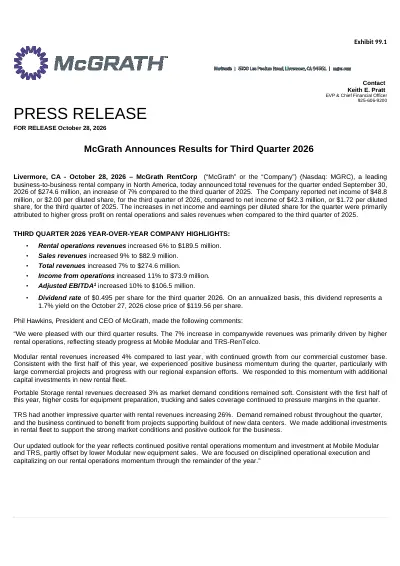
I will discuss market demand conditions, review the progress we made during the quarter, and share how our increased rental fleet investments are helping us pursue our strategic growth opportunities. Focusing first on our quarterly results, we were pleased to see rental operation revenues up 6% year-over-year, driven by continued momentum in our two largest rental businesses.
Both Mobile Modular and TRS-RenTelco grew rental revenues and improved utilization sequentially during the quarter. Overall, total company revenues increased 7%, and adjusted EBITDA increased 10%.
At Mobile Modular, we saw sustained momentum in our rental operations. Rental revenues grew 4% in the quarter, and both rental bookings and backlog were higher than a year ago.
I was pleased with the wins we secured on larger commercial projects and across our geographic expansion markets. These successes allow us to deploy standard fleet at attractive rates on long-term rental contracts.
The strength and quality of our rental pipeline and confidence in demand levels supported our decision to increase investment in new rental fleet. Sales of new modular equipment were lower for the quarter.
Despite having a healthy midyear backlog of secured projects, we experienced longer lead times for project completions. Turning to Portable Storage, rental revenues were down 3%.
Challenging demand conditions continued in smaller, local commercial construction projects, which are a large component of the mix for this business. Our team remained focused on improving utilization by both selling equipment and redeploying existing fleet to new markets.
While we continue to work hard on these efforts, progress is likely to be gradual until market demand improves. Lastly, turning to TRS, rental revenues continued their impressive growth trajectory and were up 26%, with strong demand across several key end markets.
The AI infrastructure and data center investment cycle is generating new business opportunities for TRS. The scope of the opportunity extends across the supply chain.
It ranges from semiconductor R&D, supporting next-generation chip development, to field testing and verification work as equipment is installed in new data centers. Based on what we're seeing in our business and what we're hearing from customers and OEM partners, we increasingly view this as an attractive, multiyear opportunity.
Consistent with this view, we've increased our capital investment in TRS. Summing up, we believe McGrath has multiple avenues to create shareholder value.
While this isn't an easy operating environment, we made meaningful progress against our most compelling growth opportunities during the quarter. At Mobile Modular, we grew in our geographic expansion markets.
We also applied our large commercial project capabilities to win data center, manufacturing, and infrastructure projects. At TRS, we successfully executed against the evolving opportunities created by AI infrastructure and data center buildouts.
Looking ahead, we will continue to invest capital behind these opportunities to support our customers and position the company for sustained, long-term growth. Our capital allocation priorities start with organic investments, and this year we're having attractive opportunities to invest across multiple rental equipment categories.
Our strong balance sheet gives us flexibility to fund this organic growth, support a steadily increasing dividend, and retain capacity for strategic M&A and share repurchases. I will close by recognizing our team for your focus, passion, and commitment to delivering value for our customers.
You are McGrath's greatest competitive advantage. I also want to thank our customers and shareholders for your continued partnership, trust, and investment in our company.
With that, I will turn the call over to Keith, who will take you through the financial details of our quarter and our updated outlook for the full year.
Keith Pratt
Thank you, Phil, and good afternoon, everyone. As Phil highlighted, our third quarter results reflected continued growth in rental operations revenue.
Total revenues increased 7% to $275 million, and adjusted EBITDA increased 10% to $106 million. Reviewing Mobile Modular's operating performance as compared to the third quarter of 2025, total revenues for Mobile Modular decreased 1% to $180 million, and adjusted EBITDA decreased 3% to $63 million.
Rental revenue increased 4%, driven by growth from our commercial customer base and geographic expansion initiative. Inventory center costs increased by $2.3 million as we incurred higher expenses to prepare equipment to support shipments from our existing fleet.
As a result, rental margins declined to 56% from 58% a year ago. Average fleet utilization was 70.2%, compared to 72.6% a year ago, and improved from 70.1% in the second quarter.
The sequential improvement reflected stabilizing overall utilization, consistent with our ongoing efforts to return units on rent to sustained growth. Revenue per unit trends were favorable.
Third quarter monthly revenue per unit on rent increased 8% to $932. For new shipments over the last 12 months, the average monthly revenue per unit increased 7% to $1,271.
There is a positive pricing tailwind opportunity as our fleet churns. Sales revenues decreased $5.3 million to $47.1 million.
Despite a healthy midyear sales backlog, projects took longer than expected to reach completion. Turning to the review of Portable Storage, total revenues for Portable Storage decreased 3% to $24 million, and adjusted EBITDA decreased 20% to $7 million compared to the prior year.
Rental revenues were $17 million, down 3%, and rental margins were 80%, down from 81% a year ago. Demand conditions for smaller, local commercial construction projects remained challenging.
Adjusted EBITDA was also impacted by pressure on rental-related services margins and investments in sales coverage to support future growth. Average utilization for the quarter was 59.1%, compared to 61.4% a year ago, and up sequentially from 58.3% in the second quarter.
Turning now to the review of TRS-RenTelco, TRS delivered another strong quarter, with total revenues up 23% to $45 million and adjusted EBITDA up 27% to $26 million. Rental revenues increased 26% to $35 million, benefiting from improved demand conditions, including projects supporting data center build-outs.
Rental margins improved to 48% from 43% a year ago. Average utilization for the quarter was 69.9%, up from 64.8% a year ago, and ended the quarter at 71.9%, the highest level in the past 20 years.
Given the strong demand environment and record high utilization level, as Phil discussed, we continued to invest in additional fleet to support growth. Sales revenues increased 7% to $8 million, and gross margins were 56%, consistent with last year.
Lastly, on Enviroplex, Enviroplex delivered a very strong third quarter. Sales revenue increased to $25.7 million from $13.7 million, and adjusted EBITDA increased to $10.7 million from $2.5 million.
High gross margins strengthened performance in the quarter. The remainder of my comments will be on a total company basis.
Third quarter selling and administrative expenses increased $4.4 million to $56.9 million, primarily due to investments to support our modular geographic expansion initiative. Interest expense was $8 million, a decrease of $0.2 million, reflecting lower effective interest rates during the quarter, partly offset by higher debt levels.
The third quarter provision for income taxes was based on an effective tax rate of 26%, compared to 27.7% a year earlier. Turning to our year-to-date cash flow highlights, net cash provided by operating activities was $178 million, compared to $175 million in the prior year.
Rental equipment purchases were $219 million, compared to $92 million in the prior year, as we increased investment to support geographic expansion and large commercial project wins at Mobile Modular and higher demand at TRS. In addition to investments in new fleet, healthy cash generation allowed us to pay $37 million in shareholder dividends and to complete $34 million of share repurchases.
At quarter end, we had net borrowings of $618 million, and the ratio of funded debt to the last 12 months' actual adjusted EBITDA was 1.68:1. Lastly, we are updating our outlook for 2026.
Demand for our rental businesses remains strong, and we are investing in growth opportunities across Mobile Modular and TRS. As a result, we are narrowing our adjusted EBITDA range, with no change to midpoint expectations, and increasing our gross rental equipment capital expenditure outlook.
While lower-than-expected modular new equipment sales activity is reducing our revenue outlook for the year, the strength of our rental operations continues to support our EBITDA outlook. We now expect total revenue between $945 million and $960 million, adjusted EBITDA between $365 million and $373 million, and gross rental equipment capital expenditures between $270 million and $290 million.
We are pleased with McGrath's third quarter performance, and we are fully focused on solid execution for the remainder of the year. That concludes our prepared remarks.
Leslie, you may now open the lines for questions.
Operator
The floor is now open for questions. At this time, if you have a question or comment, please press *1 on your telephone keypad.
If at any point your question is answered, you may remove yourself from the queue by pressing *2. Again, we ask that you pick up your handset when posing your questions to provide optimal sound quality.
Our first question is from Manav Patnaik with Barclays. Please go ahead.
Ronan Kennedy
Hi. Good afternoon.
This is Ronan Kennedy on for Manav. Thank you for taking our questions.
If I may start with, stepping back, I think the demand environment still seems fairly bifurcated: healthy activity across larger projects, but continued pressure in the smaller, local commercial construction. Are you seeing early signs of an inflection in broader non-resi activity, and specifically in that smaller, local project?
Phil Hawkins
Good afternoon, Ronan. This is Phil.
I think the macro theme has been really consistent like we've been sharing the last few quarters. Those smaller, local projects, that environment's stable, but they aren't increasing significantly, while we continue to see ample opportunities for the large commercial projects.
We haven't seen any strong indications of that shift happen this year.
Ronan Kennedy
Got it. Thank you.
Then the new modular unit sales came in below the expectations, I think, embedded in the prior outlook. How are you thinking about that level of sales activity in 4Q?
As you look further out, is there anything else you're seeing today that changes how we should think about the opportunity for new unit sales even into '27?
Keith Pratt
Take one step at a time, Ronan. I think with the updated outlook, it reflects two things.
Sales came in a little lower than we had expected for the third quarter, and we've sort of reduced our outlook for the fourth quarter on the new modular equipment sales. As we mentioned in some of the remarks, we had a healthy backlog at the midyear point, we went through our normal process, and what we actually experienced was, it's taking longer to see those projects that are under contract get completed.
That's really the root cause of us taking the numbers down in that area. These are really issues with the customer.
There's nothing on our side. We're ready to serve.
We have access to the product as planned. We do know customers can run into issues.
We discussed that last quarter as well. The overall experience we've had is everything is taking longer than we would have expected to complete, and that's the root cause for taking that part of the business outlook a little lower.
Ronan Kennedy
Got it. Thank you.
Then on the rental equipment capex, the guide raise, I believe, about 70 $70 million at the midpoint. Can you please help us how to help us understand how much of that is Mobile Modular versus TRS, and within each, what specifically are you investing behind?
Yeah.
Keith Pratt
Ronan, let me give a couple of comments on that. If you go way back to the February initial outlook for capex, the midpoint at that time was $190 million.
With our October update, we're now up to $280 million. What we've seen over the course of the year, and Phil alluded to this in his comments, good strength in the demand environment for certain product categories at the modular side and at TRS.
If we look at the overall shift in our outlook, really TRS has performed extremely strongly. At the middle of the opportunity to step up the capital spend in that part of the business more substantially than we really expected.
In both businesses, there is an uptick, but the majority of that change from the beginning of year view to sort of the view we have today, the majority of that increase is occurring at TRS. Just to frame that for you a little bit, if you look into the details in the Q, we ended the third quarter at TRS with essentially utilization of 72% on a fleet the size was $380 million of OAC.
We've got very high utilization on the largest fleet we've had all year at September 30th and continue to see good demand and good opportunity in the business. TRS is really getting the more significant adjustment overall for the year.
Then in terms of where that capital is going, just starting with TRS, the whole AI/data center opportunity that Phil described that has facets that range from work done in the R&D lab all the way through to people who are turning up equipment in a data center, multiple product categories, probably tilts more towards what we call the communications side. Then on the modular side, again, as Phil indicated, we have opportunities for geographic expansion and opportunities for more of those larger megaprojects, which tend to use more of the complex floors, where we're adding equipment where our existing utilization's already very high.
That gives you the overview. Again, it all speaks to the rental operations opportunity.
Phil Hawkins
I would just add, Ronan, over 80% of that modular year-to-date capex has gone out on contracts with initial average terms over 30 months. These are long-term deals for standard rental equipment with solid returns.
Ronan Kennedy
Very good. Thank you.
If I may, just one more on modular. Could you talk about how would you frame the building blocks for mobile modular growth between backlog conversion, geographic expansion, pricing, services, even underlying market demand, those dynamics from a demand standpoint, visibility into them, and kind of building blocks for 4Q into '27, please?
Phil Hawkins
Sure, Ronan, I can take that. It starts with the opportunity we have in geographic expansion and the visibility we see out into the market for these larger commercial projects.
Again, customer feedback and factory feedback that there's a strong backlog there. We have our own internal backlog, and there's a backlog of those projects out in the market.
Having that demand opportunity out there, then we look internally at our booking activity and our existing backlog. Our bookings were up over 20% in the quarter on the modular side, so that gives us strong confidence that we're going to have many opportunities to continue to participate fully in these large commercial projects.
It starts with the high-level demand picture on the commercial side, and our ability in Q3 and beyond to perform in that. We, as we've talked about before, check a lot of the boxes to make us highly successful in that type of project category.
Ronan Kennedy
Very good. Thank you both very much, greatly appreciate it.
I'll turn it over.
Keith Pratt
Thanks, Ronan.
Operator
Thank you. Our next question comes from Scott Schneeberger with Oppenheimer.
Please go ahead. Oh,
Scott Schneeberger
thanks very much. This is a modular sales question.
Just we're seeing such strength in rental, strong demand, you're still getting very nice pricing, that's high single-digit improvement there. Everything sounds great.
You all cited just delays in the sales of large projects, and with sales, it's always lumpy, I understand. Could you just elaborate a little bit more on what type of projects these are, and what the hold-ups typically are, because it's kind of meaningful.
Just kind of curious, is it going to impact how you're thinking about next year as well, and I know you're not going to guide on this call, but on the fourth-quarter call for next year's sales, just how does it affect how you're thinking about sales next year? Thanks.
Phil Hawkins
Thanks, Scott. We still believe that the ability to support and deliver these new modular equipment sales projects is a competitive advantage and add value for the customers.
These customers have needs for both rental and sales solutions, and sometimes a request that starts as a sale ends up being a rental or even a used sale versus new. The slower overall nonresidential construction market is having an impact, and the higher interest rate environment has likely depressed this opportunity over the last two years, and specifically the projects that we've had tend to be the larger commercial projects where the customers experience difficulty in permitting, getting their site ready, challenges getting all the other subcontractors in place, the things that we typically see on large construction projects.
I think have been magnified in this environment with so many megaprojects happening. We still believe that this is a solid opportunity for us over time, long term.
We've completed a significant number of projects this year. We continue to have a healthy backlog of awarded contracts, and we have good engagement with customers who are planning future projects.
Keith Pratt
Scott, if I could just-- Thanks, Phil.
Scott Schneeberger
Yeah.
Keith Pratt
Scott, I think you asked as well looking ahead to 2027, and I would agree with you, it is much too early to really say anything there. I will say, we've experienced this part of the business is harder to forecast.
We spend a lot of time on it. We're experiencing that things take longer from contract signing to completion, and our opportunity to see the revenue come to McGrath.
I think we'll be careful when we look next year at where we set the initial goalposts for what might be accomplished there. There's also a good slide in our IR presentation that just acknowledges sales were a little lower last year, and they're lower again this year.
I think, as Phil said, that may say something about this general backdrop of the strength of the overall non-res construction market, and that may be also something that's becoming reflected in that part of the business for us. The last comment I'll make, I know your question was initially about the new sales side, where we've seen a more challenge this year.
The used sales side of the business is actually up year to date, and I think that reflects the fact that we continue to look for opportunities to defleet in certain categories where we can, and when we do that, we're getting sales, we're getting good gross margins. That part of the overall sales mix, the used piece, still healthy, actually up year to date.
Those are just some other comments on that part of the business.
Scott Schneeberger
Thank you both, and great follow-up, Keith. That's helpful.
What I take away from both is maybe some issue from the smaller projects, but I feel like, Phil, from your commentary, maybe some of these large projects that are originally considering new sales are opting to rent. Is that a meaningful part of the answer here, or not as much?
Phil Hawkins
I think we've seen examples where that's happened, Scott. I wouldn't say it's a meaningful driver of what we're seeing, but in a high interest rate environment, you do typically see some shift towards lease from the buy side.
Again, I wouldn't attribute most of this. It's related to items around specific projects and not a market shift away from sales.
Scott Schneeberger
Got it. Thanks.
Shifting gears a little bit, you've hit this a little bit already, but with TRS-RenTelco, really ripping. Can you just elaborate, I know you can't track it down exactly to end market, but it's predominantly data centers and large projects that's driving this?
Is that the only driver, I guess, is what I'm asking, versus are there other areas that are pushing it as well?
Phil Hawkins
I think there's a few areas. One, we talked about the AI supply chain, not just data centers, we have equipment that's supplying R&D in the labs all the way through to that final data center build-out.
There's several types of equipment and types of customers in that ecosystem that we're seeing demand from. Then another area that we called out in the prepared remark, aerospace and defense is an opportunity, particularly with space.
You see everything going on with satellites in particular is driving demand as well. It's the data center piece and that AI ecosystem is material, but not the only place that we're seeing demand.
Scott Schneeberger
Great. Thanks.
Appreciate that. Following up on Ronan's question on capex, it sounds like the majority is going to TRS, and you also elaborated well on the drivers of modular and it sounds very logical and very good in both situations.
I'm curious, how is this going to affect next year's capex? Is this a pull-forward from next year, or is this just, wow, we're doing so much business, we just have to fund this now?
It did sound good you saying that a lot of the modular you had on three-year-ish contracts going right out the door. Just kind of curious, is this going to affect the way you think about capex next year?
Thanks.
Keith Pratt
It's a reasonable question, Scott. It's also just a little bit early, and that's the kind of work we do over the next couple of months as we get our plans lined up for next year.
I think TRS, you've heard the dynamic. We've seen this momentum building over a number of quarters and really, as you rightly said, accelerated in the last quarter, and the more we look to get verification from what OEMs are saying, from what we hear from some customers and other, even in our own data, we think there's a multiyear opportunity here and it's one that we want to fund.
We should end 2026 owning a lot of equipment. Hopefully, it's highly utilized, and that's gives us a very good starting point for next year.
Then it's all going to be a matter of where do we go from here. Is there incrementally more business, different opportunity areas?
That's all stuff we're going to assess in the months ahead and in the early part of next year. The modulars, we've certainly added more capex to the overall budget for the year.
It's not as much that we added there. We had a pretty healthy budget for the year.
We knew we were going to do the things that Phil described. I would say they've gone incrementally more positively than we expected, and we believe those are worthwhile things to fund.
Scott Schneeberger
Sounds good. Thanks, guys.
I'll turn it over.
Operator
Thank you. Our next question comes from Daniel Moore, CJS Securities.
Please go ahead.
Daniel Moore
Thank you. Good afternoon, Phil and Keith, and thanks for all the color.
Last quarter, shipments exceeded returns for the first time in quite a while. Can you just provide a little bit more color on what you saw on that front in Q3 and obviously that trend enhances your pricing tailwind.
What are the expectations for Q4 and into '27?
Phil Hawkins
Yes, Daniel. Our utilization improved slightly, as you saw, up another 10 basis points.
It was good to see that trend continue a little bit. The units on rent were relatively flat in Q3 that shipments versus returns kind of balanced out, and we expect to see to be positioned well to continue those incremental utilization improvements as we go into 2027.
As we've said before, month to month, quarter to quarter, it's not always going to be up into the right trajectory, but we're still seeing the trends in the bookings and backlog, we've already talked about, that should give us give us confidence we've got we're headed in the right direction.
Daniel Moore
Helpful.
Keith Pratt
I think the other part, Daniel, was a little bit on the pricing side. I think overall for the modular side of the business, similar to our comments last quarter, for individual product categories, in particular regions, there's some areas it's a little stronger, some areas a little weaker.
Overall, I would characterize it as base pricing being relatively stable, and then the MMGR+ the services side of attachments to a rental contract continuing to make steady progress there, and that continued right through the third quarter. There's still a gap you'll see between the average unit on rent, the revenue we get for it, and then the new shipments over the last 12 months.
That gap is still 36%, which is a significant gap. If trends that we've seen over the last 12 months continue, I think there's an opportunity for those numbers over time to continue to increase.
Again, mix factors can be very important here, everything from what the product is, which region it's in, the length of the contract, all those things can impact the revenue per month opportunity, but we've made good progress, and we're trying to price very thoughtfully as we continue to try and grow the business.
Daniel Moore
Helpful. Enviroplex last quarter experienced some delays.
Clearly, they came through in Q3 as their sales nearly doubled year-over-year. How much of that was push-out?
How much of recovery of that push-out? Was there any pull-forward from Q4 and just talk to the drivers in general in terms of the outlook for growth there?
Keith Pratt
I think the big comment would be, we had a few projects in Q2 that moved to Q3, and they got completed as planned. Then typically, third quarter for this business, for the Enviroplex business, is a busy quarter, and that's also reflected in the good numbers.
One notable item that I mentioned in the prepared remarks, we had very strong gross margins in that business in the third quarter and on a year-to-date basis. You'd have to go back probably to 2020 to see margins that were in that realm.
We typically see them in the 25% to 35% band. Here, we were well above that for the quarter and for year to date.
A number of things worked in our favor with the business mix, the project mix, and the execution that enabled that to happen, but that was another big positive in that part of the business.
Daniel Moore
One more, and I'll jump out. Going into this year, there was a shift from capex to opex that was a little bit of a headwind to margins.
With capex increasing, should we start to shift to a little bit more of a tailwind for EBITDA margins as we look to '27, or is it a little bit too early to tell?
Phil Hawkins
I'd say it's still a little too early to tell. Our utilization is still much lower than we'd like, and so what you've seen happening with the new capex is that's feeding newer expansion markets with still utilization opportunities in some of our more mature branches.
There's plenty of equipment still there to deploy as that commercial market, local small project market continues to improve, there'll be a balance of new capex and DCRO spend to get existing fleet out on rent until we get back up into those much healthier utilization levels. Keith, anything you'd add there?
Keith Pratt
One other thing, Dan, and we've mentioned this in the past, it's really in the details of the line items, but when you look at that line, the direct cost of rental operations other, that line item that we describe as primarily inventory center costs, that was up in the third quarter compared to a year ago. About two-thirds of the increase is related to preparing equipment, getting it ready to ship.
That's equipment that's already in our fleet. I want to remind you, about a third of the increase is actually related to items that we rent from others that support our MMGR+ initiative.
We saw good activity in MMGR+, we saw growth in that area. For those assets that we don't own, and there are quite a few categories where we do not own the asset, we have a cost that's associated with it.
In a sense, doing well with MMGR+ adds some cost to that line item. That was about a third of the increase in the third quarter, and again, it's a reflection of that part of the business is doing well.
It does in turn put a slight compression on the margins for our rental revenue stream because the margin we get for those rerented items is not as strong as the margin we get on an asset that we own. Just a little bit of additional color there.
Daniel Moore
Really helpful. Maybe just last one.
Any update on kind of the outlook and demand trends on the education side of your business? Thank you again.
Phil Hawkins
I'll take that one, Dan. Thank you.
Our year-to-date education activity was not as strong as last year. We said last quarter that education bookings were lower than a year ago, and that drove shipments that weren't as high as last year's levels.
Returns exceeded shipments year to date, which resulted in lower rental revenue from education this year. Back to your question around utilization, we're seeing strong shipments and excess returns on the commercial side that are more than offsetting the reverse of that dynamic in education.
Daniel Moore
Understood. Thank you again for all the color.
Phil Hawkins
We still believe education is a good long-term business for us, stable outlook there for the market, just not going to be a significant growth driver in the near term.
Daniel Moore
Understood.
Operator
Thank you. Once again, if you do have a question, you may press star and one on your telephone keypad now.
Our next question is from Steven Ramsey, Thompson Research Group. Please go ahead.
Steven Ramsey
Hi. Good evening or good afternoon there.
Wanted to dig in a little bit on the modular revenue per unit up 8%, and that's with the headwind embedded from local markets. Directionally, that implies megaproject demand is up significantly.
Am I thinking directionally correct there? Yes,
Keith Pratt
just want to be sure that we're all thinking about it the same way, Steven. The rate we get or the revenue per unit, it certainly encompasses all the things we do: education, the more localized commercial, and then the megaproject commercial.
I'm going to say again, the rate you get on any particular project depends on a lot of different things: which assets are involved, the term of the contract can be an important element as well. I would look more at that statistic, the 8% increase, as directionally, it says the tide is rising through a combination of better base unit pricing and more situations where we're attaching the MMGR+ services.
That would be the big headline. I don't know that there's as much to read into this around local versus megaproject pricing differences.
Steven Ramsey
That's helpful. Thinking about TRS revenue, rental revenue growth far outpaced the units in the fleet.
I guess I'm trying to get to, how much of this is price versus volume helping TRS rental revenue?
Keith Pratt
I would say at TRS, the pricing environment is stable. That's how I'd characterize it.
If you look at that published rate factor that we provide, you'll see that that's up year-over-year for that part of the business. That's really reflecting mix.
As Phil mentioned, with some of the work that we're seeing related to AI/data centers, in particular, more of that work related to what we would call communications equipment, that's looking at fiber-optic links and making sure that they're of the right quality at the data center that is needed to operate it at the highest level, things like that, that's having a positive impact on the rate factor. It's because those types of units in the communications arena have a short life, we charge more per unit for those units.
You'll see that metric, it was up to 4.61% in the most recent quarter, up from 4.33% a year earlier. It's mainly mix.
It's really more of the equipment on rent that is shorter-lived equipment. That's a shift we see periodically.
It's this balance between general purpose equipment that has a longer life and where the rate factor tends to be lower, and then communications equipment, shorter useful life, the rate factors higher, and then the movement in that overall fleet rate factor tends to be more the mix of those two parts of the business. Again, I'll come back to the original comment, pricing relatively stable.
Steven Ramsey
That's great color. Then TRS, thinking long-term here, with more semiconductor fabrication plants being built in the US, is this a secular positive for TRS demand with more chip production being done here in the US between Intel, Taiwan Semi, etc.?
Phil Hawkins
I would say we're still wanting to understand that more fully. In general, more of our equipment is going to be used in the R&D side versus the manufacturing, but manufacturing does present some opportunities.
We'll see how that plays out over the next several years.
Steven Ramsey
Understood. Last quick one for me.
Good to see the buyback and think it's a good use of cash. Yet you're also raising capex.
Do you feel like buybacks are something that you would continue to do assuming the stock price is fair in relation to your assessment of value? Or do you see that you would pull back on the buyback and raise the capex potentially?
Keith Pratt
I think the good news, Steven, is we've got flexibility. Leverage at 1.68, we're in a very healthy position.
We funded a lot of organic capex this year. We did one little tuck-in earlier in the year.
I don't think there's any restriction on share repurchases related to the capital structure or to the leverage. We continue to view that as a useful part of the overall management of the company's capital allocation priorities.
We've been active this year. We've almost done as much with share repurchases as we have with dividend.
$37 million year to date on the dividend side, $34 million with share repurchases, and our authorization is just below 1.7 million shares still authorized for repurchase over time. Again, we've got good flexibility, and we think it's a good thing to do for the shareholder when we see attractive opportunities in the market.
Steven Ramsey
Excellent. Thank you for all the color.
Operator
Thank you. Our next question comes from Marc Riddick with Sidoti.
Please go ahead. Hey,
Marc Riddick
good evening. I guess maybe I'll just piggyback off of the end of the last question and maybe talk a little bit about what you're seeing as far as potential acquisition pipeline and maybe what that looks like, what valuations look like, and now the opportunities and/appetite levels for tuck-ins on top of everything that you guys already sort of have on your plate there.
Phil Hawkins
Good afternoon, Marc. This is Phil.
I'll take the M&A pipeline. We have a very active pipeline that includes opportunities of all sizes.
We feel good about that, and it's a key part of our strategy. As I've said before, it takes the stars to line up of a good business with good assets, good people, and an owner's desire to sell at a reasonable valuation.
We haven't had as many of those over the last two years, three small tuck-ins, but there are plenty of opportunities out there. We continue to work those, and we believe that as we engage, especially with these smaller tuck-in opportunities, that we remain a buyer of choice because of the way we've executed and followed through on commitments and brought those businesses, integrated those businesses into our organization.
Feel good about that. It's active.
It'll be a key part of our growth, but only at the right valuation levels.
Marc Riddick
That's fair. I appreciate that, Phil.
Maybe I wanted to circle back on a couple of comments around education. Maybe you could talk a little bit about how you're feeling about general funding levels and with the elections coming up the next week, if there's any particular call-outs that you're looking at in the election cycle that could help/hinder education funding environments in key markets?
Phil Hawkins
It's a good question, Marc. There's always local bond measures that can be helpful to us across all the states we operate in, but the macro issue is really about the demographic trends and enrollment, and those local budgets are most influenced by the number of students in seats.
You have some markets where enrollment's down and so those school have more difficult budget environments, and they have to navigate through those. Sometimes that means closing a campus, which can sometimes even create demand for us, and sometimes it means partnering with local charter schools.
Those dynamics differ across each of the regions we play in, but the biggest driver on the funding side that we're seeing right now is really the demographic trend. That also is partially offset by the modernization opportunities that continue to increase.
As schools age, need upgrades or replacement, we're there to do that work, and there's more of that work being required. Those are the two main dynamics.
In this year, that demographic enrollment shift was greater than the modernization opportunity.
Marc Riddick
All right. Then last one for me, and this is sort of maybe a bigger-picture question, but it's been quite a while since we've seen TRS utilization, well, obviously historical levels that you're at now and currently, I guess at the end of the quarter, exceeding Mobile Modular.
Maybe you could talk a little bit about from a historical perspective, some of the big moves that we've seen with TRS in the past and some of the drivers and how that compares, maybe if that's that mix differential that Keith that you're talking about earlier in communications and the like, but how you might compare what you're seeing in TRS now vis-à-vis some of the big trends that we've seen in decades past where TRS has strength?
Phil Hawkins
I guess I would just start, Marc, by saying that over the last couple of decades, utilization we're seeing right now is record high and not an area where we would expect to be able to sustain over a long term. Whether it's early innings of a new cycle, call it 3G, 4G, 5G, or now what we're seeing in data centers, there will be a ramp-up in utilization, but there's also a ramp-up in equipment to support that.
Those mid-60s levels for the TRS business is a healthy range to operate. I think what we're seeing now is not only high levels of demand, but several new product introductions that are happening at the same time.
I think the OEMs are working to figure out how to get more into the market, and so there'll be a catch-up over time as manufacturing picks up, demand kind of levels out, and ideally we're kind of shaking out at those mid-60 levels. This isn't a level that we target or expect to remain at, but it's definitely helping the business right now.
Keith, anything you'd want to add?
Keith Pratt
No, I think that's well said.
Marc Riddick
I appreciate it. Thank you very much.
Phil Hawkins
Thanks, Marc.
Operator
Thank you. Once again, if you do have a question, you may press star and one on your telephone keypad now.
There appears to be no other questions. This concludes the Q&A portion of today's call.
I would now like to turn the floor over to Mr. Hawkins for closing remarks.
Phil Hawkins
I'd like to thank everyone for joining us on the call today and for your continuing interest in our company. We look forward to speaking with you again in late February to review our fourth-quarter results.
Operator
Ladies and gentlemen, this concludes today's conference call. Thank you for your participation.
You may now disconnect.