Nexi S.p.A.
Q3 FY2026 · Earnings Call TranscriptNovember 5, 2026
Operator
Good morning. This is the Chorus Call conference operator.
Welcome, and thank you for joining the Nexi 9 Months 2026 Financial Results Presentation. As a reminder, all participants are in listen-only mode.
After the presentation, there will be an opportunity to ask questions. Should anyone need assistance during the conference call, they may signal an operator by pressing * and 0 on their telephone.
At this time, I would like to turn the conference over to Bernardo Mingrone, CFO of Nexi. Please go ahead, sir.
Bernardo Mingrone
Good morning. This is Bernardo speaking.
I'm here with Piergiorgio and Stefania, and we're here to present our third quarter results and first 9 months for 2026. I will make some introductory remarks and hand the floor over swiftly to Piergiorgio, after which we will be happy to field any questions you might have.
With regards to our quarterly performance, we see an improvement in our top-line growth. I think it's another good quarter in terms of progression.
As we said, the second half was going to be better than the first half, and indeed we've seen this reacceleration in the quarter. For the first 9 months, we have revenues growing at 1.1% in an overall, I'd say, challenging environment, not only because of macro, we actually had a good summer in terms of volumes, but in general, as in the last few years, we've been digesting the outflow of certain partner banks that canceled their contracts back in 2023 and 2024.
Notwithstanding this, we continue to grow. Our revenues, as I said, in the quarter were growing 1.3%, an acceleration from the previous quarters, and indeed we expect this trend to continue going forward.
Importantly, Merchant Solutions is reaccelerating as we finish digesting the exit of some of these contracts that I was mentioning earlier. Our EBITDA remained stable, and this is thanks to significant effort we've put into making sure that our costs don't grow with inflation, with wage drift, with volume growth.
Indeed we'll speak about this later on, but we continue to focus on enhancing our overall cost efficiency and improving our operating leverage. With regards to bank contract renewals, this was a focus in our Capital Markets Day presentation back in March, and we continue to be successful in renewing contracts as they come due.
Over the last couple of years, we haven't lost any contracts. As this is crucially important given the impact this has on our financial profile when it happens.
It takes a long time to digest them, and the impacts are severe. It's very important for us to continue winning, and we have scored this 100% success rate, and we expect to continue being successful going forward, that season in 2023, 2024 when we lost the contracts being primarily due to M&A activity, which has been subdued recently, not so much between the banks, but in banks selling assets.
In the quarter, we continue to establish our role as a critical infrastructure provider to very complex European payments ecosystem. I think this can be exemplified by our role in supporting the ECB in building the European infrastructure for the digital euro, together with Deutsche Telekom.
As you read in our press release, we were selected by the ECB to provide the digital euro network connectivity. This is a project which will be of crucial importance to the enablement of the digital euro and its launch in 2029.
As in the past, we have been selected to take part in the pilot phase of the digital euro together with other 36 European institutions, and we're in the process of developing a system-wide solution that we will offer our customers together with some strategic partners. Again, very important for us to continue establishing our role in this critically important space.
We put a lot of effort into reorganizing ourselves. As I said, not only to enhance our cost efficiency, that's almost a byproduct, but importantly, it helped fund the investment in growth initiatives we're planning to do for the year.
As back in March, we were expecting our costs to increase between 5% and 6%. They're growing at 2%, and a lot of this cost containment has come from the effort we put into reorganizing ourselves.
It's not only about that. It's about putting software engineering together with product design and development, and adopting agentic capabilities at scale, which was at least enabled by the overall reorganization.
We aim to improve our time to market and make decisions closer to the point of impact. All of this enhances not only efficiency, but also our timeliness on the market, our effectiveness, and our ability to compete in this space.
I'd say that this reorganization has benefits that we will see in the future as well. If I actually look at our cost performance and see the growth in our cost base, this is actually due pretty much exclusively to wage drift and cost run-rating coming from decisions or actions which were implemented in 2025 or in the first couple of months of this year rather than anything that happened from March thereafter.
I think it stands us in good stead to continue to deliver well in terms of cost efficiency, and expect that to continue in the future. Finally, before handing the floor over to Piergiorgio, just a word on our capital structure.
I think balance sheet strength remains a very important aspect for us, strategically important aspect for us. We were recently upgraded by Moody's to investment grade as well.
We no longer have a split rating. That's on the fringe good for us as well.
We're not issuers in the market today. We're using our cash pile to pay down debt during the course of 2026, as we said, and we will continue to do so and optimize our capital base going forward with an eye to net leverage, which is coming down at 2.6 times.
Of course, this would be lower had we not paid out our €350 million dividend back in May or completed a book acquisition during the year. In general, the deleveraged path is set, our targets are clear, and we're making good progress in that respect.
Within this context, we're happy to confirm our guidance, and we'll speak more about it with Piergiorgio. Let me hand the floor over to Piergiorgio so we can walk through the results, and then handle Q&A.
Piergiorgio Pedron
Thank you Bernardo, and good morning everyone. I really appreciate your joining us today and your continued interest in Nexi, in our company.
Our 9-month results confirm Nexi business resilience. Our presence across diverse geographies and business units allows us to balance different market dynamics and sustain the group's overall performance.
Revenue growth accelerated in the third quarter, as we heard, driven by Merchant Solutions, whose strong contribution more than offset the softer trends in Issuing Solutions and Digital Banking Solutions, both of which were in line with expectations, as we discussed during Q1 and Q2 earnings call. Disciplined cost execution supported a slightly positive EBITDA evolution over the period, while we continued to invest in our strategic priorities for the future profitable growth of our company.
Let me now take you through the figures in more details. Let's start with the revenues.
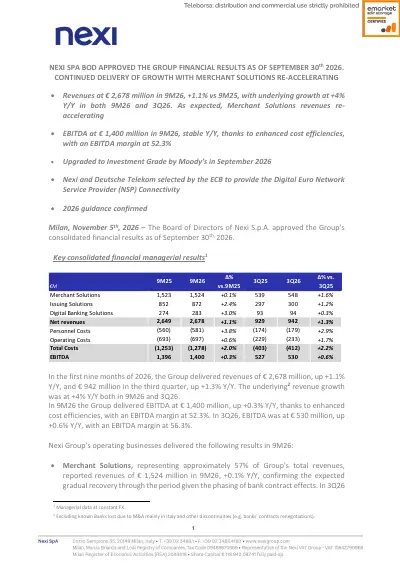
In the first 9 months, net revenues grew by 1.1% year-on-year to approximately €2.68 billion. Growth picked up to 1.3% in the third quarter, reaching €942 million, driven by Merchant Solutions.
I'll cover this in more details shortly. On an underlying basis, the group grew by approximately 4% in both the quarter and year-to-date.
EBITDA was €1.4 billion in the first 9 months, up 0.3% year-on-year with a margin of 52.3%. In Q3, it rose by 0.6% to €530 million, with a margin of 56.3%.
These results reflect our continued investment in the business and disciplined cost management. I'll return to expense later, even adding a few more comments to what Bernardo said, but I'm pleased that we have managed opex year-to-date increase to 2% despite inflationary pressures and higher volumes.
Once again, we have done so while continuing to fund the strategic priorities outlined during our recent Capital Markets Day. Let me now turn to Merchant Solutions, where the third quarter shows a clear improvement.
Revenue progressed from -1.4% in Q1 to -0.2% in Q2, and +1.6% in Q3, delivering the recovery we anticipated on our previous calls. We achieved this growth despite subdued macroeconomic conditions, as anticipated during Q2 earnings meeting, mainly in Germany in the hospitality sector, and some softness on large and key account segment, again in Germany.
This illustrates the benefits of our geographic diversification, as highlighted at the start of the call. Third quarter net revenues reached €548 million, bringing the 9-month total back into positive territory at €1.52 billion circa.
This progression reflects also the phasing of the previously disclosed bank contracts effects, which continue to affect the reported performance. Underlying revenue growth remained at approximately 3% in both the third quarter and the first 9 months.
The value of managed transaction increased by just shy of 3% in the first 9 months, also supported by the ramp-up of the Nexi Bancomat processing hub in Italy. On the commercial side, we continued to make progress with ISVs and with our direct channels.
Upselling of value-added services also supported revenues, while e-commerce delivered double-digit growth in the third quarter. All of these initiatives were covered during again our recent Capital Markets Day.
Moving to Issuing Solutions, healthy volumes growth and commercial initiatives continue to support the business. Revenues increased by 1.2% year-on-year to approximately €300 million in Q3, bringing the 9-month total to approximately €872 million, up 2.4%.
As expected, the quarterly growth rate reflected the impact of the previously disclosed bank contracts. The value of managed transaction increased by 6.4% year-on-year in the first 9 months, with continued growth in international schemes and the contribution from the ramp-up of the Nexi Bancomat processing hub in Italy.
The business also benefited from the already mentioned new client onboarding in DACH, the continued success of international debit in Italy, and the upselling and cross-selling of value-added services. In the quarter, the favorable timing of certain projects and initiatives partially offset the bank contract effect we have discussed also in the past.
Turning to Digital Banking Solution, revenue increased by 3% in the first 9 months to €283 million. In Q3, they were broadly stable at €94 million, up 0.3% year-on-year, reflecting the phasing effect, again, we have discussed so many times in the past.
The business continue to benefit from higher volumes in SEPA clearing, open banking, and our bank instant payment hub. New initiatives also contributed, including the digital euro project and Zipay, our account-to-account solution for Irish banks, alongside new customers in network services, pagoPA bill payment campaigns, and projects related to bank M&A.
Softer quarterly growth, therefore, reflect timing across the year rather than a change in these drivers. Turning to the geographic picture, diversification again helped us balance different regional trends across quarters.
Starting with Italy, revenues increased by 0.7% in the first 9 months. Merchant Solutions continued its gradual recovery as the impact of the previously disclosed bank contract effect eased.
Issuing Solutions also contributed, supported by international debit and other commercial initiatives. Overall growth was stronger in Q3 than in first half, despite less favorable phasing in Digital Banking Solutions, which shows a decrease quarter-on-quarter because of the known timing issues I've just covered.
In the Nordics, revenue declined by 1.3% year-to-date, with a sequential growth improvement in the third quarter. Merchant Solutions accelerated, supported by e-commerce and value-added services, partially offsetting the continued impact of the previously disclosed issuing client migration at the end of '25.
In DACH, revenues increased by 4.3% in the first 9 months, although the third quarter was weaker. The challenging macro environment in Germany that we discussed at the half-year results persisted, particularly in hospitality, where we have more or less a third of our business, if we think about Germany.
The large and key account segment also faced pressures. Issuing Solutions benefited from the previously disclosed client onboarding, while ISVs continue to perform strongly.
These positive contributions were not enough to offset the headwinds in Merchant Solutions during the quarter. Said that, Germany continues to be for us a growth engine, as highlighted once again during the Capital Markets Day.
Finally, CEE revenues grew by 3.6% in the first 9 months, with a clear acceleration in Q3. A strong contribution from Merchant Solutions supported this improvement, balancing the effects of shifting volume mix and competitive pressure in Polish e-commerce.
Now, let me turn to cost. In the first 9 months, total costs increased by 2% to approximately €1.28 billion, despite, as said, higher volumes, inflationary pressures, and continued investment in our strategic priorities.
In Q3, costs were approximately €412 million, up 2.2%. As we highlighted during Q2 call, spending can shift between quarters, the year-to-date figures remain the most meaningful measure of our cost trajectory.
Year-to-date personnel costs increased by 3.8% year-to-date. Virtually all of this variance reflects salary increases carried over from 2025 and higher average headcount versus the same period last year.
The average, however, does not reflect our current staffing level. Headcount has since declined and was below its year-end 20 25 level at the end of September.
These effects were partially offset by the cost-containment measures we began implementing straight away in May, which are now showing benefits. Operating costs increased by just 0.5%, despite volume growth and, as said, inflationary pressure.
Overall, I'm encouraged by the results of our cost discipline. Importantly, these efficiencies are not coming, once again, at the expense of our strategic investments.
We continue to fund the initiatives required to support the future revenue growth, innovation, and the quality of services we provide to our customers. Now, to conclude, our 9-month results demonstrate once again the resilience of Nexi diversified business.
Underlying revenue growth was approximately 4% in both Q3 and year-to-date, with Merchant Solution continuing its gradual recovery. EBITDA increased by 0.6% in the third quarter, as said, supported by disciplined cost execution.
We enter now the final quarter focused on building on this progress. As noted in our half-year results, this includes the important year-end trading period, with its usual seasonal patterns in consumer spending.
We confirm our 2026 guidance: net revenue growth broadly in line with 2025, EBITDA in absolute terms broadly stable, and excess cash generation of approximately €750 million. Our confidence in delivering this commitment is supported by the flexibility we retain in our cost base and our continued focus on cash management.
We will maintain this discipline while protecting the investments that support Nexi future growth. With that, I will hand the floor back to Bernardo.
Bernardo Mingrone
Thanks Piergiorgio. We're happy to take any questions now.
Operator
Excuse me, this is the Chorus Call conference operator. We will now begin the question and answer session.
Anyone who wishes to ask a question may press * and 1 on the touch-tone telephone. To remove yourself from the question queue, please press * and 2.
Please pick up the receiver when asking questions. The first question is from Justin Forsythe from UBS.
Please go ahead.
Justin Forsythe
Hey, good morning, Bernardo, Piergiorgio. Thank you very much for letting me on here.
A few on my end. First, just wanted to ask around the 4Q implied here.
The range is quite broad based on the guidance for broadly similar to last year, depending where we land within that. Could you just confirm whether we're expecting to see a reacceleration continue in MS, i.e., move a bit above where you landed in the 3Q?
I think there's also quite an easy comparison in Issuer, understanding the split of that expected continued acceleration would be helpful. Then I wanted to take a step back and look at the segmental EBITDA that you shared from the half-year financial statements, because we saw another step-down in 1H Merchant Solutions EBITDA margin.
Maybe you could just help us walk through the moving pieces there. I appreciate that Italy bank M&A is an impact, but even if you exclude that, it looks to me, if I have it correct, that the margins still would have stepped down.
Should we think of that as a combination of installed-base revenues declining or investments in the direct sales force in Italy? Then just on that direct sales force point, as a follow-up, could you just remind us on the efforts to win back lost volumes with your direct sales force, and just remind us around the margin contribution of the direct sales force and whether that had any drag on the margin profile?
Thank you very much.
Piergiorgio Pedron
Hey, happy to take your questions. Let me start from the implied 4Q.
Yes, as you said, and as I believe we also discussed a few times during the prior quarter calls, we do expect an acceleration of the MS sales in 4Q. There are still some moving parts.
As we said, 4Q, you have the spending season, but by all means, we do expect an acceleration there, also coming from as discussed once again, a lower impact of the bank contracts effect in 4Q. Also, if we look at the different dynamics across the different geographies, we see some positive trends.
Let me underline once again that the 3Q acceleration in MS has happened in spite of a weaker performance in Germany, which was not expected obviously when we put together our budget last year. Long story short, the answer is yes, we do expect that acceleration.
Then coming to the EBITDA margin question, I believe I've covered a few times that concept during my remarks, that we're still investing to sustain our strategic initiatives. One of those strategic initiatives was investing in direct sales, as said, and there you should expect some kind of time lag between the moment in which you do that investment and when actually you see the benefit of those investments.
We're monitoring those KPI pretty tightly, right? Usually, we do see once again, as expected, the time lag.
I wouldn't read too much into that kind of slight variances quarter-to-quarter. I would say the main reason, as you pointed out, is that investment.
Plus, like always, it's a pretty big business unit and you have plus and minuses. You have still, let me say, 25-30% of our MS revenues which are linked to projects, and there, as you can expect, margins are different from what you get from your, let me say, volume-driven business.
Also there, a different mix in terms of how those numbers move can move some decimals, if you wish, quarter-to-quarter into the profitability number.
Bernardo Mingrone
No, I would also add, let me interject. I think, Justin, I don't know how you calculated the bank contract effects on EBITDA, but you should always remember that when you lose a customer who's processed or managed on a shared platform with another 100 banks or so, the revenues you lose are pretty much a one-for-one hit on EBITDA.
In the first half on MS, we still had a big impact coming from that.
Justin Forsythe
Got it. No, that's really helpful.
Makes a lot of sense. Congrats on a nice quarter.
Cheers.
Bernardo Mingrone
Thanks.
Operator
The next question is from Josh Levin from Autonomous Research. Please go ahead.
Josh Levin
Hi, good morning. Two questions from me.
The first one is about underlying growth versus actual growth. Again, I think there was a gap of roughly 300 basis points between the reported and the underlying growth.
When do you expect reported and underlying growth to converge, and what will drive that convergence? Then, I know it's a bit early, but when you look at 2027, what actually improves in 2027?
What is the best evidence today that next year can deliver better revenue growth and operating leverage? Thank you.
Piergiorgio Pedron
Hey, happy to take your question. I believe if I go back with memory to what we said during the Capital Markets Day, we said that in 2027, the impact of the bank contracts would have been more or less similar to what we had in 2026.
I believe I remember there is a nice chart where you see a graph with the underlying growth and the reported growth getting closer in 2028. The answer to your question is that we still expect that kind of variance to be there in 2027.
The gap is going to close in 2028. Then I believe your second question was about 2027, if I...
What
Bernardo Mingrone
will change? Let me change that.
I think 2027 will be broadly similar to 2026, as Piergiorgio was hinting at, both in terms of market effect or the discounts or the banks that we lost, the renewals that we discussed back in March. It shifts from MS to Issuing, and hence we have an acceleration in MS and a slowdown in Issuing.
This is, unfortunately, what we predict happen and what is basically going to happen given what happened back in 2023 and 2024. In terms of the overall context, I think, again from a macro perspective, I hope as a European citizen that things improve next year, but I would expect them to be broadly similar to this year.
I think we will have the benefit of the investments we're making in the sales force, which have an 18-month payback period. We'll have the benefits of our investment in our ISV convergence strategy, new products and services we're putting into the market, the merchant financing products.
All of these things will help sustain the top-line growth, but I don't think we'll have any kind of tailwind coming from the market, the overall macro environment, or the disappearance of the market risk, as we termed it, the bank contract effects, next year. We'll need to wait for 2028 for that.
At the same time, I think it's important just to underscore how, in this context of growth in revenues, because unlike other companies in the space, we continue to deliver top-line growth on a net revenue basis. We continue to accelerate in terms of generating cash and distributing this thanks to the fact that we're able to optimize our cost base and extract synergies whilst at the same time growing the top line.
Josh Levin
Thank you.
Operator
The next question is from Sébastien Sztabowicz from Kepler Cheuvreux. Please go ahead.
Sébastien Sztabowicz
Hi everyone, and thanks for taking my question. I understand that MS is likely to accelerate further in Q4.
How do you see IS trending into Q4 given the Banco BPM contracts run-down? A second question is on the free cash flow.
We have seen the net debt position deepening a bit. Could you comment a little bit on the free cash flow dynamic in the third quarter, and how do you see the trends moving into Q4 for the cash flow?
Thank you.
Piergiorgio Pedron
Okay. Hey, Sébastien, this is Piergiorgio speaking.
On IS, as I believe we said a few times, we were expecting a major impact of this overall, let me call in that way, bank contracts effect in H2, and we already saw a deceleration in Q3 compared to what we experienced in Q1 and Q2. Likewise, our expectation is that you are not going to see a dramatic increase in Q4.
Said in different words, we are not expecting a very strong Q4. Once again, let me remind you that when we talk about the quarterly sales of IS, we are talking about, give or take, €300 million, right?
A couple of million, €3 million can change decimals, but like always, I wouldn't read too much into it. I believe the phasing concept stands, and it is what we discussed during...
Bernardo Mingrone
On cash flow, let me jump in there, Piergiorgio. I think, remember that the third quarter is the quarter, September in particular, when we pay taxes, and we expect a higher tax or we have had a higher tax burden this year compared to last year.
I think we discussed this back at the guidance. I would refer back to the only publicly disclosed information we can comment on, which was the first-half results, where we had a cash flow generation of €400 million, which stands us in a very good position to deliver and hopefully overdeliver in terms of our target for the year.
Remember, obviously, the fourth quarter is the strongest one in terms of cash generation, given the festive season and everything which goes on in November with the sales front and then
Piergiorgio Pedron
Christmas.
Bernardo Mingrone
I think on the cash front, you have a bit of timing because of tax in Italy in particular, which is clearly the biggest taxpayer, and then we expect a good fourth quarter in terms of cash generation such that I think we are very comfortable with our guidance there.
Sébastien Sztabowicz
Thank you.
Operator
The next question is from Hannes Leitner from Jefferies. Please go ahead.
Hannes Leitner
Yes, thanks. I got also two questions.
The first one is BPM Issuing Solution headwind started later this year, in theory, shouldn't you trend ahead of the growth rate for this year to hit the 2%? Maybe you can comment on that, and maybe that leads to a little bit more of the macro pressure you are seeing, and how do you compensate that?
Then maybe the second one is on Germany. You called out hospitality is 1/3 of your business.
I think it's also this segment where there are a lot of competitors, new startups pushing into the market. Can you talk how do you address those threats, competitive threats in Germany, and how much is there a risk that that could also spill over to Italy?
Thank you.
Bernardo Mingrone
I'll let Piergiorgio, who's been working a lot with our German colleagues and Germany, field the German question. On Banco, you're right.
Banco, I think we had mentioned that it was expected to start in the third and fourth quarter on Issuing, and I think they're coming to terms with the difficulty in terms of migrating these on the Issuing side, in particular processing contracts, and obviously that's to our benefit. You're right, I think the overall environment as a group is worse than what we were hoping for back in March.
We spoke to Germany as one of the reasons, and the two upset each other, you have a bit of support coming from slower migration in Banco and a bit worse macro. Also, from the competitive standpoint, you're right.
We are facing competition. I wouldn't say it's particularly increasing.
I think competition has been present in the space at least in the last 10 years since I've been here. We've always had a lot of competition in the space, given that it attracts competitors given the attractive dynamics, right?
Growing volumes and so on and so forth. The two do kind of upset each other, such that we're expecting, as I said, to our growth in the top line to be broadly in line with last year as per our guidance, maybe with different composition to it.
Let me have Piergiorgio give you more detail on Germany.
Piergiorgio Pedron
Thank you Bernardo. A few comments on Germany.
I would say that most of the headwind which we are seeing in the hospitality sector, that yeah, I mean it represents more or less 1/3 of our sales there, with different concentration between large and SMEs, it's actually coming from macroeconomic effects, right? I believe we said during Q2 calls that we've had the highest we have seen the highest number of insolvencies in that sector, even worse than COVID, and since our business was concentrated there, obviously, we felt that in our numbers.
Then, if I can explain a little better also on large, we have some headwind there also because we decided to, let me say, let go a couple of big customers there in order to better manage our risk. Actually, one of those customer, which was an hotel chain, eventually went bust, I believe it was a smart thing to do.
Said that, in Germany, our market share is we are a challenger there, as we like to say. I believe we have, off the top of my head, 10-15% market share, which means we still have plenty of different sectors to go hunt.
If you think about the fact that, we have 30% of our business in hospitality sector. We I'm still we are all still super positive about this market.
I've had the chance to work a lot with the German colleagues over the past couple of months, to deep dive into numbers and to understand how they're planning to, let me say, manage the situation we have in front of us, and there is a there are plenty of opportunities and a ton of excitement about, what we can do in in that market. In terms of competitor dynamics, I would say the competition dynamics we see in Germany are not very far from what we see in other geographies.
I'm not particularly worried about any kind of spillover from German market in terms of new competitive threats to Italy, Nordics, or the other geographies in which we we do business.
Bernardo Mingrone
I think one of the things that Hannes was referring to was kind of competitors' product capabilities, etc., specialized verticals within the ISV space in particular. I would highlight how, to the extent that we are lacking our own capabilities, at times we own them, verticals like in the restaurant space in Germany, we own an ISV called orderbird.
At times we partner, and I would highlight we have an interesting partnership with Planet, who's obviously very strong in the hotel space. I think we have the full suite of capabilities and products to be successful.
As Piergiorgio said, I think, other than macro being a bit of a drag there, I think we remain pretty bullish and hopeful in terms of our ability to generate growth, significant growth from Germany in the medium to long term.
Hannes Leitner
Great. Thank you.
Just a quick follow-up on your comments, Bernardo, on 2027. Do you see that's basically stable growth to 2025, or 2026 guidance, and stable EBITDA is kind of where you see today?
Clearly, it's not a guidance as of yet. Is that what you see at the moment?
Bernardo Mingrone
I see that we're going to have a meeting in March when we can discuss this publicly. Thanks for the try.
Hannes Leitner
Sounds good.
Bernardo Mingrone
All right.
Operator
The next question is from Gabriele Venturi of Banca Akros. Please go ahead.
Gabriele Venturi
Good morning, and thanks for taking my question. Could you give us some more color on how material you expect digital euro-related revenues to become in, let's say, 5 years from now, perhaps as a percentage of group revenues, and whether you expect those related margins to be above or below the current group average?
Thank you.
Bernardo Mingrone
Sorry, I got the question on the digital euro, I didn't quite get the last one, let me just answer on the digital euro. It's very hard for me to make a prediction so far out.
I think the digital euro is happening, for starters. It will be introduced in the market in 2029.
From a kind of platform provision perspective, I think we have a very attractive opportunity to be a provider to the hundreds and hundreds of European banks of system-wide solutions to be able to manage the introduction of the digital euro, so as a PSP in terms of allowing merchants to accept the digital euro, which will be legal tender. The infrastructure part, I think, is something where we expect the opportunity to be significant, also materiality-wise in terms of our revenue base.
I can't quantify it, but there's a huge amount of studies of how much the digital euro will cost banks to implement and merchants and PSPs to implement the digital euro, and we hope to take our fair share of that kind of revenue pool in terms of providing these products and services to them. In terms of the adoption of the digital euro, it's anyone's guess, and it will take a while, I would say, for the digital euro to be widely adopted, like for all payment method changes.
I think I see for us a very important opportunity there. What about the second question?
Sorry, didn't quite get that one. I think it was on leverage.
Gabriele Venturi
It was about marginality of digital euro-related revenues, if above or below the current group average.
Bernardo Mingrone
Okay. Clearly the nature of what you do in terms of digital euro will affect the marginality, but I would say that, in general, infrastructure kind of work we're doing now has a marginality which is lower than the average for the group of DBS, given its specific infrastructure-like nature.
Going forward, if it becomes a retail product, then it might be higher, but it's really pretty early for us to be able to make any assumptions on that.
Gabriele Venturi
Thank you.
Operator
The next question is from Aditya Buddhavarapu from Bank of America. Please go ahead.
Aditya Buddhavarapu
Good morning, Bernardo, Piergiorgio. Thanks for taking my questions.
A couple from me. Could you just comment on any trends you're seeing across the different markets?
For example, in Germany, you talked about the macro pressures, anything you can say about some of the other markets as well so far? Then on the cost growth, you mentioned you're running at about 2% growth year-to-date versus the 5-6% you talked about earlier in the year.
When we think about 2027, which of those cost efficiency measures should continue to have a benefit, and how should we think about that helping opex growth next year as well?
Piergiorgio Pedron
Hey, Aditya, hi, this is Piergiorgio speaking. Happy to take your question and, again, good morning to you.
Let me start taking your question about, if I got it right, the different trend across different geographies. Let me start saying that eventually what we see is a generalized volume growth across all of our different geographies, which has been driven by the known, let me say, still cash-to-card conversion that we see, then you have a different dynamics across different countries that we're trying to monitoring, obviously, countries growing at slightly higher speed and lower speed.
Generally speaking, and I have in front of me the growth by geography by quarter, as I hinted during my remarks, I believe we see overall, a nice acceleration in Italy, where we reported three consecutive quarters of sequential growth, and I'm talking MS now, but overall also it's the same story for the overall revenues of the region, with the only exception of some ups and downs linked to the DBS business that we have discussed many times. Nordics, I would say the growth is even more material, the sequential growth quarter-on-quarter.
We started Q1 in a slightly negative territory and we closed Q3 with a solid MS growth quarter-on-quarter. There in Nordics, remember, we have the impact of the customer in IS business that migrated, as we have discussed several times, but positive volume, positive trends, and in Nordics, let's remind ourselves that we also see very good traction of e-com, which is coming working our way.
I believe I've discussed about Germany, about the challenges we're facing, and about how optimistic we are with the future recovery of our business there. CEE, you have several different countries there, each one with its own dynamics.
I believe we discussed in the past about the headwind we're facing in the e-com business in Poland, but if you put that aside, and also there we are recovering, overall we see a good trajectory. Actually, the MS growth in Q3 in CEE was the strongest we experienced since the beginning of the year, very optimistic about that as well.
I believe your second question was on cost. I believe both Bernardo in his introductory remarks and myself, we discussed about how, let me say, comfortable we are with the dynamics of our cost evolution, the fact that, I would say, all of the growth that we see in our cost base, and let me underline all that we see in our cost base in 2026 is coming from a carryforward, spillover, call it as you wish, effect of things that happened in 2025, and considering that, let me say, we started these reorganization cost-containment initiatives, as we call them, in May, I think the results are pretty material.
As I think I said a few times during my written remarks, it's important to say that these did not come at the expense of not investing in our strategic priorities. We actually did.
We continued to invest in the strategic priorities that we highlighted during the Capital Markets Day. There, being cost, we retain higher, let me say, a flexibility on how we manage those costs, but, as again Bernardo said, I believe I'm comfortable that you won't see any big acceleration in our cost base in Q4.
Aditya Buddhavarapu
Got it. Thank you.
Operator
The next question is from Alexandre Faure from BNP Paribas. Please go ahead.
Alexandre Faure
Good morning. Thanks for letting me on.
Just wanted to go back to the sort of growth commentary again. I think, Bernardo, you commented a few moments ago, I think it was answering Josh's question, and on the spread between underlying and reported growth in 2027, and I think you commented that we should think of it as being very consistent with what you're expecting for 2026, which makes a lot of sense to me.
Could you help us assess the benefits and drags you anticipate for underlying net revenue growth next year? You alluded to some of them in the new sales force being a positive, obviously, new products that you intend to push with ISVs, I suppose you'll be lapping the lower e-com pricing in Poland quite early in the year.
I think we have a few ideas, but it would be great to hear from you how you're thinking of all the potential benefits and drags on an underlying basis as we go into next year.
Bernardo Mingrone
I would say, the underlying growth is slightly lower now than it was in previous quarters, right? We've dropped a few decimal points or percentage, which are roundings from 5%, I think, round to 4%, more or less.
More than this being coming from the competitive pressure or pressure on margins coming, as I mentioned, Poland, I think we discussed it in the past and Poland e-commerce, whereas on the physical channel, I think, in-store, we're doing very well. It's growing very healthily, both thanks to new products, market share, I would say slight gains.
I wouldn't say we're increasing our market share in Poland very substantially in the physical space, but we're definitely doing well in terms of our margins, thanks to the new products and services we're launching in the market. We have a full suite of products there.
It's coming from the e-commerce, which we mentioned in the past. I wouldn't say that we're losing underlying growth from margin pressure.
We're having, I would say, some market share erosion in those countries in which we are the largest players, and this is a trend which we've seen in the last couple of years. It's something we are combatting, and the direct sales channel is obviously something that we're putting or we have put in place and will continue to build on to combat this, and it's showing, when it goes into full swing, it's showing its effectiveness.
In general, the biggest effect, I would say, and this is on the margin, is the macro that we've talked about, and that is clearly impacting us. I think we've spoken a lot about Germany, and Germany is probably that region within the perimeter that Nexi operates in where it's most felt for two reasons.
One is the economy is obviously under a huge amount of pressure, and we've all read about the difficulties of the German economy. Secondly, because of, let's say, our exposure within the German market to certain sectors which are most hit.
That's what is really impacting the underlying growth most, I'd say.
Alexandre Faure
Got it. Thank you very much.
Operator
The next question is Nooshin from Nooshin Nejati from Deutsche Bank. Please go ahead.
Nooshin Nejati
Hi. Thanks for taking my question.
Actually, it's a follow-up on the previous question. On Merchant Services, what I'm asking again, what gets you beyond the 3% underlying growth you're seeing today?
Is it mostly contract effects rolling off or is the underlying business actually accelerating? Beyond the geographic trends you have already discussed, how are you actually seeing the traction coming through?
Is it ISVs, e-commerce, partnerships, or new customer wins? Are any of those channels now meaningful enough to drive an acceleration from the 3% underlying growth?
My second question on the bank contract renewals, can you shed some color on the economics of those renegotiations? To what extent are renewals coming with some pressure on pricing, and should we think about structurally lower economics on future renewals?
Thank you.
Piergiorgio Pedron
Hey, happy to take your first question, and then I guess I'll leave the second one to Bernardo. Eventually, what gives us confidence that eventually the underlying growth for the MS business is going to pick up is basically what you hinted at during your question.
I believe we've been pretty diligent in highlighting all the different initiatives, key strategic initiatives, which are the one we keep on investing to sustain our MS business, and you mentioned a few of those, ISVs, for example, direct sales, e-com, which we are tackling very closely on a monthly basis, and we see a lot of very positive signs there. I believe we wrote somewhere in our market presentation that we saw double-digit growth in e-com in Q3.
ISV, once again, is going very, very well across all the different geographies. Same story for the direct sales organization.
We have been hiring consistently over the past few months, and we put in place a series of KPI to monitor exactly how our new colleagues can affect the MS performance, and we see some positive signs as well there, right? MS is a very big business unit, off the top of my head is €2.1-2.2 billion, it takes a while for these effects to pile on, but what we are seeing give us confidence that we will get there.
Bernardo Mingrone
On contract renegotiations, I think was the second question. We are unable and unwilling to comment on any individual renegotiation, and they tend to be associated, as you suggest, with discounts, although it really depends on what you're renegotiating.
If it's a plain, simple renegotiated extension of an existing, I don't know, servicing or processing agreement, that will be accompanied by steep discounts. More, obviously our work is to try and broaden the products and services we offer our customers and compensate that with other products and services.
Indeed, when I was mentioning the 100% renewal track record we've had in the last couple of years, one contract we are in the process right now of discussing with a partner bank is indeed one in which we proposed them to as at the expiry to move on to a different service model where we do more for them, and that contract might have actually a unit pricing which is lower given the larger volumes today than when we first struck the initial deal with them, but at the same time carries a lot more products and services we offer them, and the overall economics for us are incremental also with higher margins, because the different nature of the products and services we are providing them. I think it really depends on each individual negotiation.
We can't comment on any one specifically. In general, depends if you're extending an existing contract, no changes, discount.
If you're successful in adding products and services, you might be able to mitigate, at least in part, that discount and indeed, at times, also do better than before.
Nooshin Nejati
Very helpful. Thank you.
Operator
The next question is from Antonio Gianfrancesco from Intermonte. Please go ahead.
Antonio Gianfrancesco
Yes, good morning, and thank you for the presentation, and thank you for taking my question. Just one from my side, and it is on the potential upside on 2026 EBITDA guidance, because given the cost savings delivered so far, and assuming, let's say, the same pace also in fourth quarter, I want to understand if you see some space to outperform the full-year guidance in terms of EBITDA, considering, let's say, that revenue growth may be below target, but in any case accelerating in fourth quarter also due to the Issuing headwinds from the bank contracts.
Thank you.
Piergiorgio Pedron
Happy to take your question, Antonio. What I can say, as I said, let me try to wrap it up.
We are very comfortable with our handle on our cost base, and we are very comfortable with the fact that we will not grow our cost base at 5-6%, which I believe was the number we put out there during the Capital Markets Day. Q3 and year-to-date is a testament to that, and that trend will broadly continue in Q4.
Very comfortable that we will be delivering our EBITDA guidance, absolutely there. Q4 is the biggest spending season.
I believe eventually Q4 represents 26-27% of our total yearly sales, and so a few swings of a few, let me say, beeps there, a few million more or less, which goes straight to the EBITDA, can make a difference. I would say that for the time being, it's too early to say if we will do better on EBITDA.
I can say that we feel super comfortable that we will be delivering that EBITDA target.
Antonio Gianfrancesco
Thank you. Very clear.
Operator
The next question is from Craig McDowell from JP Morgan. Please go ahead.
Craig McDowell
Hi, good morning. Thanks for letting me on.
Just one, please. It's more of a longer-term one, but, Bernardo, would like to hear your thoughts on what you think the higher cost of capital does to industry structure and the degree of competition in MS, in particular private competitors who might be operating with more leverage here.
With higher financing costs, do you think this will reduce their ability to invest and perhaps lead to a bit of an industry shakeout? Any early evidence you're seeing of this?
Thank you.
Bernardo Mingrone
Thanks for that question, Craig. I think that hopefully the higher cost of capital will make the sector more selective in terms of favoring companies with a sounder balance sheet structure, companies which are generating positive cash, that are investment grade compared to companies that are running substantial losses and burning cash.
That hopefully will help, but, that said, this is my opinion. It's more let's say a wish than a fact or grounded in any kind of evidence that I have in seeing kind of the presence in the sector being somehow curtailed by greater, stricter, let's say, lending practices or more difficult access to capital, at least for the time being.
Over time, this should be the case and it should be positive for us. That is why we're so determined to keep our balance sheet strength, our investment grade status, our continued path on deleverage, because I believe it's a distinguishing factor, a strategic advantage for us.
Craig McDowell
Great. Thank you.
Operator
Mr. Mingrone, there are no more questions registered at this time.
Bernardo Mingrone
Thank you all very much for your time this morning, and we'll be seeing some of you in the coming days, and if not, we'll speak again at our next call at the beginning of next year. Thank you very much.
Bye-bye.
Operator
Ladies and gentlemen, thank you for joining. The conference is now over.
You may disconnect your telephones.