Stellantis N.V.
Q3 FY2026 · Earnings Call TranscriptOctober 28, 2026
Operator
Hello, and welcome to the Stellantis Q3 2026 financial results call. You will have the opportunity to ask questions at the end of the call by typing pound key 5 on your telephone keypad.
Please do not exceed one question per person and, if necessary, an additional one. I now give the floor to Mr.
Charlie Christman, Head of Investor Relations, to begin today's conference. Sir, the floor is yours.
Charlie Christman
Thank you. Hello everyone, and thank you for joining us today as we review the Stellantis Q3 2026 results.
Earlier today, the presentation material for this call, along with the related press release, were posted under the Investors section of the Stellantis Group website. Today, our call is hosted by Antonio Filosa, Chief Executive Officer, and João Laranjo, Chief Financial Officer.
After their prepared remarks, Antonio and João will be available to answer your questions. Before we begin, I want to point out that any forward-looking statements we might make during today's call are subject to the risks and uncertainties mentioned in the Safe Harbor statement included on page two of today's presentation.
As is customary, the call will be governed by that language. Now I will hand the call over to Antonio Filosa, Chief Executive Officer of Stellantis.
Antonio Filosa
Thank you, Charlie. Thank you all for joining us today as we discuss our quarter three results.
As we anticipated in our second quarter call, several factors have weighed in our third quarter performance, such as lower volumes due to the planned summer shutdowns, particularly in North America, and raw material inflation. That said, we are beginning to see early benefits as we execute our Fast Lane 2030 strategy.
For example, we are heavily focused on implementing our Value Creation Program, or VCP, with many initiatives being implemented ahead of schedule. The strategy is delivering.
Despite the headwinds, we improved across all our financial metrics year-over-year. Net revenues are up 1% despite volume being down 1%.
AOI margin is up 50 basis points, and it is positive in all regions except Europe, where the pricing environment remains challenging. Industrial free cash flow, which is negative in quarter three due to the seasonality of our business, is up €300 million compared to last year.
Importantly, our industrial execution also continues to improve. Overall production efficiency was up year-over-year, with North America improving by more than 10 percentage points.
Three months in service quality improved significantly year-over-year, by 43% in North America and 13% in Europe. We continue to expand market coverage by introducing new products, which is a key pillar of our Fast Lane strategy.
In the quarter, in the third quarter, we launched the Jeep Recon BEV and the Peugeot E-208 GTi. We look forward to launching seven more products in the coming months, on time, with the right cost, and with the right quality.
At the same time, we are making great progress with VCP. Based on what we have implemented already, I am confident that we will exceed our plan to implement 40% of the initiatives comprising the €6 billion target by the end of this year.
VCP already contributed to our results in quarter three, and it will provide even more of a tailwind in quarter four. With this, I can say we are on track to realize more than €2.4 billion in '27, plus the partial benefits of all the initiatives we will implement in '27.
In addition to this progress in market coverage and VCP, we are also accelerating our work with strategic partners, which is a key pillar of our Fast Lane plan. These partnerships are reducing fixed costs by absorbing excess of capacity, while at the same time allowing us to be more efficient in capital spending.
We look forward to sharing more in the coming months. With this, and despite the market challenges you are all aware of, I am pleased to again reaffirm our guidance for '26, including that we expect to be free cash flow positive in '27.
Now let me touch on some quarter three regional highlights. In North America, Stellantis is among the fastest growing OEMs year-to-date, once again gaining share year-over-year.
Ram has led the way as the fastest growing brand in the region, both in the quarter and year-to-date. In the US alone, the Ram 1500 light-duty pickup grew 73% year-over-year.
Next, Ram will launch the Ram Rebel sport truck, which is already generating strong customer demand. Its initial allocation sold out within 24 hours of orders opening.
We have also now launched the Jeep Recon, the first and only BEV to be Trail Rated. Soon, we will be the first to market with two new products where no one else is competing today.
The Ram ProMaster City will be the only mid-size commercial van available in the US, and the Jeep Grand Wagoneer REEV will be the first and only large SUV to offer range-extended hybrid technology. Turning to Europe, the region remains challenging, with ongoing Chinese competition and a difficult pricing environment.
Despite this, we continued to grow in the region, with strong demand for the Smart Car platform nameplates and surging demand for BEVs, particularly in France, Germany, and the UK. Our Euro 30 passenger car BEV sales grew 65% year-over-year, or 93% including Leapmotor.
Shifting to Pro One, we remained market leader in light commercial vehicles with almost 27% market share. In November, we will expand our light commercial vehicle lineup with the introduction of the Pro One Smart Car compact van.
In parallel, Leapmotor continues to grow rapidly, with volumes up fourfold year-over-year, demonstrating our Fast Lane partnership strategy in action. Production of the C-segment cars, starting with the B10, have begun at our Zaragoza plant in Spain, with the B05 planned to follow in the first half of '27.
Bringing these vehicles into our manufacturing footprint helps improved capacity utilization and absorption of fixed cost. Finally, it is important to note that strengthening our competitiveness will also require the right conditions in Europe.
Despite the strong growth in BEV demand, timely action on CO2 flexibility and the Made in Europe framework are essential to creating a level playing field. Turning to South America, in a challenging market, sales declined 2% year-over-year when you include Leapmotor.
That said, we maintain our clear overall leadership position with almost 19% market share, including Leapmotor. Importantly, we also remain number one in the region's two major markets, Brazil and Argentina, each with more than 25% market share.
We increased sales in the region for important models, including a 33% increase for the Ram brand, driven by the all-new Dakota mid-size pickup. In Brazil, we increased sales 5% year-over-year to over 200,000 units, mostly driven by Fiat and Ram pickups, which represent the largest profit pool in the region.
Moving to Middle East and Africa, we remained resilient despite weaker market conditions, particularly in Turkey, where the transition from the Fiat Egea to the upcoming Fiat Grizzly contributed to a 1.5-point year-over-year decline in regional market share. At the same time, as planned in Fast Lane 2030, we are increasing localization in the region.
Small van production began in Turkey in October, and sales of locally produced vehicles in Algeria, a very important profit pool, increased 22%. Lastly in APAC, while market share declined by 1/10 of a point, reflecting the increased competition in the region, it is important to note that the region is enabling the rapid advancement of our Fast Lane partnership strategy.
For example, in quarter three, we began localizing production of the Leapmotor B10 and C10 in Malaysia. We also officially established our new joint venture, Dongfeng Stellantis Automotive Technology, allowing for the development of two new Jeep and two new Peugeot models to be sold in markets around the world.
In summary, we navigated a challenging quarter, including lower planned volumes and raw material headwinds, all while improving year-over-year across every key financial and operational metric. We are reaffirming our '26 guidance and our commitment to positive free cash flow in '27.
The challenges are real, but our industrial performance shows that we have a firm grip on the business. Our structured, evidence-based recovery is progressing.
We are taking decisive action to lower industrial costs and build the foundation for stronger financial performance in '27. Let me now hand you to João to walk you through the numbers.
João?
João Laranjo
Thank you, Antonio. While the third quarter was soft, as anticipated, we continue to make progress in our turnaround.
Our actions are delivering results, with year-over-year improvements across our key financial metrics. Let me start with the key figures.
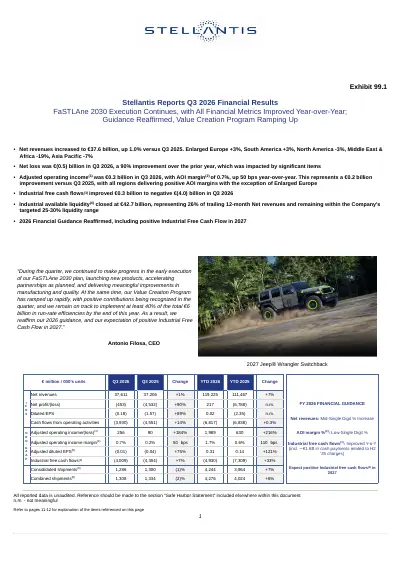
Consolidated shipments were 1.3 million units, down 1% year-over-year, as the increase in Europe largely offset anticipated lower volumes in North America. Net revenues were €37.6 billion, up €0.4 billion or 1% compared with the third quarter of last year, despite volume being down 1%, due to growth in financial services.
Adjusted operating income was €256 million in Q3, an improvement of €166 million or 184% versus last year. AOI margin improved to 0.7%, up 50 basis points year-over-year.
Industrial free cash flow was negative €4 billion in Q3, an improvement of €0.3 billion compared with last year. As Antonio made clear, we are reaffirming our guidance.
Turning to the key drivers of our year-over-year AOI performance. First, on volume and mix.
Overall volumes declined slightly, with the increase in Europe largely offsetting lower volumes in North America and Middle East and Africa, resulting in unfavorable regional mix. Additionally, unfavorable mix was driven by higher LEV penetration in Europe.
Moving to net pricing. Pricing contributed a positive €23 million, with €421 million improvement in North America, offset by continued pricing pressures in Europe.
Lastly, industrial cost. This was the single most significant driver of our performance, with an €828 million year-over-year improvement, reflecting another quarter of cost reduction.
Let me highlight two factors that contributed to this strong performance. First, we maintained our diligent focus on structural cost reductions.
Purchasing efficiencies, including initial benefits from VCP, accounted for the majority of the improvement. Importantly, we expect VCP contributions to accelerate in the fourth quarter and into 2027, as implementation continues to ramp up.
Next, we also benefited from lower CO2 compliance and warranty costs, partially offset by commodity inflation. Overall, these results demonstrate that our cost reduction actions are gaining traction and translating into measurable improvements in profitability.
This will provide an important foundation for continued improvement over time. Finally, SG&A and R&D expenses increased year-over-year, reflecting continued investment to support volume growth and our product pipeline.
Moving to industrial free cash flow. As mentioned before, industrial free cash flow was negative €4 billion in Q3, an improvement of €0.3 billion compared with last year.
This negative free cash flow was driven primarily by seasonal working capital movements, reflecting lower production and shipment volumes in Q3 compared to Q2. Looking ahead, we expect a reversal of these working capital dynamics in Q4, supported by higher volumes, particularly in Europe, and the seasonal reduction in company inventory typically seen at year end.
Finally, capital expenditures declined by €0.5 billion year-over-year. We expect full-year capex and R&D spending to represent approximately 6.5% of net revenues for the year, in line with the Fast Lane investment plan for 2026.
Now shifting to inventory. Total inventory increased 14% year-over-year to 1.4 million units.
That said, dealer inventory declined by more than 50,000 units compared with Q2, primarily reflecting the planned production downtime discussed during our second quarter earnings call. In the United States, dealer inventory increased 23% compared to last year, but declined 6% sequentially, supported by our planned production adjustments in Q3.
We remain focused on aligning production with market demand, balancing volumes with profitability in an environment where we see the impact of higher interest rates on dealer floor plan financing costs. Looking ahead, we expect to close 2026 with US dealer inventory between 320,000 to 350,000 units, compared with approximately 368,000 units at the end of September.
Turning to our regional performance, starting with North America. Adjusted operating income reached €64 million, with a margin of 0.4%, representing a €539 million year-over-year improvement.
This improvement was driven by continued industrial cost reductions, including early benefits from VCP, and favorable pricing, partially offset by lower volumes and higher R&D expenses. In Europe, adjusted operating income was negative €311 million, a deterioration of €468 million compared with last year.
Despite higher volumes and continued industrial cost savings, profitability was impacted by unfavorable mix, reflecting higher BEV sales and persistent pricing pressure. In South America, adjusted operating income reached €431 million, broadly in line with last year.
Volumes increased 7% in Brazil, compensating for declines in Argentina and other markets, while favorable foreign exchange movements offset pricing and mix headwinds. Overall, South America continues to demonstrate resilience despite an increasingly competitive environment.
In Middle East and Africa, adjusted operating income was €244 million, down €28 million year-over-year, primarily reflecting lower volumes in Turkey and the product transition to the Fiat Grizzly. Finally, in Asia Pacific, adjusted operating income improved by €22 million, turning to a profit of €18 million in the quarter.
Looking ahead to the rest of the year, we are reaffirming our 2026 financial guidance, as well as our expectation to generate positive industrial free cash flow in 2027. This reflects the continued execution of our Fast Lane plan, including consistent cost reduction actions.
Let me highlight a few key assumptions underlying our outlook. First, our guidance includes approximately €1 billion of net tariff costs, including the IPA credit recognized in Q1.
This is a modest improvement from our previous estimate of €1 billion to €1.2 billion. Second, our industrial free cash flow outlook includes approximately €1.6 billion of payments related to the charge recorded in the second half of 2025, of which €1.1 billion has already been paid through September.
This compares with our previous assumption of €2 billion for the full year. Finally, we expect capex and R&D spending to represent approximately 6.5% of net revenues in 2026, consistent with the investment framework outlined in our Fast Lane plan.
Turning specifically to the fourth quarter, we expect several important developments. With regard to volumes, we remain focused on profitability and aligning production with demand.
Overall volumes are expected to be higher, primarily driven by Europe. In North America, we are managing inventory, and Q4 will converge to a similar level to where we began the year, considering the introduction of new product offerings.
Our outlook also assumes that ongoing labor negotiations in Canada conclude without production disruptions. Now on to pricing.
We expect pricing to remain broadly stable overall. Pricing in North America is expected to remain positive, while pricing in Europe is stabilizing, but remains a year-over-year headwind.
On costs, we anticipate additional headwinds from memory chips and recall-related expenses. Regarding VCP savings, we expect savings to accelerate in Q4, reaching mid-hundreds of millions of euros, including the carryover run rate of the many initiatives already implemented in Q3.
Finally, on working capital, we expect a positive contribution from working capital in Q4, reflecting the normal seasonal dynamics of our business. All of these factors are embedded in our current full-year guidance.
In closing, while there is still substantial work ahead, we are making tangible progress. Our cost reduction initiatives are delivering results.
Our operational discipline is improving, including manufacturing efficiencies and quality improvements, and we expect these benefits to build as we move into 2027. Thank you.
We will now ask the operator to open the line for questions.
Operator
Thank you. As a reminder, to ask a question, please type pound key 5 on your telephone keypad.
The first question comes from the line of Philippe Houchois from Jefferies, your line is open.
Philippe Houchois
Oh, thank you, and good morning to you. Two questions.
The first one really is if you could quantify a little bit the working capital reversal, because without growth in North America, I'm assuming that most of the reversal will be in Europe, as you have long payment terms and helping the reversal. Should we think maybe half of the reversal that of Q3 into Q4 in terms of working capital, or is that the wrong assumption?
João Laranjo
Hi, Philippe, thanks for the question. We are expecting in Q4 on working capital to basically have working capital for the full year basically flat.
The biggest driver of the working capital improvement in Q4, it's actually inventory, as we sell down the OEM inventory by the end of the year. Usually we stop production before Christmas and we continue to invoice vehicles that we have on stock.
In terms of seasonality, you see, and it's similar to what we had in Q4 last year, you'll see a build-up of OEM stock in the first half of the year, and then by the end of the year we reduce substantially OEM stock, and that's the primary driver of the basically full reversal of working capital in Q4.
Philippe Houchois
Right. If I can stay on the cash flow and follow up on the capex, I think we've all noted that capex was down significantly year-over-year.
You reduced the guidance, but can you tell us why capex is down so much? Is it better productivity?
Is it better focus on spending on fewer areas? Or what is driving the reduction in capex?
João Laranjo
As we said on the prepared remarks, the capex, it's very consistent to what we had on the Fast Lane. As we know, we had a reset at the end of 2025.
We prepared a new product plan, and now we are
Antonio Filosa
on the work on the development of the new products, this is just a normal ramp-up of developing the new products. Again, this is consistent, there is no slowdown, and we are executing Fast Lane according to what was presented in May.
Philippe Houchois
Thank you very much.
Operator
The next question comes from the line of Stuart Pearson from Oxcap Analytics, your line is open.
Stuart Pearson
Good afternoon. Thank you for taking the question.
Can we just dig into the industrial cost tailwind a little bit more? You've mentioned the VCP savings picking up there.
Just as we look into Q4, I just wonder how big that bridge item can be. Just remember from last year there was €2.1 billion of, I guess, non-recurring items actually went into adjusted EBIT.
There was warranty stuff, LCV, CO2 stuff, supplier bankruptcy. I guess a lot of that drops out, a lot of that would have been in Q4, I think you called it out for H2.
If we put that together with what you're saying on the pickup in VCP, I guess against that there's some raw material costs, it feels like that could be quite a material acceleration in the industrial cost line in Q4. I just wondered if you could just help us think about that.
Also that number into 2027, I think you've talked about the run rate getting towards €2.4 billion-ish going into '27. Is that still correct?
You're running ahead of that, and how do you get there from what you're actually doing in Q4? That's kind of the first question just on industrial costs.
Then one just quickly on the financial services business, maybe a bit more of a niche question, but obviously with some strain on the credit at Stellantis, how do you see your ability to grow that captive in the US in particular? Is there a chance you might think about bringing a partner in there, or do you think you can still be competitive on financing in the US?
Thank you.
Antonio Filosa
Okay. Thank you for your question.
I will take the first one, which is on VCP and industrial cost, and I will leave João answering to the second one, which is on financial services. On VCP, as we introduced in Fast Lane 2030, VCP is our way to address one of the three initial issues that we saw in the company, initial gaps, that was for product cost competitiveness, where we highlighted in our analysis a gap with competitors, and we decided to address it with a very broad corporate program, which we call VCP, Value Creation Program.
What does VCP attack? VCP attack the full cost structure of Stellantis.
In simple terms, how this cost structure is divided: the first component is product cost, components, system, subsystem that enter in our products. The second cost component of our cost structure is transformation cost, manufacturing cost.
This is all the costs that happen in our plants to realize our production. The third component is logistic cost, both inbound and outbound.
Then we have other components. If we focus on product cost, we have more than 3,000 people working together on that, analyzing system by system, component by component, what are the technical and commercial saving that can be generated to reduce cost.
This is a consistent exercise in all our region. I give you an example.
We have been able, for instance, through many teardowns and through many benchmark, to reduce substantially cost of wiring harnesses by working on their layout, on the components, and on the mass of raw material that they carry. Then we switch into industrial cost, manufacturing cost, and I can give you an example there.
In one of our French plant, our team has been able to generate an AI-powered tool that make more efficient and effective our method of preventing maintenance. Now in that plant, with the use of this AI-powered tool, equipment and machines break less, thus we have more productivity and less inefficiency.
With the success of this pilot plant, we are expanding this solution to 100% of our manufacturing plants. Then when we move into logistic costs, and I'm going to provide an example about that as well, we invented an AI-powered tool that we call Optima, that is able everyday real-time to analyze logistic inbound routing and redesign them for the best cost-efficient solution.
We started with one pilot plant, and now we are expanding this solution, Optima, to all the plants. This is generating a lot of saving.
Finally, the way we organize our business. For instance, in a plant in North America, we defined as important to insource hot stamping.
This is a process that was in the hand of a supplier, and now in the mid-term we will bring into our plants, and that will generate a lot of saving in the mid-term and long-term future. Those are just, for example, one each area of cost that VCP is consistently and constantly attacking.
The way we are today, I am extremely confident that we will exceed the milestones that we set for ourselves in Fast Lane 2030 around VCP. We will exceed the €2.4 billion cost saving that we set as a milestone to start '27 and build on them, and we will exceed the €6 billion run rate cost saving by '28 and forward.
Very optimistic, very confident, because I see a lot of very good and hard work that has been deploying today in the company, and you see also that in the result of quarter three. In quarter four, the good job that we started in quarter two and continued in quarter three will get to multiply the saving that in quarter three we are observing.
That will be hundreds of million of euro that will be generated as additional cost saving in quarter four. On financial service, please, João.
João Laranjo
As we discussed during Fast Lane, the required equity on financial services in US for 2027, it's relatively limited, especially when we see the total cash generation provided by our financial services across the world. By 2028 or 2029, we expect actually to start receiving dividends from the financial services, we are not concerned about providing enough capital to grow properly our financial services in US.
Stuart Pearson
Okay. Thank you.
Operator
The next question comes from the line of Emmanuel Rosner from Wolfe Research, your line is open.
Emmanuel Rosner
Great, thank you so much. My first question is on the commodities environment.
This doesn't seem to be a factor that you're mentioning is sort of being a full change to your outlook. Some of the automakers that have reported so far have sort of flagged it as essentially trending even with some near-term consequences.
I was curious if you could just give us a refresh of what is sort of the headwind expecting for the full year and have things changed recently?
João Laranjo
On commodities, during Q1 and Q2, we said that we would see cost increase, especially in the second half of the year, to be about 1% of revenues. That's what we saw in Q3, and we are expecting in Q4.
In our guidance, we are expecting year-over-year for Q4 1% cost in, 1% of revenue cost increase on commodities. We expect that to increase next year because of some firm contracts that we have that will be renewed, but that will be a discussion that we'll address when we at the full-year earnings call once we have the budget.
That's why we're not talking about specifically commodities in Q4, because we see a similar impact on Q3. What we are highlighting related to that, it's memory chips, that we are seeing pressure.
We didn't see much costs on flowing through the P&L in Q3, but that pressure continues to increase. We are right now working to mitigate as much as we can on negotiations and also alternatives, we are not prepared to disclose a number, but that is on top of commodity headwinds what we are seeing right now that also it's going to build for 2027.
Emmanuel Rosner
Understood. Then my second question is on your inventory targets for the end of the year, in particular in the US.
How do you plan on bringing it down? Are you planning to cut some production between now and the end of the year, or is it through market share gains?
Antonio Filosa
Very well, I take this question. The way we plan to work in quarter four will be through a couple of elements.
We reaffirm the guidance for '26, as João and myself restated in this call, including the '27 free cash flow positive. We will manage the business by element number one: balancing volumes with profitability, and balancing production with market demand, converging dealer inventory in US in the range of 320k to 350k, which is very similar to last year.
That includes also the new products that will be launching this year. The second element of the way we will manage quarter four and the quarters forward will be through discipline in net pricing.
As you've seen in the result of quarter three, we have been keeping discipline in net pricing in North America, adding €425 million as positive impact versus last year. We will stabilize net pricing in Europe, as we started already, and we will build from there also in Europe positive position for net pricing.
The third element will be through even further accelerating VCP, Value Creation Program, cost saving. You saw results in quarter three where industrial cost improvement driven also by VCP has been the largest contributor to quarter three result.
The way we are seeing today VCP in the company, we can foresee that we will multiply result in quarter four, and then keep growing and accelerating in '27 and forward. We are very confident, as I said before, that we will exceed our internal target, that are €2.4 billion to start '27 and building upon that, and €6 billion by '28 as run rate cost saving.
The fourth element that will be using for quarter four and for '27 is keep improving product quality. You saw in the presentation that we improved product quality in North America by 46%, we also improved product quality in Europe by 13%, and that will set up the foundation to enjoy in the near and mid-term much better total warranty cost and much lower recall campaign cost to start.
Most importantly, that will build the foundation to drive Stellantis to be top quartile in product quality in all the segment and industry where we compete by '28, and this is one of the target of Fast Lane 2030. Finally, the fifth element will be to successfully launch the new products.
We have some that are coming still in '26 in quarter four. One is the very much expected Ram sport truck.
I want to remember that the first day of order opening, we went sold out in less than 24 hours, very promising start. Then at the very beginning of next year, we will launch also the Ram ProMaster City, which will be for at least two or three years the only compact or mid-size van in the US industry.
'27, we will also have other important launches, such as a very important product offensive for Jeep. We will launch the new Grand Cherokee, the new Jeep Wrangler, and the new Jeep Gladiator in the second half of '27, as well as the new Dodge Durango in the same second half of '27.
Those are the five elements that will be using to manage quarter four, full year, and then to enter in '27. Thank you.
Emmanuel Rosner
Thank you.
Operator
The next question comes from the line of Patrick Hummel from UBS, your line is open.
Patrick Hummel
Thank you very much. Good afternoon, gentlemen.
Patrick from UBS. My first one, apologies for following up on this, I need to double-click again on the VCP and industrial.
João, if you put yourself in our shoes, what we care about is the bridge, '26 to '27, and it's still not quite clear to me how much of a tailwind we will see year-over-year from VCP. Is that the €2.4 billion we talked about before, or is it less because you already achieved quite a good part of it in 2026?
The year-over-year effect of VCP, '27 over '26, please. If you can elaborate on whether that will be offset by higher raw mat costs?
We heard from GM the other day that mark-to-market they see a €2 billion headwind year-over-year, or whether the net of the two will still be a clear positive driver in the AOI bridge for next year? That's my first one.
The second one, I was hoping actually end of last year that the era of the big line items below AOI would be over, but now in Q3 we had another €600 million related to restructuring and recalls. I guess these items keep having an impact also on free cash flow.
Can you just elaborate a little bit to which extent the free cash flow guide is affected by these items that keep coming through below the AOI line? Thank you very much.
João Laranjo
I will take the second question. Our free cash flow obviously includes all aspects of our P&L, including restructuring costs, which is an ongoing effort to reduce the fixed costs, and unfortunately some of still lingering costs related to the Takata recall.
On the VCP for next year, this is a discussion that we're going to have when we present the outlook for 2027. It is still developing the actions for 2026, and then what is going to be the carryover for 2027.
The €2.4 billion that we talked, it's a run rate of actions implemented by the end of this year. Year-over-year, you would need to discount whatever is the VCP savings recognized in 2026, but also add what will be new initiatives in 2027.
We'll give you a view on that on next year. VCP, just to be clear, it's a gross cost savings, it does not include headwinds.
We're going to have headwinds of raw materials, as we said, for next year year-over-year on commodities, and also microchips. Then again, we are right now working on the budget and putting all the actions together to offset that inflation that we are seeing, not only through cost savings.
Antonio Filosa
No, thank you, thank you for your question. Just complementing what João said, it is important to say that we just started with VCP, and we are having great results out of it.
Then we will enter, as we are very confident of, in '27 with higher than €2.4 billion of starting cost saving. Then starting from there, we will build additional cost saving month-over-month, up to driving ourselves to the €6 billion run rate cost saving by '28.
It's going to be a curve. You can imagine linear, less linear, what you want.
We will be more explicit in the next earning call when we talk about '27. It's going to add a lot in '27, for sure more than what we'll add from now to the end of '26.
This is very important.
Patrick Hummel
Okay. Thank you.
We stay tuned. Thank you very much.
Operator
The next question comes from the line of Thomas Besson from Kepler Cheuvreux, your line is open.
Thomas Besson
Thank you very much. Good morning, it's Thomas Besson at Kepler Cheuvreux.
I have two questions as well. I'd like to start with Europe, and two points that could help you.
Do you expect next year a relief in terms of competitive pressure from the planned hybrid gaps for the Chinese imports? Do you think that your 2027 European volumes could potentially rise further, but this time in a less competitive pricing environment?
On the second aspect, what is your understanding of the CO2 easing rules we could see for passenger cars and LCVs for 2030 and 2035? That's my question on Europe.
My second question will be about your trading activity by region when it comes to planned production adjustments in the quarter and inventory reduction. Could you talk about what you have seen as well in terms of customers' reaction to higher rates, if any, and to higher oil prices?
Thank you.
Antonio Filosa
Okay. Thank you, thank you for this question.
For both of them. On Europe, obviously, as all the other automakers, we welcome the first step that has been established by the European administration on the hybrid gap, which is a very important step forward.
What we really want is a level playing field. This is our voice, but also the voice of all the other automakers that are relevant in Europe.
That means the combination of the approval, hopefully fast, of the two regulations that we are waiting for. The number one is CO2 emission, with additional flexibility needed, both in passenger cars and light commercial vehicle, as you mentioned before.
We're positive on that. The second regulation is the Made in Europe, which will be the set of rules that will reward those company that design their cars in Europe, that they engineer their cars in Europe, that they produce their cars in European plants, and they use European suppliers.
We firmly believe that we are not far, actually we are close, also after the French-German agreement, those regulation could be approved next year, as we all expect. On the net pricing environment in Europe, we see that those regulation could support, for sure.
We also see that the memory chip inflation and the raw material inflation will be an industry-wide phenomenon to work with, and we suppose that the industry will work through net pricing, also we will work through cost contentions, as we are doing through VCP. Your second question was about what?
Can you repeat, please?
Thomas Besson
Sure. My second question was about your trading activity in Q4, the production adjustments you're making to get to your inventory targets by region, notably in the US, and whether you have seen some impact from higher rates and oil prices on your customers' behavior.
Antonio Filosa
Okay. No, that's an interesting question.
Maybe I can answer for North America and Europe, our two major volume makers in the world. What we see in North America is an environment of stability of the market, of the industry, that will stay fairly stable.
We see, though, a shift in behavior of consumer. We see increasing interest for HEV, and we see the starting of interest for range-extended.
The good thing that in the market we have both a recently launched HEV that we want to keep developing for other applications, and we will also introduce very soon, as first in the market, two range-extended application, one for large pickup and one for large SUV, that we are very confident that will be very well received by consumer. In North America, we're also seeing a major shift of the market into the entry part of the market, the one below $40,000 US.
The good thing is that in Fast Lane 2030, one important pillar for the region is to introduce a lot of cars below $40,000. As a matter of fact, by the end of '27, we will introduce two Chrysler below $29,000, and then soon after we will introduce one mid-size pickup truck for Ram and one compact pickup truck for Ram.
We will expand Ram offering also in the smaller pickup truck where we don't compete today as Ram. We are doing the right moves considering the North America trends that we see in the market.
In Europe, we see, obviously, an acceleration of electrification, driven by oil price, but also driven by regulation. The good thing is that in 2027, we will have two very important competitive moves in that environment.
We will launch our global, very competitive STLA One platform that will be our most competitive platform for the segments B, C, and entry D. This is the heart of the market in Europe.
We will also switch, for many, many nameplates, from NMC battery chemistry to LFP battery chemistry, and this is a substantial saving in the battery cost. The combination of the introduction of the global STLA One platform starting in Europe and then getting to North America and the other region, and the switch of battery chemistry from NMC to the much more competitive LFP, will put also us in Europe in a very good position to enjoy the acceleration of BEV as we are seeing as major trend in the region.
Thank you.
Thomas Besson
Thank you, Antonio.
Operator
The next question comes from the line of Henning Cosman from Barclays, your line is open.
Henning Cosman
Hi. Good afternoon.
Thank you for taking the question. I just have one question, really, which is on next year's free cash flow guidance, right, which you're reiterating for that to be positive.
I'm wondering about the additional large moving parts. I think João said you expect about €3 billion positive from working capital in Q4.
Year-to-date is minus 5, let's just say we shake out somewhere minus €2 billion for the year. Then assuming industrial, and I suppose that's part of the question, is industrial outside of VCP, is that broadly neutral next year?
VCP itself, I think as some colleagues before me have asked, sounds it's more like a wash with raw material inflation. I think we're all asking ourselves, how do we get from the minus €2 billion full-year '26 exit rate to something positive for 2027, unless you have other big moving parts in there, which is industrial savings outside of VCP, or do you incorporate a strong positive bucket from volume and mix, for example?
If you could help us there bridge from the minus 2 to something positive in '27 on the free cash flow. It's probably for João, but thanks very much.
Antonio Filosa
I will take the question, and then João obviously will jump in for complementing my answer. Thank you for your question.
I want to start by saying that we are very confident in reaffirming our '26 guidance. Those include '27 free cash flow positive, we are very confident in that as well, which is our major commitment for next year.
I will tell you how we will manage the business towards that important objective, milestone, and commitment in '27. Number one will be through balancing volumes with profitabilities, and production with market demand.
Number two will be through a very high net pricing discipline. As you said, North America already delivered this net price discipline in quarter three, and we will keep building on that.
Since in quarter three, the positive impact on net pricing in North America was around €425 million, we are able also to stabilize net pricing in Europe, and we will build on that to drive Europe also in a positive territory for net pricing position. The third element will be the launch of new products.
We are launching by the end of this year the sport truck for Ram in North America. This is a big profitability builder for us.
After the opening of orders, success was much higher than expected, since we went sold out in the first 24 hours, very promising start there. Among the other important volume makers and profitability makers for next year as product launches, I want to mention the already mentioned Ram ProMaster City, that will be the only mid-size van in the US for at least two or three years, since we know by intelligence that our competitors will react in this timeframe.
We will launch a very significant new Jeep product offensive. The new Jeep Grand Cherokee will be launched in second half of '27, as well as the new Jeep Gladiator, the new Jeep Wrangler.
Those three Jeeps, they are Jeep 100%, they have beautiful design, they have a very wide offering of powertrains, and they also cost less than the current ones. We suppose to accelerate in volumes, but especially in profitability and AOI.
We will launch also the new Dodge Durango, highly renewed, also in half two '27. We will launch in Europe also important trims, and by the end of the year the first step of the Peugeot renewal, that will be very evident in '28.
The third element of managing '27 towards the important objective of free cash flow positive will be through product launches. Finally, accelerating VCP and quality improvement.
VCP will start '27 higher than €2.4 billion cost saving, and we will be building on that month-by-month to reach the €6 billion target that we put ourselves, and very confident that we will exceed that. Quality improvement are going very well in both region, 46% better in North America, 13% better than in last year in Europe.
This is a strong foundation to enjoy in the near term, including in '27, lower total warranty cost and lower recall campaign cost. Basically, the story will be driven by AOI improvement through net pricing position, through important efficiency driven by VCP, other industrial projects, and quality improvement, and revenue coming from the current lineup plus the new products that we will be launching.
Thank you. João?
João Laranjo
Yes, I just want to clarify. The Q3 '26 working capital was negative €2.7 billion.
Year-to-date, it's almost 3.1. Based on our forecast right now, working capital for the full year would be almost break-even, we expect a very sizable reversal of the working capital in Q4, similar to what we saw in 2025.
That's the comment that we did. We are reaffirming the guidance.
The free cash flow is to be better than prior year, and that's the guide, and that is the communication that we are providing today. We are not setting a specific number for free cash flow for 2026, other than stating that it's going to be better than 2025.
Henning Cosman
Of course, thank you. If you just allow me to paraphrase and summarize a little bit.
You're sort of entertaining that volume, price, mix has to be maybe a couple billion positive in 2027, and industrial savings outside of VCP also neutral to positive for this free cash flow bridge to positive in '27 to work, if I'm not missing anything.
Antonio Filosa
We will for sure be much more detailed in the next earning call for budget. Stay tuned, and we will talk about all the components.
Thank you.
Henning Cosman
Thank you, Antonio.
Antonio Filosa
Thank you,
Henning Cosman
João.
Operator
The next question comes from the line of Harald Hendrikse from Citi, your line is open.
Harald Hendrikse
Good afternoon, everyone. It's Harald from Citi.
Thank you so much for taking my questions, and thanks for the detailed answers that we've had already. You've answered a lot of the questions.
Clearly the big question for everyone is, and I hope you'll give us more detail on this in February, but obviously the bridge to '27 is absolutely crucial, both to the AOI and to the free cash flow. What we've seen across the sector is obviously an underestimation of the headwinds, just as a suggestion, I think all of us would really appreciate a more detailed analysis of what you think the headwinds in 2027 are going to be.
The only one for me, though, remaining, on the VCP, right? VCP as a program doesn't mean much to many of us, and we're just stupid analysts.
Is it possible, you've talked about thousands of packages, and I know Antonio, yourself, are managing many of these packages, can you just give us some examples of the stuff that's really starting to work, that's really impacting on profitability? If you could just sort of give us, I don't know, two or three examples of packages that have worked so far in 2026 or going into 2027, it would just give some color to what is right now a bit of a colorless program.
Thanks very much.
Antonio Filosa
Okay. No, thank you for your question.
I believe I gave some example before, but it's important to repeat and be even clearer. VCP is attacking through the hard work of thousand of people in the company, the overall cost structure of our company.
Let me first describe this cost structure. The first element of cost structure of our company is product cost.
This is direct material cost, the cost of component, system, and subsystem. We have thousand of initiatives and projects led by engineers and purchasing people to negotiate better cost, or to address technical saving ideas for lowering the cost of those component.
I want to mention one, maybe two. The first one, we are attacking a lot the cost of wiring harnesses in the company.
For all our nameplates, we have a lot of engineers that are studying in details layout of wiring harnesses in our cars, connectors and other components that those wiring harnesses are using, mass, quantity of raw material needed in those wiring harnesses, and the objective is to deliver more competitive, equally good in quality, wiring harnesses for our cars. We do that by this study, and we do also that by benchmarking ourselves to the same system, the wiring harnesses, that our most competitive competitors use.
We teardown a lot of cars to analyze what competition does. This is just one example.
Another example that I can give you on product cost is a very important work that we are doing on catalysts, and by analyzing them in depth, we are able to optimize the use of precious materials, palladium, rhodium, platinum, that are very costly in those catalysts, obviously by keeping all performance, or even improving those, in our cars. This is on product cost, the cost of component, direct material cost.
The second element of cost is transformation cost. Whatever cost happens in our plants, in our factory, to build our cars, our products.
On that, really we have armies of people that are everyday going up and down in the lines to find source of efficiency. I mentioned before a very interesting example that we have in the company, we are expanding it very fast, an AI-powered tool for preventing maintenance that is helping in being more effective and efficient in our maintenance activity.
Now, through the adoption of this tool, we see that our equipment and machines are breaking less, that means higher productivity, higher efficiency in the plant. The third element of the cost is logistics.
Here, for instance, we just introduced to many, many plants, Optima, which is an AI-powered tool that our team invented to daily reroute our logistics flows in the way now they are more cost-efficient. This exercise is done real-time by AI, by Optima, and give us real-time tons of solution to do less kilometers, or to use more efficient routings.
This is a source of big saving that was not possible before, because those study were done manually, and we have millions of routings globally, you understand how AI is powerful for that application. Finally, we are holistically taking a very close look to the way we do business, we do production, and for instance we are capturing a lot of opportunities that we call make-or-buy, basically insourcing, as we did recently in North America.
We are insourcing hot stamping, that was a process in the hands of a supplier, and in mid-term will be our process, and that will save to us a lot of millions in the mid-term and long-term. Those are tangible examples, but I can provide you how many you want.
By the way, you can visit us anytime, and I can personally bring you to the offices, to the labs where we do VCP, and you will see that activity in real life, and you will see a lot of energy, a lot of good work, presencial work that is deployed by those thousand of engineers. Thank you.
Thank you very much. Great,
Harald Hendrikse
great answer. Thank you so much.
Operator
Ladies and gentlemen, this was the last question. With this, let me now hand the call back to Mr.
Antonio Filosa for the conclusion.
Antonio Filosa
Yes. No, very well, very well.
I thank you again for joining us today and for the time and focus you have put into reviewing our results and listening to our business updates. Thank you very much, thank you again, and see you next time.
Bye-bye.