UniCredit S.p.A.
Q3 FY2026 · Earnings Call TranscriptNovember 9, 2026
Operator
Good morning, ladies and gentlemen. Before I hand over to Iacopo d'Alù, Head of Investor Relations, a reminder that today's call is being recorded.
Sir, you may begin.
Iacopo Dalu
Good morning, and welcome to UniCredit's third quarter and 9 months 2026 results. Our CEO, Andrea Orcel, will take you through the presentation.
This will be followed by an analyst Q&A session with Andrea and with our CFO, Stefano Porro. As always, please limit yourself to two questions.
With that, I'll hand over to Andrea.
Andrea Orcel
Good morning. Thank you for joining us.
Today, we are presenting another set of record results, confirming once again the strength of our strategy, our relentless ability to deliver, and that our potential remains unlimited. Under Unlocked, between 2020 and 2025, we have radically transformed UniCredit, delivering a total shareholder return of more than 1,000%, taking the group from industry laggard to industry leader.
We fundamentally reshaped our financial performance, with net profit increasing from €1.5 billion to €10.6 billion, return on tangible from 7% to almost 20%, organic capital generation from 160 basis points to more than 380 basis points, supporting total yearly distribution of €9.5 billion while increasing capital at the same time. A step change that speaks for itself.
At the end of '25, we enjoyed leading KPIs across all financial metrics, and after the transformation we had undergone, we felt our position was structurally sustainable. We were in a position most would have considered impossible to improve.
We saw it differently. Determined to build on everything we had achieved, we launched our next chapter, UniCredit Unlimited, an even more ambitious journey designed to set the pace for the industry, delivering double-digit EPS growth at highest return on tangible equity and top-end distributions.
We were and remain convinced that the operational value we can unlock will take us well beyond today's already best-in-class levels of performance. None of this would or will be possible without our people.
These results reflect their hard work, commitment, and determination of colleagues across all our markets who embraced change, drove our transformation, and delivered for clients, communities, and shareholders. We ask a lot of them.
We set ambitious goals and expect excellence, yet they continue to rise to every challenge. They drove the success of Unlocked, are powering Unlimited, and will remain the foundation of everything we achieve in the future.
Let me move to slide 2. Let me start with the five key messages of today's presentation.
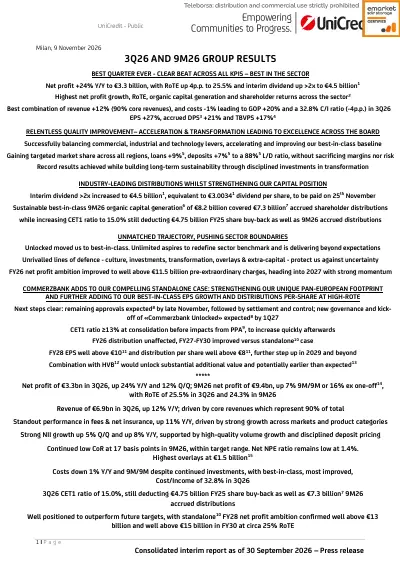
First, our best quarter ever, a clear beat overall and across all critical KPIs, and the best quarter in the sector. This is our 23rd consecutive quarter of growth and consistent delivery, with the best combination of revenue growth and efficiency improvement, and the best net profit growth, cost-income ratio, return on tangible equity, organic capital generation, and shareholder returns across the sector.
Second, relentless quality improvement, excelling across the board while building long-term sustainability through disciplined investment in transformation. We are balancing all our commercial, industrial, and technology levers, accelerating and improving an already best-in-class baseline, and gaining targeted market share in every market without sacrificing margins or risk.
This means that Italy is well on the way to organically increase its targeted market share to 15% in the medium term, very profitably, without requiring an M&A. Third, industry-leading distributions while simultaneously strengthening our capital position.
We're more than doubling our interim cash dividend to €4.5 billion, equivalent to €3 per share, to be paid on 25th of November. This is underpinned by sustainable, best-in-class organic capital generation, which in the first 9 months more than covered accrued distribution while lifting our CET1 ratio to 15%.
Fourth, an unmatched 10-year trajectory, moving from best in class with Unlocked to resetting standards with Unlimited. Unlimited is already delivering beyond expectations, with unrivaled lines of defense protecting us against uncertainty.
We are raising our 2026 net profit expectation to well above €11.5 billion pre-extraordinary charges. Fifth, Commerzbank adds to our compelling case, with clarity on a faster timeline and objective.
It strengthens our unique pan-European footprint and will propel even further EPS growth and high return on tangible equity and distribution per share. Upon settlement, we will take control of Commerzbank with new governance and the kickoff of Commerzbank Unlocked by the first quarter of 2027, and the combination with HVB, which would unlock substantial additional value for all, to potentially be executed earlier than initially expected.
I remind you, we said 2 or 3 years. In short, record results today, outstanding quality and strength, and a growing set of value creation opportunities ahead to further accelerate our trajectory and deliver great results in the future.
Slide 3. Turning to our third quarter results, they provide further evidence of the accelerating momentum behind UniCredit Unlimited.
Revenue growth accelerated significantly, up 12% year on year, driven by core revenues, which now account for 90% of our total revenues, with fees and net insurance up 11% and net interest income up 8% and accelerating. Core revenues, which now account for more than 90% of total revenues, are complemented by strategic investment at circa 7%.
Our transformation continued to deliver, with costs down 1%, leading to a record low cost-income ratio at 32.8%, down 4 percentage points, and best among our peers. Asset quality remained excellent, with cost of risk at 18 basis points, fully within target, and more evenly distributed throughout the year, with underlying net operating profit growing 18%.
Profitability reached another record, with net profit up 24% to €3.3 billion, and return on tangible equity up 4 percentage points to 25.5%, despite significant excess capital, or 28% at a 13% CET1 ratio. Value creation per share in the quarter was outstanding: earnings per share up 27%, dividend per share up 21%, and tangible book value per share up 17%.
For the first 9 months, net profit reached €9.4 billion, up 16%, excluding the second quarter 2025 insurance stake revaluation one-off, while return on tangible equity increased 2.1 percentage points to 24.3%. Organic capital generation totaled €8.2 billion, or 275 basis points.
As such, CET1 strengthened further to 15%, best in class, despite the €7.3 billion already accrued for shareholder distribution. We increased interim dividend to €4.5 billion, bringing total 2026 dividends to €7.1 billion, an in-year yield of 6.5%.
This reflects our confidence in the future and our commitment to our shareholders to minimize the year-one dividend-per-share dilution from the Commerzbank acquisition. Over the 9 months, earnings per share were up 11%, with dividend per share and tangible book value per share both up 17%.
Overall, these results demonstrate the strength of our business model and our ability to translate growth into profitability, capital generation, and sustainable shareholder value. Slide 4.
Turning to revenue, our client-driven strategy continues to accelerate, gaining targeted market share profitably, with Italy leading the charge and aiming to reach a 15% market share in targeted segments, products, and regions in the medium term, preserving margins and risk. Total revenue increased by 12% and core revenue by 9%, increasingly driven by deeper client engagement and new client acquisition rather than external market factors.
Net interest income grew by 8% year over year and 5% quarter on quarter, supported by high-quality volume growth at flat margin and flat risk, with NII RoAC stable at a best-in-class 20%. Looking ahead, we see further profitable acceleration of NII as the benefit of increased commercial volumes and supportive rate dynamics continue to crystallize.
At the same time, we have maintained our discipline on deposit pricing, with pass-through remaining tightly managed at 32.2%, leveraging our low loan-to-deposit ratio of 88% and the flight-to-quality nature of our franchise. We expect a significant acceleration in quality deposit growth in the next few quarters.
Fees and net insurance income increased by 11%, with broad-based trends across all product lines and geographies, reflecting the diversity of our product factories and the increasing value we deliver to our clients. As a result, fees and net insurance now represent 36% of total net revenue.
Slide 5. Cost of risk remains structurally low.
At 18 basis points, it is fully within our 15 to 20 basis points guidance, even after the ongoing normalization of the writebacks that supported past years. It is also much more stable and evenly distributed than in 2025, when provisions were overly concentrated in the fourth quarter.
The year-on-year comparison is therefore negatively affected by that; the underlying picture is much less so. Asset quality strong and improving overall.
Net NPE ratio is low at 1.42%, down 3 basis points. Coverage is broadly stable at 45.3%.
Default rate is low at 0.9%, down 23 basis points. We remain further protected by our unique overlays buffer of €1.5 billion, the highest stock among peers.
Slide 6. Our operational discipline continues to translate into tangible results.
We further improved our best-in-class cost-income ratio by 4 percentage points to 32.8% as we accelerate our transformation leveraging AI. Importantly, this is not a story of simply spending less.
While total costs were down 1%, with non-HR down 2%, we doubled down on our transformation-related investments. We continue to fund growth initiatives, technology, and transformation programs, reallocating resources to where they generate the greatest value for clients, employees, shareholders, and the long-term competitiveness of the franchise.
The result is a very strong positive jaws dynamic, with revenues growing 12% while costs decline 1%. This demonstrates that our two strategic pillars, acceleration of top line and transformation of the operating machine, are working together exactly as intended, driving sustainable growth while continuously improving productivity and operational efficiency.
Slide 7. Turning to capital, we continue to demonstrate the strength of our capital generation and the efficiency of our capital deployment and shareholder returns.
Our CET1 ratio increased by 70 basis points to 15%, supported by strong organic capital generation and the positive impact of the Danish compromise. Organic capital generation contributed 92 basis points, or €2.8 billion this quarter, more than offsetting 84 basis points of accrued distribution, despite continued RWA growth supporting high-return-on-tangible-equity market share gains.
Over the 9 months, we generated €8.2 billion, or 275 basis points of capital organically, supporting our distribution accrual while increasing capital. The Danish compromise contributed a further 53 basis points, while the anticipated reversal of the temporary RWA impact from strategic portfolio added 19 basis points.
Our commitment to shareholder distribution remains unchanged, with 80% of net profit accrued for distribution, totally €7.3 billion in the first 9 months. We are increasing the interim dividend to €4.5 billion, bringing total 2026 cash distribution to €7.1 billion and reducing dividend-per-share dilution for our existing shareholders, as previously promised, confident in our sustainable performance and capital strength.
Slide 8. Turning to Italy, our franchise continue to combine strong growth, accelerated targeted market share gains, and sector-leading profitability.
Commercial momentum remains strong across both lending and fees, with loans up 10% and deposits up 6%, as we managed our pass-through and leveraged our 82% loan-to-deposit ratio. NII RoAC remains best in class at 23%, while fees and net insurance now represent 47% of net revenues.
Importantly, we continue to gain share in our priority segments: total loans, excluding mortgages, up 130 basis points to 12.5%, August to August; corporate lending up 150 to 13%; consumer finance up 40 basis points to above 11%; assets under management up 60 basis points to around 12%; protection products up 60 basis points to above 15%. These gains reflect our focus on premium segments and higher-value products, where we have clear competitive advantage, well positioned to benefit from the ongoing market consolidation, and we aim to reach a 15% targeted market share in the medium term.
We're also improving efficiency while investing for growth. Costs still declined 1%, delivering a record cost-income ratio of 32.4%.
This translated into further earnings growth from an already high base, with profit before tax up 9% and RoAC at an outstanding 31%. Slide 9.
Germany continues to deliver outstanding core revenue growth and operational excellence, reflecting the strength of our franchise and a disciplined commercial strategy. Core revenues increased 8%, driven by fees and net insurance up 10%, while NII grew 6% in the 9 months and 8% quarter on quarter, also supported by spread widening on loans.
Commercial momentum remains strong across both lending and fees, with loans at 6% and deposits up 9%, as we protected our pass-through. NII RoAC remained best in class at 19%, while fees and net insurance now represent 35% of net revenue.
Importantly, we continue to gain market share in our priority segments: corporate loans up 50 basis points, mortgage new business up 20 basis points, total deposit market share 16 basis points up, maintaining excellent pass-through. We're also improving efficiency while investing for growth.
Costs declined again, 4%, with non-HR expenses down 8%, delivering a record cost-income ratio of 35.8%. This translated into a gross operating profit up 8% and net operating profit up 5%.
Profit before tax was flat as we absorbed integration charges to invest in our future, while RoAC remained at an outstanding 23%. Slide 10.
Austria delivered another strong quarter, combining high-quality growth and industry-leading efficiency to achieve record return on tangible equity. Core revenues increased 5%, driven by fees and net insurance up 9%, while NII grew 3%, with acceleration expected as volume growth and rate tailwinds crystallize.
Commercial momentum remains strong across both lending and fees, with loans up 5% and deposits stable. NII RoAC reached 16%, while fees and net insurance now represent 30% of net revenues.
Importantly, we continued to gain share in our priority segments: total loan market share increased 15 basis points to around 12%, corporate lending up 50 basis points to 14%, and consumer finance new business up 30 basis points to well above 11%. We're also improving efficiency while investing for growth.
Costs declined 3% in Austria, while non-HR expenses were down 7%, delivering a record cost-income ratio of 36.6%. This translated into profit before tax up 8% and RoAC up 4 percentage points to 27%, reinforcing our position as one of the country's highest-performing banking franchises.
Next slide. CEE remains one of the group's strongest growth engines, delivering another quarter of high-quality growth, market share gains, and exceptional return on tangible equity.
Core revenues increased 7%, with fees and net insurance up 8%, while NII grew 7%. Commercial momentum remains strong across both lending and fees, with loans up 12%, significantly ahead of market growth, and deposits up 9%, as we manage our pass-through and leverage our 86% loan-to-deposit ratio.
NII RoAC remained best in class at 24%, while fees and net insurance now represent 30% of net revenue. Importantly, we continued to gain share in our priority markets and segments: total loan market share increased 50 basis points to around 12%, corporate lending across CEE up 50 basis points to above 15%, corporate lending in Bulgaria up 110 basis points to 22.5%, and consumer lending share in Croatia grew 70 basis points to well above 20%.
We're also improving efficiency while investing for growth. Costs declined 1%, with non-HR expenses down 4%, delivering a record cost-income ratio of 32.6%.
This translated into profit before tax up 4% and RoAC at an exceptional 29%, among the best in the region. Next slide.
Our group product factories serve all our banks, combining best-in-class product offer, locally where other competitors cannot reach. All our factories are growing, with fees and net insurance up 13% to €7 billion.
onemarkets AuM grew 67%, and value chain retention reached 82%, up 12 percentage points since 2021. We're number one in unit-linked in Italy, and in corporate loan fees in Italy, in Germany, and in Austria.
Our M&A and ECM revenues have tripled. Central manufacturing also delivers economies of scale.
Our trade finance hub runs at a 30% cost-income ratio, and we are Euromoney's best transaction bank in Italy, Germany, and CEE. Our factories are easily extendable to third parties, with Alpha Bank onemarkets now exceeding €2 billion assets under management in Greece.
That partnership is also boosting trade finance. Since it began, volumes between Alpha Bank and UniCredit have doubled, while international guarantees have grown more than fourfold.
Once we take control of Commerzbank, we can extend this fully fledged offering to its clients, helping our own and Commerzbank Mittelstand clients grow across borders, with leading trade finance solutions and an extensive network of banks, branches, and correspondent banks. More products, better service for clients, greater scale for our factories, with much more to come.
Next slide. 9 months into Unlimited, we are already ahead of plan, and we're not done.
More acceleration and more transformation lies ahead, and both are still far from their full potential. Together, they will keep driving superior EPS growth at highest return on tangible equity and superior distributions.
We're uniquely positioned to deliver this even in a more challenging environment, with Commerzbank adding to an already compelling standalone case. Next slide.
Unlimited adds disciplined, profitable, target market share gains to a best-in-class efficiency and profitability we built with Unlocked. Under Unlocked, we moved to best in class.
We cleaned up the portfolio and exited negative-EVA assets. NII RoAC rose from 6% to 20%, while loans and deposits were broadly flat.
Under Unlimited, we're pushing sector boundaries. Fees and net insurance are now up 11%, loans 9%, deposits 7%, at a stable NII RoAC of 20%, and with a higher fee weight of 37%, and still growing.
We have the opportunity to keep gaining profitable share in every region: in Italy, as our in-flight growth strategy further benefits from ongoing, widespread consolidation; in Germany, with Commerzbank Unlocked, once we take control, further accelerated by a potential combination with HVB; in Austria, as the gateway to Germany and CEE; and in structurally faster-growing CEE and Greece, now adding Poland with mBank. This trajectory is expected to continue at resilient, high margins and low risk levels.
We target the most attractive client segments with higher-margin products, and we leverage our strong 88% loan-to-deposit ratio to actively manage pricing and selectively accelerate deposit growth, defending our excellent pass-through. Next slide.
Unlimited is also delivering a step change in efficiency, notwithstanding the high bar. Unlocked took us from laggard to leader, cost-income from 54.5% to 38.4%, revenue over RWAs from 5.5% to 8.5%, and organic capital generation from 160 basis points to 380.
Unlimited is resetting standards. We have already brought cost-income down a further 5 percentage points to 33.8%, while revenue over RWA improved to 8.9%.
There's more transformation ahead, from both major projects and artificial intelligence. Our projects such as nearshoring, revamping security services, centralizing our trading engine, and cloud transition and modernizing our IT infrastructure, among many others, are structurally transforming the way we operate and are almost complete.
Their full effects are still to fully crystallize, and they will free up resources to further boost acceleration. AI at scale is delivering tangible outcome in KYC, transaction monitoring, and corporate lending, all built on one centralized AI platform that has already cut time to delivery by 37% at a lower cost to serve.
Next slide. Let me step back and look at where this leaves us versus our peers.
UniCredit continues to deliver the fastest capital-generating growth among peers, despite starting from an already best-in-class position: net profit growth of 24% in the quarter, highest among peers; cost-income ratio best and most improving in the 9 months to 33.8%; return on tangible equity highest and improving the most to 26.4%, normalizing for 13% CET1 ratio in the 9 months; organic capital generation highest at 275 basis points in the 9 months. Next slide.
We're highly resilient, even in an environment that could deteriorate, and our confidence rests on clear evidence. We're geographically diversified, leveraging market disruption in Italy to gain targeted market share in a disciplined way; exposed to structural growth in CEE and Greece, soon amplified by mBank; strongly positioned in Germany to capture the transformation of its economy, further amplified by the value created together with Commerzbank; and profitably leading in Austria, our gateway to Germany and CEE, with bolt-on or inorganic optionality across our markets.
We gain market share with robust asset quality and ample buffers, including the highest overlays stock among our peers at €1.5 billion. We keep improving an already best-in-class cost-income ratio, leveraging both rising revenue and declining costs, one of the few banks in Europe decreasing costs while growing significantly, protected by investment and integration costs already expensed in the past.
We're number one in organic capital generation among peers, with 275 basis points in the first 9 months, supported by low expected loss, our country mix, and constant capital efficiency and securitization. This allows us to keep delivering superior distribution while building capital and supporting our business.
We are perceived as a safe haven for deposits. In periods of uncertainty, we see inflows accelerated, combined with conservative liquidity management and an 88% loan-to-deposit ratio.
Next slide. Acceleration and transformation are delivering above expectations.
Our 9 months results point to significant outperformance versus all the critical 2026 targets of Unlimited, which I remind you have been already upgraded in Q2 of 2026: €9.4 billion of net profit, 85% of our full-year target of well above €11 billion; €8.2 billion of organic capital generation, more than 90% of our full-year target; cost-income ratio of 33.8%, well ahead of our circa 36% target; and return on tangible of 24.3%, well ahead of our above 20% target. We now expect 2026 net profit pre-extraordinary charges to be well above €11.5 billion, and to enter 2027 with strong momentum.
This gives a positive read-across into '27-'30 in the current environment, and superior resilience with significant buffers should the environment turn substantially more negative. Even before considering Commerzbank, our standalone trajectory to be reviewed at year-end is compelling: net profit well above €13 billion in '28 and well above €15 billion in 2030; return on tangible rising to around 25%; and EPS and DPS expected to grow at around 15% per year over '26-'28 period; and in excess of €50 billion of distribution over '26-'30, or 80% of net profit, if backed by more than €50 billion of organic capital generation.
Next slide. The path forward on Commerzbank is clearer, with well-defined timeline and execution plan.
Following the ECB authorization received on 15th of October, all remaining regulatory approvals are expected by late November. We then intend to immediately ask Commerzbank to convene an EGM to elect new shareholder representatives to its supervisory board.
Under German law, a general meeting must be convened at least 30 days in advance. Shortly thereafter, we expect Commerzbank to kick off Unlocked and realize the related value creation.
Our CET1 ratio is expected to be equal or higher than 13% at the point of consolidation before temporary PPA impact, improving thereafter as we generate significant capital beyond what is accrued for distribution. Our 2026 distributions are unaffected, and we expect them to improve on a per-share basis in '27-'30 versus our standalone case, thanks to Commerzbank contribution.
Commerzbank 2026-2027 distribution are expected to reflect the extraordinary provision, charges, and investment necessary to deliver the increased returns of Unlocked. Importantly, we expect limited execution risks in delivering Unlocked, as we will leverage the transformation blueprint we have already successfully executed at HVB.
We remain open to a Commerzbank-HVB combination, which would unlock substantial additional value, subject to shareholder support. Next slide.
The consolidation of a circa 50% stake in Commerzbank is expected to accelerate our absolute and per-share value creation versus an already compelling standalone case. We expect our earnings per share well above €10 and distribution per share well above €8 in '28, with a further step-up in '29 and beyond, including the full delivery of the pre-combination value creation.
Moreover, a combination with HVB, which could potentially take place earlier than expected, would further accelerate both absolute and per-share value creation. The direction is clear: UniCredit has a compelling standalone plan that is delivering well above expectation.
Commerzbank takes it even further, accelerating our earnings growth and strengthening our distribution capacity, with the benefit building progressively over time. Next slide.
Let me close by reiterating the five key messages behind the strength of our performance and the momentum we are building. First, our best quarter ever, a clear beat overall and across all critical KPIs.
Second, relentless quality improvement, excelling across the board. Third, industry-leading distribution, while simultaneously strengthening our capital position.
Fourth, an unmatched 10-year trajectory, moving from best in class to resetting standards. Fifth, Commerzbank adds to our compelling case, with clarity on a faster timeline of execution and objective.
The momentum is firmly with us, and we're confident in what lies ahead. Let me now open the line for your questions.
Thank you.
Operator
Thank you. This is the conference operator.
We will now begin the question and answer session. Anyone who wishes to ask a question may press star and one on their touch-tone telephone.
To remove yourself from the question queue, please press star and two. Anyone who has a question may press star and one at this time.
In the interest of time, we ask that you please limit yourself to max two questions or one question and one follow-up. The first question is from Ignacio Ulargui, BNP Paribas.
Ignacio Ulargui
Thanks very much for the presentation and for taking my questions. I have two.
The first one is on NII. Just wanted to ask on the progression of NII at group level in 2027, if you think that a high single-digit growth is reasonable at this at this stage in the light of the strong acceleration in lending growth.
Also linked to this, just wanted to get a bit of your thoughts about the market share gains in Italy, and how much growth or acceleration can you see in the light of the ongoing M&A process in the country? The second question is on distributions and the DPS, particularly in the quarter, in the interim you have paid full, full cash dividend.
We expect, how should we expect the buyback to interact with Commerzbank? Is there any reason for that to change into the full year of 2026?
How should we think about distributions in '27? You have given a very clear target for for 2028 of well above €8 DPS.
How should we think about that progression from the current level? Thank you.
Andrea Orcel
Thank you, Ignacio. I'll take the first pass, and then I'll be complemented by Stefano.
NII, at the moment the NII progression is accelerating. You see it in the numbers, Q-on-Q, you see it year-on-year.
Why is that? Factors are fundamentally that the increase in rates has a deferred effect, and secondly, our market share gains have a deferred effect.
First you land, and then you clock all the NII on a more consistent basis in the quarter. Because of these two factors, we expect an acceleration going forward.
We also expect a continued market share gains across all markets, and therefore it's not that this process is stopping; this process is continuing. We're very clear that this was our objective when we launched Unlimited, and now is starting to come through.
With respect to the market share gains in Italy, we said last year after withdrawing from the acquisition of BPM that we were shifting gears and we were going for an organic growth strategy. We felt we could achieved, let's say, more targeted and therefore, in our view, higher-quality market share gains, as we are targeted by the precise client segment and the precise products that we feel are best for UniCredit, and that we could do that without the need of an acquisition, and much more cheaply.
We had prepared for that, and we doubled down on that preparation. If you look at what we've done, and we commented before, we hired about 1,800 people in the last 15 months, all on the front end.
That is equivalent to about a 15% increase of our commercial network. No bank has ever done that.
By the way, we absorbed the entire cost, optimizing our operating machine. No bank has done that either.
That's one element. These people were able to benefit from all the investment in automation, the leveraging of AI, the new credit models we have by segment, the process redesign, the automation of processes, and a number of other things that are not apparent on the outside, but that allow us to be faster, more precise, and more responsive to clients.
As a result of all of that, our market share has start trending up. From August to August, because this is the only numbers we have public, August of last year when we started really, we started a little bit later, and August of this year, we gained 130 basis points of market share, excluding mortgages, because we're not targeting that segment for a reason that you understand.
That is more than 10 basis points a month. I have given you the number.
We do not have the numbers to today, to the end of the third quarter, but we estimate we're gaining about 10 basis points of market share a month. Incidentally, this is what we have done in Bulgaria in the last 5 years in retail.
It's not the first time UniCredit does this kind of things. As we gain market share, now we have a second element that should accelerate that gain, and that is consolidation.
We were very clear that post BPM, we were going to be an observer. I know that some people did not believe it, but we said we would be an observer.
Why would we be an observer? Because we anticipated that in a market where of the top seven banks, seven, six are engaged in M&A, in integration, in antitrust remedies, in bringing organization together, and therefore are focused on adding value in ways that are different from gaining market share profitably, the only one bank, the second-largest, focused on gaining that market share can gain in spades.
Therefore, if anything, we think that our monthly market share gains in the targeted segments are going to accelerate, let's say, from the second quarter of next year, as the integration allows us to accelerate the gains. This is why we have upped our ambition, with a 15% market share targeted in the medium term.
Please don't start thinking that this is being done in a quarter because it will take time. We will update you on the gains, and we're quite confident.
We are obviously tracking very closely margins, and for the moment we're doing this at flat margins, which means we're not buying market share. We're also doing this, I would say, at flat risk, but actually the indicators are at declining risk, if you look at our indicators.
Everything is leading in the right direction, and we're monitoring very closely, but we're very, very happy with what is being achieved by the team. With respect to distribution, our distribution remains unchanged, 80% of net profit.
Ignacio, you know very well that we have been shifting mix or adjusting between interim and total over the years in response to what we felt were opportunities to accelerate certain things because we felt it was the right time, or in this case, a commitment that we took very clearly to all of you that if we were to do M&A, and in M&A in year one you traditionally have significant dilution of distribution, in particular of dividends, we would do everything possible to minimize that dilution. Therefore, that's exactly what we did.
We are paying the entire accrued dividend, which is 2x, more than 2x of what we paid last year in the 9 months, and we are reducing your dilution, and that is completely consistent with what we have said since day one. For the trend line, I will pass now to Stefano, who will add to what I have said.
Stefano Porro
Ignacio, some data points for you. As we have already highlighted in the second quarter results, we were expecting to accelerate on net interest income.
Effectively, you have already seen in Q3 such an acceleration. If you look, the quarter-on-quarter trend is plus 5%, but when you're looking the year on year, it's plus 8%.
Which are the reason why we are really confident for the future? First is rates.
For 2026, the average Euribor is 2.4%. We are expecting around 3% for 2027; '28, let's see the overall evolution, but should be around 2.8%, 3%.
Our net interest income sensitivity is plus €350 million for every 50 basis point improvement of the rates. Effectively, '27 there is an improvement.
Then there is the replicating portfolio. The hedging on the deposits, the contribution next year is going to be more than €500 million better than this year, and we are going to have the same pace in '28 and '29.
Then we have volumes. When you look to volumes, we are expecting to have increase of loans at a rate that is going to be even higher than the nominal GDP in countries like Italy and Germany, while in line with the nominal GDP in Austria and CEE.
We are expecting to growth on deposits as well. You have seen in Q3 as well.
Spread, we are assuming flat spread, don't assume that we can also keep on growing on spread, considering the size of the volumes of growth that we have, but we're keeping the margin. That is in line with our strategy.
Last but not least, deposit pass-through, that's not a point of concern for us. The deposit pass-through was slightly up 1% in the quarter, and we are expecting more or less the same trend, around 1% for each year, '27, '28.
All in all, spread is not a point of attention. Rates, replicating, plus volumes are the key elements that are explaining the acceleration of net interest income in the future as well.
Ignacio Ulargui
Thank you.
Operator
The next question is from Britta Schmidt, Autonomous Research.
Britta Schmidt
Good morning. Thank you for taking my questions.
I've got a couple of questions on Commerzbank, please. Maybe you can update us on the discussions you're having with the management as to whether you see them as constructive, and also whether you agree with Commerzbank management's assessment of the phase one of synergy creation.
Do you agree with the general direction of travel, and the prospect of a combination with HVB? I think they're pointed to either a reverse merger or structural measures.
It sounds like from your slides it would more head down the reverse merger road, but maybe you can clarify that. Then just on the €10 per share that you put on the slide with a further rise in 2029, what synergies have you included in there?
Does this include the €1.2 billion pretax value generation you previously guided to? Is this substantially still in line with the 17% EPS CAGR that you disclosed with the previous quarterly results?
Thank you.
Andrea Orcel
Okay. I think that as we near the moment when UniCredit will take control of Commerzbank, dialogue and discussion with all stakeholder of Commerzbank has moved to how do we achieve the best for both Commerzbank, HVB, and more generally UniCredit, but everybody trying to do what's best for their organization.
That means a dialogue that has taken a different shape from the dialogue that we had during the acquisition phase, if you want to call it that way. With respect to our value creation, and I remind you all, not to confuse that we have what we call phase one, which is the value we can create at Commerzbank together with Commerzbank, obviously, applying the blueprint of UniCredit Unlocked, and therefore shifting emphasis on certain variables.
That was never going to be changed. It's fully confirmed.
We don't see any reason why that would be any less. If anything, we always search opportunities to do more, not less.
The actual detailed discussion about all the elements can only take place once we get all the authorization and we can openly discuss with all the stakeholders. We're highly confident, more than we would be on any other situation, because at the end of the day, we're confident about Unlocked, which is a way of approaching bank rationalization, as we executed successfully 13 times and including HVB.
We're highly confident on being able to do it at Commerzbank because it's the mirror image of HVB, and we will be able to, if needed, integrate their team with some of the people in ours in order to get that done. Fundamentally, there is no integration in phase one; there is only applying UniCredit Unlocked, and we are highly confident.
Then you have phase two. Phase two would be if and when we execute the merger between Commerzbank and HVB.
That does add what I would call synergies. The synergies there are relatively less than what would be in a bank that have a highly overlapping franchise, because these two bank do not have a highly overlapping franchise.
Dis-synergies are also going to be a lot less, and we will prove to competitors that they're going to be a lot less, if any. What we have said about HVB is, given the statements made by a number of stakeholders that it would be better to accelerate a merger between HVB and Commerzbank because it eliminate uncertainty, it brings clarity and everything else, we had anticipated 2 or 3 years for phase one from the moment of taking control, and then possibly doing the combination of the two banks if we had shareholder, employee, and broad-based support.
If we now have broad-based support and everybody's wanting to do that faster, can we do that faster? We could.
M&A law in any case takes time, forget anything in 2027, but we are ready to do it faster. Mechanically, what would happen inside the banks won't change.
There will still be a phase one where we try to align the two banks, and a phase two where we try to crystallize the synergies, and we will reevaluate timing, magnitude, when we are able to do so, when we have all the authorization, have control, and we're part of the same group. I will pass to Stefano for the rest.
Stefano Porro
Coming back to your question on the well above €10 EPS target in '28, as commented by Andrea, we are not including any effect deriving from a potential combination of HVB into Commerzbank. The €1.2 billion value creation that we have communicated for 2029, a good chunk of that is included in the €10 EPS target, but following the implementation of Unlocked into Commerzbank.
No integration of HVB into Commerzbank. If there is that one, the effect has to be added.
Operator
The next question is from Delphine Lee, J.P. Morgan.
Delphine Lee
Yes, good morning. Thank you for taking my questions.
Just to come back on the NII outlook. Thank you for giving all the details, but it just feels like, given the loan volume acceleration you've talked about and it's already running high single digit, the €500 million of replicating income, and also rate impact and rate sensitivity, it just feels like NII should be, could be even double digit, or is that incorrect?
Then my second question is on the fees. You've talked before that a lot of the initiatives that you've taken to accelerate the fees would be a little bit more backloaded in your plan towards sort of '27, well, I guess '27, '28.
Fees have been growing already quite a bit this year. Just trying to understand a little bit what we should expect for '27.
Can that very strong momentum continue or even accelerate, or '26 has already benefited from relatively good market conditions? If you could just maybe elaborate on the different components of fees, that would be great.
Thank you.
Stefano Porro
I will start from the net interest income. We are very confident on the trend of the net interest income, but not a double-digit growth, you know?
That's not something that we would aim for that, but that's not something that we can achieve, even if we are really confident. Do consider that we have also Russia compression still ongoing, we have a few hundreds million of Russia compression to the net interest income in '27 and also in '28 to be considered.
As I told you, we are currently assuming to have flat spread, right? We are not assuming to increase also the spread on the loan perspective, the overall environment is good, but not to achieve a double-digit growth.
In relation to CEE, we are expecting to keep a similar trend in terms of, let's start from the volumes. In terms of loans and deposit growth, we are expecting to follow up with a growth that is in line with, let's say, nominal GDP on average of the specific country.
In some countries we can also be higher than the nominal GDP, in some other countries less, but that's overall the trend. In relative terms, we are expecting to improve or keep on improving with the growth on the net interest income in relation to the fees, the same, because we're expecting to have more penetration in some product.
This is the expectation for 2027 as well, where there is a slightly different trend of the GDP in some of the countries versus 2026, but we are not expecting a meaningful divergence of the growth of CEE in 2027 versus 2026. The return on allocated capital, considering the growth for the lending, I believe that will be more or less in line, can be slightly lower, but it will remain at very, very high level as we've seen for Q3.
Delphine Lee
Thank you very much.
Operator
The next question is from Sofie Peterzens, Goldman Sachs.
Sofie Peterzens
Hi. This is Sofie from Goldman Sachs.
Thanks a lot for taking my question. Sorry to go back to the dividend question, but could you just maybe talk how we should think about the final dividend for 2026?
Should we still assume a 50% cash payout, or could that potentially be increased closer to the 80% total payout? Also, how should we think about the interim dividend to be paid in 2027?
Is it fair to assume that it could be lower compared to the €3 that you are paying as an interim dividend this year? Then my second question would be if you could just talk about the extraordinary charges that we should expect in Q4, what kind of magnitude we should expect these to be?
Thank you.
Andrea Orcel
Let me go on this again. The payout will remain exactly the same, 80% of net profit.
We always said that the conservative things to do is to distribute on an ordinary basis not more than we generate organically. As we expect to generate more than 80% of net profit organically in capital, we will distribute that 80%.
We have also given a view that the right way is to have an, let's call it, ordinary dividend of 50% and then share buyback of 30%. At the moment, there is no reason why to change that, but honestly, what we do is to respond to our shareholders and what they prefer.
If at some point we would need to improve the cash dividend, we're ready to listen and to do that, but what I would like to underscore is that what I call ordinary, recurrent, sacrosanct, is 50%. The rest is optimization through share buybacks, and like some of our competitors have done, they may move between one and another to optimize.
We haven't considered that yet, but I'm not excluding it. The other thing is about the interim dividend.
At the moment, as you have seen, we have gone with 100% distribution of the dividend accrued to date, and it's something that we could keep or not. You remember that in the past, we had accelerated share buybacks, then we went back to the trend line.
At this point in time, we will be collecting feedback from our shareholders, and if they feel that the interim needs to be higher, maintain around this level, it is something we can do. Accrued is accrued, it is dividend, and as long as it is within the 50% mark, it's sacrosanct, and unless they are Armageddon-type issues, we're not changing that.
Is there any view that we can improve distribution? I think improve distribution, especially in 2027, in an environment of macro uncertainty, geopolitical uncertainty, and the first year of consolidation of Commerzbank, would not be serious.
When I talk about '27, I mean the '26 distribution paid in '27. You should assume that the 80% of '26 net profit remains and is that.
Going forward, we will see, but at the moment it remains and it is that, because there will be a number of moving parts like in any acquisition, and the environment is particularly volatile, we will remain targeted at that level. We would not be raising.
Consider your number, Sofie, including the consolidation of Commerzbank, which would bring our CET1 down 13% initially, we want to see a good track record of that increasing back, which we're confident of, but we want to see it before we move our bar. Secondly, extraordinary charges, on that topic, I assume you're talking about UniCredit and not Commerzbank.
On Commerzbank, we were clear, and it is with the extra provision, about €3 billion. By the way, just to be clear, those would be excluded in the calculation of the 80% of net profit of UniCredit, it doesn't affect.
With respect to UniCredit, as we have taken the view in the past that, number one, if the environment is uncertain, we tend to be conservative. Number two, if there is a scope or ability to front-load integration costs, to front-load investments to accelerate the performance of UniCredit in the future while meeting investor expectations, we have done that.
Are we going to do that this year? Honestly, too premature to discuss, but we're clearly leaving open the possibility.
We have effectively reconfirmed that our net profit will be well above €11 billion, and that remains what it is. We're also telling you that our underlying performance is a lot better because our underlying performance pre-restructuring charges or integration cost is going to be well above €11.5 billion, while at the beginning of the year it was probably in the low €11 billions, and at Q2 it was circa €11.5 billion.
The underlying performance is accelerating, and I think that's what matters for going forward. I don't know if Stefano needs to add a few things.
Stefano Porro
No, let's say, as highlighted by Andrea, do consider that we're going to assess in the past the payback of what we are going to do. As highlighted, we are going to do things that are going to improve 2027, '28 trajectory.
Majority of that assessment is regarding below the net operating profit line, like charges or integration cost, but we cannot exclude to have a look of topic that can affect also cost and LLP line.
Sofie Peterzens
That's very clear. Thank you.
Operator
The next question is from Noemi Peruch, Morgan Stanley.
Noemi Peruch
Good morning, and thank you for taking my questions. I have one on loan growth.
You mentioned increase in market share in SME and corporate locally, but I would like to ask you how much of the growth that we are seeing in Italy and Germany come from the CIB and international lending? Still on growth, you mentioned the opportunity in Italy due to M&A.
What are the precautions you're putting in place in Germany not to be on the other side of this trade? Then my second question is on Generali.
I would like to inquire about the state of the dialogue on the insurance and asset management cooperation, and then geographies that could potentially be impacted, including Commerzbank. Thank you.
Andrea Orcel
I guess this is an interesting debate, because the bank, or UniCredit, has, certainly since 2020, not spoken about CIB, because we have what we call client solutions and factories. Why is that important to remark?
Because the absolute priority and focus of our CIB is to lend to our clients in our countries, not to go outside, number one. Number two, it is to reach in the SME, or Mittelstand, where we can offer services and products that the competitors who reach it do not have, and the competitors who have those services cannot reach.
That is the core of the strategy. You're not going to see us ever say, league tables, we're going to grow in the US, we're going to grow in Asia, we're going to grow outside where we are.
We don't. That is also connected to international lending.
Our international lending, intended as lending outside of our core markets, and the posts we have in some other European nations like Spain, for example, is very, very, very marginal. I could add another very.
None of that growth is there, and this is one of the key points on our approach to Commerzbank. We want Commerzbank to double down on Germany.
We want Commerzbank to double down on Poland. As each and every one of our banks is focused on their core market, the growth of Italy is Italy.
You're never going to find UniCredit ranking in large loans or RCFs or whatever it is in the US, in Asia, in Latin America, in other places. We are a European bank for Europe.
We support European clients. The only time we support non-European clients is if they have a direct involvement and investment in Europe.
You're never going to find us financing data centers in the US. We don't.
We don't have that. We are all core Europe, and what you see is all core Europe, there is nothing else.
With respect to what you said about Germany, I think two things are dramatically difference between the situation in Germany and the situation in Italy. Firstly, in Italy, you have the entire market merging.
For all of you who have an age close to mine, go back to see if you ever saw the top seven, six banks in a country, excluding one, merging at the same time. That creates disruption.
Every CEO is going to tell you, there's M&A, I'm going to benefit from it. This time, you have six CEOs who need to execute integrations and generate the synergies and the value.
There is one, and it's team, who was already on a pass of organic growth and who wants to accelerate. Very different.
I don't see the top seven banks in Germany merging. That is the first thing.
The level of disruption is going to be a lot, lot less. The second thing is because of the fragmentation of German market, you're talking, because we forget about that, HVB and Commerzbank together is hardly going to reach 9% market share, and in the peaks in Mittelstand, probably well below 15%.
Try to look at those numbers for Italy. In many cases and in many regions and in many products, they're going to reach well above 20%.
That's attrition. 9% is not attrition; 12% is not attrition.
Thirdly, when you look at the banks in Italy, they all have developed nationally, and their market share relatively well distributed. Sure, emphasis in certain areas versus others, but generally well distributed.
You can have a shock that is well distributed. In the case of Germany, HVB is very strong in Bavaria and the Northeast.
Commerzbank is very strong in the center of the country. We're not geographically overlapping.
That means that your retail franchises and your Mittelstand is going to be much, much less affected. By the way, we run an analysis in terms of HVB, how many of the Mittelstand clients we will find significant, improved in concentration, intended as we would account for that client above 20% of lending, of numbers like that, and we got back low single digits.
Okay? Because of that, let's not confuse M&A defense with reality.
The franchises are very complementary. The last point is, because of this complementarity and because Commerzbank would be joining a group that is very determined to gain market share, not lose it, we are going to do everything possible to not touch the commercial networks of the two banks, and we've taken a commitment to that effect, and to actually invest further in growth, and to actually make statement of backstopping things where we believe we want to convince the client that we're there to stay.
Which is why executing in a difficult market environment is a good thing, because we will be able to demonstrate once more that we're there when we're needed. Of course, if there are risk considerations, these are being factored, but we anticipate that both banks should be relatively in a good place because of that.
When I put all of that together, suddenly the nervousness or the uncertainty, I would say, that people who actually are seeing the screens and are seeing announcement of take control, a combination, of course they're nervous. Everybody should be.
Actually, everybody has a right to be, but should not be, because actually they will find out that the way we're integrating is a lot softer, and that our purpose is to protect as much of the market share possible. That is not necessarily the purpose of everybody integrating in Italy, because they're trying to gain value in certain segment and there is a lot more overlap.
For that reason, we are optimistic. Of course, it's a combination and there will be nervousness and there will be consequences, but this is our top priority to avoid that from happening.
On Generali, look, I think Generali, we said it several times, and when I say we, I said it, Philippe Donnet said it, there is a lot of value that can be created by a closer cooperation and agreement between Generali and UniCredit. Just to be very, very clear, that greater cooperation does not require control.
Okay? What do I mean by that?
Take one thing that people don't often think about. We have probably the most efficient and modern nearshoring centers in Europe.
They're based in Romania, they're based in Poland. You have seen the dynamic of our cost, because we have reached and we have generated synergies between banks that have different legal entities in different countries.
Generali is present in exactly the same countries. Can we do the same?
Can we help them? Yes, we can.
Do they want us to help? It's their decision.
Can we generate a ton of value in that by helping them and putting to common denominator? Yes, we can.
I could list 10 different areas where without merging, we can get closer, realize value, generate the value, and benefit both as UniCredit and as a shareholder. This is what we see.
You say what geographies can be impacted by that cooperation. Obviously, the geography where we both are: Italy, Austria, Germany, Poland all the way down to Bulgaria, and then probably also Greece.
These could be impacted with a lot of value to be created, and we hope that in the next few months when things are clear in the Italian scene, we can progress and close an agreement such as this one.
Noemi Peruch
Thank you.
Operator
The next question is from Andrew Coombs, Citi.
Andrew Coombs
Good morning. Thank you for taking my questions.
The first, you're on the tape this morning saying you're happy to remain close to 50% ownership of Commerzbank. Can I just check that the reason that you don't want to go above 50% at this stage is the compulsory offer that you'd then have to make for mBank?
If that is the case, what would change your mindset? Is it just rebuilding the capital position a bit higher and then you might look to reengage?
Then the second question, just on the deposit beta. I appreciate that at a group-wide level, it's a fairly small move, 1 percentage point, as you alluded to, but could you just dive down a bit into the countries, what's driven that uptick in the deposit beta?
If you could also just comment on the German deposit growth Q-on-Q, which is remarkably strong compared to some of your peers? Thank you.
Andrea Orcel
Let me start and then we'll interact with Stefano. Yes, we're happy with a 50%.
We were very clear about it, and we are happy with a 50%. Why are we happy with a 50%?
For a number of reasons. Reason number one, we are not ready and do not intend anytime soon to launch a mandatory tender offer on Poland, and if we were to cross the 50%, we would need to.
Number two, we are quite happy with the level in general, because it's a good balance for someone or entity getting into another entity, because we are well exposed, we own 50%, but we can get through what needs to be gotten through without owning 100%. We're all sharing upside and downside of what needs to be done.
Like in everything, there will be, and we're very confident about the upside, but there will be investment, restructuring, and other things to be done, and we think we should be sharing them up and down with all the minority shareholders. That's the second reason.
I think that's where we are for the moment, and what would make us change our mind? I think if you fast forward, and you consider if there was a broad-based support, and when I say broad-based support, it's not only shareholders, but is also employees and various other stakeholder for a combination of HVB with Commerzbank, then we would execute.
If we're ready, if it's the right time, if there is that support, if we do that, obviously we cross. For us, we would do that, but we'd need to consider all the implications of doing that.
That would make us change our mind, for example, and I think it is a second step of an industrial deal that everybody agrees would be positive. Are there other things that would make us to change our mind?
For the moment, I'm not speculating, but I really don't see any for the time being. We're happy where we are.
We will be rebuilding capital very, very fast, and I think taking a pause and observing what it is and making sure that under all scenarios, our distribution trajectory is not deviated and not put off rail is as important as thinking of should I own a little bit more or a little bit less. Let's remember that as a management team, we owe it to our shareholders and our stakeholders, and therefore we evaluate any move taking in close consideration what is the impact on shareholder returns, what is the impact on disruption of employees, what is the impact on a number of other things.
At the moment and for the foreseeable future, 50% is the number. I'll pass to Stefano.
Stefano Porro
Yes. Deposit pass-through, I was commenting the group before.
We moved from 31% of deposit pass-through to 32%. Italy is up 1% as well, very low deposit pass-through, from 13.5% to 14.5%.
Germany is also up 1%, from 48% to 49%. As the franchise is really different.
I will comment further on Germany because your question was also touching the deposit growth. Austria, we are up from 37% to 39%.
There is more competition on the deposit in Austria, and so also the pricing has been affected, while CEE is the only area where the deposit pass-through actually went down. Went down from around 40% to around 39%.
Then with some differential by country, but I would not go into that detail. What is very much important for you is the differentiation of the trend of the pass-through depending on the clients, because on the retail, if you look, the quarter-on-quarter trend at group level is down 1%.
We moved from 18% to 17%. Where the pass-through went up is on corporate, as you can assume, and went up from 49% to 51%.
This trend happened in Germany as well. In Germany, we were slightly down on the retail pass-through, both retail, private banking pass-through and so on, while we were up on the pass-through on corporate.
Not so much, right? Because we moved from 59% to 60%, 1 percentage point on the corporate, but this has also allowed us to grow on the deposit because that was already part of our strategy in the second half of this year, especially in the corporate space.
Expectation for 2027, slightly lower growth of the deposit in comparison to the last part of this year, while we're expecting to keep on growing on lending, especially on mid-corporate and large corporate.
Operator
At this time, I will hand it back over to Mr. Orcel for any closing remarks.
Please, sir.
Andrea Orcel
Thank you very much for everyone, looking forward to see you during the roadshow, on any other questions, and thanks for the support and time. Thank you.
Operator
Ladies and gentlemen, thank you for joining. The conference is now over, and you may disconnect your telephones.