Merit Medical Systems, Inc.
Q3 FY2026 · Earnings Call TranscriptOctober 29, 2026
Operator
Good day, ladies and gentlemen, and thank you for standing by. Welcome to the Merit Medical Systems Third Quarter 2026 Earnings Conference Call.
At this time, all participants have been placed in a listen-only mode. Please note that this conference call is being recorded and that the recording will be available on the company's website for replay shortly.
I would now like to turn the call over to Martha Aronson, Merit Medical Systems' President and Chief Executive Officer.
Martha Aronson
Thank you, operator, and welcome, everyone. I am joined on the call today by Raul Parra, our Chief Financial Officer and Treasurer, and Brian Lloyd, our Chief Legal Officer and Corporate Secretary.
Brian, would you please take us through the Safe Harbor statements?
Brian Lloyd
Thank you, Martha. This presentation contains forward-looking statements that receive Safe Harbor protection under federal securities laws.
Our actual results may differ materially from the expectations and projections expressed or implied by our forward-looking statements. Please refer to the sections entitled Cautionary Statement Regarding Forward-Looking Statements in today's press release and presentation for important information regarding such statements.
In addition, any forward-looking statements represent our views only as of today, October 29th, 2026, and should not be relied upon as representing our views as of any other date. We specifically disclaim any obligation to update such statements except as required by applicable law.
This presentation also contains certain non-GAAP financial measures. A reconciliation of non-GAAP financial measures to the most directly comparable US GAAP measures is included in today's press release and presentation furnished to the SEC under Form 8-K.
Please refer to the sections of our press release and presentation entitled Non-GAAP Financial Measures for important information regarding non-GAAP financial measures discussed on this call. Both today's press release and our presentation are available on the Investors page of our website.
I will now turn the call back to Martha.
Martha Aronson
Thank you, Brian. Let me start with a brief agenda of what we will cover during our prepared remarks.
I will begin with a brief summary of the third quarter financial results. Then I will provide several operational updates and progress areas in Q3.
Raul will then provide a more in-depth review of the quarterly financial results as well as our financial guidance for 2026, which we updated in today's press release. Then we will open the call for your questions.
Beginning with a review of our third quarter results. For avoidance of doubt, all growth figures are on a constant currency basis unless otherwise noted.
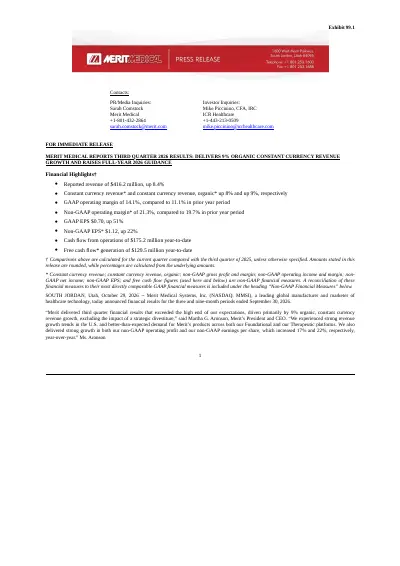
We reported total revenue of $416 million, up 8% year-over-year on both a GAAP and constant currency basis. Our total revenue results exceeded the high end of the expectations that we outlined on our Q2 earnings call.
Third quarter total constant currency growth was driven by 9% organic growth, which also exceeded the high end of our expectations and follows the 9% organic growth we delivered in Q2. By way of reminder, our organic growth excludes the contributions from acquisitions in the current year period and revenue from divested products in the prior year period.
We saw strong growth trends in the US in the third quarter and better than expected demand across both of our primary product categories, with 8% organic growth in sales of our foundational products and 11% organic growth in sales of our therapeutic products. We were pleased to deliver strong organic growth that not only exceeded the high end of the expectations outlined on our Q2 earnings call, but also reflects an improvement in our organic growth trends for both our foundational and our therapeutic product categories on both a two-year and three-year basis.
With respect to profitability performance in Q3, we delivered financial results that significantly exceeded expectations. Our non-GAAP operating margin increased 160 basis points year-over-year to 21.3%, our non-GAAP EPS increased 22% year-over-year, and we generated nearly $53 million of free cash flow.
I want to congratulate our team members all around the world. The better-than-expected growth and profitability performance delivered over the first 9 months of 2026 represents clear evidence of their commitment to our Continued Growth Initiatives program and their unwavering focus on our customers each and every day.
We've updated our 2026 guidance to reflect the stronger-than-expected results in the third quarter, and we remain confident in our team's ability to execute, deliver attractive constant currency growth, improve profitability, and generate solid cash flow this year. Turning now to a brief update on several areas of operating progress in recent months.
First, our integration of VuePoint Medical in our oncology platform continues to progress. The message that clinicians can mark a breast cancer lesion at the time of biopsy, which may reduce the need for a separate localization procedure before surgery, is resonating with both surgeons and radiologists.
We are seeing a strong pipeline of evaluations to date, particularly with academic institutions, which we believe will drive new customer adoption. Together with our next-generation product, Scout MD, which we launched in late May, the OneMark gives us a comprehensive breast care offering spanning diagnosis, localization, and surgery.
The strategic rationale for this acquisition is compelling, and the financial rationale is both attractive and consistent with our Continued Growth Initiatives program. We believe this acquisition represents another example of Merit selectively investing to expand our product portfolio in key strategic markets that leverage our existing commercial footprint.
Turning now to our recent clinical progress. In our renal therapies platform, we completed the formal analysis of the AVF and AVG cohorts in our WRAPSODY Global Registry.
The data from the AVF cohort will be presented this weekend at the Controversies in Dialysis Access, or CiDA, meeting. Last month, I, along with members of our global team, attended the Cardiovascular and Interventional Radiological Society of Europe, or CIRSE, meeting in Copenhagen.
Merit hosted well-attended symposia and conducted hands-on demonstrations with numerous clinicians at this year's meeting. Also while in Europe, I had the pleasure of attending the 10th anniversary celebration of our Think Education courses in Odense, Denmark.
Educating physicians around the world continues to be a focus for us. Notably, we have doubled the number of Think Education courses hosted in the US and international markets over the last 2 years.
In our endoscopy platform, we continue to see the clinical evidence strengthen around cTIF with our EsophyX device. At the recent American Foregut Society, or AFS, meeting, investigators presented randomized clinical data comparing cTIF with laparoscopic Nissen fundoplication, the traditional surgical approach to treat GERD.
The study demonstrated that cTIF was non-inferior in both GERD-related quality-of-life improvement and objective normalization of acid exposure while also being associated with lower rates of new onset post-operative dysphagia, or difficulty swallowing. We believe this is an important addition to the growing body of evidence supporting cTIF.
I also want to update you on a transition in our executive leadership team that we announced during the quarter. On August 19th, we announced that Cheri Lewis joined Merit as Chief Operations Officer.
Cheri brings three decades of experience across global operations, manufacturing, and supply chain. She previously held senior roles at Skan Health Systems, Avantor, Medtronic, and Honeywell.
She has led global manufacturing, distribution, logistics, supply chain, quality, regulatory, environmental health and safety, and operational excellence functions across these various organizations. In her first weeks, she has identified opportunities to advance our core business processes for the benefit of our customers and our shareholders.
Her early priorities include launching an integrated business planning process designed to align our portfolio strategy with demand and supply planning, improving working capital efficiency, and driving operational excellence at all of our sites around the world. I also want to thank Neil Peterson, who served as our Chief Operating Officer for the past 4 years and who has been a part of the Merit team for more than 32 years.
Neil is serving as a senior advisor through March of next year to help ensure a smooth transition with Cheri. Neil truly lives the Merit way, embodying our values each and every day.
He has given so much to Merit, but in particular, I want to highlight his leadership through COVID. This company would not have come through the pandemic as successfully as it did without the leadership of Neil Peterson.
His contributions to the organization can be felt all across the world. On behalf of all of our employees, I thank Neil for helping build Merit Medical to the company we are today.
I also want to highlight two other noteworthy updates before turning the call over to Raul. First, as discussed on our recent investor calls, during 2026, in addition to staying focused on delivering each quarter, we are developing our strategic plan for the period of fiscal years 2027 through 2029.
As outlined on our Q2 call, our strategic plan work in the third quarter included refining our global forecast and prioritizing our investment opportunities in both our product pipeline and potential acquisitions for the next 3 years. Within each platform, we are highlighting where we feel we have the right to win.
We are focused on high-growth procedures where we offer foundational products as well as entire clinical procedures where we offer a suite of both foundational and therapeutic products. We are also focused on ensuring we have thoughtful plans to drive continued improvement in our organizational structure, productivity, and efficiency to support our multi-year goals for both growth and profitability.
We are nearing completion of our planning work and look forward to sharing the key highlights of this strategic plan and new financial targets for the three-year period of 2027 to 2029. Importantly, we intend to host an investor event at our corporate headquarters on February 11th, 2027.
In addition to a comprehensive review of our strategic plan and new financial targets, we believe this event will be a great opportunity for the investment community to hear from members of our executive team and to see our impressive manufacturing and operations capabilities here in Salt Lake City. We will share more details on the plans and logistics for this investor event on our IR website in the coming weeks.
For avoidance of doubt, while we're excited to host this investor event in February, our team remains focused on delivering our Continued Growth Initiative commitments. As our updated 2026 financial guidance indicates, we are tracking nicely towards our CGI financial targets.
Specifically, for the three-year period ending December 31st, 2026, we are targeting an organic constant currency revenue CAGR of 5% to 7%, a non-GAAP operating margin in the range of 20% to 22%, and cumulative free cash flow generation of more than $400 million. Finally, I want to discuss a strategic announcement we made subsequent to quarter end.
This afternoon, we announced the acquisition of SoloPace. Located in Minneapolis, SoloPace manufactures temporary pacing technology designed to help physicians treat patients with aortic stenosis.
This is a company that we know well, having made phased investments over a number of years to acquire an 18% equity ownership interest. Along with that, we had an option to acquire the outstanding equity based on future milestones, and we had exclusive rights to distribute the SoloPace systems.
Our cardiac therapies platform, with the assistance of the SoloPace founder, Dr. Dave Daniels, has seen a very nice uptake of this technology.
On October 13th, 2026, we paid approximately $45 million to acquire all the remaining outstanding equity of SoloPace. The acquisition expands our cardiac therapies platform with differentiated technologies, including the SoloPace Control and SoloPace Fusion systems, that are exclusively engineered for transcatheter aortic valve replacement, or TAVR, and other transcatheter heart valve procedures.
For those less familiar, TAVR is a minimally invasive transcatheter heart valve procedure that replaces the aortic valve in the heart. A treatment for aortic stenosis or narrowing of the valve opening, TAVR is a rapidly growing procedure with more than 100,000 performed annually in the United States alone.
Temporary pacing is a critical component of TAVR procedures, supporting accurate valve deployment and helping physicians perform the procedure safely and efficiently. SoloPace Fusion is a single-use, sterile kit designed for temporary intracardiac pacing for TAVR and other transcatheter heart valve procedures.
Combining guidewire functionality, left ventricular pacing, and patient grounding in one device, the SoloPace Fusion is designed to provide stable, reliable temporary pacing throughout pacing setup and delivery. SoloPace Fusion is engineered to improve procedural efficiency during TAVR procedures and supports temporary pacing with operator-specific protocols, automated pace capture checks, sterile remote control operation, and simple visual indicators.
As mentioned, prior to the acquisition, we served as the exclusive distributor of this product. Adding this technology to our cardiac therapies platform builds on this existing commercial relationship and supports Merit's strategy to expand its structural heart portfolio with a focus on technologies designed to simplify procedural workflows and support physicians performing transcatheter heart valve procedures.
We look forward to leveraging our commercial, clinical, and physician education capabilities to expand adoption in the United States and, over time, bring these solutions to more physicians and patients worldwide. With that, I'll turn the call over to Raul for an in-depth review of our third quarter financial results and our updated financial guidance for 2026.
Raul?
Raul Parra
Thank you, Martha. I will start with a detailed review of our revenue results in the third quarter.
Note, unless otherwise stated, all growth rates are approximated and presented on both a year-over-year and constant currency basis. Third quarter total revenue increased $31 million, or 8%, exceeding the high end of the expectations we outlined on our Q2 call.
Our total revenue increased 9% on an organic constant currency basis, exceeding the high end of our expectations by approximately 90 basis points. As detailed in our earnings press release, organic constant currency revenue excludes revenue from acquisitions in the third quarter of 2026 of $2.6 million and revenue from our divested DualCap product line of $5.2 million from the third quarter of 2025.
By geography, our total revenue in Q3 was primarily driven by growth in the US, where sales increased $25.9 million, or 11%, and international sales increased $5.1 million, or 3%. Turning to a review of our revenue results by product category.
Third quarter total revenue growth was relatively balanced between our two product categories. Sales of foundational products increased $14 million, or 6%, and sales of therapeutic products increased $17 million, or 13%.
In terms of organic growth, in Q3, sales of foundational products increased $20 million, or 8%, and sales of therapeutic products increased $14 million, or 11%. Organic growth in the foundational product category was driven primarily by our vascular intervention, access, and OEM platforms.
Organic growth in the therapeutic product category was driven primarily by growth in our oncology, endoscopy, and OEM platforms, with contributions from solid growth in our vascular intervention and cardiac therapies platform. Turning to a review of our P&L performance.
For the avoidance of doubt, unless otherwise noted, my commentary will focus on the company's non-GAAP results during the third quarter of 2026, and all growth rates are approximated and presented on a year-over-year basis. We have included reconciliations from our GAAP reported results to the most directly comparable non-GAAP items in our press release and presentation available on our website.
Gross profit increased 7%. Gross margin was 52.8%, down 81 basis points year-over-year.
The year-over-year decline in gross margin was driven primarily by manufacturing variances and higher freight and distribution expenses compared to the prior-year period. Operating expenses increased 1%.
The increase in operating expenses was driven by a $1.3 million, or 1%, increase in SG&A expense, offset partially by a $0.4 million, or 2%, decrease in R&D expense compared to the prior-year period. Total operating income increased $13 million, or 17%, to $88.5 million.
Our operating margin was 21.3% compared to 19.7% in the prior-year period, an increase of 160 basis points year-over-year. We were pleased to deliver operating margin results at the high end of our guidance range despite the softer gross margin results in the third quarter.
Third quarter other expense net was $1.3 million compared to $2.4 million for the comparable period last year. Third quarter net income was $67.4 million, or $1.12 per share, compared to $54.9 million, or $0.92 per share, in the prior-year period, exceeding the high end of our guidance range by $0.04.
Turning to a review of our balance sheet and financial condition. As of September 30th, 2026, we had cash, cash equivalents, and restricted cash of $505.8 million, total debt obligations of $747.5 million, and available borrowing capacity of approximately $697 million.
Our net leverage ratio as of September 30th was 1.5 times on an adjusted basis. Turning to a review of our fiscal year 2026 financial guidance.
For the 12 months ending December 31st, 2026, we now expect total GAAP net revenue growth in the range of 7.9% to 8.4% year-over-year, and 7% to 7.5% year-over-year on a constant currency basis, excluding an expected 80 basis point tailwind to GAAP growth from changes in foreign currency exchange rates. There are a few factors to consider when evaluating our projected constant currency revenue growth range for 2026, including, first, our constant currency growth range assumes sales of foundational products increases in the mid-single digits year-over-year and sales of therapeutic products increase in the low double digits year-over-year.
Second, we expect organic constant currency growth in the range of 7.1% and 7.6%. Our organic growth guidance excludes revenue from acquisitions in the range of approximately $18 million to $19 million compared to $18 million to $20 million previously, and product sales and royalty revenue from our divestiture of DualCap of $20.3 million in 2025 and approximately $1.6 million of sales in Q1 of 2026.
Third, our total net revenue guidance for fiscal year 2026 continues to assume US revenue from the sales of WRAPSODY CIE of approximately $7 million. With respect to profitability guidance for 2026, we now expect non-GAAP diluted earnings per share in the range of $4.33 to $4.37 compared to $4.25 to $4.35 previously.
Our updated non-GAAP diluted EPS guidance range reflects expected growth in the range of 13% to 14% year-over-year. Note, our updated non-GAAP EPS guidance range assumes a full year 2026 non-GAAP operating margin in the range of 21.2% to 21.4%, up 94 to 116 basis points year-over-year.
Finally, we'd like to provide additional transparency related to our growth and profitability expectations for the fourth quarter of 2026. Specifically, we expect our total revenue in the range of $418 to $426 million, representing growth of 6% to 8% year-over-year on a GAAP basis, and approximately 6% to 8% on a constant currency basis.
We expect organic constant currency growth in the range of 7% to 8%, excluding revenue from acquisitions in the range of approximately $1.8 to $2.8 million and revenue from a divestiture of $4.9 million in the prior-year period. With respect to our profitability expectations for the fourth quarter of 2026, we expect non-GAAP operating margins in the range of approximately 21.2% to 22.1% compared to 21% last year, and non-GAAP EPS in the range of $1.08 to $1.12 compared to $1.04 last year.
With that, I will now turn the call back to Martha for closing comments.
Martha Aronson
Thanks, Raul. This team delivered an excellent Q3 and has strong momentum as we move into the final quarter of the year.
I want to reiterate how pleased I am that we are on track to meet our three-year CGI goals. While staying focused on that goal, this team is putting the hard work into finalizing our global strategic plan.
Simultaneously, we are integrating several acquisitions and, as always, evaluating additional acquisition possibilities. My hat goes off to the team, and I'm energized by the opportunities I see ahead to enhance our strong growth profile.
Operator, we would now like to open up the line for questions.
Operator
Ladies and gentlemen, if you have a question or comment at this time, please press *11 on your telephone keypad. If your question has been answered or you wish to remove yourself from the queue, simply press *11 again.
Again, if you have a question or comment, please press *11 on your telephone keypad. Please stand by while we compile the Q&A roster.
Our first question or comment comes from the line of Jason Bednar from Piper Sandler. Your line is open, sir.
Jason Bednar
Hey, good afternoon. Nice quarter, and thanks for taking the questions.
Martha, I'll start maybe with a bigger-picture question here, and Raul, feel free to layer on, too. Look, organic growth's been running at a really healthy clip, high single digits for a few quarters now, if we include the fourth quarter.
Is Merit just in a really nice cycle of growth for the company here in 2026? Or do you think there's levers that can help you sustain this high level of performance even against what will soon be tougher comps?
What are some of the call-outs that could take you higher or lower from this current growth run rate that I think we've all gotten comfortable with?
Martha Aronson
Yeah. Jason, thanks for the question.
Yes, I'm really pleased, right, that we did come in with stronger-than-expected growth again in this quarter. As you noted, 9% growth this quarter as well as in Q2.
Feel good about it. I think the key message, though, is that the growth is really balanced.
That certainly gives us good confidence as we continue to finish out the year. Obviously, as you can imagine, we're not ready to start commenting on next year or the future.
I think as you heard, we're excited to share some of that with you all in February here at an investor event. Suffice it to say, the team has done a great job this year.
I'm very proud of the team to stay so focused on delivering quarter after quarter. I think as you heard, as we said, it really was balanced across many of our platforms.
Jason Bednar
All right. Understood.
No, definitely impressive so far here. I want to pivot over to OneMark.
Sounds like the early feedback there is pretty strong. Is there anything anecdotal you can share with respect to accounts that are using both Scout and OneMark?
I think you were originally targeting those accounts that weren't using Scout, but, again, for those that have overlap, any feedback there? Is the balance of business between those two playing out as you anticipated?
Sorry to layer on a few, but do you still feel good with those revenue targets that you have for OneMark for this year and next? Thank you.
Martha Aronson
Yeah. No, thanks for the question.
As I said in the prepared comments, the integration continues to progress nicely, right? I think as we had shared before and as you just commented, we really are looking at targeting the other thing you have to remember is we're also rolling out Scout MD right now as well, right?
That's the newer version of the Scout technology. We're really focusing the sales organization, for starters, on new accounts, if you will, or not current Scout accounts for the OneMark.
We've got a really nice pipeline of potential accounts. We've got academic institutions, but it's really still kind of early days to comment on your specific question.
Jason Bednar
All right, thank you.
Operator
Thank you. Our next question or comment comes from the line of Robert Marcus from JPMorgan.
Mr. Marcus, your line is open.
Henry Householter
Hey, this is Henry on for Robbie. Congrats on another strong quarter, and thanks for taking the questions.
Maybe turning a little bit to the deal you guys announced today. As you think about Merit growing, do you think you need to adjust your M&A strategy and scale it larger?
Or is this still kind of a path to success forward? Just your thoughts on the capital allocation policy.
Martha Aronson
I think first, thanks for the questions. First, on the SoloPace, we're very excited about it, right?
Again, we've been distributing this product for a while now. It's a terrific technology.
As I'm sure many of you follow the TAVR market pretty closely. It fits really nicely, I would say, with what Merit is very good at, right?
We don't sell the heart valve, but we provide really important part of the procedure. Of course, temporary pacing is a really critical part of the procedure.
To be able to do it with an integrated kit, it can be automated, it can be pre-programmed, there's some safety features. We're really excited about having that.
I think as far as M&A strategy, I'll repeat what I think I've been saying for a while. We'll continue to look at tuck-in acquisitions.
We hear about a lot of things, certainly, and at the same time, we are asking each one of our platforms to really share with us where the areas are, the gaps they feel they have in each particular platform. Then we spend time thinking about whether we feel confident in our capabilities to develop it internally and what that timeline looks like or whether it makes more sense for us to try to go out and proactively seek some of these things inorganically.
We'll continue on that path as far as M&A is concerned.
Operator
Thank you. Our next question or comment comes from the line of Jason Bedford from Raymond James.
Mr. Bedford, your line is now open.
Zach Gold
Hey, how's it going? Thanks for taking the question.
This is Zach Gold on for Jason here. Just a quick question thinking about the fourth quarter guide here.
Can you kind of walk us through some of the puts and the takes, what's driving the guide? It seems like a bit of an implied decel just kind of looking at the comps as well.
What was sort of the rationale for thinking through that on 4Q?
Raul Parra
Honestly, I think the best way to look at it is just the year-over-year guidance, right, that we're giving. We've raised the guidance on the low end.
We've brought EPS up. We brought operating margin up.
We really haven't changed any assumptions in the fourth quarter. We essentially flowed through some of the beats of Q3, which is really standard practice for us, as most of you guys know.
Really, the only change that we have is a small change to our China outlook. We've brought that down slightly, roughly $4 million for the second half.
Other than that, everything else is essentially kind of the same and we've just essentially flowed through Q3. I would say, we continue to be excited about the business.
We're excited about the guidance that we've put forward, and just really excited about how the company is performing.
Zach Gold
Great. Thank you.
That's super helpful. Then if I could ask on WRAPSODY there, I know you guys are reiterating the guide here at $7 million.
I'm just curious color, commentary, and if it's trending better, worse, what's working, what isn't, what have you learned this year since you initially put out the $7 million, any sort of updates or color you can offer here.
Martha Aronson
A couple thoughts I'd share with you on WRAPSODY. I would say that we continue to hear from the field and when you talk to physicians directly, that how excited and impressed they are with the technology.
It is performing clinically exceptionally well. We also know, as we have all year, that we're up against some significant competition, and they are not going to just sit back and let us waltz right in.
We're definitely seeing, I'd say, what you would all consider very traditional competitive responses, if you will. I guess the good news is it validates what we know, which is how excited we are about how this product is performing.
The hard part is, right, it means it's going to be a bit of a battle out there. I'd tell you that's really what we're seeing.
We're seeing the competition hiring more people, that kind of behavior, if you will, and responses, which I think you would expect. As we said, though, again, can't talk about it yet, but there will be some data presented this weekend again at the CiDA conference to just, again, continue to tell that clinical story.
Zach Gold
Thank you, guys.
Operator
Thank you. Our next question or comment comes from the line of Mike Matson from Needham.
Mr. Matson, your line is now open.
Joseph Conway
Hey, Raul. Hey, Martha.
This is Joseph on for Mike. Maybe start off with OEM.
Looks like continued strong growth in the quarter. Just wondering there if this is continued kind of rebound or recovery from the 1 1Q.
Then maybe is the expectation moving forward that OEM returns to that mid to high single digit growth? Or could we expect to see maybe continued double-digit growth at least in the next quarter?
Martha Aronson
Yeah. Thanks for the question.
We're really pleased with the performance of the OEM business, which in totality, right, increased about 15% in the third quarter. As it was a bit of a softer first half.
It was essentially flat. We're at about 5% growth year to date.
I think, as we've reiterated before, it's fair to assume we still consider that to be really in the mid to high single-digit range. Again, it's a lumpy business, right?
I think that's the best way to think about how that business will perform going forward.
Joseph Conway
Great. That's fair.
Then maybe a question on the MOTION study. You guys had initiated this two 2 years or so ago, maybe longer than that.
I was just wondering if you could maybe revisit that, the market opportunity in GAE and maybe I think the follow-up was around 2 years, if you could maybe give us maybe a timeline or an idea of when a readout for that trial could be.
Martha Aronson
Yeah. I think, overall, we continue to be very excited about the embolics business globally.
It's performing very nicely for us, it continues to be an area we're very excited about. I don't have the exact sort of timeline, if you will, on the MOTION study, not prepared to comment on that right now.
We can get back to you with that, a little more detail on that later. Suffice it to say, this embolic space, we see a lot of growth, as we said, all around the world, and we continue to think and work very hard in that space.
Joseph Conway
Great. Thanks.
Congrats on the quarter.
Martha Aronson
Thank you.
Operator
Thank you. Our next question or comment comes from the line of Michael Petusky from Barrington Research.
Mr. Petusky, your line is now open.
Michael Petusky
Hey, good evening. Lots of good stuff.
Hey, Raul, I want to ask, I don't think that you mentioned impact of tariffs in your gross margin commentary, and I was just wondering if there's any way you could quantify the headwinds associated with that issue related to the gross margin decline.
Raul Parra
It wasn't significant, to be honest with you. Look, I think the first thing I'll point out is, obviously, despite the gross margin being down about 80 80 basis points, operating margin was up 160 basis points, right, which is really what we're chasing, really really proud of the team for delivering that.
On the gross margin side, I'll point out to a couple of things. The first one is 80 basis points of unfavorable manufacturing variances, most of it around raw materials, and most of it around platinum.
The nice thing about that is that we do have an alternative to platinum for that specific product, and we've validated that, and we're in the process of ramping that up. The other thing that happened there was we had a true-up on bonuses that impacted the gross margin by about 40 basis points.
The operations group is obviously performing well, and the company's performing well, we had to true up to our bonus accrual that impacted the gross margin. The last thing was freight, which was up 25 basis points, and unfavorable to the gross margin.
All of that was kind of partially offset by favorable obsolescence. All in all, although it was down, I think we do have kind of some unique things that we think were more in control of, than kind of what you're hearing out there, and in the street, I think I feel pretty good.
Then we've got Cheri. I think she's got a really good game plan, not only for operational efficiencies, but also just from a working capital standpoint and looking at the inventory and helping us manage that better.
Michael Petusky
Okay. Could I just real quick stay on the tariff issue real quick
Raul Parra
for
Michael Petusky
last quarter, I think you guys said you got a refund, might get another refund, and then also you sort of bumped up your headwind guidance associated with tariffs a million bucks. I'm just curious, are there any updates on any refunds, and also any update to your tariff headwind guidance of $16 million?
Thanks.
Raul Parra
We're expecting another, let's say, $1.3 million or so in tariff refunds. Now, those are kind of with the vendor, I'll say, one of our freight carriers that's the importer of record.
We're waiting on a refund from them. Last I heard is that they did receive the funds, but I can assume that they have significant amount of clients, and so they're working through that reimbursement process.
We do expect more dollars to come in. I would probably kind of guess maybe the first part of the year if I'm being honest.
I'm not really expecting it this year. The other piece is really around Section 232.
Obviously, the administration has not announced any formal plans yet. I think we're keeping an eye on it and just listening to the chatter to see how it could impact the business, but I don't know that we have anything that we can specifically call out.
Just, as a matter of reference, we haven't changed our assumptions for what we think the impact is or the incremental impact of tariffs is, which was around $16 million, which we included in our guidance at the beginning of the year.
Michael Petusky
Great. Thank you so much.
Appreciate it.
Raul Parra
Yep.
Operator
Thank you. Our next question or comment comes from the line of Sam Eiber from U.S.
Bancorp BTIG. Mr.
Eiber, your line is open.
Sam Eiber
Thank you. Good afternoon.
Thanks for taking the questions. Maybe I can start on what you're seeing in terms of end-market procedure volumes, if you're benefiting from maybe this continued shift to ASCs and any sort of, I guess, secular tailwinds that you're benefiting from.
Then, I guess as a follow-up on that, any changes on the competitive outlook? I think we saw a competitor close down their US interventional business, curious if you're seeing any impact from that and any changes there.
Thanks.
Martha Aronson
Thanks for the question. We're not hearing a whole lot, I'd say.
I think last quarter, there was a little bit of a potential scare that procedures were really slowing down. We have not seen that.
Again, another quarter of 9% growth would obviously confirm that. I think our team went out there and delivered, and I don't think we have a whole lot more to say about procedure volumes one way or the other, nothing we've been hearing about significantly from our field.
Raul Parra
Our growth is broad-based, right? It's not isolated to anything.
Again, the team is just executing really well.
Sam Eiber
Very good. Maybe I can just ask a follow-up here on SoloPace.
Just curious any learnings that you've had I guess serving as the exclusive distributor for some time now and I guess how much hand-holding or a high-touch sales model is needed to really get this out in the market? Obviously, TAVR is a very exciting end-market for you guys.
Martha Aronson
No, it's been great actually, and you're right. It is a bit more of what I think in the industry, we generally call a consultative sale, although it tends to be the kind of thing where there's a fair amount of rep support, I'd say, initially.
Then honestly, most of these physicians pick this up pretty quickly and then can run with it. Again, a shout out Dr.
Daniels spent a whole lot of time personally helping educate our sales force really really well and, when needed, would travel out to various cases, etc. Again, it's great technology that once someone's used it a couple times, right, they know how to do the pre-programming, and they can put in their own protocols.
There's really nice, simple, elegant visual indicators. You have a remote control.
They end up getting self-sufficient pretty quickly.
Sam Eiber
Great. Thanks for taking the questions.
Martha Aronson
Thank you.
Operator
Thank you. Our next question or comment comes from the line of Aidan Leahy from Bank of America.
Leahy, your line is open.
Aidan Leahy
Hi. Thanks for taking the questions.
Another one on SoloPace. Could you help me frame up how big that is a part of your revenue base now?
I imagine since you were the distributor, this would not be inorganic. Then when we think about the timing of the transaction, was the TAVR NCD a consideration?
Cuz obviously, there's going to be some upcoming data and NCD's going into effect, we could see procedure volumes expand. Was that part of your decision-making process?
Then I have a follow-up.
Martha Aronson
A couple of things. Financially, this transaction is immaterial to 2026.
It will be slightly accretive to our non-GAAP net income and earnings per share in 2027. That's sort of the financial picture, if you will.
Now, I'm trying to remember. I think you had about three other questions there, I apologize.
I'm not remembering them all. Can you repeat one or two of the other questions?
Aidan Leahy
Just basically on the timing, was a TAVR National Coverage Decision part of the decision-making process for the timing?
Martha Aronson
No, it really wasn't. It's more that, again, we've been the distributor for a while now.
We just, as I think it's fair to say, kind of came on board and got to spend some time with Dr. Daniels and spend some time with our cardiac therapies team here.
We just kind of all put our heads together and said, "You know what? I think it makes sense to do this now.
Our team is more prepared to fly solo." We made the decision it was time.
Aidan Leahy
Got it. Then a follow-up on Scout MD.
I know that's rolling out. Is there any lumpiness in terms of capital placements where customers are upgrading and there's an upfront payment that we should consider as we analyze that next year, or is that upgrade more about driving pull-through later on?
Thank you.
Martha Aronson
Obviously, anytime there's a capital component, right, there's going to be some lumpiness. The sales process is obviously longer when you're dealing with that.
In the case of Scout MD, though, because it really is kind of a new-generation device going into a number of our current customers, we did have a little bit of pent-up demand. That's really, if you looked at kind of our oncology number for the quarter, I think it was up about 16%, and that's what drove a bit of that, I would say, for this quarter.
Aidan Leahy
Great. Thank you very much.
Martha Aronson
Thanks.
Operator
Thank you. Our next question or comment comes from the line of John Young from Canaccord.
Mr. Young, your line is open.
John Young
Hi, Martha and Raul. Congratulations on the quarter, and thank you for taking the question.
I just want to go to OpEx leverage, SG&A and R&D both were down as percentage of sales over your year nicely. How much of this is just timing in terms of hiring or projects versus lasting efficiency?
Do we expect any 2027 R&D step-ups just given OneMark or anything in the pipeline that you guys are willing to highlight today? Thanks.
Raul Parra
We won't hit on 2027, but I think we've disclosed certain metrics as far as related to those acquisitions, transitory costs and integration expenses, right? I think we've given essentially the highlight of each of the acquisitions and what they're going to do on a go-forward basis, I won't comment on that.
I would say that the OpEx leverage was I think done in a really, I think positive way, right? Sales and marketing, we invested there.
We saw an increase in sales and marketing. On the G&A side, we essentially offset the investments that we made in sales and marketing.
Again, I think we're trying to find ways to leverage the P&L, specifically when it comes to operating margin growth, right? We knew that, look, we're heading into the third quarter.
As you guys know, there is some seasonality in our business. Typically, revenues are down sequentially.
You still have kind of the same overhead on the gross margin side, you're really trying to make sure that you don't spend ahead of kind of how that gross margin is going to come in. We show a lot of discipline, and we exercise a lot of discipline on the OpEx line, to try and make sure that we hit obviously our goals in guidance for the quarter.
I would say, generally speaking, we just feel really good about the control that we're showing. Overall, I would just say, I'd like to kind of just highlight really that the performance of our three-year CGI plan.
I think we're essentially going to be on the high end of our operating margin. We're going to come in somewhere close to $600 million of free cash flow when we promised a minimum of $400 million.
The growth rate or the CAGR on revenue is going to be right in line with what we said. Just overall, super happy.
I'm kind of all over the place, but just want to hit on a few things that haven't been asked yet. You look at the profitability on EPS side, we're expecting now 13% to 4- 14% EPS growth, on roughly 8% growth.
We're getting good leverage. Again, I think to Martha's point, she said it several times, the team is just executing.
We just spent a lot of time strategically planning for the next 3 to 5 years. A lot of excitement here at Merit.
Nothing else to say.
John Young
Got it. Thanks, Raul.
Then maybe one on SoloPace too, if I may. It looks like it's guidewire agnostic from what I can see online.
Do you guys manufacture or sell a guidewire that will be associated with the use of this product, or do you have plans to do so?
Martha Aronson
There is if you look at what we call the Fusion kit, it does come with a guidewire. That's actually an Asahi guidewire.
John Young
Got it. Thank you.
Uh-huh.
Operator
Thank you. Our next question or comment comes from the line of David Rescott from Baird.
Mr. Rescott, your line is now open.
David Rescott
Can you hear me?
Martha Aronson
Yep.
Operator
Yep.
David Rescott
Oh, great. Sorry.
Thanks for taking the questions. Congrats on the results here.
Two from us, and maybe I'll ask them both up front. Heard some of the comments about China.
It sounds like that's been a challenge maybe across the MedTech space that's been popping up recently. Wondering from a timing perspective, how the visibility of that end market has progressed through the year, how that is progressing as you look out into the next year.
Then the second question is more related to the SoloPace deal. Looked like you had a strategic investment in the company in the past.
That was surprising to me. I don't think I've heard at least of a Merit investment in the past, that came through a kind of prior investment in general.
Not sure if that's necessarily correct, but trying to think through how the M&A strategy plays out on a go-forward basis. Historically, it's strategic tuck-in M&A, but wondering if at all this deal is suggestive of a potential path in maybe doing some smaller investments that become part of the portfolio longer term?
Thank you.
Martha Aronson
Yeah. I'm going to take the second one first.
The answer is that Merit historically has made a series of minority investments in certain companies. In fact, VuePoint would be another example of that.
The company had an investment in VuePoint and then ultimately acquired the company. That's not necessarily a major shift.
I would just say, from my perspective, I'm a fan of using that model, right, to have a chance to be inside, if you will, and perhaps have a board seat or a board observer seat so that we can kind of keep an eye on various technologies, see how they evolve over time, and then obviously decide whether or not we think it makes sense to fully acquire and integrate a particular technology. I think you will continue to see us use that model going forward.
Then I think China was your other question. I think you're right.
A lot of discussion. I was at the AdvaMed meeting last week and was in a couple sessions with a variety of other MedTech CEOs, and I don't think there was one session where the topic of China did not come up.
Obviously, you're all hearing about it from many other players out there. Look, it's a tough and complicated situation, right?
There's the VBP situation. We're also hearing a lot more about the government cracking down on physicians and really encouraging them to be buying local Chinese products and making sure that they're using the lowest-priced products and preferably products made in China kind of for China.
Really scrutinizing if any companies outside of China help sponsor education or things like that. I think that it's put a bit of an additional blanket, if you will, on how things are looking in some parts of China.
Having said that, there's still lots and lots of people out there and lots of opportunity. I think it's really hard for us or anyone else, frankly, to say, to put a pin in timing as to when we think things will shift.
My personal opinion is, we're working on a number of pilots, if you will, on thinking about some things made in China for China. We still think it's a good market.
At the same time, I think we're being very realistic about what it can contribute to our growth over time. I don't know, Raul, do you want to add anything?
Raul Parra
I'll just add. I don't think that it's new, Dave.
Look, we've been dealing with China, whether it's VBP, the anti-corruption dynamics, essentially through our last two LRPs. I think we're well-versed in kind of the dynamics of what happens and is happening in China.
I think we've still been able to stay ahead and/or meet our LRP goals, right? I would say it's just more noise, right?
Again, to Martha's point, we think the market is great, and we think that done right, that we can continue to get back to kind of where we were historically. It just takes time, and I think you have to pay a lot of attention to it.
We've got a great team in China that's staying on top of things. From a confidence level, we feel pretty good about it.
We'll just see how things shake out. Again, it's not new.
It's just something we have to deal with, but at the end of the day, we think it's a great market. Also, if you look at our international growth, which was about three 3.3% on a constant currency basis, if you exclude the China piece, it was up 6% organically.
Again, we continue to redirect investments. We've been doing that for the last 3 to 4 years to other markets to essentially kind of hedge against that China component.
You're seeing some of it in the US sales growth. You're seeing it in the rest of APAC.
You're seeing it in EMEA. Again, you just have to kind of take a very proactive approach and just make sure that you're listening and paying attention to what's going on.
Again, it's not new. Maybe
Martha Aronson
last comment on that. That's a lot on China, but I also spent a week in the region in July, and again, really just to just reiterate Raul's point, we have a fantastic team in China, and they just do a great job.
Then frankly, I spent some time understanding our opportunities across the region. As you heard, APAC did beat the high end of our expectations in the quarter.
We're still pretty excited about the possibilities in the region and are looking to continue to think about how we can continue to drive the growth there.
Operator
Thank you. Our next question or comment comes from the line of Jim Sidoti from Sidoti & Company.
Your line is now open.
Jim Sidoti
Hi, good afternoon, and thanks for taking the questions. Raul, just a question on inventory.
It's up about 60 million for the year. Is that related to the acquisition you did last quarter, or is that something else going on there?
When do you think that comes back?
Raul Parra
I'll answer the last part first. I think it starts to come back, right?
I think Cheri's got a good game plan there. Feel a high level of confidence that we can get that to a more normalized level.
Now, I'll say, part of the increase is acquisition-related, not a significant part of it. I think the bigger piece is really a strategic component, Jim.
We were pretty short on a couple of things, kind of last year that we wanted to bump up. Then you ran into the Middle East conflict.
We made a calculated decision that we wanted to stock up on certain inventories, specifically raw materials. Did so just to make sure that we could obviously sustain the growth that you're seeing.
Then lastly, we're over-delivering on what we initially thought on from a sales perspective, just making sure we have the right inventory balances. I will say that I think we're all looking at inventory here.
We think there's a great opportunity to save some working capital there. We still have our goal of a minimum of $200 million of free cash flow on the table.
Again, hopefully, we can get our arms around it here in the fourth quarter. Then, heading into next year, we have a even better game plan.
That's been an area of focus for us for sure, some of it calculated, some of it strategic, but we're definitely kind of thinking about it.
Jim Sidoti
All right. Then with regard to VuePoint, I know a couple questions have been asked, but just overall, are you happy with the way the first quarter has gone and are you on track to hit the numbers you put out?
Martha Aronson
I think we are pleased. I would just say some aspects have gone a little slower than we had hoped.
There's always a few more little complications and things you run into when you make an acquisition. I'd say the team is very focused on it.
We're working both obviously the commercial side of things as well as doing some more integration activities to start moving the manufacturing and some of those activities and getting them on our quality system and all that kind of stuff. It can take some time.
As we said, with Scout MD also launching right at the same time, certainly that's a lot of things for our field to be thinking about, for our whole platform in oncology to be thinking about. I'd tell you it's probably a little slower than I would like, but we still feel very good about the long-term opportunity for the OneMark product.
Very excited about it.
Jim Sidoti
All right. Thank you.
Martha Aronson
Thanks, Jim.
Operator
Thank you. Our next question or comment comes from the line of Keith Hinton from Freedom Capital Markets.
Mr. Hinton, your line is now open.
Keith Hinton
Great. Thanks for taking the question.
I want to start off on the foundational side of vascular intervention. That's done really well since you moved some of the products over to the former Cook team and allowed the vascular team to be a little more focused.
I'm just curious, should we kind of think of that as more of a one-time step up as we start to lap that impact in the year-over-year comps, or do you think that franchise has the potential to continue growing double-digit going forward? Then I have a follow-up as well.
Martha Aronson
Look, I think all of our platforms, as we said, in this quarter, we saw pretty balanced growth. When we talk about the longer-term growth profiles of all of our various platforms, that's going to be the kind of thing, frankly, we're going to spend some time talking about at our investor event.
Hopefully, you'll come out here, Keith, and see our fantastic manufacturing facility, and at that time, we'll really kind of go through platform by platform and what we really see as some of the drivers going forward. We're not going to talk too much about '27 and beyond today.
Keith Hinton
Understood. Okay.
Then just on the embolics side of things, can you just talk a little bit about sort of the health of that market, where the growth that you're seeing is coming from in terms of spheres versus catheters and other things and which indications you're seeing the strongest growth in? Because obviously there's a lot that can be done on the embolics side
Martha Aronson
too. There is a lot.
There's a lot that can be done. There's definitely a lot going on.
I'd say, we're seeing it both in terms of the growth, both in the spheres and in the microcatheters. It was interesting.
I think at the CIRSE meeting I attended, again, just about every topic was in the embolic space. You're right.
It's a very very busy space. There's a lot going on.
We like our position there, and we'll continue to think about how we can continue to be very strong in that whole platform going forward.
Keith Hinton
Great. Thanks for taking the questions.
Martha Aronson
Thank you.
Operator
Thank you. I'm showing no additional questions in the queue at this time.
I'd like to turn the conference back over to Ms. Martha Aronson for any closing remarks.
Martha Aronson
Thanks, operator. Again, I would just reiterate how proud I am of our global team for delivering just an outstanding quarter here and, as we said, coming off of the second quarter as well.
As Raul said, in addition, working really hard on strategic planning across the organization. I'm just extremely energized.
I've just kind of lapped my one-year mark in this chair, and have to say just really energized by this really good work by the team, and just seeing more and more collaboration and terrific alignment by our organization. Just want to say thank you all for your time and attention today, and for your interest in Merit.
We'll see you next time. Thanks a lot.
Operator
Ladies and gentlemen, thank you for participating in today's conference. This concludes the program.
You may now disconnect. Everyone, have a wonderful day.