Merck & Company, Inc.
Q3 FY2026 · Earnings Call TranscriptOctober 29, 2026
Operator
Welcome to the Merck & Co., Inc., Rahway, New Jersey, USA, third quarter sales and earnings conference call. At this time, all participants are in a listen-only mode until the question-and-answer session of this conference.
At that time to ask a question, press *1 on your phone and record your name at the prompt. This call is being recorded.
If you have any objections, you may disconnect at this time. I would now like to turn the call over to Mr.
Peter Dannenbaum, Senior Vice President, Investor Relations. Sir, you may begin.
Peter Dannenbaum
Thank you, Julie, and good morning, everyone. Welcome to the third quarter 2026 conference call for Merck & Co., Inc., Rahway, New Jersey, USA.
Speaking on today's call will be Rob Davis, Chairman and Chief Executive Officer; Caroline Litchfield, Chief Financial Officer; and Dr. Dean Li, President of Research Labs.
Before we get started, I'd like to point out that we have items in our GAAP results, such as acquisition-related charges, restructuring costs, and certain other items, that we have excluded from our non-GAAP results. There is a reconciliation in our press release.
I will also remind you that some of the statements that we make today may be considered forward-looking statements within the meaning of the safe harbor provision of the US Private Securities Litigation Reform Act of 1995. Such statements are made based on the current beliefs of our company's management and are subject to significant risks and uncertainties.
If our underlying assumptions prove inaccurate or uncertainties materialize, actual results may differ materially from those set forth in the forward-looking statements. Our SEC filings, including Item 1A in the 2025 10-K, identify certain risk factors and cautionary statements that could cause the company's actual results to differ materially from those projected in any of our forward-looking statements made this morning.
Merck & Co., Inc., Rahway, New Jersey, USA, undertakes no obligation to publicly update any forward-looking statements. During today's call, a slide presentation will accompany our speakers' prepared remarks.
These slides, along with the earnings release, today's prepared remarks, and our SEC filings, are all posted to the Investor Relations section of our company's website. With that, I'd like to turn the call over to Rob.
Rob Davis
Thank you, Peter. Good morning, and thank you for joining today's call.
2026 continues to be a year of substantial progress for our company. We're executing well on all fronts, demonstrated particularly by the many new product launches now successfully underway and the important clinical milestones we're achieving that are further derisking the substantial long-term opportunity of our late-phase pipeline.
This momentum extends across multiple therapeutic areas and modalities, and there is much more to come, with numerous significant readouts still to occur over the coming years. I'm very pleased that the disciplined execution of our strategy over the past several years is increasingly translating into meaningful clinical, regulatory, and commercial results.
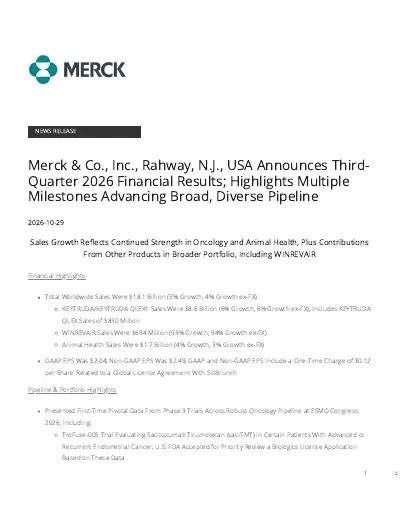
The breadth of these achievements strengthens my confidence in the future of our company and our ability to deliver long-term value for patients and shareholders. Turning to our third quarter results, we delivered solid performance with revenue of $18.1 billion, reflecting increased contributions from new products as well as strength in oncology and animal health.
Caroline will discuss our results and the full-year outlook in greater detail in a moment. We also achieved several important clinical and regulatory milestones.
In oncology, last weekend's ESMO meeting showcased potential practice-changing advances for several innovative programs, highlighted by the first positive Phase 3 results from our expansive global TroFuse program for sac-TMT in advanced or recurrent endometrial cancer. Additional data shared at the meeting from our partner Kelun further support the potential of sac-TMT in lung cancer and other tumor types.
We are encouraged by the landmark validation of a therapeutic cancer vaccine, with positive Phase 3 data presented for intismoran autogene as an adjuvant treatment for certain patients with melanoma. This new approach may offer a tangible opportunity to change the trajectory of a patient's cancer.
In ophthalmology, we presented results from the BRUNELLO study evaluating remegremig in diabetic macular edema, a significant milestone for our rapidly advancing retinal disease portfolio. Finally, in immunology, we presented encouraging Phase 2b results in HS and look forward to advancing our TL1A development program.
This year's clinical and commercial progress underlines the ongoing transformation of our business and provides us with greater visibility into the trajectory of our emerging and expansive new product portfolio. The opportunity we have to drive strong long-term growth beyond the KEYTRUDA LOE period is becoming increasingly clear as we achieve these scientific and commercial milestones.
As we look ahead, we'll remain focused on successfully executing our launches, broadening and advancing our pipeline, and making meaningful investments to realize the full potential of these opportunities. I want to recognize and thank our dedicated global teams for their ongoing commitment to delivering value for patients, shareholders, and all of our stakeholders.
Now, I'll turn the call over to Caroline.
Caroline Litchfield
Thank you, Rob. Good morning.
As Rob noted, we delivered solid performance in the quarter, driven by increasing contributions from our compelling array of important new products and continued strength in oncology and animal health. Strong commercial and operational execution continues to propel our near-term performance while we invest to optimize our launches and advance our broad and deep pipeline to create long-term value for patients, customers, and shareholders.
Now turning to our third quarter results. Total company revenues were $18.1 billion, an increase of 5%, or 4% excluding the impact of foreign exchange.
The following revenue comments will be on an ex-exchange basis. In oncology, sales of the KEYTRUDA family of products, which includes KEYTRUDA and KEYTRUDA Q-LEXX, increased 6% to $8.6 billion, with global growth driven by strong uptake in earlier-stage cancers and continued robust demand for metastatic indications.
Key contributors to growth included strong utilization in tumors that primarily affect women, particularly cervical and breast cancers, as well as increased use of KEYTRUDA plus Padcev in urothelial cancer. We also saw continued uptake in earlier-stage head and neck cancer.
As expected, the timing of US customer purchases last year created a headwind to growth, but this was largely offset by an increase in channel inventory, which we expect to unwind in the fourth quarter. Sales of KEYTRUDA Q-LEXX were $830 million.
We continue to see adoption increase, which supports our confidence in the trajectory of the product. In our broader oncology portfolio, Welireg sales increased 58% to $307 million, driven by increased use in previously treated patients and as adjuvant treatment for certain patients with renal cell carcinoma in the US, as well as continued uptake from ongoing launches in international markets.
In vaccines and infectious diseases, Gardasil sales were $2 billion, an increase of 14%. In the US, sales grew 18%, benefiting from a significant CDC purchase and price, while international markets increased 6%.
In pneumococcal, Capvaxive sales were $263 million, an increase of 7%, driven by ongoing launches in certain international markets. In the US, sales declined 13%, as increased market share was more than offset by lower adult pneumococcal vaccination rates.
In RSV, Enflonsia sales of $187 million reflect seasonal demand and associated inventory build. In cardiometabolic and respiratory, Winrevair continued its momentum with global sales of $694 million, an increase of 94%, reflecting strong demand from adults with pulmonary arterial hypertension, as well as a benefit from channel inventory.
In the US, nearly 1,600 new patients received a prescription, approximately 30% of whom were on background therapies that did not include a prostacyclin. Outside the US, we continue to progress with ongoing launches.
Ohtuvayre sales were $184 million, reflecting continued demand from adults with COPD, partially offset by a small headwind from the timing of specialty pharmacy purchases. While early, we are encouraged by the initial launch of Lipfendro.
Prescription trends and physician feedback has been positive. Additionally, we have established programs to support access and affordability for eligible patients.
As expected, broad access will take time to build, and we remain confident in the long-term opportunity for this important treatment option for adults with elevated LDL cholesterol. Our animal health business delivered growth of 3%.
Companion animal sales increased 6%, driven by new product launches. Livestock sales grew 2%, due to higher demand for poultry products.
I will now walk you through the remainder of our P&L, and my comments will be on a non-GAAP basis. Gross margin decreased slightly to 81.4%.
Operating expenses increased 12% to $7.4 billion, reflecting increased investments to support our launches and advance our diverse early- and late-phase pipeline. This increase was partially offset by benefits from our ongoing multiyear optimization effort and the recognition of a portion of the external funding for sac-TMT development.
There was also a $400 million upfront charge related to the license agreement with [Cybranch?] , compared with a $300 million business development charge a year ago.
Other expense increased to $420 million, primarily reflecting financing costs related to recent business development transactions. Our tax rate was 10.9%, reflecting a benefit from certain discrete items.
Taken together, earnings per share were $2.49, which includes a charge of 12 cents per share related to the [Cybranch?] license agreement.
Now turning to our 2026 non-GAAP guidance. We have narrowed the range and raised the midpoint of both our full-year revenue and EPS guidance.
We now expect revenue to be between $66.8 and $67.3 billion, representing growth of 3% to 4%, including a positive impact from foreign exchange of approximately 1 percentage point using mid-October rates. Our gross margin assumption remains approximately 81%.
Operating expenses are expected to be between $42.4 and $42.9 billion. Other expense is still expected to be approximately $1.4 billion.
We now expect a full-year tax rate between 32% and 33%. We assume approximately 2.48 billion shares outstanding.
Taken together, we expect EPS of $2.77 to $2.82, including a positive impact from foreign exchange of approximately 15 cents using mid-October rates. This range also includes the [Cybranch?]
charge. As you consider your models, there are a few items to keep in mind.
Third quarter sales benefited by approximately $550 million from favorable purchase timing in the US. We expect the benefit related to KEYTRUDA and Winrevair to fully unwind in the fourth quarter, while the majority of the benefit to vaccines, primarily related to Gardasil, is expected to unwind next year.
As we look forward to 2027, we recently noted an expectation for modest revenue growth. For KEYTRUDA, moderating growth reflects the success we have had in reaching the eligible patients as we now approach peak revenues for certain approved indications.
Additionally, we expect the German market to be impacted by policy dynamics. For Bridion, we expect competition from multiple generics that have now entered the market.
For vaccines, we are watching broader market trends given increased hesitancy and reduced utilization. Finally, we also expect underlying operating expenses to increase at a mid- to high-single-digit rate, reflecting our conviction in the significant opportunity from our expanding pipeline and the growing portfolio of new product launches.
Now turning to capital allocation where our priorities remain unchanged. We will continue to invest in value-creating opportunities that drive both near- and long-term growth.
We remain committed to the dividend with the goal of increasing it over time. Business development remains an important priority, and we retain financial flexibility within a strong investment-grade credit rating to pursue additional science-driven, value-enhancing transactions.
We remain on track for approximately $3 billion in share repurchases this year. To conclude, as we head into the fourth quarter, we remain confident in the outlook for our business.
Demand for our diverse portfolio of human and animal health products remains strong, and our recent launches are making increasingly meaningful contributions to growth. Our compelling, innovative portfolio of pipeline assets continues to progress, leaving us very well-positioned to deliver outstanding value for patients, customers, and shareholders now and into the future.
With that, I'd like to turn the call over to Dean.
Dean Li
Thank you, Caroline. Good morning, everyone.
The third quarter was marked by a number of significant clinical and regulatory milestones. Today, I will provide updates in oncology, cardiometabolic and respiratory, immunology, and ophthalmology.
I will close by highlighting upcoming milestones. Starting with oncology, as Rob noted, data from several pivotal studies were presented at ESMO, which exemplify our clinical development approach and reflect how KEYTRUDA is informing our pipeline progress.
ESMO marked the first presentation of detailed Phase 3 findings from our expansive global TroFuse development program for sac-TMT, our TROP2-directed ADC with a unique bifunctional linker. The TroFuse program is guided by a two-prong development strategy.
First, we are moving with speed and rigor to establish early leadership in multiple disease and treatment settings. Many of these first-mover opportunities are in gynecologic cancers where there remains significant unmet need.
The TroFuse-005 study presented at ESMO evaluated sac-TMT in patients with endometrial cancer whose disease has progressed following platinum chemotherapy and anti-PD-(L)1 immunotherapy, demonstrating a remarkable near-7-month improvement in median overall survival compared to chemotherapy alone. Endometrial cancer is one of the few cancers with increasing incidence and mortality rates worldwide.
These patients currently face a very poor prognosis, and we look forward to continuing to work with the FDA to deliver this potential new option as quickly as possible. Second, we are exploring the potential of sac-TMT in certain types of breast and lung cancers where we believe we can be differentiated.
In first-line, PD-L1-negative, non-squamous non-small cell lung cancer, results from the OptiTROP-Lung06 study conducted by our partner Kelun showed a meaningful improvement in progression-free survival for sac-TMT plus KEYTRUDA over KEYTRUDA plus chemotherapy, raising the possibility that novel combinations may improve upon the high bar set by KEYTRUDA plus chemotherapy. Our global TroFuse program includes five ongoing Phase 3 studies in various non-small cell lung cancer settings.
We plan to investigate sac-TMT in combination with MK-2010, our PD-1/VEGF bispecific, in first-line non-small cell lung cancer. Engagement with the FDA has been productive, and we anticipate Phase 3 studies in this setting in the first half of 2027.
Now turning to intismoran. Our deep understanding of tumor biology continues to inform the next generation of our oncology pipeline, including the development of an mRNA therapeutic cancer vaccine based on the unique mutational signature of a patient's tumor.
ESMO marked the unveiling of landmark results for intismoran, an investigational individualized neoantigen therapy developed in collaboration with Moderna, plus KEYTRUDA as adjuvant therapy for melanoma. Results of the INTerpath-001 study demonstrated clinically meaningful improvements in recurrence-free survival and distant metastasis-free survival for intismoran plus KEYTRUDA over standard-of-care KEYTRUDA in patients with completely resected stage IIB to IV melanoma.
These results, building on the body of evidence from the Phase 2b study, strengthen our confidence in the curative potential of intismoran when given in combination with KEYTRUDA. We are actively engaged with the FDA on regulatory submission.
Additionally, we are progressing a robust INTerpath clinical development program across a range of immune-sensitive tumors, including indications in earlier stages of disease where KEYTRUDA has established efficacy. Phase 3 studies are ongoing in melanoma and non-small cell lung cancer, which are characterized by high mutational burden.
Ongoing Phase 2 studies are also evaluating tumors with lower mutational burden, including certain bladder and renal cancers, to inform potential future expansion. I look forward to sharing further updates on these and other oncology programs.
Now to a few regulatory updates. Subcutaneous pembrolizumab and berahyaluronidase alfa was approved by regulatory authorities in Japan and China.
In Europe, we received approval for KEYTRUDA plus Padcev as a perioperative treatment for resectable muscle-invasive bladder cancer, and in the US, the FDA approved Welireg plus Lenvima for the treatment of patients with previously treated renal cell carcinoma. Regarding ifinatamab deruxtecan, together with Daiichi Sankyo, we made the decision to withdraw the Biologics License Application seeking accelerated approval.
Multiple studies of I-DXd are ongoing in small cell lung cancer, prostate cancer, and other tumor types. Next, in cardiometabolic and respiratory.
Recently, the FDA approved a label update for Winrevair, incorporating results from the Phase 3 HYPERION study, providing further evidence to support its use earlier in the treatment journey for adults with pulmonary arterial hypertension. With Winrevair, we introduced activin signaling inhibition, a novel mechanism targeting the underlying vascular remodeling that drives disease progression.
Building on the findings from the Phase 2 CADENCE trial, we are taking an important step to extend the application of activin signaling inhibition beyond Group 1 PAH. The upcoming Phase 3 CORIS study will evaluate patients with combined post- and pre-capillary pulmonary hypertension associated with heart failure with preserved ejection fraction.
This distinct population within Group 2 pulmonary hypertension has similar vascular characteristics to PAH and no currently approved treatment options. Next, in immunology.
Last month at EADV, positive Phase 2b results were presented for tulisokibart in patients with hidradenitis suppurativa, making it the first anti-TL1A antibody to demonstrate positive clinical data in a dermatology indication. The study demonstrated promising clinical responses and an encouraging safety profile.
Based on these findings, we plan to advance tulisokibart into Phase 3 development in HS. Finally, to ophthalmology.
As Rob mentioned, earlier this month, results were presented from the Phase 2b/3 BRUNELLO study, the first of two pivotal studies evaluating remegremig, a novel Wnt agonist, in adults with DME. BRUNELLO achieved its primary endpoint with both doses of monthly remegremig, demonstrating noninferior best corrected visual acuity compared to monthly 0.5 mg ranibizumab at one year.
While anti-VEGF therapies have transformed the treatment of DME, disease activity persists in many patients, highlighting the need for new therapeutic options. BRUNELLO provides clinical evidence that activation of the Wnt pathway can achieve noninferior efficacy to an anti-VEGF agent in DME.
If confirmed in the companion BAROLO trial, remegremig could introduce a promising new and orthogonal mechanism and help advance the field of ophthalmology toward therapeutic strategies involving multiple pathways. In closing, the breadth of these milestones reflects our progress in translating novel advances in the understanding of disease biology into potentially significant medicines across diverse therapeutic areas.
Over the next 12 months, we anticipate several important clinical and regulatory milestones, including: in immunology for tulisokibart, we are compiling data from the Phase 3 ATLAS-UC study and expect to share the results in the near term; in ophthalmology, the readout of the BAROLO study of remegremig; in cardiometabolic and respiratory, the initiation of the Phase 3 CORIS study; in infectious disease, anticipated regulatory filings for islatravir plus lenacapavir, the potential first once-weekly oral two-drug treatment regimen for HIV; data from the Phase 3 ANCHOR study evaluating MK-1406, our investigational long-acting and strain-agnostic antiviral designed to prevent influenza; and the data from the Phase 3 EXPRESSO program of our investigational once-monthly oral HIV PrEP option, [alamatrovir?] ; and finally, in oncology, the potential approval of sac-TMT in endometrial cancer and additional Phase 3 readouts, the anticipated regulatory filing of intismoran, and additional readouts in multiple other programs.
Now, I will turn the call back to Peter.
Peter Dannenbaum
Okay. Thanks, Dean.
Before we get started with Q&A, I'm very pleased to introduce Jannie Oosthuizen and Brian Foard, who are with us this morning to help address questions. As a reminder, Jannie serves as President of our Oncology business unit as well as MSD International, and Brian serves as President of our Specialty, Pharma and Infectious Diseases business unit.
I'd also like to request that analysts limit themselves to a single question today so that we can get to as many different questioners as possible in the time that we have. Julie, if you could please start the Q&A session.
Thank you.
Operator
Thank you. Ladies and gentlemen, if you wish to ask a question, please press *1 on your telephone keypad.
You may withdraw your question at any time by pressing *2. If you are using a speakerphone, please pick up the handset before pressing the numbers.
Once again, if you have a question, you may press *1. One moment, please, for our first question.
Our first question comes from Chris Schott with JPMorgan. Your line is open.
Chris Schott
Great, thanks so much for the question, and congrats on all the progress. I guess my question, you recently made some comments on 2027, both top line and spend, and I'm interested in a two-part question.
Just interested, do you feel that that's now appropriately reflected in consensus estimates? Then just given the R&D spend we are seeing for the company in the near term, as well as the longer-term pipeline derisking we've seen, is it now fair to think about earnings growing off of this type of level as we move through the KEYTRUDA LOE?
I guess, ask a different way, does this R&D spend effectively pull forward your trough earnings so we can think more about earnings growth for Merck as we look out to the 2030s? Thanks so much.
Caroline Litchfield
Chris, thank you for the question. First, if I can maybe provide everybody the headlines around our comments on 2027, and then I'll answer the specific questions.
For 2027, we see it as another year of investment as we invest behind our expansive pipeline and our new product launches to drive long-term growth. Specifically in 2027, we expect moderate top-line growth, and that's as a result of the strong contributions we expect from our new product launches as well as animal health that will be partially offset by more than $2 billion of headwinds as a result of generic competition and LOE, impacting Bridion, Januvia family of products, as well as Adempas.
We do expect KEYTRUDA to continue to be an important contributor to our overall revenues, although we do see growth moderating, and that's as we've reached peak penetration in a number of indications, while we also expect headwinds to price in our ex-US markets, and we are watching the policy dynamics in Germany. From a vaccines perspective, we have seen a benefit of a CDC buy-in in 2026 of approximately $250 million that will unwind in 2027.
Now as we look at the rest of the P&L, gross margin will increase given the rolloff of a royalty on KEYTRUDA. As you've noted, we expect expenses to increase because we are fully investing behind our strong pipeline as well as our launches.
We do expect slightly higher interest expense and a slightly higher tax rate. All in all, '27 marks a year of investment for strong growth in our future, which is all in part to drive our strategy of how our company grows beyond the KEYTRUDA LOE.
Now as we look at that, we see the KEYTRUDA LOE as really more of a hill on the overall revenues of our company as we will, in short order, then return to strong growth. As we look at consensus estimates for 2027, there are a number of different estimates from the different analysts, and some have incorporated the messaging that we've given, many have not yet.
Hopefully, this will provide clarity as to our expectations for 2027. As we look at earnings as we move forward, we do expect to see our company have earnings as we move towards the LOE period grow.
We do expect, as I've noted, a shallow dip in revenues in the initial period post the price-setting through IRA and the LOE, but to quickly return to growth. We would expect the earnings profile to probably mirror that given the expansive pipeline that we have and the continued studies that we will be doing and supporting, as well as the launches that are coming through year over year.
Headline: confident in our future, confident in our pipeline that will drive long-term growth and patient benefit and enable us to offset over time the KEYTRUDA LOE.
Peter Dannenbaum
Great. Thank you, Chris.
Next question please, Julie.
Operator
Thank you. Our next question comes from Vamil Divan with Guggenheim Securities.
Your line is open.
Vamil Divan
Great, thanks for taking the question, and congrats on all the progress with the pipeline. Maybe just on Winrevair, if I could ask a couple One, if you could quickly just quantify the one-time benefit you saw specifically for Winrevair this quarter.
I know you kind of grouped it into the $550 [million] you saw overall for the pharma business. Then, Dean, I specifically wanted to ask you on the CORIS trial.
We did look through the listing there on clinical [unclear] Can you just discuss how it's similar or different to what you did with the Phase 2 CADENCE trial in terms of the endpoint, in terms of the inclusion criteria, just to give us a sense of how the patients and the study will compare to each other? Thanks.
Caroline Litchfield
Thank you, Vamil, for the question. In terms of the timing benefits that we saw in the quarter, if I may give the full picture inclusive of Winrevair so that we have it out there for all: we had a benefit in the third quarter of $550 million as a result of the timing of purchases.
$200 million of that relates to KEYTRUDA, which we will expect to unwind in full in the fourth quarter. $50 million relates to Winrevair, which we expect to unwind in the fourth quarter.
A further $300 million relates to our vaccines business, which is predominantly Gardasil. We expect $50 million to unwind in a fourth quarter and the remaining $250 million to unwind in 2027.
Dean Li
Vamil, thank you very much for the question. I'll just answer it in two parts.
The first is, I just want to call out for PH Group 1, not Group 2, that the field is increasingly moving to a concept of with activin signaling inhibitor, the potential of remission. You've seen that in the European guidelines that have come out, and we are hopeful that the similar sort of standard will take.
This is really important because it suggests, similar to ACE inhibition in left heart failure, that in this right heart failure with PH Group 1, that physicians in the field can think differently about the treatment paradigm. The reason I want to bring that up is that what you've asked me now about Group 2, which is a heart failure study.
We had the CADENCE study, and what we're going to be doing in the CORIS study, and I just wanted to be pretty clear: we're not expanding the patient population in any substantive way. There are details in relationship to how we're going to execute on the trial, but we really think that, {quote, unquote} this patient population that was seen in the CADENCE has an incredibly high unmet need, there's no approved treatment, it's really poor prognosis, and it's also an orphan indication.
From the CADENCE, we met primary endpoints, reduction in PVR, and important secondary endpoints. We're going to initiate the Phase 3 CORIS this year with a 0.3 mg/kg dose and with time to clinical worsening in the endpoints.
We expect that this will be a very attractive trial for patients with Group 2 pulmonary hypertension.
Peter Dannenbaum
Great. Thanks, Vamil.
Next question, please.
Operator
Thank you. Our next question comes from Michael Yee with UBS.
Your line is open.
Michael Yee
Great, thanks. Maybe, Dean, if I could just follow up on obviously a very busy ESMO conference, maybe here you could offer a view about the fact that you have greater confidence in China studies being further replicated across all of your global TroFuse studies.
Since I think we've discussed lung cancer enough, maybe you could just comment on where the one or two other sac-TMT indications you think are most notable and that we may not be paying attention to. Thank you.
Dean Li
I had a hard time hearing, but I think the gist of your question relates to the TROP2 ADC that we have, our sac-TMT, and I would just highlight what was said in the remarks, which is we've always had a two-part strategy. The first part is, we had recognized that when we got into this field, that there were two TROP2s that were ahead of us, but we were actually surprised that they did not move quickly to indications outside of breast and lung, and we thought that there would be an enormous opportunity to do so.
You see that in our clinical trials as we move very fast outside of lung and breast. There are trials that we have in lung and breast, but we've moved very fast outside of that, and this most recent TroFuse-005 is an evidence of that.
The reason why that's important is, if you look at that TroFuse-005 as a proof point, I would just call your attention to, I think it was a presentation, I think in 2025 or 2026, with MK-2870-001 or Kelun 264-01. That's the Phase 1/2 endometrial cohort.
That was the informative information for us looking at Chinese data that allowed us to figure out how to translate that in a TroFuse-005. The bottom line is, that experience, working closely with Kelun, it isn't like you're going to translate them exactly, but it gives you the signal as to how you might translate it into global.
That gives us confidence that the Kelun data is a really important signal for us and that we are confident that we can translate into the global trials. We hope to replicate that in other indications outside of lung and breast, but clearly, as Marjorie and Eliav have talked recently, we plan to go quite aggressively in lung.
Peter Dannenbaum
Great. Thanks, Mike.
Next question, please.
Operator
Thank you. Our next question comes from Courtney Breen with Bernstein.
Your line is open.
Courtney Breen
Hi, Merck team, thanks so much for taking the question today. I just wanted to zoom into the subcutaneous or KEYTRUDA Q-LEXX litigation that is ongoing around the hyaluronidase component of that product.
We're seeing kind of obviously reports out of Europe and kind of infringement claims that are being made. Can you just contextualize where we're at in Europe relative to the US?
Is this a definitive call? Are there likely paths to moving back towards the launch in these European countries?
Is there any risk in the US as we move forward given the path and the intentions in the litigation that is ongoing? Thank you so much.
Rob Davis
Maybe I'll start, Courtney, and then I'll turn it over to Jannie. Overall, we want to emphasize: we feel very strongly that we have IP that gives us freedom to operate as it relates to Q-LEXX.
That's why we actually pursued action against others in the field to ensure we could do that. Nothing has changed to our confidence.
We see long-term. The injunction you're seeing in Europe is just an injunction until the hearing is held.
It doesn't speak to the merits of our belief. We continue to feel very very good that we have a position both in the US and in Europe.
Maybe I'll let Jannie speak specifically to the implications of Europe and how we see that potentially resolving.
Jannie Oosthuizen
Thank you, Rob, and thank you for the question, Courtney. In relation to the US, as Rob said, we feel really strong about our position in the US, and in fact, you saw the number, $830 million of Q-LEXX in the quarter, or KEYTRUDA sub-Q in the quarter, which is the majority is the US.
Since we received the permanent J-code on April 1, it's really been a very positive trajectory, and we feel good about the objective of getting to that 30% to 40% adoption in the United States by the end of 2027. In the United States, we're really on a good path.
In terms of ex-US, we've always talked about a range of adoption, from high-adoption markets to much lower adoption. In our high-adoption markets, which is the UK, Canada, Austria, we're actually able to supply.
We're waiting for the launch in Canada, but these are the higher-adoption markets, and we actually see a high level of adoption in the UK already, so that is also very positive and not challenged by the injunction out of the Netherlands. In terms of Japan and China, also no issue from a supply and launch perspective, and we're waiting to launch in those two markets where there's significant volume and we have an ambition to get a high level of subcutaneous use.
In Europe, where the Dutch ruling is valid for now, as Rob said, we do not disagree with the Dutch court, and we will continue to work to overturn this. For now, we will not supply in Italy, Denmark, the Netherlands, France, Belgium, and Ireland.
These, in general, are smaller-volume markets, it's immaterial in terms of our overall volume of sub-Q, but again, given that we have longer IP, if we would turn this decision positive, we will have time to get back and make this convenient formulation available to patients in these markets as well. Overall, we feel we're in a really good place in terms of subcutaneous adoption and trajectory of where we want to be.
Peter Dannenbaum
Excellent. Thank you, Courtney.
Next question, please.
Operator
Thank you. The next question comes from Akash Tewari with Jefferies.
Your line is open.
Akash Tewari
Hey, thanks so much. It looks like the primary endpoint for your KRAS G12C first-line NSCLC trial was changed from PFS and OS to PFS only back in September, which cut your target enrollment and moved up your primary completion.
Do you think this is a part of a larger stance that maybe the FDA's taking here where hitting on OS is important, but not gating towards initial filing? How could that maybe apply to the design for your first-line sac-TMT PD-1/VEGF bispecific trial you're aiming to start first half of next year?
Thank you.
Dean Li
Thank you very much for actually calling out colerassib. I just step back so that other people who are listening understand: that's our KRAS G12C inhibitor, and we think that MK-1084, colerassib, is a very important molecule.
It has the profile that we wish that any RAS molecule would have. It's extremely potent, it's extremely selective, and it can be well-combined, for example, with KEYTRUDA in the lung situation and with something like cetuximab in the CRC, and we've seen really strong data.
In relationship to our moving forward in relationship to this, I think part of that is discussions and feedback with the FDA. I do believe that all of those endpoints will be important.
PFS, OS eventually will all be important. Yes, we are moving with speed and rigor to get this colerassib in first-line lung with KEYTRUDA, but especially sub-Q KEYTRUDA moving quite fast.
I should also emphasize that there is a difference of how we might have a philosophy in terms of clinical development versus others in this space. For us, what's really important is, again, this is a place where we're thinking about KEYNOTE-189, KEYNOTE-407, and asking ourselves, "Well, how do we displace that with those patients who have a KRAS G12C mutation, which is the dominant mutation for RAS in that patient population?"
Our strategy is not to add it on top of pembro plus chemo, but to use a pembro plus that inhibitor by itself without the chemo, so that we can create a chemo-free option for patients.
Peter Dannenbaum
Great. Thanks, Akash.
Next question, please.
Operator
Thank you. The next question comes from Daina Graybosch with Leerink Partners.
Your line is open. Oh,
Daina Graybosch
I will follow up with right on RAS. You have two other RAS assets, one that you licensed out of China, and wonder if you could just step back, Dean, and talk about how you're thinking about the full portfolio across indications and combinations beyond colerassib.
Thank you.
Dean Li
Thank you very much for that question. I think it shares a lot of similarities.
Our interest in, for example, a KRAS G12D is whether we could, for example, replicate what we see in lung with a KRAS G12D in a very similar strategy. As I said, we're using colerassib and 1084 as a way to sort of measure what we do.
The other place that we have, we think, quite good data is colerassib in relationship to CRC, especially in first-line CRC. Now, in colerassib in CRC, KRAS G12C is a really important target, but it's the minority.
It's the distinct minority of RAS mutations. KRAS G12D is the sort of more dominant mutation.
Our hope is that this KRAS G12D that we should have important clinical data in the next year or so will replicate what we've done in KRAS G12C in, for example, lung and CRC. Also, we would clearly look to see what it does in pancreas.
Our focus has been: how do we use colerassib, and how do we look at the other isoforms of RAS or the other subtypes of RAS, and how do we recreate what we believe is a really good profile for KRAS G12C, and how do we replicate it for the other subtypes?
Peter Dannenbaum
Great. Next question, please.
Operator
Thank you. The next question comes from Mohit Bansal with Wells Fargo.
Your line is open.
Mohit Bansal
Great, thank you very much for taking my question, and congrats on all the progress. Just trying to switch to TL1A or tulisokibart.
It does look like the field of IBD is moving toward combinations as we try to push remission rates higher in earlier lines of setting. In that backdrop, how are you thinking about building a combination strategy around TL1A?
Do you think it is strategically important to have all the complementary mechanisms in-house, or would you be comfortable partnering with some established marketed products at this point to find the best combinations? Thank you.
Dean Li
You broke up a little bit, but I'll just answer in a more general way because I think you're asking a question that's a broader question in immunology: how do you think about combinations and the such? Combinations have been done quite a lot in immunology.
They were done back, I think, in the 2018, 20 2020 range, and those combinations have not generally given that much benefit. You do not see that combination strategy play out.
I do have to give our credit to a company who's more recently advanced sort of combinations, and we'll see how that data comes through. The bottom line is, combinations could be important.
We believe combinations, for example, in oncology are really important. We think combinations of different mechanisms in ophthalmology is really important, and combinations could be really important throughout immunology.
However, I think each indication and each sort of compounds that are there will have to play out, and we'll have to all do as a field the work to determine how important and how effective combination therapies are throughout immunology and the different indications.
Rob Davis
Maybe I'd just add, because I think you had a business development angle to that question as well. Starting with: we have several assets coming through early development in-house, we actually have a range of internal assets that could be potential combination partners.
We also remain open on the business development front, both in terms of products in development as well as commercialized products. We're looking at all fronts, and remain confident in that we are positioned to move depending on how we see the field evolve, as Dean said.
Peter Dannenbaum
Thank you, Mohit. Next question please, Julie.
Operator
Thank you. The next question comes from Steve Scala with TD Cowen.
Your line is open.
Steve Scala
Thank you very much. I'm curious what Lipfendro sales were in the quarter and what percent of prescriptions are free drug.
Despite lots of competitors, Lipitor generated over $800 million in its first year on the market, and I can't think of any reasons why Lipfendro shouldn't do at least that well, and I'm wondering if you agree. Thank you.
Rob Davis
Appreciate the question. As we highlighted in the opening comments, as Caroline laid out, we are focused on affordability and access in the way we've structured this, we are using couponing and other means.
I'll let Brian speak to it. I think what you're going to see right now is the scrip data is quite strong.
We're not going to give specifics on our revenue forecasts at the moment, but I'll let Brian maybe give comments just so you can get a sense of how we're seeing the scrips evolve.
Brian Foard
Steve, thank you so much for your question. It sounds like you have similar excitement as we do in this particular space as well.
We are seeing really early, positive uptake, and actually, I'll speak to a couple of the numbers. In spite of the fact that we know that this is a marketplace that there is a significant amount of inertia, and we've said that it'll be a gradual ascent as the prescriptions come in.
I'll give you a couple of metrics to think about. In the third quarter, we saw more than 11,000 prescriptions and this is coming from over 6,500 prescribers.
Those prescribers are broken down, we're actually seeing not just in cardiologists, but also in general practitioners, which is really encouraging. Probably what's even a little bit more encouraging than that is we're seeing the signs that it's expanding beyond the PCSK9 marketplace.
The vast majority of prescriptions are coming from patients on other background lipid-lowering therapies rather than switches off of injectable PCSK9s, which is exactly what we had hoped for. Now, keep in mind, as I think Rob had mentioned, we have sampling and coupon programs that are out there today.
That will affect revenue in the short term. We're also actively in discussions with payers, and the whole goal there is to get as rapid access as possible.
Commercial, we expect, as we had mentioned before, large coverage of the access in the commercial space in 2027 timeframe, and then for Medicare, it's actually in the 2028 timeframe as well. Now, our teams are working really, diligently to expedite that and bring it forward.
As we've said before, this is a place that there is natural inertia in the marketplace, and so we're cautious about the early uptake. Early signs are positive for us, and we see this, again, as we said, as a meaningful growth driver for us in the future, a multibillion opportunity.
Peter Dannenbaum
Great. Thank you, Steve.
Next question please, Julie.
Operator
Thank you. The next question comes from Umer Raffat with Evercore ISI.
Your line is open.
Umer Raffat
Morning, guys. Thanks for taking my question.
Dean, I was thinking about the recently presented melanoma data for the cancer vaccine, and my question is, how does that efficacy break down for patients that had a lower number of neoantigens, and perhaps even more importantly, patients that did not have a major driver mutation like NRAS or BRAF, etc.? I'm just trying to think through the implications for the upcoming RCC readout.
Thank you.
Dean Li
I want to be a little bit cautious of getting ahead of the data that was presented and the data that we are examining and will likely provide in sometime, I think, some people have said, in the next year or so. I don't want to get ahead of that.
I would just emphasize, and if you don't mind, I'm going to take a little bit of time here in relationship to that, which is, there was a press conference or a investor meeting that Moderna sponsored, and I would just call out the two really important experts that they had there, which was Georgina Long, who was important for this trial, and Antoni Ribas. The reason I want to call that out is, I've seen some reports about melanoma and all of this.
I just want to call out that Georgina Long was the senior investigator of NADINA, and Antoni Ribas was the senior author of 18 S SWOG 1801. I would just quote Antoni Ribas saying, "This is a landmark in cancer drug development."
We are eager to present that to the FDA, and I do think the data as interpreted by those people who are scientific leaders is that this is a landmark study in its own right, and because of that, we would expect that or we would hope, I should say, that upon approval, that the NCCN guidelines would potentially define this as a new standard of care. That's the melanoma question.
The other question is melanoma itself. You can have a spectrum of TMB within melanoma, but in general, the spectrum of TMB in melanoma is just shifted.
It's just shifted totally in favor of being high TMB. I would be a little bit cautious for me to overinterpret any data in, for example, lower TMB in melanoma as a signal for RCC.
I think the fundamental issue is that what you've seen is that, at least in our hands, checkpoint inhibitors and IO agents, not just ours, but for example, IL-2, have worked, that has been a place that RCC has been a good tumor in relationship to what you would call immuno-responsive. I think TMB is important, but I also think TMB is not the only determinant of immune responsiveness.
If you take that view, that's how I look at our upcoming study with RCC. I'm not so sure that parsing the TMB within melanoma will give me any increased or decreased confidence in relationship to RCC.
Peter Dannenbaum
Thank you, Umer. Next question, please.
Operator
Thank you. The next question comes from Asad Haider with Goldman Sachs.
Your line is open.
Asad Haider
Great, thanks for taking the question. A lot of mine have been asked, but maybe one big picture, zooming out for you, Rob.
Just given the developments over the course of this year, would be great to get any updated framing on how you see the $70 billion revenue opportunity you've talked about by the mid-2030s. You've obviously had a lot of pipeline success over the course of the year.
The company continues to transform its portfolio. Things are moving in the right direction to derisk that number.
Maybe just double-click on the pushes and pulls that have occurred to influence that, and remind us on what wasn't incorporated into that framing and what surprises to the positive side and what's still underappreciated. Thank you.
Rob Davis
No, I appreciate that. Overall, the pride I have in what we've done as a company and how we're moving forward given the fact that we've seen so much of our clinical data readout positive to date.
Obviously, these are studies, every card's a new card, and you have to wait to see to the next card's overturned. That said, what we've seen so far gives me great confidence and increased confidence in that $70 billion.
As such, as we've indicated, we expect now to be raising that number, not only because what we're seeing confidence in what we have, but what wasn't included, which is, I think, part of your question. I would just remind you that when we gave that number, we did not have the Turnstone acquisition included.
That is going to be addition to that number. In addition to that, we really put nothing in for the PD-1/VEGF, which now, given what you've heard coming out of several different conferences and other meetings, we have growing confidence in that as a combination agent for us as we think about that with sac-TMT and with everything else.
A lot of excitement there. Sac-TMT itself is probably going to have broader indications as we look forward, given the fact that we're kicking off new studies there as well.
Then lastly and importantly, intismoran. Intismoran was in our initial expectation, but it was based on a product profile that, frankly, given the data we have seen, we actually see a better commercial profile than what we expected.
The targeted product profile now is stronger, and so that in and of itself would drive some upside. As we look across the portfolio, I feel very good about where we are and our ability to navigate the KEYTRUDA LOE.
Importantly, we have a lot more catalysts coming, as you look out over the next 12 to 24 months. I think we need to continue to see those cards, but I feel very good about where we're sitting right now.
Peter Dannenbaum
Great. Thank you, Asad.
Next question, please.
Operator
Thank you. The next question comes from Terence Flynn with Morgan Stanley.
Your line is open.
Terence Flynn
Great. Thanks for taking the question.
Maybe a follow-up to a prior one. Dean, I recognize your comments on melanoma and what it means for other tumor types.
What about the implications of the INT PDAC poster that were presented at ESMO? Maybe you could just help put that into context for us and the importance of that as you think about other tumor types.
Thank you.
Dean Li
I did not enjoy the balmy weather in Spain, and I had Eliav and Marjorie out there. I listened very carefully to some of the questions that were placed before them and also to our Moderna colleagues.
I will just answer just in a more broad way. We have four Phase 3 INTerpaths, and we have five Phase 2s.
There is a strategy to broaden it from melanoma to lung to bladder to RCC within the conservative point of view in relationship of where we know that those are immune-responsive and specifically are checkpoint inhibitor-responsive and specifically are KEYTRUDA-responsive and specifically KEYTRUDA-responsive in early stage. When you look at our trials, I think it's very important because people have asked different questions, and I'll get to your pancreatic study, but we have laid it out that, what could it do without an IO agent?
You see in stage I non-small cell lung cancer in INTerpath-014, that's what we're doing in NMIBC. We're asking in the absence of checkpoint inhibitor.
We're asking what happens in metastatic, that's first-line melanoma, that's INTerpath-012, and first-line squamous non-small cell lung cancer, INTerpath-013. Specifically, your question of something that's IO non-responsive, that's not where we've placed most of our Phase 3, Phase 2, but there are data from other people moving this field that suggest that we should look at it, and we're testing whether or not with a checkpoint inhibitor or even IO non-responsive tumors, how to think about it.
I also just want to make sure that everyone understands that there were questions in relationship to perioperative and all of this for melanoma. We also have questions of perioperative.
We're not asking that question so much in melanoma, but we're asking that in non-small cell lung cancer, which is INTerpath-009. I just want to give a sense that some of the questions that were asked that I've seen, we don't have every trial, but I hope that gives you a general sense of, we have melanoma, and we're trying to broaden the scope, and we're trying to do the experiments that will teach us not just what tumor type, but how to think about the indication and the mechanism of action.
Peter Dannenbaum
Great. Thank you, Terence.
We know it's a busy day for all of you, and we're at the top of the hour, we're going to end it there. Thank you all for the very good questions, and please follow up with the IR team for any follow-ups.
Operator
Thank you for your participation. You may disconnect at this time.