Morgan Stanley Direct Lending Fund
NNYSE:MSDLQ1 FY2026 · Earnings Call TranscriptMay 8, 2026
Operator
Good day, and welcome to the Morgan Stanley Direct Lending Q1 2026 Earnings Call. At this time, all participants are in a listen-only mode.
A question-and-answer session will follow the prepared remarks. As a reminder, this conference call is being recorded.
At this time, I'd like to turn the call over to Sanna Johnson, Head of Investor Relations. Please go ahead.
Sanna Johnson
Good morning, and welcome to Morgan Stanley Direct Lending Fund's first quarter 2026 earnings call. I am joined this morning by Michael Occi, Chief Executive Officer; Ashwin Krishnan, Chief Investment Officer; Jeff Day, Co-President; David Pessah, Chief Financial Officer; and Rebecca Shaoul, Head of Portfolio Management.
Morgan Stanley Direct Lending Fund's first quarter 2026 financial results were released yesterday after market close and can be accessed on the Investor Relations section of our website at www.msdl.com. We have arranged for a replay of today's event that will be accessible from the Morgan Stanley Direct Lending Fund website.
During this call, I want to remind you that we may make forward-looking statements based on current expectations. The statements on this call that are not purely historical are forward-looking statements.
These forward-looking statements are not a guarantee of future performance and are subject to uncertainties and other factors that could cause actual results to differ materially from those expressed in the forward-looking statements, including and without limitation, market conditions, uncertainties surrounding interest rates, changing economic conditions, and other factors we have identified in our filings with the SEC. Although we believe the assumptions on which these forward-looking statements are based are reasonable, any of those assumptions can prove to be inaccurate, and as a result, the forward-looking statements based on those assumptions can be incorrect.
You should not place undue reliance on these forward-looking statements. The forward-looking statements contained on the call are made as of the date hereof, and we assume no obligation to update the forward-looking statements or subsequent events.
To obtain copies of SEC-related filings, please visit our website. With that, I will now turn the call over to Michael Occi.
Michael Occi
Good morning, everyone. Thank you for joining us today.
I'll start with some earnings highlights and our outlook before turning it over to Jeff and Ashwin to discuss the market and deployment. David will then walk through our results in more detail before we conclude with Q&A.
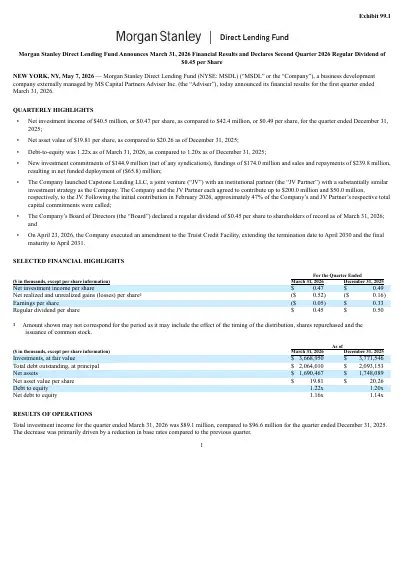
Against the backdrop of moderating base rates, improving spreads, and an increasing focus on credit quality across the direct lending landscape, MSDL delivered solid performance in the first quarter. In terms of operating results, we earned net investment income of 47 cents per share as compared with 49 cents per share for the prior quarter.
The modest decline was primarily driven by the impact of the December rate cut, which flowed through during the period. Importantly, earnings quality remained high, with the underlying portfolio continuing to perform well.
In February, we modified the dividend to 45 cents per share, consistent with the actions we're seeing take place across the sector to align payouts with forward earnings power in a normalized rate environment. Our dividend remains well supported, with coverage of 104% for the quarter.
We view the dividend policy as appropriate over the medium term based on MSDL's earnings levers in the context of the current market environment. During the first quarter, we took a disciplined approach to capital allocation amid a more dynamic landscape, thoughtfully optimizing the tools at our disposal to maximize risk-adjusted returns.
With shares trading at a discount to NAV, share repurchases were accelerated, which was accretive. In parallel, we prioritized seeding our joint venture, which delivered approximately 150 basis points of incremental return relative to on-balance-sheet deployment, although that was a contributor for only 5 weeks of the quarter.
While these actions moderated conventional investment activity, origination momentum remained solid, with 4 new platform investments added during the quarter. The direct lending market continues to navigate a range of challenges, including tariffs, ongoing discussions around AI-driven disruption, and fresh geopolitical risks emerging from the Middle East.
In our view, the disconnect between narrative and fundamentals is a defining feature of the current phase of the cycle. We expect today's credit environment to be increasingly characterized by differentiation rather than widespread deterioration.
We believe MSDL is well-positioned to continue to capitalize on this dynamic environment thanks to our unique sourcing capabilities, consistent focus on underwriting standards, and the depth of our portfolio management function. As we revisit the industry-wide pressures we outlined last quarter, we are beginning to see signs that some of these may begin to ease.
Starting with the deal environment, we continue to believe that we're in the early stages of a multiyear recovery in sponsor-backed M&A, underpinned by a conducive economy, substantial private equity dry powder, and generally efficient financing markets. While activity was somewhat choppy during the first quarter amid geopolitical developments, overall, opportunity levels remain solid, and our deep integration within the Morgan Stanley ecosystem continues to provide a meaningful sourcing advantage.
On credit, we continue to actively monitor potential risk factors across the portfolio, including elevated rates, macro uncertainty, and the evolving impact of AI, particularly within software. Despite these crosscurrents, portfolio performance remains relatively stable.
Non-accruals declined modestly during the first quarter, and we continue to see resilience across the borrower base. While we did experience some NAV pressure amid heightened public market volatility, we have not witnessed widespread fundamental underperformance of our borrowers, with instances generally isolated.
In this context, we believe MSDL's first lien, non-cyclical orientation positions us to navigate potentially increasing industry dispersion effectively. Turning to asset yields, we are encouraged by signs that the downshift may be now in the rearview.
The first quarter of 2026 marked the first quarter in the last 8 in which MSDL did not experience yield compression. While the timing of the December rate cut drove the modest quarter-over-quarter decline in net investment income of a couple of pennies, we are now seeing spreads widen and terms on new investments become more lender-friendly.
If sustained, that should support asset yields going forward. Jeff will provide additional color on market conditions in his remarks.
Finally, on capital formation and investor sentiment through the lens of the broader direct lending market, while retail flows into the asset class have shown variability, we remain confident in the long-term outlook for private credit. MSDL is a visible part of our scaled committed capital base in US direct lending, sitting within Morgan Stanley's broader global private credit business and $270 billion alternatives platform.
Our funds are capitalized by a diversified LP base, providing a stable capital foundation. Long-duration fund structures allow us to be disciplined in our deployment and will continue to support us as we scale further.
Private credit has proven to be a durable asset class with a clear and lasting role in diversified portfolios for both institutional and retail investors alike. As I close, I want to reiterate our commitment to the strategy that got us here.
MSDL will continue to provide loans to high-quality businesses while leveraging the resources of the integrated Morgan Stanley platform. We believe our transparent revenue model, conservative balance sheet, and efficient operating structure, together with our thoughtful fee framework and repurchase program, support strong alignment with shareholders.
With that, I will turn the call over to Jeff Day.
Jeff Day
Thank you, Michael. Turning to the market environment, despite elevated headline volatility, we continue to see a constructive set of conditions for private credit, with stable fundamentals and improving lender economics.
In fact, we believe that periods of uncertainty further reinforce the role of private credit as a reliable source of capital. Importantly, as Michael mentioned, we saw spreads for deployment during the first quarter widen by approximately 25 basis points, accompanied by higher OIDs.
Leverage and other terms trended more lender-friendly as well, supporting an improvement in risk-adjusted returns for disciplined lenders. Through the second quarter to-date period, we have seen economics move an incremental 25 basis points or more, and documentation has continued to shift in lenders' favor, with new investments generally including further tightening in EBITDA definitions, greater use of financial covenants, and more robust call protection, just to name a few improvements.
At the same time, higher-for-longer rate dynamics and a growing refinancing need across the private credit landscape are creating a favorable supply-demand imbalance for capital providers. Our approach to capital deployment remains deliberate and selective.
MSDL's differentiated sourcing model, leveraging the scale and capabilities of the Morgan Stanley platform, supports our thoughtful deployment approach and reinforces our disciplined underwriting standards. For the last 12 months ending March 31st, 2026, we closed on just 5% of the deals we originated, which reaffirms that selective approach to credit investing.
Further, our integration within a full-service investment bank positions us as a strategic financing partner to private equity sponsors, enabling access to high-quality, directly originated investment opportunities through both our dedicated origination team and the firm's broader relationships. Turning to origination, during the first quarter, we closed on 13 first lien senior secured transactions totaling $50 million in new commitments.
Among these, 4 were loans to new borrowers, 2 were complete refinancings of existing borrowers, and 7 were incremental commitments, demonstrating the power of our incumbent portfolio to generate deal flow. Of the new borrowers in the first quarter, half are LBO transactions with weighted average loan-to-values of less than 40%, executed at modestly wider spreads than where capital was deployed in the fourth quarter of 2025.
Beyond the net funding activity, we also seeded the Capstone JV with a total of $94.5 million of equity from MSDL. As of March 31st, 2026, the JV portfolio consists of a total of $383 million in investment commitments across 52 borrowers, which David will provide more details on shortly.
Overall fundings were offset by repayments as a few of our borrowers were acquired by strategic buyers. From a borrower segmentation perspective, we continue to believe that MSDL's core middle market focus is positioned in the sweet spot of the market, while our origination funnel and capital base afford us the flexibility to take advantage of attractive credit opportunities across the size spectrum as market conditions fluctuate.
This was evidenced during the first quarter as our median EBITDA for deals closed was approximately $126 million, which was around 40% higher than the median EBITDA of the MSDL portfolio at large as we saw increased attractive opportunities lending to larger businesses due to dislocation in the liquid loan market. I will now turn the call over to Ashwin Krishnan.
Ashwin Krishnan
Thank you, Jeff. Overall, credit performance remains stable, with modest improvements across key metrics.
Transitioning to more detail on MSDL's portfolio companies, we continue to see positive trends in key metrics, with revenue and EBITDA growth rates remaining healthy, net leverage ratios declining modestly quarter-over-quarter. While payment-in-kind income as a percentage of total income increased modestly to 4.6% quarter-over-quarter, it remains contained and compares favorably to publicly traded BDC peer averages.
Non-accruals for the quarter ticked down modestly from 1.6% to 1.5%. The mark-to-market activity that took place during the first quarter was driven by a combination of spread widening on new loans and a small number of credits that have continued to underperform.
Overall, we are pleased that the portfolio remains in good condition. Turning to software, there has been no shortage of headlines around the potential disruptive impact of AI on the sector.
Based on our ongoing portfolio monitoring and underwriting work, we have not seen evidence of material disruption within our portfolio companies. As mentioned in prior quarters, our investments are concentrated in mission-critical system-of-record platforms with high switching costs and strong customer retention, which we believe provide insulation under a range of economic and technological conditions, including near-term AI disruption.
On balance, while AI introduces the potential for disruption, we expect its impact to be more gradual, with effects likely to manifest through sorting rather than wholesale displacement. Within our portfolio of software businesses, we believe there are opportunities to benefit from integrating AI to enhance efficiency and further strengthen competitive positioning.
Our approach to evaluating technology risk is both consistent and proactive. We continue to utilize a proprietary AI scorecard for existing portfolio companies and to underwrite new investments.
The results of this analysis continue to indicate that our software portfolio exhibits minimal near-term displacement risk, with only a low single-digit percentage of our portfolio categorized as high risk for AI disruption as of the end of the first quarter. In many cases, we believe there is potential opportunity for borrowers to benefit from incremental AI-driven enhancements.
Beyond AI, we are closely monitoring the evolving macro and geopolitical landscape, including the recent volatility in energy markets and the potential impact of higher oil prices. Consistent with our approach to prior macro events such as COVID and the implementation of tariffs, we conducted a comprehensive review of our portfolio to assess potential exposure.
Given our sector positioning, where we are indexed to a broad mix of service-oriented businesses, we believe direct risk is limited. While certain companies with field-based operations such as HVAC service companies may experience incremental pressure via fuel cost inflation, we expect that most will be able to offset these impacts through price increases.
Overall, we believe our portfolio is reasonably well-positioned to navigate a range of macroeconomic outcomes. Our emphasis on sector selection and active portfolio management continues to underpin our investment strategy.
In an environment where conditions are evolving, we believe our ability to remain patient, selective, and focused on downside protection will continue to serve our shareholders well. I will now turn it over to David Pessah.
David Pessah
Thank you. At quarter-end, our portfolio totaled $3.7 billion at fair value, maintaining our strong first lien focus, comprising of approximately 94% first lien debt, 2.5% in the joint venture, and the remainder in second lien equity and other investments.
The portfolio remains well diversified, with 227 portfolio companies across 36 industries, and an average borrower exposure of approximately 40 basis points. In February, we commenced investment operations at Capstone Lending, MSDL's joint venture.
The vehicle has total equity commitments of up to $250 million, of which $200 million is committed by MSDL. To date, approximately 47% of total equity commitments has been called, supporting approximately $383 million of investment commitments across 52 portfolio companies in 23 industries.
The weighted average yield on debt and income-producing investments is 8.7% at cost. Our objective will be to continue to scale the vehicle over time to approximately $700 million in assets.
We expect a meaningful contribution to MSDL's total investment income beginning in the second quarter, fully reflecting the timing of the launch. Turning to credit metrics at quarter-end, the weighted average loan-to-value across our portfolio was approximately 39%, and median EBITDA remained relatively unchanged at $91 million.
The weighted average yield on debt and income-producing investments was flat quarter-over-quarter at 9.3% at cost and 9.5% at fair value, primarily reflecting a relatively stable SOFR curve over the past 2 quarters. In terms of credit quality, 2 investments were removed from non-accrual, including 4840, as discussed in prior calls.
We added 3 new investments to non-accrual: Abercrombie Group Holdings; Vohman-Black Holdings, also known as Specialty Dental Brands; and KWOR Acquisition, related to a preferred equity position. As a result, our non-accrual rate decreased by 10 basis points to 1.5% of the total portfolio at cost.
Underneath the $145 million of new investment commitments were loans to 7 new portfolio companies, which includes the joint venture, and 7 existing portfolio companies. Investment fundings, including those of existing commitments, amounted to about $174 million, offset by $240 million in repayments.
Moving to our financial results for the first quarter, total investment income was $89.1 million, down from $96.6 million in the prior quarter, primarily reflecting the impact of the most recent Fed rate cuts. Total expenses declined to $48.6 million from $54.2 million in the previous quarter, driven in part by our predominantly floating-rate liability structure, which reduced our cost of financing as base rates declined.
In addition, the restructuring of 4840 lowered incentive fees earned from realized losses associated. We believe the structure of our incentive fee continues to demonstrate strong alignment with shareholders.
Net investment income for the quarter was $40.5 million, or 47 cents per share. The net change in unrealized depreciation and realized losses for the first quarter was $45 million.
Unrealized losses were driven by underperformance in a small number of portfolio companies, as well as broader spread widening during the quarter, particularly within the software sector. Our weighted average portfolio mark declined by 70 basis points quarter-over-quarter, with software experiencing the most significant movement by industry.
Net realized losses during the period were primarily related to the restructuring of 4840. As of March 31st, our total assets were $3.8 billion, and total net assets were $1.69 billion.
Our ending NAV per share for the first quarter was $19.81, compared to $20.26 in the prior period. The debt-to-equity ratio increased to 1.22 times from 1.20 times in the previous quarter, with our unsecured debt comprising 55% of total funded debt at the end of the quarter.
Following quarter-end, we successfully amended and extended MSDL's senior secured corporate revolver by extending the maturity while maintaining both pricing and total commitments across existing syndicate. Considering the more fragile market backdrop, we view this as a validator of our platform's access to financing, supported by our longstanding banking relationships.
We feel confident that the right side of our balance sheet is well-positioned for the remainder of the year and into 2027. As highlighted last quarter, we renewed our share repurchase program and maintained its size at $100 million, a meaningful percentage of our market capitalization, reflecting our commitment to long-term shareholder value.
During the period, we repurchased approximately $15 million of our shares at prices below NAV, resulting in roughly 5 cents of NAV accretion. Regarding distributions, we paid a 45-cent regular distribution in the first quarter, with dividend coverage of 104% for the period.
Additionally, our board of directors declared a 45-cent per share regular distribution for the second quarter of 2026, payable to shareholders of record as of June 30th, 2026. As of March 31st, 2026, our spillover income was approximately 88 cents per share.
With that, operator, please open the line for questions.
Operator
Thank you. If you would like to ask a question, please signal by pressing *1 on your telephone keypad.
If you are using a speakerphone, please make sure your mute function is turned off to allow your signal to reach our equipment. Again, press *1 to ask a question, and we'll pause for just a moment to allow everyone an opportunity to signal for questions.
We'll take our first question from Finian O'Shea with Wells Fargo Securities.
Finian O'Shea
Hey, everyone. Good morning.
Thanks. Can you talk about the continued ramp of the JV?
If there are more sort of clients on the platform that want to sell the portfolio, maybe you could get a good price now that the market's moved a little bit, or would this come through more of a portfolio drop-down or a sort of gradual, new origination ramp over time?
Michael Occi
Fin, thanks for the question. I would expect it to be more the latter: organic deployment into the JV, potentially considering drop-downs over time as we see fit.
Recall the initial seeding of this portfolio with approximately $100 million of equity out of MSDL was facilitated in part by a warehouse. Having said that, all MSDL, Morgan Stanley Private Credit originated assets, 100% overlap with what's on MSDL's book.
Moving forward, I would expect more rational, gradual deployment over the next 4 to 6 quarters for the remaining $100 million as we balance deployment in the JV with on-balance-sheet. I would not anticipate a similar proportion as we saw in the first quarter, where we had about two-thirds of that deployment earmarked for the JV, the balance on-balance-sheet.
We will expect to see organic deployment outpace that moving forward.
Finian O'Shea
That's helpful. Then a little bit of growth in the lower-rated buckets, a portfolio grade 3 and 4 and such.
Is that overlaying with the new non-accrual names, or is that more midrange sort of underperformers in there?
Michael Occi
Fin, good question. I would first just level set maybe a little bit more detail underneath the 2 or so percent of NAV move.
About two-thirds of that was driven by market or spread widening, the balance more fundamental, credit-driven, in part due to what we've seen in terms of a couple of additions to non-accruals. Obviously, we had the one offset netting in a similar place.
Rebecca, why don't you give a little bit of color on the risk grades?
Rebecca Shaoul
Sure. As you noted, we saw some movement in primarily the 3 bucket from percentage basis, but there's movement and migration within our risk-rating categories each quarter.
Deals move up and down within the categories, but overall, remains relatively contained and driven by a small number of companies, and kind of company-specific issues rather than more kind of broad-based issues we're seeing. The non-accrual names are certainly part of it, but also some additional changes could be factored in there as we monitor the portfolio each quarter.
Overall, very contained, and we continue to have confidence in the overall health of the portfolio and quality, with near 95% remaining in that risk-rated 2 or better category.
Finian O'Shea
Appreciate that. If I could sneak one more in, I meant to tie it in with the JV question.
Did you disclose anywhere the interest rate on that? I was just looking through last quarter's transcript, is the target leverage again about 3 to 1?
David Pessah
Hey, morning, Fin. It was about 11.2% in terms of just the yield at the JV level.
The target leverage that we're looking to achieve there is somewhere between 1.7 to 1.8 times. Just as of quarter-end, we were slightly below that.
The idea is to maintain and grow that portfolio, as Michael mentioned, 4 to 6 quarters and get to a sustained level of leverage around that targeted range.
Finian O'Shea
Just to mention,
David Pessah
yeah, and the 11.2%, that's really only reflecting 5 weeks of activity for the fund.
Finian O'Shea
I meant to ask on the credit facility, your borrowing rate?
David Pessah
Oh, at the JV? It's 1.67%.
Finian O'Shea
Okay. Then the dividend therefore, it's mid-quarter.
Do we roughly double that, or is it more based on the higher sort of target leverage than you have in place now?
David Pessah
It's combination of just organic deployment plus moving up in the target leverage range.
Michael Occi
Fin, to put it in context of the NII, it was about a penny of benefit in the first quarter for that partial contribution. At full ramp, 2 to 3 pennies, all's equal.
Finian O'Shea
Great. Thanks so much.
Operator
We'll take our next question from Ethan Kaye with Lucid Capital Markets.
Ethan Kaye
Hey, good morning, guys. Just following up on the question or discussion on the yield at the JV.
Can you just help kind of reconcile? I see you quoted 11.2%.
I see something in the high 8s percent as a weighted average yield on the portfolio. Is there some kind of timing or mechanical discrepancy there or issue that's causing that discrepancy?
David Pessah
That's just the weighted average yield of the portfolio in terms of the income that was generated off of that. We at the MSDL level received an 11.2% yield from the income that was produced down at the JV.
Ethan Kaye
Okay. Sorry, go ahead.
David Pessah
No, the 8.7% is an unlevered asset yield. That's the difference between the 2, yep.
Ethan Kaye
That's comparable to the kind of low 9% on the MSDL balance sheet directly? Is that a fair comparison?
I think it was 9.3%. Do you expect those to kind of converge over time?
Is there anything that you attribute to kind of that difference between the yield at the JV and the yield directly on the MSDL balance sheet assets?
Michael Occi
Ethan, I think that's a fair assumption. It's attributable largely to the JV assets being of slightly more recent vintage.
We would expect that to converge over time.
Ethan Kaye
Got it. Then on portfolio activity, looks like was a bit kind of more active in 1Q than maybe we saw at some peers, I suppose.
Kind of half of the fundings, though, were to the JV. At least repayment activity was elevated.
Kind of any sense of what drove that this quarter? Was it kind of driven by a couple large exits or did you see kind of activity more broadly?
Then maybe any sense of what activity is looking like in 2Q?
Michael Occi
Ethan, a lot to unpack there. I would just say on the repays, similar experience to prior quarters.
We had in gross terms about 5% of the commitment base repaid. Definitionally, this captures refinancing activity, but true repayments and paydowns constituted the majority of the $240 million figure you see in the deck.
Repayment levels were pretty consistent, really, with prior quarters. Underneath that, to answer your question, repayment activity driven by a number of different things: some public market takeouts, some refinancing activity that we didn't elect to participate in, some sales to strategics, including Portfolio Group, which I think was $74 million of notional.
We could see that moving forward kind of ebb and flow depending on the direction of spreads, but it's been a pretty reliable level over the past few quarters. On the proportion of deployment, here's how we would break it down.
You start with the buyback activity with price as a factor. That drove the 50% uptick in terms of us buying back $15 million of stock at lower prices, which, as David alluded to, was accretive by about a nickel.
You take that in conjunction with the valuation impact over the course of the quarter and our desire to keep leverage constant or pretty consistent at least, as we accomplished, and that more or less dictates what we have to play with in terms of origination activity. As you alluded to, the prioritization was with the JV that we had previously announced, about two-thirds or $100 million of the $150 million.
The $50 million was organic. While not big in dollar terms, it was still accretive from a spread and a diversification perspective.
As I mentioned earlier, we would expect those proportions to reverse going forward.
Ethan Kaye
Excellent. Thanks very much.
Operator
As a reminder, it is *1 to ask a question. We'll take our next question from Cory Johnson with UBS.
Cory Johnson
Hi, thanks. The interest income came down quite a bit this quarter, as you mentioned.
What helped sort of be able to cover dividend this quarter was also just the lower incentive fees paid. We talked about certain levers that you have to be able to maybe make up that difference, the one being the JV, if I understand correctly, that probably add another 2 to 3 cents once ramped in order to be able to help achieve that dividend.
I was just wondering what other lever that you see that you have? Maybe could you talk about perhaps sizing them in terms of being able to bridge that gap so that you can see how well it will actually cover the dividend over the coming quarters and such, and add to your earnings power?
Michael Occi
Cory, great question. I think this is a more simple story than in prior quarters, which is a welcome sign for all of us.
We started to see that normalization in the first quarter that we've referenced, a little bit of a bridge from 4Q attributable to that most recent rate cut. It's going to continue moving forward to be a function of a bunch of different things, including spreads and credit, among other things.
At least for now, base rates are not a variable and tough to predict that over time. Still, we've reached the normalization phase.
I would look at the 47 cents directionally as more or less a new baseline, and underneath that, we feel pretty good about the distribution that we talked about. To your question more directly, it is absolutely going to be a focus on optimization moving forward, and the different levers available to us, including the aforementioned JV, including the share repurchase activity.
Then one thing I think we haven't emphasized probably to the extent that we would like to is the improving credit environment, how we're seeing a credit repricing actively in the marketplace, and we think we're really well equipped to go and take advantage of that.
Cory Johnson
Great, thanks. Just one follow-up.
As you mentioned, there's your ability to be able to repurchase shares out in the market as well, but maybe can you talk a little bit about how you decide to balance that, given I guess where the leverage is at the moment and you have opportunity to buy back your stock, but also there's paying out the dividend, and I guess the need or want to be able to continue to look at attractive opportunities in the market. Could you maybe just talk a little bit about that balance?
Michael Occi
It's a great question. We're committed to the buyback program.
I think that's evidenced by our activity in the prior quarters. As I mentioned, price is an input, largely a formulaic program.
We did see the pickup in utilization in the first quarter. I think what I would say to give a little bit of commentary underneath the kind of order of operations that I mentioned earlier in terms of starting with leverage, we're not blindly kind of collecting the results of all of these inputs at the end of the quarter.
We're proactive in terms of anticipating valuation moves, monitoring stock price, evaluating a vibrant portfolio that's dynamic across a large platform that we're managing here, to balance all of those things. I think, in short, we would like to continue to take advantage of the buyback program.
Obviously, we'd like to see our stock price trade above NAV, and we're optimistic we'll get there in time. Then this conversation will be moot.
Leverage is a governor, and we're going to continue to balance the accretion and the return opportunity on the deployment side as well.
Cory Johnson
Great. Thank you.
Operator
At this time, I would like to turn the call back to Michael Occi for closing remarks.
Michael Occi
Thank you. On behalf of the management team, we appreciate you joining us today and for your continued support of Morgan Stanley Direct Lending Fund.
Our private credit platform continues to benefit from the scale, sourcing capabilities, and institutional infrastructure of Morgan Stanley. The firm remains committed to expanding our team and advancing MSDL as a core component of MSIM's growing credit franchise.
We are encouraged by our execution and the continued strength of the portfolio. Market conditions have shown early signs of improvement, and our strategy positions us to win in the near and long term.
We're taking every opportunity to further optimize the business as we seek to deliver high-quality returns to investors. We look forward to providing an update on our second quarter 2026 earnings call in August.
Operator
Thank you. This concludes today's call.
Thank you for your participation. You may now disconnect.