Motorola Solutions, Inc.
Q3 FY2026 · Earnings Call TranscriptNovember 4, 2026
Operator
Good afternoon, and thank you for holding. Welcome to the Motorola Solutions third quarter 2026 earnings conference call.
Today's call is being recorded. If you have any objections, please disconnect at this time.
The presentation material and additional financial tables are posted on the Motorola Solutions Investor Relations website. In addition, a webcast replay of this call will be available on our website within 3 hours after the conclusion of this call.
The website address is www.motorolasolutions.com/investor. All participants have been placed in a listen-only mode.
You will have the opportunity to ask a question after today's presentation. If you would like to ask a question, please press *5 on your telephone keypad to be placed into the queue.
You may also press *5 again to remove yourself from the queue. I would now like to introduce Mr.
Brian Pietrowski, Vice President of Investor Relations. Mr.
Pietrowski, you may begin your conference.
Brian Pietrowski
Good afternoon. Welcome to our 2026 third quarter earnings call.
With me today are Greg Brown, Chairman and CEO; Jason Winkler, Executive Vice President and CFO; Jack Molloy, Executive Vice President and COO; and Mahesh Saptharishi, Executive Vice President and CTO. Greg and Jason will review our results along with commentary, and Jack and Mahesh will join for Q&A.
We have posted an earnings presentation and news release at motorolasolutions.com/investors. These materials include GAAP to non-GAAP reconciliations for your reference.
During the call, we reference non-GAAP financial results, including those in our outlook, unless otherwise noted. A number of forward-looking statements will be made during this presentation and during the Q&A portion of the call.
These statements are based on current expectations and assumptions that are subject to a variety of risks and uncertainties. Actual results could differ materially from these forward-looking statements.
Information about factors that could cause such differences can be found in today's earnings news release, in the comments made during this conference call, in the risk factor section of our 2025 annual report on Form 10-K, or any quarterly report on Form 10-Q, and in our other reports and filings with the SEC. We do not undertake any duty to update any forward-looking statements.
I'll now turn the call over to Greg.
Greg Brown
Thanks, Brian, and good afternoon, and thanks for joining us today. I'm going to start off by sharing a few thoughts about the business before Jason takes us through our results and our outlook.
First, Q3 was another outstanding quarter, highlighted by record revenue in both segments and across all three technologies. Revenue and earnings per share exceeded our guidance as we continue to see strong momentum across our entire safety and security ecosystem.
Both segments grew double digits, with Products and SI growing 12%, driven by growth in public safety LMR and continued robust demand for Silvus, while Software and Services grew 13%. Additionally, we expanded operating margins 200 basis points, with strong contributions from both segments, and that's inclusive of higher supply chain costs.
Second, demand remains exceptionally strong, with a record Q3 orders and our highest ever ending backlog of $16.6 billion, up approximately $1 billion from last quarter. Orders grew over 20% versus last year, with broad-based growth in both segments, demonstrating the critical need and continued trust customers put in our solutions.
Finally, following our strong Q3 performance, we are again raising full-year guidance for both revenue and EPS, as well as now increasing our full-year cash flow expectations. With that, I'll turn the call over to Jason.
Jason Winkler
Thank you, Greg. Revenue for the quarter grew 12% and was above our guidance with double-digit growth in both segments and all three technologies.
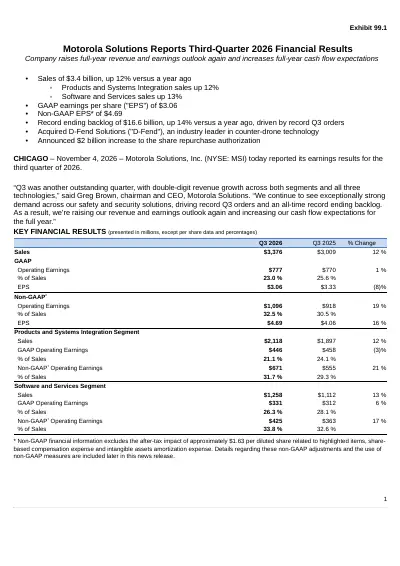
Revenue growth from acquisitions was $211 million during the quarter, while FX tailwinds were $11 million. GAAP operating earnings were $777 million, or 23% of sales, down from 25.6% in the year-ago quarter, which included an $87 million non-cash charge for the increase in the Silvus earn-out provision driven by the continued strong performance of the business.
Non-GAAP operating earnings were almost $1.1 billion, up 19% from the year-ago quarter, and non-GAAP operating margin was 32.5%, up 200 basis points, driven by higher sales and improved operating leverage, partially offset by higher supply chain costs. GAAP earnings per share was $3.06, down from $3.33 in the year-ago quarter, primarily driven by the 52 cents non-cash charge for the Silvus earn-out that I mentioned earlier.
Non-GAAP EPS was $4.69, up 16% from $4.06 last year. The growth in EPS was driven by higher operating margins, partially offset by higher interest and taxes in the current quarter.
Opex in Q3 was $696 million, up $44 million versus last year due to acquisitions. Turning to cash flow, Q3 operating cash flow was $662 million, and free cash flow was $589 million.
Our year-to-date operating cash flow was almost $1.6 billion, up versus last year, inclusive of investments that we've made in inventory. We're now raising our operating cash flow expectations $50 million, from $3 billion to $3.05 billion for the year.
Capital allocation for Q3 included $200 million of cash dividends, $94 million in share repurchases, and $73 million of capex. Additionally during the quarter, our board of directors approved a $2 billion increase to the share repurchase program.
Moving to segment results, in Products and SI, sales were up 12% versus last year, driven by double-digit growth in both MCN and video. Revenue growth from acquisitions was $169 million, and FX tailwinds were $7 million during the quarter.
Operating earnings were $671 million, or 31.7% of sales, up from 29.3% in the prior year, primarily driven by higher sales and improved operating leverage, partially offset by higher supply chain costs. Some notable Q3 wins and achievements in this segment include: $140 million P25 systems and device order with the Federal Bureau of Prisons; a $98 million P25 device and SVX order for a US federal customer; a $63 million P25 systems and device order for the metro government of Nashville and Davidson County; a $56 million fixed video order for a large convenience store chain; and a $39 million service order for a German unmanned systems provider.
In Software and Services, revenue was up 13% compared to last year, driven by double-digit growth in all three technologies. Revenue growth from acquisitions was $42 million, and foreign currency tailwinds were $4 million in the quarter.
Operating earnings in the segment were $425 million, or 33.8% of sales, up from 32.6% of sales last year, driven by higher sales and improved operating leverage. Some notable Q3 highlights from this segment include: a $139 million order that included P25 services, mobile video, and command center solutions for the state of Louisiana over a 10-year period; a $78 million 8-year mobile video award with a US federal customer; a $59 million 6-year LMR P25 services order for a state and local customer; a $51 million command center CAD and records management order for the Los Angeles Police Department; and a $27 million LMR P25 services renewal for the North Carolina State Highway Patrol.
Looking next at our regional results, North America Q3 revenue was $2.3 billion, up 10%, with growth driven by all three technologies. International Q3 revenue was $1 billion, up 18% versus last year, driven by double-digit growth in all three technologies.
Moving next to our backlog, Q3 ending backlog was an all-time record of $16.6 billion, up $2.1 billion, or 14% versus last year, and up $1 billion sequentially, driven by record Q3 orders in all three technologies. In the Products and SI segment, ending backlog increased $635 million versus last year and $454 million sequentially due to strong demand in MCN and video.
In Software and Services, backlog increased $1.4 billion compared to last year and $575 million sequentially, driven by strong demand in all three technologies. Turning to our outlook, we expect Q4 sales growth of approximately 13%, with non-GAAP EPS between $5.47 and $5.52 per share.
This assumes a diluted share count of approximately 168 million shares and an effective tax rate of approximately 22.5%. For the full year, we now expect revenue of approximately $13.050 billion, up from our prior guidance of $12.975 billion, and non-GAAP EPS between $17.94 and $17.99 per share, up from our prior guide of between $17.62 and $17.72 per share.
This full-year outlook assumes a diluted share count of approximately 168 million shares and an effective tax rate between 21.5% and 22%. With our increased guidance for the year, Products and SI is now expected to grow 12%, up from our prior guidance of 11%, and MCN is now expected to grow 11%, up from 10% to 11% previously.
We now expect operating margin expansion of 190 bps, up from our prior expectations of 170 bps, which also includes expectations for gross margins now being up. Before I turn the call over to Greg, I wanted to touch on a couple key topics.
First, on the M&A front, we are excited about the acquisition of D-Fend, which we closed for $1.3 billion net of cash acquired. D-Fend expands our radio frequency capabilities into drone detection and cyber-takeover-based mitigation and will be included in our mission-critical networks technology along with LMR and Silvus.
Our full-year outlook contemplates approximately $45 million of revenue contribution from D-Fend this year during the stub period. Bell Canada's LMR network services business, an acquisition we previously expected to close in Q4, is now expected to close in Q1 or Q2 as we continue to work through customer and regulatory approvals.
Finally, regarding our balance sheet, in August we raised $950 million of new long-term senior debt at attractive rates to fund the D-Fend acquisition and refinanced $300 million of Silvus term loans that matured during the quarter. With continued strong cash generation expected in Q4, we will remain well on track to end the year at around 2x of net debt to EBITDA leverage, in line with the expectations that we have shared with you previously.
I would now like to turn the call back to Greg.
Greg Brown
Thanks, Jason. I'd like to conclude with a few final thoughts before we open it up.
First, I'm extremely pleased with our execution in the quarter. We achieved double-digit revenue growth in both segments while also driving significant operating margin expansion.
Additionally, we saw record Q3 orders, ended the quarter with an all-time record backlog of $16.6 billion, and continued to generate strong operating cash flow. Second, over the last month, our teams met with hundreds of customers at the Army's AUSA conference in D.C.
and the International Association of Chiefs of Police in Orlando. The energy, customer engagement, and momentum coming out of both events was outstanding.
At AUSA, Silvus was front and center, underscoring the critical need for high-throughput, jam-resistant tactical communications powering unmanned systems in contested environments. At IACP, it was abundantly clear that our safety and security ecosystem is resonating as public safety and defense leaders increasingly look to us to help simplify their mission-critical emergency workflows.
Our multiyear award for the state of Louisiana this quarter was yet another example of the momentum we're seeing and continued competitive wins like this one demonstrate how customers are recognizing the compelling value of complementing our next-generation LMR devices and infrastructure with our mobile video and command center solutions. In those ecosystem wins, our purpose-built Assist AI amplifies the integration across these technologies, streamlining the end-to-end emergency workflow from incoming 911 calls all the way through case closure.
Third, we closed on the acquisition of D-Fend, which brings industry-leading counter-UAS technology into our portfolio, specializing in drone mitigation via cyber-takeover capabilities. As drone detection and mitigation becomes an urgent priority for public safety and critical infrastructure, integrating this differentiated cyber-takeover counter-UAS technology into our mission-critical networks and command center platforms provides a critical, highly differentiated tool for our federal, state, and local public safety customers globally.
Finally, as we look to close out another record year and head into 2027, I feel very good about our position. The overall demand profile for safety and security remains robust.
Our record backlog provides us with strong multiyear visibility, and our core foundation of innovative and impactful solutions position us exceptionally well to serve an addressable market that is now approaching $100 billion. I'll now turn the call over to Brian, and we'll open it up for your questions.
Brian Pietrowski
Thank you, Greg. Before we begin taking questions, I would like to remind callers to limit themselves to one question and one follow-up to accommodate as many participants as possible.
Operator, would you please remind our callers on the line how to ask a question?
Operator
The floor is now open for questions. If you have a question or comment, please press *5 on your telephone keypad.
If for any reason you would like to remove yourself from the queue, please press *5 again. We do ask that while you pose your question, please pick up your handset to provide optimal sound quality.
Thank you. Our first question will come from Tim Long with Barclays.
Your line is open, please go ahead.
Tim Long
Thank you. Two for me if I could.
First on Silvus, maybe if you could just touch on kind of the near-term strength here, where you're seeing the most activity, and related to that, if you could just update us on the capacity, the new plant, and the capacity increases and what that would mean as we head into 2027. The second, maybe for Greg, talking about 2027, Q4 is a solid year-over-year growth number, obviously a lot of visibility, a lot of good orders here, a lot of momentum in the business.
Just give us a sense on how you're thinking about kind of growth into next year to the extent that you can at this point. Thank you.
Jack Molloy
Tim, I'll start. With Silvus, I think you asked what the strengths we're seeing.
Unmanned systems is clearly been a strength, not only internationally, but here in the States. I think, as Greg just mentioned, it's high bandwidth.
It's been tested. Ukraine's a litmus test, and I think in the most contested, congested environments, it's the market leader.
I think that's the first thing. The second thing is we've doubled the sales force.
We had a presence, a heavy presence to the US within the DoD. We've expanded internationally.
We're starting to get some significant traction in NATO given what's happening in the Ukraine, and we're seeing an uptick in activity in Indo-Pacific as well. I think, and the last thing I would say is the spectrum-dominant software I think continues to be a difference maker there.
We continue to feed that investment R&D standpoint, we brought scale, we brought coverage, and from a supply constraints, we've actually doubled our Los Angeles capacity, just to meet and bring down lead times in the second half of the year. We've added an LC line, which puts us front and center in programs like Drone Dominance, and then Salt Lake City, which we announced I think 60 days ago, will start to come online and get some benefits of that as we roll into 2027.
Jason Winkler
In terms of his expectations for the year, Tim, with all the performance that we've had and what Jack just mentioned, it's on pace to do probably a little more than 900 this year.
Greg Brown
$900 million, yeah. By the way, in terms of 2027, obviously you know we're not going to guide specifics for next year, we'll update you in February, but kind of taking a step back, I think at this point we're expecting, again high level, Tim, revenue approximately in the zip code of $14 and a quarter billion.
I would also say it's worth mentioning that with that expectation, we believe organic growth will be stronger in '27 over 2026, and we also would expect again to expand operating margins, and that's in the face of increasing memory costs and supply chain headwinds. It wouldn't surprise us if memory costs they could very well double 2027 over 2026, but even with that, we would expect to provide operating leverage and grow operating margins in 2027 over 2026.
That's my view at this point in time.
Tim Long
Very helpful. Thank you.
Greg Brown
Thank you.
Operator
Your next question will come from Keith Housum with Northcoast Research. Your line is open, please go ahead.
Keith Housum
Good afternoon, guys, and thanks. Hey, Greg, if we can just unpack that memory cost that you just kind of threw in there.
What was the impact of that for the third quarter and the expectation for fourth quarter? You say doubling in '27 versus 2026.
Maybe give us a baseline for what that 2026 number is.
Greg Brown
High level, we did about $50 million in 2025 of direct memory components. Last quarter we talked about it being about $150 million, $150 million, $160 million, I think we said $150 million.
My commentary is related to that base number. As we go into 2027, that could effectively double.
Obviously, we will continue to do the things we do around that, whether it's accelerating inventory, working with suppliers to secure continuity of supply, maybe there's some surgical price increases, although we're very mindful to remain quite competitive on that front. I think overall the supply chain team and Jack's sales and operations team have done a very good job, but even in the face of those headwinds, we still expect to grow operating margins in 2027.
Jason Winkler
To dimensionalize how that $100 million of increase this year over last year in memory is presenting itself in the P&L, more of it is in the second half as we went through inventory and the price, as Keith, has gone up, we're having more of it impact Q3 and Q4 than was there in the first half.
Greg Brown
By the way, one other thing, Keith, I'd add as I think back to Tim's question on 2027, again high level, probably expect revenue linearity as we look out at this point in time in November to 2027 to be very similar to linearity in 2026. Just high level.
Jason Winkler
Keith, the IEEPA tariff which we booked in Q2, which we were very clear on in Q2, also helped Q2's margin offset from memory. As we think about next year, of course, that's about a $75 million good guy this year that, of course, doesn't present itself next year.
Keith Housum
Yep, appreciate the reminder there. Then if we just go back to Silvus and the expansion of the manufacturing capacity, I think you guys referenced lead times coming down and the capacity expansion in Salt Lake City, perhaps maybe just give a little bit more color on how that's coming down and any concerns about being able to meet demand for next year?
Jack Molloy
Number one, we have no concerns. We have not had any loss of business, which I think is really important in the face of increased demand.
We've been able to remediate from what was at one point in time around 20, 21, 22 weeks. We're down around 12 weeks right now, 12 to 14 weeks depending on the line.
Obviously, as I alluded to earlier, Salt Lake City puts us in a better position as we roll into '27. I tell you what, between the Motorola supply chain team and Bobby's supply chain team at Silvus, we've had escalation in demand, and we've been able to meet the need of the unmanned OEMs as well as the end-user environment that we've been invested in as well.
I'm really pleased with the work we've done.
Keith Housum
Thanks.
Operator
Your next question will come from Joseph Cardoso with J.P. Morgan.
Your line is open, please go ahead.
Joseph Cardoso
Hi, this is Mark Atensio on for Joseph Cardoso. Thanks for the 2027 commentary.
I guess with regards to 1Q, there's typically a pretty steep step-down from 4Q to 1Q, and 4Q happens to be pretty strong as guided this year. How should we think about the magnitude of that step-down and some of the kind of puts and takes that take us into the linearity that was described?
Then I have a follow-up. Thank you.
Jason Winkler
As Greg mentioned, the linearity that we see at this point for next year reflects the linearity that's playing out this year. As you pointed out, Q1 is typically our smallest quarter of the year, and reflects the seasonal patterns in our business.
We expect that next year will look a lot like this year in terms of how growth represents itself. We have strong demand, strong backlog, and the continued ability to convert that is included in the color that we gave in November.
Joseph Cardoso
Got it. Thank you.
Then follow-up, going into the drone space now that you have D-Fend, are there any other parts of the market that you're interested in going into organically that might look attractive to you, or is it now an opportunity to invest organically and grow from within? Thank you.
Greg Brown
We're pleased with where we are, and people call the category quote, unquote drone, but just to clarify, Silvus is MANET drone infrastructure, mobile ad hoc networking infrastructure, and it's agnostic and it powers a lot of primes and a lot of other integrators, and it's a preferred technology, proven technology, and the tip of the spear often used in conflict. On D-Fend, it's counter-drone, public safety and critical infrastructure driven.
Our focus right now, Mark, is on integrating those. Jack and the team have done a phenomenal job growing Silvus.
As Jason mentioned, we now expect Silvus to be a little over $900 million for the year. We're investing in the sales force, we're investing in R&D, we're investing in capacity.
Lead times are coming down, and demand remains very strong. On D-Fend, they're obviously a relatively newer acquisition.
We're focused on integrating them, and we love the fact that they have leading-edge mitigation, cyber-takeover technology, which is much more than just jamming mitigation, which I think is differentiated. Now having said that, we'll always look at the funnel of inorganic opportunities, but our focus around kind of things in unmanned I would continue to characterize as defense and public safety centric, and we'll see how things unfold.
Joseph Cardoso
Understood. Thank you.
Greg Brown
Thank you.
Operator
Your next question will come from Meta Marshall with Morgan Stanley. Your line is open, please go ahead.
Meta Marshall
Hey guys, thanks for the question. It's Antonio on for Meta.
I wanted to go back to the backlog here. Nice to see that accelerate on the quarter.
I was wondering if you could unpack some of the key drivers behind that and if you saw any type of impact leading up to the midterms?
Jason Winkler
Sure. We're definitely very pleased with the 16.6, which we mentioned is its highest ever.
That was driven sequentially by record orders in all three technologies, the biggest of which was MCN, which includes not only Silvus, but also our LMR public safety business. The strength of those orders continuing and our backlog position now, as well as where we anticipated to be at the end of this year, informs the revenue color that we gave entering for next year as well.
Meta Marshall
That's helpful. Then as a follow-up, thanks for those breadcrumbs into 2027.
Would you maybe double-click into some of the key drivers that you see for growth next year just across all parts of your business?
Greg Brown
At this point, I think it's pretty broad-based. We obviously have LMR that continues to grow robustly.
LMR, we expect to grow strong double digits in Q4. Backlog is driven handsomely, as Jason referenced, driven by mission-critical networks, again, a lot of which is land mobile radio as well.
We talked about Silvus. I think D-Fend is relatively nascent and early on.
I would expect that D-Fend is still expected to be about $185 million of revenue for fiscal full year 2026, and as we look into 2027, we would expect that to grow 40% to 50% given the wide aperture of opportunity that sits in front of that. Obviously, we're doing D-series infrastructure refresh, we're doing device refresh, multiyear services continues to be in high demand, and Mahesh has done a great job embedding and integrating AI throughout the portfolio with a focus around kind of emergency workflow.
MCN is growing nice, LMR is growing nice, Silvus is growing nice, D-Fend is, as I mentioned, 40% to 50%, video is growing double digits again this year, command center is going to grow 15% this year, and the backlog growth is broad-based, and by the way, orders, overall orders are up 25%. It's been a really good, I think, performance to date.
I like the position we're in, the visibility we have, and the momentum. Also, I think that we're a bit indifferent to the political ebb and flow.
Obviously, there was the quote, unquote blue wave or blue tsunami yesterday, but often, and Jack could probably comment on this, he's got more data than I do, but public safety bubbles to the top consistently in blue administrations, in red administrations. Funding remains really strong at state and local.
I think DHS is funded through 2029. Demand is strong, funding is strong.
I think that there's a lot of winds at our back. Now, having said all that, we got to execute.
We got to run through the tape on Q4, don't take anything for granted. We talked about memory things, we'll manage through and continue to manage through, but you've got more data on midterms than I do, Jack.
Jack Molloy
I think, Greg, you kind of hit some really good points. I think the one thing I'd always stress is that when you think about our government business, the state and local business is the majority of that business.
What gives us great balance there is think about P25, kind of our anchor tenant from an LMR standpoint, we've got 1,300 networks. There's a lot of balance.
There's a lot of balance in funding, meaning local funding, sales, income, real estate taxes, and then there's 911 fees, we have that. The other piece of it is we went back and did an analysis over 20 years, and in the years where you've seen a midterm flip, we've still had better than expected growth rates.
By the way, some of those years we weren't in a funding environment conducive as we are right now with a portfolio as good as we have right now. I think, all things being equal, we feel pretty good as we enter '27.
Meta Marshall
Thanks for the color, guys.
Greg Brown
Thanks, Antonio.
Operator
Your next question will come from Ben Bollin with Cleveland Research Company. Your line is open, please go ahead.
Ben Bollin
Excuse me, good afternoon, everyone. Thank you for taking the question.
Greg, I wanted to hit on a couple of items you just mentioned. When we look at the LMR refresh cycle, P25, D-series, and the subscriber trends, interested in your thoughts, where are we, how much we got left, just any high-level thoughts on that, and then I have a follow-up.
Jack Molloy
I think we'll start with the network piece of it. D-series, as I mentioned, we've got over 1,300 P25 networks.
We are very much in the early stages of a multiyear refresh. I'd remind you there that a lot of this is vintage driven, meaning it's a longer refresh cycle depending on the age of the system that was actually fielded.
I would dimensionalize a couple of things: interest is high, engagement's robust, and I think I look at our pipeline and it's healthy. If you just look over the last four quarters, we've had three of our biggest statewide networks, Tennessee, Michigan, and Colorado, that have signed new agreements.
Good things there? Yes.
They've signed new infrastructure, but with those refresh cycles, they come long-term support and service contracts, they're accretive because you're adding new things like cyber services, software agreement plans. That's that.
As it relates to the APX NEXT journey, we've talked roughly 2 2 million first responders in the United States. We've still got great opportunities ahead of us.
I think the highlight there that we probably don't talk about enough, we did probably earlier this year, but it's the recurring revenue that by the way gets reported in command center software. We've talked about the fact that we will now have 300,000 users that are consuming those application by the end of 2026.
Again, APX NEXT, early days, we had good traction with state and local. We've now seen good traction this year, as we highlighted with some of the wins within DHS.
We had a $96 million deal, APX with SVX in Q3. Like I said, I think I'll reiterate my point, as we sit and we look at our mission-critical networks business in the foundation, which is LMR, devices, we continually see great competitive wins, we think we're in a good position there, and then infrastructure, we've got a lot of room to run.
Ben Bollin
That's great. Thanks, Jack.
Last one for me. When we look at Silvus, could you talk about what does that mix look like today, international versus domestic, and how do you feel about your actual execution thus far in the domestic defense complex?
When does that really start to scale and ramp in a bigger way from the US customers? Thank you.
Jack Molloy
It has. As we've talked about, largely so since we've acquired last August 4th, early days it was more international, and even late last year in the third quarter a lot of that was Ukraine.
We have seen significant expansion into NATO, into the Indo-Pacific internationally, good momentum there. I think one of the things I'm most proud of is the growth we're getting in the US.
They were doing business within the Army, but we've made pretty significant investments, not at the executive levels, but also at the business development levels. We're now doing work, we're in test at the Marine Corps, within the Air Force, and I mentioned the Army, but also at the Navy as well.
We're doing business in more broad efforts. As if you follow the defense sector right now, I would categorize a lot of what's happening within the US is there's a lot of testing.
We've comported very well in those testing because they're doing a lot of the testing in highly contested environments. A lot of what's succeeded for us, and we talk about the litmus test of Ukraine and things like Radio Roundup and some of the other tests that have happened, we've performed exceptionally well, I think as it relates to some within our peer group.
By the way, a lot of work to do there, but we're really pleased not only what's happening internationally, but what's happening in the US as well.
Ben Bollin
Thank you.
Greg Brown
Thanks, Ben.
Operator
Your next question will come from Matt Niknam from Truist. Your line is open, please go ahead.
Matt Niknam
Hey guys, thanks so much for taking the question. Congrats on a great quarter.
My question is more related to this year's guide. If I think about Silvus, I think last quarter you're expecting 850 for the year, now it's a little over 900.
You're including D-Fend, I think that collectively is an incremental $95 million, and obviously third quarter came in a lot stronger than expectations, yet the annual guide only moved up by about $75 million. I'm just trying to figure out what changed?
Were there any more material pull-ins into third quarter from maybe what was anticipated in the fourth quarter? Then just really quickly, on one one follow-up on the $211 million from M&A, how did that break down between Silvus and a little over a month from D-Fend?
Thanks.
Greg Brown
As we think about the full-year guide, Matt, obviously which includes Q4 anchored in your question, love the fact that we've beat and raised obviously a third time now. Contemplated in the 13.050 would be our strongest and best Q4 ever.
Also included in that is the expectation for LMR to grow strong double digits, with product orders and backlog also informing that and being very strong as we head into 2027. I think the other thing I would just simply say is it's a prudent view at this point, and we are focused on finishing the year successfully, executing and closing the business we need to, continuing to drive orders and backlog, and then get a running start into 2027 to continue revenue growth, operating margin expansion, and additional cash flow generation.
It's kind of the context and the color.
Jason Winkler
Matt, on the 211, that was growth driven by acquisitions. D-Fend was pretty small.
We were expecting 45 on the year, but given the timing to close, most of that 211 was Silvus.
Matt Niknam
Thank you.
Greg Brown
Thanks, Matt.
Operator
Your next question will come from George Notter with Wolfe Research. Your line is open, please go ahead.
George Notter
Hi guys, it's Brennan Rodgers on for George. Just have a question on the AI Assist progress that you guys have seen over the last couple quarters.
You guys have a pretty broad portfolio, if you could just sort of walk us through where attach rates are the highest within that sort of emergency workflow, and sort of which specific products you guys feel most differentiated in. Then I'll just ask another one on D-Fend.
Any exciting synergy opportunities that you guys see with sort of your existing portfolio as you guys spend more time with those guys? Thanks.
Mahesh Saptharishi
On AI Assist, I would say that as opposed to sort of other models of how AI gets deployed, we embed AI in our core workflow applications. AI is an inherent part of the application, and what we have seen over the past many quarters is that customers are opting in for the Assist tier, which is our premium tier of every workflow application, and almost 100% of every one of those applications across all of them have been at the Assist tier.
In terms of differentiation, I think of it as Assist really brings together, it's almost like a connectivity fabric that brings together the core of our applications. From a PSAP standpoint, a public safety answering point standpoint, where you have 911, CAD, and consoles, those three pieces tightly getting integrated with AI Assist, that is one of the key differentiator that separates us from the rest out there.
Not only that, that now going into our APX NEXT devices, where a summary of an incident, conversations that happened during the incident, getting pushed proactively right into the radios, connects everything in the field now back into what's happening at the PSAP. Now going beyond that, once the SVX and our body-worn camera portfolios gather evidence, the ability now for us to generate reports, the ability for us to leverage AI for redaction, those are the capabilities now that thread in the full story.
On the SVX and the APX NEXT integration, critically, we mentioned this before, the key is that we have access to the right data sources to generate the most accurate reports, and even if an officer is wearing an earpiece, we're able to capture all the audio conversations that otherwise would not have been captured with just a stand-alone body-worn camera. That is how we are seeing traction across the entire ecosystem, and the successes that we have highlighted in this call talk about ecosystem acquisitions more than a product acquisitions, and I think much of it is also driven by the fact that Assist brings all these products together.
Greg Brown
Then talking about D-Fend synergy.
Mahesh Saptharishi
In terms of D-Fend, we are tightly integrating D-Fend into our RTCC solution, our Aware platform. What we see there is that within the real-time crime center, the key point of attraction there is, in fact, drones, both DFR, drone as a first responder capability, and very specifically D-Fend, which is counter-UAS integration into that same framework, both for detection purposes, but also for mitigation, which is really the unique part that D-Fend plays into this mix.
Just talking about the ecosystem integration a little bit more, when we think about mission-critical networks, for us mission-critical networks is not just a communications platform, it's actually a sensing platform as well. Within the context of the sensing platform, we have capabilities now within our APX NEXT radios, where the APX NEXT radios are able to detect drones.
Now, that data feeding back into Aware and allowing the RTCC operator to identify drones that potentially need to be mitigated, and D-Fend bringing in the mitigation capability into the mix as well. Overall, within our mission-critical networks portfolio, it's not just a communication story, it's a sensing story as well.
George Notter
Thanks.
Operator
Your next question will come from Tomer Zilberman with Bank of America. Your line is open, please go ahead.
Tomer Zilberman
Hey guys, just wanted to unpack some of the numbers further that were discussed on the Q&A earlier. Jason, I think earlier you said that Silvus is shaping up to be about 900 million for the year.
Last quarter you disclosed 210 in 1Q, 230 million in 2Q. I appreciate that you guys are lapping the acquisition this quarter, there's probably more limited disclosure you can give us, but if I look historically over last four quarters, Silvus was about 90% to 95% of the gross sales of acquisitions.
If I assume a similar contribution this quarter, it means that Silvus was within the range of, call it, 290 to 300 million this quarter. The question is, as we look to next quarter, the remainder would only be about 160 million.
I guess the first question within that would be, is that directionally sound? Two, is there anything in terms of seasonality, capacity constraint until the Salt Lake facility comes online in 1Q that gives you any pause to Silvus growth in the next quarter?
Jason Winkler
Your numbers are definitely directionally correct as to what we've disclosed, and Silvus had a very good quarter of near $300 million in Q3. It's always, as we've described it, been a non-linear business.
Some of the deals that Jack mentioned benefited us in Q3, with it now looking to be 900 million or maybe a bit more than 900 million. That puts it in a zip code of having a good Q4 to finish and then be on pace to perform again next year.
Tomer Zilberman
Got it. Maybe a follow-up looking to the next-year guide.
You talked before about the D-series infrastructure. If I move to the LMR segment for a second, kind of driving growth above historical kind of 1% to 3% LMR growth, maybe closer to the 4% to 5% range, is that still the right framework for next year?
Greg Brown
I think we're going to stick, Tomer, primarily at this point on the higher-level color. We'll dimensionalize the segments and the technologies when we get into February.
Maybe just providing a little bit more color, and connected to your last inquiry on Silvus and the numbers Jason outlined, I think as we look forward to 2027, again higher level, we would expect Silvus, it's performed above the business case, it is non-linear, but just to be clear, the investments Jack is making will improve capacity, and we certainly don't see any slow down of demand at all on Silvus. As high level, we expect Silvus to grow about 30% next year, and our expectation is that we continue to take share.
Tomer Zilberman
Got it. Thank you.
Operator
Your next question will come from Irvin Liu with Evercore ISI. Your line is open, please go ahead.
Irvin Liu
Hi, thank you for the question. I had one and a follow-up.
On Silvus, I wanted to get your view on sort of the industry mix shift toward lower-cost, expendable, or attritable unmanned systems. Just from a product perspective, how is Silvus positioned to address the kind of lower end of the market that offer a higher unit volume opportunity, but perhaps at a lower ASP?
Jack Molloy
As I've kind of continually talked about, where we've excelled within the portfolio is in the unmanned systems business. There's a lot of viewpoints.
There's some focus on attritable drones, but the reality is the contested environment ultimately is where these things won and lost, and that's won and lost through low probability of intercept, detection, the ability to resist jam, and to get the right throughput. As I mentioned, though, because to your point we want to participate in broader parts of the market, we added a facility in Culver City that's focused on a mesh radio called LC.
By the way, that does not come with all the same software capabilities that I highlighted from spectrum dominance, we're carving out certain speed, security features for those things. We'll have price points that'll play at most parts of the market, but really we're focused on the contested environment.
We think that's been the game, set, match. In fact, we haven't seen any degradation at all.
Our price points continue to hold and appreciate, and I think that just speaks to performance and execution.
Irvin Liu
Got it. Thanks.
Then for my follow-up, you're delivering on very, very impressive margin expansion despite higher memory costs. I think the magnitude of the overall margin expansion is actually larger than that of prior years where you didn't have to contend with this type of component cost headwinds.
Can you just share with us some of the underlying drivers of improving profitability? Is it pricing, mix, better execution?
Any color here would be helpful. Thank you.
Jason Winkler
Sure. As I mentioned earlier, the $100 million increase in memory costs that we're expected to bear this year, in part the IEEPA refunds helped offset a decent chunk of that.
In terms of what we're doing to continue to navigate a very dynamic environment: additional suppliers, qualifying additional components, continuing to get the supply lines that we need, paying higher prices, that's a function of the market as we see it. In terms of the P&L and our own sales, we're also in some cases reflecting those higher prices and making some adjustments to our sales prices.
That, in turn along with mix favorability, is what's helping offset and create the margin expansions that you noted.
Operator
Once again, if you have a question, you may press *5 on your telephone keypad. Your next question will come from Ryan Abbott with Piper Sandler.
Your line is open, please go ahead.
Ryan Abbott
Hi guys, thanks for taking my question. Ryan on for James Fish.
What early feedback are you guys receiving on the integration of AI-driven analytics into your dispatch and body-worn camera workflows?
Mahesh Saptharishi
Could you repeat the question once more, please?
Ryan Abbott
Yeah. What early feedback are you guys receiving on the integration of AI-driven analytics into your dispatch and body-worn camera workflows?
Mahesh Saptharishi
Oh, yeah. Right now, without the ability for us to have critical workflow acceleration, whether that be redaction, whether that be report-writing capabilities, whether that be just search Assist through Assist Chat, we have those as basically fundamental capabilities within our application set.
In terms of thinking about traction, these are no longer just nice-to-have capabilities. These are essential capabilities that are part of our applications, and the feedback we're continuing to get is that it is critical, and the usability is there.
It does what it needs to do in terms of simplifying workflows to begin with, and also acting as the glue that integrates into other parts of our ecosystem effectively as workflows flow not just from one person working in the context of one application, but a team of individuals more effectively responding to incidents.
Ryan Abbott
Great. Then following up, how are you guys expecting D-Fend to impact your margin profile into '27?
What does that look like at steady state? Any color you guys could give there would be great.
Jason Winkler
Sure. Greg mentioned on a full-year calendar view there expected to do 185 million.
We'll get about 45 million on the stub. They have been growing at 50% historically, good growth rate.
In terms of its margin contributions, we expect it to be 40% to 50% growth next year in terms of sales, and its contributions to our overall margin profile for the company are positive, and it'll be accretive next year.
Ryan Abbott
Great. Thank you.
Operator
Our final question will come from Louie DiPalma with William Blair. Your line is open, please go ahead.
Louie DiPalma
Greg, Jason, Jack, Mahesh, and Brian, good afternoon, and it was great seeing the team at AUSA. I was wondering, LMR had very strong orders for its radios and the D-series, and maybe some of that strength was related to SVX.
On the topic of SVX, are there plans for Motorola to offer the SVX speaker microphone with the AI Assist internationally to take advantage of the strong relationships that you have for Motorola's body cameras internationally? Thanks.
Jason Winkler
Louie, I'll take the first part of that question. You're absolutely right.
LMR had a very strong quarter: 25% product orders growth, most of that driven by LMR, as well as some Silvus and MCN. Very strong orders growth, and much of the overperformance during the quarter relative to our guide was driven by that important part of the business, LMR.
In terms of SVX, I'll
Jack Molloy
There's two things, and Mahesh might want to jump in and piggyback on this. SVX traction, we got 200 agencies that have ordered to date, a third of those are now utilizing them.
We've won some major competitive deals in Florida Highway Patrol, Kansas City, Missouri, St. Joseph County Sheriff, but I also want to highlight, we've talked a lot about the seeding strategy.
Jason mentioned during the script, we won $139 million deal, 10-year deal with the state of Louisiana. That isn't just one customer.
It's actually five customers. In that, two of the three of the customers actually went with the VB400 out of the gate, but it's critical to point out that part of the refresh over 10 years is they are all matriculating to the SVX device because of all the benefits that it brings from an ecosystem standpoint.
Internationally, we continue to compete very well. We believe we're the market leader internationally in 20-plus countries in Europe alone.
Related to SVX, it's obviously a TETRA, most of those countries internationally, except for really Australia, which is a P25. The rest are TETRA, there's some things to think about, but I don't know, Mahesh, if you've got any thoughts on top of that.
Mahesh Saptharishi
For sure. I think our V500 body-worn camera that we sell internationally, one of the key capabilities within the V500, it is integrated with our TETRA radios.
The integration and the synergy between the radio and the body-worn camera is certainly a capability that our customers are asking for. As we think about successive generations of SVX, we are thinking about it more broadly, not just from a North America market, but from an international market, where we feel like there is going to be more capabilities that we can bring to bear not just with P25 networks, but TETRA, Dimetra networks as well.
Louie DiPalma
Great. One final one.
As it relates to Silvus's growth, I know that every single analyst before me has asked about Silvus, I also want to get in my fill of Silvus. The US Navy recently awarded a series of contracts for unmanned surface vessels across the maritime segment, and everybody knows that Silvus has established itself as the leading provider of mesh networks for unmanned aircraft, but I was wondering what has been the traction with Silvus on the maritime and market, and does it have the opportunity to have that same leadership with maritime as it's demonstrated with unmanned aircraft?
Thanks.
Jack Molloy
We're pleased, as you're well aware, really one of the leaders there has been Saronic from a maritime standpoint. As we do with a lot of the OEMs, we've got a great relationship.
We're specified, utilized on a number of Saronic's different vessels, and in fact, even in the Gulf and some of the challenges that are going on there now, it's Silvus's communications platform that's powering some of those unmanned surface vessels. Really pleased with the work, the penetration that we're getting into the Navy, and I think there's more room for us to run there.
Louie DiPalma
Great. Thanks, everyone.
Greg Brown
Thanks, Louie.
Operator
This concludes our question and answer session. I will now turn the floor over to Mr.
Greg Brown, Chairman and Chief Executive Officer, for any additional comments or closing remarks.
Greg Brown
Thanks. I'd just simply close by saying we're really pleased with an exceptionally strong Q3, but more importantly, we're very pleased with the way things look going forward.
We've talked about strong momentum, and we talked about the customer engagement, particularly just within the last few weeks at AUSA and IACP. Demand is strong and it's broad-based.
We had record Q3 orders and record Q3 ending backlog. The pipeline of visibility is also strong.
We've had three raises this year, and importantly, strong operating margin expansion this year and our expectations for continued operating margin expansion next year. The balance sheet's in great shape, operating cash flow, capital allocation gives us a lot of opportunity, I just think we're very well-positioned.
I want to welcome the D-Fend team to Motorola Solutions, and I want to thank all of the employees and partners that continue to make this a very special mission-driven company and put up the results we continue to post. Onward and upward.
Operator
This does conclude today's teleconference.