Mitsubishi Chemical Group Corporation
Q2 FY2027 · Earnings Call TranscriptNovember 5, 2026
Operator
Thank you for joining the Mitsubishi Chemical Group Corporation earnings conference call on fiscal year ending March 2027 second quarter. Now we will like to begin the briefing.
First, Manabu Chikumoto, Representative Corporate Executive Officer and President and CEO, will deliver opening remarks, followed by Minoru Kida, Executive Officer, CFO, who will present the financial results for more details. Including the subsequent Q&A session, the entire meeting is scheduled to last 30 minutes.
Before we begin conference, please be reminded that in the presentation that follows, we may make forward-looking statements based on current expectations. However, please be aware that these statements involve risks and uncertainties, and actual results may differ significantly from these forecasts.
Please also note that the contents of today's briefing will be posted on the company's website. Now, President Chikumoto, over to you.
Manabu Chikumoto
Good afternoon. Thank you very much for joining us for the first half financial results briefing.
Before our CFO, Minoru Kida explains the details of the financial performance, I'd like to briefly share management's perspective on the results. During the first half, we achieved growth in earnings in our specialty materials business, including semiconductor materials, precision cleaning services, high-performance engineering plastics, and carbon fibers.
In addition, results of our ongoing reforms, such as pricing policy, reviewing unprofitable businesses, and optimizing production and reducing fixed costs, has begun to show in our financial performance. We believe this is the result of our underlying earning capacity itself beginning to transform.
We will continue to execute reforms to achieve sustainable performance improvement and growth. While steadily continuing the restructuring of our petrochemicals and MMA businesses, we will further accelerate growth of our specialty materials business.
We will build the organization and foster human resources so as to create new value by combining our wide range of technologies. I often tell our people that you must light your own spark yourself.
Results can only be achieved when there are people who take initiative and execute. We believe that each individual's challenge-taking is the driving force for our sustainable growth.
We will continue to steadily execute these initiatives in the second half and beyond to enhance our corporate value. Thank you very much.
We will now hand it over to our CFO, Minoru Kida.
Minoru Kida
Good afternoon, this is Minoru Kida speaking. Let me discuss the first half results.
First is a summary. During the first half of the year, specialty materials, industrial gases performed steadily.
Meanwhile, raw material markets remain volatile as naphtha prices have recently rebounded after trending downward from their spike driven by the Middle East situation. In the chemicals business, core operating income was ¥95.1 billion, up ¥62 billion over the same period of the previous year.
The increase was driven by higher sales volumes, particularly for semiconductor-related products in specialty materials, as well as cost reductions, including workforce optimization in the previous year. In basic chemicals, expanded scale of scheduled maintenance and the influx of low-priced products from overseas caused a decline in sales, but core operating income increased due to an improvement in inventory valuation with the rise in naphtha prices.
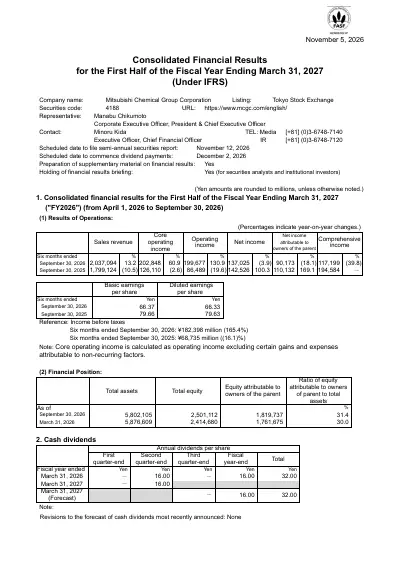
Together with solid performance of industrial gases, the overall core operating income for the group increased year on year by ¥76.7 billion to ¥202.8 billion. Net income attributable to owners of the parent for the first half came to ¥90.2 billion.
This was a decline of ¥19.9 billion year on year due to the gain on the sale of the former Mitsubishi Tanabe Pharma Corporation in the first half of FY2025. In the forecast for the full fiscal year, core operating income has been upward revised from ¥305 billion to ¥340 billion, and net income attributable to owners of the parent has been upward revised from ¥127 billion to ¥145 billion.
In the second half, we forecast continued favorable sales for semiconductor-related products, but we also expect the impact of the Kumamoto earthquake, a weakening of demand following the temporary increase in one—in the first half due to growing instability in the Middle East, and ongoing uncertainty regarding the production and supply system in that region. Our dividend forecast remains unchanged.
We are expecting a year-end dividend of 16 yen per share and an annual dividend of ¥32 billion—rather, 32 yen per share. We will continue to rigorously adhere to the three disciplined approaches in business operations, focus our management resources on areas that serve as next-generation and growth drivers, and steadily implement productive growth initiatives to achieve sustainable growth and enhance corporate value.
Now with regard to the consolidated statement of operations. The exchange rate was 160 yen to the dollar, 10% weakening of the yen—of the yen.
The naphtha price was 108,300 yen per kiloliter, up 67%. Sales revenue came in at ¥2,037.1 billion, up ¥238 billion, or 13%, year on year.
There was a positive impact of ¥187 billion from selling prices, a negative impact of ¥60 billion from sales volume, a positive impact of ¥109 billion from foreign exchange, and a positive impact of ¥2 billion from restructuring. Core operating income came to ¥202.8 billion, up ¥76.7 billion year on year.
This outperformed by ¥8.8 billion the first half forecast of ¥194 billion announced in July. Main factors were stronger-than-expected demand for semiconductor-related products and a variance in projected inventory valuation gain and loss due to the smaller decline in naphtha prices.
Special items came to a negative ¥3.1 billion. Operating income was ¥199.7 billion, and income before taxes came to ¥182.4 billion.
Net income attributable to owners of the parent reached ¥90.2 billion, down ¥19.9 billion year on year. While net income from continuing operations increased by ¥89.4 billion year on year, the overall result was significantly impacted by previous year's gain of ¥94.9 billion on the sale of the former Mitsubishi Tanabe Pharma Corporation under net income from discontinued operations.
Next, on sales revenue and core operating income by business segments. For chemical business as a whole, sales revenue increased by ¥151.8 billion, and core operating income increased by ¥62 billion year on year.
Sales revenue increased by ¥151.8 billion. This despite shipment constraints at certain sites due to the Middle East situation and an expanded scope of scheduled maintenance compared to the previous fiscal year, thanks to surging market prices for products, higher selling prices across various products centered on specialty materials, and the foreign exchange.
Core operating income for the chemicals business as a whole increased by ¥62 billion, significantly driven by strong performance in specialty materials, as well as substantial inventory valuation gains in basic materials resulting from the rise in naphtha prices. Industrial gases progressed stably—continued to progress stably, I should say—with sales revenue up 13% and core operating income up 16% year on year.
Further details for each segment will be explained later. This slide shows a breakdown of the ¥76.7 billion year-on-year increase in core operating income.
Prices contributed for a positive ¥26.5 billion. While price gap deteriorated in polyolefins in basic materials during the naphtha price surge, price gap improved overall due to higher selling prices in specialty materials and rising market prices for MMA monomer in MMA and derivatives.
Volume had a negative impact of ¥1 billion. Although sales volume expanded in specialty materials centered on semiconductor-related products, there were shipment constraints from certain sites for MMA stemming from the Middle East situation and extended scale of scheduled—or expanded scale of scheduled maintenance in basic chemicals compared with the previous fiscal year.
Cost reduction provided a positive ¥28.1 billion, as both industrial gases and chemicals accumulated cost-saving benefits in their respective businesses. Others contributed for a positive ¥23.1 billion.
This includes an improvement of ¥50.4 billion in inventory valuation gain and loss in tandem with rising material prices, including, but not limited to, naphtha. Now, further details by business segment.
Please note that major factors for the year-and-year difference have not changed significantly since Q1. In specialty materials, core operating income was up ¥30.7 billion year on year.
Prices had a positive ¥22 billion impact. The price factor improved across all subsegments, particularly semiconductor-related products.
Volume had a positive impact of ¥12 billion. In composites and shapes, there was higher sales volume of high-performance engineering plastics for semiconductor manufacturing equipment and carbon fiber composite parts, primarily for robotaxis.
In information and electronics, sales increased for semiconductor-related products, particularly synthetic silica and precision cleaning services. Cost reduction had a positive impact of ¥10 billion, with labor expenses coming down after last year's workforce optimization and rationalization through the review of production sites in each business.
Others had a negative impact of ¥13.3 billion, mainly due to cost increases accompanying inflation. For MMA and derivatives, core operating income increased by ¥5.3 billion.
Prices contributed for a positive ¥13.7 billion. Market prices for MMA monomer were higher and widened the spread.
In functional chemicals, the price gap improved chiefly for additives with higher selling prices. Volume had a negative impact of ¥8.8 billion.
In MMA, volume declined due to reduced operations and constrained shipments at certain sites due to the Middle East situation. Basic materials reported an increase in profit of ¥22.7 billion year on year.
The price gap was a negative ¥15.3 billion. In the basic chemicals business, the timing of polyolefin sales price revision was out of sync with the rising naphtha price trend.
The volume variance was a negative ¥7.9 billion. In the basic chemicals business, it worsened due to an expansion in the scale of scheduled maintenance and repair and a decline in sales caused by the influx of low-priced products from overseas.
Others were positive by ¥42.4 billion, including a ¥49.9 billion improvement in inventory valuation resulting from rising naphtha prices—it's about [for?] ¥50 billion.
Industrial gas reported an increase in profit of ¥14.7 billion year on year. This was driven by higher sales resulting from growing demand in Asia and Oceania, as well as cost reductions through productivity improvement promoted in various regions.
Special items. Special items for the first half resulted in a net loss of ¥3.1 billion.
We recorded a gain on the sale of property, plant, and equipment of ¥13.7 billion, primarily from the transfer of land associated with the relocation of Nippon Sanso Holdings' headquarters. On the other hand, we also recorded losses related to the implementation of structural reforms and disaster-related losses stemming from Kumamoto earthquake, resulting in a net loss of ¥3.1 billion.
I'll now explain the cash flows on this page. Operating cash flow resulted in a net inflow of ¥157.8 billion.
Cash flow from inventory amounted to a net outflow of ¥76.4 billion, primarily due to rising raw material prices, such as naphtha, and the buildup of inventory prior to scheduled maintenance and repair. Other cash flows resulted in a net outflow of ¥85.9 billion, which included payment to retirement benefits related to the Next Stage support program implemented last fiscal year and payment of corporate income taxes.
Investing cash flow resulted in an outflow of ¥94.9 billion. We spent ¥140 billion on capital expenditure.
Growth investment projects in specialty materials, such as capacity expansion for carbon fiber and composite engineering in Italy, are progressing. Cash flow from asset sales was a positive ¥46.4 billion.
We recorded proceeds from the sale of cross-shareholdings as well. As a result, free cash flow was positive ¥62.9 billion.
Financing cash flow resulted in an outflow of ¥164 billion, primarily due to the repayment of interest-bearing debts and dividend payments. This is the consolidated statement of financial position.
Total assets amounted to ¥5,802.1 billion, down ¥74.5 billion from the end of the previous fiscal year. Cash and cash equivalents decreased by ¥103 billion due to the repayment of interest-bearing debts.
Foreign exchange effects also contributed to the decrease in total assets. On the other hand, inventory increased by ¥70.7 billion due to soaring raw material prices.
Taking these into account, total assets decreased by ¥74.5 billion. The net debt-to-equity ratio stood at 0.79, slight improvement from the end of the previous fiscal year.
On this page, we provide supplementary information on the trend in the core operating income from the first to second quarter. The core operating income for the second quarter was ¥88.7 billion, down ¥25.4 billion from the previous quarter.
The core operating income for specialty materials was ¥32.1 billion in the second quarter, down ¥6.2 billion Q-on-Q. Although the semiconductor-related business performed steadily, this decline was driven by narrowing of spread due to rising raw material prices and pullback in demand following the surge in customer inventory buildup observed in the first quarter.
MMA and derivatives posted ¥1 billion, down ¥7 billion. This was primarily due to a narrowing of the price gap resulting from a decline in MMA monomer market prices.
Basic materials posted a loss of ¥700 million in the second quarter, a decrease of ¥15.5 billion from the first quarter. Although there was an improvement in the price gap for polyolefin due to a reduction in the scale of scheduled maintenance and repair and a decline in naphtha prices, profits fell significantly due to deterioration in inventory valuation.
The industrial gases segment performed steadily, with core operating income for the second quarter at ¥53.6 billion, remaining almost flat from the first quarter. Next, I will explain the revision to the full-year forecast for the fiscal year March 2027.
The forecast for the second half is based on the exchange rate of 155 yen to the US dollar and naphtha price of 100,000 yen. Full-year sales revenue is projected to be ¥4.06 trillion, up 7% from the initial forecast.
We're revising our core operating income forecast upward to ¥340 billion, up 12% from the initial forecast. Details by segment will be explained on the next page.
For special items, we have revised the initial forecast of -¥5 billion to -¥12 billion. The main reasons are our ongoing business restructuring efforts and the fact that we have factored in losses related to the Kumamoto earthquake.
Consequently, we are revising upward our forecast for operating income to ¥328 billion and net income attributable to the owners of the parent to ¥145 billion, an increase of ¥18 billion from the initial forecast and a year-on-year increase of ¥133.2 billion. I will now explain the full-year core operating income forecast by segment.
Specialty materials is projected to reach ¥118 billion, up ¥28 billion from the initial forecast. Although there will be some impact from the Kumamoto earthquake, we expect results to significantly exceed the initial forecast due to increased sales volume of semiconductor-related products and the effects of our ongoing pricing policies.
For MMA and derivatives, we expect ¥10 billion, down ¥1 billion from the initial forecast. Although we are seeing rising MMA monomer market prices and the effects of our pricing policies in the functional chemicals business, the outlook is expected to fall short of the initial forecast due to impacts on the production and supply system stemming from this situation in the Middle East.
Basic materials is projected to reach ¥11 billion, up ¥16 billion. Although sales have declined due to the influx of low-priced overseas products, significant inventory valuation gains resulting from the rising naphtha prices were recorded in the first half.
As this is expected to persist throughout the fiscal year, earnings are projected to significantly exceed the initial forecast. As a result, the core operating income for the chemical segment is expected to exceed the initial forecast by ¥35 billion, reaching ¥135 billion.
However, we anticipate a ¥55.2 billion decline in profit from the first half to the second half. This factors in the negative impact of deterioration of inventory valuation gains recorded in the first half, the effects of Kumamoto earthquake, and deterioration in the price gap due to rising raw material prices compared to the first half.
For the industrial gases, we are maintaining our initial forecast at ¥205 billion. Last but not least, I'd like to discuss dividends.
Given the outlook remains—that given that the outlook remains uncertain due to the situation in the Middle East, the board of directors resolved at its meeting today, November 5th, to set the interim dividend per share for the fiscal March 2027 at 16 yen, in line with previously announced forecast. Furthermore, for the same reasons, we are maintaining the previously announced forecast of 16 yen for the year-end dividend.
Consequently, the projected annual dividend per share for the fiscal year March 2027 is 32 yen. We will revisit the year-end dividend at the time of the year-end earnings report for this fiscal year.
This concludes my presentation. Thank you for attention.
Operator
Thank you very much. We will now take questions from the floor.
The first question, from Daiwa Securities, Umebayashi-san, please.
Hidemitsu Umebayashi
Good afternoon. Thank you very much for your presentation.
This is Umebayashi from Daiwa Securities. I have a question on specialty materials, and particularly the volume factor.
In Q1, the situation in Middle East caused some increase in volume, and you mentioned that there was a reactionary decline in Q2. What does it look like now?
Is it continuing, and we will see more in the second half? That's one part of the question.
For some products, I understand that there will be an impact of the earthquake in Kumamoto. If you could perhaps provide some information, particularly some quantitative information.
Manabu Chikumoto
Thank you very much for your question. First, on the Q-on-Q comparison and the reactionary decline Q-on-Q, I think we've run—that's run its course, we are back to normal for most of products.
Having said so, going forward, some customers are still going through inventory adjustment, but generally speaking, Q2—in Q2, the reaction or adjustment has run its course, we are now on normal levels. With regard to the impact of the Kumamoto earthquake, the earthquake was quite severe, and our production facilities were damaged, and some of the logistical facilities were damaged.
Our inventory—the products in inventory were not so damaged, we were able to continue to ship the products. Restoration, particularly for OBL, so that is a type of film that we actually produce in Kumamoto, we are trying to restore that.
OBL, we were preparing for capacity expansion, or so there are—we call this 8K. We have this facility that is an eight, but line nine, we are actually using the parts that we were planning for line nine for line eight so as to restore the production as soon as possible and minimize the impact on our customers.
We are working hard on that. Having said so, if you look at a full year, there will be expenses incurred, maybe ¥4 [billion] to ¥5 billion would be the negative impact from the Kumamoto earthquake, and we factored that into our revised forecast.
That's where we are.
Hidemitsu Umebayashi
Thank you very much.
Operator
Thank you very much, Mr. Umebayashi.
Next, from Morgan Stanley MUFG Securities, Mr. Watabe, please.
Takato Watabe
Thank you for the presentation. Is President Chikumoto still there?
Manabu Chikumoto
Yes.
Takato Watabe
I have a question to President. As for specialty materials profitability capability, it is improving significantly, and as for direct and indirect materials for semiconductors like [Courtland?]
, are improving. This organic semiconductor materials growth and inorganic growth, including M&As, what is your thought on this?
Manabu Chikumoto
As for organic growth, as you can see, well, we're doing well in terms of growth. As for inorganic growth, we would like to be more proactive.
Takato Watabe
There are various reports being made. Any comments on those?
Manabu Chikumoto
For the moment, there's nothing that's official. Even though the media are reporting, it's not finalized, and the numbers are not that finalized, and sometimes don't make sense, I'm not wondering what.
If there's some direct reports, then we may give you some thoughts.
Takato Watabe
Thank you very much. I'm sorry for asking this question.
Operator
Let's go to Ohmura-san from UBS Securities.
Shunta Omura
Good afternoon, this is Omura from UBS Securities. It's related to the first question.
I'm also interested in the volumes, and I would hope for further clarification there. For specialty materials and the volume, you talked about ¥12 billion from volume, but MMA and basic materials, ¥7 [billion] to ¥8 billion, that's negative.
Could you perhaps explain why the difference is and what product they are related to, perhaps?
Minoru Kida
Thank you very much for your question. For the volume part, and thank you very much for looking at all the details.
For specialty materials, there's a volume factor of ¥12 billion. I'm actually impressed, although I may not be supposed to say this.
What is this ¥12 billion? If you look at the breakdown by segment, of this, more than ¥10 billion comes from composites and shapes.
Volume contribution from composites and shapes, 10 billion out of that 12—¥10 billion-plus, I should say. Half of that comes from high-performance engineering plastics.
We call them stock shapes or engineering shapes. We called it Quadrant business.
Why is this volume growth? This is related to semiconductor, too.
For semiconductor manufacturing equipment, they use high- or specialty engineering plastic, particularly those with high thermal resistance. There's half comes from that growth.
Then the remaining half comes from carbon fiber and parts and components. I'm sure we showed you to everyone, and we had this tour for some people, before we are serving the robotaxis.
That's the breakdown of that ¥10 billion-plus from composites and shapes. If you look at it from a market perspective, ¥70 billion—¥7 billion out of the ¥12 billion comes from semiconductor-related demand.
I talked about composites and shapes, and ¥5 billion is semiconductor-related. The remaining ¥2 billion comes from information electronics.
This time, there was big growth in synthetic quartz, and we are getting a lot of inquiries, but we are trying to open additional capacity in FY2028, and the current capacity is running at full capacity. There's very strong demand here, and the business is doing very well.
As I mentioned at the beginning, precision cleaning, that business is also strong. I talked about the materials that supply semiconductor manufacturing equipment, but in relation, the precision cleaning is also getting more orders, and that's contributing to volume.
Then with regard to MMA, there was this -¥8.8 billion impact. Not all, but part comes from plant trouble, which curbed shipments.
Most comes from the sales volume reduction in Saudi Arabia. There's this issue of a plant operate or not, and then the vessels can't really get there or get out of there.
It's not 100% impossible, but it's very risky. We can't really ship from that location, and that accounts for the majority of that -¥8.8 billion.
Another part is basic materials, -¥7.9 billion is a negative contribution from the volume factor. Of that, one quarter comes from the scheduled maintenance, and there's been some minor troubles or stoppages, and that also had a negative impact on volume.
Then the technology licensing fees also included in this volume factor, so that also had some contribution. That would be the breakdown of the volume factor.
I hope I'm answering your question.
Shunta Omura
Yes, thank you very much. What about film-related, OBL and polyester film or SoarnoL?
What would be the volume momentum currently?
Minoru Kida
Thank you very much, and I actually wrote that in a comment. For films, MLCC, these ceramic condensers use films, and we are shipping a lot for that application.
That has a positive impact on volumes. Films and performance materials, the volume increase accounts for about ¥1 billion, that's from MLCC.
Then the earthquake in Kumamoto was in August, the negative impact is only one month worth. The OBL impact was not major in the first half, but there will be more in the second half.
We may fall a little short of the plan there, but we're trying to minimize the impact. We are working hard to restore the production facility.
We're also trying to make the best use of the inventory available.
Shunta Omura
Thank you very much.
Operator
Thank you very much. Next question from Nomura Securities, Mr.
Okazaki, please.
Shigeki Okazaki
I'm Okazaki from Nomura Securities. Thank you very much.
I'd like to also ask about specialty materials in the second quarter to the third quarter. The terms of trade, how should we look at this?
In the first half and second half, there's a comparison on page 24. From the second quarter to 3Q, for those five subsegments, on the current assumption of naphtha prices, what would be the terms of trade?
Minoru Kida
Thank you very much. As for the terms of trade, well, in terms of special materials, there's not a special or a fixed formula to decide the prices definitely.
Relatively speaking, there's a major trend by customer, but different customers have different trends, and different products have different trends. From the second to third quarter, if you ask us what would be the products where we would see big changes in the trend, some film products, mostly bulk, something close to what is called bulk products, the film products, this is linked to the raw material prices.
As for specialty materials, what would be most affected and linked, relatively speaking, with naphtha, that's a polymer compounds, polypropylene compounds would be affected by naphtha prices. Going forward, what would be the oil prices?
And ¥100,000 is the price assumption now, but this could change, and that could have some impact. We can't really tell what would be the price of oil, and so is the naphtha prices, it's very difficult to predict.
Because oil prices have dropped by $8, for instance, this morning, after the result of midterm elections in the US, energy indexes may move, we have to closely watch that.
Shigeki Okazaki
What you said at the outset is the polymer compounds based on ¥100,000 naphtha price from Q2 to Q3, you're saying that spread is going to worsen?
Minoru Kida
For some products, yes, there could be a deterioration as for polymer compounds. To supplemental question, the fuel and raw material prices could go down from now, it's difficult to tell the timing, but you don't have to reduce the price as much as the fuel and raw materials costs decline.
Is that what you feel? As for the formula, the price revision timings are different from customer to customer, and frequencies are different.
Sometimes some customers have just once a year, although very few, but most of them have accepted the price revisions twice a year. Frequency of price revision is different.
Also, the inventory valuation differences also are related in some of the specialty materials. What is the inventory valuation?
At that time, the price index would decline, but there are fuel prices on the average, the price would decline faster than the cost decline. If the fuel prices are going up, then the product price would go up first, and then cost would catch up later.
In the first quarter, there was a more positive gap favorable to us. In the second quarter, the fuel prices and raw material prices went down.
The cost actually caught up afterwards, there's a squeeze of the gap. The sine curve and cosine curve and there's a difference.
Always the prices are catching up with the cost prices, it's very difficult to see that. For the second quarter, third quarter, what would be the price reduction that we should ask, or we should be asked, there's no such information or awareness that we have now.
Operator
Nishihara-san from Okasan Securities, please.
Takashi Nishihira
This is Nishihira speaking. I have one question.
This time, you have upward revised the core operating income forecast for the full year. Is this something that is on a comparable basis, or is it something that you have further upside, but trying to be conservative?
Could you perhaps elaborate on the nature of the upward revision, please?
Minoru Kida
Thank you very much for the question. Personally, I believe it's a little conservative.
There are various risks that we are aware of, and we are wary of. For example, with pricing, and particularly pricing, perhaps I should say.
We try to be conservative. Obviously, this is formulated bottom-up, and the result is this number.
We are probably falling short by 15 or ¥10 billion, particularly for chemicals. We wouldn't fall short of that, but then there's this volatility with regard to energy prices and raw materials.
We really can't be very accurate in our forecast, but these numbers are quite solid numbers.
Takashi Nishihira
Thank you very much. That was very clear and easy to understand.
Thank you very much.
Operator
Thank you very much, Nishihara-san. From Mizuho Securities, Mr.
Yamada, please.
Mikiya Yamada
Yamada from Mizuho Securities. Thank you very much.
You said that you're conservative, but I'm maybe not appropriate to ask this question afterwards, but I'd like to ask about basic materials more. In the second quarter, there's a slight deficit, almost breakeven.
From the first to second quarter, the inventory valuation -¥1 billion-plus, and the purchase unit price is going to go up, the terms of trade is not going to improve. That was the situation that we've seen.
In the second half, ideally, the volume is going to recover to some extent. Based on ¥100,000 assumption, there's no major absolute value negative number in terms of inventory valuation.
Why is it going to deteriorate in the operating income in the second quarter? Times two, there was a more worsening of that.
Can you explain more of that? You said that coke for steelmaking was strong, but there's some continuation of business.
Even if you have withdrawn from the cokes, you can still continue with pitch cokes, which are the byproducts. Why is that?
Minoru Kida
Thank you very much. For basic materials, honestly speaking, it's very difficult to tell and predict.
In terms of price gap, in the first half, it was a timing difference, and it turned out to be negative to us. There was a time lag, and it is catching up.
There is going to be improvement because of this catch-up. In the end, what matters most is the ¥100,000 assumption, and there will be some inventory valuation gain that will be gone to some extent.
That will be the biggest impact, in one word. As for the sales forecast, from second quarter to third quarter, or first half to second quarter, there's no major change in the trend that we see.
From the last fiscal year, we have been talking about this from time to time, but we are saying that this is a living animal. Ethylene derivatives, ethylene oxide or ethylene glycol, or polypropylene derivative acrylate and oxo alcohol or acrylonitrile, those are the products that would see the sales decline, and this is becoming more serious in the long-term trend.
If you can't sell those products, those products have not been imported from overseas, but the customers' products that are using our products as a raw materials are actually faced with the competition from the products overseas, and our products are not selling in the end. That's very clear.
Restructuring the plant, downsizing would have to be done more drastically, otherwise it would be very difficult to recover from this impact. Restructuring has to be accelerated.
That's how we are in the basic materials.
Mikiya Yamada
What about carbon?
Minoru Kida
As for the carbon, well, you asked about this carbon business, right? Carbon materials, right, that we announced today?
Mikiya Yamada
Yes.
Minoru Kida
The carbon materials, we have decided not to stop the business. It's not about carbon materials business that have seen some major changes, but rather than that, derivatives or chain products like pitch-based carbon fiber is something that we are seeing very important.
As there's a PAN-based and pitch-based. Pitch-based is a very niche product, like elasticity and also strength coexist, and also thermal conductivity is very high.
The pitch-based carbon fiber specification is really increasing in terms of pure specialty applications. The pitch-based carbon fiber quality has to be maintained in order to meet that demand.
In order to do that, the upstream carbon material production facility would have to be continued to be operated. That's how we decided in the end.
That's why we said that we decided not to withdraw from carbon materials. Of course, in the carbon materials, needle coke business would be continued, and we will work on improvements.
Needle coke is not the reason for this decision this time, but pitch-based carbon fiber, increased sales or sales to new applications, these are the things that we're taking possibly. That's how we got to the decision that we made today.
Mikiya Yamada
Thank you. I'm not learning much, but even if coke oven is stopped for steelmaking, the pitch-based carbon can be produced because even if it is a chain byproduct.
Pitch-based carbon fiber is used for semiconductor production equipment like robot arms, and PAN-based carbon fiber cannot be used because of Young's modulus. It's a very monopoly.
The raw materials that are procured from others cannot make that performance. Vertical integration really has barriers to new entry.
Is that something that has been demonstrated?
Minoru Kida
In terms of technologies, it's just our secret, we cannot tell you details. There's carbon materials, there's cokes, and then there's tar.
The pitch is coming out, and then from tar, you create carbon materials, and then pitch tar and pitch carbon fiber is produced at the same time. As a flow, pitch is and then carbon materials and the carbon fiber.
The needle cokes and others are intermediate processes, in the overall workflow. At the most downstream, there's a pitch-based carbon fiber.
We would like to just continue with pitch-based carbon fiber which is the most downstream, but then we get back and consider that the intermediate process could affect the quality of our product, the carbon fiber product at the downstream. We learned that.
That's why the intermediate process of carbon materials would not be withdrawn from, but rather to be continued. As Mr.
Yamada, you said, the pitch or tar is coming from cokes, that's what you're talking about. You can actually use a tar that has been externally procured, that's what we've learned, and that's why we made this decision that we made today.
Mikiya Yamada
Thank you. It's clear now.
Operator
Thank you very much. Let's go to Miyamoto-san from SMBC Nikko Securities.
Go Miyamoto
Miyamoto speaking. Thank you very much.
I have a question about composites and shapes and Q-on-Q difference and the first half/second half difference. I'm looking at page 25 of the slide set, and you looks at the subsegments are going down on Q-on-Q, and could you explain that?
Then what do you expect for the second half? You are looking at a decline of ¥5.5 billion.
What would that mean for a subsegment? Particularly, what about the carbon fiber composite parts for robotaxis?
Minoru Kida
Miyamoto-san, thank you very much for your question. You are trying to be nice, and you're holding back things as you ask questions.
Because I think that between the first half and second half, there's this ¥5 billion decline. Now, this business, the major battlefield is in Europe.
There's this impact of the holiday season, the Christmas season. The production and shipments are always slow.
Seasonally, every year, second half is slower than the first half. Even with that, the decline appears quite large, and maybe I shouldn't say that, but I actually thought so, too.
With regard to robotaxi, compared with initial expectation at the beginning of the year, the supply chain on the customer side is actually causing us to expect a smaller number than initially expected. The momentum is not so different.
Manabu Chikumoto
Rather than that, this is driven more by engineering plastics. There's this low season that we maybe misread.
We were expecting the second half to be a little better in earnings. We are expecting that things will be a little better in second half.
Go Miyamoto
What about Q1 to Q2? That would be due to robotaxi?
Or what about the shipments for robotaxi?
Manabu Chikumoto
Actually, Q1, Q2, that was increasing. If you look at first half and second half, this year, the calendar year and fiscal year, it's a little confusing even for me.
Let me see. Q1, Q2, almost same with regard to the number of units, and actually, there will be slight increase into Q3 and Q4.
Compared with the first half, second half will be up by 50% in terms of the number of cars.
Go Miyamoto
You talked about the client part supply chain. Is that like batteries and other components?
Manabu Chikumoto
I'm afraid that's a client-side issue, I can't really discuss too much detail. I'm not sure if it's the assembly process or if it's about the procurement of other materials, I'm not privy to all that.
Go Miyamoto
Over the mid-term, you don't need to adjust your view.
Manabu Chikumoto
That's how I think.
Go Miyamoto
Thank you. I have a related question.
NHTSA, the exemption, there's this 2,500 units, that's a ceiling. What are you going to look at beyond the 2,500 number?
Your strategy?
Manabu Chikumoto
Thank you very much for the question. For the short term, we are trying to increase the number, and so that's two years down the road, three years down the road, and there is uncertainty.
We'll need to see an increase in the geographical recovery and coverage, and we also expect some demand growth. Then we'll need to look at a track record, how safety is confirmed, and that would probably lead to an expansion in the number of cars allowed.
Go Miyamoto
Thank you very much.
Operator
Thank you very much. We can take one last question.
This will be the second time, but Mr. Okazaki from Nomura Securities, please.
Shigeki Okazaki
Thank you. Okazaki from Nomura.
MMA, like usual, second quarter or second quarter—second half market assumption and capacity utilization assumption and supply-demand gut feeling and the production status, can you talk about all these? Thank you.
Minoru Kida
As for the market prices, in the second quarter, $1,700 was mostly the price that they were in. As for this price assumption for the second half, it is expected to go down between $1,700, $1,600, but upper half of $1,600 is the price assumption that we have.
With regard to capacity utilization, it's very difficult to tell. In Saudi Arabia, at least, in the third quarter, we won't be able to restart the plant, so that is incorporated in the forecast.
Shigeki Okazaki
In the second quarter, the capacity utilization was 60%, that was assumption. What was the result, actually?
Then what would be the assumption for the second half?
Minoru Kida
As for the second quarter, as you said, well, 60%, I can't go into too much detail, but slightly less than 60% was the result of second quarter, globally speaking. In Asia, there was a supply chain disruption, but in other sites there were some problems.
Relatively speaking, we are expecting a low level. In the second half, how are we looking at this?
On the average, around 60%, 6-0. Of course, plant by plant there will be some ups and downs, but overall, 60% on the average.
Shigeki Okazaki
What about supply-demand tightness? Isn't it different or change?
Change? No, no change?
Low level?
Minoru Kida
Supply-demand's level is not that low if you ask us. Of course there's an issue of spread in the market prices, but it is close to $1,700, the things will not change that much from now.
Shigeki Okazaki
Thank you.
Operator
Thank you very much, Okazaki-san. We have five more minutes, I think we can take one final question from Umebayashi-san of Daiwa Securities.
If you could make your question short, please.
Hidemitsu Umebayashi
Thank you very much. This is Umebayashi speaking.
It relates to Yamada-san's question earlier. You are no longer withdrawing from some carbon materials.
You will probably have to reverse ¥9 billion for that for the provision you took for restructuring. If you look at the annual forecast, if you look at the special items, you are actually downward revising by ¥7 billion.
That would mean you have ¥16 billion that's something negative in the special items that's not coke.
Manabu Chikumoto
Yes, thank you very much. As you pointed out, it's ¥9 billion reversal that we have factored in.
Then the situation in Kumamoto after the earthquake, and there are losses that are recognized or factored in. Then other than that, we are still continuing our structural reform.
The major things have been done or are underway, but there are smaller ones that we are continuing. That's probably the normal course of things that we do, and so those are included.
To be more specifically, what items, what projects, how much, I'm afraid at this point in time we cannot share any further details.
Hidemitsu Umebayashi
Thank you very much. That's all from me.
Manabu Chikumoto
Thank you very much. May I?
Yamada asked a question: why now the carbon material business facility is going to be restarted? It's very difficult to understand, I'm so sorry.
We've announced this first and then withdrew that. Very important to explain to the customers, as well as to the government.
We are still in the process of explaining for the next few days. Even if we have decided not to withdraw, it would be worthwhile to do that, and there's a potential large enough for the future as a product.
That's why pitch-based carbon fiber expansion is something that we have changed our directions to. For the applications, the thermal management materials, or space, outer space or aerospace, those are the applications that we see.
In the near term, there's a momentum that we see, honestly speaking. It's not that big of a number yet, but our pitch-based cokes quality, I believe, is the world's best.
In order to incorporate that world's best quality, we need to continue to have the production facility that is unique to us, and we definitely need to continue to operate that facility and increase the investment as well. That's what we've announced.
Operator
Thank you very much, Mr. Chikumoto.
That's the last question that we had received, and I'd like to ask Mr. Kida to give us closing remarks.
Minoru Kida
Thank you very much for joining us for this earnings conference call out of your busy schedule today. Our first half results showed a significant increase compared to our initial projections at the start of the fiscal year as a result.
As we explained, there's some inventory valuation gains that is incorporated in this increase. After the midterm election in the US, there could be more uncertainty going forward.
In this uncertain situation, we like to get united to meet the expectations from the stakeholders. Thank you very much, and I'd like to ask for your kind cooperation.
Thank you.
Operator
That concludes the conference call. This will be archived and made available on demand, you can replay that at any time you like.
That concludes our conference call. Thank you for your attendance today.