MTU Aero Engines AG
Q3 FY2026 · Earnings Call TranscriptOctober 29, 2026
Operator
Welcome to the conference call on MTU Aero Engines' 9-month 2026 results. For your information, the management presentation, including the Q&A session, will be audiotaped and streamed live or made available on demand on the internet.
By attending in the conference call, you grant permission for audio recordings intended for publication on the internet to be taken. The speakers of today's conference are Mr.
Dr. Johannes Bussmann, Chief Executive Officer, and Mrs.
Katja García Vila, Chief Financial Officer. Firstly, I will hand over to Mr.
Thomas Franz, Vice President Investor Relations, for some introductory words.
Thomas Franz
Thank you, Madalina. Good morning and welcome to our conference call for MTU's 9-month 2026 results.
We'll begin today's session with Johannes, sharing some thoughts on the current environment and recent developments. Following that, Katja will walk you through the financials.
Johannes will share our guidance and will summarize the key takeaways before we open the floor for your questions. With that, it's my pleasure to hand over to Johannes.
Johannes Bussmann
Thanks, Thomas. Welcome, everybody.
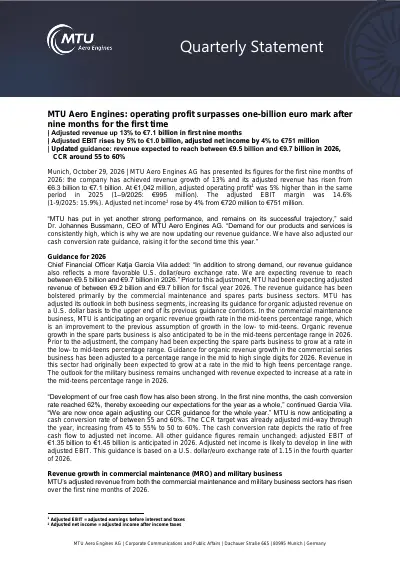
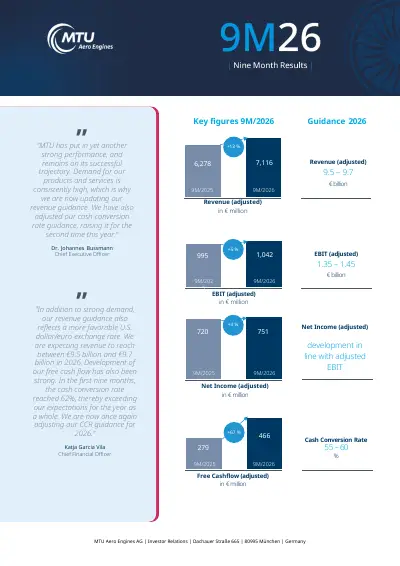
Today's key message is straightforward: MTU continues to execute exceptionally well. In the first 9 months of the year, revenue grew by 13% to €7.1 billion, with an adjusted EBIT exceeding €1 billion and a margin of 14.6%.
Most notable, free cash flow increased by 67% year-over-year to €466 million, resulting in a strong cash conversion rate of 62%. This strong performance gives us the confidence to update our 2026 guidance, in particular for revenues and for free cash flow.
Let us start with a brief look at the market environment and some key business highlights from the quarter. The overall industry environment remains supportive.
Global passenger and cargo traffic continues to show resilience despite ongoing geopolitical uncertainties and elevated jet fuel prices. Flight cycles have steadily recovered since June this year with limited disruption from renewed hostilities.
At the same time, we're not seeing any material changes in the airlines' behavior. Demand for both new aircraft and MRO services remains strong.
This reflects the continued importance of fleet availability and operational reliability for airline customers. The aftermarket environment remains particularly strong.
High fleet utilization combined with low retirements on mature engine platforms continues to drive demand for the maintenance services and supports favorable market conditions across the MRO value chain. The key challenge for the industry remains on the supply side rather than on the demand side.
Demand continues to exceed available capacity, while supply chain bottlenecks and production constraints are limiting industry output. As a result, execution, capacity expansion, and supply chain stability remain critical priorities across the aerospace sector.
Thanks to our diversified product portfolio, MTU remains very well positioned to capitalize on the attractive growth opportunities across both OEM and aftermarket. Let's take a look at the GTF program.
Execution of the GTF fleet management plan continues in line with our expectations. Improved operational performance, better availability of powder metal parts, and additional shops in the network have contributed to a higher output of GTF engines from maintenance.
Due to an expected seasonal peak in engine removals, AOGs remained relatively stable recently. We expect a further reduction of aircraft on ground during the coming months.
Overall, we see a significant lower level of AOGs compared to 1 year ago. Good progress on compensations.
We expect the remaining powder metal-related AOG compensation payments to be settled by the end of 2026. During the first 9 months of 2026, we paid roughly $170 million.
At the same time, we achieved important milestones for the GTF Advantage. MTU assembled and delivered its first GTF Advantage engine this summer, and in September, United Airlines took delivery of the first GTF Advantage-powered A321XLR.
The aircraft has entered service the past weeks, and we are very excited to see this engine in service now. Looking ahead, the transition from the PW1100 base production to the Advantage standard across the network will further strengthen the competitiveness and operational performance of the GTF program.
The technological improvements of this upgrade will also be made available for the GTF base engines. After certification of the hot section plus package, we expect to incorporate the upgrade during the shop visits already early next year.
Let's move on to our MRO network and two expansion projects in particular. The opening of our Fort Worth DAT facility and the induction of the first CFM LEAP-1B engine marked an important step in expanding MTU's global MRO network and capabilities.
The site strengthens our North American footprint, adds significant capacity, and supports long-term growth. It allows us to increase our capabilities in the huge LEAP MRO market.
In a second step, we will add GEnx full engine overhaul capabilities, rounding up our profile for this new site. Zhuhai already completed its 100th PW1100 shop visit just 18 months after opening as part of the successful ramp-up of our global GTF MRO network.
Zhuhai's rapid start highlights the scalability of our global MRO network and our ability to efficiently expand capacity. The facility is well positioned to support growing GTF aftermarket demand through potential further capacity expansion and productivity gains.
Let me now hand over to Katja for the financials.
Katja García Vila
Thank you, Johannes, and a warm welcome also from my side. Let me start with an overview of our key financials.
As Johannes highlighted at the beginning, we continued our strong performance in the first 9 months. Revenues increased by 13% to €7.1 billion.
In US dollar terms, revenues show a 17% increase. Growth was primarily driven by our commercial MRO and military business.
In commercial OEM, euro revenues remained almost stable. Adjusted EBIT increased by 5% to over €1 billion, resulting in a margin of 14.6%.
A strong profitability while down year-over-year due to a different revenue mix with stronger MRO growth. Profitability was influenced by higher installed engines and strong spare parts sales, as well as a solid military business.
Commercial MRO delivered a strong EBIT contribution despite ongoing headwinds from the capacity ramp-up in our entire network and a high GTF MRO revenue share of 45%. Adjusted net income increased by 4%, broadly in line with EBIT, reaching €751 million.
Free cash flow is exceptionally strong at €466 million, an increase of 67% year-on-year, and already above the full-year level reported for 2025. Cash conversion of 62% is ahead of our expectations and highlights our consistent focus on cash generation, operational excellence, and long-term value creation.
Now turning to OEM details on page 9. OEM continued to deliver a solid performance with strong spare parts demand and high military revenues offsetting OE mix headwinds.
Starting with commercial Q3 2026. Total OEM revenues increased by 15% in euro terms, driven by 16% growth in commercial OEM and 10% growth in military OEM revenues.
Military growth was mainly supported by EJ200 and TP400 programs. In commercial OEM, organic US dollar revenues increased by low-to-mid teens percent, reflecting high single-digit growth in OE revenues and mid-teens growth in spare parts revenues, particularly for V2500, GTF, and P&WC engine families.
While installed engine deliveries increased significantly during the quarter, spare engine deliveries normalized from the elevated levels seen earlier in the year. Together with ongoing supply chain constraints, this led to OE revenues coming in below our initial expectations.
As a result, we have lowered our full-year OE revenue outlook. Johannes will provide further context on this in a moment.
Consequently, adjusted EBIT declined to €212 million, resulting in a margin of 28.6%, in line with our mid-term outlook. Headwinds from OE mix effects were largely offset by the stronger spare parts business and solid military performance.
Turning to the 9-month performance. Total OEM revenues increased by 2% in euro terms, with commercial OEM revenues broadly stable and military OEM revenues up 13%, again driven by the EJ200, NEFE, and TP400 programs.
Commercial OEM organic US dollar revenues increased by low teens percent, supported by mid-single-digit growth in OE revenues and mid-teens growth in spare parts revenues. While spare engine deliveries remained broadly stable during the first 9 months of the year, installed engine deliveries increased as expected.
Adjusted EBIT stays even above our mid-term target range. It reached €633 million, corresponding to a strong margin of 30.3%.
These earnings reflect robust spare parts demand and high military revenue growth, slightly impacted by the OE mix. Overall, OEM profitability remains fully in line with our full-year expectations despite continued supply chain constraints and the OE mix.
Let's move to commercial MRO on page 10. Commercial MRO continued its strong performance in the first 9 months, driven by GTF MRO and a healthy core MRO business, resulting in a stable EBIT margin of 8%.
Let's have a look at the Q3 2026 numbers. Commercial MRO revenues in euro were up 14%.
In US dollar, revenues have been up 13%. Core MRO revenues in US dollar increased by 18%, mainly supported by broad-based growth across independent MRO, MLS leasing and asset management business, and parts repair activities.
The GTF MRO revenue share stood at 45%, reflecting a higher number of shop visits as well as high material content. Adjusted EBIT increased by 20%, resulting in an improved margin of 8% compared to Q3 2025.
Strong performance in our core MRO business, including MLS, overcompensated headwinds from the capacity ramp-up, particularly at MTU Fort Worth and Zhuhai, and the higher share of GTF MRO revenues. Turning to the 9-month figures.
Commercial MRO revenues in euro were up 19%. In US dollar, revenues have been up 23%.
Within that, core MRO revenues in US dollar increased by 11%, driven by the aforementioned contributors. The GTF MRO revenue share stood at 45%, reflecting, as already mentioned, a higher number of shop visits, including high material content.
Adjusted EBIT increased by 15%, resulting in a solid 8% margin, underlining the resilience of our MRO business and earnings profile. The basic effects were basically identical to the ones described for the quarter.
Let's move to page 11 for more details on our free cash flow. Cash generation was once again a standout of our performance in Q3 and the first 9 months of 2026.
In the third quarter, free cash flow more than doubled to €172 million, resulting in a cash conversion rate of 69%. Lower GTF AOG compensation payments and military prepayments were the main drivers of the improvement.
Year-to-date, free cash flow increased 67% to €466 million, lifting cash conversion to 62%, slightly above our expectations for the full year. The improvement reflects lower GTF AOG-related cash-outs, strong operational performance, military prepayments, and healthy dividend inflows.
At the same time, we continue to invest in capacity expansion to support future growth. Excluding GTF AOG compensation payments, cash conversion would have reached 81%, underlining the strong cash-generating capabilities of the business.
Overall, these results confirm that MTU continues to translate profitable growth into strong cash generation while investing for the next phase of expansion. Let's now move to our hedge book on page 12.
As already mentioned in our previous earnings call, we are fully hedged for 2026 at an average hedge rate of 1.14. For 2027, we increased our hedge coverage to $2.36 billion, in line with our hedge coverage target range, with an average hedge rate of 1.16.
Due to our rolling hedging model, we are well positioned to take advantage of more favorable FX rates in the coming months, depending on US dollar movements. Nonetheless, our hedging policy and related actions limit the impact of US dollar fluctuations and provide greater predictability of our earnings.
Turning to our order book now on page 12. Our strong order book of €29.8 billion continues to provide exceptional long-term visibility for both revenues and earnings.
Demand remains strong across our businesses. In OEM, order momentum continues to be driven by the GTF program, reflecting airlines' ongoing need for fuel-efficient aircraft.
In MRO, we see continued demand for widebody engines as well as mature narrowbody platforms, underlining customers' confidence in MTU's technical capabilities and global service network. Overall, our backlog and recurring aftermarket exposure provides the resilient foundation for sustainable growth over the coming years.
With that, I will hand back to Johannes for the guidance update and final remarks.
Johannes Bussmann
Thanks, Katja. Let's turn to our updated guidance for the full year 2026, which we updated on revenues and free cash flow.
Based on the strong performance in the 9 months we had already in 2026, we feel very confident with these targets. We now expect group revenues to reach between €9.5 and €9.7 billion, supported by both the strong business performance and a more favorable US dollar FX exchange rate.
Our guidance for adjusted EBIT remains unchanged between €1.35 and €1.45 billion. Adjusted net income is expected to grow broadly in line with adjusted EBIT.
As Katja already highlighted, free cash flow benefits from lower GTF-related AOG compensation payments, military prepayments, higher dividend income from our equity-accounted companies, and strong business performance. As a result, we have increased our cash conversion rate guidance to the upper end at 55% to 60%.
This is already the second increase in our outlook on cash conversion rate coming from 45% to 55%. This represents a significant improvement versus 2025 when the cash conversion rate stood at 39%.
Based on the ongoing supply chain constraints across all major programs, we have adapted our expectations for organic commercial OE revenue growth to mid-to-high single digits. Previously, we had expected growth in the mid-to-high teens.
Organic spare parts revenues performed strongly during the first 9 months of the year, giving us confidence that growth will reach mid-teens, the upper end of our previous guidance. Within this, we see a higher share of newer engine programs providing a slightly unfavorable mix effect.
The outlook for our military revenues remains unchanged at up mid-teens growth, sorry. Commercial MRO continued to perform strongly above our expected growth range, allowing us to increase our outlook, and now expect growth at the upper end of our previous range in the mid-teens percentage.
To specify for Q4, our shops are operating at full capacity, and engines awaiting induction are already lined up outside the facilities. Due to ongoing supply chain issues, revenues will defer into 2027 partly.
To wrap it up, MTU delivered a strong performance in the first 9 months, leading to our 2026 guidance update. The GTF program is progressing as planned.
As planned, the GTF Advantage has entered service, and the fleet management plan remains firmly on track. Free cash flow improved above initial guidance.
This proves our relentless efforts to improve cash conversion rate and future shareholder returns. We look forward to discuss these topics along with MTU's next phase of growth at the upcoming Capital Markets Day, and to welcome many of you to Munich on November 30th.
With this, I would like to conclude our presentation. Thank you for your attention, and more than happy to take your questions.
Operator
Thank you very much. We will now begin the question-and-answer session.
If you'd like to ask a question, please press star one and one on your touch-tone telephone. The operator will announce your name when it's your turn to ask a question.
In case you wish to cancel your question, please press star one and one again. We are now going to take our first question.
This one is from Sam Burgess from Goldman Sachs. Please go ahead.
Sam Burgess
Good morning, all, and thanks very much for taking the questions. Just starting on free cash flow, it was particularly strong, €172 million.
Could you just quantify broadly how much of that was supported by the military prepayments and increased payables, just to help us think about the sustainability of that conversion? Secondly, you've upgraded growth expectations for both spare parts and commercial MRO.
You've increased the bottom end of the group revenue guidance, but that EBIT guidance has remained unchanged. Could you just help us understand why that stronger aftermarket outlook isn't translating into higher EBIT expectations?
Is that solely the spare engine normalization and new engine MRO in the mix, or is there anything else at play going on there? Thank you.
Katja García Vila
Maybe let me start with the question on free cash flow, Sam. I will not exactly specify the individual numbers for the contribution, but I think when you look at the payables, you see that our business continues to grow strongly, and we also always said that we would work on improvements of our working capital profile going forward.
What you see here now are the results more or less of that, growth and improved management on the payable side. For the prepayments in the military business, I can also not give you the customer more or less, but if you look back over the past calls that we have had, you see that we do have a stronger order intake on our running programs at the moment, which we also see continuing during the course of this year, and the prepayments that we have received there are supporting our business going forward.
With regards to the growth rate or the overall rate, I think you've already laid it out quite well, we do see in the second half of the year rather a normalization of the spare and lease engine ratio. That was also what we said, yeah, going forward, when we also talked about the first half of the year, we said that we would see a pickup in installed engine deliveries across the programs in the second half of the year, and that's what you also see in the Q3 figures, yeah, going forward.
Regarding the overall margin, you see that we do have a very strong growth in the MRO side, and that is naturally, mathematically, yeah, due to the difference in EBIT profitability, also dilutes the overall group margin, yeah. Let me say it like this: dilution is one thing, we've also proven that this business is a very high-quality, very resilient business that we continue to execute very well.
Sam Burgess
That's helpful. Thank you very much.
Operator
Thank you. We are going to take our next question.
This one is from Sebastian Growe from BNP Paribas. Please go ahead.
Sebastian Growe
Hi, Katja. Hi, Johannes and Thomas.
Thanks for taking my questions. One on MRO, and maybe we start there, and then I have another one on the cash conversion ratio.
Katja, you pointed to ongoing headwinds from the ramp-up costs across your network, and at the same time, the margin has improved year-on-year. I was wondering how we should think of the cost phasing related to the ramp-up, or simply put, whether we might have reached a tipping point for MRO margins to expand from here.
If we can start there, please.
Johannes Bussmann
I'll start with that one. No, I think we mentioned first that the investments there roughly €100 million year-over-year for the ramp-up, is and that what we exactly spend and build it up.
I think what is really important, and where we managed the project very well, to come into operation soon, so that we have also work that is done and revenues that are generated. That's definitely one thing.
The other topic is, of course, that we are leveraging our abilities on the repair side. That's why also from the outlook perspective, we see still strong potential to have positive development on the profitability, on the MRO business across all the programs.
We have a wide portfolio, as and that's something that we're leveraging even more in the future.
Sebastian Growe
Sounds good. Then the next one is on the cash conversion ratio, and as a follow-up to Sam's questions prior.
Apparently, indeed, the adjusted EBIT outlook hasn't been touched, but I was wondering if you could talk about the impact then from other key levers such as working capital, CapEx, etc., behind that improved outlook, and particularly how to think about the potential spillover to outer years. Thank you.
Katja García Vila
I think, Sam, what we have said, there are a couple of drivers on the cash flow performance, yeah. One driver that we haven't spoken in before in Sam's answer was that we also have lower AOG payments compared to last year, yeah, at this point in time, and that this will for sure be a positive development going forward, as we already said that we expect AOG direct payments for the GTF fleet management plan to end by the end of this year, yeah.
The good improvement on the payable side due to business and improved management overall is also something we expect to continue to be carried on. Prepayments we've already spoken about, and another question we always get were the dividend payments.
The dividend payments follow our good business development that we have, and we had strong contribution in the first half of the year, but for the third quarter, that was not the predominant contribution. We do expect that to continue to perform well, yeah.
You all know that we've laid out the mid-term guidance, and we will also provide you with some more details on cash development, cash conversion rate development during our Capital Markets Day on November 30th.
Sebastian Growe
Thank you. May I just squeeze in one quick one on the CapEx side?
Because apparently we were surprised by another supplier earlier this reporting season on the CapEx step-up. Is there anything, because you also flagged that apparently you see good dynamics then on the order intake side for existing programs, which would require you to step up the CapEx payments going forward, or do you feel well-covered with what you had put into your planning assumptions prior?
Thank you.
Katja García Vila
I think we do feel quite comfortable with the current setup. You see, when you look at the quarter at the quarter reporting, that we had higher CapEx compared to last year at the same point in time.
This is due to our increase in capacities across all our network. We feel very well-positioned there, and there is currently no nothing to think about in a significant step-up going forward.
Sebastian Growe
Great. Thank you very much.
Operator
Thank you. We are going to take our next question.
This one is from Robert Stallard from Vertical Research. Please go ahead.
Robert Stallard
Thanks so much. Good morning.
Johannes Bussmann
Morning. Good morning.
Robert Stallard
Just want to follow up on your commentary on the supply chain. Correct me if I'm wrong, but it sounds like there's been some deterioration here relative to what you've said in the past.
I was wondering if you could elaborate on what those pressures are. Then secondly, in relation to that, you've made this cut to your OEM forecast here today.
Does that have any knock-on impact on the Airbus ramp plan? Thank you.
Johannes Bussmann
The supply chain is across all programs tense, and we said that that is the main topic already for the course of the year. We see now in some of our shops and programs coming across.
That's correct. At the same time, we are also with our wide portfolio in a position to still have strong growth on the MRO side.
Nevertheless, this is something that is widening, as also our mates in the market mentioned earlier on, and something we are dealing with. That's actually, from our perspective, nothing that really changed.
It becomes more visible for the one and the other program during the recent month. Nevertheless, with the workload in front of our shops, we feel very confident that we can keep on the growth.
For the second part of it, I think Guillaume mentioned it yesterday, we're fully in line with the deliveries towards Airbus, so that should work out.
Robert Stallard
Okay. Thank you very much.
Operator
Thank you. We are moving to the next question.
This one is from Adrien Rabier from Bernstein. Please go ahead.
Adrien Rabier
Morning. Thank you.
Two questions, if I may. First, on the V2500, cycles seem to be declining a bit more than your competing engine.
I know this is also because the GTF is improving, but at the same time, you're upgrading the spare parts guidance. If I'm right, the workscope impact for you going into shop visit two and three is going to be very positive.
How do we think about the outlook for the V2500 going forward, please, in this environment? Then secondly, on OEM margins, can you help us quantify how much is due to the spare engine ratio declining versus the other factors?
Can you help us think about the pace of this spare engine ratio normalization, and how we think about OEM margins for the coming quarters, please?
Johannes Bussmann
Happy to do so. On the V's, we still see, you're right, less flight hours and cycles, of course, but we see still very, very low retirement rate.
The shop visits that happen are quite interesting and have full workscopes, and that's one of drivers also for our spare parts business, as you can see. Don't forget, it's still half of the fleet that is operating that requires the second shop visit, which is a heavier one.
That's why we feel quite confident that the program is running on track and will contribute to our numbers for quite a while. On the OEM margin side, I have to say sorry, but we are not splitting this out to the extent that you requested.
Adrien Rabier
Understood. Thank you very much.
Operator
Thank you. We are going to take our next question.
This one is from Chloé Lemarié from Jefferies. Please go ahead.
Chloé Lemarié
Yes, good morning, Johannes, Katja, and Thomas. Thank you for taking my questions.
I was wondering, first, if you could elaborate on the supply chain challenges seen on the OE. Is this linked to the introduction of the Advantage and the challenges there, or is it just more broadly on the acceleration of the delivery required across the board?
I was also wondering about price increase on spare parts. Could you remind us in which month those were effective in 2025 and in 2026, and whether we're still on a mid-single-digit level for this year?
Thank you.
Johannes Bussmann
The supply chain issue, as you already said, is a really broad spectrum across all programs, there is not a specific program, whether it's new or it's more mature, that is sticking out there. This is something that is not addressable to a single topic or geopolitical jurisdiction or whatever.
That's really a broad topic that we're dealing with, and it was like that also for the first half of the year. That is also nothing new in the structure of the challenges.
Katja García Vila
Maybe I take the pricing question, Chloé. Overall, pricing power in the market is strong.
That there are differences from program to program on how prices really develop. As in the last years, the impact of price increases has started to materialize in the third quarter of this year, but we even had individual programs that came in even a little bit later than last year, and that will materialize to the full extent then in fourth quarter of this year.
Chloé Lemarié
Just to follow up, fair to assume that you would have a little bit more pricing tailwind in Q4 on spare parts than you had in Q3?
Katja García Vila
That is a valid assumption, yes.
Chloé Lemarié
Okay. Thank you so much.
Operator
Thank you. We are moving to the next question.
This one is from Christophe Menard from Deutsche Bank. Please go ahead.
Christophe Menard
Yes, good morning. Thank you for taking my question.
I had two. Sorry to labor a little bit into the commercial OE guidance.
If I understood you well, the new engine being delivered to Airbus, you are in line with the expectations. If you lower the guidance, it has to do with the spare engine ratio.
The normalization you're talking about, is it coming faster than expected on the spare engine ratio than what you expected basically at the start of the year? The second question on MRO.
You mentioned MLS growth as part of the 18% core MRO growth. Can we have an idea of how much that represents in this very strong growth?
Do you see MLS growing faster than what you guided us to at the Paris Air Show? It was moving from €500 million to €1 billion between 2025 and 2030.
Is it going faster? Thank you.
Katja García Vila
Maybe I take them, to say. On the commercial OE, we have no reason to see that there is any reduction in the absolute number of spare and lease engines being supplied compared to what we had originally anticipated.
We spoke about a normalization in the second half, a pickup of the OE installed deliveries, yeah, so that the ratio in the second half would be less favorable to our mix than in the first half of the year. Now, we do see overall supply chain constraints that hit the overall engine deliveries, yeah, not specifically the spare engine deliveries going forward.
The supply chain challenges meets both categories. On the core MRO growth, I will not specify a explicit growth rate, but we are very satisfied with the growth that we are able to see in this specific business.
The MLS contribution definitely is a positive contribution going forward, but not exceeding what we originally anticipated. We are very well on track with our growth rate towards our targets for 2030.
Johannes Bussmann
I would add to that one, as you see, we entered in Fort Worth on the LEAP side, there are, of course, also contracts coming under our belt that are supported by LEAP engines, also by LEAP spare engines, that we then support our customers with. That's as per plan, and as the revenue on the MRO side growth, especially also in these new capabilities, it's natural that they, of course, take the opportunity in the market and support our customers with lease engines while all in line of our business cases.
I would even put it the other way around: if it would not be that way, that would mean we would not be as successful in the market as we are, and that's why I'm very happy that both the MLS development and then the Fort Worth capability expansion is moving on and is on track.
Christophe Menard
Thank you very much. Thank you back.
Operator
Thank you. We are going to take the next question.
This one is from Benjamin Heelan from Bank of America. Please go ahead.
Benjamin Heelan
Yes, good afternoon, guys. I hope you are well.
Thank you for the question. I wanted to go back on this commercial OE guide, because a 10-point cut is very material.
We heard from Airbus yesterday that they were getting what they needed from you and Pratt. You've said that the spare engine ratio has normalized as you expected.
I think it's quite difficult on the outside to understand exactly why you've cut this. You've said supply chain.
Is there something else going on? Is it on the industrial gas turbine side?
Is there something on GEnx? Is there a bit more color that you can give on that?
I think that would be helpful, because Boeing said GEnx was a bit delayed, but it doesn't sound like it was actually the GEnx. A 10-point cut is just a massive cut this late in the year, and it's just quite hard to square it from the outside.
That would be the first one. A second one is going back to one of the questions on the V2500 as well, because to the point that was made earlier, the cycles are down quite a lot.
They're down 20% run rate year-on-year. As you think about your MRO business, you do have quite a significant V2500 exposure within the independent MRO.
I think it's 350 shop visits a year broadly. How can we think about that next year?
Are you confident, given the backlog visibility that you have, that you're going to be able to continue to hold that level at 350, 400, whatever it is, or should we start assuming that V2500 comes under a bit of pressure over the next couple of years? Thank you.
Katja García Vila
Maybe, Benjamin, let me take the first question on the OE growth rate, yeah? If you look back at the year, our first half of the year, we were more or less flat on OE growth, yeah, commercial OE growth.
Now, we have seen a pickup, as we had also expected, but the pickup across all the programs that we serve have been a little lower than originally anticipated, all based on the supply chain challenges that we do see in the industry overall. There is not one customer that I could call out or one program that I would call out.
It's really an overall challenge on the supply chain side. I think Johannes would like to talk about the V2500 topic.
Of course.
Johannes Bussmann
We have a very stable induction and request rate also from the market looking forward on the V2500 shop visits. Still the retirement rates are very low.
This is something where customers have the V2500 within their plan, and that's what we are seeing also in the MRO market and in the outlook and in our planning going forward. The V is, to say, on a stable level of inductions.
Benjamin Heelan
Thank you.
Operator
Thank you. We are now going to take our next question.
This one is from Ian Douglas-Pennant from UBS. Please go ahead.
Ian Douglas-Pennant
Thanks very much. I've got a couple of questions.
The the first one, Pratt & Whitney spoke about both a tariff rebate and a bankruptcy charge. Can you just comment on whether that has fed down to you, either cash and P&L, or P&L?
The second question is the OE series guidance. I believe, but please correct me if I'm wrong, that the definition of OE series growth in your guidance has changed year-over-year.
Could you just educate us on—I mean, firstly, if I'm wrong, just just we can clear this up straight away, but but what is that change exactly? How does it affect comparability?
Maybe you could just talk us through that. Thank you very much.
Katja García Vila
Maybe I'll start with the question on the tariff rebate. If you remember our guidance or our conversations about 2025, we said that we had a very low impact from tariffs on our year-end results, and therefore there's also not much to reclaim or any impact really on our results.
The second question you have was regarding Chapter 11 topics. That Chapter 11 topic also is reflected in our figures as we have communicated them right now.
We do have a low, let's say mid-teens million impact in our revenues and EBIT coming from that Chapter 11 topic as presented by Pratt. On the methodology for the sales, we adjusted the growth rate slightly to reflect last year the rather unusual nature of mix and pricing in 2026.
The effect was relatively minor, and the growth rate would have been slightly lower, but was within the communicated bandwidth last year.
Ian Douglas-Pennant
Sorry, just so we can understand, how was that methodology changed, exactly? Are you able to give us that?
Because if there's a definitional change year-over-year, it's helpful to understand it in detail.
Katja García Vila
The the pricing the pricing was reflected differently on the spare engines in Q2. That was the challenge with the Q2 reporting.
That was the challenge with the with the Q2 reporting last year, 2025, yeah. We have not adapted anything in 2026.
Ian Douglas-Pennant
I'll follow up with IR. Thank you very much.
Katja García Vila
You're welcome.
Operator
Thank you. We are now taking the next question.
This one is from George McWhirter from Berenberg. Please go ahead.
George McWhirter
Good morning. Thank you very much for taking my questions.
I've got two, please. Firstly, on the spare parts guidance, I think you mentioned unfavorable effects from higher growth on newer engine programs.
Do you mind just providing some high-level thoughts on how you think that could impact margin development in OEM? The second question is on the order book.
You mentioned it was up a percent year-to-date, which seems mainly driven by the FX change. What are you seeing in terms of order pipeline for the GTF engine today in your new engine business, and do you expect to see the backlog trending higher in Q4?
Thank you.
Katja García Vila
Maybe there was a little bit of a misunderstanding, the spare parts guidance we put to the upper end of the bandwidth. I think what you are maybe reflecting at, George, is the spare and lease engine ratio, and that we said that we do see a normalization there, and in the second half, a pickup of the installed engine deliveries.
All that is as expected and as already included in the guidance, yeah. This is also true for the next years to come.
We continue to see also clear demand for lease engine and spare engine business across all the programs that we serve due to where the engines are being operated compared to in the past, more on the hot and harsh environments. That drives the continued demand for the spare engines.
As already said also in some of our other calls, we don't expect that to fall off the cliff in the coming years, yeah. It's all already factored also in the mid-term guidance that was provided in May last year.
Regarding the order book, you are absolutely right. There is an impact, a positive impact coming from the exchange rate, from the stronger US dollar.
There is significant new engine business, especially also on the GTF side ahead of us, and not everything that is already contracted at the moment is yet fully reflected in the order book, there is more to come.
George McWhirter
Thank you very much.
Operator
Thank you. We are now going to take the next question.
This one is from Milène Kerner from Barclays. Please go ahead.
Milène Kerner
Yes, hello. Thank you for taking my question.
I have three, please. The first one is just a precision.
The normalization in spare engine that you have seen in Q3 and you are guiding for H2, did you meant the ratio or in absolute term? Then my second question is on the free cash flow, just to come back on earlier question.
Could I ask it slightly differently and focus only on one specific point? Can you walk us through the main item that drive the €100 million free cash flow improvement versus your initial expectation at the start of this year?
Then the last one, looking a bit further ahead of the CMD, that will be the first CMD for you both. Historically, MTU has guided on free cash flow conversion.
Would you consider moving to an absolute free cash flow target, as all your European aero engine peers do? Thank you.
Katja García Vila
Maybe I'll take it up. When we speak about the normalization of spare engine delivery mix, yeah, we always said that we do expect approximately the same amount of spare and lease engines to be shipped this year compared to last year.
What we said is that the ratio is going to change because we will also ship more installed engines, yeah. That means that there is a ratio change, but in absolute terms, the expectation for the year was to be approximately at the same level as last year.
Now I need to see what the second question was, I'm sorry. I take the third first with regards to free cash flow or cash conversion rate guidance.
I would say stay tuned, and we will provide you with an update on how we are going to continue to do that. We are absolutely aware that the rest of the industry guides free cash flow in absolute terms and not cash conversion rate, yeah.
The second question, oh, what drove now the increase in expectations on the cash flow, exactly? That was
Milène Kerner
Yes, I mean the absolute €100 million, basically what is better than what you were expecting at the start of the year.
Katja García Vila
I would say it's a mixture of individual input factors that we spoke about. The positive development in the military business connected to prepayments, for example, the effect that we have worked hard on the improvements on some of our working capital positions.
We have seen higher dividends compared to last year. That has also to do with the positive development of our business.
Overall, these were the major drivers, and that's the outcome of this stringent cash management that we have performed during the course of the year and the focus that we have additionally put on delivering better cash than in the past years.
Johannes Bussmann
Absolutely.
Milène Kerner
Thank you, Katja, Johannes.
Operator
Thank you. We are now going to take our last question for today.
This one is from David Perry from JPMorgan. Please go ahead.
David Perry
Hi, Johannes. Hi, Katja.
Hope you're both well. If you don't mind, three questions as well from me.
First one is on the MRO growth guidance that you've given, the tweaked guidance. It implies a much, much slower growth, almost no growth in Q4.
Just wondered if you can speak to that, whether you've been conservative there. The second one is the AOGs.
You say it seems quite confident and your peers as well that the GTF recall is nearing a resolution. The data that we track as outsiders looks like it's stalled a little bit the last couple of months.
Just an update there and why you're confident that this issue will be resolved. Then the third one is just going back to this CapEx issue.
I also notice your operating leases have gone up a little bit, I just wonder if you can say is that something we should expect going forward, that some of the CapEx is going to be funneled into leasing going forward? Thank you.
Johannes Bussmann
Hi, David. For the MRO growth, I think the supply chain topic is, of course, slowing us down there a little bit.
The shops are full, as I mentioned earlier on, and we will see the one or the other finishing line for these engines going into 2027, so that means the revenues will then also be deferred into 2027. This is something more on the billing side than on the markets and demand side that we are seeing.
On the AOGs, that's something that we expected during the course of the summer, and also the commitments that we have with our customers to provide installed engines so that they are able to deliver aircraft until the end of the year, as you heard yesterday as well. That is, of course, also something that we will positively see developing in the fourth quarter.
We expect engines AOGs to come down during Q4 so that we are back on track. Don't forget, year-over-year, it's still a strong, strong, strong decrease of the AOG rate.
Definitely, each one is one too much for our customers, and that's what we are striving for to change.
Katja García Vila
Maybe I take the CapEx. The increase in lease, David, is attributable to our increase of our leasing business at the MLS.
Johannes just said that we also start to support our LEAP customers in our MRO business, and the MLS business is an incremental driver also of profitability on the MRO side and of customer satisfaction. Therefore, you do see the lease continue to grow with the expansion of the existing lease and asset management business.
David Perry
Thanks. Can I just sneak one more in, if you don't mind?
I know it's been a long call. Just so I understand correctly this bankruptcy charge, did you take that on the chin?
What was it, a €15 million hit that you absorbed in your adjusted EBIT, or has it been an exceptional, or have I just misunderstood it?
Katja García Vila
It was not adjusted, it's not an exceptional. It's fully included in our Q3 figures, David.
I don't quantify the number, but it was higher than the one that you just mentioned.
David Perry
Higher than €15 million?
Katja García Vila
Yes, I said it was so to say, mid-mid double-digit number.
David Perry
Okay. All right.
Katja García Vila
That's what I said.
David Perry
You took it on the chin, that's the key point.
Katja García Vila
Exactly, it's included.
David Perry
Okay. That was all in Q3?
Katja García Vila
That was done in Q3, exactly.
David Perry
Okay. Thank you.
Katja García Vila
You're welcome.
Thomas Franz
All right. We're at the end of the call.
Thanks, Johannes. Thanks, Katja.
Thank you all for your participation and the interest. Have a great rest of the day, and goodbye.
Operator
We want to thank Mr. Dr.
Johannes Bussmann and Mrs. Katja García Vila and all the participants of this conference.
Goodbye.