Motorpoint Group Plc
Q2 FY2027 · Earnings Call TranscriptNovember 11, 2026
Mark Carpenter
Good morning, everyone, and welcome to our H1 presentation. This is Chris Morgan, our CFO, and I'm Mark Carpenter, the CEO.
As you can see, we have some lovely photographs of us just in case you can't recognize us. Then we'll come into the agenda.
I'm going to take us through a background to our technology part of our business that we've been working very hard on for a few years now, then cover off some operational highlights. After that, Chris will take us through some financial highlights and looking in at our new stores and how we can scale the platform that we've built.
We'll then cover off some ambitions, which are some targets we want to set out, and round off with our trading outlook. For a couple of years now, we've been talking about data and how we're using that, and particularly then how that's expanding into some of the software we've built internally and the automation to be able for us to buy and sell used cars at scale.
We know that it's a fragmented market, and we believe that the development of all of these tools and technology that we've developed internally mostly, we now refer to as MotoAI, and basically, it explains how we sit all of our data in a way that we can then access and drive the intelligence to decide what to buy, where we should allocate and sell that vehicle, and at what price. We've always been a pretty digitally led business, being mainly online in terms of our customer acquisition, and that discovery that we can then help with our customers continues to remove the friction from customers finding their next vehicle.
Automation is something we've worked very hard on. I think you'd probably be surprised the lack of back-office people in Motorpoint.
There's no back-office staff in any of our branches, for example. Then we're continuing to use that automation to further things like our agentic AI sales adoption.
I think the point here is that this is very scalable. We've built this platform, the scalability of it is undoubted in our opinion.
We continue to add stores, and the way we view it now is that this platform will allow us to bolt on more stores as we go forward without really requiring much more investment in our head office and our tools and systems. If we talk about our pillars, again, using technology and MotoAI as the backdrop, it's under three pillars: the intelligence, the digital demand, and then the physical fulfillment.
Under intelligence, the pricing, including how we bid for vehicles, how we allocate vehicles, our demand forecasting, are all using algorithms, whether that's the dynamic pricing—that's been achieving record metal margin, by the way—and our marketing approach. That leads us on to winning customers and using our agentic AI tools to then find our customers and also then keep in touch with our customers, whether it's a revised valuation on a vehicle, all helps to lead the customer back to us to fulfill their requirements to buy another car.
In terms of physical fulfillments, it's not all about digital. It's about how we use the tools for procurement, for logistics, and moving cars around more efficiently.
We move around 11,000 cars a month, and whether that then be preparation and how we can be more efficient in preparation, the merchandising of vehicles, what to sell and where, which vehicles to list first in our website, all of those things are done using our technology-enabled platform pillars. Then in terms of how we then further that in terms of a bit more explanation of MotoAI, again, we use our data, whether it's transaction data—we've been in business for 28 years—the customer signals, and then external data sources are all used to then feed into the models that we've developed.
Whether that be around how we determine what our stock mix should be, valuation of the vehicles when we're bidding on vehicles, how we price the vehicles, where we place them for preparation and then ultimately sale, and then what our customers are demanding, and even then with our voice, where we have AI overlays to understand all of our call transcripts to what customers are asking and how our sales teams are completing the requirements of our customers. Those applications fall into various different boxes: the intelligent boxes of buying, valuation, allocation, pricing, and marketing, and then our digital customer experience, where we're using various different tools on our website—we've talked a lot about Lily in the past—and our CRM system, and then also our call intelligence analytics, which look at the voice that we're seeing in the business as well, and what our customers are asking for and how we're fulfilling that.
Then in terms of customers, making sure basically we have the right cars in the right place at the right price is absolutely key. That's always been core to what we do, but now most of those decisions are automated and very frictionless in terms of how we make those decisions, and requiring a lot less people.
Actually, opinions are pretty much dead in our business, and facts and data are what lead everything. We see this as a virtuous loop where continuous learning keeps going because every vehicle we acquire and price and sell continues to feed back into the platform and make it smarter.
Why is that important? I think it's important because how do you differentiate yourself in such a fragmented market?
Everybody can buy and sell vehicles. There are low barriers to entry to start a small used-car business.
However, we believe with our scale, whether it's the estate that we've built over the years with 21 locations, the infrastructure, whether it's the technology or the preparation and logistics infrastructure, that will be what helps us to deepen our competitive moat and take more share in a fragmented market. We only have 2.5%.
We believe the market's going to grow, based on registration data, by about 20% in the next five years, and clearly, that's a huge opportunity for us in such a large market. In terms of why Motorpoint is an investable company, I've just covered the huge growth opportunity, but now with our technology platform, all built internally, and an efficient operating model where we are as efficient as you can be—if you look at other used-car specialists, we have a lot less people in our business per car sold—and our business model obviously being capital-light and highly cash-generative also makes it a compelling case.
We will talk later about our new store pipeline, but also, one thing I think we always should cover is how engaged our team are, and we've just been awarded another award with The Sunday Times in terms of employee engagement, and that culture in the business, the openness and the willingness to try and be better every year, continues to drive us on. Obviously, that benefits our customers, and our customer experience continues to be industry-leading, with NPS over 80.
Just a few operational highlights. We do still sell cars, thankfully, it's not all about technology.
Strategic prioritization, what have we invested in, as you won't be surprised, the data, and I think it is important to say that this is something that we've been working on pretty much since COVID, 2021 we started investing in our chief digital officer and bringing in a team then around digital marketing, data scientists, a lot more web analytic people, and they have been the people who have been working on these journeys for the last four years, so that is why we are where we are now. It's not just we've spent millions and millions of pounds on AI or data.
It's because we've been working very hard at a modest level to get these positions in place. Where we've invested, the deals in the agentic AI around pricing and allocation, legacy stock systems replacements—we continue to do those, we have a few more coming later this year—and whether it then be a digital marketing journey or a Sell Your Car journey, all of those things have been our priorities in the past.
What we're trying to do on the next two columns is show you, well, what does that really mean? What are the adoption examples?
Our algorithmic vehicle pricing means 70% of vehicles now have a QR code engagement with our vehicles so we can understand customers are on our pitch, what are they doing, which cars are they scanning, what should we do with the price of that vehicle, and also then, how many vehicles have been scanned, and how many customers have been sat at our desk, and how is our conversion metrics and things like that. Other examples, algorithmic vehicle allocations, again, it's not an opinion-based allocation method.
If we buy 20 cars, historically, we might send one to every store. Now, the system might tell us to send 10 here and 10 to another store.
We trust what the system is telling us, and obviously, then with a consistent method, we can then assess the impact and effectiveness of that method being used. A few other examples further down, like Sell Your Car procurement and our QR-linked price boards.
Then in terms of the outcomes, as you can see, 62% of our vehicles in the financial year to date were allocated using an algorithm, most of that business now continues to increase, and we continue to use algorithms more and more to allocate the vehicles. Then in terms of our leads from digital sources, that continues to grow, over 40% now, where we are basically getting the customer coming into the website and then being able to really understand and identify where did that lead actually originate and where did it come from, how did the customer get to us.
We've talked before about our incremental sales through Lily, so that was almost 1,000 in the half, so that continues to grow. Our Sell Your Car channel, which was zero a few years ago, is now providing us with 11% of our stock, and again, a lot of work goes into understanding what are we bidding on vehicles, why is that not converting, why is the customer not going through to the final completion point on Sell Your Car.
Again, using that data to make that channel more and more effective. In terms of a few highlights I mentioned people, I mentioned the engagement rating, so that increased from 78 to 81%, and again, team is one thing, customers are our second part of our virtual circle.
In terms of our Car Buying Champion NPS, that's come down a little bit in FY27 from 84 to 81, but we always say as long as it's over 80, we are happy. We can go higher than that, potentially, but it costs a lot more money to go higher than that, in our opinion.
You can see our Trustpilot score as well is one of the highest in the industry at 4.6. Couple more highlights.
We keep talking about our volumes are growing, we're on track to have a record year this year. Last year was a record year.
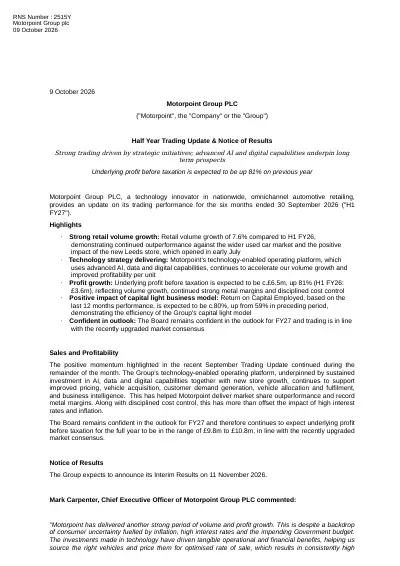
What that means is we continue to grow. The market is up 0.6% in the first half, we were up 7.6%, again, we're having record volumes, we continue to take market share.
I think the important thing there is that we need to keep growing, we need to keep opening stores to continue taking much bigger share in markets we are not in today by opening stores in those locations, which we'll cover off later. In terms of profitability, clearly, we've come from a journey of recovering from a post-COVID low.
That continues to increase, very strong profitability this first half, with profits up significantly, and that shareholder value, creating that return on capital employed, continuing to drive that to over 100%, which is where we think we can get to. That exceptional return on capital employed demonstrates how we can continue scaling and grow profitably, which is our ambition.
I'll pass you over to Chris now for some half one financial highlights.
Chris Morgan
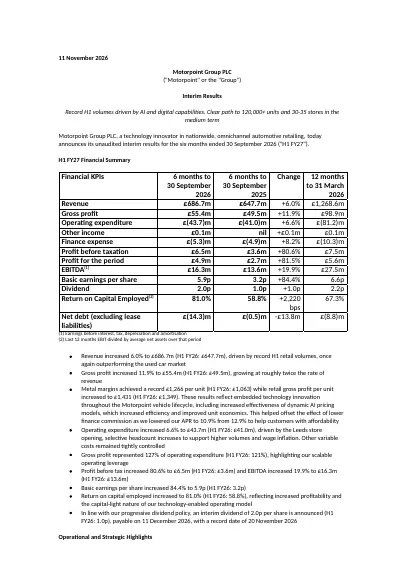
Thanks very much, Mark. I think Mark's already sort of fed in in terms of record volumes, which we're obviously pleased with as a total, if you include retail and trade as well, then over 50,000 vehicles, again, a record number, which is good.
Turnover per unit was slightly down, you can see 19 and a half from 19.6, and that reflects finance commissions, which have come down slightly as we've reduced our APRs to improve affordability for customers back in I think it was July. I think the key things to take out from this slide is if you take revenue growth 6%, gross profit has grown 12%, and then opex has grown just over 6%.
It's all about the operating leverage of our P&L, which is driving the profitability. A key ratio for us that we do focus in on is that gross profit to operating expense ratio, which has grown to 127% from 120%.
We'll continue to drive that. It's really about, as well as obviously using things like AI and the tech-enabled platform to drive sales, it's also about efficiency and making sure that the cost base is lean, and we're seeing some good benefits of that coming through.
Opex grew 6.6, but that did include the new Leeds site, and obviously, most of you now know, which opened in July, as well as some headcount to support the growth in stores. Also, we're investing in things like warranty technicians and MOT testers, we're bringing some of the work that externally would have gone to a third party in-house, and that's starting to sort of help the P&L and drive some profit through that, which is good.
Mark's already talked about some of the record metal margins, but you can see £1,266 up from £1,063 is a significant jump, and that's helped the retail gross profit per unit, which is a key measure for us, grow up to £1,430. Marketing costs, relatively flat year on year, but cost per unit is down, £143 to £143 per unit.
I think the point to make here is we've got really good granular detail on marketing in terms of the spend that we're making, the number of leads that are coming through the various channels, and it's all very much variable costs, we look at it weekly, and we can change quite quickly. If we think something's not working, we'll move our marketing spend into other areas.
Again, that's proving fruitful, and again, it's no doubt that is really helping grow our volume and profit. There we go.
Turning to the balance sheet, you see the fixed asset increase probably just worthy of note, you can see a year ago, it was about £11 million, that's jumped to £26 million, and that's primarily because of three freeholds that we purchased. We purchased Leeds, that you're aware of, and then two other sites.
Those are important because they will fuel our pipeline of new stores, which we're going to come back to later. That's a real key enabler of our future growth.
You can see that stocks are up, which is great, that is satisfying demand, and the payables rise as well, reflects stocking facility requirements. The good news there is that we've got £225 million available now for stocking, and so it means that we can go out and buy the vehicles that we need.
We've taken a lot of opportunities in September and particularly October where we have bought ahead, because we can see advantages in the market to purchase stock. Then if we look at the cash flow, you can see as a move, debt has increased by about nine about £5 million from £9 million to about £14.
You can see the capex effect coming through in there. There's 4.1, which includes a dividend of about a million that we paid in the summer and about £3 million that we incurred on shares where we've hedged the employee benefits trust going forward, we've got a good bank of shares now in the tank to support future share obligations that we meet with employees.
Also, the final bit was stock. Again, we're seeing opportunities in the market, we are buying because the demand is definitely there.
I think that's proven in October where we grew 9.7%, which is sort of stellar growth we feel in October. Just on our capital allocation priorities, again, these haven't really changed.
Organic growth, clearly, is our number one priority. Just a point on there, we talk about selective M&A activity.
The M&A activity could be we see an opportunity to buy a store or a couple of stores from another business, which will fuel the new store pipeline, so that's really, really important. Effectively, the organic growth, any M&A activity that we feel is fruitful, we will do as a priority, and then obviously, any excess cash we return to shareholders.
We've just announced the dividend of 2 pence per share at half year, which is roughly about 33% of EPS, which is our sort of guidance. We've mentioned new stores briefly.
You can see a picture there of our new store at Leeds, which is trading ahead of plan, sort of really pleased with that, and should make money this year. Normally, we've seen in the past that a store won't make money in the first year, but this should make a few hundred thousand pound in the first year, which is really important, and obviously, gives us a good platform going forward.
This is a map of our current portfolio across the UK. We've got 21 stores.
We closed Ipswich in October, just after the half-year end. Reason for that was it's one of our smaller stores, and there's a couple of small stores out there, which are still making money.
However, somebody came in saying that they'd take Ipswich off our hands, effectively bought out the lease. We're expanding our Norwich site, which is about 30 miles up the road, and again, that will make sure that we shouldn't see any negative trading impact, and actually, we should save some money from opex from obviously, we're freeing up staff, etc., and rent and rates for that site.
More new markets. We're targeting 30 to 35 stores, we've currently got 21, so that's another sort of 10 to 14, 15 new stores.
It's a data-led site selection, we use drive-time insight, SMMT data, it's very specific, very unique, and so we can look at all the markets where we're not, for example, a Bristol or a Swindon, or you can see on the map where we're not, the M4 corridor, certainly areas around the M25 and parts of the north as well. We know what the markets are for used cars in the 0 to 6 category in those areas.
We know we're not there, and our market share might be 1 or 2%, we know if we go in there and we can drive to get to that 10% market share, which is the goal for us in each market that we operate in. This is an example, if we take our business case for the new stores, and we've modeled them, this is basically an average of the new stores that we've got in our pipeline.
You can see, they're really lucrative returns, return of over 50% IRR is particularly strong, very quick payback in terms of the fit-out costs, and these stores, we're targeting at least 4,000 units per annum and a £3 million profit impact. I think point to mention there is that if we look at our current portfolio, let's take a Swansea, for example, which is one of our more recent openings back in 2020, and Swansea is already doing over 4 million unit, 4 million, I wish, 4,000 retail units, it's already doing 13% market share in that market that it operates in, despite Newport, which is really strong as well, which is about 40, 50 miles down the road, and that is doing over 4 million profits as well.
You can see, we've got evidence that historically, we can do 3,000, £3 million PBT and over 4,000 units. Actually, if you go back and look at the 14 stores that we opened up to 2020, then 10 of those stores already are doing over these metrics, we see opportunity there.
We've got a lot of confidence that with our new stores, with the SMMT data, what the market says, we can deliver these numbers. That's a big payback, so that's why it's so important that this is a real enabler in terms of a driver for future growth, and Mark will talk about our ambitions in seconds.
Just to summarize, returning to a larger format, moving away from the likes of Ipswich, which obviously, we've closed, so that means 300-plus pitch size capacity within new stores. Leeds, as I mentioned, trading ahead of plan and should make profit this year.
We'll go down the freehold or leasehold route. What tends to happen with the freehold, and I've mentioned a few freeholds that we bought recently, once those stores are up and running and trading well, then we probably we will look to sale and leaseback those stores, and we've done that historically with almost all our stores, actually, so that model certainly works.
We believe attractive market share gains in these markets. We don't think that the cannibalization is a significant effect, and again, because of the market share data, we know what sales we've got in various postcodes, we can measure the cannibalization very accurately.
We will have some prep capacity for these new big pitches. Obviously, it depends if it's a 3-acre site or a 5- or 6-acre site, then that will govern how much preparation we can put on a site, but it could mean that we need additional preparation, standalone facilities.
Again, that's something that we'll look at over time. Then the other important point, and the one to finish on, really, Mark's already talked about MotoAI, but the best thing about that, or one of the best things about it, is a new store just plugs into it.
Effectively, we haven't got to invest in the back office because we've got a new store, we can keep the operating costs lean as we move forward, so that's a real advantage of the technology-enabled platform that we see. Thank you.
Right, I'll pass it back to Mark.
Mark Carpenter
Thanks, Chris. One of the things we wanted to set out today is some medium-term ambitions.
I know everybody wants to know when is the medium term. It's in the medium term, is our answer to that.
Some of the points that we want to just set out, the foundations of why are we able to do that? I think we've come through a pretty challenging period with COVID, with lots of demand post-COVID and then a lack of supply, and one of the reasons that we're in a position to do this today now is we are a lot more confident about the stability going forward.
I think one of the things we internally believe is, irrespective of market conditions, which may worsen in the short term if interest rates and inflation go up, is that we're much more in control of what we can influence in the market in terms of our using all of the information and the data that we talked about earlier, plus all of the tools that we have. We have such strong line of sight now as to how we're going to perform, how we can win, how we can outcompete in the market using all of those tools.
We've talked about our scalable, resilient technology model, but again, we have to remember the customer. We are a digital-first customer experience, over 90% of customers discover us online, and then determine whether they want to interact with us over the phone or online or walk into our store.
We already talked about a compelling market opportunity, with 97.5% of people deciding not to buy from us, and only 2.5% of this market deciding to buy from us, I think we can understand that there's a big opportunity there. We truly believe we have a differentiated competitive position.
We've always been a value-led retailer, we remain that, but when you underpin that with the tools that we have, I think it's much easier for us to see where our competitive position is and how differentiated we are going forward. The business direction remains the same, which is to buy as many cars as we can and sell as many cars as we can in as many markets as we can, and that strategic direction, underpinned by the technology platform, continues to be the case.
We don't want to overcomplicate things. A lot of the technology opportunities we see in front of us can really complicate things, and we're very selective about the cost that we incur, and we're also very selective about the tools we use.
We are only using tools and developing tools that either make us more efficient or help us sell more cars to more customers. I think the execution over time, we've come through a few choppy waters, as I mentioned, in the past five years.
We've also seen some highly funded competitors coming into the market and leaving the market, I think our execution is undoubted going forward. In terms of our ambitions, we've set out here the last reported financial year, which was the year to March 26, we sold 26,000 vehicles from 21 markets, retail gross profit of just over 1,300, that turns into an EBITDA of 425 per unit, and the return on capital employed was 67%.
What we're setting out today in the medium term, and I would say that where these targets will be achieved depends on the target, really. We know in order to sell 120,000 cars plus, we are going to need to be in more markets with more footprint and more cars on display so we can take advantage of that.
That one probably will be at least five years, depending on how quickly we can roll out. The 30 to 35 obviously follows the same thing, we see that to be a over five years target.
The retail gross profit is possibly more achievable. We have a lot more data, as we've talked about relentlessly through this presentation, when that can help us determine, well, how can we get more money for each car that we sell?
Is it about buying smarter, preparing smarter with efficiencies in preparation, and obviously, the products, the ancillary products we also sell, looking at those and the profitability and penetration of those. The EBITDA number, again, will follow that number, and the return on capital employed, obviously, those three are all linked to profitability, they're potentially more achievable more quickly, but certainly in the medium term, we believe we'll achieve all of these.
Just diving into each one, then. Retail volume, target over 120,000, this is based on where we look at the market size in each market we're in, the market sizes of the markets we want to be in.
We know that, well, if we achieve a certain percentage of the market in the 0 to 6 primarily, then we will achieve these volumes. I think that's the point that, historically, we know how our stores have performed when we've opened.
Chris mentioned Swansea, which is over 13% market share. We're actually saying 10% market share for each store on average within a 30-minute drive time gets us to these numbers comfortably.
It's about having the stores, the footprint on the ground. We know, as an example, that in Swansea, prior to being there, our market share would have been under 2%.
You can see that we do still need the physical footprint. We need to put cars on the ground in these markets close to customers.
Customers do still want to buy relatively locally, in our opinion, and we see customers come and buy from us far more confidently when they know that we're there to help them with any issues, they want to know where they bought from, what do I do if there's a problem, what do I do if I need assistance, where do I buy my next car from, and customers like to come back to those in-person stores. Just moving on to retail gross profit per unit, the channel of acquisition of the vehicle is very important.
We historically, if we bought every car from auction, we would have a higher gross profit per unit, but then we would incur a large fee from whichever auction company we're buying the car from, the net gross profit per unit after fees can be lower. We've worked very hard to try and generate as many cars as we can from our own customers, whether that be from the general public or from people buying a car from us, part-exchange or Sell Your Car.
That is now around 25% of what we sell as a business. As you can imagine, those cars are brought to us by the customers, there's no logistics fees, the car tends to be a car that we may not see at an auction because it's somebody's car rather than a fleet car, and in addition to that, there's no purchasing fees, so that is a more profitable transaction, hence we are using the data to try and get into more of that.
Where should we be? How can we increase that supply of vehicles, because it's our most profitable channel.
We feel that as we grow that channel, that will help us get to that target, and obviously, some of the other products we sell as well will help us achieve that. In terms of EBITDA per unit, I think this comes down to how can we leverage our opex base.
We are very focused on efficiency, making sure we can use technology to be a lot leaner. I think, as an example, with our sales team, one of the things our sales team would have had to do historically is contact customers continuously through their journey, whether it's pre- or post-sale: don't forget to bring this with you, don't forget that you need to pick up your car tomorrow, how are you getting on thinking about the red car you were looking at last week?
A lot of that is now done by agentic AI, and we're actually transforming Lily, our plan now is to make Lily our sales PA to all of our sales people, they have a personalized PA that does all of these things for them, and therefore takes a lot of the sales work away. Less say the less value-added work will be done by agentic AI, and really, if you think about the sales person, they're the people that are the goal hanger, if you want to use a football analogy, they're the people who put the ball in the back of the net, and the rest of the team is basically the agentic AI team keeping the customer warm, taking the customer through the sales process, through the journey, answering questions, and trying to get to the customer to the end point where we just need to put the ball in the back of the net.
We can see efficiencies from that going forward. The sales team love it, because there's a lot of work that maybe feels like admin is no longer being done by them, and will be done even less by them going forward, and that's an example of where we can leverage our cost base.
Return on capital employed is basically a function of that, but we will continue to have a capital-light model. We will continue to sale and leaseback our properties that we either own or develop, and therefore, we do see that we will return to historical norms.
This isn't a futuristic number, this is a number we've achieved in the past, and it's very very much a value creation focus from us, being disciplined on our cost base, and that obviously leads to the capital allocation policies that we can then decide what to do with that additional cash. The business has always thrown off a lot of cash, has always had a return on capital employed of around 100%, and we're just getting back to that level.
They're our ambitions, as I said, medium term, we'll leave others to decide when we can get to those, but we certainly think they're all achievable. We believe we're well positioned to continue to grow, and profitably grow, I think, is the important thing.
October has started well, up around 10% versus last year's, we've continued to perform strongly. There is a lot of stock around, whether that be new or nearly new vehicles, there is a little bit of margin pressure in the market we see, and as always, our final quarter, January, February, March, is our biggest quarter, there's a lot riding on that final quarter.
Right now, we are well stocked, we have strong supply lines, supply is not a problem at all, and therefore, we're very confident on the current trading outlook, despite that economic uncertainty, which maybe a little bit of a fly in the ointment, but clearly, we want to focus on what we can control and continue to deliver that profitable market share of performance is what we're focused on. The end of the presentation, questions?
Does
it surprise you, the SMMT's expectations of market growth, and what's driving that?
Mark Carpenter
There's obviously we know the rise of the Chinese, everybody talks about EV, but the Chinese typically are bringing in petrol and hybrid vehicles. The amount of vehicles coming in is very high, and historically, that supply and demand is fairly well balanced.
If somebody's pumping in a lot more vehicles from what is basically a new channel, then no, I'm not surprised. I think that the market can take it.
A lot of the product is cheaper than the equivalent European product, the technology is better, the look and feel and design is impressive, the demand is definitely there for that product. I think any growth is likely to come from that channel, and potentially would be offsetting some decline from other manufacturers as they continue to take share.
You don't think there's a sort of recalibration risk from the European Union come UK on tariffs on Chinese vehicles?
Mark Carpenter
I think the UK might do something. I think the UK might do something which could slow it a little bit.
Clearly, we're not in new cars, so, even if that was to happen, there could be an argument that that nearly new product would still continue to flow through. I think there's a lot of talk about where the vehicle comes from and the rules that the UK will have to follow potentially.
I think maybe the UK will have to do something, but I think from where we are, we see a lot of supply coming in. It's at a level where we're more than happy.
Slightly below new-car-wise would still be absolutely fine for what we want to achieve. I think we got really hurt when the registrations went down significantly.
Anything over or around 2 million is absolutely fine for what we want to achieve.
A lot of what you talked about is a bit back to the future. When you floated, you were sourcing a lot of cars from fleets at that stage.
Now you're buying more direct now, aren't you? How would you categorize those two previous big buckets for you in terms of fleets and rentals?
Because that was originally much more closer to the 0 to 2 range rather than 6.
Mark Carpenter
That market's been very small in recent years. It is definitely coming back.
There's a lot of that product is around, we are nowhere near as reliant on it as we were. Fleets do still run cars typically longer than they did pre-COVID, and that's okay, so that market's still not where it was.
I think being highly reliant on it in the way we were is unlikely going forward. I think we want to have that mix of product.
Again, looking at the data, we know that we create more new customers to Motorpoint with older product, and then they tend to move into the newer product as time goes on. I think having the balance of product, making sure we've got that right mix, and again, as you'd imagine, we're using data to say, what is our optimum mix of vehicles in terms of price point, brand, location, vehicle type.
I think the channels will continue to be more self-generated, because that gives us that reliance going forward that we are more self-sufficient and not as reliant on an external shock if there was to be one around fleet and rental.
Just the last one for me for now. Your trading margin is more of an input for you rather than something you'd cross by.
I was just listening to you talk about the level of digitization at center, the control of a lot of previously decentralized functions. If you deliver the sort of market share gain and units that you're talking about, is the operational gearing such that we should anticipate quite a step change in your operating margin, again, without being the tail wagging the dog?
Mark Carpenter
Yeah. No, I do think that, because we think if we can expand the volume, clearly, it will be a growing central opex base, but no, we do see that that's how this leverages up.
We've obviously seen and achieved that in the past, and as I said, I think we're at the point now where we know when we bolt stores on, we shouldn't really need any more headcount in head office, because where we are in a department, let's say we've got three people today and we think, oh, we will need six going forward, we are, as you'd imagine, saying, well, we're not going to do that, how do we do this more efficiently using AI? That will be what drives us, because the head office is almost fully formed in our opinion, and therefore, we will bolt these additional stores into that platform and continue to leverage that opex base.
Thanks, Clive.
It sounds like your Leeds store has had a fantastic start to its life. How is it generating a profit so early on?
Mark Carpenter
Chris is a Leeds fan, he can
Chris Morgan
answer that. I'm sort of happy with that.
It's just the way that the volume's flowing through. Did you do anything differently on that site?
I think a couple of things. Obviously, it's a return to a slightly or a bigger format, so that's important, we spent a lot more time on training staff than perhaps we would have in an Ipswich, for example, or one of the more recent smaller stores that we moved away from.
I think the staff training is probably the first thing. We brought in a manager from one of our stores by 30 34 Sheffield, to help with the opening, so that's really helped in terms of the training.
Where that's come through, and just to answer your question, is things like the KPIs, the volume's obviously important, but things like finance, extras as well, which obviously a big profit enabler. More recently with the smaller stores, maybe the training might not have been quite as good, perhaps, then you'd have seen a lower penetration, whereas actually, I think its first month, it topped the charts, Leeds, in terms of finance pen, it was in the 50-odd percent, which is fantastic.
Then also, I think marketing as well, finally. I think now, and I think I touched on it, we're talking about the customer acquisition costs, but we've got such a fluid approach to marketing in terms of what work what doesn't, whereas I think historically, we might have just thrown a load of money at local radio or something.
We might still do that, but of course, we've got much better analysis of what works, what doesn't. Again, we've probably invested a little bit more than perhaps we would have as well, but that clearly pays dividends.
A good volume and good KPI management, and controlling the cost base. Thank you.
Obviously,
to get to where your ambitions, you need a lot of new stores. Where are we now in terms of that pipeline of new stores?
Have you got exact locations that you already know that you're working on? Can you talk us through that?
Mark Carpenter
We've got four secured, which we're in for planning, whether it's change of use or building ourselves, we obviously have some land. We have two in advanced negotiations, which we can add on, so that would give us, if we can get all six of those secured and planning consent, which is, I don't know what word it would be, but it's unbelievably, frustratingly slow, then we will have a good line of sight of that period.
Then you almost have a small luxury of thinking, well, those six are going to give us two a year for three years. You may then be able to bolt in the odd one or two, which maybe something that could get up and running faster.
We would always look for change of use, because that's a lot faster than building from scratch. Building from scratch is a lot more expensive than buying an existing building, certainly in our sector.
We've got good line of sight, I think.
What can you tell us about those stores in terms of are they back to the old
Mark Carpenter
pre-COVID...? They're all large format.
They're
Mark Carpenter
all large format stores. Yeah.
What's that, three to five acres or something?
Mark Carpenter
Yeah. Some bigger than that,
Chris Morgan
yeah.
Mark Carpenter
Sometimes there'll be larger-scale preparation on that store. It is all about how big is the availability of the land in that market.
I think there people talk about constraints to these targets. New store openings clearly is something that is not easy to find, because we typically want a large piece of land with not much density on it, which is not great for a landlord as an example, which is why we need to try be very creative with it, especially when you can buy that same land and put a God knows what square-foot warehouse on it.
That's where the competition comes in sometimes. I think if we continue with those larger-format stores, and Leeds isn't even the larger format, it's just about a large format, but again, if you put enough cars on that display and you market it correctly and you have the staff trained as Chris mentioned, then you can get off and running a lot faster.
Within that 30 to 35, is there likely to be more closures?
Mark Carpenter
Relocations, yeah. We know some of our stores are not big enough, we would love to relocate.
We don't have any small stores where we don't want to be in that market. I think Norwich we acquired after Ipswich.
We were always trying to be in Norwich, not Ipswich. We couldn't find anywhere in Norwich, we went close to where we could, and then I think, as you'd expect with us, hopefully, we would be responsible and we're not going to walk away from a lease with a huge obligation.
We know that if we get an approach on one that we don't think is core, then we would take that opportunity. I think Ipswich is probably the only one of that applies to.
You talked about those numbers on maturity. What would you say maturity would be, five to seven years?
Chris Morgan
Usually, I think five, and that's because of the
Mark Carpenter
cycle
Chris Morgan
of a used car, a customer will buy a car every around about 50 months, effectively, you get the full benefit of that cycle, it's usually about five years. We tend to start by assuming sort of maybe 2,000 units in the first year, let's say, and then it'll build up to four or above over the next four to five years.
Mark Carpenter
Yes, the capacity really rather than maturity, to be honest, because the capacity, you might get to what we deem is a mature, Swansea's probably close to maturity at five years, but it still has some capacity. I think don't confuse maturity with capacity.
It can still continue to grow from there, and then when you come up to the capacity constraints, then that's when we've got a bit of a problem. In Glasgow,
Chris Morgan
we're
Mark Carpenter
at capacity pretty much, we're very very busy, very full, very compromised in some ways as to how many more we can sell from that location.
Chris Morgan
That's interesting. We talked about 10% market share.
Glasgow won't get to 10% market share as it stands, because it's at 6% now. It's one of our top three trading stores across the UK, but we can't physically get more cars on there, so, no doubt we may need another location to support it, but yeah, that's got about 6% market share.
I'll have one more if you don't mind, which is, one of the sort of the big plus points of Motorpoint when you floated pre-COVID was the level of repeat purchases, people coming back into that cycle. Are you seeing that now?
Mark Carpenter
Still high. It dropped off post-COVID because the model mix was changing of what we were selling, but it's definitely coming back now, and it's at close to record levels.
Sell Your Car, just looking at efficiencies on purchasing inventory, what sort of level do you think that Sell Your Car can get to? Are those customers selling into that channel sort of trade-in, or actually...?
Mark Carpenter
Sell Your Car is about 40% of that, it's about 11% Sell Your Car, and then another 15% of part-exchange are retailed. In terms of where that can get to, I'm not sure, to be honest, is the answer, because it's dependent on how many Sell Your Car locations we have.
What we know is that the customers want to drop the vehicle off to us. There are buying services where you can turn up at the house in the doorstep, and then pick the car up from the customer.
They tend to be quite risky transactions sometimes. We do use that through third parties, but if we're fulfilling internally, that can be a very expensive aborted transaction if it was to abort, we use third parties for those ones.
Having 21 footprint stores means we've only got 21 drop-off locations for Sell Your Car, we are looking at, right, how can we expand that and sort of test those supermarket car park drop-offs. We're at quite an advanced stage with that.
We'd be rolling that out within the next 12 months, and on a test, and then seeing where we get to. Then
also, just on the ROCE target, 100%, appreciate most of that would be the profit side, but how much can you do on the other side of the equation in terms of working capital efficiency, useful balance sheet efficiencies?
Chris Morgan
I think, well, we talked about sale and leaseback, obviously, the business generates cash, so that helps us be a lot more fluid and flexible with what we do, I think that's important. The other thing is stock, that's the big number on the balance sheet.
We're very fortunate, we've got two great partners who help us fund the stock through stocking facility, and we just need to be efficient with that as much as we can, making sure that any cars that we've bought then get onto that cycle, which takes a few days. The quicker we can get those on, the more cars we can get those on, then obviously helps us.
Clearly, retained profit is the big number that will drive the ROCE improvement.
Can I ask on marketing, how you've shifted your kind of approach to marketing? I guess looking forward over this growth plan, should we expect marketing per unit to remain fairly constant?
Mark Carpenter
If you ask the marketing team, they think they're saving money so they can spend more in the future, but obviously, what if they don't spend it, I'm saying you're not having it. It's a challenging one, because I think we were about £300 a unit at one point, and it's now at £143, we're not looking to spend massively less, but at some point, you get that spreading it across bigger units becomes more efficient.
I think around the level it is, I would say, is where we see it going forward. I don't see dramatically more efficiencies there, because when you dial it back, obviously, then you might not be winning as many customers going forward.
We will have to increase it in markets where we're not in. We need to get some brand recognition, tends to then be above the line, which is then not as efficient as the digital spend.
I think, to answer your question around how is it more efficient, it is about using the data to decide what is working. Where are all the leads coming from?
We obviously use third-party platforms, and testing and learning on those constantly is really important. We know, as an example, we have a very strong amount of customers on our own website looking for cars, the fresh cars tend to get exposed to our customers first, and then we would release them into the sort of third-party platforms.
That gives you an efficiency straightaway rather than putting everything on every platform all of the time. We're much more efficient around that.
Your competitive environment has been remarkable in the last 10 years, if you think about everything Peter Vardy went through, what dealers have gone through. Yet you still have a very small market share.
How would you characterize that competitive environment now? Is it the same in terms of intensity, but different, or is it easing, allowing you that sort of half-way to breathe more sensibly to where your PE
Mark Carpenter
term efficiency...? I think it is an ultra-competitive market, the used car space.
Like I said earlier, you could literally go and get going. I think the industry is dramatically changed even in the last five years with the tools you can now get, the analysis you can provide.
I think one of the things with the scale that we have is that we've been able to invest in those teams internally to focus on us whereas others obviously can't, the smaller mom-and-pop style struggle to get that investment, as you'd expect. I think it is still ultra-competitive.
We can stand in an auction hall and bid against a one-man band, and he could outbid us on a car. It's still ultra-competitive from that perspective.
There clearly is less irrationality in the market. I think people are more rational, people are trying to make sure they can make money.
I think that is the big change, probably, that there's a bit more rationality, which is— [unclear] I think so, and just generally people, that sort of bubble has gone, I think, in other industries as well.
You mentioned the M25 as an area, and going back, you've got a store at Chingford which always sort of was online, it was sort of a home delivery hub. Is that sort of site part of your thinking going forward as well, do you need more of them as well as the big five acres?
Mark Carpenter
I think the M25 is a difficult question, because it's clearly more expensive for us to operate in that area. Again, the land is the issue, that there's not many locations that fit what we need in that area.
I think we'll be selective. What you're referring to is about half of the customers use it to pick up an online order, and half do still walk in and purchase.
Clearly, we can't have a 500-car display around that without some really prohibitive cost base, I think we just need to be selective and flexible. Okay.
Thank you, guys. I think that's the end of it, just to wrap up, we think there's a great opportunity ahead of us to continue our journey of profitable growth.
Thank you for listening.