B&M European Value Retail PLC
Q2 FY2027 · Earnings Call TranscriptNovember 12, 2026
Andrew Orchard
Good morning everyone, and welcome to this presentation of B&M's FY27 interim results. My name is Andrew Orchard, Head of Investor Relations.
Presenting today are Tjeerd Jegen, our Chief Executive Officer, and Pete Waterhouse, our Interim Chief Financial Officer. We'll start with some prepared remarks alongside a presentation before opening the floor up to Q&A.
For those joining online via the webcast, please insert your questions using the chat function, and I'll relay those to the room. With that, Tjeerd.
Tjeerd Jegen
Thank you. Let's get technology sorted.
Thank you, Andrew, and welcome everyone to today's presentation both here in the room and joining us online. It's 12 months now since I set out the first of our three-phase plan to strengthen the foundation of B&M.
At that point, our immediate priority was restoring sustainable like-for-likes in the UK. Today I'm pleased to announce that the actions we've taken under Phase 1 of this plan, Back to B&M Basics, are starting to deliver.
The return to positive UK like-for-likes in the second quarter reported this morning is an encouraging milestone and gives confidence for us that the first phase of our strategy is working. At the same time, we're making good progress with Phase 2.
We're testing how we can use better customer insights, more tailored ranges, and improved formats to raise the productivity of our existing estate. Particularly, the early results from our store Wigan 2.0 are encouraging.
In terms of today's presentation, I'll begin with a short overview of the progress we've made during the first half before handing over to Pete, who will take you through our financial performance and the outlook of the year. I'll then provide an update on our strategy with particular focus on Phase 2 and the promising opportunity we see to improve the productivity of our UK estate, as well good progress we're making in France and at Heron.
Like usual, then happy to take your questions. Summarizing the last six months, I would say it's good progress, and my observations would be as follows.
I think the actions of the first phase of our strategy are starting to deliver. B&M UK delivered a growth of 3.2% in the second quarter, quite a good number compared to last couple of years.
General merchandise led the performance, but we also saw an improvement in FMCG across the quarter, ending Q2 flat and then FMCG is currently in growth in Q3. Secondly, I think the category margin rebuilds, as we communicated at the FY26 results, continues.
It's driven by a recovery in general merchandise category margins. We see a favorable mix, and we also have seen really good work in stores leading to an improved shrinkage number supporting gross margins.
We expect this trend of year-on-year category margin growth to continue during the second half. Third, we're making good progress with Phase 2.
We're testing new format strategies across a range of stores, and we are preparing for broader deployments. The goal here is very simple.
We target store investments to produce stronger sales outcomes, but within our very well-known disciplined capital investment model. Then fourth, over the Channel, France continues to perform very strongly and taking share in a market where we're achieving critical mass and breakthrough customer awareness.
Heron has delivered a second quarter of positive like-for-likes, demonstrating the relevance of its everyday low-price offer as household budgets remain under pressure. Fifth, these achievements are rooted in a solid financial foundation.
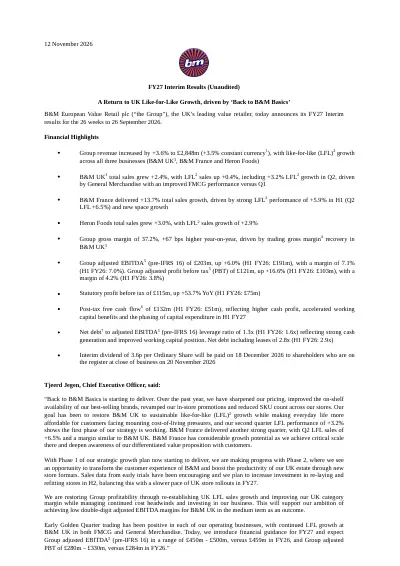
Leverage is very close to midpoint of our target range of 1 to 1.5 compared to 1.6 the same point last year, and clearly helped by a strong free cash flow. Finally, our achievements to date give us confidence that the group can deliver adjusted EBITDA pre-IFRS 16 in a range of 450 to 500 million and adjusted PBT in a range of 280 to 330 million, which was introduced today as our financial guidance for FY27.
I would like now to hand over for the financial review to Pete. Thank you very much.
I'll come back later.
Pete Waterhouse
Thanks for the introduction, Tjeerd. Good morning, everyone.
I'm glad to be here in front of you today to deliver what I believe is a robust and promising set of results for our first half of FY27. As I go through the presentation, there'll be three or four things I'd like to focus on: our successful restoration of positive like-for-like sales and gross margins through our Back to B&M Basics strategy; strong, stable cash flows that will support our investment choices in the second half; and finally, continued outperformance in France.
Let's turn to our key financial indicators. I'll start by calling out positive like-for-like growth in each of our three businesses.
B&M UK's came despite our weather-affected spring, with a strong run-rate like-for-like through the summer of 3.2%. Gross margin was up, whilst EBITDA margin held steady, with the margin upside offset by some cost pressures.
We've guided to full-year figures of between 450 and 500 million adjusted EBITDA. This translates to a range of 280 to 330 million for our post-IFRS 16 measure of adjusted profit before tax.
Cash flow remained strong. This included working capital benefits that were experienced earlier than we anticipated and capex phasing which was shifted towards the second half compared to our usual pattern.
Leverage at 1.3 times demonstrates a significant improvement over our prior-year position. With the golden quarter cash flows to come too, this demonstrates that we have the ammunition to support our second-half investment choices.
I'll now go into more detail. Sales were good.
All three businesses delivered like-for-like growth in the year, with France the star of the estate. They experienced nearly 6% growth, contributing 39 million in additional sales year on year.
Heron demonstrated strong recovery too. Their 2.9% outturn was delivered consistently in each period of the half.
With B&M UK, it was a game of two halves, or maybe I should say two quarters. The chart on the bottom right shows the impact of the seasonally affected first quarter, and then our return to positive like-for-likes in the second.
That is demonstrated by these charts. Concentrating on the B&M UK side, we can see an upward trend that extends back two years, which is only interrupted by our two weather-affected Q1s: a glorious early spring in FY26, and a delayed wait for the sun in FY27.
On the right, France continues to impress. Their Quarter 2 performance came despite a strong comparative, and they've now experienced 23 consecutive quarters of growth.
That's an excellent return. Part of the story has been our repair of our general merchandise gross margin.
Our 94 bps overall B&M UK trading gross margin improvement has included success with our bought-in margin rate and a significant contribution as a result of our management of stock loss. We don't expect that to reverse.
Whilst stock loss continues to rise across the retail industry, we've worked hard on our internal processes, and particularly early identification, with these benefits directly impacting our gross margin outturn. Gross margin benefits in our GM category were offset by a year-on-year reduction in FMCG.
Here, our competitive pricing strategy involved investing in our key value items towards the end of the first half last year. Our FMCG category margin has been lower year on year due to not having annualized this impact until late in the half.
The Quarter 2 position is where we see our run rate, although this will continue to be managed with the primary focus of maintaining our competitive position. This investment is more than offset by the repair of our general merchandise rate, which has shown consistent uplifts since the second quarter of last year.
Back to B&M Basics initiatives are driving success here, including a focus on bought-in margins and enhanced analysis of our ranges and mix. The shrinkage benefits previously mentioned are not included in these charts.
That demonstrates the core and continuing category margin improvement we've achieved in this area. How does this translate to profitability?
Overall, the sales line has dropped through to our EBITDA, with our margin improvements offsetting cost pressures to land at a similar level of profitability year on year in B&M UK. These cost pressures reflect estate growth, our continued investment in our supply chain, and wage increases.
These wage increases were driven by the 4.1% increase in the national minimum wage, whilst the growth of the estate includes annualizing last year's new store opening program. On supply chain, we have two new DCs which are fully operational.
As they are at an early stage of their life cycle, these are not yet operating at their most efficient operational levels, either individually or as part of the overall DC estate. These cost pressures will continue into Half 2, and we are actively working on short, medium, and long-term mitigation plans, a project which has a high internal profile.
Costs have been less of a factor at B&M France and Heron, where for both, increased sales have led to an increased EBITDA margin. It's particularly notable that France now leads the company in terms of their level of profitability.
On to cash. We continue to be cash-generative.
Whilst we're pleased with our level of cash generation in the half, it comes with a slight health warning with respect to the second half. Firstly, our working capital benefits, realized through Back to B&M Basics initiatives such as stock cover reduction, have come earlier than we expected, including at the back end of last year.
We'd now expect our working capital position to stabilize. Secondly, our capital expenditure has been relatively low in the first half due to a lack of new openings and a test-and-learn phase in respect to investments in our existing estate.
We expect investment in both areas to accelerate in the second half, and the calls on cash will therefore increase. Despite this, due to our usual golden quarter returns, we do expect to continue to delever in the second half of the year.
That and the cash we have built up in the first half will give us a full range of options when we discuss our plans for investment in future years and any of our potential uses of cash in January. In reflection, a promising half.
Like-for-like growth and margin have both been restored through our Back to B&M Basics strategy, with growth in all three businesses, including a positive 3.2% in the second quarter for B&M UK. EBITDA margin is stable, with cost pressures mitigating margin gains.
Our full-year guidance as a result is a range of 450 to 500 million EBITDA. That compares to last year's outturn of 459 million.
France continues to outperform with excellent execution of the B&M model. Their EBITDA improvement now has a significant impact on the group's overall results.
Cash generation was strong, with a full range of options expected to be available following the golden quarter, even with the phasing of our capex weighted to the second half. Finally, we are declaring an interim dividend of 3.6 pence per share.
That's a slight increase on last year's, and it remains within our 40% to 50% range on a full-year basis. I'd like now to hand over to Tjeerd, who will speak more to our strategy.
Tjeerd Jegen
Thank you very much, Pete. Thank you.
Let me return to our strategy, and a reminder of the journey we embarked on in October last year. At the time, we saw a three-phase opportunity to first restore like-for-like growth to B&M UK before deepening the growth foundations of our business and over time reviewing strategic choices to accelerate growth in the future.
Let's focus on Phase 1, Back to B&M Basics. It is now starting to deliver.
All four workflows on price, availability, promo, SKU count reduction are now in place, and we're seeing the benefits of those initiatives clearly in the UK like-for-likes. Our focus now is on Phase 2, where we see an opportunity to transform the B&M customer journey and boost the productivity of our UK estate with updated store formats.
The opportunity is significant because we have a large and well-located UK store base, but historically we've applied a broadly uniform model across all these stores even though there were different sizes, different locations, and different customer missions. We now have better data, clearer customer insights, and a very disciplined test-and-learn model to flex our stores to different customer missions as well as develop an entirely new store concept which is, as I'll show, already showing promising early results.
Phase 3, which is not the focus for today, is capturing our medium-term growth opportunity, and it includes accelerating growth in France, investigating opportunities e-commerce, loyalty, and private label. We will approach those opportunities over time with the same discipline: a clear customer rationale, controlled testing, and evidence of attractive returns before wider deployments.
Let's go back to the present. Slide 15 summarizes our goals on Back to B&M Basics, and it's a review what we have delivered and the KPIs when are monitoring to sustain progress.
The first workflow: price. We have restored a much sharper discipline.
We track key value items in the overall basket every week forensically, with a very clear focus on remaining competitive against our closest competitor. That enables us, in turn, to maintain a meaningful price advantage versus the major supermarkets.
90% of our key value items, or KVIs, are priced at or below discount and grocery peers, and our total basket remains 15% cheaper than the supermarkets after their loyalty scheme discount mechanism. Importantly, price perception amongst our customer base is also now improving.
We track a variation of brand association measures, and the strongest growth we saw was the value message measure. It's up 9 percentage points year on year, and it's the highest increase of all brand association measures we use.
Price index stronger, price perception stronger. On promotions, we've doubled the front-of-store space available in more than 600 stores and using that space much more dynamically all year round for seasonal events and customer moments.
We now call them Big Brands Big Savings for the best deals, and we call them Seasonal Favorites for the best of the season. On range, we've completed our FMCG SKU rationalization in full.
The final two seasonal categories went live in October, and the reduction in live FMCG SKUs is about 20%, making our stores easier to shop and enabling us to communicate on-shelf value much better. In availability, the introduction of new store workflows, we've given our stores the tools with automated store-specific alerts, have really improved the availability of our key items from 86 to around 95%.
We're also deploying new end-to-end initiatives in order to improve overall availability across our FMCG ranges. We try to test and analyze the results of our actions.
Taken together, these measures have created a simpler and more disciplined retail model, and we've seen and we've measured pre-post a combined sales uplift of about 5% across the FMCG categories where we've completed both range rationalization alongside availability. Those two combined have delivered a 5% uplift in sales in those categories which we have completed.
Moving to like-for-like review, the impact of our actions are visible in the like-for-like momentum we're seeing in B&M UK. It's back in growth alongside France and Heron.
It's also pleasing to see that the like-for-like numbers improve each year for all three businesses once the impact of weather is taken into consideration. The 3.2% of B&M UK was led by general merchandise.
Seasonal categories did really well in the quarter, but also very important category like core home performed strongly. FMCG like-for-likes, they improved significantly across the quarter and finished the quarter flat.
The improvement has continued into this quarter, where we've seen FMCG and general merchandise positive like-for-like growth. In France, Q2 like-for-like growth was 6.5%, and that was basically on the back of a very strong comp in the year before of 9.4%, two-year like-for-like very strong.
It's driven by transaction volume, new customers and customers shopping more frequently, and deeper customer awareness leading to sizable market share gains. Just to put the French performance into group perspective, B&M France contributed in the half 7 million of the 12 million group adjusted EBITDA growth in H1.
That's 50% of total growth from a business that's only 1/7 of the size of B&M UK in revenue terms, but growing fast. Heron delivered Q2 like-for-likes of 3.1%, a second positive quarter, and like-for-like growth in Heron Foods has also continued into Q3.
As you might know, Heron operates in some of the most economically challenged urban neighborhoods in the UK, and our performance demonstrates the relevancy of our everyday low-price customer offers as cost-of-living pressures continue to grow. Let's now talk about Phase 2.
That's the core focus of this slide. It's all about property, and it moves beyond the single retail format we used to use across the different sizes and locations to deliver a layout and a store experience matched to the customer mission.
Back in June, we shared the six customer clusters which we're now using as a base to relay stores to match those customer missions in those clusters. It involves flexing category space, flexing category range to each customer cluster profile by making layout changes within the existing store space.
We're trialing these relays alongside refits. In those refits, we combine range optimization with really targeted investments to improve the in-store experience.
We're testing different levels of refits because we really want to understand which elements produce the stronger sales outcomes. We've brought relays and refits all together in our Wigan store, and we call that store our B&M 2.0.
We relaunched that store at the end of August. This is basically our most comprehensive intervention and is a complete rethink of the layout and design concept that together define the B&M store of the future.
We launched six relay trials and 10 refit trials in H1 alongside Wigan 2.0. Far in this quarter, we have added 11 more relays and three more refits, and those refits are modeled on the Wigan layout.
Across all three approaches, the discipline is the same: we test, we measure, we learn before we deploy broader. The goal is very simple: it's sustainable improvement in like-for-like sales, sales density, but ultimately supported by a positive margin impact.
They are already evident in Wigan. Wigan we could say is our store of the future, and it began with, as it should begin with, customer feedback because our goal was to solve for the customer pain points or customer friction points and to remove them from their shopping experience while creating a much better store experience for them to enjoy.
Our customers told us consistently they wanted to be easier to find products in B&M, that some parts of the store were very cluttered, that price and product signage was not always clear, and that queues and congestions at weekends could be reduced, especially at the checkouts. We used the feedback to identify several practical opportunities: better product signposts, better product visibility, warmer and brighter lighting, stronger point-of-sale value communication, much more prominence of seasonal ranges.
We believe seasonal is a core strength and a core differentiator for B&M, and we've brought seasonal all the way in the first quarter of the shopping trip. It's a much more fluid journey through aisles and through the checkouts, with more space for customers.
The result is a materially different customer journey. We introduced a landing zone at the entrance, people stop and they start to browse.
We have a very clear sense of arrival and a very strong platform to showcase seasonal and event-led merchandising, and now finally you know what time of year it is when you walk into a B&M. We created new merchandising spaces and a much more intuitive flow that plays to our strength in general merchandise and seasonal.
We improved the aesthetics, as you would expect, with brighter and warmer lighting, in this store also air conditioning, new flooring, stronger power aisle, very clear messaging on value. At the checkout, for the first time ever, and I know we're late, but better late than never, we introduced self-service tills.
There for the first time in B&M, 60% of customers overnight in Wigan are using self-checkouts, which of course helps reduce queues, but also make sure we still have manned checkouts to support customers who would like to still use manned checkouts. We've also made changes for our colleagues because refreshing your store is refreshing the store, but also helping the teams.
We've looked how technology, simpler processes, and better colleague space can make the store easier and more enjoyable to operate. We've got cleaning robots and headsets for teams to work in a much easier way together.
We actually have a video which I would like to share with you, and I'll do the live voice-over for the people haven't been there. It's a fly-through.
I'm not sure how often this happens in such an update, but it's a first for us. Could you switch on the video, please?
This is a Sainsbury's parking where we are located. You enter into Wigan, you see a trolley with baby seats, that's helpful for customers with young kids.
This is the landing zone where you can clearly see on the left side Big Brands Big Savings. It's very obvious what the best deals are.
At the back end of Big Brands Big Savings, you see Seasonal Favorites, you know what time of year it is. The first category you're faced with is health and beauty, but with three different aisles to get into.
Health and beauty, you can see it's low fixturing, it's easy see-through. These are islands so you can browse and you can really shop, we created a health and beauty shop-in-shop.
The first category you see on the left is seasonal, there's a very dominant power aisle. Seasonal on the left side moves into toys, moves into pet food, moves into DIY.
On the right side it is food. We're going at speed, it sets some time.
At the very end, you see the garden center, you can't miss it now, but in the previous layout of Wigan, many customers didn't realize we had a garden center. The garden center is very much cleaned up.
We have very clear signposting, it's very easy to shop, very easy to navigate. Obviously we opened the store at the very end of this garden season, we're looking forward to a great garden season next year when all of the great plants come into that store.
Then from the garden season, you go back into the store. On your left side is furniture, bear with me, and on the right side is electrical.
Furniture, we have an extra installation of trolleys for great furniture products. We get inspiration on your left side from furniture, on the right side it's home.
Cleaning, a core element of our proposition, is very clearly at the very end. Then the first tills you see are self-checkouts, so that's why 60% is the dominant flow.
At the very end of this store before you leave the till, there are six upright freezers under the sign of Pay Here, and those six upright freezers are nice pick-up lines for customers to leave with some food in their baskets when they go home because 75% of frozen food in the UK is consumed on the day. Good, that's Wigan.
I would like to invite you to visit the store. Customer feedback is very strong, and sales numbers are promising.
Let's talk a bit about the results here. They're encouraging.
We see a very strong uplift in like-for-like sales, and the good thing is like-for-like sales predominantly driven by higher transaction volumes. We're attracting new customers, we're attracting customers who actually shop more often.
We've also seen a basket growth obviously, and you could imagine, if you look at the new flow: health and beauty, seasonal, non-food, all of the higher-margin categories are first in flow, you can imagine that the mix impact is even stronger than the actual top-line results. That's why cash margin is growing ahead of sales.
We believe as a consequence, if you would extrapolate this, and obviously we have to test and learn and we have to get more data points, but it could be a very meaningful value to unlock from the existing estate because those categories are the dominant customer missions for B&M. The customer response for me is really the highlight, which is very important.
Customers give us feedback. They think it's a fresher store, a brighter store, a more modern environment.
They love the self-checkout tills. They find it an easier store to find products, and they actually say the store is probably enlarged, but it's not.
It's the illusion and the optics of taking density out. We've also had recognition from professional peers, the Institute of Grocery Distribution, IGD, made us a Global Store of the Month in the month of November, and they cited, it's an example of excellence, not my words, in retail execution, and we believe it's first for value retail in the UK.
Test and learn is really our approach here. We're happy with Wigan, but we want to see more installments of that.
We're tracking performance every single day against comparable control stores, and we keep using customer feedback to track and refine the concept. The next step is really taking Wigan across the UK.
In this quarter, we have updated three more stores with Wigan-style refits, that's what we call it, and this will help us really understand which features work and how we can calibrate investment level going forward to produce the best sales outcomes. The work is shaping ultimately how we will allocate over time our capital across our UK estate.
Leveraging what we've learned so far, we plan to do another 10 refits in Q4, all modeled on Wigan, across the UK, larger stores, and these refits will continue to test which improvements generate the best sales and margin outcomes in order for us to direct capex most effectively. We're balancing these investments with this year a slower pace of new store rollout.
We now expect for new store openings this year 15 to 20 gross new stores in the UK in FY27. Our guidance was 25 to 35, but we will go back to the 25-35 rhythm in FY28, assessing attractive leases as they come to market.
This doesn't stop and doesn't take away from our belief that over time there is a widespread opportunity in this country for about 1,200 stores of B&M UK. Moving over to France, we're much earlier in our development, and the returns of scale are becoming apparent.
We expect 15 to 20 stores in FY27, and they will operate the same scrutiny to lease opportunities as they arise. 15 to 20 is a departure from about 12 stores we normally would open in France.
Then moving on to France, it continues to be a very important multi-year growth opportunity for B&M. Total revenue growth of 13.7% in H1, like-for-likes of 5.9%, as said before, Q2 6.5% on back of a very tough comp in the year prior.
The offer is built on the same fundamental as with B&M UK: it's newness, it's amazing value, it's broad choice, and a very very strong home category. We believe the part of the reason why like-for-likes are so strong is that we really have reached another critical level of awareness in France because the sales is really driven by transaction volumes.
It's customers discovering B&M France, liking B&M France, and coming back. At the end of Q2, B&M held 9.4% share of the French discount market, excluding Temu, which is an increase of 140 bps year on year.
Its EBITDA margin rate is now even a bit higher than the UK at 7.9%, demonstrating operating leverage that comes from achieving greater scale. We now have 156 stores in France, plan to open 15 to 20, and the market, in our perspective, could see more consolidation over time, providing opportunities for B&M.
Heron Foods delivering another positive quarter: Q2 like-for-like sales 3.1%, total H1 growth 2.9%, second consecutive positive quarter. You are aware, of course, Heron serves communities that are under acute financial pressure, but we demonstrate the relevance of our low-price convenience offer.
We're continuing to evolve, that's the word we use, we're evolving Heron's offer, and we're trying to implement more convenience categories to deepen and further strengthen the offer of Heron and its value proposition. We've made a change at the leadership of Heron, and that's very important for the next stage.
Tony Dobbs has decided to step away from executive life, and I would like to thank Tony Dobbs for his 35 years of service with Heron. On the back of Tony's departure, we have searched in the market and found Michael Fletcher as his successor.
Michael has worked for a number of blue-chip retailers with very deep knowledge of the convenience market. Started his career at Tesco, worked for Co-op and Spar, and the last 10 years more so he only worked in convenience.
Michael, together with the talented Heron team, will take the business further and continue to evolve its business. Then something which I'm quite passionate about personally, which probably normally doesn't feature in these types of updates, but I think it's really important that culture and values are critical for sustained success.
I'm a big believer of a quote attributed to Peter Drucker, who actually says, "Culture eats strategy for breakfast," which means strategy can only become performance when people have a joint set of values and see culture as its north star. That's why we started with getting extensive internal consultation.
We asked colleagues what they think where the business is at today and where it should be in the future. Based on a lot of iterations, we developed something which we call the B&M DNA.
It's a set of five core behaviors linked to our core purpose, our ambition, our customer proposition, and it's really built on the feedback from colleagues what makes B&M B&M. Customer value, as you could expect, is at its heart, and it's an important foundation for execution.
We launched it at the Golden Quarter Conference this year across the UK, and we're now cascading across the teams, and the five values are already driving very valuable conversations how we work together every day. It really provides a joint set of values and a very clear north star for all of us, and, I would say, it has had a good start in the business.
Before I conclude, I would like to remind you how operational progress translates into value creation. That's, of course, our growth algorithm.
It's underpinned by clear organic growth, restoration of like-for-likes, obviously, through Back to B&M Basics, space impact of new space growth in B&M UK and France. We also now added additional mix and cash margin benefits from boosting the productivity of our estate under Phase 2 formats.
We're improving our profitability by restoring trading margin and supporting a return to low double-digit EBITDA margins at B&M UK in the medium term, and just to remind you, as an outcome, not a financial input. In the meantime, our business is strongly cash-generative, which is strengthening our financial position through better leverage outcomes, and together, we believe, a supported delivery of an attractive total shareholder return over the long term.
I would like to conclude now. B&M UK, positive like-for-like growth in Q2.
Category margin rebuild continues, which means supporting a recovery in profitability, but based on a solid financial foundation. Current trading, we've made a positive start to golden quarter trading across all businesses.
UK like-for-like growth now in FMCG and general merchandise, and broadly current trading in the UK in line with Q2 numbers. Back to B&M Basics is starting to deliver, and Phase 2 is underway with what I believe promising opportunities to raise the productivity of our estate through tailored ranges, relays, and refits, and the early results, as shared before, are encouraging.
France continues to perform strongly with robust like-for-likes, market share gain, and demonstrating operating leverage as this business achieves critical scale. Heron, sustaining positive like-for-like for the second quarter and also in Q3, and well-positioned to serve customers seeking everyday value and convenience, and evolving its offer.
We've also introduced today for the first time this year, what we normally do in November, our financial guidance based on our performance to date, current trading, which is captured also on the slide. With that, I would like now to hand over to Q&A.
Thank you very much.
Andrew Orchard
Thank you, Tjeerd. Thank you, Pete.
Delighted to take some questions. We have a microphone in the room as well, which we can bring to you.
Warwick, why don't we start with Warwick from BNP?
Warwick Okines
Morning. I've got two questions actually.
The first is on the general merchandise margin. I think it's notably higher than it has been in the past per your slide.
Could you just give us some reassurance about that and how you're ensuring customer value?
Tjeerd Jegen
The actual drivers of the GM improvement are actually more rooted in improving mix, driving different types of categories, and actually also making sure we have a cleaner and healthier range, higher full-price sell-through than it is with price. Let me unpick this.
We've seen over the half that higher-margin GM categories have done relatively well, so that's helped mix. We've introduced, especially in our seasonal categories, items with a higher margin, but also a higher price point than traditionally would have.
We've got items of £30, £40, £50, amazing value compared to like a Dunelm or John Lewis, but at great margins. We've also seen, thanks to the increase of space at the front of store, our full-price sell-through has been much stronger, our clearance has been significantly more efficient.
Because in historically, we would clear our seasonal ranges within aisle, and that's quite hard if the season is over. If you clear at front of store, you actually get 100% of your customers faced with those items, we've got a much higher full-price sell-through.
The combination of those two elements have led to an improvement in GM. It's also fair to say, the strategy that was in place before I joined was very much focused on the good items in our range, and clearly good in GM means the lowest margin rate.
We're also introducing better and best ranges because we believe, for every customer we would like to have an offer, and that also drives and helps margin improvement.
Warwick Okines
Thank you. Just if I may, a second one, maybe for Pete.
You talked about cost initiatives getting some high profile internally. Maybe you could just lift the lid on that, what you mean by the opportunities to control costs in H2.
Pete Waterhouse
Yeah. Internally we call it our cost out program, and we have focus over all three of our main operational areas, we buy for less, we move for less, and we operate for less.
There are some areas which are short-term in nature, but some also which are medium and some which are long-term. Short-term initiatives are all in flight, and they're all expected to deliver in Half 2 in case of items such as on wages, on operational efficiencies, and process improvements, and in scaling our DCs, which will take place over Half 2, but also the out years as we progress through.
Tjeerd Jegen
I would say it's still very early days, it's something we're shaping. It's all about in this phase initiatives that don't require a technology investment.
It's, for example, we're grouping promotional products in the DC together. When the store receives the pallet, in the past, you would have to find in every single pallet the promotional items.
It was quite a lot of labor wasted in store. We're now picking those promotional pallets separately in the DC.
That's a slight cost uplift in the DC, but end to end, a big saving. Those are initiatives we're now implementing.
Obviously, self-checkout works, and we're happy with self-checkout over the business. That could be an opportunity as well.
It's early days, yeah.
Andrew Orchard
Richard, should we take your question? Richard from RBC.
Richard Chamberlain
Thanks, Andrew. Morning, everybody.
It's Richard Chamberlain, RBC. Two from me, please.
Tjeerd, I wondered if you can just talk to developing this sort of Wigan store new store relay and refit, which elements are you most pleased with, and I guess which can be sort of scaled fairly straightforwardly across the estate? The first one, and then the second one, can you give us an update on Far East logistics and transportation, I guess, setup and how you're thinking about that and are there any sort of scope for cost efficiencies there?
Thank you.
Tjeerd Jegen
Relay, refits, if you would look at Wigan, the number one positive from the layout perspective from customers is the landing zone. I think you've all probably been to a B&M store, and it's you enter into the store, you've got probably 3 yards to move and somebody already in your back, and then there's tinned soup, and then you have to run, and then you're forced in an aisle for quite a long time.
That doesn't happen at Wigan. In Wigan, you've got space, you land, you take a breather, you can look.
That's the number one, and we would like to implement this in most of our stores. The other element of Wigan is actually flow.
Tinned soup is our hallmark category in all of our stores when you walk in. That's relevant for 6 months of the year, but the other 6 not.
Actually buying food is a chore, buying health and beauty is indulgence, and health and beauty is 12 months of the year relevant. I think the other one is reflowing our stores.
As I said when I did my voice-over of the video, I strongly believe that our seasonal categories are a core strength of B&M. Because if you think in the physical retail space in the UK, how many retailers at the value end have the breadth and depth of our seasonal offer, which is very hard to replicate online, and we've hidden it actually in the back of most of our stores.
I would say the relay and the reflow and landing zone, probably taking out the canopies, having good sightlines, and then finalizing it with a good checkout service with self-checkouts and manned checkouts, that's probably the most important elements. That's exactly why we're doing all these trials.
That's why we're having three more and 10 more. Every single of those stores, we've got different fit-outs, we're testing to see what the impact is.
The relays are very low-op budgets. It's a three-week evening type of thing to relay a store, that's it, very low capex.
If on the back of those relays actually we see good results, you can imagine it's quite a good payback and a minimal investment. We're trying a whole set of initiatives, and we're applying the same mindset as we did with range rationalization with the seven sub-cats where we trialed and learned.
We're doing the same thing here. On Asia, we are using many many ports in Asia, I can tell you, over 20, I think there's consolidation opportunities to work in a more efficient way.
We have a dedicated partnership with one of the larger shipping companies in the world, and on the back of this dedicated partnership, we've got a dedicated team working with us and analyzing all the opportunities in bringing stock in in a more efficient way, taking days out of the shipping, let's say time it takes, and of course taking days out helps working capital release. We're looking carefully at also consolidating containers at point of departure, which means you can actually fill your containers in a smarter way.
That's the focus we're working on. We believe there's opportunities.
Clearly, we've had the surcharge at the moment because of the higher oil prices, but by and large, we're very pleased with our partnership, and we still see good opportunities to work in a more efficient way.
Richard Chamberlain
Great. Thank you.
Andrew Orchard
Let's take the next question from Vandita, Vandita from Citi. Please ask your question.
Vandita Sood
Thank you. I've got two, please.
One is just on the gross margin. When you're thinking about the medium-term mid-teens margin, do you have more to go on gross margin or is that all going to come from operating leverage, in your view?
Just if you can also help us think about gross margin drivers for the second half. Then the next one is on the store openings.
Is part of the reason you've held back on the UK because you see the potential for more distressed opportunities coming up, and also is it because you just want to give yourself more time to test and learn from the other relays and refits? Thank you.
Tjeerd Jegen
I'll take both, Pete, if you're okay. On margin, there's a bit of a different focus operationally versus how we report.
What Pete showed was category margin, that's basically the bought-in margin, the impact of promotions, and the sell-through elements. Trading margin consists of supplier income, it consists of shrink results, consists of FX.
Our core focus is really the category margin. On category margin, we will annualize FMCG about now, which did the investment in FMCG.
That means the overall category margin total will get another boost. We do believe there's opportunities to gradually improve general merchandise margin rates.
We think it's mainly because of mix and a better category planning there's an opportunity, but I strongly believe in a gradual build. It's really let's say in the low double-digit bps type of improvement, but if it's year on year, it's a good improvement.
Let's go back to your more strategic question. Our exit EBITDA margin rate last year was 8.6%.
We've guided to an outcome of near term, of the next number of years of a low double-digit. It's 140 bps basically we're short of getting that objective.
I believe, and again if you look at the P&L, I think we've got some exciting opportunities for new space and like-for-like. I think mix plays an important element, and what I said, if the early signs of Wigan and improving the estate, if we can replicate that, then actually mix improves even further, and then the mix will also help category margin rate improve.
We're in a very early stages of mitigating costs. The building blocks, we need to deliver 140 bps improvement, and I strongly believe we have all the ammunition to get there over time.
I think the lower rate of openings this year is more reflection of that for this year, in terms of supply, in terms of offer of locations, we didn't see sufficient opportunities meeting our thresholds, our investment thresholds. Distressed opportunities, you can't plan for these, but we'll seize them when they would be offered to us and when we can go after them.
At this moment in time, normally a pipeline is filled of 18 to 24 months before opening, we can clearly see now the openings for next financial year. That's why very confidently we can talk about going back to a 25 to 35 number for next year because we've secured the vast majority of those already and they're in preparation.
There is a benefit, ultimately. It wasn't by design, wasn't let's say a master plan, but there's a benefit of having a smaller amount of new stores this year because if we would decide to apply the Wigan concept to all of our stores going forward, yeah, this is probably the year you would like to have a lower number because beyond this year, all new stores will most likely be Wigan.
There's a benefit of having a lower amount, but we'll go back to a normal gross opening number as of next year. Go
Andrew Orchard
online for a question. Question here from Ben Hunt from Liberum.
One for you I think, Tjeerd. Ben is asking, what's driving the 5% uplift from range rationalization and availability?
Specifically, is it about basket size or does it also reflect frequency of purchase and/or new customers?
Tjeerd Jegen
Yeah. A good question.
I think we shared when we launched this that historically with other retailers you would normally see a 4% availability improvement translate to a 1% sales improvement. The 9% availability improvement we believe and we estimate that it's about 2 to 2.5% sales improvement.
We've seen in our trials that we saw a 2 to 3% sales improvement, and the pleasing thing is we're also now seeing that improvement across the estate. That's the way you should look at the breakdown of the 5.
Probably 2 to 3 are both drivers. It's very hard to connect transactions to individual SKUs.
What I could share though, if you look at the shape of Q2, the vast majority is transaction-driven, and a smaller amount is basket-driven. We've seen customers buy more often, and we've seen larger amount of customers come to B&M.
This makes sense because if you think about the cross-shop, 60% of our customers also shop at the other similar value retailer in the UK. We were significantly uncompetitive against them price-wise for a long time.
We fixed that. It's pretty obvious that customers are now actually transacting more because they see the value at B&M.
Andrew Orchard
Thank you. Next question from Richard Bernstein.
Please go ahead, Richard.
Richard Trainor
Thanks very much. Good morning.
Richard Trainor from Bernstein. Two questions, please.
One on culture, the other on consumers. It's very interesting to see the new cultural DNA.
How would you characterize the culture that B&M is coming from and where you hope it to come to? Then secondly on consumers and the health of consumers, very very strong results, particularly in France.
Do you think B&M is benefiting from pressure on the French consumer or is the French consumer in ruder health than people assume?
Tjeerd Jegen
I'll talk both of them. In terms of culture, I think if you would summarize and if you listen to colleagues, I think they would say frugality is a very strong element of our culture.
That's why we have behave like a founder, a bit like an owner, in our value, it's actually treating every pound like it's your own. I think simplicity, agility is typical B&M.
B&M speed is the word we use, we retained that. We also added a couple of values that we believe opportunity for all is very founded in B&M.
It's probably not very well-known, but we offer over 3,000 people who have long-term unemployment work experience opportunities at B&M. We're the largest work experience provider in the UK with a significant difference with any other employer, and 2/3 of the people on our work experience actually have a contract with B&M, and 95% of people in a new store, at various locations, are Jobcentre clients having their job with B&M.
I think opportunity for all is something we live every day. I would say one team is probably a value that needs to be developed, it is still very much influenced by founders, and founders normally have a very strong siloed way of working.
They like to be the spider in the web. I think from a corporate way of managing a business, you probably want people to work as a team across the departments.
That's something we're encouraging more and more. Using customer insights to make decisions probably wasn't very pronounced, so that's something we're focusing on.
Probably those two values are the ones we want to see more of. Moving to France, I'm delighted with their performance, they're doing a great job.
If I would unpick the performance of France, which is clearly very strong, I think we have the team in France, credit to them, they have developed a value proposition that is moved on from the dominant discount retailer that we all know. I think that retailer taught the French customer you don't have to pay more for non-foods, and they get access to amazing value.
We have replicated that amazing value in our stores, 400 key lines in our store are identically priced to that other retailer. We've added a nicer shopping environment that they are a bit nicer, our stores, and they are three times larger, we offer a much larger, broader range.
The French team have really developed a very solid good-better-best architecture. For example, in bed linen, they have a polyester 100% entry price compared with the other guys, a polycotton mix, and then a premium offer compared to a Maisons du Monde, but for our pricing.
There is a tailwind, I can't deny, that some of our peers have a more complicated situation at the moment. The good thing is, clearly, I think there's always a bit of criticism, the EU is very slow, but the EU has implemented a level playing field for the overseas platforms ahead of the UK doing that.
We're delighted with the level playing field that now Temu and Shein are facing in terms of protecting customers, creating a situation where people who pay taxes in the country compete, let's say, in a more better way with the other of these people. I would say those are the key drivers.
It's very difficult to pinpoint what is, let's say, driving which element. I strongly believe the value proposition is the core driver, and clearly, when you're a bit negative about your personal outlook in terms of finances or employment, you probably shop more often at a discounter than you would shop at a premium retailer.
That's obvious.
Andrew Orchard
Thank you, Richard. Jonathan Pritchard from Peel Hunt, you've been very patient.
Do ask your question.
Jonathan Pritchard
Hi. Jonathan Pritchard, Peel Hunt.
The first one's sort of a half answer. Just on that point on French awareness.
Is it just opening new stores which act as sort of billboards? Is it or is it something different?
Is it word-of-mouth? Is it advertising?
Is it social media? What have you done to boost that awareness?
I was interested in your response to Richard's question about what has traveled from Wigan to the new refits. I know you mentioned frozen food in passing, but you didn't mention it then.
What are the initial feelings towards frozen food after Wigan?
Tjeerd Jegen
The French team actually operate with a very similar marketing budget as B&M UK, being very limited. It's not marketing, we're not spending much more money there.
Social media is a big driver. We use social media a lot, and many of our products go viral quite often.
We bring a lot of newness, and we are working with local influencers across France. It's really word-of-mouth ultimately driving B&M's awareness, clearly helped by social media.
If you see a nice movie on TikTok and you're in a city where there's no B&M, it's irrelevant. Suddenly if you've seen that B&M store, you've seen something on TikTok, that's probably triggering a visit.
I think the impact of social media that we're doing actually is now driving awareness. The vast majority of our like-for-like growth in France is transaction-driven, it's really customers that we haven't shopped before are now shopping at B&M.
In terms of your other question on frozen food specifically or elements in general on Wigan, yeah, I know of course in the past there was a trial many many years ago, but that was actually in a very different way. I think it was quite a large part of the store with chest freezers.
We have a very succinct offer. It's six upright doors at the very end of the store.
It's a test, it's a trial. Again, we know from Heron Foods that 3/4 of frozen food is consumed on the same day.
It's a much easier category to manage than fresh food. The shelf life is much longer, the supply chain is much easier.
It's more like, let's say, ambient grocery in a way in how to manage, how to handle. The great thing of frozen food, we can actually offer an amazing value like we do in our ambient categories.
First signs are positive, we're learning, it might not be that we will put frozen food everywhere across the country, but I think in some of the locations where we've started, we see promising results. It is just supporting the complete offer that we stand for.
It's the broad choice element of B&M. Clearly, we can't win in frozen food, we're very much aware, but having customers picking up the odd item of frozen food just strengthens the overall basket and relevancy.
We can win in GM, we can defend in food, and frozen food fits with that model.
Andrew Orchard
Thank you, Jonathan. A question here.
Just bring the microphone in.
David Hughes
Hi. David Hughes from Shore Capital.
A couple of questions from me, please. Firstly, on the price position, it feels like you've got that to the place that you want it to be.
With the expectation of more food inflation coming through next year, would the view be that you'll also be passing on those higher costs to customers in order to protect the margin? Then secondly, just in terms of the longer-term strategy, obviously when you laid out Back to Basics, there were some aspirational things in the long term around introducing your own label, or perhaps a loyalty scheme.
I know that we're only just getting into Phase 2 now, but just wondering what your thoughts were on there and what kind of potential time frames we could be looking at.
Tjeerd Jegen
Yeah. A really good question.
I would say on price, it's actually quite simple. Leading is our price index to our competitor, not leading is margin.
We cannot break the contract with our customers. Our pricing can never be more expensive than the number one competitor that we are faced with, and it's irrelevant what the margin impact is because we need to protect our competitive position.
That's the essence of B&M, and it's the job of the buyers to work harder in making sure that being price-competitive is still a profitable outcome. We've made a significant investment, we've seen great improvement in our value perception, and we do not want to lose that ever again.
That's a contract with our customers. On the long-term plans, clearly we only showed it for reference.
I strongly believe in sequencing things and not distracting teams with too many priorities. Our focus in Back to B&M Basics was single-mindedly on like-for-likes, on current estate, current operation.
We're now moving into a second phase where we probably become a bit more sophisticated retailers where we're starting to tailor using data and try testing and learning. I don't want to confuse things with starting on other things, it's really at a later stage.
It's good because I think there are solid opportunities that can enhance over time our growth, our relationship with our customer, potentially also even margin enhancement, but let's sequence things properly.
David Hughes
Thank you.
Andrew Orchard
Thank you, David. Let's take the next question from Matt from Barclays.
Matt Clements
Hi, thank you. First one on shrinkage.
Obviously quite an important driver of margin in the first half. Can you just bring that to life a bit for us, or what have you actually done, what actions have you taken, and how sustainable can they be?
The second one, accelerating France is in Phase 3. Phase 2 is quite UK-focused, I understand the sequencing point, but what is the kind of constraint there?
I know you pointed to a bit of a tick-up, but it feels like with that momentum, it could go a bit faster.
Tjeerd Jegen
Yeah. A good one.
On shrinkage, I think just really good work from the store teams. The driver here is the unknown elements of shrink, theft ultimately.
We have focused a lot on making sure that every single stock record that is inaccurate is being corrected, we're adjusting our stocks real time. We can immediately take action when we see that things aren't going in the right direction, and we have an early warning, and we're very focused on this.
It helps enormously if you run your business on less stock because less stock means less opportunity for shrink, it's very simple. Actually less stock means, a year ago when I joined, or I say a year and a half ago I joined, but a year ago going into golden quarter, and when a year ago I would walk in this time of year walk into a store warehouse, it was so full that most stock actually wasn't able to hold in the warehouse, and we even had sometimes stock outside.
In such a situation, you cannot manage your stock, you can't manage your stock records, you can't manage your flows. If you walk into a B&M store warehouse now, it's an organized warehouse.
The team have focused enormously on this. We call this a retail footprint, we've worked hard on reducing stock levels.
Less stock, a better process, better visibility ultimately leads to less shrinkage. What we hear is that many of our peers are faced with higher shrinkage, we've managed to actually reduce shrinkage, which we're very happy with.
Accelerating France, I would love to bring that element of Phase 3 forward. There's a structural, let's say, limitation unfortunately.
You might know the French legislation on retail space is prohibiting greenfields expansion, the French model basically says, retailers, you have to use the existing space, but we don't want more retail expansion. Which means it's harder work for us to find the right units, and you have to be patient for other people to vacate.
The other element is we tend to have a larger store size than most French retailers in our industry. I referenced the fact that we're two to three times larger than the other discounter retailer in France.
That actually also means there's less opportunity, less boxes. That said, we are about 160 shops now, there's 800 in the UK.
I think we can still see a meaningful multiple of the 160 in France before we reach full saturation, but it will take more time. We haven't seen distressed opportunities yet in France.
You can't plan these, they might come, and obviously when they would come, we will not hesitate to convert those into new B&M France stores if the model works, yeah.
Matt Clements
Thank you.
Andrew Orchard
Thank you. I think with that, we are out of time.
I'd like to thank Tjeerd and Pete for presenting today, thank all of you for attending here in the room and also online. We look forward to seeing you in January with our Q3
Tjeerd Jegen
We look forward to seeing you in our stores buying our Christmas ranges. That's really what we look forward to.
Andrew Orchard
The punchline was going to be happy shopping,
Tjeerd Jegen
but that's
Andrew Orchard
a great double act. Thank you, everyone, and thank you for attending.