Phillips Edison & Company, Inc.
Q1 FY2026 · Earnings Call TranscriptApril 24, 2026
Operator
Good day, and welcome to Phillips Edison & Company's first quarter 2026 earnings call. Please note that this call is being recorded.
I will now turn the call over to Kimberly Green, Head of Investor Relations. Kimberly, you may begin.
Kimberly Green
Thank you. I'm joined today by our Chairman and CEO, Jeff Edison; President, Bob Myers; and CFO, John Caulfield.
As a reminder, today's discussion may contain forward-looking statements about the company's view of future business and financial performance, including forward earnings guidance and future market conditions. These are based on management's current beliefs and expectations, and are subject to various risks and uncertainties as described in our SEC filings.
In our discussion today, we'll reference certain non-GAAP financial measures. Information regarding our use of these measures and reconciliations of these measures to our GAAP results are available in our earnings press release and supplemental information packet, both of which have been posted on our website.
Please note that we have also posted a presentation and our caution on forward-looking statements also applies to these materials. Following our prepared remarks, we will open the call to Q&A.
Given the number of participants on the call today, we respectfully ask that you be limited to one question. Please rejoin the queue if you have follow-up questions.
With that, I'll turn the call over to Jeff Edison. Jeff?
Jeffrey Edison
Thank you, Kim. Thank you, everyone, for joining us today.
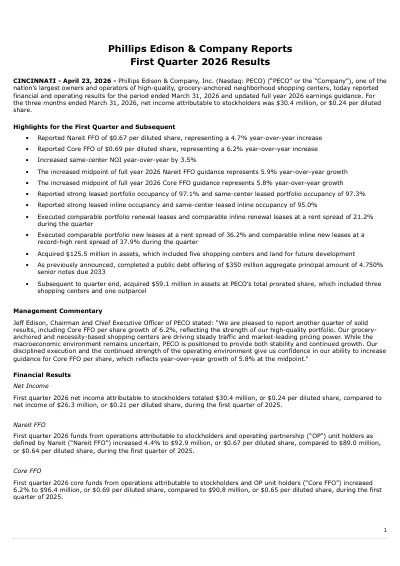
We're pleased to report another quarter of strong results, which reflect the strength of our high-quality portfolio and the consistency of our execution. The PECO team delivered Nareit FFO per share growth of 4.7%, core FFO per share growth of 6.2%, and same-center NOI growth of 3.5%.
We're pleased to increase our full year 2026 guidance. Our growth rates for Nareit FFO and core FFO per share are in the mid-to-high single digits, consistent with our long-term targets.
We are operating in a time where there are many ongoing uncertainties, both domestically and globally. Interest rates have been volatile, the global trade picture is shifting, and conflicts overseas continue to affect markets.
Technology, especially AI, is changing how companies work. Add in an active election cycle and high energy costs, and it's no surprise that there is a general feeling of uncertainty.
In times like this, the market tends to reward businesses that have stability, and that's exactly where PECO plays: grocery-anchored, necessity-based everyday retail. PECO offers resilience while also offering steady growth.
We believe PECO is built to deliver growth across changing economic cycles. Our long-term growth targets remain unchanged.
We are maintaining our focus and driving value at the property level. Our retailers are healthy and continue to look long-term.
We're seeing a resilient consumer, and our top grocers and necessity-based retailers continue to drive solid foot traffic to our centers. One of the dynamics we're watching closely is the gap between private and public market pricing of assets.
This influences our capital decisions, including how we fund growth and where we invest. It's why the PECO team stays disciplined about accessing the most efficient capital.
Our platform can raise capital in the public markets, through institutional joint ventures, and through asset recycling. We believe markets in 2026 will reward companies with a focused growth strategy and the ability to fund growth responsibly.
PECO is well-positioned to continue to do both. In summary, we're pleased with first quarter results and our outlook for 2026.
We operate in a resilient part of retail. We're located in the neighborhood, close to your home.
We're disciplined about our investments, and, most importantly, we have the best teams in the business. With our shares trading at a discount to our long-term growth profile, we believe PECO represents an attractive opportunity to invest in a leading operator that can deliver mid-to-high single-digit annual earnings growth.
We will continue to drive more alpha with less beta. With that, I'll turn the call over to Bob.
Bob?
Robert Myers
Thank you, Jeff, and thank you for joining us, everyone. Our first quarter results were marked by solid leasing activity and success in growing cash flows.
We continue to see high retailer demand with no current signs of slowing. Necessity-based categories, including quick service and fast-casual restaurants, health and wellness, beauty, fitness, and medtail, continue to be excellent drivers of demand.
74% of PECO's rents come from necessity-based goods and services. PECO's leasing team remains focused on capturing demand and driving continued high occupancy.
While pushing very impressive comparable rent spreads, our pricing power remains market leading. During the first quarter, leased portfolio occupancy remained high at 97.1%.
Leased anchor occupancy remained strong at 98.4%, and leased inline occupancy remained high at 95%. Our rent spreads reflect an extremely positive retailer environment.
During the first quarter, PECO delivered comparable renewal rent spreads of 21.2%. Solid retention during the quarter means less downtime and lower tenant improvement costs, which translates to better economics for PECO.
Looking at comparable new rent spreads, they remained strong at 36.2% during the quarter. Inline leasing deals executed during the first quarter, both new and renewal, achieved average annual rent bumps of 2.7%.
This is another important contributor to our long-term growth. As it relates to bad debt, we actively monitor the health of our neighbors.
Bad debt was lower than expected in the first quarter at around 60 basis points of revenue. We continue to expect bad debt in 2026 to be in line with 2025, which came in at just 78 basis points of revenue for the year.
Our retailers remain healthy. We have a highly diversified neighbor mix with no meaningful rent concentration outside of our grocers.
Turning to development and redevelopment, PECO has 19 projects under active construction. Our total investment in this activity is estimated to be approximately $74 million with average estimated yields between 9% and 12%.
During the first quarter, six projects were stabilized with over 87,000 square feet of space delivered to our neighbors. This reflects incremental NOI of approximately $1.7 million annually.
We're focused on growing PECO's development and redevelopment pipelines, which is an important driver of growth. In addition, the PECO team continues to find accretive acquisitions that add long-term value to our portfolio.
Our year-to-date acquisition activity through this week reflects $185 million. This includes five grocery-anchored shopping centers, three everyday retail centers, and land for future development.
Currently in our pipeline, we have approximately $150 million in assets that we've been awarded or under contract that we expect to close by the end of the second quarter. Our pipeline reflects a combination of grocery-anchored neighborhood shopping centers, everyday retail centers, and joint venture opportunities.
I will now turn the call over to John. John?
John Caulfield
Thank you, Bob, and good morning and good afternoon, everyone. Our strong first quarter results demonstrate what we've built at PECO: a high-performing grocery-anchored and necessity-based portfolio that generates reliable, high-quality cash flows.
First quarter 2026 Nareit FFO increased to $92.9 million, or 67 cents per diluted share. First quarter core FFO increased to $96.4 million, or 69 cents per diluted share.
Same-center NOI increased 3.5% in the quarter, primarily due to higher revenues, which was driven by increases in average rent and economic occupancy. Turning to our balance sheet, this quarter we extended our weighted average duration on our maturities and increased our percentage of fixed-rate debt, which is important in times of interest rate volatility.
In February, we completed a public debt offering of $350 million aggregate principal amount of 4.75% senior notes due 2033. The proceeds were used to repay term loans that were maturing in 2027 and a portion of our revolver.
With $810 million in liquidity at the end of the quarter, we have the capacity to execute our growth plans. Our net debt to trailing 12-month annualized adjusted EBITDAre was 5.3 times at quarter-end, and was 5.1 times on a last quarter annualized basis.
At the end of the first quarter, PECO has outstanding debt at a weighted average interest rate of 4.4% and a weighted average maturity of 5.8 years when including all extension options. And 94% of our total debt is fixed-rate debt, which includes PECO's share of debt for our JVs.
We are pleased to increase our 2026 guidance. Key drivers of our increased guidance include a continued strong operating environment, strong year-to-date acquisitions activity, and our recent bond offering.
Our updated guidance for 2026 Nareit FFO per share reflects a 5.9% increase over 2025 at the midpoint. Our updated guidance for 2026 core FFO per share represents a 5.8% increase over 2025 at the midpoint.
We are pleased with these strong growth rates. We are reiterating our full year 2026 guidance of 3% to 4% same-center NOI growth, and we are pleased to reaffirm our full year 2026 guidance of $400 million to $500 million in gross acquisitions at PECO's share.
The PECO team is not just maintaining a high-quality portfolio, we're building one. We continue to have one of the best balance sheets in the sector, which has us well-positioned for continued external growth.
As Jeff mentioned, we remain disciplined about accessing the most efficient capital. These sources include additional debt issuance, dispositions, joint ventures, and equity issuance when the markets are more favorable.
Year to date, we've sold $29 million of assets at PECO's share. We plan to sell between $100 million and $200 million in assets in 2026.
In summary, we're very pleased with our results this quarter and our ability to raise guidance for the remainder of the year. We continue to see a resilient consumer, and we believe our portfolio will outperform as necessity-based retailer demand remains strong.
Looking beyond 2026, we continue to believe that PECO can consistently deliver 3% to 4% same-center NOI growth and achieve mid-to-high single-digit core FFO per share growth on a long-term basis. We also believe that our long-term AFFO growth can be higher as more of our leasing mix is weighted towards renewal activity.
We believe our targets for core FFO per share and AFFO growth will allow PECO to outperform the growth of our shopping center peers on a long-term basis. With that, we will open the line for questions.
Operator?
Operator
Thank you. If you would like to ask a question, please press *1 on your telephone keypad to raise your hand and join the queue.
If you'd like to withdraw that question, again, press *1. As a gentle reminder, please limit yourself to one question.
If you have a follow-up, you may requeue. Your first question comes from Andrew Reale with Bank of America.
Please go ahead.
Andrew Reale
Good afternoon. Thanks for taking my question.
We can appreciate your necessity-focused tenant base is positioned to weather some macro uncertainty, but just curious to hear any latest color on your conversations with some of these discretionary or off-price mom-and-pop tenants in the current environment. Maybe just any incremental changes in their tone or plans versus six months ago, and how do those conversations compare to what you're hearing on the necessity side?
Jeffrey Edison
Andrew, great question because it's one that we are very focused on trying to read what kind of feedback we get there. Bob, I don't know if you want to give a little color to that and what we're seeing.
Robert Myers
Absolutely. Andrew, thank you for the question.
This is something that we monitor all the time and probably our best indicator. Not only are we on the ground locally smart, the visibility that we have would suggest that we have the best renewal pipeline and new leasing pipeline that we've seen in about the last 6 to 9 months.
An interesting fact, we just approved 28 deals in the last 9 days. The feedback that we're getting with high retention and leasing spreads of 21.2% this last quarter reflect strength, and that we're not seeing any cracks from that.
Occupancy costs continue to remain very strong at 10%. We're seeing a lot of success with market-leading spreads, and we're not seeing any pullbacks, even from the local tenants or from the national retailer demand.
Even all the retailers that we meet with at ICSC are looking for new sites in 2026, '27, and '28. We feel very good about where we're at currently.
Andrew Reale
Thank you.
Operator
Your next question comes from the line of Haendel St. Juste with Mizuho.
Please go ahead.
Haendel St. Juste
Hey there. I wanted to ask about transactions.
Obviously you guys had a very active start to the year, $185 million, I think you cited in the quarter, another $150, I think, under negotiation and contract. I guess I'm more curious on kind of what you're seeing or picking up in your conversations.
Are there any change in either the volume of buyers out there, underwriting, competition that suggests that there could be people pulling back in light of the macro, the choppiness we're seeing? Then thoughts on perhaps the deployment of capital over the next few months?
Is there a willingness to maybe scale back a little bit to see if there's any changes in pricing or anything that could be the result of the choppy macro? Thanks.
Jeffrey Edison
Yeah. Haendel, it's a great question.
It's a simple supply-demand issue. What we're seeing is that there is a very ample supply of product coming on the market.
Yes, there are more buyers, and we've had some major transactions take place in the business that we haven't seen for a while that are of substance, billion-plus kind of acquisitions. You continue to see a strong appetite, and I think it's all driven by sort of what Bob was talking about in the last question, which is we're in a really good operating environment, and in that operating environment, there continue to be a strong group of buyers out there that are keeping that happening.
We're also seeing a lot of product, and I think our opportunities here are up 70% over last year at this time. We are seeing a lot of product, but we do have competition.
Bob, anything else you want to add on that?
Robert Myers
The only other thing I would add is we continue to see a lot of product. We have investment committee every week, and we're reviewing anywhere between 5 and 10 new projects a week.
What's interesting is that, and Jeff is right on top of it, we've reviewed 195 deals this year compared to 115 last year. The deals that we're underwriting were up about 26%, and the deals that have been presented to investment committee is up 40%.
If anything, we continue to see more product hit the market than less. I think there's real sellers.
Yes, there is more competition. There's more buyers out there.
Quite frankly, you've seen the success that we had with the 10 acquisitions that we acquired year to date. We're buying these at a cap rate of about a 6.6, 6.7, and we're still solving for our unlevered returns above 9%.
We don't see anything really slowing down, and if you look at the $150 million pipeline and the 185 that we've closed, we're sitting in a great spot to certainly be in the range of our guidance between $400 and $500 million, if not more, based on the opportunity set that we see.
Haendel St. Juste
No change in the cap rate for the pipeline? The 150 versus the 185 done already?
Robert Myers
It's consistent with that 6.5% to 6.75%.
Haendel St. Juste
Got it. Thank you, guys.
Appreciate it.
Robert Myers
Yep.
Jeffrey Edison
Thanks, Haendel.
Operator
Your next question comes from the line of Michael Griffin with Evercore ISI. Please go ahead.
Michael Griffin
Great. Thanks.
Just on the leasing pipeline, and particularly as it relates to renewals. It seems like you've really gotten some continued strong demand there.
I guess, Bob, in your conversations with folks when leases are coming up for negotiation, I'm thinking particularly maybe these bigger boxes, these grocers, is there any I guess opportunity to shorten the number of option periods, to embed some kind of rent step-ups? I realize you're able to really get those with the inline tenants, but kind of the bigger boxes, is there any way to in those lease negotiations to get maybe more leverage on the landlord side to try to get some earnings growth or some rent bumps throughout the course of a new term?
Thank you.
Robert Myers
Yep. It's a great question.
Certainly, we acquire most of our grocers that we've inherited over the past 25, 30 years, and as they already have embedded options for the next 30 years, and they're typically flat. Sometimes you get lucky, they might be 5%.
That's something if we ever have the opportunity to renegotiate with them, or in a case where they're paying percentage rent, something like that where we can blend the rent together and reset the terms, or if we decide to give say an anchor that's a grocer an inducement, in a lot of cases we're able to negotiate added term and some sort of bumps that go along with that. We're capitalizing on as much of that as we can.
Probably the biggest value is just through consents on restrictions, no-build areas, where given the relationships of being the number-one grocer and owner in the market, it gives us flexibility to create a lot of value. We're picking up value in other places, and then, as you've mentioned, our inline tenants that we're negotiating new leases with, we limit the amount of options.
If we do give options, we want to see 20% with good 3%, 4% CAGRs year after year. It's a combination of that and it's a combination during our renewals of cleaning up items that are non-monetary clauses.
Think about caps and restrictions, no builds, a lot of those types of things that we're able to unlock value. I'm glad we're doing it because we are 97.1% occupied, we continue to find leverage through those avenues.
Michael Griffin
Great. Thanks.
Operator
Your next question comes from the line of Caitlin Burrows with Goldman Sachs. Please go ahead.
Caitlin Burrows
Hi, everyone. Good morning, good afternoon.
I guess given the strong operating environment, your comments that you bought land and that you want to increase development and redevelopment, what's your latest take on your own development and redevelopment and the industry more broadly?
Jeffrey Edison
Thanks for the question, Caitlin. I think we've announced we have about $70 million of development work that we are on right now for this year, and we continue to be able to do that at very attractive returns.
It's an important part of our business. It's not the major part of our business, but it's one that we are looking for opportunities all the time.
Bob, any other thoughts on that?
Robert Myers
The only thing I would add is that we've purchased two parcels so far this year and they're right beside our grocers. A great example would be one that we acquired in North Port, Florida.
It's about 5.8 acres and we're going to create five different pads. Our center is Publix-anchored right across the street.
It does $1,000 a foot and it's full. There continues to be a tremendous amount of demand and we already have a lot of this pre-leased.
We continue to find those type of opportunities. The other land parcel that we acquired is an old bank, and you guys know this.
Banks are wonderful opportunities to repurpose and bring in a Starbucks or Chipotle or Swig or somebody that's hot and in demand. We're able to generate somewhere between 9% and 12% returns on those ground-up development opportunities, which is consistent with us.
We've increased our development pipeline from over the past few years of $40 to $50 million to $74 million this year as an example. We want to continue to lean into those opportunities and continue to look for ways to create value at each of our properties.
Caitlin Burrows
Thank you. Thanks, Caitlin.
Operator
Your next question comes from the line of Ronald Kamdem with Morgan Stanley. Please go ahead.
Ronald Kamdem
Hey, just a quick two-parter. Just on the 95% inline occupancy, just thoughts on getting to 96% and 97% and what sort of the blocking and tackling that needs to get done to get there?
Then the quick follow-up. I think I see your local neighbors concentration ticked up to 26%, I think, versus 25% last quarter.
Just don't know if that was intentional or where you're comfortable with that local neighbor exposure. Thanks.
Jeffrey Edison
Great. Thanks, Ronald.
Bob, you want to take the 95% inline question as well as sort of the small movement in local leasing?
Robert Myers
There's no real movement on the local side between 25% or 26%. That's right on top of each other.
Can you ask the question again on the 95% on inline?
Ronald Kamdem
Sure thing. Just what's the upside from there?
What do we need to do to get to sort of 96%, 97%, and what's the plan? Thanks.
Sure.
Robert Myers
All right. Perfect.
Thank you. One of the initiatives that we put in place this past year was a bounty targeted space approach, and we really wanted to identify our top 100 spaces that would create the highest ABR on an annual basis.
We put our leasing team on that. I put different incentives in place for that.
Already through April, we've executed I believe 28 deals on those particular spaces with another 24 at LOI or lease out. We're almost 50% of the way there.
That's your needle-mover. With very high retention numbers of 90% to 93% and you complement it with these types of initiatives on a targeted space approach.
That's how you get the other 100, 150 basis points. We're seeing a lot of success in it, I'm really excited about where we'll finish the year.
Ronald Kamdem
Thanks so much.
Operator
Your next question comes from the line of Cooper Clark with Wells Fargo. Please go ahead.
Cooper Clark
Great. Thanks for taking the question.
Retention came down year over year while new rates were up significantly. Just curious how much of this was maybe intentional and a result of you proactively deciding to take back space and not renew certain tenants just given the ability to drive strong pricing power with potentially healthy operators?
Then just any color on how we should think about that dynamic and retention levels moving forward?
Jeffrey Edison
Great. Thanks, Cooper.
Bob, you want to take that?
Robert Myers
Yep. Appreciate the question.
Great question. Our retention rate this quarter was 88%.
That had 100% to do with a 64,000-square-foot box that we knew was going to vacate about 3 years ago. We knew that.
We already have three tenants lined up to backfill it at significantly higher levels of rent. What's interesting is if you exclude that one-time situation, our retention for the quarter would have been 92.4%.
It's not a crack. It's not an indication.
Yes, normal part of our business is to recapture spaces where we see better opportunities to do mark-to-market rent adjustments. We will always be focused on merchandising and finding the right necessity-based goods and services retailer that, one, we can continue to get attractive leasing spreads, but have the right complement where we can continue to drive consumer demand.
Cooper Clark
Great. Thank you.
Operator
Your next question comes from the line of Michael Goldsmith with UBS. Please go ahead.
Michael Goldsmith
Good afternoon. Thanks a lot for taking my question.
You took up the FFO guidance, but none of the underlying components moved higher. Can you provide a little bit of context of what drove the higher earnings expectation?
Is it acquisition timing? Is it termination fee income or anything else, just trying to get a sense of what's driving the greater confidence in earnings here.
Thanks.
Jeffrey Edison
Great. Thanks for the question, Michael.
It is of a variety of things. John, do you want to go through with what the piece are?
John Caulfield
Good afternoon, everyone. Look, we started the year at a great pace with a strong operating environment, like Bob has been talking about, and strong year-to-date acquisition activity and our recent bond offering.
In the quarter, our bad debt was near the lower end of our range, and we were pleased that the bond offering was at an interest rate lower than we budgeted. It's still early in the year, and one thing we're watching is the SOFR curve, which is higher than where we started the year.
When we look at bad debt, we maintain that range. Look, we considered each of the ranges, and when we consider the balance of what goes into each, we really like the ranges where they are.
Overall, after a good first quarter, we're more optimistic about the year than where we started, and that gave us confidence to raise our ranges for FFO. It's early.
It's Q1. We'll have opportunities to really refine, but we are very happy that our growth rates are in the mid-to-high single digits for 2026, which is consistent with our long-term growth targets, and that gives us a good, more confident outlook for the year.
Operator
Your next question comes from the line of Todd Thomas with KeyBanc Capital Markets. Please go ahead.
Todd Thomas
Yeah. Hi.
Thanks. Good afternoon.
Jeff, I just wanted to circle back. You indicated in your prepared remarks that you're closely watching private and public market valuations.
Can you just elaborate a little bit on that comment, what you see as the spread today, perhaps relative to where you're trading, the acquisition cap rates that you're achieving, and so forth? Maybe just to follow up on that a little bit, what actions does the company take as a result?
Thanks.
Jeffrey Edison
Yeah. Great question and one we've spent a fair amount of time looking at.
Our view is that in the private markets today, and there's some fairly major transactions that have taken place, is there is 50 to 75 basis points difference between where the public markets are and where the private markets are. That makes the private markets a better source of capital.
If you look at the major transactions that have happened in our space this year, the winners are the private equity capital across the board. It's not like they've won a little bit.
They took all the chips off the table in terms of the major transactions. I think for the public companies, we have to continue to find the cheapest source of capital as we look forward so that we can continue to take advantage of the opportunities that are in the marketplace.
That's what we will be doing over the year. That means you're always looking at everything.
You're looking at joint ventures, you're looking at issuing equity, you're looking at selling assets, all of which are part of figuring out where can you get the cheapest source of capital so you can continue to fund your growth going forward. That's what we're focused on, and I think the markets come up and down and change over time, but that's what we're focused on.
Todd Thomas
Okay. That's helpful.
I'm just curious, you reiterated the disposition volume for the year that you're anticipating. Do you lean in to dispositions a little bit more as the year progresses, or do you lean a little bit more on joint venture capital than you have year to date?
Any sort of changes around the edges just given that spread that you're seeing in the market?
Jeffrey Edison
Yes. I think there is a little bit more lean-in because it's attractive.
You'll see some leaning in.
Todd Thomas
Okay. Thank you.
Operator
Your next question comes from the line of Floris Van Dijkum with Ladenburg. Please go ahead.
Floris van Dijkum
Thanks, guys, for taking my question. Following up on the capital allocation, I noticed that I think you closed on two unanchored centers during the quarter, and you have one that has happened subsequent.
Maybe talk a little bit more about the return expectations and why you think this makes sense for PECO to pursue these centers, and why should investors be excited about your venturing away from your typical grocery-anchored?
Jeffrey Edison
Thanks, Floris, for the question. I'll take a quick shot at it and Bob obviously follow up as well.
I think we've made it kind of clear over the last 12 months that we're really excited about very specific opportunities to take advantage of everyday retail where we think we can get outsized returns. It's a much more inefficient market than our core market, and we think there's a place for that in our portfolio where we can use our market knowledge and our locally smart ability to know markets to take advantage of that.
We think it's a great opportunity for the company to get outsized returns for part of our portfolio, and we're going to continue to look for those opportunities. It's hard.
It's big markets. You've got to find the inefficiencies, but that's what we're really good at.
Then what we're the best at is taking those properties and turning them into really strong assets. You'll see in our buying we're buying stuff where we can take the PECO machine and create a lot of value in those properties.
We're excited about it. The first two are great examples of what I think we'll be able to show the market what we can do with them.
Bob, any add-ons there?
Robert Myers
Yeah. Thanks, Floris, for the question.
Great question. I'm really excited about this strategy.
Far as an organization over the last I'd say 2.5 years, we've closed on 12 assets so far. So, 12 assets for about $221 million.
The reason I like this strategy so much is that we're finding opportunities to buy properties from less sophisticated owners where we're able to put our national account teams on them. The criteria that we set out when we acquire these are exceptional demos.
So, $110,000 median incomes in 3 miles, 100,000 people in 3 miles. The criteria about configuration, sight lines.
I'd love to see them about 45% local tenants, 55 national, which gives us the opportunity to continue to increase spreads and rents. As an example, when you look at the subset of 12 and why I'm so excited about it, they all have 5% CAGRs.
What a great complement to our 3% to 4%. In some cases, we've acquired some that are 8% to 10% CAGRs.
We've already moved the needle 310 basis points in occupancy on this subset of 12. That's because we are in a great environment, one of the best operating environments that we've seen.
What I'm also excited about is our new leasing spreads in this category have been 45% and our renewal spreads are 27%. There's some inefficiencies that we have found while not overpaying for assets.
If you look at what we've acquired in this space, it's a 6.9 cap and we're solving for between 10% and 11% unlevered returns. Our average purchase price is about $321 a foot, and it allows us to lease it the Phillips Edison way, which we just do exceptionally well with our operating results and the team that we have on the ground.
Operator
Your next question comes from the line of Juan Sanabria with BMO Capital Markets. Please go ahead.
Juan Sanabria
Thanks. Only my best friends call me Ron, but that's okay.
Just curious on maybe going back to Caitlin's question on new supply. Are there any pockets of the country where you are seeing new greenfield development, picking maybe pockets of the Sunbelt that you'd call out or are watching?
Jeffrey Edison
There are again, overall across the country, it's a really small amount. There are specific cases where grocery stores are looking for specific locations where you are seeing some growth.
You're seeing Publix grow north from their existing platform. You're seeing H-E-B add additional stores in Texas.
They're specific, and they're very small. Part of our business is to make sure that we know what's going on in every market that we're in, because it doesn't matter if they're building one in a specific market.
If it's near one of our centers, it's a competitor, and we got to beat it. We got to figure out how we're going to win in that.
We're just not seeing much at all in our markets. I think that's what is creating the operating environment we have where there's a ton of opportunity to be aggressive on your leasing and reach very high occupancy levels and be able to really drive rents.
That's what, I think, we're proving out with our performance.
Operator
Your next question comes from the line of Paulina Rojas with Green Street. Please go ahead.
Paulina Rojas
Good morning.
Jeffrey Edison
Hello, Paulina.
Paulina Rojas
Hello, everyone. You have indicated that you have a health ratio, or OCR, for your inline tenants, that sits at about 10%.
You have also mentioned that you see room to gradually push that up to 13%, 14%. Can you walk us through the thinking behind that feeling that you see, whether it's anchored on prior high-water marks or any other benchmark?
I think at the end of the day I'm curious about what that means downstream for the tenant. I don't know their margins, but I wonder what a shift like that would mean on an EBITDA basis, for example, for the average inline tenant.
Jeffrey Edison
It's a great question, Paulina, and it's a very complicated question, as you know. The 10% is such a generic number because each specific retail category has a different health ratio that's healthy for them.
We're using broad numbers here, but it's very specific to the type of retailer what a healthy number is. We also get the advantage of inflation in the growth in sales, which is allowing us to keep at 10% while we're actually growing rents because of the growth in sales.
Bob, what do you want to talk a little bit about sort of your views on the health ratio and how we're doing on the leasing side?
Robert Myers
Yep, absolutely. Great question.
I think for me, when it comes down to merchandising and health ratios, most importantly, we want to make sure that our neighbors are profitable. We have seen a lot of success over the last 2 or 3 years with not only our retention rates, but also our renewal increases being 18% to 21%.
Again, Paulina, the visibility that we have out with 125 renewals out for signature show no slowdown or cracks. We've been able to hold that what I would say 9.5% to 10% health ratio pretty static over the last 3 years while still maintaining those types of renewal spreads.
I do think there's room to move to 10% to 13%, 14% over time, very use- and merchant-specific, as Jeff had highlighted, over the next several years. The other thing that's been helpful in this 10% and what gives me confidence to increase it over time is that we're starting with ABRs, on average, of our inline neighbors at $27.
It's a lot different increasing rents at $50 than it is at $27. There's a combination of a lot of things, as Jeff mentioned, that goes into that health ratio, but bottom line for us, it's all about keeping our neighbors healthy, profitable, and being a good partner.
Paulina Rojas
Thank you.
Operator
Your next question comes from the line of Mike Mueller with JPMorgan. Please go ahead.
Mike Mueller
Hi. Just another quick JV question.
How much are the investments that are being made in those programs going to be influenced by your equity cost, particularly if your equity cost improves a lot where on-balance-sheet looks much more attractive?
Jeffrey Edison
I'm not I'm not totally sure, Mike, what what you're what we're you're getting at there. Our our our JV I guess maybe
Mike Mueller
Oh, sorry. I I was just saying
Jeffrey Edison
No, no, go ahead. if your equity cost if you like your
Mike Mueller
What's the sensitivity of, I guess, the transaction flow that the JVs will see depending on, whether or not you like your equity cost and how how attractive on-balance-sheet is or not?
Jeffrey Edison
Yeah. Our JV strategy is primarily to expand what we can buy.
We're buying things in our JVs that we would not buy on the balance sheet, and that's an important part of why we set this up. If our cost of equity changed dramatically, we would still be buying the same stuff because that's the level of ownership we want in those properties and we think we can add value there to those properties.
We also get a fee structure that's complementary and so for us, it's expanding where we can buy and what we can buy and without putting the full 100% exposure we would from the balance sheet. That's worked out, I think, very well for us historically, and it's working out great in the two JVs, or three JVs that we have going right now.
Mike Mueller
Thanks.
Jeffrey Edison
Yep. Thanks, Mike.
Operator
This concludes our question-and-answer session. I will now turn the conference back over to Jeff Edison for some closing remarks.
Jeff?
Jeffrey Edison
In closing, I want to reiterate how pleased we are with our first quarter results. Our grocery-anchored neighborhood shopping centers are driving solid foot traffic and market-leading pricing power.
We continue to see a strong operating environment. While the macro environment remains volatile, PECO is well-positioned to perform through cycles.
We offer both stability and steady growth. PECO's disciplined execution and operating strength reinforce our increased guidance for core FFO per share growth.
With our shares trading at a discount to our long-term growth profile, we believe PECO represents an attractive opportunity to invest in a leading operator that can deliver mid-to-high single-digit annual earnings growth. The PECO team remains focused on executing our strategy and generating stable, long-term value.
We will continue to drive more alpha with less beta. I'd like to thank our PECO associates for the continued hard work, and I'd also like to thank our shareholders and neighbors for their continued support.
To all of you, thanks for being on the call today. Have a great day.
Operator
Ladies and gentlemen, this concludes today's conference call. Thank you all for joining, and you may now disconnect.