NBT Bancorp Inc.
NNASDAQ:NBTBQ1 FY2026 · Earnings Call TranscriptApril 24, 2026
Operator
Good day everyone, welcome to the conference call covering NBT Bancorp's first-quarter 2026 financial results. This call is being recorded and has been made accessible to the public in accordance with the SEC Regulation FD.
Corresponding presentation slides can be found on the company's website at nbtbancorp.com. Before the call begins, NBT's management would like to remind listeners that, as noted in slide 2, today's presentation may contain forward-looking statements as defined by the Securities and Exchange Commission.
Actual results may differ from those projected. In addition, certain non-GAAP measures will be discussed.
Reconciliations for these numbers are contained within the appendix of today's presentation. At this time, all participants are in a listen-only mode.
Later, we'll conduct a question-and-answer session. Instructions will follow at that time.
As a reminder, this call is being recorded. I will now turn the conference over to NBT Bancorp President and CEO, Scott Kingsley, for his opening remarks.
Mr. Kingsley, please begin.
Scott Kingsley
Thank you. Good morning, and thank you for joining us for this earnings call covering NBT Bancorp's first-quarter 2026 results.
With me today are Annette Burns, NBT's Chief Financial Officer; Joe Stagliano, President of NBT Bank; and Joe Ondesko, our Treasurer. Our solid operating performance for the first quarter was driven by disciplined balance sheet management, the growth of our diversified revenue streams, and the continued benefits of integrating Evans Bancorp into our franchise following the merger in May 2025.
These factors have contributed to productive gains in operating leverage. Operating return on assets was 1.29% for the first quarter, with a return on tangible equity of 15.50%.
These metrics represent meaningful improvement over the first quarter of last year and have provided incremental capital flexibility. Our tangible book value per share of $27.05 at quarter end was more than 9% higher than a year ago.
The continued remix of earning assets, diligent management of funding costs, and the addition of the Evans balance sheet resulted in a 28 basis point improvement in net interest margin year-over-year. We got off to a slow start in January and February with the very difficult winter weather conditions, and we experienced a higher-than-expected level of commercial real estate payoffs.
With that said, activity since then has been quite good, and we are very pleased with the types of customer opportunities we are seeing across our footprint, as well as our current pipeline levels. Growth in noninterest income continued to be positive, highlighted by a new all-time high in quarterly revenue generation from our retirement plan administration business.
Our capital utilization priorities remain focused on supporting organic growth while continuing our long-standing commitment to annual dividend growth. In addition, our strong capital levels continue to allow us to evaluate a variety of M&A opportunities.
Another component of our capital planning is to return capital to shareholders through opportunistic share repurchases. Consistent with that approach, we repurchased 250,000 of our own shares again in the first quarter of 2026.
One year in, the integration of our Evans Bank colleagues has gone smoothly and validated the strong cultural alignment we saw from the outset. Their customer- and community-focused approach continues to enhance our franchise, and we remain excited about the opportunities ahead in the Western region of New York.
Momentum across Upstate New York's semiconductor corridor continues to build. Since Micron's groundbreaking late last year and the completion of its site acquisition from Onondaga County in the first quarter, development activity has accelerated.
Site development and infrastructure build-out for the first fabrication facility are now underway, and we are already seeing tangible benefits, with more than a dozen of our customers securing contracts tied to the project. Stepping back more broadly across our seven-state footprint, we continue to see encouraging activity tied to advanced manufacturing, infrastructure investment, housing development, and workforce-driven economic initiatives.
These dynamics are evident across our core markets, including manufacturing and defense activity in New England, as well as construction and community revitalization efforts throughout our legacy regions. While activity levels can vary quarter-to-quarter, the depth and diversity of these initiatives reinforce our confidence in the markets we serve.
We believe NBT is well-positioned to support this activity through our relationship-driven model, significant balance sheet capacity, and a diversified set of financial solutions. I will now turn over the meeting to Annette to review our first-quarter results with you in detail.
Annette?
Annette Burns
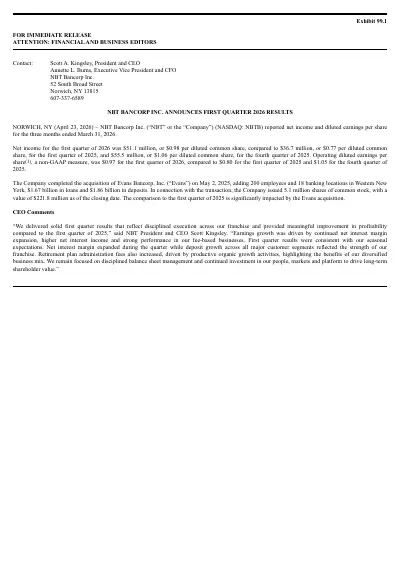
Thank you, Scott, and good morning. Turning to the results overview page of our earnings presentation, for the first quarter, we reported net income of $51.1 million, or 98 cents per diluted common share.
We have improved earnings 27% from the first quarter of 2025, with growth in our balance sheet, net interest margin improvement, and a 4.5% year-over-year growth in our fee-based income, as well. Earnings were modestly lower than the prior quarter, consistent with seasonal expectations, two fewer days in the quarter, and a normalized effective tax rate.
The next page shows trends in outstanding loans. Total loans at $11.5 billion were down $50.9 million from December 31st, 2025, with other consumer and residential solar portfolios in a planned runoff status, representing half of that decline.
In addition, we continued to experience an elevated level of commercial payoffs, similar to the prior two quarters. Our total loan portfolio remains purposely diversified and is comprised of 56% commercial relationships and 44% consumer loans.
On page 6, total deposits were up $244 million from December 2025, primarily due to the inflow of seasonal municipal deposits during the quarter, along with increases in consumer and commercial customer account balances. Generally, in most of our markets, municipal tax collections are concentrated in the first and third quarters of each year.
We experienced a favorable change in our mix of deposits out of higher-cost time deposits and into checking, savings, and money market products. 59%, or $8 billion, of our deposit portfolio consists of no- and low-cost checking and savings accounts at a cost of 38 basis points.
The next slide highlights the detailed changes in our net interest income and margin. Our net interest margin in the first quarter increased 7 basis points to 3.72% compared with the prior quarter, as the 9 basis point decrease in the cost of funds more than offset the 2 basis point decline in earning asset yields.
Loan yields decreased 4 basis points from the prior quarter to 5.66%, primarily due to the repricing of variable-rate loans following the prior quarter's federal funds rate decreases. We were able to actively manage our funding costs downward to more than offset that impact, as evidenced by the 10 basis point decline in our total cost of deposits to 1.34% for the quarter.
Net interest income for the first quarter was $134.3 million, a decrease of $1 million compared to the prior quarter, but more than 25% above the first quarter of 2025. The decrease in net interest income from the prior quarter was driven by two fewer days in the first quarter of 2026.
The opportunity for further upward movement in earning asset yields and net interest margin will depend largely on the shape of the yield curve and how we reinvest loan and investment portfolio cash flows. The trends in noninterest income are outlined on page 8.
Excluding securities gains, our fee income was $49.7 million, consistent with the prior quarter and increased 4.5% from the first quarter of 2025. Our combined revenues from retirement plan services, wealth management, and insurance services exceeded $32 million in quarterly revenues.
Noninterest income represented 27% of total revenues in the first quarter and reflects the strength of our diversified revenue base. Total operating expenses were $112 million for the quarter, a 0.5% increase from the prior quarter.
Salaries and employee benefit costs were $68.8 million, an increase of $2.8 million from the prior quarter. This increase was primarily driven by seasonally higher payroll taxes and stock-based compensation, partially offset by lower medical expenses.
In addition, annual merit increases occurred in mid-March at an average rate of 3.3%. The quarter-over-quarter increase in occupancy expenses was expected, driven by increases in seasonal costs, including utilities and higher maintenance costs.
The effective tax rate for the first quarter was higher than the prior quarter at 23.3%, primarily due to the finalization of the deductibility of last year's merger-related expenses and the associated impact on the full-year effective tax rate in 2025. Slide 10 provides an overview of key asset quality metrics.
Provision expense for the three months ended March 31st, 2026, was $5.6 million compared to $3.8 million for the fourth quarter of 2025. The increase in provision for loan losses was primarily due to a slightly higher level of net charge-offs and nonperforming loans, resulting in a higher level of allowance for loan losses.
Reserves were 1.2% of total loans and covered more than two times the level of nonperforming loans. In closing, we believe the strength of our franchise positions us well for growth opportunities as they arise.
We continue to see productive engagement across our markets, reflecting our ongoing investment in our people and communities. Thank you for your interest in our results.
At this time, we welcome any questions you may have.
Operator
Thank you. To ask a question, please press star one-one on your telephone and wait for your name to be announced.
To withdraw your question, please press star one-one again. One moment, please.
Our first question comes from the line of Mark Shutley with KBW.
Mark Shutley
Hey, good morning.
Annette Burns
Good morning.
Scott Kingsley
Morning, Mark.
Mark Shutley
Expenses came in a little bit better than we were expecting despite sort of the seasonal factors there. I was wondering if you could maybe update us on your outlook there and sort of maybe what's an appropriate run rate for the year.
Annette Burns
Sure, I'll take that, Mark. Yes, there were some seasonality in our first-quarter expenses, primarily higher levels of salaries and benefit costs related to payroll taxes and stock-based compensation, as well as some higher level of occupancy costs.
As we look into the next quarter, and we think about salaries and benefit costs, we'll probably see some increased costs related to our merit increases as well as an additional payroll day, as well as our occupancy expense seasonal increase will probably be offset in the second quarter by just increase in productivity across our markets, like higher travel, training, as well as technology initiatives. With all that being said, our run rate in the first quarter was right around $112 million.
That'll probably be a good place to be in the second quarter. We still think overall operating expenses is typically runs between 3 and 4% annually.
We still think that that is kind of where we're landing for 2026.
Scott Kingsley
Mark, we had some costs in the third and the fourth quarter of last year on the operating expense side that were a little bit higher than sort of standard run rate, some specific initiatives or some specific costs that we incurred in those quarters. Not unusual for sort of the other expense line to be a little bit lower in the first quarter, as Annette mentioned, with the costs associated with stock-based compensation and payroll taxes to kind of be the higher one.
Mark Shutley
Great, that's helpful. Thank you.
Then maybe just looking to the NIM, deposit costs are really strong, but sort of given the current rate environment maybe seemingly more flat, I was wondering if you're seeing sort of increased deposit competition in your markets and what you expect for deposit costs from here.
Annette Burns
If I think about the margin over the last two quarters, I think it's kind of as we expected to see kind of with the federal funds rate cuts, that our loan repricing was going to happen almost immediately, and then we were going to have a little bit of time to work through our deposit rate changes, we actively managed that. I think we were successful through the first quarter of 2026.
Our margin right now stands today at 3.72%. We think that's a really great place to be and throwing off some really meaningful earnings.
As we look forward, when we look at our funding costs, I think they're stabilized, there's probably a little bit of opportunity to work that down a little bit, but that'll probably be offset by some of our deposit growth initiatives, as well. I would say stabilized there.
Then as we look at our earning asset yields, there's probably some repricing opportunities as we primarily look at our investment securities book, as well as our residential mortgage book. Then really the shape of the real yield curve will kind of influence margin improvements over the next couple quarters, particularly where we reprice our assets in the 2- to 5-year range of that yield curve, which has seen some improvements in positively sloped starting in March.
I think as we look forward, it's stabilization as well as maybe a few basis points of improvement depending on that yield curve. We think about deposit pricing, I think there is competition for deposits, but it's fairly disciplined, or we don't see anything terribly crazy, maybe a few pockets here and there.
Scott Kingsley
I'd add to that, Annette, that, to your point, in most of our markets, and we've got some pretty diverse markets, but in most of them, deposit gathering has not been focused on additional share grab. In most of our markets, most of the people we compete with find that, even the large banks, that the cost of funding in our markets where we compete with them is probably lower than some of the larger metropolitan areas that they do business in.
What we have seen on the asset pricing side is a competitive landscape. I think as people look for yielding assets, there's been a little bit of give up in spread, whether that's on the commercial side or business banking, and in the first quarter, we thought that there was some people that mispriced indirect auto.
We chose not to participate in that at the same level that historically we might have from a growth standpoint. In a difficult quarter for pure auto sales, I think there was certain other people out there that were trying to sustain their portfolios.
We think we're really good at that portfolio from a total operational management standpoint, and remember the duration of that portfolio is somewhere between 24 and 28 months, re-engaging in that when the economics make a little bit more sense is kind of how we look at that.
Mark Shutley
Awesome. Appreciate all the color.
I'll step back in the queue. Thank you.
Scott Kingsley
Thanks. Thank you.
Operator
Our next question comes from the line of Feddie Strickland with Hovde Group.
Feddie Strickland
Hey, good morning.
Scott Kingsley
Hey, good morning, Freddie.
Feddie Strickland
Scott, I think you addressed this in your opening comments, but just wondered if you could talk generally about sentiment among commercial customers. Are you seeing clients pull back at all on some of the economic uncertainty and interest rate uncertainty?
Or the trends in the footprint like the chip manufacturing facilities still kind of pulls the local economies forward regardless?
Scott Kingsley
Thanks for that opportunity. Across the markets, customers are feeling pretty good about themselves.
I don't think that we started the year thinking that they could possibly have more uncertainty than they went through in 2025, but we appear to have topped that in early '26. We've said this before that uncertainty doesn't inspire action.
I don't think things have been held up. I don't think we have customers who have said, "I'm going to pass on fulfilling capital expenditure projects that I had planned, either for capacity improvement in their businesses, or just general recurring costs associated with being technically better."
We haven't seen any of that. I will say this: In the first quarter, we had a number of really exciting and really robust construction projects that did not get underway in the timeline we expected, but most of them, as the grass is turning a little greener, they're finding their way to get out and start to work on some of that stuff.
We think there was probably a little bit of a backup in the first quarter that'll get taken care of here in the second quarter. Nothing that we're seeing that is falling away.
I do think that some of our very astute customers who use our treasury management tools, in some cases are paying down some of their leverage, because their opportunity to earn yield on that is not at the same level that it was 18 or 24 months ago. I think much like our balance sheet, there's a lot of tactical management going on in our customers today.
Sentiment quite good across the franchise.
Feddie Strickland
All right, that's great to hear, Scott. Just if you could also give us an update on M&A conversations, it sounds like those are ongoing.
Just curious, kind of a similar question whether current conditions are maybe making that a little bit of a priority for some potential partners or whether that's a little bit of a headwind.
Scott Kingsley
Let me kind of attack that in a couple different ways, which is we have ongoing conversations with like-minded smaller community banks across our seven-state footprint. Our priority is to try to do some fill-in work, and whether that's a practical M&A transaction or build out concentration in some of our markets ourselves.
If I was to hit on that really quick, I would tell you that our strategy in Greater Rochester, New York, and into the Finger Lakes is a build-out strategy, that we recognize that we don't have the market coverage that we needed. Getting closer into the city of Rochester and maybe in the Western and Southern suburbs is a priority for us.
Something you'll see us act on in the next 12 to 18 months. Feel a little bit similar to that in Southern New Hampshire and Southern Maine, where our concentration in terms of spots in the market is not that concentrated, but we've got great commercial lending teams in both markets.
Giving them a little bit more to work with. We opened another branch in Bayside in Portland during the quarter.
We're going to make a commitment in Scarborough, going into the second half of the year or early next year. We'd like to find a couple more spots in Southern New Hampshire, again, just to give our folks some opportunity for enhanced branding.
I think if you look at the rest of our franchise, there's spots where we're still missing some participation in markets that we think we would thrive in. It doesn't require us to move our geography another 100 or 200 miles.
These are things that are either next door or within the existing footprint. That's where we've been spending our time.
To your point about priority for certain other people, and maybe some people who are not necessarily experienced acquirers, there's been a handful of transactions in our marketplace that we think presents a disruption opportunity. There was, for us in the market, a substantive transaction in the Mohawk Valley, outside in the Greater Utica area.
We think that'll present some opportunities for us. A handful of things going on in sort of Western New England, Western Massachusetts, and Connecticut, a couple large transactions, but then a couple small transactions where a couple small community banks are getting together.
We've got some very specific and pointed initiatives attached to that from a disruption standpoint. Are pretty confident given past results that we'll see some productive gains from that.
Feddie Strickland
Thanks, Scott. Super helpful color.
Just one more quick one for Annette. I apologize if I missed it somewhere, but did you have the loan discount accretion number for the quarter?
I think I saw it was up, but not by how much, and maybe what expectations might be for that number going forward.
Annette Burns
Sure. Our loan accretion for the quarter was right around $6.5 million.
That's kind of a little bit down from what we had in the fourth quarter. I would expect it to run somewhere in the $6 to $6.5 million.
That corresponds with our intangible asset amortization around $3.5 million a quarter. Aligned with that.
As we think about accretion, where we mark those loans, we think we're capable of getting pretty close to those rates as we reinvest those cash flows in our loan book, as well.
Scott Kingsley
I would reinforce Annette's comment on that, that the size of the marks in either our residential mortgage portfolio or commercial portfolio, from both Salisbury and Evans, don't leave us with the yields that are above current market yields.
Feddie Strickland
All right. Great color.
Thank you both.
Operator
Our next question comes from the line of Manuel Navas with Piper Sandler.
Manuel Navas
Hey, good morning. Can you just speak to loan growth this year and the kind of the makeup of the loan pipeline?
Just wondering how things look with the runoff portfolios, the pullback in indirect auto, just kind of level set things as we kind move across the year.
Scott Kingsley
Sure, and let's see if I can sort of accomplish this sufficiently from those sort of four subsets of questions, Manuel. Runoff portfolio, primarily solar residential, we've said before that's roughly $100 million a year.
That's exactly what we incurred in the first quarter, $25 million in the quarter. Our expectation is that continues on.
The prepayment patterns in that portfolio are more similar to the prepayment patterns of home mortgage, probably not a really unexpected outcome since the equipment sits on top of the house. From a practical standpoint, that's kind of going according to plan.
I think, to the extent that we're incurring some losses in that portfolio from customers not paying us back timely, it's as expected, not outside of that. Just as a reminder, we carry reserves around 4% of that portfolio.
I think we're really well covered relative to the expectation of future results as that portfolio runs off. Indirect auto's an interesting one for us.
Again, as I said before, we're really good at this portfolio. We really like the short duration of the portfolio.
We like the asset because the customers in our market actually need that asset. Our performance from a quality standpoint has been really, really solid.
Matter of fact, sub-30 basis point charge-off levels for quite a while now in that portfolio. In that portfolio, though, that if people are trying to get share to build to their book, and in the first quarter, we saw a handful of institutions, probably more dominated by credit unions, that had really low rates, rates that made no sense, rates barely above Fed funds rates, and that's not where we're going to participate and add to our portfolio.
From the rest of the pipeline standpoint, nice mix of commercial real estate and C&I in our current portfolio, in the pipeline for that. Like the construction projects that are out there, and as I said before, a couple of them have probably got underway a little bit later than maybe we would have hoped from a progress standpoint.
There's a lot of infrastructure build going on in our markets, not just Central New York, but across the footprint. Opportunities for our contracting clients and people who service those industries to move forward.
We really think that in the first quarter for us historically is not our most robust quarter of growth, and that was evidenced in this quarter. We think we start to get back to more of that low- to mid-single-digit growth rates for the balance of the year.
Manuel Navas
I thought that was pretty fulsome answer. Could you remind me and level set a little bit on kind of fee growth expectations, where the largest opportunities are, where you'd like to see better growth, for example?
Just kind of thoughts on that year-over-year.
Annette Burns
Sure. Our fee-based income does have some seasonality with the first and third quarter usually being the most robust and the second and fourth being a little lighter.
I think we're really excited about the growth opportunities in our fee-based income, most excited about the performance of retirement plan services. They really had some really great wins in the first quarter of 2026, and that's evident in their numbers.
Really, really good trajectory there. We also feel that wealth and insurance have some really good opportunities, as well, particularly as we bring the whole bank to some of our markets, like the Western New York region as an example.
Feeling good about the trajectory there. I think as we think about full-year growth expectations, I think we can look back to our historical performance over the past couple years, which is somewhere in the mid-single-digit growth rates for our fee-based businesses.
I think we still continue to expect that that's achievable for us. Deposit service charges and banking fees generally are a little lighter in the first quarter, seasonality, and that'll continue to build, as well as we get into the next few quarters.
Manuel Navas
I appreciate that. My last question, do you have any extra color on some of the NPL build here?
Just anything we can disclose on that?
Annette Burns
Sure, I'll take that. Nonperforming loans, the majority of our increase during the quarter was related to a C&I relationship in the Western New York region.
We're actively working through that. It's really a specific customer circumstance.
We have a handful of other nonperforming loans that we continually to actively engage and work through, as well, which are primarily commercial real estate-based. We feel pretty good about our capacity to work through those and feel very good where we are from a positioning as far as our allowance associated with those.
I would just add that our consumer delinquencies have performed kind of in line with our expectations and, in some cases, better than our expectations, those are really looking good through the first quarter, as well.
Scott Kingsley
Yeah. Just where we are, and this is not just us, but we're coming off such a low base that one relationship or a couple of relationships can actually make a difference relative to the size of that nonperforming.
I think the important comment that Annette made was we think we have the capacity to work through these. Not only do we have the stamina to work through, but we have a really good job at identifying a customer that may be just going through a really difficult period of time, but we like everything about what they do.
This doesn't have to be us moving really quickly to sell assets and remove them from our portfolio. We have the stamina to work through stuff.
Manuel Navas
I appreciate that. Thank you.
I'll drop back into the queue.
Operator
Thank you. Our next question comes from the line of Steve Moss with Raymond James.
Steve Moss
Good morning.
Scott Kingsley
Morning, Steve.
Steve Moss
Good morning. Morning, Scott.
Maybe just, most of my questions have been asked and answered here, just following up, I'm not sure if I caught this or you might have spoken to this, Scott, but on the deposit cost side here, definitely a healthy step-down. Just kind of curious, I know you operate in lower-cost markets for sure, but just is this a good bottom to deposit costs or, as you're entering maybe a little more relatively suburban markets in Upstate New York, do we see a little bit more of an upward pressure if that holds flat here?
Scott Kingsley
It's a decent question, Steve. I would kind of reflect on this, that if you thought about the fourth quarter, where there were three Fed funds changes in the last 4 months of the year, and the impact that that had on our variable-rate assets, we knew that we had a responsibility to cover that and maybe a little bit more.
It was difficult to get all that in the same quarter that all of those happened, and I would really focus on sort of the month of December. We had active management across all deposit portfolios and achieved that lower rate in the first quarter, arguably in January, to get back to levels of beta performance that we think are sustainable for us.
Your question is a good one relative to if we end up in a little bit more suburban or light metro markets with some of our growth plans, will the cost of entrance be a little bit higher? It might be.
Again, think about the product we're really leading with is we're leading with the checking product. If it's necessary for some larger commercial customers or even municipal customers for us to have a higher rate, to secure the win of that customer, long term, it's total cost of funds in the relationship.
I don't think we think it's going to be outside of the norm that we can't handle. If you kind of think about a growth rate of, just pick a number, 4 or 5% on a $13.5 billion base, that's a half a billion dollars of new deposit balances on an annual basis.
Even if those are a little bit above the blended cost of our existing deposit portfolio, we can probably handle that small dilution.
Steve Moss
Okay. That's helpful.
Then just in terms of the other thing I just wanted to touch base on in terms of cash flows, just kind of curious on the security side, just maybe I missed in the deck, but what's the amount of cash flows that you guys have for the upcoming 12 months for securities?
Annette Burns
Securities cash flows probably run somewhere in the $20 to $25 million a month. Pretty consistently, maybe out in '27, '28 where there might be a little bit of more lumpiness to it, but pretty consistently over the next several quarters.
Steve Moss
Okay. Then on auto loans I did want to ask about was you guys mentioned competition with regard to pricing, just kind of curious, was it just incrementally tighter that you guys weren't willing to put it on this quarter or was it kind of a meaningful step-down, and maybe we see that extend for a little bit here?
Scott Kingsley
In the first quarter, and I think we're actually seeing a little bit more rationality here in the second quarter already, in the first quarter there were offerings out there that were 150 to 200 basis points below ours.
Steve Moss
Okay. Got it.
Annette Burns
I think you could combine that, too, with some lower auto sales, just generally, as well.
Steve Moss
Okay. Appreciate all that color there.
Thank you very much.
Scott Kingsley
Thanks, Steve.
Operator
Thank you. Again, if you have a question, please press star one-one on your telephone.
Our next question comes from the line of Matthew Breese with Stephens.
Matthew Breese
Hey, good morning.
Scott Kingsley
Morning, Matt. Good morning.
Matthew Breese
A few for me. First, Annette, maybe you could help me out with new loan yield originations this quarter and what's some of the roll-on versus roll-off dynamics, to what extent is that positive still?
Annette Burns
Sure. I'll get us started here.
If we look at our book, our residential mortgage probably still has somewhere around 120 to 125 basis points to reprice. Our commercial yields have come in a little bit, particularly with the 75 basis point drop in the yield curve over the past 12 months, but was probably still about somewhere in the 20 to 25 basis point range of repricing opportunities in our commercial book.
If you look at our indirect auto book, our new origination rates are actually a little bit below where our portfolio yields are, they're completely repriced and a little bit underwater at this point. Then I spoke about our investment securities portfolio, that's probably somewhere in the 150 to 175 from a repricing opportunity.
Matthew Breese
Perfect. Okay.
Then, I guess if loan growth remains subdued, might we see some tactical changes? I'm thinking, do we see more consistent or even more aggressive buybacks?
Or do we see you, perhaps, Connecticut is a really kind of heavily disrupted market right now with all the M&A, you have your toe in there, maybe see you lead with lending to drive some better growth in that geography. I'm just curious, as you play this out, what might we see you do?
Scott Kingsley
I don't think the strategy holistically changes by a lot, Matt. Will there be tactical opportunities in markets with disruption, where it is definitely faster to lead with the asset products from a loan standpoint?
For sure. To your point, whether that's Northwest, North Central Connecticut, whether that's the Berkshires, or in fairness, whether that's in spots in Central New York, honestly, today.
You're not wrong about that. I don't think that we will think that it's a holistic change in strategy.
What we are experiencing is an opportunity to hire some very high quality people in several of our markets today, either coming from some of our larger bank competitors or for people that have been displaced via disruption. That has been an opportunity, and we've probably added a half a dozen people to our mix in the last 6 months that we probably, 2 years ago, weren't sure we'd ever get access to that level of quality of an individual.
That's a net positive. Has that shown up on the balance sheet yet?
Probably not. On a going-forward basis, we certainly expect some opportunities to come out of that.
I think tactically, I think we're proving that we're pretty adept at moving with situations, and as logical opportunities present themselves in the markets, we'll be there and will be in a position to win those opportunities. Should there be pricing dynamics that don't make sense for us on a long-term basis, we're unlikely to chase for those.
Matthew Breese
Should we think about consistent buybacks here? It's been 250,000 the last couple quarters.
Is that something we should model in for one or two more quarters?
Scott Kingsley
Here's how I kind of look at that, Matt, is that generating and retaining capital is hard. You work really hard to get to that privilege to generate capital to use for future opportunities.
We are not opposed to share buybacks. We don't think that that's top of our priority list, but we can certainly fund what we've done for the last two quarters because our earnings generation has been so robust.
I don't think that we need to think about that as we're probably never going to start one of our conference calls with, "We bought 9% of our shares this quarter." That's not us.
A practical mechanism that says if the market's not recognizing our value, we want to be participatory in that? Absolutely.
Matthew Breese
Yep. Okay.
Last one for me. Just an update on all things kind of chip manufacturing, not just Micron, but there's been tens of billions directed to NY CREATES and GlobalFoundries, and just curious in terms of activity, what's going on, and, two, when do we start to see that translate into a bit more loan growth than we're currently seeing?
That's all I had. Thank you.
Scott Kingsley
Yeah. Really really decent question, Matt.
I think the build-out up at GlobalFoundries in Saratoga is a great model to watch relative to one might expect in the future, with other fabrication facilities coming online. The total sort of vendor environment that they had to create to be able to service that facility, you've watched housing developments and demographic improvements exist in that area for a number of years now.
That ought to continue. To your point, we're engaged in not only a lending facility at NY CREATES, but just the throw-off that the activity generates there.
It's a really important feature for not only Micron and GlobalFoundries, but other people who are interested in pre-testing their products are using that facility. It's a very important economic stimulator for future development.
All in all, like anything from these very, very large project base, I wouldn't say we're disappointed that the pace has been a little bit slower than we might have initially expected, but remember just the sheer size of these projects. When you think about what's really important there, we keep coming back to what's really important is the sponsor, right?
GlobalFoundries is doing very well. Micron is doing exceptionally well.
The strength of the sponsor is really, really important to this, and I think that they're committed to these build-outs on a long-term basis.
Matthew Breese
Great. I'll leave it there.
Thank you, Scott. Thank you, Annette.
Scott Kingsley
Thank you.
Operator
Thank you. Our next question comes from the line of Jake Civiello with DA Davidson.
Jake Civiello
Hey, good morning, Scott. Good morning, Annette.
Scott Kingsley
Morning, Jake. Good morning.
Jake Civiello
Just two quick questions for me. I apologize if I missed this, but did you have a spot NIM for the month of March that you provided?
Annette Burns
It's pretty consistent with where we landed for the quarter.
Jake Civiello
Okay. Then you talked about the commercial payoffs in the quarter being relatively consistent with the past couple quarters.
As you kind of look ahead or think ahead, I know you talked about loan growth being kind of back to that low- to mid-single-digit growth trajectory, are the payoffs and paydowns factored into that, or are they slowing? Can you give us any perspective there?
Scott Kingsley
Sure, Jake. Absolutely.
Just to give you a framing reference here, in the first quarter of last year, we had about $45 or $50 million worth of early payoffs. That was pretty consistent with the second quarter.
Starting in the third quarter, the number went above $100 million, and for the first quarter, about $125 million for this year. Again, I think a lot of that has to do with the valuation of some of our customers' assets, whether it's the holistic business they're doing or a piece of real estate that they own.
I think that as people look for yield from performing assets, all of those things have been in that consideration. I don't think that early payoffs are going to go back to zero, but I also think we're seeing signs that our production levels are capable of handling a higher level of payoff and still demonstrating that balance sheet growth.
I think we're already in that phase.
Jake Civiello
Okay. Any particular geographies or customer types or loan sizes?
Scott Kingsley
Quite wide, Jake, widespread. A couple of very attractive operating businesses, some real estate projects that the owner probably thought that they were going to be the holder for 5 to 7 years, and they were able to go into an agency, I was at a hockey game in Western New York and had a chat with one of our customers who moved to an agency instrument 3 years before he thought it would be available.
Wide variety and a wide variety of geographies. As well as that is that there's none of our geographies today where we're not seeing good growth attributes or good opportunities coming through.
Kind of balance that with it's widespread on the payoff side, pretty widespread on the growth side.
Jake Civiello
All right, that's fair. Thank you, Scott.
Thanks.
Scott Kingsley
Thanks, Jake.
Operator
Thank you. I am not showing any further questions.
I will now turn the call back to Scott Kingsley for his closing remarks.
Scott Kingsley
Thanks. In closing, I want to thank everyone on the call for participating today, and thanks for your continued interest in NBT.
Talk to you next time.
Operator
Thank you, Mr. Kingsley.
This concludes our program. You may disconnect.
Have a great day.