Quebecor Inc. Class A
Q3 FY2026 · Earnings Call TranscriptNovember 5, 2026
Operator
Good day, everyone, and thank you for standing by. Welcome to the Quebecor Inc.'
s financial results for the third quarter 2026 conference call. I would like to introduce Hugues Simard, Chief Financial Officer of Quebecor Inc.
Please go ahead.
Hugues Simard
Welcome, everyone. My name is Hugues Simard, I'm the CFO, and joining me to discuss our financial and operating results as usual for the third quarter of 2026 is Pierre Karl Péladeau, our President and CEO.
Anyone unable to attend the conference call will be able to access the recorded version by logging onto the webcast available on Quebecor's website until the 3rd of February of next year. As usual, I also want to inform you that certain statements made on the call today may be considered forward-looking, and we would refer you to the risk factors outlined in today's press release and reports filed by the corporation with the regulatory authorities.
Let me now turn the floor to Pierre Karl.
Pierre Karl Péladeau
Pierre, Hugues, and good morning, everyone. I'm very pleased to report once again solid operational and financial results for Quebecor in the third quarter of '26.
In all our business sectors, we're continuing to improve our performance quarter after quarter through disciplined execution and rigorous management, resiliently and ever more successfully delivering on our expansion plan, growing our wireless market share in all markets across Canada, generating consistently strong cash flows, and maintaining the best balance sheet of the industry. On a consolidated basis in the third quarter of '26, Quebecor continued to improve all its key financial indicators.
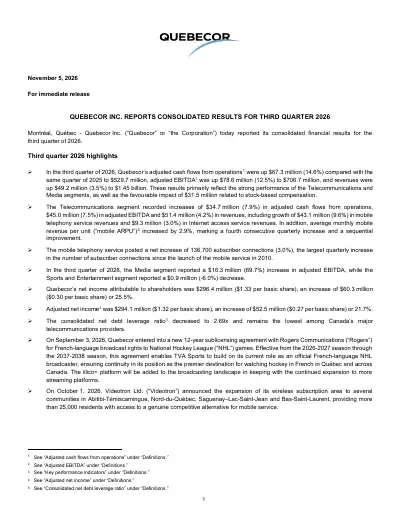
Cash flow from operations increased by $67 million or 15% to $530 million. EBITDA improved by $79 million or 13% to $707 million.
Net income attributable to shareholders grew by $60 million or 26% to $296 million. We reduced our net debt by more than $220 million in the quarter, bringing our net debt-to-EBITDA ratio to 2.69 2.69, still the lowest leverage of the Canadian industry by some margin, after buying back more than $50 million of our stock and investing $177 million in capital expenditures for growth projects, investment in our core systems, and the continued improvement of our network and best-in-class client experience to fuel our resilient and profitable growth.
I will now review our operational results starting with our telecom segment. I am proud to report yet another record quarter for our telecom segment.
In the third quarter, we delivered adjusted EBITDA of $648 million, up $45 million or 7.5% year over year. This is the highest quarterly adjusted EBITDA in our history and our strongest EBITDA growth since the acquisition of Freedom Mobile.
Our adjusted EBITDA margin was 51%, an improvement of 160 basic points. Total revenues were $1.3 billion, up 4.2%, driven by service revenues of $1 billion and 05, which grew even faster at 4.4%.
Adjusted cash flow from operations reached $475 million, up 7.9%. These are outstanding results, confirming that the momentum we have built over the last several quarters is not only sustained, it is accelerating.
Let me start by outlining our key achievement this quarter. We added 100,000 700 net new mobile lines, the best quarterly growth in the history of our company.
This surpasses our previous record of 100 1,000 100 30,000 800 lines we added in Q3 last year. All three of our brands, Videotron, Freedom Mobile, and Fizz, contributed to this performance, and we achieved this in a market that, by our national competitors' own estimates, saw total industry net additions decline by 30 to 40% this quarter.
Despite the tighter market and maintaining our everyday value-driven pricing strategy, we continued to grow and even accelerated our growth, proving the strength of our business model. At the same time, our consolidated mobile ARPU continued to its progression.
For the first the fourth consecutive quarter, ARPU increased year over year, reaching $36 and 8 cents in Q3, up $1 and 3 cents from 35.05 in Q3 '25, beating again the sequential gain of 48 cents in Q4 '25, 49 cents in Q1 '26, and 86 cents in Q2 '26. While our competitors continue to report declining revenue per subscriber, we continue to improve and even more each quarter.
Once again, we are demonstrating that volume and value are not mutually exclusive and that our ARPU growth is sustainable. Our growth is sustainable because contrary to our competitors, it is achieved without any price increase from our existing customers across all our brands, be it Videotron, Freedom Mobile, or Fizz.
Over the course of this year, the Big Three have implemented successive rounds of price increases on their customer base, with some of them raising monthly rates several times since the beginning of '26. We have chosen a different path.
Our ARPU growth results from our customers choosing richer plans and staying with us longer, not from raising their bills or adding various fees. Our performance is a testament to the strength of our marketing approach, built on superior customer experience, transparency, and peace of mind.
Let me share with you a concrete example. On July 24th, Freedom Mobile gave access to its 5G+ network to all customers on all plans at no additional cost.
That is how we build trust and value, by giving our customers more, not by charging more. Our customers know what they pay for, they know what they get, and they know it will not change without their consent.
Despite a sluggish market, anemic population growth, and a slowing improving penetration, we're continuing to show that the runway ahead of us is still long, with very significant untapped opportunities to continue to grow our market share profitably in all our main markets. Many many Canadians still want to break free, free from price increases they never asked for, freedom from complexity, free from the feeling of being taken for granted.
That is exactly why every quarter more Canadians are choosing to make the switch. We're also continuing to expand the reach of our networks.
During the quarter, Freedom Mobile further expanded its 5G/5G+ network in Ontario, Alberta, and British Columbia, bringing enhanced connectivity to more than 500,000 additional Canadians. Here in Quebec, on October 1st, Videotron announced the extension of its wireless service area to several communities in Abitibi-Témiscamingue, Nord-du-Québec, Saguenay–Lac-Saint-Jean, and Bas-Saint-Laurent, offering more than 25,000 residents a true competitive alternative for their mobile service.
Turning to wireline, we added 8,600 internet customers in Q3 at a higher average revenue per customer, generating 3% internet revenue growth. This is a good performance in a mature market, which bodes well for the coming quarters.
Looking at the cumulative first nine months of '26, we clearly continue to execute and perform with remarkable consistency. Year-to-date service revenues grew by 4.2% to $3.1 billion.
Year-to-date adjusted EBITDA grew 6.4% to $1.9 billion, once again a meaningful higher rate than revenue, and we consistently pared down our cost structure while expanding our business. Year-to-date adjusted cash flow from operations reached $1.4 billion, or up 7.4%.
These results reflect a platform built for durable performance, not for short-term gains. Looking ahead for the fourth quarter and the holiday season, I'm confident in our trajectory.
Freedom Mobile national expansion continued to gain strength, Videotron leadership in Quebec remains strong, and Fizz continued to build its position as the leading digital brand in Canada. Our cost discipline creates operating leverage that will continue to benefit our shareholders, and our internet speed upgrade and 5G/5G+ investments are building the network differentiation that will drive growth for years to come.
We're coming to the last month of '26 with strong momentum and the strongest value/volume combination of the entire Canadian industry. Turning to the media segment, I am pleased to report a significant improvement in our financial performance, with adjusted EBITDA reaching $40 million in the quarter, up $16 million year over year.
This improvement mainly reflects savings from cost-reduction initiatives, including lower content costs, higher TVA Sports subscription revenue driven by TVA Sports Direct and new affiliation agreements, and estimated support from Quebec new tax credit for news media. While encouraged by these results, we remain prudent and disciplined, given ongoing industry challenges, notably in advertising.
TVA led once again the Quebec television market in the third quarter with 4.3 43, sorry, 43.5% market share, up 2.3 points year over year. The TVA Network grew its share to 23.1%, up 1 point, driven by such hits as Chanteurs masqués, which is The Masked Singer, and Indéfendable, the most popular scripted daily program.
LCN remained Quebec most-watched specialty channel. Together, TVA and LCN led political coverage, airing the most-watched leader debates, Face-à-Face '26, and election night, Quebec '26.
We also reached a new 12-year sublicensing agreement with Rogers for the French-language broadcast rights to the NHL games through the 2037-2038 season, reinforcing TVA Sports position as the premier destination for hockey fans in Quebec and across Canada. Games will also be available on illico+, as viewing habits evolve and distribution platforms diversify.
I will now let Hugues review our detailed financial results.
Hugues Simard
Merci, Pierre Karl. On a consolidated basis in the third quarter, Quebecor recorded revenues of $1.45 billion, up 4% from last year, and EBITDA reached $707 million, up $79 million or 13%, helped by a $32 million decrease in stock-based compensation expense across all the corporation's segments.
Excluding stock-based compensation, EBITDA is still up $47 million or 7%. Free cash flow decreased by $22 million or 5% to $422 million due to a lower working cap adjustment, while cash flows from operating activities increased by $11 million or 2% to $593 million compared to the same quarter last year.
In our telecom segment, total revenues increased 4% to $1.3 billion. Total service revenues, our primary indicator of recurring revenue momentum, were $1.05 billion, up $44 million or 4.4% year over year.
Wireless service revenues were $492 million, up 10%, driven by continued subscriber and ARPU growth across our three brands. Wireline service revenues were $555 million, up 0.3%, with internet revenue growth of 3% more than offsetting the ongoing structural decline in traditional services.
With rigorous cost management, adjusted EBITDA reached $648 million—in the telecom sector, of course—up 7.5%, our highest adjusted EBITDA ever recorded in a single quarter, with adjusted EBITDA margin reaching 51%, a 160 basis point improvement, as Pierre Karl mentioned, year over year. Once again, our adjusted EBITDA grew at a rate significantly higher than our revenues.
Operating expenses thus fell to 48.9% of revenue from 50.5% a year ago, and to 48.7% year to date from 49.7%. This is not a one-time optimization, and it has not come from headcount reductions.
It is the compounding effect of the continued optimization of our cost base while improving the quality of our revenues. We expect AI to continue driving efficiencies in the years ahead, and this transformation is already underway.
Telecom capex spending, excluding spectrum licenses, was up by $10 million or 6.4% in the quarter, while we continue to invest in the deployment of our internet infrastructure and the continued 5G and 5G+ rollout, including the expansion of Freedom Mobile's national footprint. While some of our peers are cutting back on their network investments, we continue to deploy capital with discipline where it creates genuine competitive differentiation and lasting value for our customers and shareholders.
Despite these additional investments, quarterly adjusted cash flows from operations still increased by $35 million or 7.9% to reach $475 million. This sustained cash flow generation reflects the quality and resilience of our operating model and gives us the flexibility to keep investing in our networks, expand Freedom Mobile nationally, and create long-term value for our shareholders.
Our media segment revenues reached $154 million, up $2.1 million or 1.4%, driven mainly by higher subscription revenues and increased activity in our film and audiovisual services. EBITDA rose by $16 million to $40 million, primarily reflecting the benefits of our cost-reduction initiatives along with revenue growth.
Sports and entertainment segment revenues declined by $4 million to $65 million, with EBITDA down $0.9 million to $14 million. Quebecor reported a net income attributable to shareholders of $296 million in the quarter, or $1.33 per share, compared to a net income of $236 million, or $1.03 per share, reported in the same quarter last year.
Adjusted net income excluding unusual items came in at $294 million or $1.32, compared to an adjusted net income of 4 of $242 million, rather, or $1.05 per share in the same quarter last year. For the first nine months of the year, Quebecor's revenue rose 4% to $4.3 billion and EBITDA increased 7% to $1.9 billion, held back by a $55 million increase in stock-based compensation charges.
Excluding stock-based compensation, EBITDA would have grown $183 million or 10%. In our telecom segment, EBITDA grew 7%, an improvement of $131 million year over year, excluding stock-based compensation.
Our telecom adjusted cash flow from operation totaled $100 $1 1 billion and 44, an increase of $99 million or 7%. As of the end of the quarter, Quebecor's net debt-to-EBITDA ratio decreased to 2.69 times, a significant improvement from the 2.87 times just a quarter ago, further widening our lead as the least-leveraged telecom operator in Canada.
During the quarter, Videotron repaid $200 million in its last term loan tranche that came from the Freedom acquisition, and that was maturing April 2027, and another $100 million on October 6th, after quarter end. Only $100 million now remain in this tranche, the last remaining portion of the financing put in place, as I just said, for the Freedom acquisition.
All in all, we have a best-in-class balance sheet with available liquidity of more than $900 million at the end of the third quarter. In the first nine months of the year, we purchased and canceled 3.9 million Class B shares for a total investment of $238 million.
We thank you for your attention, and we'll now open the lines for your questions.
Operator
Thank you. Ladies and gentlemen, if you do have any questions at this time, please press star followed by one on your touchtone phone.
You will then hear a prompt that your hand has been raised. Should you wish to decline from the polling process, please press star followed by two.
If you're using a speakerphone, you will need to lift the handset first before pressing any keys. Please go ahead and press star one now if you have any questions.
Thank you. Your first question will be from Sebastiano Petti at JPMorgan.
Please go ahead.
Sebastiano Petti
Hi. Thank you for taking the question.
I guess number one, can you just help us on update us I guess on the push into Western Canada, I guess how we're thinking about the contribution there relative to your your legacy or previous your GTA as well as some of the other markets as well? I think PKP Pierre Karl, you talked about taking share in all markets.
Just help us think about, what inning are you in in terms of the Western Canada push, just so as we kind of think about extrapolating, the healthy volume gains going forward? Then for Hugues, as you think about capital allocation, leverage continues to drift down here, as you kind of talked about, 2.69 down from 2.87 last quarter.
Buybacks slowed in the quarter. Can you just maybe help us, update us on the capital allocation framework?
Should we anticipate leverage continuing to drift lower? Should we anticipate a reacceleration in buybacks in 4Q and beyond?
Thank you, both.
Pierre Karl Péladeau
Yes, good morning, Sebastiano. As Freedom has started more as an Ontario customer base.
Through all the years, and especially probably under more Shaw than ever, they've been investing more on the western side. It was still considered or at the end of the day, the smallest part of customer base for Freedom.
There's always two sides on a coin. The first the positive one or the negative one is that it's a small position.
The positive one is that it creates a significant opportunities and a market to grow there. Certainly, the market is different and on the western side.
Even it's different between Alberta and BC. They're different markets and obviously they're different also from Ontario.
We need to look at them differently. The quality of our network is also different from one to the other.
We know where we should invest. Somewhere it's tougher to invest in certain areas because of probably not as good conditions that we can find elsewhere.
That would not stop us to continue to invest, to make sure that we will be able. Obviously, service is there because we go through roaming, but at the end of the day, we would prefer going our own network for cost reason.
We will continue to make our brands known. This is an exercise that we will continue to do.
Where we're sitting here, we can see that we have favorable results and our brands continue to be better known. I think that for Fizz in BC is also a good positioning because digital is something that is more in demand.
It's a matter of continue to work day to day and bringing our brands better known, and our strategy and marketing strategy also as efficient as it is elsewhere.
Hugues Simard
Just pointing out maybe to add a little bit, Sebastiano, that our market share out west are still fairly limited, to be honest. As Pierre Karl said, we started from almost nothing, to be honest, but still we're still in the single digits, to be honest.
This is something that is obviously a huge opportunity ahead of us still, and one that, as Pierre Karl just said, we're diligently working on. As to your capital allocation question, I'll point out firstly that Q4 capex, as I've said a number of times, we're still in line with our annual capex guidance, which will obviously mean, if you run the numbers, that there'll be a bit of a pick up in Q4.
There is some timing in some of our investments that will just catch up in Q4, there should be a bit of an increase in capex in Q4. Other than that, at 2.69, we are well into the sweet spot that we had outlined as our operating leverage going forward.
Now that we've almost repaid all of it There's $100 million, as we said in our scripted remarks, there's $100 million left of term loans, and we're not using margins in any way, and haven't been for quite some time. We'll just keep on focusing on our optimal refinancing of our various bonds and fixed-income instruments that will come up over the next years.
We don't have anything pressing in terms of our next maturities. I would expect a continuation of our ongoing capital allocation strategy that we've been executing for the past little while in terms of dividends.
We increased last quarter. We will revisit next year.
Continue to pay down the debt that we can, that's left to be repaid. As we have renewed our stock buyback program as well going forward.
I wouldn't expect any short-term change in our capital allocation strategy, Sebastiano.
Sebastiano Petti
Great. Thank you, both.
Operator
Next question comes from Matthew Griffiths at Bank of America. Please go ahead.
Matthew Griffiths
Yeah. Hi, good morning.
Thanks for taking the question. Maybe just to start, just to clarify on the impact of the stock-based comp this quarter.
Is the 31 that you're quoting, are we supposed to interpret that as the in-quarter amount or is that the year-over-year change that you're quoting? Sorry if I'm maybe the only one who is unsure about that, but if you could clarify that, that'd be helpful.
Then just on the 5G coverage and 5G+ kind of coverage expansion, was that done within the quarter or was that kind of an ongoing process throughout the year and you're just kind of disclosing that you hit a milestone of half a million people covered? I guess the obvious next thing would be, are you planning on continuing that expansion or is this kind of more of a lumpy type of upgrade?
Thanks.
Pierre Karl Péladeau
Thank you, Matthew. I will answer the second part and quite easily.
It's an ongoing process. We are not rushing anything.
I remember a few years ago, some companies were rushing to go 5G, thinking that it will be the end of the world and a big revolution, that never happened. Monetization was something that people was considering.
We work in a competitive environment. At the end of the day, what customers are looking for is good service, good product, but also good prices.
Then therefore, if you're moving different to what customers are expecting, then unfortunately, you go not in the right direction. We always thought that we will invest with discipline, not in a quarter to build out our 5G network.
Just to conclude again, it's an ongoing process and it will continue to be in terms of quality of the network and the extension or the amplitude of the network.
Hugues Simard
Your specific $31 million stock-based compensation question, Matt, the $31 million is the difference and impact for the quarter compared to last year of stock-based compensation. Just to give you the direct numbers, our EBITDA for the quarter is $707 million.
Including stock-based compensation, it would have been $693 million without stock-based compensation. A positive pickup of $14 million.
Last year, our EBITDA was $628 million. Excluding SBC, it would have been 646.
That's a $17 million hit on EBITDA. So 14 plus 17, you've got a $31 million impact year over year for the quarter.
Matthew Griffiths
Great. Perfect.
Thank you, guys. I appreciate it.
Pierre Karl Péladeau
Matthew.
Operator
Next question comes from Maher Yaghi at Scotiabank. Please go ahead.
Maher Yaghi
Yes, thank you for taking my question. Merci d'avoir pris ma question.
I wanted to ask you just to follow up on the question on the EBITDA here, if you can also take away the impact of ETIYA, maybe just to have the numbers year on year clear for us in terms of the growth and the telecom business on the EBITDA side.
Hugues Simard
Sure. For the quarter, ETIYA's EBITDA is honestly marginal.
It's about $5 million or less, you shouldn't worry so much about that.
Maher Yaghi
Great. Obviously, very strong numbers on subscriber loading.
I wanted to ask you two questions on that. First one is, compared to Q2, Q1, it looks like your market share of net new adds this quarter is closing in on 50, 52%.
In your view, what is the biggest driver for the improvement versus the first half? Was it improved retention, lower churn, or gross loading improved beyond what we saw in the first half?
The second question is, when we see numbers like these and we look back previous periods where you had very strong loading like that, we got followed by increased competitive dynamics in the industry that we all suffer from, I guess, is how do you think you can sustain those kind of net adds without seeing increased competitive pressure coming from the incumbents?
Pierre Karl Péladeau
Thank you, Maher. I will let maybe Hugues give more details, but I would say that it's all the answer [laughter] you mentioned are the reasons that you know.
Before going there, you mentioned ETIYA. I think it was important to tell you that, financially or in terms of numbers, it's not and we hope that maybe it's going to be a huge reason or positive results.
What is important to remind is ETIYA is a company that is providing some very strong support in a very competitive environment where the experience we have with them for the last what, 10 years now, almost, was very positive. We continue to think it will continue to be positive and it brings us the capacity also to increase in a different kind of business the revenue growth.
It reminds me, and sorry, I'll take a few seconds, yes, it's like my father. My father, when he started Le Journal de Montréal, a newspaper need to be distributed.
Okay? Sometimes what you do is that you hire your own employee that will distribute the newspaper.
Instead of doing that, he created a company that was distributing periodicals and newspapers, and it became a company that was also servicing others customers, which basically was using the asset to grow the revenue. I think of ETIYA, obviously, differently because we're talking here on IT, which is creating significant value.
For us, having the capacity to grow this business in the future. Eventually, if you have additional questions, I'm sure that Hugues will be happy to answer them.
We think this as a very strategic acquisition. We have our own employees that work very closely with them, but we also have a different kind of intelligent network that brings value to the company.
For your other piece, I guess that what I will say is that and we've been seeing this all day, all week, all month long, our competitors don't help themselves. They have fights against the regulator, they go in court, they fight fees, the CRTC are going against them, they charge that kind of fee, additional fee.
I think that the market and the customers know that. They know that they receive increases without even known about it.
I don't know what's their mindset. Maybe they think that, yeah, we'll lose some customer, but at the end of the day, the most of our customers will not going to be able to find out and they will pay.
That could be something that they consider. We're not going to do this.
We never been part of the Big Three, and we will never be part of that. What we're doing is servicing our customers.
I mentioned it in my remarks, transparency. This what brings the kind of financial and favorable results we had for the last what now, almost 20 years in wireless.
We will continue to service this market with that kind of philosophy, that kind of policy. We look forward to see this as a continuous recipe being favorable.
I don't know, Hugues, if you have anything else to add?
Hugues Simard
Just adding honestly, as you just said, how did we do this, Maher? As Pierre Karl said at the beginning, all of the factors you mentioned are true, in terms of gross loading, in terms of churn, in terms of other things.
What's our different path, as Pierre Karl outlined in his opening remarks, is what? It's been everyday low price for many many quarters and many years, and this is just building that confidence with the customers that there will not be surprises and that we will continue to provide the best service and the best experience at the best price.
What, that's why people are switching, and that's why people are coming to us, and they're staying with us, and that is what is explaining that high loading. If I can, let's take you guys off the loading for a minute, and if you look at wireless service revenues, we've said it in terms of growth that we still have market share to gain in the West.
We still have market share to gain in Ontario, and obviously in Quebec as well, but we still have a long runway ahead of us. Looking at, putting that in perspective, we said still single-digit market share in the West, obviously huge opportunity.
Look at it from a different lens and have a look at the wireless service revenues for the industry this quarter, or last 12 months, let's say, and you'll see that we're almost 8% of wireless service revenue. If you add, we're just slightly under $2 billion, if our calculations are correct, or for the last 12 months, whereas the top, the top three are more than $20 billion.
So, 8% market share of service revenues, I think you will agree, is still a sizable opportunity ahead of us, because we were clearly gain a lot more than that. A year ago we were at 7, maybe slightly ahead of 7%, now we're almost 8%, and this is the path ahead of us and this is the opportunity ahead of us, and doing it while, as we've just explained, through everyday low price approach that's been successful for many retailers in the past and is clearly successful for us right now.
So.
Pierre Karl Péladeau
I will finish, Maher, by adding, you've been following the industry for so many years and then what's the difference between Quebec and the other areas in the country. We've been used to having lower prices in all our details, in all our services, and accordingly, we have our cost structure structured considering this specific environment.
We're bringing this elsewhere, and this is why we have the capacity to remain very competitive, and we intend, and again, as I said, one is not the opposite of the other one. We can create value and we can create volume.
RGU are not going against ARPU. In fact, they goes in the same direction for us.
Maher Yaghi
Thank you. Congratulations on the quarter.
Operator
Next question comes from Vince Valentini at TD Cowen. Please go ahead.
Vince Valentini
Hey, thanks very much. First, given how strong the wireless service revenue is, I'm assuming there's positive operating leverage.
I know you don't have it broken out exactly, Hugues, but directionally, do we think of wireless segment EBITDA being up sort of 12, 13% year over year?
Hugues Simard
That's reasonable. Yep.
Vince Valentini
Okay. Thank you.
Just nitpicky on the financials, other revenue within the telecom segment, it seems to be up every quarter this year, and this quarter is up 36% year over year. What are you putting in that other category?
Hugues Simard
In the wireless?
Vince Valentini
No, not in wireless. Just on your supplemental, where it's got all the categories of revenue for telecom, there's an other segment, and it's up 36% year over year.
It's not mobile equipment revenue, it's something you call other.
Hugues Simard
Tower revenue. I don't know.
I'll get back to you on this because I'm not quite sure with the other. 30 say, but it's a small number, right?
It must be very small in the revenues.
Vince Valentini
$60 million or thereabouts. Whatever, we can take it offline if that's easier for you.
That's fine by me. The last one I had, look, you gave a very comprehensive answer to Maher's question, but I just want to double-click on it.
I think you have to admit that the incumbents, despite all of, yes, their potential challenges and the CRTC issues and the fact that you guys have sort of grown up with a different starting point and maybe better behavior, despite all that, the incumbents all moved their flanker brands from $45 to $50 early in Q3. There's a lot of moving pieces around that of promotions and so forth, but that's been the rack headline rate on their websites the entire quarter.
You guys stayed at $40 for Freedom. The price gap went from $5 to $10, and instantly you've seen this massive surge in your market share.
Clearly you're going to add over 50% of the sub adds in the industry this quarter. Do you not think that there's some linkage there and that maybe you're in some respects overearning this quarter, and if you keep this up with a $10 price advantage, that the others may be forced to respond at some point, and then everybody just loses, as opposed to you guys just taking that extra ARPU and still driving strong sub adds?
Pierre Karl Péladeau
That's a tough question to answer, Vince. I would say, if it's not broken, don't fix it.
I guess what we've been able to achieve are good results. Again, I guess that you would like to have a different answer, but again, volume is not against ARPU.
If we're able to achieve both, we'll continue to do so. Obviously, we take care about what's taking place elsewhere.
We're looking about what our competitors are doing. I think, and you will agree, I guess, as your colleague in the industry, that they probably didn't follow the right strategy, and they possibly changing their mind right now.
The repricing effect was hard for them. Are they changing their mind?
Maybe. Maybe yes, maybe no, we'll see.
For the moment, what we can see is that they probably find out that was not a good strategy. Again, if they don't fix it, then we've been doing good, there's no reason why we should change our strategies since we deliver good results.
Vince Valentini
Okay. Fair enough.
Thanks. Just
Hugues Simard
Vince, just back to your other revenue question, okay, I guess I should have reacted, but it's fairly new. ETIYA revenues are in the other revenue, so that's most of it.
We probably also in other is we put sub SVOD revenues and others. That's what makes up the other revenues.
The increase is due to the fact that we now include ETIYA revenues as opposed to not having them last year. That's the 36% increase.
Vince Valentini
That makes sense. Thank you.
Pierre Karl Péladeau
Vince.
Operator
Next question comes from Drew McReynolds at RBC. Please go ahead.
Drew McReynolds
Thanks very much. Good morning.
Just Hugues, for you, just back to telecom EBITDA growth ex stock compensation expense year over year, I'm not sure in your prepared remarks you actually gave that, my apologies. Can you just let us know what that is?
Hugues Simard
Yes, it's 5.5%, 5.6% exactly, increase ex SBC.
Drew McReynolds
Okay. Awesome.
Thank you. Then just back to capital allocation, obviously you're in fantastic shape.
What's preventing you from kind of taking capex up significantly and accelerating network expansion? You've been very I think clear and transparent, it's a gradual step-up over time as you build out the network, but you seem to have so much financial capacity, why wouldn't you step on the gas on network expansion?
Pierre Karl Péladeau
Drew, I'll answer by saying, first of all, again, it's not because we have money that we'll spend it stupidly. I'm not saying that investing in our network is stupid, but we've been disciplined and we will continue to do so.
If we were to have a weak product, then we will be forced to do something. Again, roaming is certainly something that is adding our capacity to continue to offer good service.
We'll do this, and we will continue to be disciplined in terms of allocation. I guess the board, at the next board meeting, after reviewing the year results, will sit and we'll listen and we'll discuss what could be a different capital allocation.
It's a matter of the board, and we look forward to have their own insights and to make sure that we're heading in the right direction.
Drew McReynolds
Okay. Thanks, Pierre Karl.
Then and then one final one for me, maybe back to you, Hugues, just amazing work on the EBITDA margin for telecommunications. I I think you you've quarter in, quarter explain kind of everything behind it.
As you think about Western Canada expansion and that next leg of growth, I know last quarter you remained comfortable that you could absorb, the opex investment as you kind of build out your brand and and grow that in the West. Are you still comfortable in kind of maintaining, that margin trajectory or operating leverage as you you put more into the West?
Hugues Simard
Absolutely. Absolutely.
Drew, I think, operating margin and EBITDA margin is something of an obsession for us. It is something we have been not only good at, but I would argue the industry standard at for many many years.
Even starting with a $20 less ARPU, we keep maintaining higher margins. Why I'm saying this is that that is the result of continuous improvement, continuous day after day and month after month, trying to find opportunities for cost savings and investing in new platforms that will lead to cost savings and to opex reduction.
It's in our DNA, and it's something that will continue, and I'm more than confident that this is something that will always give us the flexibility to continue to invest for our growth, because we are hyper-tight and hyper-rigorous on our cost base.
Drew McReynolds
Okay. Amazing performance.
Thank you, both.
Pierre Karl Péladeau
Drew.
Operator
Next question comes from Jérôme Dubreuil at Desjardins. Please go ahead.
Jérôme Dubreuil
Oui, bonjour tout le monde. Thanks for taking my question.
I guess I'll have to be that guy, but we'll see what happens after 2030 with regards to MVNO, but in the meantime, do you think it would be beneficial for Quebecor to have some sort of an agreement with SpaceX, possibly for an MVNO, or do you think letting them in is too risky of a strategy? Thank you.
Pierre Karl Péladeau
Thank you, Jérôme. You guys, we know that you have another appointment in what, 9 minutes, we're going to try to answer that more quickly.
Obviously, MVNO is of importance, the policy is of importance. We've been seeing the government, the federal government being concerned about this situation.
We see the government having a narrative regarding NTN, the non-terrestrial networks. I think it's of importance for Canada, and we will continue to look what's taking place there.
As of today, as you all know, we're in a regulated business, then therefore, spectrum is a scarce asset, and we need to make sure that Canada will use it as most efficiently as possible. We're always open about new technology.
We will need to look at that in details. I guess that it's too early to have a final or the beginning of a final conclusion.
There's certainly some interesting movement for the future, and yeah, networks will change, but certainly something will never change is the customer experience and our capacity to deliver a good product. This, I think, that we're good at, and we will continue to enhance and increase the capability of having different networks.
The backbone is there, the wireless network is there, NTN is another thing that we will need to consider either in association or either in a different mode.
Jérôme Dubreuil
Sorry, I'm just going to push a bit further on that one. If SpaceX were to come knocking on your door and ask for an MVNO, would you say yes or no today?
Pierre Karl Péladeau
[laughter] He's avoiding
Jérôme Dubreuil
my answer. [laughter]
Pierre Karl Péladeau
Well, I would say, I did some politics, I will answer [laughter] that question. No, well, to your question, This is an assumption that we didn't face yet, I don't think it worth to answer it.
Okay.
Jérôme Dubreuil
Thank you.
Pierre Karl Péladeau
Jérôme. Merci beaucoup.
Operator
[laughter] Stéphanie,
Pierre Karl Péladeau
I think that last one.
Operator
Next question comes from Stephanie Price at CIBC.
Stephanie Price
Hi. Good morning.
Just wanted to stick on internet here, or maybe transition to internet a little bit after the SpaceX commentary. Internet revenue growth was strong at 3%.
Just curious if you can give any additional color there on the competitive environment in Quebec, and also you can touch on bundling and thoughts on west of Quebec internet expansion.
Hugues Simard
Yes. Certainly some color on internet.
Plus 3%, as you just said, and you will remember, this is after a couple of years of difficult performance on internet. You will remember, last year or two years ago at this point, we were struggling, and our internet revenues were actually lower.
Now we are back in positive territory. Why?
Because we are within a very competitive environment, but a rationally competitive environment. We are able to better value our services and our client experience in Quebec.
Globally, I think the market is a lot healthier, and we are certainly able to monetize that value and this superior service that we've built over the years and finally translating this in revenue growth in Quebec. We're quite positive on broadband in Quebec going forward.
Even in cable, wireline is something we haven't talked much or you guys didn't ask us a lot about this quarter. Even on cable, you'll look at -4% decreases two years ago or about 18 months ago, we're now at -1%, and we certainly see that as continuing.
This is, in our view, a healthy environment, one in which we are clearly demonstrating the value of our products and services, and it's a healthy cash flow [laughter] generation machine for us and is something that we're quite positive on.
Pierre Karl Péladeau
I would add, Stephanie, also that I mentioned it, but I think that it's worth to add a few words there. The NHL rights renewal that we signed is a great interest for our TV cable or TV product.
As you probably know, Montreal Canadiens have been very strong for the last months, that brings additional interest on cable and give us the capacity also to improve our streaming and OTT capabilities, which diversifying our capacity to remain strong there. We look forward at the decent price.
As you saw, prices were significantly higher. We didn't disclose our price, but what we know is that we had games and our penetration in terms of providing games is higher, and then therefore, giving us an interesting edge for the future.
Stephanie Price
Thank you very much.
Pierre Karl Péladeau
I think that there's two other There's Tim and David. We'll try to go short again, because my mother educate me politely and I don't want to make sure that you're [laughter] miss our friends the blue guy.
Okay.
Operator
Next question comes from Tim Casey at BMO.
Tim Casey
I'm covered. Thanks.
Hugues Simard
All covered? Great.
Thanks, Tim.
Operator
Next question will be from David McFadgen at ATB Cormark. Please go ahead.
David McFadgen
Oh, great. Thanks for squeezing me in.
Maybe you could just give us an update on the network build-out, your own network build-out in BC and Alberta?
Pierre Karl Péladeau
Quickly, David. Alberta and I forgot to mention that, but Alberta is going well.
We have good capabilities of growing our network there. In BC, it's different from one area to the other.
When you go more urban, it's different. It's not as easy as elsewhere.
Manpower and experience is not as easy also to find. In terms of build-out, it's not also going at the same level that we would like us to do, and obviously, if you were to report of our previous answer on capital expenditures, and this is also a reason why we've been disciplined.
We're not going to do things that are going against quality. We need to make sure that the expertise of building our network will continue to be strong, and then therefore continuing to be in the future providing quality service, quality product.
David McFadgen
Thanks. I'll follow up with Hugues later on.
Thank you.
Pierre Karl Péladeau
Good, I would like to thank you all. You're just fine on time, and have a nice day.
Operator
Thank you. Ladies and gentlemen, this concludes Quebecor Inc.'
s financial results for the third quarter 2026 conference call. Thank you for your participation, and have a nice day.