NeoGenomics, Inc.
Q3 FY2026 · Earnings Call TranscriptOctober 28, 2026
Operator
Good afternoon and welcome to the NeoGenomics third quarter 2026 financial results conference call. Please be advised that today's conference is being recorded.
I will now turn the call over to Andrew Brackmann, Vice President of Investor Relations.
Andrew Brackmann
Thank you, Sylvie, and good afternoon, everyone. Representing NeoGenomics here today are Tony Zook, Chief Executive Officer; Warren Stone, President and Chief Operating Officer; and Abhishek Jain, Chief Financial Officer.
This call is being simultaneously webcast and a recording will be available following the conclusion at ir.neogenomics.com. During this call, we will make forward-looking statements regarding our future financial and business performance, our planned leadership transition, planned future operations and related expectations with respect to timing and performance, future financial position, future revenues, growth potential and expected growth drivers, projected costs and capital expenditures, prospects and plans, estimates of market size and position, the implementation of our new revenue cycle management platform and its anticipated benefits and effects on the timing of our collections, objectives of management, and financial guidance.
We caution you that the actual events or results could differ materially from those expressed or implied by the forward-looking statements. These forward-looking statements made during the call speak only as of the original date of this call, and we undertake no obligation to update or revise any of these statements.
Please refer to the information disclosed on the safe harbor statement slide in the deck posted on our website, as well as the information under the heading Risk Factors in our annual report on Form 10-K and our subsequent quarterly results on Form 10-Q and current reports on Form 8-K filed with the SEC to identify important risks and other factors that may cause our actual results to differ materially from the forward-looking statements. These documents can be found in the Investor section of our website or on the SEC's website.
During this call, we will also refer to certain non-GAAP financial measures that involve adjustments to our GAAP results. The non-GAAP financial measures presented should not be considered an alternative to the financial measures required by GAAP, should not be considered measures of our liquidity, and are unlikely to be comparable to the non-GAAP financial measures provided by other companies.
Any non-GAAP financial measure referenced on this call are reconciled to the most directly comparable GAAP financial measures in a table available on the press release we issued earlier today and in the slide deck available in the Investor section of our website. I will now turn the call over to Tony.
Tony Zook
Thank you, Andrew, and good afternoon, everyone. We're excited to report another strong quarter, which shows we have the right strategy in place, the right team to execute it, and we're delivering consistent results because of this.
Our business is continuing to gain momentum and our third quarter results show it. Clinical revenue grew 13% year-over-year.
NGS revenue grew a strong 29%, and our adjusted gross margins expanded by over 300 basis points, all of which allow for us to increase both total revenue and adjusted EBITDA guidance for the year. We made a lot of progress on our key initiatives this quarter and are well positioned to deliver a strong finish to 2026 and a continuation of these trends into 2027.
Before I walk through the quarter highlights in more detail, I want to acknowledge that this will be my last earnings call as CEO of NeoGenomics. As we announced earlier this month, effective January 4th, 2027, Warren Stone, our current President and Chief Operating Officer, will become Chief Executive Officer of NeoGenomics and join our board.
I'll support his transition and remain actively involved as our new Executive Chair. We shared three messages at the time of transition announcement that I want to reinforce.
First, these roles cement our leadership team well into the future. Warren, Abhishek, and the broader leadership team in place have helped drive our recent progress and will continue to do so.
Second, this change comes from a position of strength. Succession is best done when the business is performing at or above expectations, which is exactly where we are.
Warren has earned this promotion, and I'm confident that he's the best person to lead NeoGenomics well into the future. Finally, with our strategy firmly in place and not changing, now is the time to accelerate execution and advancement of that strategy.
Warren will remain focused on the same value drivers that our team has been fixated on, and he'll speak to that in a moment. As I step into the role of Executive Chair, I see great opportunity for NeoGenomics over the coming years as our business shifts to higher-value, advanced testing modalities.
Today, NGS represents about a third of our clinical revenue and only 10% of our clinical volumes. Over time, we expect NGS and MRD together to ultimately approach two-thirds of our revenue.
With that inversion, we see the potential for durable and accelerating revenue growth, which will also drive disciplined margin expansion, just as we saw in the third quarter. We'll continue to seek ways to remove operational complexity, upgrade our infrastructure, and invest where we see the highest ROI, namely in our clinical business across the NGS and MRD franchises.
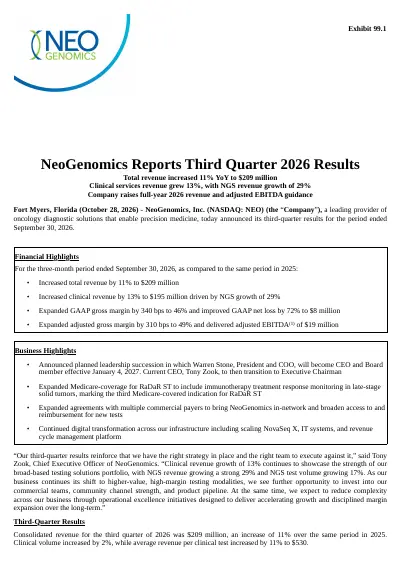
Now let's get into the third quarter highlights. Total revenue grew to $209 million, up 11% year-over-year and ahead of our expectations of approximately 10% growth.
Our entire clinical business, which makes up roughly 93% of our revenue, is gaining momentum and exceeded our expectations. This is driven in large part by strength in NGS, with this higher-margin revenue growing 29% as strong trends across both heme and solid tumor continue.
On the much smaller non-clinical side, quarterly results met our expectations, though still represented a modest headwind to total revenue growth, declining approximately 10% or $1.5 million year-over-year. As a reminder, our non-clinical business is made up of two parts: one, our high-margin oncology data solutions business or ODS, which is an emerging opportunity for us, selling proprietary real-world evidence to pharma customers; and two, our pharma services business, which supports customers through drug development and clinical trials and historically has been comprised of legacy lower-value tests.
Looking ahead, as we have done in all parts of our business, we continue to evaluate the low-margin commoditized contracts in our legacy pharma testing, which are not strategic to our business. However, we remain committed to more high-value services, which move us up the pharma value chain.
On the margin front this quarter, we again saw significant improvement. Adjusted gross margins expanded by over 300 basis points, driven by mix shifts, strong AUP growth of 11%, and Lab of the Future initiatives.
Together with operating expense discipline, this drove adjusted EBITDA to $19 million, well above our expectations. Beyond our financial results, we achieved several important business milestones in the third quarter.
In August, RaDaR ST received MolDx coverage for immunotherapy treatment response monitoring, our third Medicare-covered indication and a cornerstone of our MRD launch. We continue to expect two additional indications to be granted reimbursement by MolDx, one potentially by year-end and the other by mid-2027.
Warren will discuss recent customer feedback and other payer successes shortly. Separately, we continue to advance Lab of the Future initiatives and investments in digital transformation, including upgrades to sequencers and our revenue cycle management system.
Lastly, our pipeline continues to advance, and we expect several tests and upgrades to move closer to clinical availability in the coming quarters and years. In the third quarter, we upgraded our flagship NGS test, our Neo Comprehensive heme panel, to include UBA1 and to detect variants at allele fractions as low as 3%.
These additions, along with turnaround times as fast as eight days, further differentiate the test. In MRD, our next-generation, whole-genome assay remains on track, with data generation expected next year and a potential clinical launch in 2029.
In sum, this was another strong quarter for NeoGenomics, with our team of over 2,400 individuals delivering the consistency that investors expect. As Warren takes over as CEO in January, I expect that he and the team will continue to execute on the objectives in front of them.
With that, let me turn it over to Warren.
Warren Stone
Thank you, Tony, and good afternoon, everybody. I want to begin by thanking Tony, our board, employees, and the shareholders for their confidence in me as I take over the CEO role early next year.
I'm excited and grateful for the opportunity to lead NeoGenomics, something I have prepared for during my time with the company. Let me start by sharing a bit about what inspires me about the opportunity ahead.
At NeoGenomics, we're a pure-play precision oncology company focused on the community, where approximately 80% of patients seek treatment. Today, we estimate roughly 60% of patients are still not receiving advanced, comprehensive genomic profiling, which could lead to improved treatment decisions and outcomes.
We have the opportunity to be the company that bring these tests to more patients through our leadership in hematology, a trusted position in the community providers, a broad test menu that spans diagnosis to recurrence monitoring, and our growing oncology field force. Now is about leveraging our strength and momentum to advance the execution of our strategy and accelerate value creation.
Our focus areas remain consistent: delivering durable NGS growth, driving MRD uptake with RaDaR ST, and investing in our business while driving profitability through operational excellence. I'll briefly touch on each of these today.
First, let me begin with NGS, which we view as our key value driver. In the quarter, NGS grew 29% and volumes grew 17%, with large panel volumes growth above 25%.
We view these trends as durable based on new product launches, mix shifts to higher-value tests, and our integrated portfolio offerings. In hematology, new therapies are driving demand for our tests, and we have upgraded our flagship Neo Comprehensive heme panel as we continue to deliver industry-competitive turnaround times.
In solid tumor, pan-Tracer family, inclusive of approved tissue and LBx, are seeing strong uptake while driving halo effects across the entire portfolio. LBx in particular is seeing increasing utilization and managed care reimbursement tailwinds following the MolDx reimbursement decision earlier this year.
In total, we estimate large panel therapy selection penetration in the community setting to be around 35% to 40%, leaving substantial room for our business to grow. As we drive more wins with commercial payers and deliver more integrated testing solutions across the entire testing journey, our momentum should grow.
As we view it, our NGS therapy selection and expanded portfolio provides us a unique opportunity to differentiate ourselves. This becomes even more true now that we're promoting RaDaR ST for immunotherapy or IO monitoring.
A recent customer experience highlights the power of our comprehensive offering. A community oncologist in Texas, frustrated by ordering from multiple vendors for a single patient, worked with our team to standardize testing on NeoGenomics given our breadth of primary diagnosis through surveillance.
Now new patients at this practice start with pan-Tracer Pro and pan-Tracer liquid for therapy selection, followed by RaDaR ST for MRD. A single vendor also allows for faster turnaround time and better tissue preservation.
It's a strong example of how an integrated menu sets us apart in the community oncology channel and drives multi-product adoption. Next, in MRD, we are confident in the opportunity and the foundation that we are setting.
Early launch indications are encouraging. Over 30% of RaDaR ST orders are accompanied by other NeoGenomics tests.
Approximately two-thirds are in-indication, and about 20% are in-indication orders for patients on Medicare. Clinical RaDaR ST volumes continue to improve on a month-over-month basis following the August decision by MolDx to reimburse RaDaR ST for IO monitoring in late-stage cancer patients.
IO monitoring is a critical piece of our foundation for a successful RaDaR ST launch, with what we estimate to be a US market opportunity of just under $4 billion, including several hundred thousand stage IV patients, of which approximately 40% are on Medicare. Looking ahead, we expect further progress on the reimbursements, with two additional indications for RaDaR ST currently under review by MolDx.
If approved, these additional indications would expand our access to over 40% of the total addressable market for tumor-informed MRD testing. Moreover, a leading regional commercial plan has informed us that effective December 15th, it will cover RaDaR ST for all MolDx reimbursed indications.
While clinical revenue will take time to ramp as we further unlock commercial opportunities over time, we are encouraged by the recent volume trends and oncologists' receptivity to the test, and expect growing momentum in 2027 to support more meaningful revenue contributions in 2028 and beyond. Finally, we're instilling operational excellence initiatives across our enterprise that will free up dollars for growth investments.
These efforts will help fuel investments into high-ROI areas like commercial, Lab of the Future initiatives, and product pipelines. In commercial, we ended the quarter at over 160 sales resources, consistent with prior commitments.
Given the strength of our NGS business and recent reimbursement wins for RaDaR ST, we plan to further expand our sales force in a disciplined manner in the fourth quarter and into 2027. In addition, we're investing in our vision of delivering a differentiated customer experience.
This quarter, we released a real-time order status tracker, which provides improved visibility to expected completion timing of test results to support downstream workflows and patient scheduling. We also continued to improve EMR connectivity through Epic Aura integrations, and in the near future, integrations with Flatiron.
Progress on our Lab of the Future initiatives also continued this quarter. We remain on track to transition our heme NGS portfolio, the largest revenue components of our NGS business, to the NovaSeq X platform in the first half of 2027.
Separately, we recently expanded our digital pathology partnership with Indica Labs to prepare for AI's growing role in cancer diagnosis and therapy selection. In closing, I'm excited about the future.
We have a tremendous opportunity ahead to deepen the penetration of precision oncology in the community setting while delivering consistent, durable, profitable revenue growth. With that, I'll hand the call over to Abhishek.
Abhishek Jain
Thank you, Warren, and good afternoon, everyone. In my remarks today, I will discuss our third quarter financial results and our updated 2026 guidance.
We reported total revenue of $209 million, up 11% year-over-year. Clinical revenue grew 13% to $195 million, driven by a 2% increase in test volumes and an 11% increase in AUP.
NGS revenue grew a strong 29% year-over-year, driven by 17% volume growth and above 25% volume growth of our large panel NGS test. As Warren noted, we are pleased with the consistent, durable growth in our NGS portfolio and are excited about the opportunities ahead, driven by product upgrades across both heme and solid tumor, as well as growing adoption of our large panel tests.
This mix shift towards higher-value testing is also the primary driver of the increase in AUP, with the balance coming from RCM initiatives, including managed care pricing gains with payers. Turning to our non-clinical business, we reported revenue of $15 million, in line with our expectations, representing a decline of approximately 10% year-over-year.
We continue to see compelling opportunities across our high-margin ODS business, though legacy pharma remains a headwind for us as we evaluate low-margin commoditized contracts while staying committed to offering high-value pharma services. Adjusted gross margin for the third quarter was 49%, an expansion of over 300 basis points versus the prior-year period.
Adjusted gross profit increased by $16 million or 19% to $102 million. This was driven by AUP growth, a higher mix of NGS revenue, and continued lab efficiencies driven by our Lab of the Future initiative.
We continue to invest in the areas that will help us drive the gross margin expansion. We bought new sequencers and data servers for over $5 million in capital expenditures as part of NovaSeq X transition in this quarter.
Also, we upgraded our revenue cycle management platform to XIFIN, as Tony noted. XIFIN is one of the leading RCM platforms for its ability to streamline and automate workflows, improve collection rates, and reduce bad debt.
With a platform transition of this size, we saw a temporary impact on our receivables that we expect to normalize throughout the fourth quarter and into early 2027. Over time, we believe XIFIN will help us continue to drive AUP improvement and greater efficiencies.
Moving down the P&L, total operating expenses in the quarter were $105 million. Sales and marketing expenses grew 27% year-over-year as we continue to invest in our sales team to help accelerate growth.
R&D increased 13% year-over-year as our team works to upgrade our on-market tests and advance next-generation products. These increases were funded in part by decreases in G&A spend, which declined by 4% year-over-year.
This decline reflects our commitment to reduce G&A expenses as a percent of revenue and an intentional shift in capital allocations within operating expense line. Adjusted EBITDA was $18.7 million for the quarter, up 53% year-over-year, reflecting strong operating performance and disciplined investments.
Turning to balance sheet, we ended the quarter with $139 million in cash and cash equivalents, down $6 million as compared to the last quarter. Cash flow in this quarter reflects three discrete items: the payment of roughly $10 million for the DOJ settlement that we reserved for and discussed last quarter, transient effects from the XIFIN implementation, and our continued investment in modernizing and scaling our infrastructure.
Now turning to our 2026 guidance. Given our strong third quarter, we are raising our full-year '26 revenue guidance to a range of $807 to $809 million, up from $802 to $806 million discussed previously, and representing full-year revenue growth of approximately 11% at the midpoint.
The key assumptions underlying the midpoint of our revised revenue guidance are as follows: First, our clinical business to grow in the low teens for the full year, reflecting strong Q3 performance. Second, we expect NGS revenue to grow more than 25% for the full year, approaching approximately $250 million in 2026.
Third, no change to our pan-Tracer Liquid or RaDaR ST revenue assumptions. Finally, we now expect our non-clinical business to be down low double digits year-over-year.
For the fourth quarter, this implies revenue growth of approximately 11%, slightly ahead of our prior commentary. Turning to gross margin, we now anticipate well over 150 basis points of adjusted gross margin improvement for the full year, implying fourth quarter gross margin of approximately 48%.
Finally, we are raising our full-year '26 adjusted EBITDA guidance to approximately $60 million versus $56 to $58 million discussed previously, representing year-over-year growth of approximately 40%. With that, let me turn the call back over to Tony.
Tony Zook
Thanks, Abhishek. We're making great progress in 2026 and expect a strong finish to the year.
Four of the five growth catalysts we outlined for 2026 are now behind us, and the fifth, expanding RaDaR ST reimbursement, is well underway, with IO monitoring secured and two additional submissions pending. Our priorities from here are clear: deliver a strong fourth quarter, drive durable NGS growth, uptake in MRD, and disciplined margin expansion through operational excellence.
We're looking forward to exiting 2026 with momentum, and we're excited about 2027. Thank you for your continued interest in NeoGenomics, and with that, operator, this concludes our prepared remarks, you can please open up the line for questions.
Operator
Thank you. The floor is now open for questions.
If you wish to join the queue to ask a question at this time, please press star one. If listening on speakerphone, please pick up your handset while asking your question to provide optimal sound quality.
We also ask that out of consideration to other callers on the line today and time allotted to please limit yourself to one question and one follow-up. Thank you.
Once again, please press star one on your phone at this time to join the queue to ask a question. Your first question will be from Dave Westenberg at Piper Sandler.
Please go ahead.
Dave Westenberg
All right, thank you for taking the question. Congrats on Warren on taking over and congrats on Tony on being the new board member.
Chairman of the Board. Yeah.
I think I just kind of want to ask broadly about the management transition here. I think all of us that follow Neo very well think that Warren is the obvious successor and clearly this is 100% who that we would all want to be CEO.
Now saying that, I think Neo's transition and leadership haven't always been seamless. The business doesn't appear to be broken, can you just talk about some of the timing on this, why we made this decision now?
Then just some of the questions directly for Warren, can you talk about some of the things that you've been involved with in terms of the management decision over the last couple years? As you step in the role, how you're going to kind of communicate the long-term ambition versus keeping things in check.
I know during the transition from Chris to Tony, there's a little bit of maybe not the best communication of the long-term ambition as a company. Then last, was there any lessons from that transition from Chris to Tony?
I know there's a lot, but I think a lot of us want to know about this Tony to Warren transition.
Tony Zook
Sure, Dave. I'll kick it off and then Warren, turn it over to you.
I would say there were a lot of lessons learned, Dave, and I think that's benefited us as we've done this transition. I would say first and foremost, relative to the timing of the transition, this was the result of what I thought was actually really good succession planning.
There were no guarantees given to anybody, and if you recall when I came on board, the first thing I did was appoint Warren to who's current role, where he would move from leading just the commercial organization to also include lab operations and demonstrate enterprise leadership across multiple functions and as well representing almost 75% of our employee population. I will tell you, Dave, that Warren did a marvelous job there.
The degree of innovation and change within the labs today is literally amazing, and we continue to gain momentum in what we're doing across the commercial front. I would say without any hesitation, through my eyes as well as the board, Warren earned the opportunity.
Once we knew that we had the right person for the future, then it became a question of what's the right time? We just believe that we're doing this from a position of strength.
By making the transition now, we get continuity for me going back to the board as Executive Chair, there's not going to be with Lynn stepping out and not seeking reelection, there won't be a new chairperson coming in that might challenge strategy. It just seemed a perfect opportune time for us to do it.
Second, by doing it when we did it earlier in the month, it gave us the opportunity to get in front of all of our leaders, because we already had a senior leadership team scheduled, and there we were able to guarantee that there would be no disruption from the change, and everybody is fully aligned internally around what we're doing. I would say the key lessons learned as well as that Warren and I have been working closely together over the last few years, and we continue to do so.
We're joined at the hip relative to the strategy. We'll be very, very much aligned as we go through the budget process in the final quarter.
I think those were the big lessons learned. I was basically handed a budget that I didn't have the same insights that I would have liked to have had.
Warren will be able to own this budget himself due to the timing. That's kind of the macro wise, and then Warren, you can give your own perspectives.
Warren Stone
Thanks, Tony. First, thanks for the kind words.
Appreciate that. I think to one of your questions sort of how involved have I been, I think that's a critical question.
I've just come up on sort of four years at NeoGenomics, and I'd say in my first two years, I was very involved in most things. Over the last two years since Tony transitioned to CEO, I'd tell you I was acutely involved in practically all decisions, certainly those that related to people and strategy.
I already consider myself as sort of one of the architects of the strategy, and I say that because it's important. I think we have momentum in the business right now, and I hope the results that we've just reported here in the third quarter actually demonstrate that.
What we want to do is not only maintain that momentum, but obviously accelerate that momentum. Continuity in the strategy is critically important, and maintaining continuity within the leadership is important as well.
The fact that I've been heavily involved in that process, I feel very confident we're able to achieve that. That's to that point.
I think in terms of sort of what is changing, I think maybe the ambition in terms of the value that we can deliver from the strategy as we transition into this next chapter. I think lastly, your point is how are we going to keep the community sort of informed around our ambitions and the future?
I think so what we're certainly planning on doing, outside of investor comps like J.P. Morgan, is to have an Investor Day in the first half of 2027.
A lot of exciting things to share from the portfolio perspective, from the commercial expansion point of view, operational excellence, and we feel it's been four years since the last opportunity, and it's time for us to do the same again.
Dave Westenberg
Got it. Thank you very much.
Since that was a long answer, I'll keep it kind of short. Abhishek, I just wanted to know about what MRD and liquid contribution would be in Q4, if you have any.
Just given the fact that you gave it on the year, there's technically only one quarter in the year. Honestly, we're just trying to get kind of a run rate for '27.
I know you're not going to give '27 guidance, I'm going to try my best with kind of looking at that. Thank you.
Abhishek Jain
We would expect nothing less from you, Dave. No, again, I think we're not breaking it down to the quart level for now, Dave.
Sorry to disappoint you on that one. We'll provide more color in our Q4 call for that one.
Overall, for both liquid and the MRD, our guidance that we gave in the beginning of the year, we are tracking well to those numbers.
Dave Westenberg
Operator, let's go to the next question.
Operator
Next question will be from Puneet Souda at Leerink. Please go ahead.
Puneet Souda
Hi guys. Thanks for the questions.
Warren, congrats, well-deserved, and excited to have you in the spot. Tony, really solid job and as you came into the seat and executed.
First one from my side is really again, AUP growth is a very important part of the story. Came in again slightly even ahead of the pre-announcements, as we looked at it.
Maybe could you elaborate, just how should we think about that and the sustainability of that into 2027? I know you're not giving '27, but the volume growth 17% NGS, really great; 25% on the larger panels as well.
Just wanted to get a sense of the AUP growth, sustainability of that.
Abhishek Jain
Sure, Puneet, I can take that question. AUP growth came in at 11% for the current quarter as we reported in our numbers this quarter.
We had guided in the beginning of the year that overall, AUP growth is going to be in the high single digit and the volume growth is going to be in the low single digit. The reason for the AUP growth being higher and volume growth below was primarily because of this exit of the high-volume, low-value test, one particular customer that basically kind of had run pretty high volumes in 2025.
What we are basically suggesting that once we kind of stabilize out of this particular dynamic of exiting this high-volume, low-value contract, what we have guided that the volume and the AUP should track back to the mid-single digit, which we have been in the past. That's the first piece of the question, that AUP growth should, in the normal environment, be around mid-single digit.
Now, on the 11% AUP growth, and from the durability perspective, I would say that we feel that there is a lot of room for us to continue to deliver on the AUP numbers. The reason number one is the mix.
The two-thirds of the AUP growth is coming from us driving the high-margin, high-value NGS part. Given the fact that our larger panels are even growing strongly within the NGS family, that is actually helping us drive the AUP growth.
Now, the second piece of the AUP is the RCM initiatives. Now, RCM initiatives, as we kind of called out in our prepared remarks, we are actually encouraged by seeing some of the recent wins in the commercial payers, and that is basically helping us drive the real AUP benefits that we are seeing now.
Those two pieces kind of actually help us continue to drive the AUP growth.
Puneet Souda
Got it. Super.
Then just briefly on the NGS volume growth itself. Wondering if you could qualify how much of that is as a sort of new store sales or same-store sales?
Essentially, I'm trying to get to is are you taking share or how much of this is just market growth versus taking share? Again, competition in this space is, as you know well, is there, but you have a very strong position in the community setting.
I just wanted to get a sense of how you are winning there.
Warren Stone
Puneet. Firstly, thanks for your kind remarks upfront.
I don't have the data specifically broken out. I can tell you that this is not just with regards to growth at existing customers.
We're certainly seeing robust new customer acquisition, which is supporting this growth, as well as incremental volumes that are coming in from existing customers enabled by our bidirectional interfaces that we've put in place to support a simpler workflow and better customer experience.
Tony Zook
Thank you, Puneet.
Operator
Next question will be from Bill Bonello at Craig-Hallum. Please go ahead, Bill.
Bill Bonello
Hey guys, thanks a lot. I want to come at the growth, maybe hopefully I'm not asking the exact same question that everybody else has been asking, but obviously the NGS growth was especially strong this quarter.
When I think about it, there's a lot of drivers, including the expanded sales force, you implemented the specialized oncology sales team, and then obviously the new products. I'm just wondering if you can give us some sense of the relative importance of those factors.
What I'm really trying to get at is, to what extent the new products are already truly kicking in and adding growth or is most of the growth still coming from those other factors, and the growth from the new products is largely in front of us? That 25% number you gave, it actually sounded a little bit low to me, and I don't have a base to put it on, anyway, I think you get the gist of what I'm asking, and then hopefully a follow-up.
Abhishek Jain
Bill, I'll kick it off and then Warren, please drill down a little bit more. I think you were right in your initial talking about the sales force expansion and product introductions.
All these things contribute. I think, when you look across the spectrum, I think actually, some of the product upgrades and new therapies were additive to the overall growth rate.
What is also nice is that we're seeing it's broad-based. It's across heme as well as solid tumor.
Heme being a larger portion of the business, it's still showing very good robust growth, and solid tumor is beginning to kick in. It's on a smaller number, but that does help fuel a growth trajectory as well.
You mentioned the mix shift to the larger panels, and 25% volume growth is really, really strong, especially when you consider that the mix shift impact. Then, of course, there is, as you mentioned before, the sales force expansion.
Any other color, Warren?
Warren Stone
I think, again, I'd say, well, there's no one single factor. If we go back to the five products that we launched in 2023, that's contributing about 25% of our revenue today, and the actual growth of those five products was north of that, well north of that 25%.
They were all large panel being introduced in 2023, well north of that 25% that we articulated. There's definitely still a lot of opportunity in the products.
Then secondly, yeah, certainly field force expansion is something that we continue to see as a really attractive investment. We're getting good returns there that's substantiating the growth, and that's why in my prepared remarks indicated that we're going to make further investments into the commercial organization to support NGS and MRD that's coming as well.
Then just our work around customer experience, I will maybe just call that out both in terms of just taking friction out and our bidirectional interfaces. That channel continues to work very effectively for us, so that's helping accelerate the growth.
The only comment that I will make is the upgraded panel that Tony spoke about, our heme panel, that happened very late in the quarter and probably has very little to do with the results that we've actually articulated.
Tony Zook
Bill, and just maybe just to capstone on this, I guess, as an organization, you can do anything you want, you just can't do everything you want. This organization is focused relentlessly on driving our key growth drivers, which NGS is the biggest short-term driver that we have, and so it is an organizational focus point for all of us.
Maybe the final thing is, and Warren's made this apparent in previous conversations, moving from a product mindset to a portfolio mindset. We look for connectivity across the portfolio, and that is certainly having an effect.
Bill Bonello
Thank you, that's really helpful. Just the quick follow-up, and I know that the focus is on NGS growth, but we have had a little bit of a drag from discontinuing the high-volume, low-margin customer.
Can you just remind us when we should start to see that annualize, and maybe what a normalized growth rate for the non-NGS portion of the business is on a volume standpoint?
Abhishek Jain
No, absolutely, Bill. What we have generally called out, this high-volume, low-value customer peaked in Q3 of '25.
We basically had the toughest comp in this particular quarter, and then this will start to taper off in the Q4, which I would say that it will basically start to kind of get muted as we go in Q1 and Q2 of next year. The whole idea here is that if we were to strip out basically this particular dynamic and a little bit of the path lines and non-oncology testing that we exited, when I do my math, the volumes are growing in the mid-single digit, very similar to how we have seen in the past.
My sense is that you will start to see the volume to uptick. For example, the Q4 volume growth is anticipated to be about 3%.
We were at say zero in Q2, we came in at about 2% this quarter, and we are going to be growing at 3%. You will start to see that the volume will start to normalize in the back half of 2027.
Bill Bonello
Thanks, that's super helpful. Thank you very much.
Tony Zook
Thanks, Bill.
Operator
Next question comes from Mark Massaro at BTIG. Please go ahead.
Mark Massaro
Hey guys, thank you for taking the questions. Tony and Warren, congrats on your new roles.
In some of our recent doc calls diligence, we found that there were clinicians ordering RaDaR ST in indications that you don't have reimbursement yet. Can you maybe talk about the strategy there?
I recognize the volumes are probably small here, but maybe just remind us, I believe RaDaR is a pan-cancer test. I'm just curious if you can speak to whether or not some of the indications that they're ordering in, in your view, are close to reimbursement, or is this perhaps part of a strategy to increase interest in the platform pan-cancer ahead of the reimbursement?
Warren Stone
Yeah. Mark, thank you, and thank you for your kind words as well.
I think a couple of points I'd like to highlight there. First and foremost, we are actively promoting RaDaR ST for in-indication volumes at this particular point.
IO actually covers a lot of different indications where it's relevant, it actually has allowed us to proactively broaden our message in the market, not that we're taking all comers, to speak, but we can take many more indications than we could before, and that's really helped to drive adoption. We've seen meaningful uptick there as well.
Then I think your other point is that we are taking orders for indications that we are anticipating, because we obviously understand the timings of those and we're starting to prime the pump there as well, even though we're not actively promoting at this stage. If you go back to the prepared remarks, two-thirds of our volume today is in-indication, one-third isn't.
Tony Zook
Yeah. Mark, again, this was a conscious effort on our part.
When we initially had the good opportunity to re-enter the market, we basically had head and neck and a subset of breast. The reality is, while we were excited, it's still onesies and twosies with an individual doc.
They're not going to start to embed you in workflows in broader use until you have a more expansive indication base. That's why IO was so important to us, because for the first time, we can start to position the product more broadly.
As Warren said, with the other two indications that we anticipate, all of a sudden you're now talking more like 40% of the TAM, and we no longer have to settle for the onesies and twosies, we can go after workflow. That's why it's such an essential element to secure those as we then head into 2027 from a position of strength.
Andrew Brackmann
Mark, it's Andrew. Just one other thing I'd mention here is just the halo effect that we're seeing, right?
One of the things that Warren said in his remarks was we're seeing about a 30% attach rate from orders with RaDaR. I think that's sort of what we're seeing across the portfolio, right?
It's less about the single product, single indication in these early days, but more about the broad portfolio effect that we're seeing here with RaDaR as that enters the market.
Warren Stone
I think maybe to build on that, the greater majority of that attachment is actually NGS as well.
Mark Massaro
This
Warren Stone
halo effect is starting to see come through very clearly.
Mark Massaro
Perfect. Then my follow-up, in your press release, you indicated that you expanded agreements with multiple commercial payers for some of your new tests.
Are any of these with large national health plans? Can you speak to any progress either with pan-Tracer Liquid or with RaDaR ST?
Abhishek Jain
I can basically say, Mark, that we are not providing that level of detail. There have been a handful of wins in the last one quarter, and I would say the majority of the wins that we are seeing, they are coming in the pan-Tracer Liquid and for RaDaR.
We are not providing more details other than that, but we are very encouraged to see these wins with many of these payers.
Warren Stone
Thanks, Mark.
Tony Zook
Great. Thanks, guys.
Abhishek Jain
Thank you.
Operator
Next question comes from Matt Larew at William Blair. Please go ahead.
Matt Larew
Hi, good afternoon. You called out improving month-over-month RaDaR volumes following the MolDx decisions.
Just curious what you're seeing from physicians, what gives you confidence this is sign of real early adoption in practice versus initial trialing? Would be curious, both to Andrew and Warren comments around attach, just where you're finding the most attach and kind of workflow synergy.
I know, Warren, you briefly addressed it in your response there, but would love to hear a bit more.
Warren Stone
Maybe I think what gives us confidence is I think one of the things that we track is not only new physician adoption, i.e., how many new physicians are coming on board, how many people are coming back multiple times. We've in the past sort of looked at somebody who reorders a test five or six times, it creates a bit of a stickiness.
We saw this when we were trying to drive adoption for NGS solid tumor previously, driving a similar sort of metric here on RaDaR ST. We're seeing more and more physicians, particularly now in the IO setting, that are actually seem to be sending to us on a regular occurrence.
Consider that as sort of sticky and adopted versus trialing would be what I would describe. In terms of the attach rate, there I was actually doing some due diligence on this before the call, and there isn't a particular trend that is linked to a certain indication, or if it's a specialist or a generalist oncologist.
It's pretty broad-based, whereas single oncologists may have an attachment for one patient and not for the next two. They seem to be using it very selectively at this stage, but equating out to about 30%, which is remained consistent from when we reported after the first quarter of launch at the end of the second quarter, where at about 30%, we're still there, and volumes increased meaningfully.
Andrew Brackmann
Matt, I think you were asking also something there on workflow integration too across our portfolio. Warren, it might be interesting to talk sort of about from diagnosis to recurrence monitoring.
Warren Stone
I think great call. I think one of the biggest values that we bring, particularly in the community setting, is that we have this sort of workflow that starts with the primary diagnosis, where we actually get to see the patients or the patient's sample first, because they need the primary diagnosis.
That kicks off all of the downstream work. We get that first, and more and more of the work that we're doing, particularly with pan-Tracer Pro, is trying to actually drive an automatic ordering of downstream workflow requirements.
A lot of our philosophy is sort of trying to leverage the fact that we get to see the patient first from the primary diagnosis, and how can we then attach other downstream testing from that initial testing that we do?
Matt Larew
Yep, that's really helpful. Not to distract from the main stage here, but just on the non-clinical side, it sounds like you're thinking about maybe approaching that differently, and there might be some decisions made about areas that are worth pursuing versus those that are not.
Just curious, do you think that's a business that remains attractive for your long term and that you can be well positioned to grow in at some point, perhaps again after you've gone through some portfolio rationalization?
Tony Zook
I think it's a great question, Matt. I would tell you that again, where's our focus?
Our focus long term has to be on what our growth drivers are, and our growth drivers are molecular, right? They're NGS, they're MRD, they'll be whole genome.
We do think that the pharma segment overall, longer term, can be an enabler of that growth, right, because it's the kind of products, that emerging portfolio, that they would find attractive, and it fits nicely into what is our biggest driver, which is our clinical business and those very specific technologies. When you look at our emerging database with ODS and what that could look like with a community-based whole-genome data set, that could be attractive.
When we see how they can enable longer-term growth with launch products in NGS and MRD and whole genome, that's attractive. I just don't believe, just like we looked at with our clinical business, we want to continue to pursue the kind of commodity-based, bespoke solutions that really aren't going to be supportive of long-term growth and margins.
I think we just need to refocus our energies there, but longer term, it's still an area that we want to be supportive and grow through the value chain on pharma, especially the higher-tech part.
Matt Larew
Appreciate it. Thank you.
Operator
Next question comes from Mason Carrico at Stephens. Please go ahead.
Mason Carrico
Hey guys, thanks for taking the questions here. I guess the first one, how are you thinking about the potential impact of the preliminary 2027 rates on the clinical business?
Have you guys sized up the headwinds? Do you still think you could grow ASPs in the mid-single digits next year if those were finalized?
Tony Zook
Mason, I'll kick that one off and Abhishek, certainly you can dive in if you'd like. I think relative to PAMA, when we've looked at the preliminary rates that came across, for us, our Neo exposure, it's relatively low.
It's low- to mid-single digit millions because we enjoy a book of our business that's more client bill. We have not quite the same exposure that some other companies would have.
Knowing that it's in that mid-single-digit million, we're confident that we can continue to show growth in AUP in other areas and ASPs over time. The area that we'll obviously have to sharpen our pencils on is that while it's only mid-single-digit millions and we can absorb a lot of that, it does drop down to EBITDA and through gross margin.
We'll have to get creative in our expense base and making sure that we're making the right investments. It is not a big headwind for us as we envision it today.
Abhishek Jain
I think you have covered it all, Tony. I think I'll only add to that one, Mason, that at the end of the day, if our AUP growth is mid-single digit, this basically represents a very small portion of that, right?
Overall, it will not be meaningful from the AUP growth perspective. It's just that the overall number for the adjusted EBITDA, we will have to basically kind of make up for this number that you would have basically seen as a higher either basically a flow-through to the adjusted EBITDA, or we'll have to basically see, okay, do we need to make some conscious choices on our investments?
Mason Carrico
Got it. That makes sense.
Maybe for Warren, first, congrats on the new role. I think it was maybe you who touched on this at a past conference or earnings call, but you've talked about a halo effect from pan-Tracer Liquid on pan-Tracer Tissue.
I was wondering if you could be able to quantify that to some degree. I guess are you seeing faster tissue order growth in accounts that have adopted pan-Tracer Liquid versus those that have not yet?
Oof,
Warren Stone
I don't have the answer to that question off the top of my head. I'd have to look at that.
Abhishek Jain
I can I can take a stab at it, because I was looking at some data yesterday. What we are seeing that okay, now based on the pan-Tracer Pro, now you can actually reflex to a liquid test automatically, right?
What we are clearly seeing that our pan-Tracer Pro orders are going through the roof, and that basically gives us the optionality basically that basically gives us the optionality that if you're not able to perform the tissue, then we're able to reflex on the liquid. That's the good part.
Maybe I'll I'll say not going through the roof,
Warren Stone
I'll
Abhishek Jain
go back to our guidance on the liquid. Basically, we are doing as we have we have expected on the liquid side of the house.
Warren Stone
Mason, and this is what happens when finance talks about the growth rate in NGS through the roof. I wouldn't quite quantify it through the roof.
It's doing very well, though. We see more the other way around.
Now, we seem to start from tissue, and when we don't have enough tissue or tissue fails, we get to reflex to liquid. Yes, we have isolated situations where we have customers that are just using us for liquid and not actually using us for solid yet, and we actually obviously working to try and drive adoption of tissue in that particular case.
We do see this as a growth opportunity in terms of the portfolio, and when physicians are ordering one and not the other, we obviously actively promote against the other tests as well. Pan-Tracer Pro is our key vehicle here, and it gives them optionality as to where they start.
Mason Carrico
Got it. Thank you, guys.
Tony Zook
Thank you.
Operator
Next question comes from Tycho Peterson at Jefferies. Please go ahead.
Tycho Peterson
Hey, thanks. Want to probe a little bit on gross margins.
Understand you're obviously taking it up here above 150 basis for the year. You've had really really two strong back-to-back quarters here.
Can you maybe just talk on where you see a ceiling for margins as the Lab of the Future, efficiency scale, anything you can quantify on what X is going to do on margins? Then, on prior quarters, I think you talked about clinical AUP growth was aided by MCO pricing gains, is any of the portion of the margin expansion you're seeing now tied to structural payer contract improvements that won't repeat next year?
Abhishek Jain
On the adjusted gross margin, again, Tycho, we are seeing a solid growth there, 300 basis point increase year-over-year. We finished the quarter at our adjusted EBITDA margin 49%.
What we're seeing is the benefit of the AUP growth, which is primarily driven by the strong uptick in our NGS revenue, which is a high-margin business. That's the first one.
For the second piece stays the RCM, where the benefit will be a direct pull-through to the adjusted gross profit dollars. The third piece is the Lab of the Future, as you called out.
I would say the most of the Lab of the Future benefits are driven by the sourcing and the efficiencies within the lab. We have not yet started to see the impact of the NovaSeq X transition, because the liquid portfolio has moved to the NovaSeq X, but that's a relatively small revenue in the overall scheme of things.
We are excited about the transition of the heme portfolio that we are anticipating will take the first half of the next year. We should start to see the impact of the NovaSeq X transition in the second half of 2027.
As we roll out the remaining portfolio on the NovaSeq X in the second half of '27, early '28, I would say '28 would become the year when we will start to see a more benefit of the transition to the NovaSeq X.
Warren Stone
Tycho, anything that I would say is, although I would consider ourselves in the fairly early innings in terms of Lab of the Future initiatives, etc., probably innings three or something, and we have a great sort of outlook in terms of how gross margins can expand, in the short term, the one offset you encourage us to target is just we are running a lot of MRD where we're not likely yet to get reimbursed, and that'll be a headwind from a gross margin perspective.
Tycho Peterson
That's helpful. Follow-up, you had a number of questions on the exit of kind of high-volume, low-value tests.
I'm wondering just practically how you're handling that in the community channel, just in terms of retention of the community level relationships where you have account-level relationships and you're no longer offering the high-volume commodity tests that those practices need for broader patient population. How are you kind of managing that practically in the channel?
Warren Stone
Tycho, no, the high-volume, low-value business that we were exiting was actually not a product that we exited, it was one customer that we secured about a year ago, maybe 15, 18 months ago. We decided to no longer do that business with that customer because it wasn't profitable.
Those tests are still readily available in our portfolio and the community channel are actively using them. This was a one customer scenario, not an overall product discontinuation.
Tycho Peterson
Okay. Then lastly, just on pharma, you had the question earlier on longer-term strategic value of that business.
In the near term, has that segment bottomed? I guess, just touch on the corrective actions you're taking that could allow it to return to growth next year.
Tony Zook
I would say, Tycho, our view relative to '27 hasn't really fundamentally changed, right? We still see that we want to prioritize the key growth drivers that I've mentioned before, the NGS, MRD, and whole genome.
We don't just want to pursue new kind of low-volume, low-value bespoke solutions within that segment. I would say in general, we still see the potential for return to growth to be slightly positive in '27.
We still see our growth coming from the ODS segment, that's showing really good quality revenue. I would say the legacy pharma would be low-single-digit kind of decline, that net-net, it would be slightly up.
Tycho, again, I would probably just say in general, it's not material really to the '27 guide, because to be up, positive growth, we're talking a difference of $1 or $2 million. If you miss the numbers by $1 or $2 million, it's probably not going to be material to how we view the business in 2027.
The real opportunity for the pharma piece is how it can help drive our revenues in '28 and beyond as we bring out things like next-gen MRD and whole genome and things like that.
Tycho Peterson
Okay. Thank you.
Operator
Next question comes from Dan Brennan at TD Cowen. Please go ahead.
Dan Brennan
Great, thank you. Thanks for the questions.
Hey, Tony, congrats, and obviously, Warren, congrats. Maybe just start on MRD.
What mid-single digit revenue guide was for this year, right? Any color what it was actually in the quarter?
Just thinking through with IO being such a larger market than the first two that you have, as Tony alluded to, I would think doubling from $5 million is not a big Herculean task in '27. Any way to think about how much that IO opportunity can mean in '27?
Tony Zook
We'll definitely go to '27 in '27, Dan. My view on that, right?
We got to keep both our feet in this quarter and we still have a quarter to deliver. Relative to the mid-single-digit millions we posted for RaDaR and LBx, I would tell you that in totality, we're pretty much in line with those expectations, to be slightly maybe even slightly positive.
On RaDaR very specifically, that was broken in, if you remember, there were two parts of that, and it was clinical as well as pharma. I would say on the clinical side, Dan, we like what we're seeing relative to the volumes.
Those plans seem to be moving in the direction that we anticipated relative to that key assumption. Now the key is just pulling it through, right?
Continuing to beat down the commercial side and securing additional indications would also go a long way. Pretty much in line there.
The pharma adjustment that we said, low double digits, that did include a little bit of what was in there for RaDaR, and that was more of contract timing. I would again say on the clinical side, it's pretty much right where we thought we would be, pharma maybe just a hair behind, and that's more on the timing.
In totality between RaDaR as well as LBx, we're on if not slightly ahead of that mid-single-digit million number, okay?
Dan Brennan
Great. Thanks for that, Tony.
Then obviously, NGS, very clearly ringing through is the future growth, future margins. You mentioned the penetration opportunity in CGP, but when you talk to all the large CLIA labs, they're obviously going after this market extremely hard and the community is important.
I know there was a question from Puneet earlier about trying to disaggregate maybe same-source sales growth versus new clients, but is there a way to discuss kind of how often you run into large CLIA labs, like what's the overlap of your customers versus theirs, and have you guys discussed any kind of win rates versus them? If you have, how have those been trending, steady, up, down, anything of that nature?
Thank you.
Warren Stone
Dan, it's a complicated analysis. We obviously see most of the large CLIA labs in most of our customers.
Seldom that we don't, at the end of the day. It's very regionalized in terms of who we bump into.
A lot of our business is certainly take away from a number of those players based on our portfolio opportunity from diagnosis and therapy selection, now MRD. There's this count, the fact that we have a foot in the door all the time from the heme side of things, that creates a unique position for us.
We always have that seat at the table, and then that's a leverage point for us. They typically sending high volume to us, we have couriers arriving every single day to collect samples, and our workflow simplification is really a key driver for us.
That's why we're winning, that's why we differentiate. Exactly what the win rate is, relative to different competition, I don't have that data.
Dan Brennan
Great, thank you.
Warren Stone
Thanks, Dan.
Operator
Next question will be from Subbu Nambi at Guggenheim. Please go ahead.
Subbu Nambi
Hey, guys. Thank you for taking my question.
I have a slightly different question on NGS. What share of NGS volume is now comprehensive panels versus targeted, and where do you expect that mix to settle?
How much AUP runway is left from the mix shift alone?
Warren Stone
Are you talking from a volume perspective or a revenue perspective?
Subbu Nambi
Let's start with volume.
Warren Stone
We're quickly approaching sort of a 50-50 mark now between large and targeted panels from a volume perspective, slightly higher volumes on the large panel on the heme side and slightly lower volumes on the large panel on the solid tumor side is sort of how the mix is actually breaking out. The growth rates in terms of large panel, as we indicated, north of 25%, you're going to quickly see the shift taking place and that's part of what's helping from a mix shift perspective and supporting higher AUPs.
Subbu Nambi
There should be much more AUP runway left even next year as the mix shift continues, right?
Warren Stone
Yes.
Tony Zook
Yes.
Warren Stone
Yes.
Subbu Nambi
Perfect. Then on pricing, how many of the 300 contracts that you have renegotiated since 2Q, how much of that uplift is still ahead of you in 2027?
Warren Stone
I'm not sure which 300 contracts are you referring to, Subbu?
Subbu Nambi
That you guys spoke about renegotiating since 2Q, that you were revisiting all the accounts and that's how you found out this high-volume, low-contract customer that you exited? Or do I have that wrong?
Warren Stone
Actually, maybe, Subbu, we do not recall the 300 contracts comment.
Subbu Nambi
No worries. You noted a 30% attachment rate of RaDaR ST to other Neo test.
What's the internal goal for attachment, and how do you plan to get there? That'll be it.
Thank you, guys. Thank you.
Warren Stone
I think we didn't set ourselves a goal, and we're actually in the midpoint of our goal at this particular point from an attachment rate perspective. We're actually seeing quite an encouraging uplift as you said, at 30%.
We're in the mid-range of the goal. However, we have identified a few other opportunities whereby we feel, over time, we could increase that attach rate further.
Not necessarily MRD attached to NGS, it's also the other way around. You're now doing the NGS, you may have a TMB-high outcome, the odd logically you're a candidate for RaDaR ST with IO, and how can we actually attach from NGS to RaDaR?
We're thinking of that attachments from both ways. The 30% that we called out is just RaDaR to other testing, where we feel we can also drive it in the other direction, if that makes sense.
Subbu Nambi
Definitely. Thank you so much, and congratulations again, Warren.
Warren Stone
Thank you, Subbu.
Tony Zook
Thanks, Subbu.
Operator
Next question comes from Derik de Bruin at Bank of America. Please go ahead.
Lu Li
Great, thank you for squeezing me in, I will keep the questions short. I guess I think you mentioned you're going to increase the MRD investment, including the sales force.
Wondering can you give a little bit more color in terms of the size of the investment, and then maybe specific areas that you're going to invest? Then just another quick one, in terms of oncology data that you see as emerging opportunities, I wonder you do have a large data for a while, I guess what kind of strategy how to monetize that assets?
Thank you.
Tony Zook
Maybe just on the first one, and then Warren, you can take the second. Relative to the investment areas for us now and moving into the future, we'll get more specific and give you some metrics for '27 in '27, but the areas that we would continue to invest would certainly be on the sales force size.
We're still a little under-indexed, and there's more opportunity for us there. Warren and his team and Christie, they've nicely ramped up the selling resources available to us today, but there's probably more opportunity there.
We're not talking doubling or anything of that nature, it would be a really disciplined expansion on the sales force size, that we'll be happy to share when we get into the February session. Likewise, we'll continue to invest in the R&D side of our house, because any indication growth that we can get for our portfolio serves us not just in revenue growth, but also bad debt, because we can start to collect some money back on these things.
Expect R&D to go from what was in that 4% to 5% range, we're talking now 7%-ish, a step up, but it won't be crazy. We'll also continue to invest in Lab of the Future initiatives, where we see that we can be really good with our investments and drive margins.
Those would be the areas that we'll continue to look to invest. I would tell you there'll be some offsets as well, right?
We're going to continue to get smart in G&A, want to continue to drive that down. We have a number of efficiency goals across the organization as well, it won't be all additive, because we still want to have a disciplined approach to EBITDA.
That's kind of a higher level of where we're going, and Warren on the second part?
Warren Stone
I think on the data side of things, you're absolutely right. We've been generating data from the testing that we've been doing for many years.
Up until recently, and probably the 2022 timeframe, most of our data was image data, it wasn't genomics data. Maybe in terms of what pharma is looking for today, less valuable the image data than it is genomics data.
Since 2022, we've started to develop quite a robust database, and we expect that database to grow significantly as we launch the WGS portfolios in 2028 and beyond. This is an attractive business for us, it's growing in the double digits, and it's very very high-margin business, we're going to continue to invest in there, and actually the raw material, to speak, is going to continue to grow at a compounded rate based on our NGS growth rate.
Lu Li
Thank you.
Warren Stone
You bet.
Operator
Next question will be from Mike Matson at Needham. Please go ahead.
Joseph Conway
Hey, guys. Really appreciate you getting this on.
This is actually Joseph on for Mike. I'll just keep it to one, just given that it's late in the call.
Maybe just on the Indica Labs partnership, was wondering if you could give some more color on the breadth of what's being collaborated there? Is this something that maybe we should expect development of an AI pathology tool for specifically in clinical diagnostics, or is this likely to stay in kind of the research side of it for the time being?
Warren Stone
No, we've had a partnership with Indica Labs for a number of years. We actually started this back in 2016, and it's the reason why we had so many images that we actually sell on the ODS side of things right now, because they were digitized all the way back to 2016.
We've expanded that. We like Indica Labs because it's an open system, different to other providers.
Ultimately, we see two primary areas where we're going to get a lot of efficiency. The one is operational efficiency, and it's all AI-driven at the end of the day, where we can use AI interpretation of digital images, so that's going to be a big area of focus for us.
It's one of the Lab of the Future initiatives that's going to help, and it's particularly going to free up capacity on the doctor side of things where they do the sign-out. Then, absolutely, these are going to be AI algorithms which will ultimately be tests to support diagnosis and therapy selection decisions.
We see it both commercially and operationally creating value for us.
Joseph Conway
Very helpful. Congrats on the strong quarter, you guys.
Warren Stone
Thank you very much, appreciate it.
Operator
At this time, we have no other questions. I would like to turn the call over to Tony Zook.
Tony Zook
I'd like to thank everybody for joining us on the call, and I want to personally thank my NeoGenomics teammates for their unwavering commitment to our mission. It's been a privilege to lead this company, and I leave this role with great confidence in Warren, our leadership team, and our strategy.
We look forward to updating you on our fourth quarter results in 2027 outlook in February, with Warren leading the call. Thank you again, and have a great day, everybody.
Operator
Thank you. This does conclude today's conference call.
You may now disconnect your lines at this time. Thank you again for your participation.