NewtekOne, Inc.
Q3 FY2026 · Earnings Call TranscriptOctober 28, 2026
Operator
Good day and thank you for standing by. Welcome to the NewtekOne, Inc.
third quarter 2026 earnings conference call. At this time, all participants are in a listen-only mode.
Later we will conduct a question-and-answer session. To ask a question during the session, you will need to press star one one on your telephone.
You will then hear an automated message advising that your hand is raised. To withdraw your question, please press star one one again.
Please be advised that today's conference is being recorded. I would now like to hand the conference over to your speaker, Barry Sloane, Chairman, President and Chief Executive Officer.
Please go ahead.
Barry Sloane
Thank you very much, operator, and good afternoon, everyone, and welcome to the third quarter 2026 financial results conference call for NewtekOne, stock symbol NEWT on the Nasdaq. Joining me today on today's call is Frank DeMaria, Chief Financial Officer of NewtekOne, as well as the CFO of Newtek Bank, National Association.
I wanted to thank Bryce Rowe, in charge of investor relations for NewtekOne, for helping put the presentation together, and also the management team of all the Newtek entities for helping deliver a real solid quarter for us. For those of you that want to follow the PowerPoint presentation along, please go to newtekone.com, go to the Investor Relations section, and you'll be able to follow along with this presentation in that particular area under Presentations.
I'd like to bring everyone's attention to slide number 2 in that presentation. Please note the note that is in the document regarding forward-looking statements.
Let us go to slide number 3. Third quarter 2026 highlights.
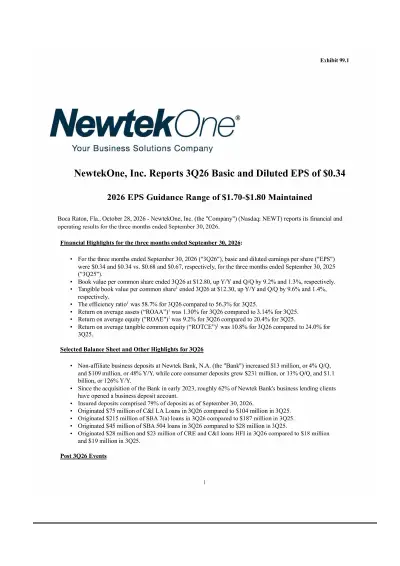
We delivered basic and diluted earnings per share of 34 cents. We are able to reiterate the 2026 earnings per share guidance range of $1.70 to $1.80 for the full calendar year.
That is maintained. Important to note, up and to the right pattern in growth in book value and tangible book value continues to be maintained intact.
Matter of fact, our book value came in at $12.80, tangible book $12.30, respectively. The tangible book value growth was up 10% year over year and 78% since we took over the bank in January of 2023 and converted the publicly traded NewtekOne into a financial holding company.
Also important to note that we were able to continue to grow earnings with real good operating leverage on a year-over-year basis. Our Q3 2026 operating expenses were flat and a 3.7% respectively on asset growth of 47%.
The 3.7% is on a year-over-year comparison. Important to note, the company since acquiring the nationally chartered bank has had good experience in growing deposits, as they have more than doubled for the second consecutive quarter.
In 15 quarters, we have grown Newtek Bank's deposits from $142 million when we took over the bank to $2.6 billion. Non-affiliate business deposits increased quarter over quarter and year over year by $13 million and $109 million respectively, and core consumer deposits climbed $231 million quarter over quarter and $1.1 billion year over year, with loan originations also growing, with deposits fueling that growth, and year-to-date loan originations of $1.2 billion are up 12% year over year.
Also important to note, for the SBA's fiscal year ending September 30th, 2026, Newtek Bank ranked number one by volume—excuse me, number one in units of SBA loans approved and number two by dollars. Slide number 4.
In focusing on NewtekOne, I think the important aspect of our organization, as we look at the market and the economy, clearly the concept of how our business is going to grow going forward with the marketplace really embracing artificial intelligence, or as the president calls it, super intelligence. We have built one integrated platform over the course of 28 years to serve the 36 million demographic that are defined as U.S.
SMBs through five digital solutions without the use of traditional bankers, brokers, or BDOs. We think this is extremely important because as the marketplace starts to move towards the use of super intelligence or artificial intelligence, organizations that embrace that, particularly financial institutions and banks, are going to be extremely important and viable going forward.
We do have concerns over an industry that is primarily focused on traditional bankers and traditional branch network to acquire customers. On slide number 4, our NewTracker system, you can see, is able to acquire 600 to 800 unique business referrals per day, and the cost per referral is zero.
We manage that through alliance partners. It's all in our public documentation, in our Ks and Qs, organizations like UBS, Morgan Stanley, Raymond James, Monroe County Bar Trade Association, that don't make these types of loans, aren't depositories, don't do payroll, don't do insurance, don't do real-time payments, refer their customers to us to provide them solution and enhance the overall benefit to the relationship they have with customers.
I think it's important to note that over 28 years and 3 and a half years operating as a digital direct bank, we have excelled in banking, lending, insurance, real-time payments, and payroll. The patented NewTracker system, which I think is extremely important to our business model and its proprietary capabilities, are extremely valuable.
The Newtek Advantage, which is the business portal which is on our website, that gives the client a real advantage of doing business with us over other financial institutions, offers a single pane of glass delivering a full product suite to the customers. It gives them transactional capability, analytics, and data that competitors simply do not.
Looking at our organization further, we are an S&P-rated servicer. We're currently servicing over $5 billion worth of loans, and this is a business that we excel in.
We service for the FDIC. We service for NCUA, and NCUA is the credit union regulator.
We have a nice reputation in servicing small- to medium-sized business owners and loans that are made to that particular investor group. Also important to note, we have a frictionless digital account opening infrastructure that continues to gain momentum.
Now a lot of banks have digital account opening, but it's primarily for consumer checking or consumer high-yield savings. There are very few financial institutions, and particularly even the biggest banks in the United States, that in order to open up a banking account for business, you have to go into the branch and fill out the paperwork.
We've done a very good job in this particular area. We have approximately 47,000 depository accounts with no traditional bankers, with zero branches, that basically are assisted by business service specialists on camera in the United States 24 hours a day, 7 days a week.
We're very proud of our operating history, and it really delivered robust, flexible, and financial returns, both for ROAA, ROTCE, revenue growth, and our last 12 months of trailing net income. On slide number 5, we talk about our ecosystem for the customer, where there are five solutions built around the SMB: banking, lending, insurance, payments, and payroll, all necessary and important functions for business owners that instead of dealing with us, if they don't deal with us, they're going to an ADP and Paychex, they're going to a local insurance agency, they go to a fintech for their loan, and their bank for deposits, and regarding real-time payments, they just don't have it.
We're very proud of the ecosystem that we have built for our customers, and think it is very much of a hidden value in our organization. Historically, we have expensed the intellectual property and the IT off of our balance sheet and income statement.
Slide number 6. NewtekOne's ecosystem, once again focusing on that SMB value proposition, it all relates to the customer: helping them grow their business and their revenues, reduce business owner risk, reduces business owner expenses, and give them one platform, the Newtek Advantage, for real-time data, which enables us to onboard them in a frictionless manner, very quickly, give the customer a real-time view of their balances, card batches, chargebacks, ACH, Fedwires visible in the Newtek Advantage, as well as an invoicing system, as well as full analytics capturing historic transaction information and a lot of information that exists in the Advantage, including document storage and QuickBooks integration as well as QuickBooks analytics.
On slide number 7, there's a nice diagram on slide 7 which really discusses how clients approach us with a referral through the NewTracker system. You have this very big funnel, some coming from financial institutions for referrals, trade associations, CPAs, law firms, and alliance partners, and we get these unique referrals, we don't pay for them, we do pay a success fee if we provide a solution, some up front in the case of lending, and ongoing reoccurring income usually on the other solutions, and we're able to do this without branches, traditional bankers, or brokers.
We say hundreds of alliance partners, it's actually in excess of 1,000 that we have contracts with, and these referrals come in on a regular basis. When customers come to us for a loan, we don't look at the client saying you're applying for an SBA loan, you're applying for a commercial and industrial loan, or a line of credit.
We look at the customer and fit them with the best solution. If you actually go to our website, we don't advertise on the website that we're an SBA lender.
In many cases, they get an SBA loan, but we wind up giving them the best product at an attractive price and a low monthly payment to fit their needs. NewTracker is our patented engine.
It's one application. It's one CRM.
It gives us tremendous intake, particularly using artificial intelligence, to examine tax returns and spread financials, to examine lease agreements, to examine operating agreements, as well as using AI to go to municipalities and get liens. This is how we're able to make loans on a completed loan package within 7 days from having all the information in one particular area.
We also offer real-time tracking to our alliance partners, 24/7/365, as well as giving them nightly reports. Underwriting and compliance check, it's terrific.
We have complete data on the interaction with the customer, whether it's a text, whether it's an email, or telephonic conversation. Let's go to slide number 8.
The Newtek Advantage, that single pane of glass. Extremely important is the quality of service.
Matter of fact, when you look at our Trustpilot scores, NewtekOne on Trustpilot, 4.9 out of 5. Newtek Bank, 4.5 out of 5.
When you go to entities like DepositAccounts.com and you compare us against some of the top banks which are below two, they're like 1.8, 1.7, 1.6, we're 4.0 on DepositAccounts.com. We're very proud of the fact that Trustpilot has us positioned as the number one payroll provider for service, and number two in real-time payments.
The Newtek Advantage snapshot on slide number 8 gives you an idea of the view that the client gets when signing up for one or many of our Newtek products. It's a digital-first entry.
It gives them real-time payments clarity, whether it's a wire, whether it's making payroll with the money going in on Monday and paying employees on Monday, whether it's having a batch of a Visa/Mastercard receivable actually hitting the same day that we're able to process the transaction, showing the client in the banking portal what their batches are, refunds, chargebacks, everything right in the portal. We really give the client a live view of cash flow, payments, loans, banking, and payroll, and importantly, it's on demand, on camera, access 24/7, individuals in the United States that can help the customer.
It's really tremendous value beyond traditional banking, particularly where we give clients unlimited document storage, web traffic analytics, and two-way QuickBooks integration. On slide number 9, this is what NewTracker does.
It does many, many things, not only for the client or the alliance partner, but for our organization. Those Trustpilot scores that we get are not by happenstance.
It's a live check on the operational efficiencies of our business service specialists and our CSRs in the field each and every day, every a.m., every p.m., every day, every week, and every quarter. Slide number 10, which we talked about a little earlier, demonstrates the tangible book value per share, has a nice depiction of the dividends on top.
It shows the growth from the time we bought the bank to today, $12.30 in tangible book, with dividends, $15.11. Slide number 11 shows the deposit growth and the success that we talked about, 11,646 business accounts for checking and business savings, core deposits, 35,000 accounts.
Slide number 12, we talk about this product quite a bit. It's an important product to us.
It's a growth product for us. We refer to it as commercial and industrial, acronym C&I LA, LA standing for long-am loan securitizations.
What we've learned over the course of 23 years is clients strongly prefer amortized loans without a balloon payment over 10 to 25 years. We do require personal guarantees, joint and several, every 20% equity owner or greater at a minimum, and we also lien personal and business assets when obviously the business assets are required, personal when applicable.
You could see, when we put these loans on our balance sheet, we then put them into securitization. We're now doing these loans out of Newtek Bank, National Association.
We talk about initial overcollateralization and current overcollateralization. That is the ownership certificates in these securitizations as they're done off balance sheet.
Important to note, look at the current OC versus initial. You could see, the excess cash flow that we get from these loans is amortizing the senior debt in the securitization.
It grows the ownership certificates and the book fairly rapidly over the course of time. I think this is indicative of the power of the excess cash flow coming off of loans that are put on the books at Treasuries plus 950 over the 5-year.
When you look at our securitization spreads, which are things that we've talked about in past presentations, they're typically 660 off the 5-year Treasury. The loan is typically fixed for 5 years.
There's 100 basis points of servicing which we keep, and then we have a spread historically of 560 to where the bonds are yielding in the marketplace. Slide number 13 is an important slide, that's Newtek Bank, N.A.
You could see that at the bank, and we're looking to do more and more of our business at the bank and less and less of our business at the holding company. We have fairly high ROAAs, ROEs, efficiency ratios are low, NIMs are high, cost of deposits, a market rate.
I continue to say this on conference calls: If you're paying the consumer 1% or you're paying them 3.8%, and I use the consumer, whether it's a business or whether it's actually an individual, what's more likely to move? Paying them a market rate of interest or a rate that is materially below where the 2-year Treasury or T-bills are currently paying?
We think it's the latter. We think we give our customers a good deal, and through the Newtek Advantage, we actually are able to do more things for the customer, where we're typically able to pay them 1% for business checking, 3 and a half percent on savings.
Why should they give us their deposits below the risk-free rate? Because we give them value, because we give them real-time payroll, because we give them real-time payments, because we give them analytics and transactional capability and data that they simply can't get at the top four big banks, who historically love this customer base because they can grab their deposits at 2% to 3% below the risk-free rate.
One other important note, when you look at our organization relative to capital and credit, we're utilizing more of our capital at the bank and at the holding company. Non-accruals, and I think this is extremely important, excluding government guarantees that the SBA prefers in its SOP that we buy out of the secondary versus them, 3.9% non-accruals.
Obviously, when you include the government guarantees and the guarantees are still intact, it's a much higher number. As market participants and analysts take the call report data, jam it into their AI models, and they come out and go, wow, this is really high, that's where we're running into issues.
For those of you that are following the company, paying attention to what we're doing, we believe we've historically done a good job over 23 years managing risk and reward, and you're getting compensated for the risk that's being taken. Slide number 14 provides further evidence of the fact that we are working very hard in improving the quality of the portfolio, with enhanced hires in the servicing department, managing our ACL to loans held for investment, excluding the guarantees, and this is important data and statistics that we look at and manage on a regular basis.
Slide number 15 addresses our returns that we're providing our shareholders. With that, I'd like to turn the presentation over to Frank DeMaria, and then we'll go to Q&A.
Frank?
Frank DeMaria
Thanks, Barry. Barry covered most of the relevant metrics for the third quarter, but I wanted to touch on a couple of topics, namely net interest income and the bank's held-for-investment loan portfolio.
Moving to slide 17, third quarter net interest income of $18.9 million is the highest quarterly net interest income that we've generated in the almost 4 years as a financial holding company. Quarterly net interest income was up 26% quarter over quarter and 30% year over year.
The quarter-over-quarter increase reflects a full quarter of interest income from long-amortizing C&I loans that were originated in the second quarter, as well as the impact of holding the government-guaranteed portions of SBA 7(a) loans on the balance sheet for longer than we have historically. Similarly, we expect third quarter C&I LA originations should benefit net interest income in the fourth quarter.
Year-to-date net interest income climbed 20% versus the first 9 months of 2025, and the revenue mix is also shifting to net interest income, with third quarter and year to date at 26% and 23% of revenue respectively, versus 19% and 20% for the comparable periods of 2025. I'd also note a favorable net interest margin trend, with a mix shift on both the earning asset and liability sides, with the earning asset yield increasing with higher short- and medium-term interest rates, and funding costs moving lower, with deposit costs flat and the cost of borrowings down overall.
Moving to slide 18, slide 18 describes the bank's held-for-investment loans at cost, which are subject to CECL. The primary point of this slide is that the $57 million allowance for credit losses is largely comprised of reserves against the portfolio of unguaranteed SBA 7(a) loans, which accounts for almost 90% of the bank's ACL.
The $51 million portion of the ACL on the SBA unguaranteed book is 8.1% of the SBA unguaranteed balances. With that, I'll turn it back to Barry for closing remarks before we get into Q&A.
Barry Sloane
Thank you. I'd like to draw everyone's attention to slide number 19.
Recently, we saw a transaction in the capital markets where Bluevine, a fintech that acquires deposits and also acquires lending opportunities for third parties, agreed to be acquired by Valley National Bank for approximately $340 million. When I look at their technology versus ours, and we have intangible and goodwill assets on our books at $14 million because we've written off our IP over the course of time, I think that there's a lot of value in NewtekOne, and slide number 19 reflects that.
We have a proprietary, internally developed technology stack. The NewTracker system is patented.
It's digital account opening, it's automated, it's a frictionless loan origination platform, it's automated lead generation offering real-time payments, and a tremendous value proposition for the customer through the Newtek Advantage. It is a differentiated origination engine at a much lower cost and incredibly scalable.
It's a closed-loop customer funnel. Borrowers are required to make payments from a Newtek Bank account in lending, and there's a tremendous cross-service opportunity where one customer application feeds multiple applications across multiple solutions.
We think that the banking industry, which is feasted on deposits below the risk-free rate and low-margin riskless loans with low charge-offs, we do believe that SI or AI will change that over the course of time. Depositors and savers, particularly with higher rates, are really going to push for higher rates for what basically, through FDIC insurance, is essentially some form of a Treasury account.
We have a very scalable operating infrastructure and platform, and we have a complete offering of solutions for SMBs. Once again, there's no, I'd say, real mark-up given the low value of the intangibles and the goodwill.
We welcome offering demos of the NewTracker system and the Newtek Advantage to the six analysts that follow our stock. Learn more about our company, learn how we do the business, understand the scalability, and we welcome that opportunity and offer it on a regular basis, and hopefully we'll get some takers after this call today.
With that, operator, I'd like to turn it over to Q&A.
Operator
As a reminder, to ask a question, please press star one one on your telephone and wait for your name to be announced. To withdraw your question, please press star one one again.
Please stand by while we compile our Q&A roster. Our first question will be coming from the line of Elizabeth Wainer of Raymond James.
Your line is open.
Elizabeth Wainer
Hi everyone, this is Elizabeth Wainer on for Jon Arfstrom. Thanks for taking my questions.
Barry Sloane
Thank you, Elizabeth.
Elizabeth Wainer
In the prepared remarks, you reiterated your 2026 EPS guidance of $1.70 to $1.80, which implies a step-up in 4Q earnings. Could you walk us through the primary drivers of that improvement, particularly given the sharp decline in gain on sale income?
Should we expect the improvement to come primarily from continued NII growth, or are there other revenue or expense items that should contribute?
Barry Sloane
Thanks, Elizabeth. I appreciate that.
I think that if you go back and look at the company's history as a bank both and as a BDC, there clearly is a seasonal lift to Q4, particularly for lending originations, which do drive the P&L. I think the concept of us doing more loans in the fourth quarter as well as the growth in net interest income, which our press release indicated probably is growing somewhere around 20% sequentially, and certainly bigger numbers on a year-over-year basis, and that's going to start to compound.
Matter of fact, if you look at an SBA loan, we are typically a prime plus three lender, which today would get you to about 10% coupon, with our cost of funds at call it 3.6% or 3.65%. That's about 640 basis points of spread income.
You could sell it for a gain on sale or you could hold it for a 4- or 5-year duration, and over the course of time, you'll probably do better holding it. It does affect the current income and the current quarters.
After running the bank and bank holding company model for 3 and a half years, we're looking to diversify that a little bit, and I think you'll see that split up going forward. I do appreciate the question.
Thank you.
Elizabeth Wainer
Thank you. That was helpful.
Then we've seen some softer small business confidence data recently, with inflation and labor costs continuing to pressure business owners. Are you seeing that translated at all into any weaker demand for SBA loans or any change in borrower performance?
Are there any particular industries or borrower vintages where you're seeing more stress?
Barry Sloane
To be frank and transparent, we believe that, and we have adjusted for that in our risk models, in our CECL calculations, and in our business valuations, that the uptrend in rates, particularly post-COVID, of 3% to 5%, now we're off of the highs of 5%, but we're still pretty high, and the fact that we've had fairly stubborn inflation for a window of 4 or 5 years has been difficult on us. It's been difficult on older vintage loans.
Look, I don't have a crystal ball. I don't necessarily have a forecast.
We just had the Fed governor, who really only controls short rates and not long rates, pretty much left the short rate environment flattish, but they're looking at it. He has some concerns about inflation, and I do think that there has been stress on the historic portfolio.
I do believe that once we get through these midterms, I think that oil, which has been the primary driver of inflation—these are all risk factors that are in our Ks and Qs, I point out to please, please read those risk factors—will hopefully move in the right direction, reduce rates, reduce inflation, and give us a lift. We are seeing that at these higher level of rates, it is more challenging to make loans, it's more challenging to grow the business, and therefore we have muted our origination volumes with the guidance that we've given recently and going forward, and we've also tightened underwriting guidelines historically and are doing so as we speak right now.
Elizabeth Wainer
Understood. Thank you for answering my questions.
Barry Sloane
Thank you.
Operator
Our next question will be coming from the line of Emily Lee of Keefe, Bruyette & Woods. Your line is open, Emily.
Emily Lee
Hey everyone, this is Emily Lee on for Tim Switzer. Thanks for taking my questions.
Barry Sloane
Thank you, Emily.
Emily Lee
I was wondering if you could provide some details just on the size and economics of the securitization expected to occur in 1Q 2027?
Barry Sloane
We're looking to hopefully do a financing with about $350 million to $400 million of collateral. I think it'll be closer to the $400 million.
We'll be looking to issue bonds in the month of January.
Emily Lee
Great. Thank you.
Then also, could you just elaborate on some of your comments in the release and the prepared remarks regarding exploring all strategic alternatives to help the market recognize Newtek's value? What exactly strategies are under consideration here?
Barry Sloane
I think that from our standpoint, we're in the market every single day. I wake up with a clear head and a clear vision, and that's been true since we became a public company in September of 2000.
We clearly think that there are opportunities within our organization, and we have regular conversations with strategic alliance partners. We have regular conversations with technology solutions providers that are interested in our technology.
From time to time, we have people that look at different components of our organization. We will always be opportunistic to recognize value and reduce risk for our shareholders, depending upon where the market is at a given point in time and conditions, which frankly are pretty volatile and constantly changing.
Without putting my finger on any one particular item, I think it just says we are open to having conversations with people about our business, our business model, how it works, and where we could derive value and get better value frankly than where we're currently receiving in the marketplace, where we think we are dramatically misunderstood, particularly when it comes to the technology platform that we have.
Emily Lee
Understood. Thank you, Barry, and thank you, everyone.
Thanks for taking my questions.
Barry Sloane
Thank you.
Operator
Our next question will be coming from the line of Christopher Nolan of Ladenburg Thalmann. Your line is open.
Christopher Nolan
Barry, I'll take you up on the tech demo at some point.
Barry Sloane
Would love to do that, and we'll call you and schedule something right after your earnings season, okay?
Christopher Nolan
Sounds good. Your capital ratios seem to be at a point now where should we expect balance sheet growth to slow in the fourth quarter pending the securitization?
Barry Sloane
Chris, good question. When we do the securitization in January, whatever's on the balance sheet will come off the balance sheet, so that'll be helpful just from a ratio perspective.
We obviously have to have the right capitalization on the ownership certificate that we will be holding. I think that we're pretty much where a normal organization would be, a bank of our size, relative to these ratios.
I think from our standpoint, we're going to take it one quarter at a time, manage the capital, manage the risk, and look to continue to be well capitalized given the risk that we have in the marketplace.
Christopher Nolan
Great. Then the boost in the Holdco net interest margin, now is related to the strategy of moving more of the 7(a) business to the bank?
Barry Sloane
Yes, moving them to the bank, and while they're in that accumulation phase, they're on balance sheet, that expands the NIM. The reality of it is in the appendix we have a slide which we refer to NIM and adjusted NIM.
Adjusted NIM would bring them back on the balance sheet. We've got a much larger adjusted NIM at the Holdco rather than what I would call the non-adjusted NIM, because you don't have the off-balance-sheet loans as part of that calculation.
If I can just quickly go forward here, I'll have to dig it out, but it's one of the slides. I don't know, Frank, if you know what that slide is, but there's an adjusted NIM calculation, I believe, in the appendix somewhere.
Frank DeMaria
Slide 28. To that, Chris, we did have a full quarter of the C&I LA loans that were originated in Q2.
Then cost of borrowings, as we bring that down, the overall cost of borrowings came down, too, at the holding company, so that also helped.
Christopher Nolan
Okay. Thanks, Frank.
Then final question, talks on deposits. One of the growth challenges that you guys experience is growing your low-cost core deposit base.
Over year to date, based on the last Q, yeah, it seems like growing that percent that as a percentage of total deposits seems to have stalled, excluding savings accounts and CDs and stuff. It was just trying to get an idea as to obviously you want more core deposits, but is it one of those things where we're going probably have to wait till back half of 2027 or something?
Barry Sloane
Chris, it's a good question. For all my presidents and COOs and operators that are on the phone, get moving.
Christopher Nolan
There you go, Barry. Crack the whip.
Barry Sloane
I owe you a high five on that. From real-time payments, insurance, payroll, ham and eggs, you can't have a payroll account without a depository account.
You can't have a merchant account without a depository account. Insurance, buying and moving the premiums right out of the account, particularly as it connects to payroll.
I wish we could move sort of in this really straight line with a lovely slope. We work on trying to put this into the software and make it more of a function that just kind of goes with the whole thing.
Today when you go in a Dunkin' Donuts, they jam the hash browns in your bag whether you want them or not. I think that, a, through better mentoring, management, and training, and we've recently made some hires, and going forward, through the use of agentic AI robots, we're going to get this done.
It's all there, and it's to be taken. However, it's slower than I'd like, and it's a good point.
Yes, we're on the team.
Christopher Nolan
Okay. Thank you, Barry.
Thanks, Frank.
Barry Sloane
You made my job easier, Chris. Thank you.
Christopher Nolan
Hey,
Frank DeMaria
it's
Christopher Nolan
my day. Thank you.
Barry Sloane
Okay.
Operator
As a reminder, to ask a question, please press star one one on your telephone and wait for your name to be announced. Our next question will be coming from the line of Crispin Love of Piper Sandler.
Your line is open.
Ben Graham
Hey, good afternoon. This is Ben Graham for Crispin Love.
Thanks so much for taking my question. Just looking at the slide deck where you highlight the C&I LA loan metrics, non-performers increased to $82 million from $46 million last quarter.
Just wondering if you could discuss a little deeper the drivers of that increase, and is it concentrated in any type of industry or type of borrower? Then what's your sort of general outlook for credit in the C&I LA loan book in the current environment?
Thank you.
Barry Sloane
It's over a billion dollar portfolio. As you ramp up the default curve for business loans, that starts to come into place, and we actually have embedded in our calculations a historic cumulative severity and charge-off number.
I would say there's no specific industry where that might be coming from. It's hard to predict a pandemic.
It's hard to predict not that we have these issues, our own like taxi cab medallions, where all of a sudden overnight an industry gets obliterated by Uber. It's a diversified portfolio.
When you're charging borrowers at T plus 950 off the curve, the excess servicing spread and the collateral that you get for these loans and the personal guarantees offsets that. Now that this is not similar to a bank portfolio where you're doing residential mortgage loans that might have a 10 or 12 year duration at 120 to the curve, and you really don't know what your duration is, or car paper, which is really short in duration.
You wind up getting the benefit from huge spread with longer duration over time. You get that on the 7(a) portfolio, and you get that on the C&I LA loans.
That actually compounds and offsets that. This has been where this becomes really difficult for the community and investors to look at a traditional bank model, take this stuff, put it in the computer on a call report, bang out a report, and that's kind of where we have heartburn.
We'll get through it, and we'll continue to produce the good returns. No, there's nothing specific.
We've talked about as a portfolio seasons over the course of time, you're going to have these issues.
Ben Graham
Got it. I appreciate the color there.
I'll step back, but thank you so much.
Barry Sloane
Thank you.
Operator
I would now like to hand the call back to Barry for closing remarks.
Barry Sloane
Great. Thank you, operator.
Greatly appreciate all the analysts' activity and the questions and paying attention to our organization. Once again, I want to thank the management team for delivering a really good quarter, and also to Bryce Rowe and Frank for putting together a real strong investor deck.
It's not easy. We put a lot of time and effort into this, so, and also for all the investors for listening in today.
Thank you very much. Have a good rest of the afternoon.
Take care.
Operator
This concludes today's conference call. Thank you for your participation.
You may now disconnect.