NextDecade Corporation
Q3 FY2026 · Earnings Call TranscriptOctober 29, 2026
Operator
Good morning, and welcome to the NextDecade Corporation's Third Quarter 2026 Investor Call and Webcast. At this time, all participants are on a listen-only mode.
A question-and-answer session will follow management's prepared remarks. If you'd like to enter the queue, the command is *1 on your telephone keypad.
If anyone should require operator assistance during the conference, please press *0 on your telephone keypad. As a reminder, this conference is being recorded.
Now I'd like to turn the call over to your host, Megan Light, NextDecade's Vice President of Investor Relations. Thank you.
You may begin.
Megan Light
Thank you, and good morning, everyone. Welcome to NextDecade's Third Quarter 2026 Investor Update Call and Webcast.
The slide presentation and access to the webcast for today's call are available on our website at www.next-decade.com. Today, I am joined by Matt Schatzman, NextDecade's Chairman and Chief Executive Officer, and John Zuklic, NextDecade's Chief Financial Officer.
Before we begin, I would like to remind listeners that discussion on this call, including answers to your questions, contains forward-looking statements within the meaning of U.S. federal securities laws.
These statements have been based on assumptions and analysis made by NextDecade in light of current expectations, perceptions of historical trends, current conditions, and projections about future events and trends. Although NextDecade believes that the expectations reflected in these forward-looking statements are reasonable, it can give no assurance that the expectations will prove to be correct.
NextDecade's actual results could differ materially from those anticipated in these forward-looking statements as a result of a variety of factors, including those discussed in NextDecade's periodic reports that are filed with and available from the Securities and Exchange Commission. In addition, discussion on this call includes references to certain non-GAAP financial measures, such as distributable cash flow.
A definition of and additional information regarding these measures can be found in the appendix to our presentation. Now, I will turn the call over to Matt Schatzman, NextDecade's Chairman and Chief Executive Officer.
Matt Schatzman
Thank you, and good morning. We continue to make excellent progress toward first LNG production at Rio Grande LNG.
Phase 1 construction remains safe, on budget, and ahead of schedule. We remain on schedule to introduce hydrocarbons into the facility before year-end.
Today, we're narrowing our guidance for first LNG production from Train 1 to the second quarter of 2027, consistent with the early volume guidance we provided earlier this year and are reaffirming today. Train 1's guaranteed substantial completion date is near the end of the fourth quarter of 2027.
We expect Bechtel to achieve substantial completion in the third quarter of 2027, which is one quarter early. Trains 2 and 3 also remain ahead of schedule and aligned with our early volume guidance.
During the quarter, the main cryogenic heat exchanger was installed for Train 2, and the first compressor string was set for Train 3. We expect both trains to achieve substantial completion about one quarter ahead of their guaranteed schedules, consistent with Train 1.
As outlined in our early volume and cash flow guidance, commissioning and early uncontracted volumes from Rio Grande LNG Trains 1 through 5 provide valuable market exposure to NextDecade over the next few years, and the current LNG market dynamics are very favorable. Spot LNG prices remain strong and have increased materially over the last year due to the loss of supply from the Middle East.
Based on current forward LNG and U.S. gas prices, we estimate the volume-weighted average implied margins on the projected uncontracted volumes from Train 1 start-up in 2027 through the date of first commercial delivery under the Train 5 long-term SPAs at RGLNG, together with the impact of the 175 TBtus we sold forward in Q1 of this year, to average over $6 per MMBtu, more than $1 per MMBtu above our base case guidance.
Using these estimated implied margins for our projected uncontracted volumes, NextDecade's share of Rio Grande LNG project-level distributable cash flow during this period would total over $2.4 billion, or over 20% above the projected $2 billion of cash flow in our base case guidance. Each $1 per MMBtu change in the estimated volume-weighted average implied margin on our uncontracted volumes from Train 1 start-up through Train 5 DFCD, including the impact of the additional 175 TBtus sold in Q1, would change NextDecade's projected share of project-level distributable cash flow by approximately $350 million to $400 million over the forecast period.
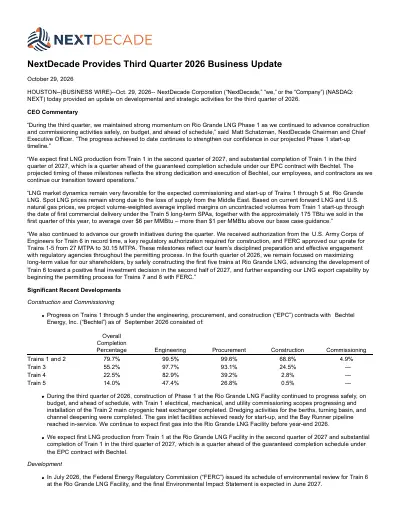
As of September 2026, Trains 1 and 2 were nearly 80% complete. Engineering and procurement were nearly finished, construction was almost 70% complete, and commissioning was approaching 5%.
Train 3 was more than 55% complete, with engineering nearly finished, procurement above 90%, and construction approaching 25%. Train 4 was 22.5% complete, and Train 5 was 14% complete.
During the third quarter, electrical, mechanical, and utility commissioning advanced on Train 1. More than 100 operations personnel seconded to Bechtel in the second quarter are working alongside its team and will remain through commissioning and start-up to support a smooth transition to operations.
During the third quarter, installation and pre-alignment of Train 2's compressor strings were completed, and its main cryogenic heat exchanger was installed. Train 3's first compressor string was set.
Foundation pours began for Train 4's main cryogenic rack, along with the excavation of its refrigeration area. Soil stabilization using the direct mixing method began for Train 5.
Tank 1 completed inner tank nickel plate welding and its first hydrotest. Piling advanced for Tank 3 and began for Tank 4.
Site-wide dredging for the berths, turning basin, and channel deepening is complete. The gas inlet facilities are ready for start-up, and the Bay Runner Pipeline entered service during the third quarter.
More than 7,000 workers are now on-site each day, with over 70% of them local residents. We are proud to provide safe, high-quality, long-term jobs that make a meaningful impact in the Rio Grande Valley.
Across the site, commissioning of systems is underway to support initial hydrocarbon introduction before year-end. We made meaningful regulatory progress during the third quarter.
FERC approved our uprate request for Trains 1 through 5, increasing authorized LNG exports from those trains to 30.15 million tons per annum, consistent with our expected annual five-train LNG production. As we mentioned on our last call, in July, FERC released its schedule of environmental review for Train 6, and the final environmental impact statement is expected in June of 2027.
In September, the U.S. Army Corps of Engineers authorized a key construction permit for Train 6 in record time, reflecting our team's disciplined preparation and effective regulatory engagement.
We're advancing commercial discussions with multiple high credit quality counterparts for long-term Train 6 LNG offtake. Demand for our long-term LNG from Rio Grande LNG remains strong across a global customer base.
Since the Iran conflict began in February, the global LNG market has tightened significantly, and forward prices for 2026, 2027, and beyond have risen. Potential long-term buyers have also placed greater emphasis on energy security and supply diversification.
These priorities have been prominent since the Russia-Ukraine conflict began in 2022 and have intensified this year. As we have said, long-term LNG supply from Rio Grande LNG offers buyers an effective combination of attractive pricing and supply security.
United States' abundant, diversified natural gas resources and our competitive LNG construction costs support affordable, reliable long-term supply and help protect customers from regional natural gas and LNG price spikes. We expect to advance long-term Train 6 offtake discussions while permitting proceeds, with the goal of securing sufficient commercial support to enable a positive final investment decision, or FID, in the second half of next year.
Long-term LNG contract pricing has remained strong since we contracted Trains 4 and 5. Based on current market conditions, we'd expect Train 6 returns to be at least as strong as those trains.
Given that outlook, our goal is to retain a substantial economic interest in Train 6, which NextDecade currently wholly owns, although we may consider a joint venture tied to a high-quality strategic LNG offtake. We continue to evaluate capital raising options for our projected Train 6 equity commitments, with a focus on maximizing shareholder value.
We expect additional Finco capacity to fund part of Train 6's equity requirement, and are evaluating alternatives for the balance, with a focus on the most accretive per-share solution. Finally, we selected the western end of the Rio Grande LNG site for Trains 7 and 8.
We expect to pre-file with FERC before year-end. The schedules place Trains 7 and 8 roughly one year behind Train 6 in permitting and development.
I'll now turn it over to John.
John Zuklic
Thanks, Matt, and thanks to everyone for joining us on the call today. During the third quarter, we continued to execute our project-level balance sheet strategy of turning out bank facility debt through opportunistic debt capital markets transactions, which during the third quarter included approximately $4.1 billion of senior secured notes issued by Rio Grande LNG LLC, our Phase 1 financing entity.
These refinancings extended and staggered our debt maturity profile while also releasing committed bank capacity for financing Train 6 and subsequent expansions. We've now refinanced over $7 billion, or 60%, of the $11.1 billion of initial capacity under the Phase 1 bank facilities, leaving drawn balances under those facilities of approximately $700 million as of September 30th.
As we mentioned on our last call, in July, Rio Grande LNG LLC issued $3.5 billion of senior secured notes in its inaugural 144A offering. These notes, which were rated BBB- by S&P and Fitch, were issued in four tranches with maturities ranging from 2031 to 2041 and with fixed rates ranging from 5.15% to 6.15%.
We used proceeds from the offering, net of fees, to reduce outstanding balances on the Phase 1 bank facilities. In conjunction with the 144A offering and the $1 billion term loan we entered into at a Phase 1 holding company in late June, we unwound the portion of our interest rate swaps associated with the bank debt those transactions repaid, resulting in $109 million of settlement proceeds in July, which we used to further reduce our Phase 1 bank borrowings.
Then in September, Rio Grande LNG LLC issued another $575 million of senior secured notes in a private placement transaction. The notes, which bear interest at 6.72%, will amortize over a period of approximately 18.5 years, beginning in June 2029, with a final maturity in December 2047.
Similar to the previous two issuances noted, we also utilized proceeds from this transaction to reduce outstanding borrowings under the Phase 1 bank facilities and to pay transaction-related fees and expenses. We're very pleased with the market response to our recent financings.
There has been tremendous demand for and interest in Rio Grande LNG project-level credit. As an indication of that interest, the 144A offering in July was four times oversubscribed, and the notes priced at the tight end of our expected range.
As we've said previously, we expect to continue to opportunistically capitalize on robust market opportunities as we seek to refinance the remaining Phase 1 bank facility balances, as well as the project-level bank facility balances for Trains 4 and 5, which consisted of approximately $900 million drawn on the Train 4 bank facility and no outstandings under the Train 5 bank facility as of September 30th. Two additional financial transactions I would like to note are the July issuance of a $100 million installment and, subsequent to the third quarter, the October issuance of a final $150 million installment of the Train 5 6.56% senior secured notes due 2050, which were issued pursuant to the note purchase agreement entered into in conjunction with the positive final investment decision on Train 5 in October 2025.
The full $500 million of these Train 5 senior secured notes have now been issued and remain outstanding. There's also one minor accounting item that I would like to mention before moving to our NextDecade-level debt discussion.
In the third quarter, we moved proceeds from vessel sub-chartering to other income, net on our income statement, where it will be recorded until we begin operations. Sub-chartering proceeds were previously recorded as an offset to operating and maintenance expense.
We made this adjustment because we believe presenting sub-chartering proceeds in other income, net provides a more helpful view of our activities and operating expenses. Once we begin operations, we expect any proceeds from sub-chartering vessels to be recorded as part of revenue on our income statement.
Next, I'd like to talk about our leverage above the project companies, up at the NextDecade level. Since I joined the company in July, we've received a fair number of questions about our capital structure, and I'd like to take a few minutes to better explain our current balance sheet, debt targets, and near-term capital priorities.
In February of this year, we introduced a steady-state NextDecade-level unconsolidated leverage target comparing NextDecade-level debt to NextDecade's share of Rio Grande LNG project-level distributable cash flow less NextDecade-level G&A. For purposes of this leverage ratio, NextDecade-level debt excludes debt at the project and project holding company levels, which is consolidated on the NextDecade balance sheet, but is non-recourse to NextDecade.
This NextDecade-level debt currently consists primarily of the Super Finco and Finco term loans we entered into to fund the majority of our equity commitments for Trains 4 and 5 and relatively small corporate loans outstanding at a super holdings level. For purposes of this leverage ratio, NextDecade's share of Rio Grande LNG distributable cash less NextDecade-level G&A, which excludes non-cash compensation and also excludes G&A at the project and project holding company levels, effectively represents cash expected to be available for NextDecade-level debt service after the impact of debt service at the project level.
Using our base case guidance, which assumes $5 per MMBtu average margins on uncontracted cargoes during our ramp-up period, the leverage target we provided previously is consistent with NextDecade-level debt of approximately $2 to $2.25 billion when steady-state operations begin, following the date of first commercial delivery, or DFCD, for Train 5 long-term SPAs in the second quarter of 2031. We believe this NextDecade-level debt range will ensure a strong credit position into steady-state operations, given that the distributable cash flows from the Rio Grande LNG projects are underpinned by long-term SPAs on approximately 85% of the total expected Rio Grande LNG production volumes with high-quality, investment-grade customers, with a weighted average life of 19.5 years, and provides strong visibility and predictability during steady-state operations.
As a reminder, we are committed to using NextDecade's share of project-level cash flows generated during our ramp-up period from Train 1 start-up through DFCD of Train 5 SPAs to reduce a portion of the term loans we entered into to fund the large majority of our equity commitments for Trains 4 and 5. In our base case early volume and cash flow guidance, which assumes $5 per MMBtu margins on uncontracted volumes, we expect NextDecade's cumulative share of Rio Grande LNG project-level distributable cash flow to be approximately $2 billion, which we will use to first pay down Finco balances, then to pay Super Finco interest and/or principal balances.
In our base case, applying the projected approximately $2 billion of early cash flows to NextDecade-level debt repayment results in NextDecade-level debt that is within our target range of $2 to $2.25 billion when we enter steady-state operations. As Matt mentioned earlier in the call, market conditions have improved meaningfully since the Iran conflict began eight months ago, and today's forward curves imply LNG margins that exceed our base case guidance.
With current volume-weighted average estimated margins implied by the forward curves over our ramp-up period of over $6 per MMBtu, we would expect our share of project-level distributable cash flow to be over $2.4 billion for the ramp-up period of 2027 through the second quarter of 2031, or over 20% above our base case, which would result in projected cash flow generation in excess of what is needed to achieve our target debt range. Finally, I wanted to note that our downside steady-state guidance case assumes $3 per MMBtu margins on uncontracted volumes during our ramp-up period.
In this case, we assume that we contract an additional approximately 2 million tons per annum of capacity from Trains 4 and 5 under long-term SPAs, which would enable us to increase Trains 4 and 5 project-level debt, and therefore reduce our NextDecade-level debt down to a level consistent with our target. Given current market conditions, we do not expect to contract additional Train 4 and Train 5 volumes to achieve our steady-state NextDecade leverage guidance.
With that, I thank you again for joining the call today, and we'll open up the line for questions.
Operator
Thank you. At this time, we'll be conducting a question-and-answer session.
If you'd like to ask a question, please press *1 on your telephone keypad. A confirmation tone will indicate your line is in the question queue.
You may press *2 if you'd like to remove your question from the queue. As a reminder, we ask that you please limit to one question and one follow-up.
For participants using speaker equipment, it may be necessary to pick up your handset before pressing the star keys. One moment, please, while we poll for questions.
Our first question comes from Olivia Foster with Goldman Sachs. Your line is now live.
Olivia Foster
Hi, team. Thanks for the time.
I wanted to start on the operating front following the narrowed first LNG guidance on Train 1. Could you walk us through your expectations for commissioning milestones that underpin the second quarter '27 first LNG target?
Similarly, could you walk us through your expectations for timing on the commissioning processes broadly from first gas to first LNG to balance of plant commissioning to Train 1 substantial completion? Thank you.
Matt Schatzman
Hi, Olivia. As we mentioned in our commentary and in our presentation that's available on our website, we narrowed our guidance for first gas into the facility to the fourth quarter of this year.
We now expect first LNG production in Q2 of 2027 and substantial completion of Train 1 in Q3 of 2027, which is one quarter ahead of the guaranteed schedule in our EPC contract with Bechtel. I believe that provides the market a very good indication as to the milestones as they should expect to see.
I think we've laid them out fairly clearly. As we get closer to first LNG production and we have the opportunity to engage with the market, we will be able to provide even, hopefully, more specificity on the months that we expect to see the first LNG production and the exact month that's expected substantial completion.
Olivia Foster
Thank you. That's clear.
For my second question, I wanted to ask on the commercial front, particularly given ongoing LNG supply disruptions globally. How should we think about Next's ability to announce long-term SPAs for potential Train 6 FID by the second half of 2027?
What details can you share on the types of counterparties for which you are seeing the most interest, particularly following the Qatar headlines this morning? Then maybe zooming out, in the context of ongoing supply disruptions, how would you expect a bid for LNG supply security to drive potential contracting activity on potential Rio Grande capacity beyond Train 6?
Thanks.
Matt Schatzman
Thank you. Like I said in my comments, we've seen an increased interest in our LNG out of Rio Grande LNG, as well as other U.S.
LNG projects, after the Ukraine invasion. Now that's ramped up even more with the Middle East conflict and the disruption of LNG in the region.
I think it puts U.S. LNG, and specifically Rio Grande LNG, in an excellent position to sell more LNG out of our expansion capacity.
I think the timing of this is absolutely perfect. As far as the timing of when we're going to be announcing SPAs, we've said that our plan is to commercialize the facility during the time that we'll be permitting it.
We are in the midst of permitting at FERC. We filed the formal application.
We've received our schedule. When we expect to get the final EIS, and we expect the approval from FERC not soon thereafter the final EIS is issued.
We expect to FID in the second half of next year. You should expect to hear announcements on SPAs over the coming months as we approach those deadlines around the FERC issuing its order and our expectations to FID in the second half of next year.
Olivia Foster
That's clear. Thank you for the time.
Matt Schatzman
Thank you.
Operator
Our next question comes from Doug Irwin with Citi. Your line is now live.
Doug Irwin
Hey, team. Thanks for the question.
I wanted to start with the ramp period volumes. You've obviously sold the 175 million tons already, but could you maybe speak to your ability to potentially sell some additional volumes here to take advantage of the current spread environment?
Is that something you're making more comfortable doing now that you have better line of sight to first LNG on Train 1?
Matt Schatzman
As you can see on slide 39 in our corporate presentation, we highlight very specifically our expected available volumes that are uncontracted for certain periods of time, like 2027 to Q1 of '29, Q1 of '29 to Q3 Q3 of 2030. I think you're referring to those orange bars on that slide, which is in total during our ramp-up period 1,100 TBtus of available volume.
Right now, we have said in the past that we got the question about whether or not we planned to forward-sell more volumes. We're very, very comfortable with being long 1,100 TBtus during this period of time.
Importantly, we're about 700-plus million TBtus long, excuse me, 700 TBtus, not million TBtus, 700 TBtus long from Q1 '29 to Q2 2031. That period of time is not trading as high as '27 and '28.
I'd say on average, those margins are probably more in line with our $5 guidance case. We see the risk in that period as asymmetric to the upside.
We think obviously prices could retrace down the road, maybe come off a dollar or two, but considering the situation in the Middle East, we're really not anticipating that situation to resolve very soon, and we could continue to see volatility in the region, which could create more upside for those volumes. At this stage, I think we're comfortable not forward-selling more of this volume, especially those volumes on the back end of the period of time that's in question.
Doug Irwin
That's helpful. Maybe a follow-up around Train 6 financing expectations.
Just wanted to get your latest thoughts on how you expect to finance it, kind of what are the next milestones to look for, and kind of more broadly, does an improved margin outlook here during the first phase maybe give you a little bit of increased flexibility just throughout the process as you think about those options?
Matt Schatzman
I'll turn that to John. Thanks for the question.
John Zuklic
Thanks, Doug. As far as funding Train 6, first of all, just start back at the, and we've talked about this a little bit, but the contracting, we expect to contract a large portion of the capacity of Train 6 with long-term SPAs.
We've kind of said in the past, more than Train 5, more than that 75%, probably less than Phase 1 of 90%, somewhere in there. That large percentage of contracted volumes with long-term investment-grade SPA offtake parties is going to allow us to maximize the project-level non-recourse debt.
That's number one in reducing kind of the equity need there. Then as far as the equity, we expect to maximize the use of our attractively priced Finco debt structure, and that's exactly why you hear us now refinancing bank capacity in Trains 1 through 5 to free up that capacity for Train 6.
We like that pricing. We like the delayed-draw feature of that, we think that's an effective thing.
Then after that, obviously the remainder will be funded with some form of equity or convertible instruments. Of course, at the time, we'll look to maximize sort of the accretion for the shareholder at that point, but that's something we'll look at at the time.
Finally, I'd just say that when you think about the equity lift from our perspective, we think it's a very attractive project. We'd like to take a large portion, if not all, but we're also open to JVing with a strategic partner, some level of it, retaining majority interest in it, but that sort of a partnership that we may consider would also reduce the equity lift from a NextDecade perspective.
Matt Schatzman
I'll add on that last part that any sort of strategic structure that we're looking at, John and I are focused on maintaining a value for our shareholders that would not dilute in any way if we had just done it on our own. It's not necessarily that we would be giving away equity.
We basically structure in such a way that it maintains or maximizes value for our shareholders. It doesn't take anything away.
Doug Irwin
Understood. Thanks for the time.
Operator
Our next question comes from Jason Gabelman with TD Cowen. Your line is now live.
Jason Gabelman
Hey, good afternoon. Thanks for taking my questions.
I wanted to go back to the exposure that you've locked in here, the 175 TBtu. Is that in line with the $6 per MMBtu margin that you're seeing over the next few years?
I know you locked in earlier in the year before margins really stepped up, wondering if you can remind us what margins are there. Then, as capacity comes online and it seems like construction is progressing better than previously expected, is there kind of upside to the spot volumes that you could have over the next call it 12 months or so?
Matt Schatzman
On the first question about the 175 TBtus, you'll recall we disclosed that when we did those, the margins that we expected to achieve on that were north of $3. When we talk about the $6 weighted average price, it includes the impact of the volumes that were sold under that 175 TBtus and the price that we sold it for.
To answer your question is, no, they're not the same $6 margins, but the margins associated with those sales are included in our weighted average $6 price, $6 margin that we're referring to. As far as the potential to produce additional volumes, all the volumes that we have in our projections do not include the potential to debottleneck the facilities, and there's always a chance that some of the trains could start up earlier than what we've projected, including Train 1.
We're very, very confident now in the volumes that we provide in our guidance based upon the current ramp schedule and the discussions we've been having with Bechtel and the progress we've been making with the project.
Jason Gabelman
Great. My follow-up is, since we're approaching start-up, I was hoping you could refresh us on how the cash flow distribution will work from Rio Grande up to the NextDecade level.
Is it just a straight 20% payout from day one, or is it a bit more involved than that? Thanks.
Matt Schatzman
Thank you. I'll turn this over to John to kind of explain the whole thing as far as where the cash is going to go and how it's going to be utilized.
We have not provided detailed guidance on the exact structure of the waterfall between us and the financial investors. What we have provided, I believe, is a lot of clarity around based upon certain outcomes, whether that's a $3 margin, a $5 margin.
Now we're giving you guidance on what each additional dollar of margin on a weighted average basis, what impact that would have on the cash flow that we expect to achieve during this period of time, which we call the ramp-up period. Let me turn it over to John to explain again what we plan to do with the cash flow that we're going to produce during the ramp-up period.
John Zuklic
Thanks, Matt. I'd just reiterate that we don't look at it kind of annually.
We look at it over the entire ramp-up period, just to your point, there's a little bit more nuance than straight up, but that's exactly why we structure our cash flow guidance when we look at the entire ramp-up period from first LNG to Train 5 DFCD. There's a few reasons for that.
As with most typical project finance restrictions, cash is not allowed to leave the project companies until certain milestones are met. Even when we get into production, there'll be cash remaining in the project companies for those restrictions.
At the point cash can leave the project companies, they'd go to the investors as well as NextDecade, the NextDecade portion of those distributions from the project companies is required to pay down, as we talked about, the Finco and Super Finco debt. That's the next step in that evolution.
Then Finco being maturing in late or fourth quarter 2030, at some point there or at least before steady state, we expect to refinance both Finco and Super Finco for a few reasons. One, get us more attractively priced debt than we currently have, and secondly, open up flexibility to be able to allow for use of that cash.
When we do hit steady state at the end of DFCD of Train 5, as we said, our guidance case at $5 would have said $2 billion. Our current forward curve look would have us at $2.4 billion, which is kind of in line with the guidance we give that for every dollar of increase in margins over this period, we'd expect to generate an additional $350 to $400 million.
As we've said, we need to generate about $2 billion consistent with our guidance case to get us within that $2 to $2.25 billion of debt at the NextDecade level. At current forward prices indication, that would have us giving us excess cash about $400 million after we refinance Finco and Super Finco, we'd be able to use that cash, that incremental cash, once we've met our debt target, to fund subsequent trains or even distribute, but we'll make those capital allocation decisions a lot closer to that point.
Jason Gabelman
Great. Matt and John, thanks for the time and the answers.
Operator
Our next question comes from Wade Suki with Capital One. Your line is now live.
Wade Suki
Thank you. Good afternoon, everyone.
Appreciate you taking my question. Just going back to, I think, Olivia's question earlier on in the call on commercial activity and kind of the dialogue you're having there, I was just wondering if you might be able to kind of more broadly characterize the types of customers.
Are these mainly consumers, maybe portfolio players, combination thereof, and any read-throughs regionally or whatever you can give us, that would be great. Thank you.
Matt Schatzman
Thanks for the question, Wade. All the above.
I wouldn't say there's anything specific in the LNG market that I would highlight, except for a trend that we actually kind of started with our Train 4 and 5, and obviously appears to be accelerating, which is an apparent diversification that is occurring in the Middle East with some LNG producers there. I'll include our partner, ADNOC XRG, who is an LNG producer, has invested in our project as an offtaker.
You're absolutely seeing Qatar now diversifying their portfolio outside of Qatar beyond Golden Pass to whether they're now buying from third-party projects. I think that's a very interesting thing that's occurring, and I think it highlights the fact that the global market for LNG is starting to look for reliability, not just price, and that now that we have a destabilized location that represents currently 20% of our LNG supply, customers are starting to focus more on that.
They already were, but they're starting to focus on even more. It's highlighted even more lately.
All of our customers are very focused on the reliability, the certainty of supply, as well as price. Price is still really important.
It's a competitive market. Prices haven't increased from our last discussions.
The ranges of outcome we still think are in the same range they were last time we spoke, equal to or higher than what we were achieving in Train 5. Still a strong market.
I think, importantly, this massive spike in LNG pricing has not driven the long-term market price up dramatically. That's good for our customers.
We can manage that, and we can still have very healthy returns on Trains 6, 7, and 8 with the type of marketing prices that are currently out there. It's very good for our customers and very good for demand growth in LNG because with the U.S.
gas pricing where it stands today and where it's expected to be over the next 10 to 20 years, we can provide a very reliable, cost-effective natural gas supply to these companies and the countries that they serve.
Wade Suki
Fantastic. Appreciate that.
Appreciate you answering my second question there without me having to get in the way on the long-term pricing. I'll ask another one then, maybe shifting to the expansions Train 7 and 8, kind of beyond Train 6.
I think you mentioned these perhaps moving forward at, I want to say you said a year lag. Are you thinking, just to clarify, are we thinking Train 7 a year later, and then Train 8 a year after, a year later after that, or could you see these actually moving ahead pretty close together or if not, simultaneously?
Matt Schatzman
Thanks for the question. I'll make it very clear.
7 and 8 are one project. They are not going to be sequenced one train at a time.
We'll be pre-filing those here in short order, the market will get a better indication of what the project looks like. It's two trains, expect another berth, and expect a couple, maybe one or two tanks.
It is a stand-alone project separate from RGLNG Train 1 through 6. As we said in our comments and on our presentation, we are now highlighting that we're going to do that on the western side of our facility, and we're going to leave the eastern side for any further development for potentially the next two trains.
That's where we could put Trains 9 and 10 if we do them in order.
Wade Suki
Got it. Thank you so much.
Appreciate it.
Matt Schatzman
We are going to do them in order. That made it sound like we weren't.
We're going to do them in order. 9 and 10 will be on the east.
Wade Suki
Perfect. Thanks again.
Mhm.
Operator
Our next question comes from Alexander Bidwell with Webber Research. Your line is now live.
Alexander Bidwell
Good afternoon. Appreciate the time.
Just wanted to circle back over to SPAs. You touched on pricing earlier, but can you give us any color on what you're seeing in terms of appetite for tenor?
I know we've seen a number of recent SPAs out of the U.S. come in north of 20 years.
Do you see that as a meaningful representation of demand around tenor?
Matt Schatzman
Thanks for the question. I think the tenor is still coalescing around 20 years is the standard contract.
There are customers out there looking for shorter, 10 to 15, but even European customers are willing to do 20 years. That was an issue.
I think they've figured out how they can do that. I think the longer-term contracts are there are some out there, but I think they're the exception, not the norm.
Alexander Bidwell
Okay. That makes sense.
Then wanted to also circle back on the debottlenecking. Could you walk us through how you're thinking about any of those potential debottlenecking opportunities?
Would you potentially pursue debottlenecking on T1 through 3 before 4 and 5 are finished, or is it something that's more of a long-term goal?
Matt Schatzman
We've had a team in place that's been focused on optimizations for quite some time. The plan is once we start operating these facilities, the keys are turned over to us at substantial completion for each train, and even during commissioning, is to understand what the bottlenecks are going to be and to put them into a hierarchy of lowest cost to achieve outcomes to the highest cost, and knock out that low-hanging fruit as quickly as possible.
Expect us to be focused on this. They're already focused on it, but from day one, once the operations are turned over to NextDecade, we get the keys, we'll be trying to debottleneck as soon as possible.
If there's any capital investment required, clearly, if it hurdles properly for our returns, we'll be focusing on trying to do that as soon as possible for Trains 4, 5, and 6, and probably working that into the construction if it makes sense.
Alexander Bidwell
All right. That makes sense.
I'll turn it back over.
Matt Schatzman
Thanks. Thanks.
Operator
Our last question comes from Craig Shere with Tuohy Brothers. Your line is now live.
Craig Shere
Hi. Thanks for taking the questions.
One to dig in to Doug's questions about contracting out the $6-plus margins. I understand the 725 TBtu from first quarter '29 to second quarter 2031 is not that liquid.
It's further out there. The pricing's not as good, and you're more optimistic than the market, and you want to wait it out.
That makes sense. You still have this 275 TBtu open before that, and it kind of feels like if you're able to do something with that by the first half of next year, that might make some of your Train 6 total financing plans a little easier.
Then with respect to your $6-plus netbacks that you kind of alluded to, is it fair to say that that does not assume any Herculean assumption around the advantaged feedstock, which may be attractive?
Matt Schatzman
Just on the basis differential?
Craig Shere
Yes.
Matt Schatzman
I'd say the basis As we've said before, when we look at our margins, we we take a snapshot of everything that's in the margin of producing LNG, including the gas cost. Is there a possibility that basis differential could continue to blow out during this period of time?
Yes, it's possible. It could narrow as well.
Going back to your question about the the volumes that are available in the short term, kind of '27 and '28, look, I I think we're comfortable with the 175 TBtus we've already sold. The market price has changed pretty dramatically during this period of time, and it's much, much higher prices.
I think we have to be mindful of both sides of this equation now, which is we're an LNG project in start-up. We're not producing LNG right now, and we want to be mindful of the fact that, although we're extremely confident in in the timing and and our ability to to ramp this up to achieve these volumes, that, we don't want to get too far of our skis, sell everything out, and then have some sort of disruption where we are short in this market.
I'd rather be long with the current volatility that we're we're seeing than short. Now if the if it looked like there was a lot of LNG coming back into the market in in short order, and it was going to be there on a reliable basis, and I'm speaking to the Qatari volumes, and we think things are going to start to soften, then we'll we'll probably have a different view.
Craig, I'm of the view right now with respect to the Qatari volumes that, they may come back from time to time, but it's not going to be a reliable supply. We could see disruptions from time to time that could cause massive upticks in pricing on a short-term basis.
Being long during this period of uncertainty, we think, is more valuable than hedging the short-term price risk that exists.
Craig Shere
Gotcha. Last one for me.
Just logically, when you've got one EPC contractor for a three-train FID, and the first one comes online a quarter early, it kind of feels like there should be some additive impact to that. We're a quarter ahead on the first train, now we can put more total manpower on finishing the second train.
It kind of feels like just each train being a quarter early versus the original guarantee date still sounds very conservative.
Matt Schatzman
Let's just see what happens.
Craig Shere
All right. Thanks for the time.
Matt Schatzman
We'll leave it at that, Craig. Thank you.
Craig Shere
Mhm.
Operator
We have reached the end of the question-and-answer session, and this concludes today's conference. You may disconnect your lines at this time, and we thank you for your participation.