Nomura Holdings, Inc.
Q2 FY2027 · Earnings Call TranscriptOctober 28, 2026
Operator
Good day, everyone, and welcome to today's Nomura Holdings second quarter operating results for fiscal year ended March 2027 conference call. Please be reminded that today's conference call is being recorded at the request of the hosting company.
Should you have any objections, you may disconnect at this point in time. During the presentation, all the telephone lines are placed for a listen-only mode.
The question-and-answer session will be held after the presentation. Please note that this telephone conference contains certain forward-looking statements and other projected results, which involve known and unknown risks, delays, uncertainties, and other factors not under the company's control, which may cause actual results, performance, or achievements of the company to be materially different from the results, performance, or other expectations implied by these projections.
Such factors include economic and market conditions, political events and investor sentiments, liquidity of secondary markets, level and volatility of interest rates, currency exchange rates, security valuations, competitive conditions and size, number and timing of transactions. With that, we'd like to begin the conference.
Mr. Hiroyuki Moriuchi, Chief Financial Officer.
Please go ahead.
Hiroyuki Moriuchi
This is Moriuchi, CFO. Thank you for joining us.
I will now give you an overview of our financial results for the first half and second quarter of the fiscal year ending March 2027. Please turn to page 2.
The first half of this fiscal year got off to a volatile start with crude oil prices at one point exceeding $110 per barrel because of the turmoil in the Middle East. Thereafter, stock markets in major markets then registered all-time highs driven by rises in AI and semiconductor-related stocks, and client transactions picked up, too.
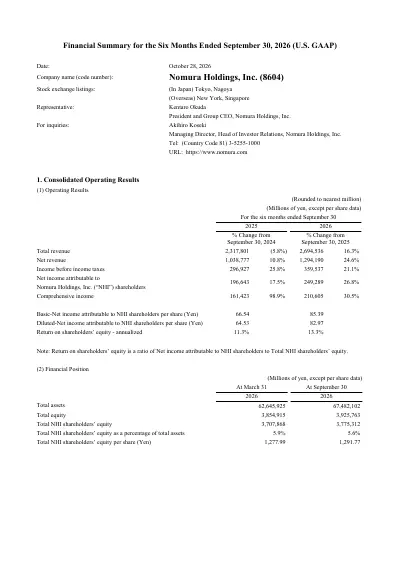
Later on, though, the outlook became increasingly uncertain again with a combination of rising interest rates, renewed geopolitical risk, and equity market corrections. Our ROE came in at 13.3% in the first half of the fiscal year, representing a solid performance in light of changing market conditions that testifies to our improved earning power.
I would like to highlight the following three points in particular. First, profits rose substantially across all divisions with total four division income before income taxes up 50%.
Our earning power has risen sharply over the past year. Second, growth in asset management-based business has steadily strengthened the stable revenue base.
Recurring revenue assets in Wealth Management rose 20% compared with the end of September last year to around ¥31 trillion, while assets under management in Investment Management rose by ¥50 trillion to around ¥150 trillion, particularly reflecting the impact of acquisition. As a result, stable revenue increased roughly 1.6-fold year on year.
Third, structural reforms have led to a steady improvement in ROE. Based on these results, the interim dividend with a record date of September 30th will be ¥35 per share, representing a payout ratio of 41%.
I would now like to run through second quarter results. Please turn to page 3.
Earnings remained solid in the second quarter despite uncertain market conditions, and ROE came in at 10.9%. Group-wide net revenue came in at ¥607.5 billion, down 12% quarter on quarter.
Income before income taxes fell 30% to ¥148 billion, while net income fell 29% to ¥103.7 billion. Earnings per share for the quarter came to ¥34.61.
Although performance moderated from the first quarter, we achieved our quantitative target for ROE of 10% to 12% or higher toward 2030, which we raised in May 2026. Stable revenue also expanded as we responded steadily to long-term asset formation needs.
We will now look at second quarter results for each division, starting with Wealth Management. Please turn to page 8.
All percentages discussed from here out are based on quarter-on-quarter comparisons. On the top left, you can see that Wealth Management net revenue fell 3% to ¥141.5 billion, while income before income taxes fell 8% to ¥65.6 billion.
Favorable developments in the asset management business ensured strong performance despite uncertain market conditions, and margin on income before income taxes remained high. On the bottom left, you can see that recurring revenue rose 13% to an all-time high of ¥66.7 billion.
Net inflows of recurring revenue assets also rose to an all-time high of ¥755.4 billion, reflecting increased inflows. Flow revenue fell 13%, but remained high in absolute terms with several major deals countering a lull in equity market trading.
The recurring revenue cost coverage ratio came in at 79%, testifying to the improved stability of earnings within the division. Please turn to page 9, where you can see an update on total sales by product.
Total sales fell 13% versus the previous quarter to ¥7.4 trillion. Despite increased uncertainty about the outlook amid rising interest rates in Japan and the United States, purchases of assets for long-term diversified investment continued to gain traction.
Sales of equities fell 21%, but remained high in absolute terms. Bond sales rose 66% with increased sales of public and corporate bonds thanks to rising yen interest rates and contributions from a major primary deal, too.
Sales of investment trusts, which constitute recurring revenue assets, fell 14%. Investors adopted a wait-and-see stance towards thematic funds, but there were sustained inflows into assets designed to be held over the long term, including Japan equity funds and balanced funds.
Discretionary investments rose 9% with SMA contract value reaching all-time high. Insurance also registered growth of 14% on demand for pension and estate planning.
Next, we take a look at KPIs on page 10. On the top left, you can see that net inflows into recurring revenue assets rose 40% quarter on quarter to an all-time high of ¥755.4 billion.
This shows that we are having success in the steady accumulation of recurring revenue assets irrespective of market conditions. Recurring revenue assets, which you can see on the top right, were down slightly at the end of the quarter because of market factors, but recurring revenue rose to an all-time high thanks to steady growth in recurring revenue assets over the course of the quarter and by investment advisory fees received semiannually.
As shown on the bottom right, assets under custody in workplace services remained solid, supported by continued inflows from employee share ownership plans. Next, let's take a look at Investment Management.
Please turn to page 11. On the top left, you can see that net revenue fell 14% to ¥84.8 billion, and that income before income taxes fell 39% to ¥27.4 billion.
While not as strong as in the previous quarter, revenues nevertheless remained high in absolute terms. On the bottom left, you can see that business revenue, which constitutes stable revenue, came in at ¥82.3 billion.
Asset management fees remained solid. Furthermore, assets under management in actively managed Japanese equity fund established in July exceeded ¥150 billion, while fund inflows enabled assets under management in flagship balanced funds to rise to almost ¥2 trillion.
Investment gain fell to ¥2.5 billion, reflecting a lower contribution from American Century Investments-related gains. Let's now turn to page 12 and examine our asset management business.
The graph on the upper left shows that assets under management remained high at quarter end. As shown at the bottom left, net inflows over the quarter amounted to ¥478 billion.
Net inflows into investment trusts totaled roughly ¥1 trillion with inflows into private equity, balanced funds, and actively managed Japanese equity funds, including newly established funds. Domestic investment advisory and international businesses saw net inflows in Japan, mainly into Japanese bonds and private assets, but net outflows overseas, albeit on a smaller scale than in the first quarter, with sustained outflows from mutual funds, but inflows into high-yield US bonds.
As shown at the bottom right, alternative assets under management rose to a new high owing to net inflows. Next, Wholesale.
Please turn to page 13. Following the division's record-high results in the first quarter since its establishment, net revenue for the second quarter was ¥308.9 billion, down 16%, while income before income taxes was ¥46.1 billion, down 51%.
On the bottom left, you can see that Global Markets revenue fell amid increasingly uncertain market conditions, but Investment Banking revenue increased with contributions from its major products. Please turn to page 14 for an update on each business line.
Net revenue in the Global Markets business fell 20% to ¥254.2 billion. Please look at the middle section on the right.
Fixed Income revenue fell 14% to ¥119.2 billion. In Macro Products, Rates revenue declined amid rising rates globally, while FX/Emerging revenues fell relative to strong performance in the first quarter.
In Spread Products, credit client activity was subdued as spreads widened. However, Securitized Products revenue rose mainly in the Americas, and thereby offset some of the decline in Macro Products revenue.
International Wealth Management revenue also remained high thanks to growth in assets under management. Equities revenue fell 25% to ¥135 billion.
In Equity Products, financing revenue performed solidly, but Derivatives revenue declined from the first quarter when it benefited from a wide range of revenue opportunities. Execution Services revenue fell as well on lower market trading volumes.
While there was some quarterly volatility, sustained growth in the revenue base for Equities and International Wealth Management helped to diversify and stabilize revenue within Wholesale. Let's now turn to page 15 and look at Investment Banking.
As you see on the top left, Investment Banking net revenue rose 9% to ¥54.7 billion. Major products such as Advisory and Financing & Solutions, etc.
saw growth in revenue, and we ranked first in both Japan-related ECM and DCM league tables for April through September periods this year. Advisory revenue benefited from growth investment and portfolio realignment deals in multiple sectors, including sponsor-related deals and infrastructure deals.
In Financing & Solutions, etc., ECM continued to benefit from major public offerings and CB deals in Japan, and acted as bookrunner for 9 of the 10 biggest deals in Japan in the first half of the fiscal year. In DCM, we addressed strong funding demand from domestic companies through a wide range of financing methods.
We also supported bond issuances overseas, including SSA bonds. Solutions business also continued to perform strongly, mainly in Japan.
Next, Banking division. Please turn to page 16.
As shown on the top left, net revenue was up 7% to ¥16.4 billion, and income before income taxes was up 20% to ¥4.4 billion. As you can see in the middle on the right, banking net revenue rose 11% to ¥4.5 billion.
The deposit sweep service grew steadily in terms of contracts and balances, while funding costs were also kept in check thanks to growth in balance of deposits. Revenue from investment activity also increased on contribution from growth in holdings of securities and other investments, as well as rising market interest rates.
Trust and agent service net revenue rose 6% to ¥11.9 billion. Trust fees increased steadily as new trusts boosted investment trust balances, resulting in solid revenue growth.
Next, KPIs on page 17. As you can see on the top left, loans outstanding totaled ¥1.361 trillion.
The expansion of client touch points through the deposit sweep service has also contributed to greater awareness of our services. Against this backdrop, both the number of loan accounts opened and the loan balance have continued to grow steadily, particularly for Nomura Web Loan.
Next, expenses. Please turn to page 18.
Group-wide non-interest expenses came to ¥459.5 billion, a decline of around 3% from the previous quarter. Performance-linked bonus provisions and other compensation and benefits fell by around 5%, and trading-related expenses also normalized.
Expenses continue to be appropriately managed relative to revenue. Next, our financial position.
Please turn to page 19. As shown in the table on the bottom left, the end of September common equity tier 1 capital ratio was 12.6%, down 0.6 percentage points from 13.2% at the end of June.
This completes our overview of second quarter results. Finally, to summarize our earnings performance, we achieved ROE of 10.9% in the second quarter and 13.3% in the first half.
Even as market conditions normalized, we achieved ROE in excess of 10%, demonstrating the fruits of restructuring for our business model. Let me comment briefly on the condition in October to date.
While the market outlook remains uncertain amid concerns about renewed inflation associated with geopolitical risks and rising interest rates, the global economy has remained broadly resilient. In Wealth Management, revenue has been at roughly the same level as in the second quarter amid these conditions.
While we have seen some cautious trading on the part of some of our clients, inflows into products and services designed for medium to long-term asset management remain solid, supported by preparations for inflation and growing demand for long-term diversified investment. In Wholesale, concerns over geopolitical risks and persistently high interest rates have sent some market participants to the sidelines, and the division has got off to a somewhat slower start than in the previous quarter.
Conditions vary across businesses. Within Global Markets, some products have been subdued, while equities have remained solid, and rates have been recovering.
Investment Banking is also off to a slow start, but the pipeline remains solid. We plan to monetize business opportunities while engaging in appropriate risk taking and maintaining thorough cost controls.
That concludes my presentation. Thank you.
Operator
We have a question-and-answer session now. If you have a question, press *7.
If you want to cancel a question, press *7. The first question, SMBC Nikko Securities, Muraki-san.
Muraki-san, please go ahead.
Masao Muraki
SMBC Nikko Securities, Muraki. I have two questions.
Page 14, Global Markets, October revenues, you made a comment in your presentation. CoreWeave, French government bonds, and leverage, this month there has been various press reports, but has there been impact to revenues, or is there any particular position you are watching very closely into?
Second question, Nomura's investment and M&A pipeline. Swiss wealth management investment or entry into the market, there were press reports.
Once again, overseas asset management, organic growth versus M&A pipeline, inorganic, what's the outlook, and based upon your outlook, how much funds would be made available for share buyback?
Hiroyuki Moriuchi
Muraki-san, thank you for those questions. Then let me take the first question first.
October, CoreWeave hedge fund leverage, and what's the impact to our revenue position? Has there been any impact?
Credit aside, yes, we need to focus a bit on the credit side, that is our perception. Are we hit in our positions?
No. No, we have not seen such phenomena.
For example, regarding data centers, if I may touch upon data centers, there are some concerns in the market, but Nomura's view is that our position has not been impacted. Data center-related investment, yes, we're partly into such investment, but there has not been any excess investments into a particular company or particular area.
Regarding data center, in addition to individual due diligence project by project, we are also controlling the overall total risk, creditworthiness, offtaker credit. From a few factors, we dismantle into factors, and we have control in place, factor by factor.
Regarding hedge fund deleverage, as you have rightly pointed out, most recently there has been partial risk position reduction. We're not just looking at the equity, but credit markets and rates included as well.
This week, next week, monetary policy announcements, and the midterm elections in the United States, and other events including the Middle East situation, these are some of the factors where we expect impact. October is a very interesting timing, an eventful period.
Focusing on a few of those events, if they are absorbed into the market, the fog will be cleared, and equity investors and bond investors, both fixed income and equity investors, will have more freedom to make decisions and invest. As I said, at the beginning of October things were rather slow, but that was probably because of the unique timing of wait-and-see before those events unfold.
We are not heavily concerned on that point. That's my response to your first question.
Secondly, overseas asset management, wealth management, M&A pipeline, and how much funds would be made available for share buyback. Regarding the first half, overseas asset management, wealth management, organic versus inorganic, overseas asset management business, former Macquarie public asset management which we acquired, US-centered wealth market position, if we are blessed with great opportunities, then we will study those opportunities.
Regarding asset management, other than seed capital, we will not be using capital for organic growth, but we will be generously deploying capital. Size-wise, we are not expecting a large-sized deal.
Regarding wealth management, in principle, IWM, Wholesale is in charge. They are focused on organic sales, that's our plan.
Far organic growth is healthy, we will continue with this strategy without expending much cost, or without using much capital. We think there's still room for growth doing it ourselves organically.
Finally, share buyback, how much funds would be made available. As I've said a few times already, financial soundness is the minimum we need to achieve, but current growth opportunities and expected growth opportunities in the future will be taken into consideration, and shareholder return.
Those are the factors we will simultaneously consider. At any rate, as I say each time, 40% or higher payout ratio, 50% or higher total payout ratio, we are committed to those indicators, throughout the year we will consider what steps would be appropriate.
Sorry for the long response.
Masao Muraki
Understood. Thank you very much.
Operator
The next question comes from BofA Securities, Ms. Tsujino.
Tsujino-san, please.
Natsumu Tsujino
Thank you very much. Regarding overseas high net worth individual business, page 13, in Asia, there's a lot of them.
In Q1, performance was very strong, and there's some decline. However, it's still at an elevated level.
International Wealth Management business, in what kind of a situation is it, then do we see the increase in client counts? Hopefully the number of clients will not be reduced dramatically by half, but I want some remarks from you that would be supportive to the future outlook.
That's my first question.
Hiroyuki Moriuchi
Tsujino-san, thank you. Regarding IWM, as you point out, continuously the performance is strong.
In 2020, from Retail, current Wealth Management, the IWM has been shifted to Wholesale as a new owner, and since then, transformation has been continued, and the revenue has grown by about sixfold, and recently, AUM is about $44 billion. In the second quarter, revenue declined slightly.
That's due to the uncertainty in the market, and equity-related flow from IWM clients decreased slightly. However, just like Wealth Management in Japan, overseas IWM has grown quite rapidly.
However, we can expect stable growth, and it is a client service business, sticky revenue can be expected into the future. Since 2020, more than 3,000 client accounts have been opened, mainly in Hong Kong and Singapore, but also in Dubai we opened up our hub, and we are now ready to accelerate the growth.
For your information, IWM has the nature of upfront investment. The last one year or so, we have increased the headcounts to be ready for future growth.
Hope I answered your question.
Natsumu Tsujino
Thank you very much. The number of accounts is increasing, but within the community, the presence of Nomura or the profile of Nomura is rising.
In this process, the number of clients, can I understand is on the rise constantly?
Hiroyuki Moriuchi
Yes, as you say. Since it's a wealth management business, there's not going to be an abrupt change just like a magic.
Our asset fast approach to clients and wealth management partner count increase, those are what we are focused on. One thing that's unique to Nomura is as follows: especially Asian clients have expectations or requirements for the Japanese perspective or Japanese aspects.
To satisfy such requirements, we are tying up with Japanese products. Also, we are working with group firm, Nomura Real Estate in the area of real estate.
In the cross-border area connected with Japan, co-work and synergy are not big in terms of numerical contribution. However, we are a Japanese firm with lots of knowledge about Japan, when clients are onboarded, our strength, unique base in Japan, is an appeal to them.
Natsumu Tsujino
Thank you. Second question.
When you explained the situation in October, it just slipped out of my mind, but regarding wealth management, what's the progress in sales? Is there any additional comment that you can add, anything you can elaborate on regarding the situation in the month of October?
Hiroyuki Moriuchi
Thank you. In October, the revenue level is about the same level as in the second quarter.
There's not a major change to be noted. For us, rather than capturing opportunities in the market, our approach is to provide advice to clients in managing their assets.
If you look at page 9, total sales, I made some comment about total sales in the most recent quarter. Bond sales went up by 66%.
That's against the backdrop of increase in Japanese yen rates. Government bond sales did well.
When interest rates go up, our clients become more sensitive to yields. Reflecting that, a fund rotation seems to be taking place.
That's what we observed in the most recent quarter.
Natsumu Tsujino
Thank you very much.
Hiroyuki Moriuchi
The next question is by Watanabe-san of Daiwa Securities. Watanabe-san, please go ahead.
Watanabe of Daiwa Securities, I have two questions. First, you touched upon this already, but page 9, the JGB for individuals, maybe the revenue contribution is limited, but it's a very important product in terms of deposit-to-investment flow.
Will you be injecting much efforts? What is the positioning of JGBs for individuals as an alternative to deposits?
What's the percentage that you are able to capture in this regard? Second question, page 13, Wholesale expense ratio, 85%, higher than the target.
Why was the upside, and what's the response to achieve the 80% target?
Hiroyuki Moriuchi
Watanabe-san, thank you very much. The first question is with regards to government bonds for individuals and the positioning of this product.
As you have pointed out, it's not just Nomura that's focusing on this project, but I think the preference of customers is rising. It's becoming more popular amongst our customers as an alternative to deposits.
The sensitivity to rates goes up, and then in the capital market, in direct financing, customers tend to have more interest in such products. Government bonds as an entry point is a product that is easily accessible by customers, there is strong demand from customers.
At the same time, in government's part, if they become familiar to direct financing, then they tend to become more interested in investment products. We're hoping that investment into government bonds will diversify into different products like mutual funds, investment trusts, or public bonds, corporate bonds, and other asset classes.
That's our hope and expectation. In that sense, as you have rightly pointed out, rather than the rate, I think qualitatively this is an important product.
As an alternative to deposits, what's the percentage, I apologize I don't have the number at hand, and I'm not sure whether we can respond to that question, but separately offline, our IR team will contact you. On Wholesale expense ratio, 85%, a bit higher than we had targeted, let me explain my idea.
In order to reduce expense ratio, that's an important Wholesale goal and group-wide goal. It's a challenge that we need to respond on group-wide basis.
Wholesale expense ratio, as a policy, first of all, as a cost-related response, SRC is the label that we have given, but on the cost side, if things are unchanged towards 2030 with inflation, cost will naturally rise. How can we control that rising cost?
There are a few structural measures that need to be taken, with management at the top, we are thinking of appropriate responses. There are a few areas where we are still studying, but for example, systems architecture has become quite complex, of course to a certain extent, upfront investment may be required, but with that, in the mid to long-term, we will be able to reduce expenses.
That's an area we are hopeful. AI, which is gaining traction, offensive AI versus AI for improvement of efficiency, there are two types, but regarding the latter, to a certain extent, along with investment, we need to reduce cost.
We do have a few ideas, but in the mid to long run, those are some of the measures we need to solidly implement. On the other hand, Wholesale expense coverage ratio, in reducing this, what contributes best is not just the cost control, but revenue contribution.
Wholesale does business along with the market, there could be some ups and downs depending on the market, but towards 2030, under self-funding, we need to invest and gain scale merit, and ROE hurdle rate must be surpassed. By piling up such investment, not just enjoy economy of scale, but with ROE, we will be reducing expense ratio.
Operating leverage is a major key, and if there is a business that doesn't contribute to operating leverage, then Wholesale shouldn't engage in such business. We shouldn't let them engage in such business.
I think those are some of the measures that are very important. I hope I answered your question.
Yes, well understood. Thank you very much.
Operator
The next person to ask a question is JPMorgan Securities, Sato-san. Sato-san, please.
Koki Sato
Thank you. I am Sato from JPMorgan Securities.
The two questions overlap with those asked by Watanabe-san, but my first question is regarding the expense ratio, or cost-income ratio of Wholesale. The economy of scale or operating leverage is going to be used, I do understand, but in the second quarter, revenue on risk-adjusted asset was at a relatively good level, a top line is generated.
However, you had this ratio, expense ratio. Then in the second half, what kind of outlook do you have for the cost-income ratio?
Even if you maintain the current level of revenue, if you are going to continue some investments, then would the rate continuously exceed 80% as the run rate for the time being? My second question is regarding public and corporate bonds.
You have spoken about government bonds, but what about corporate bonds? Profitability or any expectations you have about public bonds.
Now Debt Capital Market unit or department was newly established, and I suppose you have expectation regarding the revenue. In the most recent quarter, there was a big primary transaction or deal, is the forthcoming pipeline robust?
Could you speak about your future outlook? Thank you.
Hiroyuki Moriuchi
Thank you. First, regarding the cost ratio for Wholesale.
Operating leverage is understandable. However, revenue on RWA is high.
That's the comment you made, I understand. In the second half, it's difficult to comment quantitatively, but in the medium to long term, our response to the cost ratio, I spoke about operating leverage of revenue and the SRC, but in the second quarter, the cost seems to have risen somewhat, and let me comment on that.
In the second quarter, within the cost, as an offsetting factor for revenue due to weak yen, it's not just cost, but revenue went up, in that sense, it's neutral. That factor is included in the cost in Q2.
Also in the US, Instinet side, ACC commission was booked both in terms of revenue and cost. Just like FX, it's offsetting between revenue and cost side.
On other points, due to inflation, IT costs and corporate per capita personnel cost slightly or somewhat increased. In addition, more than those cost factors, in Wholesale, some upfront investment in headcount is included, specifically IWM and in equity domain.
We are observing growth, and we look to grow further, by making upfront investment, we'd like to prepare for future growth. In any case, I commented more on costs in the second quarter, but in the second half, we had a relatively slow start in October, but as we go through various events, the excessive situation will be unadjusted, and as we proceed with monetization, then a cost ratio is expected to come down.
That's my answer to your first question. The second question about corporate bonds.
Currently, regarding DCM, we have quite robust pipeline. Companies' demand for financing continues to be strong, and inclusive of large-sized deals, we have a solid pipeline.
Money flow is changing structurally, as mentioned on several occasions, but eventually from government bonds to corporate bonds, if there is going to be such a spread, then we can expect a broad-based trend. IM division's products to benefit from that, the scope of implication would be broad-based.
It's a qualitative comment, but that's my answer.
Koki Sato
May I make a confirmation? Regarding Wholesale, especially revenue on RWA, according to your explanation, in the second quarter, there were offsetting factors included.
So 7.7%, the result is, medium-term target was 7%, is there some additional factor included? How should I understand the gap against the target?
Hiroyuki Moriuchi
If there is something we can share with you to be more specific, IR will come to you. In terms of revenue, what's big is Wholesale, compared to that, the number is not so significant.
Koki Sato
Understood. Thank you very much.
Operator
The next question is by Otsuka-san of SBI Securities. Otsuka-san, please go ahead.
Wataru Otsuka
SBI Securities, this is Otsuka. Is my voice getting through?
Operator
Yes, we hear your voice, Otsuka-san. Please go ahead.
Wataru Otsuka
Thank you. Let's go one by one.
First question, page 30, Wealth Management, inflows of cash and securities. On the right, you have quarterly numbers for Retail only.
I'm looking at the Retail only numbers, but 773 for this quarter. In corporation to a typical quarter, I think this is a large number.
Inflow was quite significant, I suppose. Specifically, what were the channels?
As you have disclosed, SoftBank corporate bonds, ¥240 billion was underwritten by Nomura, so that was probably big. Did those primarily deals contribute?
Can you give us more details? That's my first question.
Hiroyuki Moriuchi
Otsuka-san, thank you for the question. As you have rightly assumed, inflows of cash and securities, the number has grown.
Mid to long-term discretionary investment and trust products are there, but yen rates have gone up, public and corporate bonds have been attracting funds. There are the government bonds, and a few bond transactions were quite a significant portion.
Wataru Otsuka
Thank you very much. Just to confirm then, at today's telephone conference, you talked about individual JGBs and corporate bonds.
According to press reports, SoftBank corporate bond was quite popular. I'm not asking the actual number or ratio, but people have become interest rate sensitive, people pay cash, not selling Nomura's product, but is it correct to consider that they are offering cash to purchase corporate bonds?
Hiroyuki Moriuchi
Thank you for the question. Regarding individual transactions, I cannot make any specific comments, but as you have said, generally speaking, transaction-related cash in, Nomura Securities, rather than Nomura Securities' existing, the inflow has become quite significant.
In that sense, investment banking DCM, ECM deals and Wealth Management inflow, there has been good collaboration in between.
Wataru Otsuka
Thank you, understood.
Hiroyuki Moriuchi
Thank you.
Wataru Otsuka
The next question is quite similar to that. Page 10, Wealth Management, recurring revenue asset net inflow, ¥800 billion.
This was a big number. On page 9 and page 8, you see net inflow, but can you specify which products contributed to this big number?
I wish to have a clear message. Can you be more granular?
That's my second question. Thank you very much.
Hiroyuki Moriuchi
Sorry, I'm not yet catching up with you, but you're talking about page 10?
Wataru Otsuka
Yes.
Hiroyuki Moriuchi
Net inflow, you want the breakdown, and you want more color. Investment trust, discretionary net inflow, plus insurance, level fee, loans, diverse assets contributed.
All in all, comprehensively, we provide asset consulting services, so that has remained unchanged. Recurring revenue asset net inflow, if you look into the substance, they are diverse.
That was the characteristics of this quarter. Then it's not excessively concentrated into one area or one asset, is that correct?
Wataru Otsuka
Yes, that's correct. Thank you very much for the response.
Operator
The next question comes from UBS Securities, Niwa-san. Niwa-san, please.
Koichi Niwa
I am Niwa from UBS Securities. I have two questions, but can you hear me?
Operator
Yes.
Koichi Niwa
Thank you. I have two questions.
First, regarding IM division. Valuation loss was incurred in the first and second quarter related to seed money.
Currently, Nomura Holdings as a whole and IM division, what is the magnitude of total investment amount, and on what is investment being made, and what was the reason for the valuation loss, and what's the quarterly volatility, and what's the background? The second question relates to Muraki-san's question, but AI or data center or hyperscaler finance, that's what I would like to inquire about.
At this point in time, for Nomura, what is the size of business opportunities for you? You have spoken about risk management, realistically, in what division, what size of revenue is being generated, and do you have expectations for future potential?
Could you speak about your perspective?
Hiroyuki Moriuchi
Thank you. Niwa-san, thank you.
Your first question, IM division seed investment valuation loss, IM or Nomura Group. Regarding the size of seed pilot investment, I'm afraid I cannot disclose specific number.
In any case, as you are aware, seed investment is including R&D for originating future products, it's IM division's necessary investment, which is going to be continued. In addition, regarding NAM International, we are the new owner.
In the past, they had underinvestment situation, to normalize that, regarding seed investment, we have been allocating capital to them. Also, we'd like to increase active ETF by transitioning to that direction, for that, we have allocated certain capital.
Regarding seed investment, it is not for us to make profit out of that, but basically to suppress P&L volatility. There is a certain macro hedging, but in the second quarter, I do not have numbers with me, but my sense is that the numbers were bigger than usual.
If there are other colors to be added, then our IR team will contact you with more details. Niwa-san, thank you for waiting.
Regarding AI, data center, hyperscaler finance. As specific business within our Fixed Income, there's SPBC, which is securitization and private credit category.
In this area, we have lending activities and some other activities. To give you a sense of numbers, our SPBC activity as a whole compared to that, the ratio is only a few percentage points, it's not so big in terms of scale.
However, as mentioned, we need to conduct risk management, to control risks, individual risk and overall risks, we have put in place a framework to do so. Revenue going forward, we will be managing risks, and we will be selective in what transactions to handle.
In the context of the overall market, we expect opportunities to keep growing. In this situation, what transactions do we capture?
We will be mindful of risk management and determine which opportunities to pursue. The opportunities are significant, but given our situation right now, we are being conservative in pursuing business opportunities.
Hope I answered your question.
Koichi Niwa
Thank you very much. Could I have your qualitative comment in the domain of hyperscaler finance?
Is there unique features that's unique to Nomura that you can speak about? The background is that Japanese peers, they seems to be quite aggressive, in comparison to them, what is your evaluation of Nomura's position?
Hiroyuki Moriuchi
Thank you. Thank you for your question.
As you pointed out, we are not a commercial bank, our business does not use a huge balance sheet in the area of data center. Big players, mega deals are on the market, but we are skipping such deals.
Instead, we are going after medium-sized deals. That's one thing.
Also, in this business, the power of funding does not guarantee a deal. Deal structuring capability is also required.
Also, how do we remove exposure in the market? Structuring and solution capabilities are needed, as well as knowledge on the industry.
Sometimes speed is required, skill sets of investment bank are required. That's where we have been competing, and I understand that's been the source of our competitive edge.
Thank you. Thank you very much.
Koichi Niwa
That deepened my understanding. Thank you very much.
Operator
It's time to finish, and we'd like to conclude question-and-answer session. If you have some more question, please ask our Nomura Holdings IR department.
In the end, we'd like to make closing address by Nomura Holdings.
Hiroyuki Moriuchi
Thank you very much for sharing your precious time to join our results presentation. ROE 13.1%, 2030 vision to be achieved, I think we were able to make a good start.
As we enter into the second half in terms of prospects, you might have found us as being a bit conservative, but that's not our take. This week and next week, there will be various events, the fundamentals will become more clear.
Then we think that we will be able to capture opportunities. On top of that, regarding the domestic market, there is a major change in the financing cycle, and I think we are beginning to see such emerging trends.
For the first time in a long period, this may become a major theme. In order to monetize those opportunities, not just Wealth Management, but Investment Banking and IM will work together to capture these opportunities.
Once again, thank you for joining us.
Operator
Thank you for taking your time, and that concludes today's conference call. You may now disconnect your lines.