NN, Inc.
Q3 FY2026 · Earnings Call TranscriptOctober 29, 2026
Operator
Hello, everyone. Thank you for joining us, and welcome to the NN, Inc.
Third Quarter Earnings Call and Webcast. After today's prepared remarks, we will host a question-and-answer session.
If you would like to ask a question, please press star one to raise your hand. To withdraw your question, press star one again.
I will now hand the conference over to Joseph Caminiti, Investor Relations. Joseph, please go ahead.
Joseph Caminiti
Thank you, Christine. Good morning, everyone, and thanks for joining us.
I'm Joe Caminiti with NN, Inc.' s Investor Relations team, and I'd like to thank you for attending today's earnings call and business update.
Last evening, we issued a press release announcing our financial results for the third quarter ended September 30th, 2026, as well as a supplemental presentation, which has been posted to the Investor Relations section of our website. If anyone needs a copy of the press release or the supplemental presentation, you may contact Alpha IR Group at [email protected].
Joining us from NN management today are Harold Bevis, President and Chief Executive Officer; Chris Bohnert, Senior Vice President and Chief Financial Officer; and Chief Operating Officer Tim French will be joining us for Q&A. Please turn to Slide 2, where you'll find the forward-looking statements and disclosure information.
Before we begin, I'd like to ask you take note of the cautionary language regarding forward-looking statements contained in today's press release, supplemental presentation, and in the risk factors in the company's annual report on Form 10-Q for the third fiscal quarter ended September 30th, 2026. The same language applies to the comments made on today's conference call, including the Q&A session as well as the live webcast.
Our presentation today will contain forward-looking statements regarding sales, margins, inflation, supply chain constraints, foreign exchange rates, tax rates, acquisitions and divestitures, synergies, cash and cost savings, future operating results, performance of our worldwide markets, general economic conditions and economic conditions in the industrial sector, including the potential impacts and ramifications of tariffs, the impacts of pandemics and other public health crises and military conflicts on the company's financial condition, and other topics. These statements should be used with caution and are subject to various risks and uncertainties, many of which are outside of the company's control, which may cause actual results to be materially different from such forward-looking statements.
The presentation also includes certain non-GAAP measures as defined by SEC rules. A reconciliation of such non-GAAP measures is contained in the tables in the final section of the press release and supplemental presentation.
Please turn to Slide 3, and I will now turn the call over to our CEO, Harold Bevis.
Harold Bevis
Thank you, Joe. Good morning, everyone.
We had a pretty eventful quarter, and last four months, and we're going to recap our results for you. I want to start off by saying that we had a great Q3, and the results show significant progress with strong momentum continuing into 2027.
Our Q3 net sales increased 26% year-over-year. Our Q3 adjusted EBITDA increased 50% year-over-year, bringing us to Q3 year-to-date net sales up 19% over the same period of prior year, and our Q3 year-to-date adjusted EBITDA up 40% year-over-year.
We're getting the flow-through that we want to on that incremental sales growth. We also have secured $106 million of new business awards during this year, in the first nine months.
We have a strong looking fourth quarter as we close out the fiscal year, and the momentum is building, setting up an even stronger 2027. Turning to Slide 4, I wanted to just highlight the key messages for today's session.
Number one, our sales are growing, and we are increasing our profits. Number two, we're winning new business, both for immediate launch in 2026 as well as securing launches for 2027 startup and 2028 startup.
We are increasing our gross margin rates and our adjusted EBITDA margin rates. It's leading us to be comfortable to raise our guidance again for 2026 and creating solid momentum going into 2027.
With that, I'd like to turn it over to Chris Bohnert, our CFO, for a moment to review the company's financial results more at a lower level of detail. Chris?
Chris Bohnert
Thank you, Harold. Good morning, everyone.
If you're following along, I'm on Slide 5. I'll talk about our financial results and key metrics for the quarter and year-to-date through 9/30/2026.
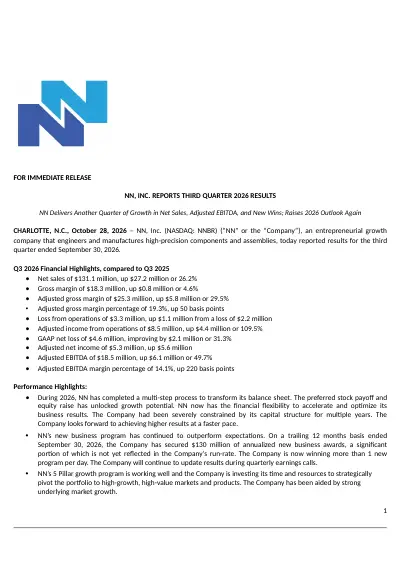
Third quarter net sales were $131 million, up $27.2 million or 26% versus the prior year period, primarily driven by higher selling prices, reflecting the pass-through of increase in raw material costs, and higher volume. Year-to-date through the third quarter of 2026, net sales were $378.3 million, up $60.8 million or an improvement of 19% compared to our results through the third quarter of 2025, continuing the momentum established across the previous quarters.
Third quarter adjusted gross margin dollars of $25.3 million are up $5.8 million or 30% versus the prior year third quarter. This growth continues to be supported by a stronger mix of sales and new business launches.
Across the first three quarters of the year, adjusted gross margin dollars of $74.5 million are up $16 million or about 27%. These results also reflect solid adjusted gross margins of 19.3% in the third quarter and 19.7% year-to-date, increasing 50 basis points and 130 basis points respectively compared to the prior year periods.
Third quarter adjusted EBITDA of $18.5 million increased by $6.1 million, an increase of 50% versus last year's third quarter. This growth was primarily driven by improved sales mix, better operating performance, and higher income from our joint venture in China.
Across the first three quarters of 2026, total adjusted EBITDA of $50.6 million is up $14.5 million or 40% versus the first three quarters of 2025. This strong growth in our profitability measure has been driven by similar drivers as in our quarterly results.
The adjusted EBITDA growth has come with an improvement in our margin capture, as third quarter adjusted EBITDA margins of 14.1% of sales expanded by 220 basis points versus last year's third quarter. On a year-to-date basis through the first three quarters of 2026, adjusted EBITDA margins of 13.4% are up by 200 basis points versus the 11.4% across the first three quarters.
Now, turn to our segments, starting on Slide 6. First, in our Power Solutions segment, where our business consists largely of stamped and plated products, net sales for the quarter were $63.2 million, up 41% compared to $44.9 million in the prior year period.
This growth was driven by increased volumes and higher selling prices, reflecting the pass-through of increased raw material costs, particularly precious metals. For the third quarter to date, Power Solutions generated net sales of approximately $180.9 million, compared to $133.1 million in the prior year period, an increase of 36%.
Power Solutions quarterly adjusted EBITDA was $13.4 million, an increase of $4.5 million or 51% compared to last year's third quarter of $8.9 million. The improvement was driven by stronger operating performance resulting from higher selling prices and volumes, along with the continued benefits of our cost-down initiatives.
It's worth noting that we continue to operate in an inflationary raw material environment, particularly across precious metals. As we've discussed previously, there can be a short lag before increases in metal costs and other inflationary impacts are fully recovered through customer pricing, which can temporarily pressure profitability.
Along with the improved adjusted EBITDA results, we're also capturing stronger margins, with quarterly adjusted EBITDA margins of 21% of net sales. Our year-to-date results paint a similar margin story for the segment, with 20% adjusted EBITDA margins up roughly 200 basis points versus the first three quarters of 2025.
Now, turning to Slide 7, our Mobile Solutions segment, which covers our machined products business, net sales for the third quarter were $68.2 million, compared to $59.1 million in last year's third quarter, an increase of $9.1 million or 15%. This growth was driven primarily by higher volumes and favorable foreign exchange impacts.
Across the first nine months of the year, net sales of approximately $197.9 million are up 7% versus the $184.8 million in the first nine months of the prior year. This year-to-date growth reflects continued contributions from new business awards and program launches, partially offset by certain softness in automotive markets in the first half of the year.
Our third quarter adjusted EBITDA in this segment was $8.8 million, up 31% versus last year's third quarter of $6.7 million, with the segment's adjusted EBITDA margins of 12.9% expanding 150 basis points versus the 11.4% in the prior year. Adjusted EBITDA for the first nine months of 2026 was approximately $26.8 million, compared with approximately $23.5 million in the same period in 2025, reflecting the continued improvement in both earnings and margin performance as volumes ramp and recent program launches mature.
Please turn to Slide 8. I want to spend a few minutes on our balance sheet, as the last couple of months marks a big turning point for NN.
As you can see from the chart, total net debt and preferred stock was reduced significantly from $261 million at year-end 2025 to $139 million on a Q3 pro forma basis. This represents a reduction of $122 million due to the payoff of all of our outstanding preferred stock.
On our last earnings call, we detailed the significant reduction to our preferred stock outstanding as we utilized the proceeds from a successful equity issuance to address a meaningful portion of the outstanding preferred stock. Subsequent to quarter end, we were able to execute another successful PIPE transaction to redeem the remaining $35 million of preferred stock, and in doing so, capturing a $5 million discount.
With that final redemption, we now have eliminated all preferred stock obligations dating back to 2021. That has been a priority for this management team, and we're pleased to have it behind us.
Notably, this recent PIPE allowed NN to delever further and brought in new growth-oriented institutional investors, and we see their participation as a strong vote of confidence in our strategy and long-term opportunities. We now have more flexibility to keep optimizing the business results and take our growth to a higher level.
The debt reduction and comprehensive improvement to our balance sheet has strengthened our foundation, and now our focus shifts to executing our growth strategy to achieve higher returns. Thank you.
With that, I'll turn the call back to Harold. Harold?
Harold Bevis
Thank you, Chris, appreciate it. Some of you that have been following us, or everyone that's been following us, know that we have a multi-point growth program.
We call it our five-pillar growth program. If you look at our 10-Q and Note 3, which goes through our sales by segment, you'll see that for the first nine months of this year versus last year, every single segment of the company is growing, all of them.
It's not really a one-segment story, but we do have some parts of the growth that we're more focused on than others, and I really wanted to bring you up to speed on some of the details here as we go through it. Data center is a big one for us.
We were able to get into that business. It's grown a lot for us.
It's fast growing, and our opportunity set is fast growing. It's really growing by leaps and bounds for us right now.
Of course, we recently expanded into liquid cooling products, and that's absolutely exploding, and I look forward to talking about that in a page or two. Defense electronics is another really good one for us.
If you look at our stated results in the 10-Q and follow along with the details here, you'll see that that's a big part of our year-over-year sales growth. We have a growing portfolio of products, and an expanding customer base, and expanding plant certifications that we are compliant with.
It has led to some recent tier one awards for us that are just now in the launch phase. Medical is an attractive long-term growth market, not as fast-growing as Department of Defense, United States, or data center globally, but still a good one, and sticky, and it is attractive.
We have had some breakthroughs this year where we've become approved supplier at multiple customers, but one really, really big one, a marquee customer that's a market in and of itself, and we have some programs that are ramping up there. Electric grid, we all know what that is.
The grid in the United States is under stress for expansion and improvement of grid management, and we're right in the middle of that. We have strong demand across our product portfolio.
Then high-value vehicle parts, that is the part of auto that we like. There's part of auto that we got rid of already in the last three years that was negative EBITDA.
We still have some parts of auto that are low-margin, and we're not trying to grow that at all. We have forward plans to continue to minimize that.
On the high-high-value side, we have some business there that's over 40% gross margins, and we're quite good at it and have been for a long time, and we're still focused on getting it. Those are the five elements of our growth program.
I'm going to go to each one a little more detail. Turning to Slide 10, an update on what are the numbers.
The top three growth markets are data center and grid, defense electronics, and medical. Right now, those are $162 million of our run rate, those are year-to-date.
We have pipelines to continue growing those sales that aggregate to $270 million. Pipeline, when we talk about it on our calls, it's a quoted opportunity.
We have a prospecting list that's over on top of that, but it enters a pipeline when we've quoted it and start tracking it in Salesforce.com. If you look at the components, data center and grid is $87 million of our company.
We have a quoted pipeline of $100 million. Defense electronics, $62 million of our company, with a quoted pipeline of $85 million.
Medical, $13 million of the company and a quoted pipeline coincidentally of also $85 million. We're using rounding numbers here, we're rounding to the closest $5 million.
You can see the order of magnitude of both the actual reported sales and the business that we're chasing. On the next page, going to go through data center and grid, and then data center only.
Data center and grid is a line item that's called out in our Q, I want to make sure I touch right back to our reported statements here. Again, with our trailing 12-quarter sales at 87, excuse me, through Q3 of $87 million, that's our second largest market already.
We have quite a few products. We're on grid edge power delivery and in-rack cooling of the power system.
We're all around the electricity and the heat that it causes, and the connectivity of it. We have a global prospecting list over and above the quoted opportunities that we have.
In fact, it's multiples of our pipeline, and growing as we've become an approved supplier. We had the new product line we came out with this year, it's absolutely going gangbusters for us.
We've globalized it now. We are now quoting and doing business in Asia-Pacific, in Europe, in South America, and in North America.
We're leveraging our know-how, and now we're leveraging references with customers who are using our products. We're off and running with that one.
We're adding new capacity, in China specifically, with 50 new machines, and we're also adding capacity in North Attleboro, Massachusetts, for our power products. It's really growing for us.
On the next page, I just wanted to talk a minute about data center only. We got that request in our last earnings call, and a logical request.
Wanted to say that it's $35 million right now on a run rate basis, up from basically nothing at the beginning of last year. We have a significant pipeline of quoted opportunities that are already out there, and we have our prospecting list that's several multiples that size.
Our goal for this area is to get it to 100. That's 100 from virtually zero last year, it's a big move for us.
It could be bigger, we're not capping it, we haven't set any caps, but we have had to set some goals for ourselves and be accountable to them. That number right now is a forward-looking management objective.
It's not an estimate of current business we have in hand. There's a lot of go-get to get to that number, but that is what we're tracking to.
On the lower left here is our installed machine capacity to make liquid connectors. Most of you know we're underway with a ramp-up, starting from scratch.
In Q3, we averaged 19 machines installed and commissioned. In Q1, we'll be at 55 machines, and our objective is 180 machines.
We have multiple opportunities that are 100 at a time, 100 at a time, 100 at a time. We're being picky here, we're picking our partners carefully, we're picking partners we can make money with and that value what we're bringing to the table, but it will be selecting from a big basket of opportunities.
In the middle here is the three segments that we're going after in data center: the power infrastructure, the rack components, and the cooling system. We're not just chasing one thing.
We tend to talk a lot about liquid cooling in our investor talks, but we're actually doing more than that. At this point on the lower right here, we are shipping from four plants globally: Wuxi, China; Attleboro, Mass; North Attleboro, Mass; and Kentwood, Michigan.
We'll be bringing other plants into the production cycle for this also. On the next page, I wanted to just show you our products and our machinery.
In the middle here, on the bottom, those are the actual machines that we have bought to make liquid cooling connector components. We're up and running, we're online.
As I mentioned, in the quarter we had 17. We're on a continuum process now: ordering machines, installing, commissioning; ordering machines, installing, commissioning.
It's a thing for us that we're going through. We have an ability in our current footprint to get in about 70 machines, and then we're going to need more footprint.
We didn't have that amount of space open, and we're also trying to get out of all the automotive business that we can as we shift the mix here. In the upper left here, you can see these are actual products that we're making, largely made out of stainless steel, specifications, different versions of stainless steel, turned, some of them start off milled to get to a net shape, but then turn down to get to the final shape, a lot of heat treating and processing, abrasive flow machining it's called, to get to the final specifications, and that's the big new product that's blasting off for us.
The PCB test probe components, that's our current best seller. If you look at our 10-Q and look at the sales there, that's a big one for us.
What's that used for? When they're installing the racks, they're powering them up, they're synchronizing them to get them up and running, they have to test all the probes and test all the PCBs as they go through it, and we make the majority of the components that go into those.
They do not have an unlimited life, they're used and discarded. Then electrical switch components, a lot of our switching components and terminals are being used to power the racks, and those are growing for us also.
That's our current main bestseller, [laughs] that we have for data center. The product line's expanding.
If you looked at our quoted pipeline, or prospecting, we're going after quite a few different products for us. On the next page, want to turn our attention to defense electronics for a minute.
That's $62 million of our trailing 12-month sales through the end of the third quarter. We've had $10 million of wins this year, and we have $85 million of quoted opportunities, and again, a big prospecting list.
A couple big things for us in this business so far year-to-date: we've registered a couple of our plants to ITAR and ATF levels so that we can quote unimpeded into market opportunities that we see or chase. We've had two big two big products that we've landed this year.
You heard us previously talk about the firearm products for a US company that are titanium, which was a new accomplishment for us, and it turned out to be harder than we thought, to be quite honest, but we've conquered it, we're over the hump. It's got advanced coatings, Cerakote coatings, diamond-like coatings, as well as titanium and that welding of the titanium.
We have multiple ramp-ups underway right now. It's not just one product, it's multiple products now.
We recently have won a munitions contract to make munitions for the Department of Defense and NATO. It's again a first-time product for us.
We hadn't done a large-scale brass machining, or multi-part matching, and we had to conquer that as well, and we have. The initial ramp-up is underway right now, and we have a large go-forward opportunity here as a new manufacturer of munitions for NATO, the Department of Defense, and specifically the Marine Corps.
That's a brand new product adding category for us that we've just entered since we last spoke. We didn't put out a press release, you're hearing it first here, and we're underway with that.
On the next page, medical. A few years ago, we were talking a lot about medical, because it was part of the company's history.
We sold off the medical business to correct the company coming out of COVID, and we got back into it. It was harder to get into than these other areas, but we have done it.
We have done it. This year's an important year for us.
We have passed some hard-to-pass plant certifications that are customer specific, and we, as I mentioned earlier, have gotten inside with a very, very large medical equipment maker who has 30 30 machine platforms, and we have our initial POs received for the first platform, which is robotic orthopedic surgery. That's a growing area, thanks to pickleball and all the things that happen to cause [laughs] knee surgeries and ankle surgeries, elbows, people that play tennis.
It's heavily rolling over to robotics, and we're right in the middle of that, making the end effectors that actually perform the surgery. That's just starting up for us.
It's specialized equipment, specialized process, and specialized plant certifications. In the middle here, the business is only $13 million, but this customer alone is an opportunity for us to almost triple it.
We have additional quoted opportunities in the pipeline. We're quite excited about the multiple growth things that have taken root for us after multiple years of investment, and hard work, and bidding, and correcting, and sampling.
It's a very big program we have. We are launching as a company right now over 150 programs this year that are worth $100 million in annual sales, it's way more than just one thing.
Again, back to the 10-Q, if you look at the nine months of this year versus nine months of last year, every single end market is growing. Turning to the next page, would like to turn it over to Chris, who is going to walk through our guidance for this year.
Chris Bohnert
Yep, thank you, Harold. I can hear the excitement in your voice with these new verticals and our growth strategy.
As a result, we decided to raise our guidance a little bit. We had a range previously of $460 to $480 million.
We're increasing that to $480 to $500 million, with a midpoint of about $490 million. Same with the adjusted EBITDA, the drop-down.
We're going to increase that range from $55 to $65 to now $64 to $68, with a midpoint of $66. That'd be about a 35% increase from our 2025 actuals.
Same with new business wins. You heard Harold talk about all the new business wins.
We've seen a lot of the new wins feathering in this year so far, we're going to increase our new business wins midpoint as well from $80 to $100 million to now $110 to $130 million, with the midpoint of $120 million. Obviously, this assumes our current base metal costs are relatively flat with where they're at today as well as FX rates.
Turning to the next slide, just to give you a little highlight on the future, we like to put out some longer-term growth targets, and so our multi-year plan with our current guidance at $490, we're targeting $625 million in 2029 on revenue and commensurate adjusted gross margin growth as well as adjusted EBITDA at $66 million targeting at midpoint right now, going to $87 $87 million. With that, I'd like to turn the call back over to the operator for questions.
Thank you.
Operator
We will now begin the question-and-answer session. Please limit yourself to one question and one follow-up.
If you would like to ask further questions, kindly rejoin the queue. Reminder, if you would like to ask a question, please press star one to raise your hand.
To withdraw your question, press star one again. We ask that you pick up your handset when asking a question to allow for optimum sound quality.
If you are muted locally, please remember to unmute your device. Please stand by while we compile the Q&A roster.
Our first question comes from the line of Rob Brown with Lake Street Capital Markets. Rob, your line is now open.
Rob Brown
Thank you. Congratulations on a great quarter and all the progress.
First question is on kind of the ramp rate of all the new business wins that you've got. Could you sort of go through how that lays to the business, how many quarters it kind of takes to ramp and maybe a sense of the gross margin impact of that new business?
Harold Bevis
Yep, thank you, Rob, for your comments. Tim French is on the phone, too.
He's personally leading the ramp program. Numerically, what you're speaking about is we do have $100 million of business this year that we've launched and it's in ramp-up mode, but we're still winning business that has not yet begun its ramp process.
Going into 2027, we're doing our '27 business plans now. We can see what the ramps are pretty clearly in data center, in medical, and defense, and the whole company.
Rob, one thing that we haven't done yet is take a decision on how aggressive to be on, quote, the old legacy business that we have. The numbers are large enough that we need to have board buy-in and talk about it when we have a board meeting.
We don't have a '27 business plan yet. Chris Chris flashed up the long-term goals that we have for over the next few years, and if you chop that down, it's about $50 million of net sales growth a year, it's about $7 million of EBITDA growth a year.
Right now, I'd just say, Rob, that we believe those are very achievable goals. We'll give an update that's more clear on '27 when we have our '27 business plans completed.
Since we don't, I don't really want to have conjecture on that.
Rob Brown
Great. Fair enough.
Then you gave some great color on the data center kind of opportunity and market. How much penetration do you have in those different product lines?
I think you've made good progress in the liquid cooling. Could you maybe give us a sense of how much pipeline is in some of the other product areas and what the timing is on some of those programs?
Harold Bevis
Yep. On data center, for us, for what we do, on liquid cooling, there's a top 20 that matters, a top 20 customer set that matters.
We have a data center meeting every two weeks. I chair it.
Right now, I'm leading data center personally, given that we don't really have a business leader of it. We have these bi-weekly meetings, and we're trying to get into all 20, Rob, all 20, and we haven't been blocked from any of them yet.
There's a decent amount of small little guys, but we're really focused in on big plays right now. We have our hands full.
Tim French has been meeting with the operations team at these and procurement teams at these data center customers also. We're engaged with all of the top 20.
In the other areas, we also have explicit prospecting lists. It's so easy to do now with AI.
We're a user of AI. We use ChatGPT here at the company and trained all of our executives how to use it.
With our prospecting lists that we're developing, we're using AI, and we're really seeking customers who source the products we make versus they need the product, but they make it themselves. I would say we have pretty smart prospect lists.
Overall, the prospect list is $750 million right now of quoted opportunities. The prospect list is over a billion of additional opportunities we're tracking that are not yet quoted.
For data center, it's mostly prospecting right now, we're still working our way in to get to the firm quote stage. We're quoting in Europe, and in South America, North America, and in China.
It's multifaceted, Rob, and it is not static, it's definitely dynamic. If we go to the point of a quote that we lose and it closes out with a loss for whatever reason, we take it out of the list.
We're still running over a 25% hit rate. We have a floor on gross margins on new business of 25%, we're targeting 35%, and we're over 25%.
We have a floor on IRR on the return on invested capital for new business of 25%, and we're tracking over that. These are similar numbers that we've said before in the past, we haven't lowered the bar, Rob, on that, and we haven't changed the bar.
We're marching to those rules. If you look at our gross margins right now, they're about 20.
Hey Joe, can you advance to page 17, the next page? If you look at our longer-term goals on gross margin, it's on the left-hand side of the chart on page 17, it's 22% gross margin as a longer-term goal.
Aspirationally, we'd like that to be 25. Aspirationally on EBITDA, you can see in the quarter that we just had, we finished at 14% of sales on the right part of this chart.
We're there. A fair question could be, 'Well, okay, well, what's the real number?'
I think aspirationally to have 25% gross margins and 15% EBITDA looks achievable, but Chris, myself, the board, we'll all update this together and give Chris '27 guidance and an updated longer-term plan the next time we speak.
Operator
Your next question comes from the line of Greg Palm with Craig-Hallum. Greg, your line is now open.
Greg Palm
Thanks. Morning.
Congrats on the progress. I feel like I'm maybe teeing up a softball here, but I am genuinely curious, cuz I think you started the year thinking you were going to win something like in the $70 to $80 million range of new business.
You'll probably do something close to 120 or maybe even more this year. I'm just wondering why.
What is allowing you to win all this new business? You've launched a lot more programs than you thought.
I think you've targeted 70, 80 going forward, but you're much better capitalized now. Why isn't that annual target even more than that going forward, just based on what you've done year-to-date?
Harold Bevis
It's a good point. In reverse order, what should the new wins number be per year going forward?
You can see the guidance here. We moved it up to 120, Greg, for this year, and then your question is, why shouldn't it be 120 forever, or higher?
I think you're right, especially given data center, the opportunities are bigger than we thought. Defense, bigger than we thought.
Munitions, now we're in munitions. You've probably followed munitions for other reasons, but we're in munitions now, and the numbers are quite staggeringly huge.
That's a reasonable request. It's probably going to be a bigger number, Greg.
We'll open that number up. The first question you asked is, how are you able to exceed the growth targets that you set?
If you look at the continuum here over the last few years, we've grown our EBITDA for four years in a row, we've grown our new wins for four years in a row, and we're increasing the amount of launches that we do, and we're increasing the amount of growth capital that we're spending. It's a continuum.
We kind of saw that that might happen this year towards the end of last year, and we have the same feeling right now. I think our momentum's increasing, Greg, right now, it's not flat.
It's increasing, and I'll credit a couple of our executives to that. We have a person that I don't know if you've met him, Rob Ash.
He's probably on the phone, I'm going to make him blush, but he's a difference maker. Paul Wong, our leader in APAC, and his team there, Kaiyin, Zhong, and Lou Tao, they've chased this data center business for us.
I would say we have a few key executives that have made a big difference for us, and been very entrepreneurial. Our board has allowed us to be entrepreneurial.
The downside of that is our non-operating expenses, our one-time expenses are a little higher than we had hoped, but it's a very small price to pay for the position that we put ourselves in. I just think that it's been smarter prospecting using AI, entrepreneurial behavior, and letting a few of our executives go for it, and they really have the subject matter expertise.
I don't think this is going to stop, Greg. I really think that we have a continuum going here in these areas.
Greg Palm
No, makes sense. I'm going to also give you a chance to maybe talk about Q4 a little bit.
We still have a pretty wide range for the full year, and I'm just kind of curious, do you have any visibility in maybe some of the kind of the balance sheet, working capital on behalf of your customers, year-end positioning versus some of the newer business that's sort of still ramping up? I guess I'm just trying to get a sense for how much conservatism is baked in, and just from a seasonality standpoint, we're obviously still expecting a pretty big seasonal sequential decline, maybe just some additional color behind that.
Harold Bevis
Yep. Tim, get ready to pipe in here, Tim French.
I can answer it generally. Yes, we're being conservative.
We've kind of been that way this year. We've up- dated our guidance a few times, but we've always left ourselves room to beat the guidance, I want you to know that our mindset is the same.
We haven't stopped being that way. There's conservatism in here.
With regards to your request for actual facts, we do obviously know what October was, and it was really good. We have no slowdown.
We have visibility into the end of the year. We have all the material we need.
The short-term here, the next eight weeks, we have the people we have, we have the material we have, we have the machines we have. We have really good visibility, and we have backlog.
We have a backlog, especially in data center. The data center number could be bigger right now, but we have a backlog in China, we have a backlog in Attleboro.
We're working our way through that, but in the short term, we have visibility to a strong Q4. Numerically, if you look at our last several years, Q4 is usually 7% lower than the others.
It's quite possible that doesn't happen this year, Greg, because automotive is less as a percentage of our total than it normally is. Our automotive business is even growing if you look at the 10-Q, global automotive.
Automotive production's flat globally at 90 90 million-ish kind of passenger vehicles, and the North America's flat around 15. There's moving parts and a lot of talk you can get into, but we track production.
Production is fine, and that business is fine. Commercial vehicle is strengthening for us, we have that legacy markets actually getting stronger, and we're layering on top of it our wins.
We're not expecting any slowdown, Greg, to happen. The thing is, since we're a tier two guy, we can't control our sales.
We're a taker on our sales, we get pull signals, that's us, we can't control the sales, and we can't stuff the channel. I would just say that we're being conservative right now because we can't control that outcome, but no signals have been given to us right now to slow down.
The signals that Tim has right now are, 'I want more.' Tim's on the phone.
Tim, I'll turn it over to you for a minute. You're on mute, Tim.
All right, that didn't work, Greg, sorry.
Greg Palm
That's all right. I think you covered it.
I'll leave it there. Thanks.
Harold Bevis
Thank you, Greg.
Operator
Your next question comes from the line of George Proost with Noble Capital Markets. George, your line is now open.
George Proost
Hi, this is George Proost, I'm filling in for Joe Gomes this morning. You guys mentioned that you guys have a backlog in China.
I was kind of wondering if there would be any sort of decision that would drive to expand capacity there.
Harold Bevis
Yep. Good question, George.
We won a big chunk of business this year to make components for the NVIDIA supply chain, and we put out a press release on that, and it was a part of our investor deck when we went and did our PIPEs. The equipment that we need to produce the parts, we had to order it.
The equipment has a lead time itself. We're subject to the equipment lead times, the installation, the validation.
There's a strict process that's followed called PPAP. That can't be truncated or shortened.
It has a timeline to it. We're underway ramping up about 55 new machines.
They're on the way. They're not all here.
It goes into Q1 of '27. As I kind of gave some forward thinking here this morning that we're headed to 180 machines.
It's a continuum, and there's go-get in saying that number, because we're prospecting and quoting and need to win business in order to keep filling those machines, and we're underway with it, and we're getting good at it, and we're in that business now, we're feeling comfortable about it. We foresee ourselves adding capacity all the way through 2027, not just right now.
We view this as a continuum for us.
George Proost
All right, thank you.
Harold Bevis
You're welcome. Christine, Tim French sent me a note that for some reason his phone's on mute, if you can unmute him.
Operator
Yes, I believe he would just have to unmute on his device, cuz right now...
Harold Bevis
Thank you. Okay.
Operator
I'll assist with it. In the meantime, our next caller comes from the line of Robert Sussman with Bentley Capital.
Robert, your line is now open.
Robert Sussman
Yeah. Thank you.
My first question is, you said nothing on the call about cable assembly, but you announced that new business, and even indicated you're going to open a plant in Mexico. Can you talk about the prospects for that, and how large an investment is required, and what commitments you have?
Harold Bevis
Yes. Thank you for the question, Robert.
That will help the '27 numbers for sure. Right now, it's an investment program.
We are launching our Juárez plant first with a machined product. I could send you pictures of the first machines that are in there, they're installing machines, it's underway.
Cable assembly is going to be second inside of that plant. We've ordered the machines, we don't have any yet to my knowledge.
We have machine lead times we're dealing with. We expect to get the machinery for both the machine parts side, and we have a launch customer there, and the cable assembly side at the end of this year and beginning of next year, and we will be completing the ramp-up during Q1.
When we give '27 guidance, 2027 guidance, we will be giving that for what we expect out of that plant in '27 and going forward. We're not ready to release those figures just yet, Robert.
Robert Sussman
Understand. A follow-up, this is for Chris.
What should be the tax rate in '27 for both book and tax?
Chris Bohnert
We are not in a taxpaying situation. We have a very large tax loss deferral.
Our cash taxes are very small. They're in the $4 to $5 million range, it's on a percentage basis, it's very tiny.
We expect to be in a tax loss deferral situation for the next couple of years because of all the losses that the company had in previous years. I would say we're going to continue to be a cash taxpayer just for foreign repatriated dividends and other non-US taxes as well as franchise taxes in the US, which is a very small number.
Robert Sussman
What will be your book tax rate, though?
Chris Bohnert
Globally, our book tax rate, like I said, will be about $4 to $5 million cash taxes. That's what I would expect over the next couple of years.
Robert Sussman
It's a very, very low book tax rate, as well as actual paid taxes.
Chris Bohnert
Correct. Correct.
Robert Sussman
Okay. One comment, if you don't mind.
It sounds like these estimates for '29 on revenues are way, way low. You're talking about increasing revenues $40 million each year, and when I listen to your opportunities, that's a very, very low number.
I know that you're always conservative, but seems to me to be extremely low.
Harold Bevis
Our thought on that, Robert, is how fast do we want to deal with automotive sales that are dilutive to the company. Automotive is about $200 million of our $500 million sales, just using round numbers here.
We've closed a couple plants that the entire plant lost money, but we still have about 10 automotive customers that are right around zero gross margin. We have working capital tied up to keep them happy.
They take sales people to keep them happy, etc., etc. We're planning on curtailing those customers over time, not all in one big fall-off so that we have some big thing we got to talk about, but we are planning on curtailing our business with them.
The first move obviously is go in and say, 'Listen, here's my new price that I need to continue to be your partner, okay? I know we've been partners for 20 years, but it doesn't work that well for us, and here's what it's going to take for us to stay in the game.'
Some people will engage on that, some people won't. Tim and I spend a lot of time on that, including this week, and so that's the offset, Robert, to the gross number.
You're correct that if the wins were just completely additive, that the number's higher, you're correct about that. The takeaway is us shedding this part of automotive business that doesn't make sense.
We're committed to doing that. We're committed to making that a smaller number.
That's board-level talking, right? We've been on a shedding plan, and it is getting smaller.
That will be part of our '27 guidance when we give it, and we'll take a point of view on how much of the automotive business we want to get rid of.
Robert Sussman
I endorse that plan totally. No, and if your sales grow a little slower because you're getting rid of very low-margin business and replacing it with high-margin business, I'd be thrilled.
Great job. Great job.
Thank you.
Harold Bevis
Thank you, Robert. Thank you.
Operator
Your next question comes from the line of Barry Haimes with Sage Asset Management. Barry, your line is now open.
Barry Haimes
Thanks so much, and congrats on the great results. Had a couple questions.
One had to do with the win rates. You mentioned over 25%.
Does that vary much by the three major segments? As you've gotten further into some of the new segments like medical, do you see that rise over time?
Then I think you said $750 million of pipeline, which was quoted business. If we take the win rate, that would imply for next year new business wins could be $150, $200 million.
Am I doing the math right? Then just a couple questions on the auto business that you were just talking about.
What's the timing on when those contracts typically reprice? How soon in the future would that happen?
To the extent you exit some of that business, are some of those machine tools movable to some of the other end markets or are they unique, kind of one-off, and would have to be written off? Thanks.
Harold Bevis
Thank you. Tim, you're going to have to help me.
Barry, I think you asked four questions. [laughs] On the win rates, yes, they do vary by area.
Yes, sir. Our win rates are turning out to be quite high in data center.
High. Our win rates in defense are turning out to be high.
We don't think we're actually a better supplier in those arenas, we think there's a higher need for supply. [laughs] So both markets are supply-limited, and therefore, people that are available and know what they're doing and can make the products are welcomed in to begin producing and supplying.
There's a natural draw. Medical is harder to get into.
It's a risk-averse market, it's slow-growing, they have suppliers already, you're waiting for someone to fail, and so it's been harder to get into kind of a static situation. Tim tracks the win rates by area, and our win rate metric, just to be transparent on that, is on closed opportunities.
When the opportunities close and a winner is selected, we track how many we won, how many we lost. Tying into your question that you asked about on the size of the opportunity versus a quoted pipeline, not all opportunities that are in the pipeline will close out in '27.
We're working on multiple programs that cross multiple years, and so the wins this year were not all quoted this year or even last year, they have a gestation period that they go through. I think we'll continue to have around a 25 to 28% win rate on closed opportunities.
This gets back to the question Greg Palm asked also was, hey, it seems like we're able to pull off $120 million of wins from the pipeline versus 80, and he's correct. I think it's going to stay a number like that, Barry.
On the auto contracts, how much lead time, it varies by agreement. Very few are longer than 12 months, but there's usually about a 12-month heads up that you can give that this isn't working.
With regards to price negotiations, we have the right to go in and argue for price compensation for basis cost changes like steel. We have a dynamic environment for pricing conversations as you go through an agreement, but they still have the right to say no, and all contracts have a meet comp.
Their pushback is, 'Hey, I know that what you're saying is true, it all makes sense, it's logical, you guys are really smart, but you have to meet comp, and I have someone that's willing to do it at the current price, you can take it or leave it.' It's an old-fashioned negotiation.
We just have too many that are ending up in zero, and so we're going to be taking that down over time. Yes, a lot of the equipment can be repurposed to make products that are growing, especially defense and especially munitions.
Yeah.
Barry Haimes
Great, thanks so much.
Harold Bevis
Appreciate it. You're welcome.
Operator
Our last question comes from the line of Greg Palm with Craig-Hallum. Greg, your line is now open.
Greg Palm
Thanks for taking the follow-ups here. I know you're not wanting to comment specifically about 2027, but are you willing to endorse that $50 million incremental revenue in fiscal '27 over '26?
I just want to be clear cuz you've I guess referenced that number a couple of times. [laughs]
Harold Bevis
Greg, I would just say we're very comfortable with our long-term guidance. We made it on purpose, we did look at the incremental years of estimates, and they're in the ballpark.
They're in the ballpark. Yeah.
Greg Palm
Okay. All right.
Then, I guess my other question, just on M&A, because I don't think we talked about that, but just given the balance sheet, you're much better capitalized now than you have been, and you've talked about that a little bit. I don't know, in a perfect world, what does an ideal acquisition bring you?
Is it more capacity? Is it capabilities?
Is it new customers? Maybe you can just talk a little bit about your appetite there.
Harold Bevis
Yep. We have one that we like right now.
Their customer base is medical and defense. They have machines like us made by the same people, INDEX machines.
They have some capabilities that we don't have to do what's called gun drilling, and then they have multi-axis EDM machines, which we don't have. It's capabilities and customer roster expansion, it's into the areas that we've already selected.
We're not looking to get into new areas per se, we're really looking at how to continue our quest to get bigger in these end markets, the five pillars, and can someone bring a customer roster to us, and someone bring some know-how to us, and are they willing to sell at a multiple that's accretive to our company? It's got to be all three of those, Greg.
Greg Palm
All right, makes sense. Thanks.
Harold Bevis
Thank you very much. Christine, thank you for hosting the call.
Thank you, everyone, for calling in today, we appreciate it. We look forward to delivering the quarter that we're in and speaking about '27 when we have clarity over our commitments that we want to make.
Want to thank our advisors, some of whom are on the call today, who helped us get through six separate transactions over the last four months and create a new NN that is going to be unleashed to create value at a higher level. Thank you, everyone, for being on the phone today, and with that, we'll end the call.
Operator
This concludes today's call. Thank you for attending.
You may now disconnect.