ServiceNow, Inc.
Q3 FY2026 · Earnings Call TranscriptOctober 28, 2026
Operator
Hello, everyone. Thank you for joining us, and welcome to the third quarter 2026 ServiceNow earnings conference call.
After today's prepared remarks, we will host a question-and-answer session. If you would like to ask a question, please press star one to raise your hand.
To withdraw your question, press star one again. I will now hand the conference over to Darren Yip, Senior Vice President, Investor Relations and Market Insights.
Darren, please go ahead.
Darren Yip
Good afternoon, and thank you for joining ServiceNow's third quarter 2026 earnings conference call. Joining me are Bill McDermott, our Chairman and Chief Executive Officer; Gina Mastantuono, our President and Chief Financial Officer; and Amit Zavery, President, Chief Product Officer, and Chief Operating Officer.
During today's call, we will review our third quarter 2026 results and discuss our guidance for the fourth quarter and full year 2026. Before we get started, we want to emphasize that the information discussed on this call, including our guidance, is based on information as of today and contains forward-looking statements that involve risks, uncertainties, and assumptions.
We undertake no duty or obligation to update such statements as a result of new information or future events. Please refer to today's earnings press release and our SEC filings, including our most recent 10-Q and 10-K, for factors that may cause actual results to differ materially from our forward-looking statements.
We'd also like to point out that we present non-GAAP measures in addition to, and not as a substitute for, financial measures calculated in accordance with GAAP. Unless otherwise noted, all financial measures and related growth rates we discuss today are non-GAAP, except for revenues, remaining performance obligations, or RPO, current RPO, and cash and investments.
To see the reconciliation between these non-GAAP and GAAP measures, please refer to today's earnings press release and investor presentation, which are both posted on our website at investors.servicenow.com. A replay of today's call will also be posted on our website.
With that, I'll turn the call over to Bill.
Bill McDermott
Thank you, Darren, and thank you, everyone, for joining today's call. For more than seven years now, I've said ServiceNow is a one-of-one company.
One of one. As you'll hear, these Q3 results represent a trifecta moment for ServiceNow: quarterly results beating expectations across the board, again; significantly accelerating AI performance at the largest quantum yet; a hybrid business model shifting more to consumption.
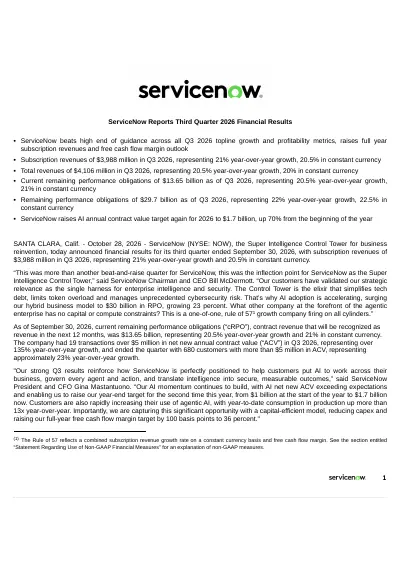
Let's do the standard results first. Subscription revenue growth was 20.5% in constant currency, 50 basis points above the high end of our guidance.
CRPO was 21% in constant currency, 100 basis points above our guidance. Operating margin was 32.5%, 150 basis points above our guidance.
Free cash flow margin was 20%. We had 19 deals greater than $5 million net new ACV in Q3, up 135% year-over-year.
We have a $30 billion remaining performance obligation growing at 23% year-over-year. That's growth at scale.
To my trifecta point, here is where the Q3 print gets even more dynamic. For many quarters now, we've been aggressively building the consumption engine into the business model.
Our ambition is to be the governed execution layer for enterprise AI, with multiple commercialization paths, all driven by customer choice. Q3 is the banner achievement to date.
The strategy is working. We have tangible AI monetization.
AI net new ACV was 65% year-over-year growth in Q3. Control Tower net new ACV grew over 6x year-over-year.
Our agentic front door, Employee Works, reached $100 million ACV in less than three quarters. The number of $1 million-plus AI deals grew 4.5x year-over-year.
Year to date, agentic AI consumption in production is up 13x year-over-year. If you look at the consumption of Action Fabric assists alone, that number is up 500% month-over-month.
This is not only the direction of our customers; this is where they want us to go. It's the right direction for long-term shareholder value creation as well.
As a reminder, we began the year with a $1 billion AI target by year-end. We raised that target to $1.5 billion at Financial Analyst Day in May.
Today, we are raising that target again, this time to $1.7 billion-plus by year-end. As you've come to know me pretty well by now, I've challenged the team to even surpass that number.
Overall, the company is now full speed in our Q4, and Gina will give you the guide shortly. I don't want you to wait too long.
She will raise. As everyone on this call knows, ServiceNow always closes strong.
We have no intention of delivering anything less than the best year in our history. Let's spend a few minutes on what remains a very complex environment for the enterprise.
We hosted our biannual CEO event with more than 125 CEOs a few weeks ago. Here's what I heard.
All of them are investing in the intelligence revolution. They've spent billions on it so far.
They all went through the token maxing phase. Here's the big lesson they all learned: all of the vibe slop flops.
Sprawl and lack of integration are even greater risks in the AI world. When I spoke to them about ServiceNow's role as the superintelligence control tower for business reinvention, their endorsement was universal.
Our SICT, Superintelligence Control Tower, brings together the right model for the right workload to solve the right problem and unlock the right opportunity for our customers. Businesses in every industry need a harness for enterprise AI.
This is more than orchestration, governance, or security alone. It's the nexus of all three categories coming together.
We're now in the rules and rails phase of enterprise intelligence. 94% of enterprises report gaps in AI visibility.
88% can't even distinguish personal AI accounts from corporate instances. ServiceNow's Control Tower discovers and inventories the entire AI estate.
As stories of rogue agents persist, ServiceNow controls what agents can do. That's why we introduced AI Passport to issue every agent an official, attested record based on context in our platform.
Who owns the agent? What's it allowed to do?
What data can it access? How much risk exposure is it allowed to take?
This enables the most capable kill switch available in the enterprise today. When our Control Tower revokes a passport, NVIDIA Sentry stops honoring it, and the agent stops at the infrastructure layer.
We are scaling that capacity everywhere. Our Control Tower signals Okta, Microsoft Azure AI Foundry, and Google Gemini Enterprise agent platform so they can cut off the agent's access wherever it runs.
ServiceNow already sits at the operational core of the world's largest enterprises: the CMDB, the Workflow Data Fabric, 20-plus years of embedded operational intelligence and context across IT, security, and risk. With Armis and Veza, we can now pinpoint specific known vulnerabilities against a cybersecurity landscape that has irreversibly changed.
We call this Shift Zero. It moves security from remediation to prevention, from human speed to machine speed, and from blind to governed.
The average enterprise runs more than 70 security tools. ServiceNow offers a single, governed system with proof of what acted, why, and who is accountable.
This is not an incremental improvement to a reactive model. It is the replacement to consolidate a fragmented market.
It is the gateway to autonomous defense. That's why we're the fastest-growing cybersecurity company at scale, and why the growth is accelerating so rapidly.
When you're operating in the superintelligence era, the pace of innovation has to keep pace with the growing size of the opportunity. I'm really proud of what the ServiceNow team has delivered.
Our Level 1 Service Desk Specialist resolves incidents 85% faster than human agents. This is now in full autonomous production across customers of varying size and sector, from a global automotive leader to a leading enterprise technology company.
Our AI Ops Specialist has already reduced median time to resolution by 40% within the first month. We now have over 100 customers actively innovating with our AI specialists.
AI Ops, HRSD, and CRM specialists are expected to become generally available in Q4. As enterprises rethink the mandate of their CRM systems, ServiceNow is leading the way.
The old CRM was built for sales teams. The new one has to work across your entire business.
That's a different product. That's a different architecture.
That's why we're seeing customers rip and replace, not just add alongside. Conversational voice AI is the next big leap in connecting the front office to the entire enterprise.
The customer conversation is where the work starts. The platform has to carry it through every system and workflow behind it.
We're redefining how enterprises engage with customers. Our tuck-in of Swoop adds deep expertise in rapid agentic deployments, giving us another gear to accelerate while improving customer outcomes.
One year after we brought Logik.ai into ServiceNow, we've been named the leader and customer favorite in The Forrester Wave for Configure, Price, and Quote Solutions. We see a similar change in gravity for the employee experience.
For the Fortune 500,000, we introduced Flow. There are many enterprises that want leading domain expertise, but aren't ready for formalized ITSM.
Flow fills the gap, a new conversational service desk that is self-serve and consumption billed. A customer that signs up for Flow today can begin using Flow today.
That's a big reason it's off to a lightning-fast start with businesses and government agencies around the world. ServiceNow Employee Works continues to be a fast-growth machine.
This gives enterprises one place to search knowledge, get things done, and route work across IT, HR, finance, and procurement. It also becomes the destination for employees to build AI assistants, agents, and automations, all secured by enterprise guardrails.
This is only scratching the surface of the groundbreaking innovation on the ServiceNow platform. Even the best platform won't deliver for enterprises alone.
ServiceNow Control Tower Alliance is a new ecosystem of leading companies in AI, cloud infrastructure, security, governance, and token management, who will help customers adopt trusted enterprise AI safely at scale. Founding partners include Anthropic, AWS, Cisco, HiddenLayer, Kong, Okta, OpenAI, WitnessAI, and Zenity.
Today ServiceNow announced an expanded partnership with OpenAI to help enterprises move seamlessly from AI reasoning to governed action. The partnership expansion starts with a new ServiceNow plugin for ChatGPT, enabled by Action Fabric.
We aim to develop security and risk solutions powered by OpenAI's cyber models, a Codex integration in AI Workflow Factory, and voice-driven governance for ServiceNow's Superintelligence Control Tower. We have very big plans for this partnership, especially in cybersecurity.
We expanded the partnership between Google Gemini Enterprise and ServiceNow Action Fabric. Gemini Enterprise provides the conversational front end, while ServiceNow provides the governed industry workflow execution.
Our partnership with Innrï, a Sea-Prime company, shows what happens when a partner builds on ServiceNow before they sell it. Innrï went live on Employee Works in six weeks.
That's the new bar for time to value, rather than the exception. They didn't sell the solution until they lived on it themselves.
Median submission time is now down 60%. Completion rate's 97%.
ServiceNow and Aramco Digital established an agreement to standardize and govern digital workflows across Aramco's affiliates, subsidiaries, and joint ventures in more than 50 countries. The list goes on and on.
I could end on the countless industry accolades we've earned: three new Gartner Magic Quadrants, two new Forrester Waves, IDC reports, and many more. Instead, I'll close with the ultimate measure of a defining enterprise technology company: our customers.
A major Asian telecommunications leader, with over 130,000 employees and contractors, became the first enterprise in the region to deploy ServiceNow Autonomous Workforce for a zero-touch help desk in IT and HR. This'll handle 70,000 IT requests and 6,000 HR inquiries annually.
The Salvation Army Australia is using ServiceNow AI Specialist to give frontline employees more than 5,000 hours back so far, time that is redirected towards supporting community members that are in need. Germany's professional soccer league expanded with ServiceNow as its official CRM partner.
It's about one month, only one month, they've already consolidated fan services from seven digital channels into a single ServiceNow platform, resolving 89% of inquiries at first contact, cutting previous case volumes in half. When a global logistics leader, Shipman, operations were drawing terrible manual work processes across siloed systems that were soul-crushing, ServiceNow built them an AI partner, the Shipman Issue Analyzer.
The result is nearly 100,000 hours saved annually, resolution from three days to less than 30 minutes. Jack Henry & Associates, one of the leading financial technology companies in the US, chose ServiceNow CRM to modernize its CRM capabilities with AI that automates routine tasks and strengthens post-sale operations.
At a consumer finance company, spotting risk meant sending it nowhere: multiple channels, unclear ownership, legacy systems swallowing signals. Our applied AI FDE team, forward-deployed engineers, built them the AI Risk Front Door, a two-layer agent architecture targeting 85% accuracy.
It compressed signal to routed case time by more than 85%. Nestlé has started to leverage our Control Tower to scale AI with strong governance across its operations.
They are progressively deploying agentic marketing operations across 60 countries, with the potential to reduce marketing campaign coordination by 25%. Together, we continue to drive innovation across all key business functions.
InterContinental Hotels Group, one of the world's largest hospitality and travel services companies, is using Veza from ServiceNow to govern who and what can access its systems, it can safely scale across its 7,000 hotels worldwide. These amazing enterprises are putting AI to work for people.
They're doing it with ServiceNow on our AI platform with the security of our Superintelligence Control Tower. We see clear momentum in AI monetization, driven by our organic innovation, our pricing, and our intelligent packaging.
Our security business is differentiated, with the potential to be even bigger in a few years than all of ServiceNow is today. We're strong across industries, including the public sector, which once again delivered in its biggest quarter of the year.
We're not compute-constrained. We don't have capital constraints.
We're activating a hybrid business model. As you'll hear in the raised full-year guidance, we're a company going from the rule of 56 to the rule of 57 on our way to the rule of 60.
That, of course, is free cash flow plus revenue growth. We have six businesses that have now surpassed more than a billion run rate, with a TAM that continues to multiply and expand.
What other businesses are there that can even contemplate these fundamentals? It's only getting better.
As the cost of intelligence falls, the tailwind for software is strengthening. We are a one-of-one growth company.
We have deep incumbency in the enterprise, with proven global distribution. We're honoring the principle and the promise that the world works with ServiceNow.
I really appreciate your belief and support. I look forward to your questions.
Now I'll turn things over to our President and Chief Financial Officer, Gina Mastantuono. Gina, over to you.
Gina Mastantuono
Thank you, Bill. We delivered another strong quarter, exceeding the high end of our guidance across every top-line and profitability metric.
Q3's results reinforce that ServiceNow is becoming even more strategic as enterprises move from experimenting with AI to deploying it at scale. Customers want the productivity and growth that come with the superintelligence, but they also need the visibility and security to do so with confidence.
With the ServiceNow AI platform at the operational core of the world's largest enterprises, we are perfectly positioned to help customers put AI to work across their business, govern every agent in action, and translate intelligence into secure, measurable outcomes. Q3 subscription revenues were $3.988 billion, growing 20.5% year-over-year in constant currency, and 50 basis points above the high end of our guidance.
RPO ended the quarter at $29.7 billion, representing 22.5% year-over-year constant currency growth as average customer contract duration continues to expand. Current RPO was $13.65 billion, representing 21% year-over-year constant currency growth, a 100 basis point beat versus our guidance.
Across our workflows, we saw widespread demand. Technology Workflows had 54 deals over $1 million, including six over $5 million.
Demand for our core workflows remains robust as every new AI asset and agent introduces greater requirements to manage, monitor, secure, and govern the enterprise. ITSM was in 11 of our top 20 deals.
ITOM was in nine of our top 20 deals, with 14 deals over $1 million. Asset Management crossed $1 billion in ACV this quarter and was in 13 of our top 20 deals, with 11 deals over $1 million.
Our Security and Risk solutions were in 16 of our top 20 deals, with 13 deals over $1 million. CRM and industry workflows maintained its rapid growth trajectory and were in 13 of our top 20 deals, with $1 million-plus deals surging to 28 in the quarter.
Core Business Workflows had 15 deals in the top 20, with 24 deals over $1 million. Creator Workflows had 19 deals in the top 20, with 13 over $1 million.
From an industry perspective, business and consumer services led the way with net new ACV growing over 3x year-over-year. Technology had robust growth as well, at nearly 40%.
Our US federal business also delivered an excellent quarter, with deals over $1 million growing over 30% year-over-year. We expect federal net new ACV growth to accelerate further in Q4 as agencies increasingly see ServiceNow as the AI operating system for the enterprise.
In Q3, our renewal rate remained best-in-class at 98%, reflecting the enduring value we deliver to our customers. We ended the quarter with 680 customers generating more than $5 million in ACV, with 31 additional customers surpassing $20 million in ACV over the past year.
As our largest customers continue to scale with ServiceNow, they're expanding their platform adoption, with 19 of our top 20 deals including six or more products. The momentum in our AI solutions continues to build.
We continue to exceed our AI expectations for the year, with AI net new ACV growing 65% year-over-year in Q3, allowing us to raise our AI ACV target for the second time this year, from $1 billion at the start of the year to now $1.7 billion by the end of 2026. In Q3, the number of AI deals over $1 million grew 4.5x year-over-year.
We're also seeing customers embrace AI more broadly across their enterprises, with deals spanning five or more AI products increasing over 8.5x year-over-year. AI adoption is pervasive across the platform, evident in every workflow.
ITSM AI deal volume increased nearly 80% year-over-year. HRSD AI deal volume nearly doubled.
Newer AI solutions saw deal volume grow even faster, with ITOM growing more than 7x and Portfolio Management more than 6.5x. We also saw strong net new ACV momentum, with Security and Risk AI growing more than 4.5x year-over-year, App Engine AI more than 4x, and Asset Management AI nearly tripling.
CRM AI had a standout quarter as well, with net new ACV tripling both quarter-over-quarter and year-over-year. Just as importantly, customers are moving rapidly from adoption to production.
As Bill mentioned, our year-to-date consumption of agentic AI in production is up more than 13x year-over-year. We're passionate about helping customers realize value faster.
With the help of our forward-deployed engineers, we've seen an accelerated time to value of 80% year to date. For example, one European customer went live in just 12 weeks and is on track to consume nearly 1.5 million in annual assists.
When we provide deployment expertise, we've seen AI adoption move twice as fast in just the first five weeks of involvement. Turning to profitability, non-GAAP operating margin was 32.5%, 150 basis points above our guidance, driven by the revenue outperformance, efficiency gains, and timing of spend.
From a productivity standpoint, our internal use of AI is now generating more than $1 billion in annualized value, more than double the level we exited 2025. Free cash flow margin was 20%.
Together, these results continue to demonstrate our ability to drive a strong balance of world-class growth, profitability, and shareholder value. Moving to our outlook, for 2026, we're raising our subscription revenues by $15 million at the midpoint, from $15.77 billion to $15.785 billion, representing 21% year-over-year growth on a constant currency basis.
We are raising our full-year free cash flow margin target by 100 basis points, from 35% to 36%, driven by lower CapEx spend. Against a backdrop of growing investor scrutiny around AI-related infrastructure spend and leverage, ServiceNow is positioned to capture the AI opportunity while reducing its CapEx and expanding free cash flow margins.
We continue to expect subscription gross margin of 81% and operating margin of 31.5%, up 50 basis points year-over-year. Our execution has enabled us to fully offset the dilution from acquisitions this year and still deliver meaningful margin expansion across both operating and free cash flow margins, reinforcing the strength and scalability of our business model.
Finally, we expect GAAP diluted weighted average outstanding shares of 1.04 billion. For Q4, we expect subscription revenues between $4.245 billion and $4.255 billion, representing 21.5% year-over-year growth on a constant currency basis.
We expect CRPO growth of 18.5% on a constant currency basis. This reflects a higher mix of on-prem deals and excludes a rising balance of T for C backlog, both of which contribute to revenue, but not CRPO.
We expect an operating margin of 32%, and we expect 1.05 billion GAAP diluted weighted average outstanding shares for the quarter. In closing, Q3 was another strong quarter of execution and accelerating AI adoption.
What excites us even more is the scale of the opportunity still in front of us. From SI Control Tower and autonomous security to Employee Works and our growing portfolio of AI specialists, we're helping customers operationalize AI across the enterprise, turning innovation into measurable business outcomes and ROI.
Just as important, we're helping customers accelerate adoption without losing control. This is where ServiceNow is differentiated.
By combining workflow, data, AI, and governance on a single platform, we can help customers manage the complexity of the AI era while unlocking its full potential. This gives us confidence in the substantial growth opportunity ahead and our ability to create long-term value for customers and shareholders.
Bill and I would like to thank our employees around the world for their continued focus, execution, and commitment. Their ability to innovate while operating with discipline is what enables us to consistently deliver quarter after quarter.
With that, I'll open it up for Q&A.
Operator
We will now begin the question-and-answer session. Please limit yourself to one question.
If you would like to ask a question, please press star one to raise your hand. To withdraw your question, press star one again.
We ask that you pick up your handset when asking a question to allow for optimal sound quality. If you are muted locally, please remember to unmute your device.
Please stand by while we compile the Q&A roster. Your first question comes from the line of Brad Zelnick from Deutsche Bank.
Your line is now open. Please go ahead.
Brad Zelnick
Fantastic. Thank you so much for taking my question.
Bill, we increasingly hear about AI-native applications companies implementing outcome- or value-based pricing, and I'm just curious to what extent you're seeing customers asking you to go down this path. I know you have a perfect mix of subscription and consumption, but it seems like the market is moving in this direction.
Maybe for Gina, I imagine this is something you've contemplated internally. What would the impact of something like this be on the financial model?
Thank you.
Bill McDermott
Brad, thank you. We have the best of both worlds in the sense that the customer likes the predictability of the seat-based pricing model for their budgeting purposes.
People that run Fortune 2000 companies run on budgets, we give them that. Also, we're driving consumption, and the idea is simple: get the customer live fast, and once they're live, the token economics take off, whereby we have a chance to improve our revenue per user by a factor of 5x, and that's only because the customer derives substantially more value than that.
It's kind of a win-win. I would also point out that with the announcement of Flow, the native AI standalone autonomous service desk type of provider are no longer required, as we have that now shipping globally.
You can buy it online, and you can go live in the same day. That'll be yet another net new ACV engine for the company and obviously a problem for the competition.
Again, best of both worlds. One thing that really is interesting with the Superintelligence Control Tower, you should know, a 500% growth month-over-month in terms of the AI action that's activated in that Superintelligence Control Tower, coupled with a 13x improvement in AI consumption.
Clearly we're benefiting from our current model because we're growing 21% year-over-year, and this hockey stick formation has yet to be fully realized. I think that is yet another exciting point for the investors to contemplate.
Gina Mastantuono
Then, Brad, from the impact on the financial model, as Bill said, our customers are very focused and quite happy with the hybrid model that we have today and are not asking at all for outcome pricing. You would imagine if the day were to change that we'd be ready and waiting for that.
As of now, our customers are very, very happy with the hybrid model as Bill talked about.
Operator
Your next question comes from the line of Alex Zukin from Wolfe Research. Your line is now open.
Please go ahead.
Alex Zukin
Hey, guys. Thanks for taking the questions, and congrats on another strong performance.
I guess maybe, Bill or Gina, for you, there was some nuance on kind of some of the impacts that you're seeing on the numbers in the guide, particularly for Q4 on CRPO and subscription revenue. Maybe to the extent that, again, all of the metrics that you're citing sound like you're expanding your growth opportunity, expanding your growth potential.
Obviously, the stock is down pretty meaningfully aftermarket on some of, I think, the 4Q guide. Any constant kind of comments on your confidence in growth going kind of either staying high or going higher, particularly even for next year, as some of these nuances normalize, and they don't necessarily impact subscription revenue as much as maybe the CRPO deceleration would imply?
Gina Mastantuono
Thank you, Alex, and appreciate the question. First and foremost, we remain as confident as ever in our growth opportunities, as I hope came through very clearly in both Bill and my prepared remarks.
We had strong beats across the board: revenue, CRPO, op margin, free cash flow. We raised free cash flow margin.
On the revenue beat, what I'd say is that while we actually passed through half of the beat, all of the FX and a half of the beat that we saw in Q3 to the full-year guide, with respect to why we didn't raise by the entire beat, there's a couple of things. Number one, with our scale, this beat is really strong, and we feel really good about that.
To help our customers realize value even faster at scale, we've made the strategic decision to invest in their success by including delivery expertise with our platform solutions to accelerate AI deployments for select large deals. From an accounting perspective only, the value of those deployments are carved out of subscription revenue, and they're included in professional services rather than subscription revenue.
Notably, upon renewal of those contracts, the value of those services carved return to subscription revenue. It provides a structural acceleration to growth, and it's not huge: about 25 bips in Q3, and expecting it to have approximately 50 bips in Q4, which is the only reason why we didn't pass through the full beat in Q3 into the rest of the year.
Subscription revenue, feel really, really strong about that. With respect to CRPO, we saw strong early renewals in Q3 that contributed about half of the beat in Q3.
Now, that has a negative impact in Q4 because we pulled those deals out of Q4 and into Q3, so that growth is already in Q3. Couple of other things to factor in: strong public sector demand is driving higher on-prem mix in Q4, which is actually a great result, but that is driving a 25 basis points headwind in Q4 CRPO, but will absolutely hit revenue and be part of revenue.
The other thing is those incremental investments in deployment expertise, a small, modest RPO headwind also does not impact revenue in the long term. Just more generally, I'd note, and we've talked about this before, right, CRPO is a very nuanced accounting metric, and it doesn't necessarily capture all of the momentum in the business.
A good example for that is there's approximately 50 basis points of year-over-year subscription backlog growth that's excluded from CRPO in Q4 due to T for C provisions, but absolutely will be included in revenue. While CRPO is a good indicator of next year's revenue, it's certainly not perfect.
The momentum you're hearing in the business, especially around all of the AI amazing things, will absolutely translate to strong revenue growth in 2027 and beyond. At the end of the day, we feel as confident, if not more confident today in our growth opportunities than ever before.
Operator
Your next question comes from the line of Adam Wood from Morgan Stanley. Your line is now open.
Please go ahead.
Dan Dorman
Thank you for taking the questions. This is Stanjit Singh for Adam.
I wanted to just zoom out a little bit and just talk about the momentum you're seeing on the AI ACV side. Gina, as you noted, you've raised the guidance twice now to $1.7 billion in revenue.
At the same time, if we look at just the broad story of CRPO, we could call it stable, maybe on an organic basis modestly decelerating, but sort of generally stable. My high-level question, Bill, is just when do you think the AI momentum will start to translate to overall top-line acceleration, CRPO acceleration?
With respect to that, in terms of the go-to-market motion, you guys have made a lot of pricing and packaging changes. You guys just noted that you're doubling down on delivery.
Do you feel you have the sort of AI agentic sales go-to-market motion right, or is there room for improvement on that front? Thank you.
Hey,
Bill McDermott
thank you very much, Adam. Let me just be extremely clear: the business has never been in better shape than it is right now.
I think one of the luxuries that you have when you have the Superintelligence Control Tower and every partner, that's a hyperscaler or a lab company, these are great companies, from NVIDIA all the way through to the labs are teaming up with ServiceNow and realize the importance of coming through our Superintelligence Control Tower to drive enterprise value for their customers also. That's where the network effect is really starting to kick into extra high gear.
I want you to please register that as a significant momentum advantage that we are experiencing. Also, we are very cognizant of the importance of getting these customers live fast.
They have to get value out of AI now. As Gina said, we've made the necessary decisions strategically to get them live fast, invest in doing that, ultimately they can not only derive the benefit from the license, but they can also activate the tokens to create the tokenomics that our shareholders are looking for, and also that their shareholders are looking for.
That virtuous cycle is kicking into high gear. As I mentioned, we have a 500% month-over-month increase in the activity on the Superintelligence Control Tower, and a 13x improvement on the AI consumption itself.
The strategy is working, and yet we're still in the early days. You will absolutely see in some now, but also in 2027, as Gina said, the true acceleration because it's all about the customer getting these implementations and getting these tokens activated in their workflows or their business processes.
We have made a decision as a company and our ecosystem to do that because that's where the long-term value creation exists for us, for the shareholders, and, most importantly, for the customer. I feel great about it.
Gina Mastantuono
Then I'd just take you back to Financial Analyst Day, Adam, when we talked about by 2030, our AI business would be 30% of our ACV. We're absolutely on path and trajectory to get there, if not actually ahead of schedule, as you can tell by our continued raise of AI.
We are well on our path.
Operator
Your next question comes from the line of Samik Chatterjee from J.P. Morgan.
Your line is now open. Please go ahead.
Samik Chatterjee
Oh, hi. Thanks for taking my question.
Maybe if I can just go back to the strategic decision to invest with your customers to accelerate AI adoption with them. Sounds like you did some of that investment in Q3 already.
Any early data points in terms of those engagements that is driving the confidence about sort of expansion on AI adoption from them? What are sort of the ideal metrics you've been focusing on to measure that outcome there with the customer?
Thank you.
Gina Mastantuono
Absolutely. As you can imagine, this market for AI is moving very quickly, and so are we.
We noticed that customers receiving the support saw AI adoption progress twice as fast during just the first five weeks of that support, with multiples higher of assists consumption and product usage versus those without support. That assist consumption and product usage are the metrics that we're looking at.
When we're seeing accelerating customer AI consumption, as you would expect, it unlocks a significantly larger monetization opportunity, making the ROI very compelling. Therefore, we're reacting by building more of these deployment teams into our forecast because we're seeing such incredible results.
Bill McDermott
I would add to that, Samik, just one very interesting move that we made, which was the acquisition of Swoop. As one of the big reasons why customers sometimes have a more difficult time changing from one CRM system to another is they have a long implementation cycle, and nobody wants to have long implementation cycles, especially when it relates to taking care of their customers.
Now we're able to accelerate the deployment times for CRM to instead of talking years, we're talking a month. We're talking like days, 30 days, 60 days, for a serious company of serious scale.
This same logic also applies to the enterprise Superintelligence Control Tower and all of the workflow processes on ITSM, as an example. In 24 hours, we activated that.
What we're looking at here is a Superintelligence Control Tower, a completely open ecosystem feeding into the rules and the rails of the way the enterprise runs, connecting the fabric of the data and the processes, and we're going to do this at record pace. It's going to drive implementation cycles to record speeds, which is necessary to get the tokens fully consumed, activated, and generating revenue.
As I always want to remind everybody in our company and otherwise, there's no other company growing at the rule of 57 in the enterprise software industry. If you can find them, please let me know.
I want to talk to them. I want to get the best practices, with 21% growth on revenue and 36% growth on free cash flow, all while building the most superior Superintelligence Control Tower that the world has ever known.
I want to meet that company.
Gina Mastantuono
Thanks, Samik.
Operator
Your next question comes from the line of Peter Weed at Bernstein. Your line is now open.
Please go ahead.
Peter Weed
Thank you. I think one of the impressive things you've been doing is investing internally in productivity optimization, and I think we're seeing that come through pretty significantly in some of the headcount numbers.
Can you help us understand how that's playing out? Because it looks like a lot of it is actually focused in maybe front office, product and sales and marketing.
How are you able to get that productivity in these areas to the level that you want, while this is also what will be driving revenue looking forward?
Gina Mastantuono
Thanks, Peter. First and foremost, so, excited to say that we've crossed the billion dollars in efficiency gains through our own internal use of AI.
The lion's share of that is coming from our own use of our own products, Now on Now. It's just incredible.
Yes, that efficiency gains means that we're able to not hire as many people. That being said, we're absolutely hiring folks in the right spots.
While you might see total sales and marketing headcount come down, actually, quota-bearing heads are up double digits, while sales operations, for example, is down significantly. Very similar in the R&D organization: as you would imagine, real increases in AI engineers, in top talent, but there's lots of efficiency gains that we're driving through AI that means that we don't have to hire as many support people, for example, or overhead in the R&D organization.
We're absolutely still hiring across the board in both go-to-market and R&D. We're hiring in the right places, but that's being offset by incredible efficiencies that allow us to bring those more operational roles, those headcount roles, down significantly.
Bill McDermott
I would build just to share with you, Peter, a couple of things that are very interesting. We have our own Employee Works solution in the company.
If you think about our great go-to-market machine, which is the best in the industry by far, they all have a coach, and that happens to be Employee Works. It is autonomously activating all of the controls that are necessary to build great customer relationships and bring all of our innovation to the customer.
This is being done autonomously, not that they have to even request it. They're also getting the insight pushed to them to make them more productive on the front line.
Think about it: if we go back 3 years, that was like 100 people in the sales operations department moving around information on email. That is now completely autonomous.
It's a sales coach in the pocket. It's driving enormous productivity.
Just to be clear, we're actually significantly improving and increasing feet on the street. While our ultimate headcount has actually slightly declined, which is a gorgeous situation as Gina pointed out, the 90% response time to customer service or employee service inquiries is now done autonomously and in a way that is so much easier for people to deal with, and it gives them an improvement in their life experience here at ServiceNow.
Finally, while the headcount may remain consistent, we continue to strengthen the workforce. We continue to bring in net new talent in AI on the innovation side, and on the quota-bearing side, we have a higher standard for the kind of individuals we need to take us from here to there.
While the headcount's steady, the innovation and the improvement of the human capital condition has only increased substantially. That's a very important thing that sometimes doesn't show up in the numbers.
Operator
Your next question is from the line of Arjun Bhatia from William Blair. Your line is now open.
Please go ahead.
Arjun Bhatia
Perfect. Thank you so much, and add my congrats on a good Q3.
I want to go back to an earlier question. Bill, one of the most important and sort of biggest debates and questions that we get from investors is whether AI is cannibalistic or accretive to software companies.
We're kind of seeing this in your results, where the AI adoption is increasing and accelerating, and you're seeing raises on that guidance, and then some of the other metrics are sort of not yet inflecting. I'm just curious, and I'm sure there's a timing mismatch there, but when you look at your early adopters and your most advanced AI customers, what are you seeing in terms of how their overall spend with ServiceNow is changing as they've adopted Now Assist and your AI capabilities?
Bill McDermott
There's no doubt. I really remind people, including at the CEO meeting that I referenced, the world GDP rests on superintelligence, and this intelligence generation, that we'll look back on it 10 years from now and say that was a Renaissance moment.
All the business cases that are tied to return on invested capital from AI are a factor 10x greater than anything that preceded AI solutions. This is really unbelievable stuff.
Just take ourselves. Gina talks about a billion.
A billion is a lot. A billion in a year is a lot of money, and what's unbelievable in terms of the operational performance of the company, we continue to grow the company at a pace consistent on a much larger base than we were growing before we saved a billion.
Less people doing extraordinary things, enjoying their work much more because the autonomy of the AI platform has taken the pressure off of them, they can do the work that really matters. We're one example.
The business cases, and we review them all the time with Amit and Paul, they have a 10x improvement over anything that we've seen before. Amit, feel free, comment on this.
Amit Zavery
Yes. Arjun, on your question about the use cases and how we're seeing that adoption grow, many of the customers typically start with one or two use cases where we help them, or they decide, like incident management or triaging or resolution planning.
Once they see that go live, we've seen that go up to 3x, 4x usage, but also new use cases emerge because now they're seeing it in their production environment. That's really been the growth.
If you see a lot of the customers we talked about in last quarter as well as now, they're re-upping their licenses and the new renewals with higher tokens because they're seeing the adoption go up as well. We have customers like Nestlé, for example.
They went live in six six weeks with this marketing optimization agentic workflow, and now they're unleashing that in 90 different countries, and they're starting to now use it across the world to get value out of one time they use the use case they built and grow it significantly across the world as well. Those are kind of the common patterns we see, and then we're seeing this autonomous IT, for example, and then with that kind of use case going into AI Ops, CRM optimization, and other industrial use cases as well.
Very, very easy to kind of start seeing that growth come through.
Operator
Your next question comes from the line of Samad Samana from Jefferies. Your line is now open.
Please go ahead.
Samad Samana
Hi, good evening, and thanks for taking my question. Gina, I just wanted to ask about the decision to have resources for large customers to accelerate AI deployment.
I'm curious, I guess, when was that decision made, and I'm just curious how we should think about modeling that. Is this something that'll be broadly available?
Is it something that's on a customer-by-customer basis? Then is there anything that we need to make a consideration for given the rev rec on the margin side as well?
Maybe just help unpack that for us, and what you're assuming in the forward guidance, given I know it's not the biggest thing that happened, but it did sway, I think, the guidance a little bit, and so I think investors would get some more comfort if we had more color on how to unpack that.
Gina Mastantuono
Perfect. Yes, as I said earlier, Samad, the market for AI is moving very quickly, and so are we.
When we saw the real inflection with customers that were receiving this support, we decided to double down because that consumption flywheel is going to drive significant incremental growth, right? Deployment times are rapidly improving, and these services are being, as you say, provided for a select number of large deals, and we talked about it's in the number: 25 bips in Q3 and 50 bips in Q4.
We don't expect to include this delivery expertise over the long term. As with other new technology adoption cycles, it's really about optimizing the first wave of adopters and leveraging the know-how in a repeatable and scalable way.
As the AI gets better, the ability to autonomously deploy gets easier and easier. We don't expect this to be long-term, but we absolutely believe it's the right thing for the business, and is going to continue to help drive that consumption flywheel.
Amit Zavery
One thing I'll add on this one, Samad: we also building, using AI, implementation agents. When we help our customers go live, a lot of the heavy lifting is done by AI.
This is really identifying the early use cases and make it simple for them to go live with it. Once they get one or two of these live, then the volume goes up very quickly.
This is not a long-term engagement. It's very short, but we get that value quickly for customers.
Gina Mastantuono
Yep. Thanks, Samad.
Operator
Your next question comes from the line of Kirk Materne from Evercore ISI. Your line is now open.
Please go ahead. As a reminder, please remember to unmute your device.
Bill McDermott
Kirk?
Kirk Materne
Oh, sorry about that. I'm sorry, couldn't hit the mute button.
Bill, I was just wondering, on Control Tower, obviously everybody is getting ready to have to build an orchestration layer to sort of manage their agents at scale. Are they doing that now, or are they waiting till they get more deployment in production?
I was just wondering how you guys see that playing out, where they're going to lay out sort of a baseline, and then they can drive consumption once the agentic population builds up. I was just wondering if you can give us some color on that front.
Thanks.
Bill McDermott
Sure. First, I'll just say, big picture, the Superintelligence Control Tower is basically redesigning what the enterprise visibility, governance, and security posture is of these major corporations.
If you look at the partnerships we announced today across the board, and especially OpenAI, it's clear that the best and smartest companies in the world realize that this Control Tower and activating that across rules and rails that are deterministic and companies rely on to run their business is a pretty important thing to do to grow their businesses. Amit can give you some color on exactly how we're driving this and the impact that it's having.
Amit Zavery
Yeah. Thank you, Bill.
Kirk, usually, I think if you look at last year, the concerns many customers had when we would speak to them is they had no idea of what's going on with AI, how many shadow projects are going on, what agents are doing. Control Tower really resonated very well when we introduced it last year because we are kind of putting this in front of the AI deployments.
This is really the governance, the trust, and the safety layer, which gives you a lot of confidence and the ability to really have trust in the system. As we build out the discovery capabilities across multiple third-party AI systems out there, any kind of in-house built AI agents, you have one place to monitor, manage, including cost, but also really have the ability to kill any agents which should not be going and doing something which they're not allowed to.
It's become very strong part of a governance layer, but also the runtime layer. This is where the difference comes in.
It's coming in first before AI goes in production, and the volume of usage just starts going up because as you start building out more AI, as you get confidence, we are really helping them manage it. It's not about orchestration really.
It's really the visibility, the control, and the safety. Then we can orchestrate many things underneath the covers, depending on what other systems customers might be using.
This is really up-front, first investment customers are doing, and unlocking a lot of value for us going forward. It's built on our core competence we had with CMDB and the Asset Management, and we're introducing ability to do any kind of physical assets, as well as physical AI and non-human identity in one place.
It's really resonates and works very well for our customers if they want to really scale AI.
Bill McDermott
If it helps you, an example might be, think about AI adoption, unifying IT, audit, legal, risk, and this single governance framework that Amit is discussing. Accenture has over 800,000 employees, I believe, and every single corporate function now is running on ServiceNow.
They use the Control Tower to govern nearly 900 ServiceNow native AI assets, and they measure the business outcomes across all of their departments. What it's done for them is, like it's done for us, a substantial increase in productivity across the enterprise as they scale agentic AI.
I can also tell you about a global tech leader that's basically using the Superintelligence Control Tower, and their driver was Armis and Veza, because they wanted to manage the identities of obviously the people and the agents, but at the same time, they wanted to secure the operating technology environment of the company: networks, devices, critical infrastructure, and so forth, and lower their cost to serve, drive their productivity, and remediate things at machine speed. That's going to be a consistent theme that you're going to hear.
When you think about it, this particular company had about 80 different security tools, and that's pretty dangerous. I used Nestlé as an example in my remarks, but they've expanded their footprint of ServiceNow through the prism of the Superintelligence Control Tower, and they're running their governance across a very complex, large, global corporation, and all of their operations are governed by the Superintelligence Control Tower, and we're just getting started with them.
There's just so much in front of us, so much bandwidth that we bring to the customer, and the word's out there now. We're ready to roll.
Amit Zavery
I'll just add one thing, sorry, Bill. On the idea that we can discover, but also the SecOps products we have built for many years.
Bill McDermott
You're
Amit Zavery
combining this ability to discover, preempt any kind of issues, as well as proactively remediate in one platform. That's when you combine the Control Tower with what we do in SecOps, Veza, and Armis, suddenly you have a platform which completely has visibility, but also the ability to save you if something goes wrong.
Operator
Your next question comes from the line of Michael Turrin from Wells Fargo. Your line is now open.
Please go ahead.
Michael Turrin
Hey, thanks very much. Bill, given it's nearly November, I'd just be curious to hear how you characterize the tone of overall IT budget discussions you're hearing, how ServiceNow is specifically positioned, where Armis and some of the agentic offerings we're talking about fit, and just how that impacts where you focus the company both into end of year and towards a successful '27.
Thanks.
Bill McDermott
Thank you very much for the question, Michael. I feel really great.
The most important thing is strategic relevance, and that's what we have. We have a system of record that has been trusted for a couple of decades, and the net new innovation from ServiceNow is truly breathtaking.
What I see is solutions that don't matter or point solutions, they will get eliminated, while strategically relevant platforms will not only do well, they'll do a lot better, especially if they're relevant in this era of superintelligence. We are seeing our pipelines grow extremely well: the Superintelligence Control Tower, Veza, Armis, Moveworks.
In three quarters, you created $100 million in ACV. All these businesses are way ahead of what we had anticipated when we brought them into the family.
Too is Logik.ai. What you're seeing is we're building lots of innovation thanks to our great innovation machine led by Amit.
We made the right strategic choices to complement what we were building, and our customers really love it. Our biggest opportunity right now is to get out there in front of the customer, make sure they understand, because they're getting hit from all angles.
The one angle that is consistent everywhere is they want ROI now. We're past the proof-of-concept phase, we're past experimentation phase, and we're past point solution or vibe coding or do-it-yourself phase.
We're now in serious enterprise phase, where it's all about get the job done, deliver real value. This platform is one of a few that will do extraordinarily well now and in the future.
Operator
We have time for one more question. Your last question comes from the line of Mike Cikos at Needham.
Your line is now open. Please go ahead.
Matthew Calitri
Hey, guys. This is Matthew Calitri on for Mike Cikos over at Needham.
Thank you for taking our questions. We wanted to ask on Action Fabric monetization, particularly with the OpenAI partnership expansion announcement that came out with earnings tonight.
What sort of spread are you seeing between early adopters that are moving with Employee Works versus using external agents? What are the monetization implications of this?
Amit Zavery
Sure, Matt. I think that our view always has been that provide customer choice.
Customers should be able to use whatever tools they want to access capabilities in ServiceNow and be able to do actioning, which is where we have really great differentiator and capabilities. With Action Fabric, what we've allowed customers to do is to go through MCP and A2A kind of interactions and build any interface they want.
What we're doing with OpenAI is allowing ChatGPT as a way to interface into ServiceNow, but all of the work happens inside ServiceNow. It's just the call coming from ChatGPT.
Then the work which we were doing typically through our user experience now happens through this interface, and we get full value for it from the monetization perspective, because you're burning down assists for every work you'd ask ServiceNow to do. That work is not able to be done anywhere else because we have the context, we have the ability to understand what you're trying to do, and all the connectivity to all the third-party systems as well as the workflows which are running already inside ServiceNow for any enterprise customers.
We're just opening up the ability for any ways to access ServiceNow, and we get an opportunity to monetize this much more than we typically would have done by just providing our own interface. Of course, Employee Works is also another option for customers to use, but the Employee Works provides a lot more capabilities than ChatGPT can provide or Gemini Enterprise can provide, because they're just the calling part of it.
What we do with Employee Works, we are doing a lot of the reasoning, the orchestration, the planning, as well as providing you specialized agents, which gives you, again, as an employee, a lot more capability than you would get typically from other third-party front doors. There's a lot of differentiation built in Employee Works, but again, we do want to allowing customers to use Action Fabric in another way to interface and still get value out of ServiceNow investment they've made, and we continue to monetize, we get ability to really grow our revenue through many many mechanisms now.
The partnership with OpenAI is great. I think that a lot of capabilities we'll deliver with them from skills perspective, but they're depending on us to really do the work, and that's where the value gets created.
Bill McDermott
If you think about it, as Amit said, ServiceNow basically is the execution layer. I believe we're the execution layer for the entire AI economy.
If you look at what's happening with the partnerships we announced today and many more to come, it's not just where the work gets done, but it's where every human and every agent in the enterprise is coming to get things done. That's a large market.
We're positioned at the center of it. If you say, well, how should we know?
Just keep in mind that Action Fabric has seen a 500% growth in assists in less than 30 days. It's multiplying so so quickly, and I think this represents a business model innovation that will be substantially larger in a very short period of time than the entirety of ServiceNow is today.
Operator
We have reached the end of the Q&A session, and this concludes today's call. Thank you for attending.
You may now disconnect.