Energy Vault Holdings, Inc.
Q1 FY2026 · Earnings Call TranscriptMay 5, 2026
Operator
Greetings, and welcome to Energy Vault's first quarter 2026 earnings conference call. At this time, all participants are in a listen-only mode.
A brief question-and-answer session will follow the formal presentation. If anyone should require operator assistance during the conference, please press *0 on your telephone keypad.
As a reminder, this conference is being recorded. It is now my pleasure to introduce your host, Mr.
Michael Beer, CFO. Thank you, Mr.
Beer, you may begin.
Michael Beer
Hello, and welcome to Energy Vault's first quarter 2026 financial results conference call. As a reminder, Energy Vault's earnings press release and presentation are available now on our investor website, and we will be referring to the presentation during this call.
A replay of this call will be available later today on the Investor Relations portion of our website. This call is now being recorded.
If you object in any way, please disconnect now. Please note that Energy Vault's earnings release and this call contain forward-looking statements that are subject to risks and uncertainties.
These forward-looking statements are only estimates and may differ materially from the actual future events or results due to a variety of factors. Please refer to our most recent 10-K or 10-Q filing for a list of factors that cause our results to differ from those anticipated in any forward-looking statement.
We undertake no obligation to publicly update or revise any forward-looking statements, except as required by law. In addition, please note that we will be discussing certain non-GAAP financial information.
Please refer to the Safe Harbor disclaimer and non-GAAP financial measures presented in our earnings release for more details, including a reconciliation to comparable GAAP measures. Joining me on this call today is Robert Piconi, our Chairman and Chief Executive Officer.
At this time, I'd like to hand the call over to Robert.
Robert Piconi
Michael, thank you, and I'd like to welcome everybody, good afternoon, evening, and morning. I want to call out upfront as well the investor presentation that hopefully all of you, by standard course, download.
It is on the website, and would be great if you are listening in here to download that. I will be referring to some of the charts in that deck, in particular, pages 4 through 9.
Very interestingly, hopefully, as you've noticed, we are providing even more transparency with some of the data, in particular, as we have made this transition now to an integrated storage IPP and will be providing some more details in and around backlog, for example, and even looking at our comparable companies in what we're considering as a new peer set as we've made this transition. If you've seen the results by now, hopefully you'll agree that this is a very strong validation of our shift into an energy infrastructure platform provider, more than doubling our megawatt capacity under management from last quarter to over a gigawatt.
The new project acquisitions that make that up, as designed, will ensure long-term high-margin recurring revenue streams, as reflected in the strong contract backlog growth that, as you see, is over $1.3 billion, made up primarily of our own and operate projects now, projects that are prefunded for existing Asset Vault platform. We also see strong near-term demand growth for our AI compute infrastructure solutions, integrating storage, generation, and under our unified software control.
That strong historical execution capability, and I know I've talked about that a few times here, in particular, in the last year, as we've delivered revenue, and in particular in Q4, delivering over $150 million, we have earned this right with our customers, and that's enabling interim revenue upside potential while our larger-scale own and operate projects are being constructed and coming online in the coming 12, 24, and 36 months. With the move squarely now into the IPP and digital infrastructure company peer groups, as reflected by our current contracted backlog, and you can refer to page 9 as we look at this, we do believe a rerating here is going to help the valuation and the related upside to our current trading.
Over the past 12 months, we've transitioned from a project-based provider to a fully integrated power and AI infrastructure platform, and as we can see by the results in the execution and scaling of our own and operate model, the quarter demonstrates that acceleration. This is no longer a forward-looking transition.
It is now visible across our backlog, our asset base, and our financial performance. In particular, it will, as it did last year, as we get into the latter half of the year as revenue again scales.
We're providing an integrated energy and power infrastructure platform that's bringing together, as a reminder, not only energy storage, but also now generation components, and as always, our intelligent software platform, that from the inception, was designed to handle any generation tech, whether that be gas or renewable, as well as any and all storage technologies, to solve one of the most pressing challenges in the global economy today, and that's delivering reliable power quickly and at scale. We integrate these capabilities and capital structures to build, own, and operate, and in particular, as a vertically integrated IPP.
What that means is we can be faster, we can be more cost effective, as our gross margins are showing and demonstrating at about 2x the market. That comes from less friction in terms of costs and time.
At the end delivers higher quality, or achieving over 99% uptime across every one of our storage projects that are operating today. We do this now, and are solving what is the primary constraint across global markets, and that is access to power.
The most important takeaway perhaps this quarter is we're accelerating that execution now of our own and operate model. You can see that in three areas, as well as many other details that we're going to be providing on the call.
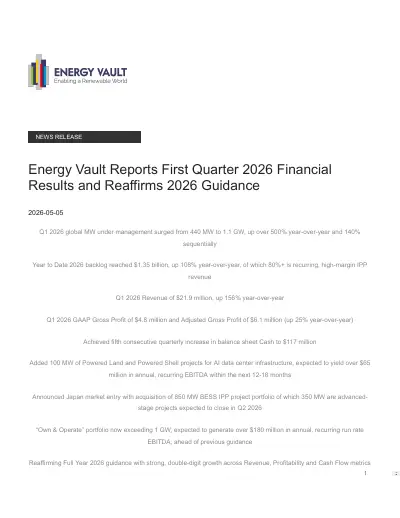
Our portfolio now exceeds 1 GW of assets under control that's contracted, under construction, or already operating. Our backlog has grown to over $1.35 billion, and over 80% of that, as you'll see, is tied to owned assets now, which is a shift if we go back just a short four to five quarters.
We now have visibility to over $180 million of recurring EBITDA run rate, which is ahead of our plan, also reflecting the inclusion now of powered land and powered shell opportunities where we are owning assets and providing power. This has obviously reflected a shift from a more episodic project revenue to predictable, long-term infrastructure cash flows.
Importantly, we are executing ahead of that plan, as I've just mentioned, and a lot of that's due to some of the dynamics we're seeing now in the AI infrastructure compute space. If you look at page 4, which we've provided, which looks back from our Q4 2024 actual, looks at our revenue and our backlog, and shows what that looked like at the end of 2025, growing that backlog from about $400 million to $1.3 billion today, as well, it looks at our gross margin, which has improved from 13.5% just six quarters ago to almost 24% at the end of '25, and projecting close to 25% for this year.
I would say that if you look at the backward-looking view, we have executed now the strategy and are now, if you look at our backlog, at 80% own and operate, we're there. At the same time, as highlighted therefore in the press release, and if you turn to slide 5, we've delivered broad-based triple-digit growth across most all key metrics: revenue up over 150% year-over-year; backlog more than doubled, 108%; adjusted gross profit up 25%; cash up 148%, reaching $117 million; and our megawatts, very importantly, under our control, up almost five times year-over-year, and already more than doubled to 140% sequentially.
Every core metric, all of these, capacity, backlog, revenue, and our liquidity, is fulfilling what we've outlined and what we've demonstrated with our strategic shift from two years ago. If you look at slide 6, we've added this look at our backlog to take a look at where we've transitioned in just the last six quarters.
What you see is a shift from what historically has been our energy storage EPC revenue, looking at our current backlog at $1.35 billion towards primarily the long-term own and operate revenue streams. Importantly, the gross margins associated with that backlog will be fundamentally shifting as we build these projects and bring them online over the next 12, 24, and 36 months, those margins shifting from the 20% to 25% range up to the 60% to 80% range for IPP-level margins.
A lot of the growth that we're seeing, both in terms of the initial megawatts we've been adding, but as well as what will be added more in the future, is related to the AI data center space as well that's powering a lot of the infrastructure investments, in particular, in the US. Power availability is now the gating factor for expansion.
We've added 100 MW of powered land and powered shell just this quarter. That alone is going to be expected to generate $65 million in recurring EBITDA in the next 12 to 18 months as that comes online.
Beyond the primary power capacity, we're addressing resilience needs through energy storage systems that we deliver and operate. If you go to page 7, just a reminder of that unit economics growth that I just described from that backlog, you can see how that works relative to our core stand-alone storage there at the bottom of the metric, and then moving up to our powered land and powered shell, as well as the geographic expansion.
The addition of the powered land and powered shell for AI is what's helping drive our acceleration. Very importantly, I think as you move to page 8 as well, you can see that we're expanding where we're going to be going, not only as we look at this quarter, you see expanded from 440 MW to over a gigawatt, as I mentioned previously, but looking out over the years, we're also increasing where we're going and what we're going to have under management by 2030, reaching almost 4 GW as we look at today, and what we see in our funnels, in our development pipeline, and what we're executing that's underneath our control already.
You can see the EBITDA numbers there in those outer years get very large, and a lot of that work to achieve that is underway now as we're building and constructing these systems that are going to come online over the next two to three years. I want to finish here if you look at slide 9, and highlights how the market is beginning to reframe Energy Vault, not as a traditional storage company, but as a broader power infrastructure platform.
This evolution is critical as we expand into owning and operating integrated energy assets, particularly in support of the AI data center and digital infrastructure. I've mentioned this before, but not all megawatts are valued the same, and hence, our move into the AI digital infrastructure space is accelerating what we're going to be delivering in our initial targets.
We're moving into a category that commands structurally higher valuation multiples. The infrastructure platforms with predictable long-duration cash flows and low revenue volatility are valued differently from project-based businesses, and this shift is increasingly reflected in how investors benchmark this sector.
Importantly, this repositioning supports a meaningful rerating opportunity. As we execute and continue to execute against our megawatt pipeline and bring assets under ownership control, we unlock the full value of the long-term contracted EBITDA streams.
Successful execution of megawatts under control is the bridge to this value realization. I mention again that strong historical execution capabilities have earned us this right with our existing customers who want to work with us on new projects, but also enabling this interim revenue upside while our larger-scale projects are being constructed and coming online.
With this transition, we're firmly into the IPP and digital infrastructure peer groups, reflected in our contracted backlog now at about 80%, when we believe this evolution is going to support the rerating and some meaningful upside to our current trading levels. If you look at that chart, you'll see how we've historically looked at our comp companies in there and looked at the performance both the year-to-date this year, as well as the trailing 12 months.
You can see we've had a very, very strong appreciation of the stock price if you go back one year ago, but also this year now in our current trading. I think most importantly, if you look at some of the new trading comps in the mid-part of the page there, and look at the valuation multiples there on the right, you'll see the opportunity that of course we've seen and why we made the strategic shift back two years ago.
To close, before I turn it over to Michael, who's going to get into some of the details of our results for the quarter, we're accelerating the execution of our own and operate strategy. I think this big increase in the uptick in the megawatts under our management is a strong reflection of that.
We're also scaling a globally diversified infrastructure platform now over 1 GW, and I think that's important because things regionally can change. We saw that with the tariff environment just one year ago, that was a lot of uncertainty.
Having the exposure to markets like Australia, for example, and our recent acquisition of a large portfolio, 850 MW in Japan with 350 MW of near-term projects there, reflect the fact that we are expanding in the most attractive markets and will give us that global diversity, despite the fact that we see tremendous and large opportunity and probably the largest opportunity right here at home in the US. Energy Vault today isn't just participating in this transition, we are building the infrastructure backbone that enables it across the energy and power side, AI, and the industrial markets.
I also want to mention and thank the Energy Vault team for their dedication, their passion, their commitment to executing our strategy here every day. I think the results here are a reflection of this, our reiteration of where we're going to be this year, and the guidance we just set six weeks ago.
We feel very, very good about executing and a lot of upside we believe that exists within that guidance range. With that, I'll turn it over to Michael Beer.
Michael Beer
Thanks, Rob. As you can see in the financial summary on slide 18, we delivered Q1 revenue of $21.9 million, representing a 156% increase year-over-year, driven by higher energy storage project deliveries and initial contributions from assets within our Asset Vault portfolio.
Adjusted gross profit for the quarter was $6.1 million, up 25% year-over-year, with an adjusted gross margin of 27.9%. Adjusted gross profit reflects the removal of Asset Vault operating project-related depreciation and amortization as those projects commenced operations in mid-2025.
The prior-year gross margin of 57.1% was highly skewed by IP-related revenue. Adjusted EBITDA was -$13.6 million in the period compared to -$11.3 million in the prior-year period, reflecting continued investments in our own and operate strategy, including development expense and organizational scaling to support long-term growth.
Excluding one-time impacts from the extinguishment of debt and stock-based comp, Q1 2026 adjusted net income of -$20 million compared to -$11.8 million in the prior-year period due to higher D&A and personnel from the new O&O Asset Vault projects and associated project-related financing expense and interest. From a cash position and financing perspective, we ended the quarter with $117.1 million in total cash and cash equivalents, reflecting continued investment in our Asset Vault portfolio alongside strengthening financing activities.
As Rob mentioned, during the quarter, we significantly enhanced our balance sheet through the successful completion of a $150 million convertible senior notes offering, which was upsized from $125 million. A portion of the proceeds was used to repay $45 million in higher-cost debt while also implementing a capped call structure with an implied conversion price of $8.12 per share.
In addition, we began monetizing investment tax credits, completing approximately $12 million of net ITC transfers, with approximately $40 million in total ITC proceeds expected across all projects placed in service thus far. These actions collectively strengthen our liquidity position and provide the financing flexibility to accelerate execution of our global asset ownership strategy.
At the project level, management is in the market for the Sossa and Stoney Creek project financings, which we expect to complete this quarter and in the second half of 2026, respectively. We're also evaluating a number of other financing opportunities, including those in support of our ramp in Japan and surrounding the powered land space.
Turning to our latest backlog and development pipeline on slide 17, we exited the quarter with a record backlog of $1.35 billion, representing 108% year-over-year growth, with over 80% associated with our own and operate portfolio across the United States and Australia. This backlog provides strong multiyear revenue visibility and reflects continued traction in converting our developed pipeline into contracted projects.
From a commercial activity standpoint, we made meaningful progress expanding our global footprint and asset base. One, we advanced our US portfolio with the acquisition of the 175 MW, 350 MWh McMurty BESS project in Texas.
Two, we announced entry into the Japan market, including the 850 MW development portfolio with 350 MW in advanced-stage projects expected to close this quarter. Three, we have added a number of smaller projects in Switzerland and made headway with the opportunity in the Balkans.
Four, we continue scaling our AI power infrastructure platform, including progress on the 75 MW powered land opportunity, where a number of agreements have now been secured. Across our platform, total megawatts under control, in construction, or in operation now exceed 1 GW, supporting a growing base of long-term recurring revenue opportunities.
From a developed pipeline perspective, which we now view on a megawatt basis versus megawatt-hour, we are now actively progressing opportunities valued at $3.5 billion associated with over 3.5 GW. Taken together, our advanced developed pipeline and contracted backlog provide strong visibility into the next phase of growth for the company.
As we continue executing our strategy, we are seeing clear validation of our transition towards a vertically integrated build, own, and operate model. Our global asset portfolio now exceeds 1 GW and is expected to generate over $180 million in annual recurring EBITDA run rate, ahead of prior expectations.
This positions us to deliver increasing levels of predictable, high-quality earnings as assets move into operation. Turning to our business outlook for 2026, we are reaffirming our full-year 2026 guidance, including revenue in the range of $225 to $300 million, with approximately $75 to $100 million in internal Asset Vault project builds, gross margin of 15% to 25%, and year-end cash in the range of $150 to $200 million.
This outlook reflects continued execution across our backlog, scaling contributions from owned and operated assets, and disciplined capital deployment. With that, I'll hand it back over to you, Rob.
Robert Piconi
Great. Michael, thank you.
I think with that, we'll turn over to the operator for any questions. Thank you.
We will now be conducting a question-and-answer session. If you would like to ask a question, please press *1 on your telephone keypad.
A confirmation tone will indicate your line is in the question queue. You may press *2 if you would like to remove your questions from the queue.
For participants using speaker equipment, it may be necessary to pick up your handset before pressing the star keys. As a reminder, please restrict yourself to one question and one follow-up.
One moment, please, while we poll for questions.
Operator
The first question comes from the line of Justin Clare with ROTH Capital Partners. Please go ahead.
Justin Clare
Hi, thanks for taking our question and congrats on the growth in the backlog here. Wanted to just start out on the AI infrastructure here and the 100 MW of powered shell and powered land that you plan to complete over the next 12 to 18 months.
Wondering if you can just share more on the status of those projects, for example, how much of the 100 MW is contracted and has offtake versus how much is in negotiation, what's the interconnection status, and then where are you in terms of permitting those projects as well?
Michael Beer
Thanks. We have announced 100 MW there in powered land and powered shell, as you know.
I think at our last earnings, we mentioned publicly the Southwest utility for the 75 MW of powered land that also is under a load study for application for 925 additional megawatts for a total of 1 GW. That's in the phase right now of the first 75 MW is already in construction and committed, and it's going to be coming online in January, okay?
As far as the powered land goes. From the powered shell perspective, we have our already announced agreement with Crusoe that's under now that development, and we have all the sites and all the load ready for that, and that's going to be constructed, and as we said before, that'll start to come online in Q4 this year.
That's where we are and as far as the powered land and the powered shell, and I think most of those, and as we look at the opportunities that we're developing, is where you're going to expect to see some significant growth. If you looked on, I think it's page 8 of the deck, you'll see, in fact, that mix shift.
You'll see the mix of powered land and powered shell versus our stand-alone storage, you see it increasing significantly there between where we are today in March 2026 up through 2030. You can see that that's going to move from roughly about 10% of that megawatt funnel to a little over half of it over the next few years.
I would expect that you'll be seeing and you can expect to be seeing more announcements in that space.
Justin Clare
Great. Appreciate the detail there.
Then on the $180 million of recurring EBITDA that is anticipated when you build out the backlog here, wondering what the timing of that is and how that ramps over the next two to three years or so. Then wondering on the $180 million if you could also break down how much of that may be related to BESS projects versus how much is powered land and powered shell?
Michael Beer
Sure, happy to comment. We've previously gave guidance in November of last year around the overall size of the Asset Vault portfolio, and we had initially talked about that being sort of a target of $150 million of recurring EBITDA.
We've since announced our entry into Japan. We believe Japan is a 350 MW sort of attractive late-stage portfolio, so that would be an addition to that initial guidance.
Now we've given more fidelity around what we believe the contribution would be from powered land and powered shell on the order of about $65 million in recurring EBITDA. If you were to take the $150 million, remove the $65 million from powered land and powered shell, obviously the increase beyond that is associated with the Japan portfolio.
This is sort of envisioned to be in that sort of, let's call it, circa 2028, early 2029-type timeframe.
Robert Piconi
Justin, just to add to that, too, and there's some good charts we've included in the deck that reference that, the one on the unit economics. The reason we're seeing this acceleration is as we met almost a year ago, we looked at a lot of the storage, the stand-alone storage IPP.
As we've evolved the last 12 months and looked at the AI compute infrastructure space, those deals and those megawatts that we're contracting and owning are delivering anywhere from 5 to 10x the EBITDA contribution per megawatt per year. That's why we're providing some of the breakdown around what that mix shift of these megawatts is going to look like.
As we add more of those, you obviously can expect continual acceleration in terms of hitting and just growing that annualized recurring EBITDA number. If you look at the chart on page 8, you'll see where we expect that to go as we've increased that just from the last quarter.
Justin Clare
Got it. Thank you.
I'll pass it on.
Operator
Thank you. Next question comes from the line of Derek Soderberg with Cantor Fitzgerald.
Please go ahead.
Derek Soderberg
Hey guys. Thanks for taking the questions.
First one on gross margins here. Guidance looks like 15% to 25% for the year.
Just kind of thinking about that range, what are some of the variables? Maybe it's battery cell pricing, maybe some project mix.
What sort of variables are going to determine where you guys sort of land in that range? Maybe as of today, where do you think you're sort of tracking towards that range, maybe the lower end, the higher end?
Maybe talk about that. Thanks.
Michael Beer
You can see quarter to quarter, there can be some different mixed components. Even a year ago, we had some significant IP-related contribution, we had a 57% gross margin.
This quarter, on an adjusted basis, it's about 28%; on a GAAP basis, it's about 22%. Obviously, we're tracking to be better than the midpoint of guidance.
You will have a very back-end loaded sort of revenue year associated with project deliveries, right? We still are in the EPC business, and so the fourth quarter will be heavily influenced with some of those deliveries.
Those deliveries can generally obviously balance out the overall shape of the year and the total gross margin profile. Still feel very confident around the overall range.
Obviously, we endeavor to do better than the midpoint, just as we had done last year.
Robert Piconi
Derek, the other thing just to add to that is our new gross margins now and revenue that's going to include the storage IPP is also just from a GAAP perspective is going to include the noncash portions of depreciation. That's why we're referring, and this will make the comparisons good from last year to this year, our adjusted gross margin, which is really getting at that cash gross margin only without the IPP revenue, you can really compare apples to apples as you look at the EPC revenue.
If you do it that way, for example, we're closer to, I think it's 27.8%, 27.9% this quarter. We intend to focus on execution, on managing our supply chain.
As we've done the last quarter, we obviously continue to be setting ranges that we know and feel comfortable we can hit and will push execution to remain on that upside.
Derek Soderberg
Got it, that's helpful. Then as my follow-up sort of related to the first set of questions, the first 75 MW on the powered land piece coming online in January of '27, and then the 25 MW coming online in Q4 of this year, I was wondering if you could sort of maybe provide some detail on how that revenue is going to scale, how that EBITDA is going to scale, anything around that.
Then also just on that opportunity to potentially go up to a gig on that sort of higher EBITDA per-megawatt opportunity. Can you talk about what sort of milestones you need to hit before that larger opportunity starts to materialize?
Thanks.
Robert Piconi
Sure, let me I'll I'll hit both of those, and Michael can chime in as well. To the first question on, the both the 75 MW and the 25 MW, the 75 MW is committed to be online in January, as I mentioned, so that full 75 MW will be online.
The essentially, the switch is getting put in place, there's some transmission that's being built out, that is already underway. We're already have made payments toward that to happen and committed.
What you would see on that is an offtake agreement of that 75 MW, but once that turns on in January, you can expect that to be fully monetized, meaning we will be in a contract and monetizing that. We should get almost a full year of of EBITDA there of that 75 MW, and it's, estimated at somewhere in and around $35 million, so that's the 75.
On the 25, just to be clear, we're going to be starting those deliveries, meaning we're going to start to receive and have those systems come on within Q4. Not all 25 MW will be in Q4, but then will, as we've said, will come in the next 12 to 18 months.
Meaning we'll be beginning to receive and and activate the powered shells and then be installing those, and then the forward quarters from there. That's helpful.
The good news about that is we're going to we expect in the next 12 to 18 months to have that roughly $65 million, up and going and on an annualized run rate basis. The second part of your question on the 75 going to a gigawatt, there is a a study that's already underway that we're engaged with with the with the Southwest utility.
That study is looking at the addition of 920 MW to that 75, so that would be up to a full gigawatt. Those are large numbers.
You can do the math on just what that 75 is, as I said, and and scale that. We do expect somewhere in and around half a million or so per megawatt on that, but that's that's a study that's going to happen that's happening now.
There'll be some decisions, I think, made then this year. We expect in the next three to six months on also some sizing of what the capacity upgrade will be, and that's essentially going to be all the transmission and high-voltage equipment that will be required to bring that 920 MW here to market.
That will be coming in place over the next, 24, 36, 48 months. We are expecting, just to be clear on that, we are expecting to look at doing an interim step with some other generation equipment that we would couple with our storage, for example, to try to bring online something on an interim basis of another 225 MW to potentially add to that 75.
This is within this core powered land segment. That would be a an interim step to to get us a solution in place.
Obviously, as we've said before, with a hyperscaler that's in a it's in a very attractive location that we'll be sharing more of as we we do some formal amount announcements, namely the utility, etc., and other things this year. From a timeline perspective, just to summarize, the 75 MW in January.
Following that within the next 18 to 24 months, we're looking at another 225 MW to bring online on an interim basis until that other 920 MW of grid power would come online in the next 36 months plus.
Derek Soderberg
Appreciate the detail on that. Thanks, guys.
Robert Piconi
Thank you, Derek.
Operator
Thank you. Next question comes from the line of Brian Lee with Goldman Sachs.
Please go ahead.
Tyler Besson
Hey, guys. This is Tyler Besson on for Brian.
Thanks for taking our questions. Just first wanted to touch on the margins in terms of the backlog.
What is the timeline to reach the 60% to 80% IPP margins as you execute on the backlog? Just to confirm, this would be on an adjusted basis?
Michael Beer
This is over time. There's obviously two distinct margin profiles for each of the different businesses.
The 20% to 25% is akin to the legacy, let's call it EPC-related business. The transition to the IPP business, a model of 60% to 80% IPP margins, you can see that all laid out on, I believe it's slide 6.
Obviously, there's going to be a mix effect that will take place over time, right, as these projects come online. We're not exiting the EPC business, we'll continue to do that not only for third-party customers, but we self-perform these projects for ourselves, and there's actually a positive working capital function that serves, we'll continue to be in that business.
It'll be a blending over time. It won't just be a flip of a switch.
Tyler Besson
Helpful. Then can you provide an update on just your revenue trajectory for the balance of the year?
I noticed accounts receivable stepped down in the quarter, could you see 2Q revenues decreasing quarter-over-quarter? I guess how are you thinking about the balance of the year from a revenue standpoint?
Michael Beer
We generally don't give sort of quarterly guidance in that respect, but as mentioned, it will be a back-end loaded year. I would use a profile akin to what you would see last year.
Robert Piconi
As you saw there, just to add to that, we have very strong year-over-year compares, just given we are projecting over 30% growth at the midpoint here. If you look at the trajectory, as Michael said, and look at that framework, we are expecting something similar there, but generally, I think if you look at the year-over-year compares, we're still going to be pretty favorable, I think, as we ramp and scale.
Tyler Besson
Understood. Just one more from me.
Can you just provide some more details on the progress on the developed pipeline and backlog? Looked like developed pipeline increased to 3.2 GW from 1.8 GW last quarter, but the value went up to $3.5 billion from $3 billion.
Then on the backlog, it looked like it remained flat at 3 GWh, but the value went up slightly. Can you just discuss some of the moving pieces here?
Michael Beer
There's always a bunch of ins and outs, FX, there's a host of things that can sort of move these things at the margin. I think within developed pipeline, interestingly, we're starting to see some real benefits of this integrated model, and the fact that sort of one hand washes the other.
While we are in both the EPC business and the IPP business, we're now starting to see some opportunities emerge that sort of split the difference or are emerging from both camps. The fact that we do have a team focused on both sides of the business is being very additive in that respect.
We're seeing new projects being added all the time. We also cull our developed pipeline to make sure that if things are stale or projects have moved on or for whatever reason.
We try to keep this very current and make sure it's stale. I think this does represent the current slate of investments that we have here in the US across multiple sort of industry subsegments and geographically, we're seeing some other things emerge internationally.
Robert Piconi
The other perspective I'd share with you here, and this is an important one, and it was something that we looked at as we made the decision two years ago to focus on owning and operating, so that means we're acquiring megawatts, we're going to be building them, but then the revenue doesn't come during that build, right? It doesn't come until we actually go COD or we go online with the project.
You would have normally expected, if we're really making that shift, you might have expected our revenue, our rev rec, actually going down over a period, right, 12 to 24 months as you make the transition. What we challenged the team with here and what we targeted to do was despite the shift we've made from owning and operating assets where we are not recognizing revenue even though the activity is much more than even our projected revenue is showing because we have activity that we don't recognize, we are building projects, Energy Vault is building projects for Asset Vault that is not showing up in recognized revenue, we have more activity than we've ever had.
The challenge was how do we keep revenue growth, meaning recognized revenue going until these new projects come online? What I feel very good about with the team and the execution is that we were able to still have a year this year in 2026 with strong double-digit revenue growth despite the fact that, as you see, in the megawatts that are growing to now over a gigawatt that we have under our control and management and building out that we are not recognizing revenue on that, despite that, we're still seeing that revenue growth.
That's a lot of that's driven, I think, in the US market, in particular, with what's happening with the AI infrastructure, and in particular, these power packages that are getting put together where we're looking at and we are doing integrating our energy storage with generation, with gas generation, for example, but also with UPS backups that are a part of those, and coupled with that gas generation, and then we're integrating that solution across a single pane of glass, meaning a single software platform to bring that all together for a customer. Those are solutions that we actually do sell and turn over.
That allows us to do the revenue recognition in parallel. The whole AI compute infrastructure and the billions and, arguably, you'd say trillions over time that's going to be spent for that, that is enabling us to maintain this revenue growth with that focus on these solutions.
A lot of that has come from customers that know us, that trust us, where we've executed for, they have their systems up and running at 99% plus availability. We feel not only good about that and the revenue projections we've done this year for growth, but we do see a lot of upside to the current revenue projections for that growth as well.
Tyler Besson
All right. Thank you very much.
I'll turn it over.
Operator
Thank you. Next question comes from the line of Sid Ranjan with Fundamental Research Corp.
Please go ahead.
Siddharth Rengachari
Hi, congratulations on the strong results. How are Calistoga and Cross Trails operations performing, given it's been almost 12 months since both started operating?
Are revenue and margins there in line with your expectations?
Michael Beer
The Cross Trails project continues to perform well. There hasn't been a change, and we're expecting on the order of circa $10 million in EBITDA on a full-year basis.
Across CRC and Cross Trails. Yeah.
Robert Piconi
I'd add to that, too, is we all know, I think, in the market, anyone that's in the IPP market, ERCOT obviously is undergoing and has been really the last 12, 18 months, really almost the last two years weakness at least on a cyclical basis versus the prior year. I think we're seeing that and the good news about our system there in ERCOT is it's been running at a 99% availability despite that.
Obviously, we'll take advantage of opportunities when they come, but that sort of softness in the ERCOT market has made it a buyer's market when we're looking at acquiring megawatts. Therein lies some opportunity.
We've been very, very careful with selecting the best points of interconnect and doing a lot of diligence there to have the points of interconnect, as is the case with McMurty that we announced that's just north of Dallas there in Texas, at points where we do believe we can leverage good economics.
Siddharth Rengachari
Great. Thank you for that.
With the ownership structure of the Japanese initiative, will that be similar to your other assets given you're partnering with a local developer there? Yeah.
Robert Piconi
Yes, we were expecting, and I think we mentioned this when we made the announcement, the Japanese market is fascinating because if you go back and look at where ERCOT was four to five years ago, we see the Japanese market just evolving now in that same type of economic environment and opportunity therefore to initially deploy and take advantage of a lot of the frequency and some of the other ancillary services and even the arbitrage opportunity there in Japan. In terms of structurally, that initial team that we're acquiring that was from an existing large company there, that team is going to be the one that's going to be continuing developing those near-term projects.
Of the 850 MW that are within that portfolio, there's 350 MW of near-term projects that, as we said in our announcement, we expect this quarter to close on that 350 MW and then get those constructed and get those up and operating. I think from an overall structure in terms of how we look at debt and equity and financing these, I would say it wouldn't be unlike as we're looking at projects in the US and Australia.
I think one of the differences there, and Michael can comment on this too, is you have a very favorable interest rate environment, I think, in Japan that is going to be helpful relative to the financing and they're very known project financing models as well.
Michael Beer
It's an existing team that we're effectively acqui-hiring with a very robust portfolio. As we mentioned in some of the prepared remarks, we are going to be going to market from a financing perspective in support of a host of those projects.
The fact of the matter is we entered the Australia market just a few short years ago and look at the amount of traction that we've been able to sort of generate there. We're looking to replicate that in the Japanese market.
Siddharth Rengachari
Any comments on the offtake pricing you can get there? Is the ROI, would you say it's comparable to the US or higher?
Michael Beer
I don't believe we've given real specifics there. It is an attractive market, but obviously we feel as if we're early to that market and, obviously we're putting our money where our mouth is, but we haven't given any of those specifics.
Robert Piconi
I was just going to add, I wouldn't think that it's going to be far off from what our expectations are on achieving IRRs, sort of low double-digit-type of IRRs as we get started there and an opportunity for optimization on that, but hence our investment there. It is what we believe that is today and will continue to be in the coming years an attractive market.
Siddharth Rengachari
Appreciate the color. Thank you.
Operator
Thank you. Next question comes from the line of Noel Parks with Touhy Brothers.
Please go ahead.
Noel Parks
Hi, good afternoon. I had a couple.
One thing you were mentioning gas generation a moment ago, and sort of the landscape of potential business out there for your pipeline, I guess I'm wondering maybe what's the main pain point for potential customers? I guess I'm thinking about whether there's any difference between those where they're looking, say, for new AI-related generation, where gas generation is probably going to be at the core of it, versus situations more where it's a case of playing catch-up with wind and solar for grid integration.
Is one of those a much bigger driver than the other, would you say?
Robert Piconi
Noel, it's a good question. The reason you're hearing more and more about gas is just the two things.
Obviously, the power demand is largely outstrips the supply or the ability to deliver it, so that's one. Any and all solutions, solar, wind combined with other types of generation, we have, obviously abundant natural gas in the US, I think gas is going to play an important component, in particular, over the next three, five years plus.
In addition, remember what's driving this are data centers, and the requirements are at five nines reliability, which is if you're thinking about that and thinking what that requires and it's going to be different regionally, but look at if you go back to an event, for example, in Texas, we all remember, and the cold and the frost and the freeze, and that shut down things for a matter of days. With the requirements and SLAs at five nines reliability in AI compute infrastructure, these are things that therefore require not only redundancy, but in some case, there's multiple redundancy.
You can think about having a grid connection, okay, everybody likes that; you can add energy storage to that, which will be good for if there's an outage, you can name it, for some hours, let's say, and even up to the day, but if you get into a multi-day outage, that's where looking at having some type of reciprocating engines or gas, diesel gen, etc., you can actually have a solution that when you put together, for example, grid power plus energy storage plus some gas-powered backup, you've got something where you can deliver on five nines. Hence that's the numbers you're seeing in that tremendous amounts of capex in the data center buildouts.
A lot of that capex is also essentially guaranteeing that power availability and delivery. Does that make sense?
Noel Parks
Yes, absolutely. You did touch a bit on it already, sort of the comparison of Japan to where ERCOT was a few years ago.
When you announced the Japan acquisition, you sort of stressed the importance of grid stability and load balancing in Japan, that they're at that stage now. I just wonder if you could maybe just dig into that a little bit deeper, and whether there are similar, analogous regions that might be needing to deal with this sooner rather than later.
Robert Piconi
I'd say the perspectives we've shared from the announcement and what you've just articulated is what we see, and as I mentioned, we're going to see some of the fast frequency response, that load balancing, and I think opportunities to capture different types of pricing at different times of day. I think generally, that dynamic is going to be positive, we believe, for the market, and I think others that have entered there recently are seeing the same thing.
As far as other markets that have those same dynamics, there's an important aspect to look at this, and I think APAC's a great example where there are other markets that may have those same types of environmental factors, but the other thing we look at is scale and priority in terms of the markets we choose and not spreading ourselves too thin. There are, I think, other markets that have those same characteristics, and even in some newer European growth markets, for example, that we're seeing, but we're very focused right now, I think, on some of the largest opportunities and focusing our capital investment, our human resource investment in the areas where we see the biggest upside, and a lot of that, by the way, is right here at home in the US.
Noel Parks
Right, great. If I could just run one more by you.
I was thinking about the process of project finance, and over the last couple of years, you've seen this real transition from being able to get it much earlier in a project's lifecycle. I'm just wondering, as you're going through your process of negotiating and arranging it for your upcoming projects, I was wondering, is there a considerably less of an education burden that you have to address in terms of your counterparties and their due diligence, or is it essentially still just everyone needs to go through a pretty similar, painstaking process?
Michael Beer
The market is evolving so quickly. Whereas nobody would have even looked at sort of merchant years ago, now that's being sort of incorporated in the models, and people are getting very creative in how they structure bridges or construction financing sort of in and around sort of some of the ITCs.
The market is evolving very, very quickly, certainly here in the US. We're also seeing that bleed over into some of the other markets where we're constructing assets, such as Australia, and what I suspect is likely Japan, but we need to go through that process.
The fact of the matter is we've now done this a few times, and we now know what we're looking for as we're evaluating project attractiveness and what can possibly go wrong, just mitigating risk where possible, bringing partners into the fold earlier in the conversation, and trying to build a good let's call it feedback loop of existing partners so that we can sort of rinse and repeat across the entire portfolio and just remove friction where possible.
Noel Parks
Terrific, good to hear. Thanks.
Operator
Thank you. Ladies and gentlemen, we have reached the end of question-and-answer session.
I would now like to turn the floor over to Robert Piconi for closing comments.
Robert Piconi
Great, Operator, thank you. Look, just in closing here, and hopefully as you've gone through the numbers and go through the charts, I again encourage everyone to to download those.
We are sharing more and more detail and some transparency on things that tie to the future profitability and growth of this business. I think a lot of the the key metrics we shared, that the growth in the megawatts under management that have more than doubled since just going back, since we last spoke, which wasn't that long ago, six, seven weeks ago, getting over that gigawatt, that that first gigawatt that's within our control now to go execute, those are not small markers.
I think on top of that, then you look at the backlog, which is a different cut, looking at what we've actually contracted. Just to highlight, 80% now of that backlog that's stands today at the $1.3 billion is contracted at much, much higher IPP-type of gross margins.
Again, that's something that should give investors a lot of comfort relative to the the future profitability as we bring those online. Also just operationally, and this, I think, is as investors look at teams and companies to invest in, the execution that we've had, if you look at just the last six, eight months, last year, one of the most challenging years, starting off with the tariffs and uncertainty really through the first half of the year into the mid-part of the year, yet the team at Energy Vault executed and delivered the only energy storage company to deliver on their and their original guidance that we set for the year, and in a strong way in the quarter, delivering a positive adjusted EBITDA even in that last quarter as we as we delivered.
We're expecting to do the same this year, and and, with strong execution, expect to have some continual positive and upside surprises in what we're doing just with the nature of our our market penetration, in particular, what's happening here in the in the in the US market. We have a lot a lot underway, as I mentioned in answer to one of the the the questions here on other regions, other markets.
We are staying very, very focused on these three core segments and just the very attractive core markets. That's, the the APAC, as far as Australia and Japan go, that's in in Europe, we're developing, I think, some of the interesting own and operate opportunities there, as we've mentioned before, but in particular, right here at home in the US, and it's required us to have a very nimble and diverse and dynamic supply chain, given the changes in the rules and FEOC and a lot of the the focus on domestic solutions, so that is something our supply chain has been able to be very nimble and deliver, as we demonstrated in Q4.
Really, as far as where we are at this point with what we have both under under contract now and under development that's within our control, as well as those opportunities as referenced by one of the questions, we our developed pipeline has more than doubled just from the last time we spoke, which was six weeks ago. These are really important markers to look at.
We've had a a very good hit rate in terms of and conversion rate, I'll call it, in terms of taking that developed pipeline and converting that, in particular, those megawatts into into things that are within our control, meaning acquiring attractive points of interconnect. These are really the markers that I think investors should be looking at relative to the future, with a very proven team that's been able to execute and deliver here for customers at at extremely high availability, which is at the end of the day now how we're really being judged by our customers, is being able to achieve that 99% plus availability that they, not only require contractually, but really demand.
It is a market requirement now as we look at power solutions. Finally, just again as I as I always do, none of this happens by itself or under standard processes and procedures.
We have a very nimble and agile and and hard-working and do whatever it takes team at Energy Vault, a lot of hours worked to deliver what we deliver day in and day out. I want to thank all the employees that that make these results happen, that are passionate about delivering for customers, are passionate about maintaining our focus on sustainability.
As, we announced also this past quarter, two years in a row now being ranked the number one energy storage company, number one energy company in our industry from a sustainability score judged by S&P Global. True to our mission and the vision we want to achieve as a company, I could not be prouder of the the team here at Energy Vault and where we are today.
Personally, I have never felt better about where this company is going to go, what we're going to be able to achieve. We do not limit our thinking in terms of where we go, how big the hill is to climb, and what it takes to get there.
As as all of you know listening in on this call, there's no shortage of capital to put behind strong management teams in a very attractive space with a proven track record of delivery, and I think we hit on all those fronts. With that, Operator, I'm completed the call here.
I'll turn it back to you.
Operator
Thank you. This concludes our today's teleconference.
You may disconnect your lines at this time. Thank you for your participation.