Aavas Financiers Ltd.
Q3 FY2026 · Earnings Call TranscriptFebruary 5, 2026
Operator
Ladies and gentlemen, good day and welcome to the Aavas Financiers Limited 9-month and Q3 FY26 earnings conference call. This conference call may contain forward-looking statements about the company which are based on the beliefs, opinions, and expectations of the company as on date of this call.
These statements are not guarantee of future performance and involve risks and uncertainties that are difficult to predict. As a reminder, all participant lines will be in the listen-only mode, and there will be an opportunity for you to ask questions after the presentation concludes.
Should you need assistance during the conference call, please signal an operator by pressing star, then zero on your touch-tone phone. Please note that this conference is being recorded.
I now hand the conference over to Mr. Rakesh Shinde, Head of Investor Relations of Aavas Financiers Limited.
Thank you and over to you, sir.
Rakesh Shinde
Thank you, Danish. Good evening, everyone.
I extend a very warm welcome to all participants and thank you for joining us on today's earning call to discuss the financial and operational performance of our company for 9-month and Q3 FY26 along with the business outlook going forward. The results and the investor presentation have been uploaded on the stock exchanges and are also available on our company website.
I hope you have had a chance to review them. We have also uploaded Excel factsheet containing historical data on our website for your easy reference.
Joining me today is the entire management team of Aavas. We will begin this call with opening remarks from our MD, Sachinder Bhinder, CFO, Ghanshyam Rawat, and CRO, Ashutosh Atre.
This will be followed by Q&A session. With that, let me now hand over the call to Sachinder.
Over to you, Sachinder.
Sachinder Bhinder
Thank you, Rakesh. A good evening to all, and I thank you all for joining this earning call.
Wish you a happy 2026. The recent macro developments have been very encouraging for the Indian economy.
The Aatmanirbhar Union Budget, followed by the positive progress on the India-US trade agreement, marks an important inflection point. These developments are expected to support external stability, improve systemic liquidity, ease interest rates, and create a more favorable environment for credit growth.
Q3 also saw several structural reforms, including GST rationalization, Labor Code implementation, progress on key trade agreements, and continued FDI liberalization. Together, these measures should strengthen household balance sheets and drive urban and rural consumption recovery.
The Union Budget 2026 reinforces the government's focus on capex-led growth, while continuing to support consumption and affordable housing. Alongside this, the High-Level Committee on Banking for Viksit Bharat clearly positions NBFCs and housing finance companies as key enablers of credit expansion.
The emphasis on developing Tier 2 and Tier 3 city economic regions creates a strong structural tailwind for affordable housing. Overall, we believe the macro environment is becoming increasingly supportive for housing finance, with improving affordability, stable funding conditions, and a strong runway for sustainable growth.
On Aavas' performance, I am pleased to share that during Q3 FY26, our balance sheet size crossed ₹20,000 crores, marking an important milestone in our growth journey. During the quarter, we also successfully raised approximately ₹975 crores, equivalent to US$108 million, from a marquee multilateral financial institution at a competitive cost.
This represents the largest NCD placement in company's history and underscores our position as one of the leading players in affordable housing finance. It also reflects strong external confidence in our measured, quality-led growth strategy and long-term vision.
The proceeds from this financing will be deployed to support affordable housing loans for EWS and LIG households, promote women home ownership, scale green-certified housing, and expand MSME lending in underserved regions, further strengthening our development-focused lending franchise. During the quarter, we rolled out a branch excellence program to drive sustainable quality growth across branches.
Project NEEV, focusing on strengthening pre-login discipline and frontline effectiveness through better field management and coaching. Project NIPUN, institutionalizing the post-login rigor by improving quality documentation discipline and turnaround times.
Project SAMPOORN drives a first-time-right culture to enhance login quality and reduce rework. Project SETU optimizes our channel management through digital integration and more effective partner management.
Finally, the Project RISE, which strengthens employee engagement through structured rewards, recognition, and clear career pathways. Together, these initiatives are creating a strong operating backbone for consistent and sustainable growth.
On to the business front, after the transition to the new disbursement recognition framework in Q1, operations have now normalized, resulting in a 10% Q-o-Q growth in disbursement during Quarter 3. Our sanction to disbursement ratio, which was impacted in Quarter 1, has recovered and now stands at more than 80%, demonstrating improved conversion efficiency.
Traditionally, Q4 is a strong quarter for us, and we expect this momentum to sustain. Our credit-first approach continues to benefit us with best-in-class asset quality.
Our 1+ DPD has shown a sharp improvement across geographies, resulting in lowering GNPA during the quarter. Our AUM grew by 15% Y-o-Y to ₹222 billion.
The broader economic backdrop remains supportive, and conducive interest scenario continues to support affordability and demand momentum in our core segments. During the quarter, we further benefited from a lower cost of funds following a 25 bps cut in the repo rate.
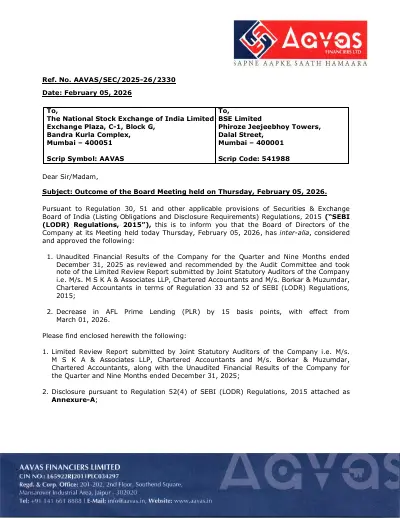
In today's ALCO meeting, it was decided to pass on 15 bps of this benefit to our customers, effective 1st March. This revision will benefit around 70% of our customers who are on the floating rate book, while maintaining an appropriate balance between customer benefit and margin sustainability.
Furthermore, government initiatives like the Interest Subsidy Scheme, ISS, under PMAY 2.0, coupled with a stable interest rate environment, continue to support homebuyer sentiment and affordability. We are pleased to report that over 2,800 Aavas customers have already benefited from the scheme, receiving subsidies amounting to more than ₹90 million.
As we look ahead, our long-term strategic priorities remain clear: to fully leverage our digital platforms, distribution network, further strengthen governance, drive scale efficiently, optimize cost, and enhance productivity across the organization. With that preamble, I'll now take you through our quarterly performance.
Our AUM has now reached at ₹222 billion. During Quarter 3 FY26, we disbursed loans worth ₹17.2 billion, registering a 10% sequential growth, while maintaining our strong focus on quality origination and prudent underwriting.
Our net profit for Quarter 3 FY26 grew by 16% Y-o-Y to ₹1.7 billion, led by 17% Y-o-Y growth in NII on account of healthy improvement in spread. Our net worth continues to compound steadily, growing at 16% Y-o-Y with the strength of our capital position driven by consistent compounding internal accruals.
Our NIMs expanded by 27 bps sequentially to 8.01% during the quarter. This improvement was supported by improvement in the spread, coupled with our continuous focus on risk-adjusted pricing.
Our opex to asset ratio saw an improvement of 8 bps sequentially to 3.44%, while the cost to income ratio continued to trend lower by 66 bps sequentially to 42.9%, reflecting improved efficiency gains. Our asset quality remains pristine, with 1+ DPD well below 5%, improving by 19 bps sequentially to 3.80% as of December 2025, while GNPA improved 5 bps Q-o-Q to 1.19%.
Credit costs stood anchored at 16 bps, driven by lower 1+ DPD flow and improvement in Stage 2 and Stage 3 buckets. We continue to maintain our guidance of keeping credit costs below 25 bps on a sustainable basis.
Our ROA improved by 6 bps Y-o-Y to 3.43% and ROE improving by 8 bps Y-o-Y to 14.29%. We remain committed to delivering quality, profitable, and sustainable growth, powered by tech-led efficiency and cost optimization.
With a robust risk management framework, deep and diversified distribution network, and the strong execution capabilities of our experienced team, we're confident of achieving our strategic milestone and delivering long-term value to all stakeholders. With that, ladies and gentlemen, I would now hand over to our CFO, Ghanshyam Rawat, to discuss the financials in detail.
Ghanshyam Rawat
Thank you, Sachinder. Good evening, everyone, and a warm welcome to our earning call.
To provide update first on the borrowing part, the improvement in cost of fund continued to underscore strength and resilience of Aavas' well-diversified liability franchise. In line with our strategy of innovation in liability sourcing, we proactively anticipated a potential softening in interest rate and strategically shifted a sizable portion of our borrowing to EBR-linked instruments and various market-linked benchmarks.
This forward-looking approach has continued to yield tangible benefit in Q3 also, as our liabilities are repriced faster than those of many peers. This positioned us well to maintain a competitive cost of fund, while supporting sustainable quality growth.
Well-diversified liability franchise linked with various benchmark and competitively priced in Q3 FY26, we were able to deliver an additionally 16 basis point improvement sequentially in our cost of fund and 56 basis point improvement in 9 months of this year. In today's ALCO, we decided to pass on benefit of 15 basis point to our customers with effect from 1st March 2026.
Our spread improved by 40 basis point year-on-year to 5.34% in Quarter 3, while calculated spread increased by 65 basis point year-on-year. We continued to borrow judiciously, raising around ₹15.41 billion at competitive rate at 7.78% for Quarter 3 FY26.
The average tenure of borrowing continued to be longer than that of our assets, ensuring a positive ALM across all the buckets. As of 31st December 2025, total outstanding borrowing stood at ₹193 billion.
We have optimum mix of borrowing linked with various benchmarks of interest rates, such as 35% borrowing linked to external benchmark such as repo, T-bill, MIBOR, and 34% linked to the sub-3-month MCLR, enabling faster repricing of nearly 69% of our borrowing in line with the interest rate movement. Lender supports remain strong as Aavas continued to evolve.
We maintained access to diversified and cost-effective long-term financing. Our relationship with development finance institutions remain robust in supporting our strategic funding goals.
As of 31st December 2025, we maintained ample liquidity, and including cash and cash equivalents and unavailed cash credit limit of ₹19.55 billion, documented unavailed sanction of ₹24.54 billion. Profitability and capital position: Our net total income in absolute terms grew by 18% year-on-year in Quarter 3 FY26.
Net interest margin, as a percentage of total assets, expanded by 27 basis point year-on-year to 8.01% in Quarter 3 FY26. We remain well-capitalized with a net worth of ₹48.6 billion and a capital to risk-weight assets ratio of 46.4%, significantly above the regulatory requirement.
Now, I would hand over the line to our CRO, Ashutosh Atre, to discuss the asset quality. Ashutosh, over to you.
Ashutosh Atre
Yeah. Thank you, Ghanshyam.
Good evening, everyone. I am pleased to share the key portfolio risk parameters with you.
Asset quality and provisioning: Aavas is strongly positioned to continue delivering industry-leading asset quality. Our asset quality remains within the guided range, with 1-day past due well below 5% at 3.80% in Q3 FY26, and gross Stage 3 and net Stage 3 under 1.25%, stood at 1.
19% and 0.79%, respectively. During the quarter, not only in terms of percentage, as mentioned by Sachinder, our principal outstanding of 1+ DPD and Stage 3 principal outstanding has also reduced in absolute value.
From geographic perspective, asset quality in our vintage states continued to remain healthy. The average 1+ DPD and GNPA stood well below 4% and 1.25% of AUM.
Similarly, in our emerging markets, we are observing healthy credit performance, with 1+ DPD and GNPA level remaining comfortably within 4% and 1% of AUM, respectively. Our total ECL provisioning, including for COVID-19 impact as well as the resolution framework 2.0, stood at ₹1.27 billion as of 31st of December 2025.
Our disciplined underwriting standards, coupled with proactive risk management framework, have enabled us to stay ahead of emerging macroeconomic challenges. We continue to follow a rigorous credit assessment process, stress tested across multiple economic scenarios, and remain selectively calibrated in our exposure to higher risk segments.
This approach has helped us prevent asset quality, which continues to rank among the best in the industry. With this, I open the floor for question-and-answer session.
Operator
Thank you so much, sir. Ladies and gentlemen, we'll begin with the question-and-answer session.
Anyone who wishes to ask a question may press star and one on their touch-tone telephone. If you wish to remove yourself from the question queue, you may press star and two.
Ladies and gentlemen, we request you to use handsets while asking a question. We'll wait for the moment while the question queue assembles.
Our first question comes from the line of Kunal Shah from Citi Group. Please go ahead.
Kunal Shah
Hi. Thanks for taking the question.
The first question is on growth. When we look at maybe the first 9 months' growth, it clearly suggests maybe the guidance which was given of closer to 18-odd-percent, that appears to be quite stretched and it might settle at less than 15-odd-percent.
Maybe in terms of the indicators as to how do we plan to get towards 18% to 20-odd-percent growth in the coming years? The related question is on the branches.
Last time you indicated that you will add 20, 25-odd branches, but we had seen some consolidation of branches in Rajasthan and Maharashtra. Maybe the addition of branches has also been not very high.
What's happening on that front in terms of the franchise expansion?
Sachinder Bhinder
Thanks, Kunal. During H1, we undertook a significant transformation in our business and accounting processes with a calibrated tightening of credit in a relatively subdued macro and credit environment.
As communicated earlier, our priority has been to protect portfolio quality and not to pursue just the headline growth. Accordingly, the final AUM growth outcome continues to be influenced by how the macro and credit environment had evolved, even as we remain committed to our long-term growth aspiration.
Encouragingly, post-Diwali, we've started seeing a pickup in the business momentum, and we expect this trend to continue through our Quarter 4 FY26. Quarter 4 last year was a strong quarter with disbursement crossing ₹20 billion, and we are confident of exceeding that level comfortably this year as well.
On the AUM front, H1 created a meaningful drag on the overall growth run rate, which has led to AUM growth moderating to around 15%. Given this backdrop, our focus for the remainder of the year is to maintain the current growth trajectory while continue to safeguard asset quality rather than pushing for aggressive growth.
The second question on the growth for the next year, looking ahead, FY27 should be a year of strong recovery with transformation initiatives, a number of initiatives which we have taken, and incremental investments being made in branch expansion to drive growth. With a stable operating environment and a stronger platform in place, we are targeting around 25% growth in disbursement in FY27, while continue to build a resilient, high-quality franchise.
This is how it is planned is that we are planning to have around 25% of disbursement growth, solving for an additional 2,000 crores that we are looking at for the next year. We already are ahead by 500 crores in our monthly average run rate, so that will add on to the total cumulative sum.
The branches opened in the last 24 months will give another 200 to 250 crores of additional business. Whereas we are opening other additional 50 branches in the next year, which will contribute about 100 crore-odd of business.
Really, the digital channels, Kunal, like the CSC, E-Mitra, and allied channels will give us another 500 crore additional business. Plus the inflation-led growth, we are factoring in around 6%, which is about 400 crores, would really improve the numbers, as I speak.
Over and above, as I spoke about the lot of initiatives which we have taken, which has given the green shoots in Quarter 3, where the customer visit related from the direct channels have actually improved by 30%, and we are confident that productivity enhancement really will come through all of this. As management, we are confident with this measures, which I pretty spoke about, contributing to a robust 25% growth in the coming year.
Kunal Shah
Sure. With respect to branch expansion, it was quite slow during the quarter, and there was some rationalization as well?
Sachinder Bhinder
There was multiple branches which we had done, it was not about consolidation. As we speak, Kunal, on the current date, we are at 410 branches as of today.
In addition to that, this quarter we'll add another 20 to 25 branches in Quarter 4.
Kunal Shah
Okay. That trajectory, maybe that guidance still continues in terms of adding 20, 25 branches in the second half?
Sachinder Bhinder
Yeah. Next year, we are going to add another of around 50 branches next year we will add on.
What we are doing is we are going deeper in the regions where we are there in Tier 2, Tier 3 towns by our RRO model, which is already there. I think that deepens our market as far as that is concerned.
Where we've stabilized RROs and we find that there is a good potential, we are looking at converting into what we call the model branches, which are self-sustaining of branches at a lower infra cost, which really helps us to build that. We continue our guidance and our trajectory of geographic expansion by going deeper and opening physical branches.
Kunal Shah
Got it. That helps, yeah.
That's all from my side. Thank you.
Sachinder Bhinder
Thanks, Kunal.
Operator
Thank you. Our next question comes from the line of Abhijit Tibrewal from Motilal Oswal.
Please go ahead.
Abhijit Tibrewal
Good evening, everyone. Thank you for taking my question.
Sachinder, sir, again, just maybe repeating what you've already said, right? Again, I think while we have managed to get some handle on the BT-outs and the portfolio attrition this quarter, which I'm sure was driven by all the actions that you would have taken because from what we hear from other housing finance companies, the competitive intensity continues to still remain very high.
I think disbursement momentum kind of still leaves a lot to be desired. What we usually know, right, a 40-60 kind of a disbursement mix between 1H and 2H, even if we were to do that, right, I think we'll still fall a little short of what maybe you would have targeted on disbursements for this year.
While you've already partly answered it in the previous question, but what were the growth headwinds this year, and what will change next year for us to start accelerating on growth, except for this addition of branches that you just explained?
Sachinder Bhinder
Kunal, sorry, Abhijit, thanks for joining the call. See, if you place it in the two ones on the growth, as we said, that because we had the transformation on the accounting process of disbursement recognition, the Quarter 1 cover-up, whatever was there, I think that actually delayed and lagged our entire stuff for the current financial year.
I think that is one which was there. Secondly, at a conscious call of some of the states which we had taken in Karnataka and other places, as we start seeing in Quarter 2 and Quarter 3, we started stepping up.
That's more so to really look at it from a perspective of the credit environment and the overall environment based on the khatas and e-khatas and stuff which was there. I think that were a couple of those stuffs which actually had the muted one.
On your second question of how do you really span out the growth for the next year, so as we highlighted in the projects which we highlighted, on specifics, the digital channels which really have started contributing to us, like CSC, E-Mitra, incrementally would contribute more than 500 crores on a monthly average run rate, which is there for us. Currently, we are at a 500 crore monthly average run rate, but additional CSC and E-Mitra would contribute to an extent of another 500 crores next year.
We are confident of the digital channels. We are confident of the branches which have opened in the last 24 months really contributing, including the new branches, additional about 300 crores really coming across from there.
Plus an inflationary small bit of 6% growth coming across from the inflationary-led growth. Plus the initiatives whatever we spoke about on the productivity enhancement.
As I spoke, that visit to customer ratios actually have improved by 30%, finally really helping us improve the productivity. Primarily the input really is getting refined and crystallized, and we've seen that green shoots in Quarter 3.
We're confident that we'll able to carry forward in Quarter 4 and build that in the next financial year.
Abhijit Tibrewal
Got it, sir. Sir, then on the disbursements again, if I look at the disbursement mix, very clearly, right, until last year, the non-HL in the disbursements is typically used to be around that 35% ballpark.
Now if I look at this year, it is consistently, the non-HL piece is consistently above 40% in the mix. How is the demand landscape today purely in individual home loans?
The related question here also is that, recently, right, at least some of the larger HFCs who've reported, they have all been talking about kind of moving towards near-prime and affordable. Do you think that, until now we very often used to say what if there is a competition from the banks, but now if the larger HFCs also start looking at the affordable pie, is it going to kind of meaningfully increase the competitive intensity in the affordable housing sector?
Sachinder Bhinder
I think your first question on the HL, NHL part, I think it is more about the recognition of that pushed the HL to a little drag as far as recognition was concerned because as the home loan transactions are operated through a check disbursement mode and NHL and those portions are more by the RTGS mode, which was there. That differentially had a drag on the kind of HL which is there.
Unlike the normal one, we've not seen any of the drop which is there. It is just a what I would say a movement which has moved quarter on quarter to the subsequent quarter.
That's one. Even with our PMAY 2.0, where we disbursed more than 2,800-plus customers in the ISS scheme, is also reflective of the strong home loan growth what we really see.
The logins and from the home loan really continue to build on, and we will continue to build in the markets where we operate on that franchise. That's one.
Secondly, on the competitive intensity, I think we stand out as far as our understanding of self-assessment-based strong SENP direct model is concerned, and our inroads into Tier 2, Tier 3 markets, both from a perspective of understanding the customer and understanding the property and buying in the two of both with the quality which is there. I think stands good at Aavas, which is there.
As you highlighted, that on the BT-out, we continue to be at 4.5% for Quarter 3, which is 60 bps lower than the same period last year. I think we are confident that our kind of underwriting practice, our kind of customer segment, our deeper reach, which we continue to further build and expand, will actually also help us to thwart the normal competition what you're referring to.
Again, from a perspective of, if you look at the average ticket size, Aavas continues to be in the average ticket size of 12.5 lakhs, whereas affordable for some of the peers you were talking about, the ticket size is more than double what typically we service on an average pie. I think from that, still it is far away as far as reaching that customer segment, to say.
Ghanshyam Rawat
Abhijit, what Sachinder said, I think apart from this, two things very important to see. Like in Aavas, today we have 65% to 70% 65% to 70% self-employed customer basically, whereas all large HFCs, banks has 80% to 90% salaried customer.
In the same market, in the same geography, even we are present both, and we target different customer class, they target different customer class. We target 12 to average ticket size ₹13, 14, 15 lakhs, they target ₹25 lakhs and above ticket size customer in the same market, basically.
That make a huge difference. Thirdly, I think as Aavas, we have very deep-rooted in those market.
We are almost today source the customers around 2,000-plus towns, basically, where they are remain still in the large market, in a city or district headquarter, they remain up to that level. We goes at a subtown level, basically.
That I think that is continue to be, I think, in the same market, all we make a separate road for us, there is enough opportunity in the market. Even despite I think large HFC focus for affordable housing.
Abhijit Tibrewal
Thank you, Ghanshyam and Sachinder, sir. Just one last question on the borrowing mix.
If I look at the NHB refinance, from its peak of 22%, 23%, kind of declined to 20% and then to maybe 16% same time last year, and now 14 now 14% to 12%, rather 12% now. Just trying to understand, was it because NHB was not giving out sanctions because of the ongoing CVC transaction, but now that the transaction has also been concluded, have you received any new sanctions from NHB, and what are the plans to draw them down?
Sachinder Bhinder
Abhijit, you are right. Our contribution of NHB refinance in overall borrowing has fallen because as you appreciated that CVC transaction was in process and it got now completed, everything.
Now we have applied for our refinance limit also, which is under consideration at their end, basically. We hopeful that in the coming quarters, we will listen a positive from their side.
Otherwise that, I think company has done a very fantastic works in even NHB borrowing was less than, let's say, what ratio was there year back, basically. All banks, institutions, multilateral institutions, and our borrowing has almost we have shown a 56 basis point reductions, which is far better than the peer group, basically.
Even sequentially, our overall interest cost is lesser than the Quarter 2, basically, which shows strength of liability franchise of Aavas. Now we are already AA-rated and positive outlook and so that is also helping us, basically, to explore the new market of a borrowing at a competitive priced.
Abhijit Tibrewal
Got it, Ghanshyam-ji. Thank you so much for answering my question, and I wish you and your team the very best.
Sachinder Bhinder
Thanks, Abhijit.
Operator
Thank you, sir. Our next question comes from the line of Varun from Kotak Securities.
Please go ahead.
Varun Palacharla
Hi, sir. My question was regarding to disbursements and how we see disbursements going up, or what will the driver.
In light of that, I would want to ask what is the login to sanction ratio for us? How has it trended over the last 2, 3 quarters when we've tightened the screens?
Is there leeway over here that as the field staff get normalized to these new credit screens, that that ratio might expand? The second question is with regard to the disbursement.
I think you've mentioned that the new channel partners currently contribute about 7%. How much do DSAs or connectors contribute?
Because those channels can scale up faster than the others, if you can give that.
Sachinder Bhinder
Yeah. Thanks, Varun.
I think, as you rightly pointed out, the screens on the or the credit quality and we had called out, there has been a sequential improvement where we saw improvement in the credit environment and the credit quality, hence our our sanction ratios also improved from around 30%, 32% in the Quarter 1 leading to around trending at around 38%, 40% in the last quarter, to say. I think that's the that's the positive side for looking at the credit quality.
The Aavas has always been looking at the risk-adjusted returns and really underwriting what we feel right at that period of time, which is suitably from a credit environment perspective. I think that's the positive trajectory which is there.
The most important point is our sanction to disbursement ratios also improved sequentially from the earlier period of time. That also gives us confidence.
That's number two. Number three, on the channels, what you rightly elicited, the scaling up, why we are confident, because as couple of digital channels like CSC, E-Mitras, and Mitras is the ones where we've actually put in efforts, and those efforts have really shown traction in the current financial year.
Where as we entered the quarter as we are in Quarter 4 and entering the FY new FY, we gives us confidence of an incremental scope of expanding at a faster pace, which which I had elicited that it is going to contribute an extra around 500 to 600 crores from from those channels. The other part, which we said that on a muted expansion of the grab branches, the last 2-year branch opening, the new financial year branch opening further adding an input as about 200 to 300 crores.
Plus the retail inflationary-led growth, which we have taken it a very, very conservative level of about 6%, further contributing to another 200 to 300 crores for the next financial year. Plus the productivity improvement, as I spoke about in my call about the various projects under branch excellence which we have taken.
Therein also we've seen the green shoots about improvement in the quality of logging, the customer visit increasing by 30%, really improving the quality input, also will continue to contribute to our our expansion of the scalability in a right format. Plus earlier part, as I said, that we had a little muted geographical growth on certain parts of Karnataka knowing the the credit environment and the the part of the khata-related stuff which had hold on to our disbursement.
We've seen that acceleration also happening in in that pace, so that also will start contributing. Plus we've opened Tamil Nadu in the last couple of quarters.
I think that also slowly and steadily will also start contributing to our numbers as we effectively go in the next financial year. We're pretty confident with all the measures rightly, we will be able to scale up in a more modular, sustainable, and a rightful quality growth manner.
Varun Palacharla
I just had one more question on the incremental yield. After the PLR cut, what is the gap between the incremental yields and the book yields?
Where will it trend towards?
Ghanshyam Rawat
I think incremental yield is already even without 15 basis reduction, it already got transmitted because by spread corrections which keep on happening when we source the customers. The new business will not much impact, but by 15 basis point reduction, we will have a almost overall AUM yield reduced by 9 to 10 basis point overall impact on the book because we have almost 37%, 38% fixed rate book.
It will have a 9, 10 basis point impact. Okay.
Varun Palacharla
Thanks. Those are my questions.
Ghanshyam Rawat
Yeah. I think let's say, I further update you on that piece.
We see few basis point cost of borrowing reduction in this quarter. Overall, we are comfortable or we are confident our spread will remain around 5.25% for the year ending.
Few basis point, two basis point here and there, but roughly we are confident to have 5.2 5.25% spread.
Sachinder Bhinder
Currently, we are at 5.34 as we speak for the current quarter, Varun.
Operator
Thank you. Our next question comes from the line of Raghav from Ambit Capital.
Please go ahead.
Raghav Garg
Hi. Am I audible?
Sachinder Bhinder
Yeah. Thanks.
Raghav.
Raghav Garg
Okay. Sir, I just had two questions, actually two clarifications before I ask my questions.
One, did you say that you are targeting 35% disbursement growth in FY27? Did I hear that correct?
Sachinder Bhinder
No, it's
Raghav Garg
25%.
Sachinder Bhinder
25%.
Raghav Garg
25%. 25.
Two five. 25, is it?
Sachinder Bhinder
Four,
Raghav Garg
25. Okay.
25. Then new branch addition will be 50, right?
Sachinder Bhinder
Yeah.
Raghav Garg
Okay. Okay.
Sir, my question is, without the PLR reduction, you haven't reduced your PLR so far, it's only effective March. Despite that, the yields have come down by about 16 basis points because of competition, and that continues to intensify.
Effective March, you're taking a 15 bps PLR cut. On the liability side, it seems that the cost of funds has likely bottomed out at 7.7%, for FY27, what is your expectation in terms of how much your spreads can normalize lower?
I think you just mentioned 5.2% or 5.25%, but are you confident that the spread decline from here will not be more than say a 15, 20 basis points, given the kind of competition that we are seeing out there?
Sachinder Bhinder
See, Raghav, we've always guided that we'll remain the range-bound of 5%. If you look at our trajectory, we hovered around, we came down to around 4.89 and further jumped back.
I think looking at the overall environment, the cost of funds and rightfully passing on the cost of reduction in the cost of borrowings to the customer, it is a fair and right thing for an institution to really do. That, with continued softening, as what Ghanshyam highlighted about the softening of expected cost of borrowing, we'll be able to balance that on the entire portfolio.
Even on the portfolio, we have 70% floating as far as the passing on on the PLR reduction is concerned. We're pretty confident, as we've guided, we're well above the guided level of 5%.
We are currently at 5.34, and we are confident of 5%-plus at 5. ranging between at around 5.20 to 5.25 in the coming quarters.
Raghav Garg
Understood. Understood.
Second question is on your branch and workforce count. That has been more or less same since last few quarters.
I think you may have mentioned, another participant may have mentioned that there has been some consolidation. Actually wanted to ask that, what is your plan for next year, but I think you've already answered that, around 50 branches.
Can you give some color on employee attrition, because I notice that workforce count has not been increasing as such, and your employee productivity has also been coming down. I'm guessing that's partly impacted because of the higher attrition that's there in the industry in general.
Your thoughts on this will be very helpful. Thanks.
Sachinder Bhinder
Raghav, as we speak, we are at 100 410 branches. I think from a branch perspective, we continue to go and expand in more deeper in the geographies which we are.
We have an RRO model, which is a resident relationship officer model, which is without a branch, that is where we cover to. I think that is one we will further strengthen in the coming quarters.
Again, developing and building those model branches, as I spoke earlier, also will help us from a branch expansion perspective. Secondly, I think a lot of other parts on the RISE kind of program which we've done, I think which has resulted into holding on to our attrition rates at a constant compared to the industry standards which are there.
I think that two, three things which actually help us to have stability which is there. Some of that doesn't really fructify initially in the immediate months on the productivity, but as you proceed and the vintage of the RRO really, at the first-mile relationship officer starts, you start delivering and getting the productivity over a period of the next quarter.
From that perspective, we're confident of getting that productivity rise which is there. Again, this is also backed up by how we've done scientifically and analytically right to get that and help that in a right perspective.
I think from that perspective, we are very clear that this will also help us in building across in the current quarter as well as the next quarter. This is as a part of the branch excellence program which I spoke across, which is Project RISE, which strengthens the employee engagement through structured recognition and clear pathways.
There is a right mechanism put in place institutionally to help that to build in a stronger and enduring way.
Operator
Raghav, are you there?
Raghav Garg
I'm all done. Thank you.
Thanks a lot.
Sachinder Bhinder
Thank you so much.
Operator
Thank you. Our next question comes from the line of Shreepal Doshi from Equirus.
Please go ahead.
Shreepal Doshi
Hi, sir. Thank you for giving me the opportunity.
My question was on the asset quality front. There, undoubtedly, we've done decent performance with trends improving.
Incrementally, is that also likely to help us on seeing better business momentum as we can now relax some of the underwriting related norms in the coming quarters? Would we look at doing that in order to, let's say, revive business momentum and our disbursements?
Sachinder Bhinder
Shreepal, we've always looked at risk-adjusted return, looking at the credit environment. Whenever we've felt that it is conducive as per our standards, I think we accelerate.
Having seen, it is not about that having achieved a particular goal, you really step up. You really look at the environment, and then you really find that it is suitable, credit-conducive, and it gives us in a risk-adjusted returns in the format which, as Aavas as an institution, has worked across over a period of so many years.
We actually then try to look at the market and accelerate our growth pedal. We continue to build that, and I think what you see now is our earlier credit-cautious approach considering the environment, which is resulting into such numbers as far as that concern.
We always focused on our input quality. Whenever there is a credit-conducive environment from a perspective both customer side and the property side, we've always pushed the pedal and accelerated the pedal as it comes and as this environment really helps us.
Shreepal Doshi
Sir, in that case, are you feeling that you are in a position wherein you would want to accelerate the disbursement or business momentum for us?
Sachinder Bhinder
As I spoke, we had a couple of states, as we had called out earlier, which have seen a positive credit environment really playing out, typically states of Karnataka, both from a perspective of the credit behaviors and the microfin outlay and overhang which was there, followed by the registration, which was actually now getting streamlined because of the khata-related challenges which had posed. I think as that little pushes out, we've put the acceleration on the right kind of credit growth, actually.
Shreepal Doshi
Sir, apart from that also, because Karnataka is just 4%, are you seeing the similar trends in some of our key geographies, which is Rajasthan, Maharashtra, Gujarat, MP? Are you seeing this north-central belt also giving you signs of business momentum improving at customer levels?
Sachinder Bhinder
Yeah. In our base state, at such a high base level, we continue to grow in Rajasthan at a compounded rate of more than around 20% or so, and with 111 branches and at a AUM which is touching about ₹7,400 crores for us in Rajasthan.
At that base, we continue to grow with a supreme and pristine quality. UP is one of the areas on the expansion spree for us in the coming years to really get into much deeper.
We've had 5-year-plus of an experience in there, and touchwood, the quality has been pristine from our risk metric perspective, and that's one area which we go deeper, further to expand the Uttar Pradesh belt, to say. Uttar Pradesh belt, the states, the cohort of our states, which are tenured kind, which is Rajasthan, Gujarat, Maharashtra, and MP, really contributing to the ones.
The other cohort, which is the likes of Haryana, Delhi, and specifically UP, where we have been only with about 39 branches in UP, that's one state which we want to really push the pedal and accelerate given that we've had an experience of more than 5 years in that state. Plus, as we said and called out earlier, on the southern states, we are still having Tamil Nadu, Andhra Pradesh, and Telangana, three states actually available to us for our growth opportunities.
We just entered Tamil Nadu, but these three states along with Karnataka, southern states, the cohort of the old states, which are vintage states, and the existing ones like the UP, where we like to expand, will really help us go much deeper and accelerate growth.
Shreepal Doshi
Got it, sir. The second question was, while you highlighted that we'll have 25% disbursement growth as target for '27, FY27, what would be the loan growth aspiration for '27 in that case?
Sachinder Bhinder
As I spoke, that we have a 25% growth on the disbursement. See, we've actually, again to put that in metrics, in a very simplistic manner, we said that we are doing around 1.4 approximately ₹1.4 crores per branch per month on an average basis.
Just a bump-up of 1.6 to ₹1.7 crores really helps us to move the needle much faster. Plus an additional as 25 to 30 lakhs of business per branch really moves that.
Why I'm saying so is based on the lot of management initiatives which we've been taken by the branch excellence program, which really help us to granularly move the needle in all of this. Incrementally, that actually helps us to project that kind of forecast, that kind of growth in a very, very secular and a granular manner.
Shreepal Doshi
Got it. The loan book growth guidance for '27?
Sachinder Bhinder
That would be in the range of 17% to 18%. Which is almost around 300 basis point better than the FY26.
Shreepal Doshi
Got it, sir. Thank you so much for answering my question, and good luck for the next quarters.
Sachinder Bhinder
Thanks, Shreepal.
Operator
Thank you. Our next question comes from the line of Chintan Shah from ICICI Securities.
Please go ahead.
Chintan Shah
Thank you for the opportunity. On the disbursements, again, basically, we are guiding that it would be 25% run rate, driven by the branch expansion and a couple of projects which we have implemented, which is a kind of transformation project, and due to inflation.
Sir, just on asking it in a different way, what could be the risk which could lead us to not achieve this? Do you envisage any risk, or what could be the probable risk which could lead to miss on this number, if any, which you could think of right now?
Yeah. Thanks.
Sachinder Bhinder
I think it is only about the macroeconomic stability has to continue. There has not to be any of the typical headwinds which really should blow us out or any black swan event which is very difficult to underwrite or to predict.
Other than that, on the basis of what we are currently doing and whatever we've seen in Quarter 3 and what we've seen in Quarter 4, I think that gives us confidence to really project and forecast with the granular and secular growth, Chintan.
Chintan Shah
Sure, sir. Nothing related to the competition or as such probably interest rates movement, probably that could be a deterrent to this growth, right?
Sachinder Bhinder
No, nothing of that sort that we envisage. See, if you look at a couple of things, if I were to highlight is the BT-out, I think that's one indicator which you would look at it.
For the Quarter 3, we are at 4.5%, which is 60 bps lower than the same period last year. Again, from a ticket size perspective, if you look at it, whatever competition or what people are envisaging on the affordable housing finance companies to really step up, I think the ticket size is very, very different range.
That's point number two. Point number three, we have focused very much on self-assessment-based self-employed non-professionals as one of our key segments, which are around 15% new-to-credit, 92% of them remain to be new-to-mortgage, which is for the first dwelling house that they are taking and raising the finance, which is very different from underwriting something which has a different connotation from affordable, which is in excess of 25 lakhs as what people really classify.
From our segment, we are very clear that our reach, Tier 2, Tier 3 towns, deep-impact one, understanding of having underwritten more than half a million customers at this period of time, as we speak. That's one which we already underwritten.
Plus the kind of logins which you do every month, we have a proper data history of the customers what we have sourced, what you have underwritten, how they have performed. I think there are a lot of data and science available to us to understand much more granularly, secularly, region-wise, customer-segment-wise.
I think that really helps us and stands out in the market, actually.
Chintan Shah
Sure, sir. That is quite helpful.
Just one last thing on the Tamil on Tamil Nadu. We have recently entered Tamil Nadu with around 10 branches.
Given that this is a very highly competitive market, which is what we hear from peers as well, how are we placing ourselves to gain the to get our share market share in this market? Any numbers you could throw on the disbursements or AUM target for Tamil Nadu for FY27?
Yeah.
Sachinder Bhinder
Chintan, if you look at Aavas' philosophy of doing credit right, and once we enter a new state, we give good enough time to understand the credit environment, the local environment, and then really step up. We've never chased market share, really so to say.
The market share chase is typically when you go out in the market and try to do the BT-ins and stuff like that. I think we've never believed in that philosophy.
Even if you look at from a perspective of entry into Tamil Nadu, that is where we started Hosur. We were there in Karnataka and we entered the piece which is nearing the Karnataka belt.
Understanding of the market, doing the credit right, and giving enough time for the market to mature, to understand for the segments which we serve for, I think and then typically we step up. As we've guided, we will continue to do that in the near-term period.
We are confident in the next year, having opened 10 and another seven, because we are with 17 branches, that will additionally have about 75 to 100 crores next year to our kitty. As I again reiterate, we never chased market share.
I think when you start chasing market share, I think it's very important to get the foundations right in the new state which you do. Like, for example, the last state which we entered was Karnataka.
We're very cautious about what we underwrite, what we put the fundamentals in place, and then really accelerate, which is there. To your point of competition, I think from a perspective of the market segments which we serve, we are very very sure about the kind of potential which is available there as we are clear on our SENP focus, unserved, underserved, plus the new-to-credit and new-to-mortgage.
I think that gives us confidence getting into those markets and building that. I think I look at from an opportunity perspective for Aavas because if you look at we have three wide open spaces available, three states actually available for us to really build on, which is Tamil Nadu, Andhra Pradesh, and Telangana.
Chintan Shah
Sure, sir. This is quite helpful.
Thank you and all the best.
Sachinder Bhinder
Thanks.
Operator
Thank you. Next question comes from the line of Rajiv Mehta from YES Securities.
Please go ahead.
Rajiv Mehta
Hi. Congrats on good performance and on asset quality and spreads.
I just have two, three things. First is, for having a better productivity, any changes planned in incentivization for employees and channel?
That's first question. Second is on this 1+ DPD improvement.
Did the bounce improve or did we make a better effort on collections and hence we were able to correct a larger volume of bounce? Third is on asset quality.
Generally, traditionally, we see a large pull-back in buckets and sizable NPA recoveries in Q4. It did not happen last year because it was a difficult income liquidity environment for customers, but this quarter in Q4, can we revert back to that traditional movement in asset quality which we generally see in Q4?
Sachinder Bhinder
I think your three questions, I'll answer the second question. I think the input quality of credit underwriting is the ones which really define on risk-adjusted returns, and doing the robust risk management practices has always helped Aavas right from day one.
Foundationally, our risk architecture really contributes towards sound sourcing, sound underwriting, and sound risk management, and coupled with state-of-the-art digital and analytical-backed collection mechanism. As we say, that we have a robust one on predictive, prescriptive, and descriptive analytics to really forecast the probability of the bounce much before the customer really bounces.
I think all of this have been perfected. I think all of that really put together really helps us to deliver for what numbers you see on board.
That's the answer to your question number two. Question one was on the employee productivity.
As I spoke, that the branch excellence programs under the part of where we focus on really helping the channel and helping the last-mile frontline sales person to know where to go, how to go, and how to approach, aided by digital mechanism. That's led by the pin code identification, the market identification, and coupled with lot of CSC-led or E-Mitra-led kind of sourcing, which is also helping to really increase the one.
What is important there is that how do you increase the throughput when your input increases by the visits which has it? I'm again reiterating that we've seen a 30% increase in the sales visits by the frontline, which has resulted into the good quality really coming in, and finally resulting into a good, stable growth.
Again, we will really look at Gen AI bot implementation in Quarter 3 for, which will actually help in collection as an advanced stage from our analytics perspective, which will also help in the quality which is there. As we move on this, we will enhance digitally aided to the frontline staff to increase their productivity in a right manner.
I think we are incentivizing the right kind of effort by digitally aiding them to perform and helping them to really source right, source well, and source it in quality manner.
Rajiv Mehta
The third question was on the traditional pullback that we see, which is very significant in Q4 for asset quality. Would we see that kind of a pullback in this quarter as well?
Sachinder Bhinder
By seeing January number, I think we are at a good trajectory, have a pullback in 1+. Our 1+ always have, I think, after a quarter, we start to see good bounce-back in the 90+ in Stage 2 basically.
We are quite hopeful our number will be much better on the quality front, because across the state we have seen the improvement, across the states.
Rajiv Mehta
Got it. Thank you, best of
Sachinder Bhinder
luck. Thank you.
Operator
Thank you. Our next question comes from the line of Sonal Gandhi from AM Securities.
Please go ahead. Hi,
Sonal Gandhi
yeah. Thank you for the opportunity.
When I look at AUM per branch for Gujarat, Madhya Pradesh, and Uttar Pradesh, these three states have been showing growth of less than 10%, probably MP being somewhere closer to 4%. Now, if you look at the data, even the branches have not been really added over last 7, 8 quarters in these states.
Anything that has happened in the states or are the attritions high, or is the competitive intensity high, or did you kind of tighten your credit filters, what? This almost contributes almost about 30% of your AUM, if you could talk about it.
Sachinder Bhinder
I think MP, we had called out earlier on certain part of which is there. I think the other, we really look at Aavas from an opportunity perspective both from Gujarat and Uttar Pradesh.
I think as we speak, we focused on, as I spoke earlier, on Uttar Pradesh going really deeper into the geographies and the districts of Uttar Pradesh, and that's what our plan is for the next financial year. That will actually help us to really scale that operations in Uttar Pradesh.
Specifically on Gujarat, we're going quite deep because we've realized and recognized that we are there in the state for last 10 years, and we've had a lot of implementation programs of going deeper by the RRO mechanism, which is resident representative officers which we are looking at it, coupled by model branches. I think that spread-out for us in Gujarat will also contribute and help us to build the right mechanism and scale up rightfully in that state.
This is what for the three states for Aavas, which would be really helpful in the coming quarters.
Sonal Gandhi
My second question was on opex to assets. We are planning to add 25 branches this quarter, probably seven, eight, six, seven already added.
50 branches next year. That's a big chunk.
How do we see our opex to assets moving? Second related would be on ROE.
Our ROEs are still at 14.3%. On stable basis, where do you see ROEs reaching in say next 2 to 3 years?
Ghanshyam Rawat
We appreciate your question. I think when we open the branch, I think 25 branches just make out 2%, 3%, 4% roughly 5% of your total branch strength, basically.
All these branches are now we are opening the deep market. Per branch opening infra cost is not that much high.
Generally now these small branches has a manpower 4+1. We are more going deeper through RRO, as Sachinder mentioned, where it hardly add any opex cost.
In mix all these things, we are confident that our opex is more or less on downward trajectory. Yes, if this year when CVC came, they have announced ESOP plan for long-term management performance-driven.
That the extra cost came in in this Quarter 3, basically. If you remove that one, you will find it is not much change in Quarter 2 to Quarter 3 or year-over-year basis.
Excluding ESOP cost, we are at a similar level. With the digital, all in infra, tech invitation, we are looking forward next year another 25 basis point opex saving in the next year.
With this 25% disbursement growth, 18% in AUM growth will give us a 25 basis point opex saving in the next year.
Sonal Gandhi
The ROE part?
Ghanshyam Rawat
ROE, again, you see overall ROE, basically. We are now crossed 5%-plus spread after I think six 6 to 8 quarters after that, basically, and which is now more or less sustainable, despite 15 basis point reductions.
Opex, as I mentioned, we are in that trend. Credit cost, we are not seeing much change.
We are confident 20 basis point credit cost across the, I think, in next couple of years every year we don't see. All this lead to sustainable better ROA, and ultimately our growth is coming to back.
That will increase our leverage. Obviously, right now we are almost 16% on net worth growing on annually without bringing new capital on the table.
Because of all this IndAS adjustment, on P&L basis, you find ROE around less than 15%, but at net worth growth level without taking any new capital, it is 16% around, consistently, basically. We are in that trajectory of, let's say, net worth growth 16% to 18% in next couple of years.
Sonal Gandhi
Sir. Thank you.
Operator
Thank you so much, sir. Ladies and gentlemen, that was the last question for today.
I would like to hand the conference over to the management for the closing comments. Thank you and over to you, team.
Sachinder Bhinder
Thanks, everybody, for joining the call. As we conclude today's earning call, I would like to extend my sincere gratitude to each of you for your time, engagement, and continued support.
The progress we've made is a testament of our unwavering dedication of our team, the trust placed by us in our shareholders, and enduring loyalty of our customers. Looking ahead, we remain optimistic about the opportunities that lie before us.
We are confident that our strategic initiatives, underpinned by product risk management and a customer-centric approach, will continue to deliver sustainable growth and long-term value for all our stakeholders. Should you have any further questions or require additional information, please feel free to reach out to Rakesh Shinde, our Head of Investor Relations.
Thank you once again, and we wish you all the best for the days ahead. God bless.
Operator
Thank you so much, sir. Ladies and gentlemen, on behalf of Aavas Financiers Limited, that concludes this conference.
Thank you for joining us, and you may now disconnect your lines. Thank you, team.
Sachinder Bhinder
Thank you.