Aditya Birla Lifestyle Brands Limited
Q2 FY2027 · Earnings Call TranscriptNovember 2, 2026
Operator
Welcome to the second quarter earnings conference call of Aditya Birla Lifestyle Brands Limited. The call will begin with a brief discussion by company's management on the Q2 FY27 performance, followed by a question-and-answer session.
We have with us today Mr. Ashish Dikshit, Managing Director, ABLBL; Mr.
Vishak Kumar, Deputy Managing Director and CEO, Aditya Birla Lifestyle Brands Limited; Mr. Dharmendra Lodha, CFO, ABLBL.
I want to thank the management team on behalf of all the participants for taking valuable time to be with us. I must remind you that today's discussion may include certain forward-looking statements and must be viewed therefore in conjunction with the risk that the company faces.
Please restrict your questions to the quarter performance and to strategic questions only. Housekeeping questions can be dealt separately with the IR team.
With this, I hand the conference over to Mr. Dharmendra Lodha.
Thank you, and over to you, sir.
Dharmendra Lodha
Good afternoon, everyone. Thank you for joining us today.
I would like to welcome you all to the Quarter 2 FY27 earnings call for Aditya Birla Lifestyle Brands Limited. The domestic consumption environment remained broadly stable during the quarter, with demand trends largely in line with recent periods.
While shift in the festive calendar influenced year-on-year comparison, the broader consumption landscape remained steady amid ongoing global macroeconomic uncertainties. Against this backdrop, our business sustained healthy momentum across key performance metrics, delivering strong revenue growth, healthy like-to-like growth, and improved margin.
Importantly, this marks our fourth consecutive quarter of double-digit revenue growth and fifth consecutive quarter of margin expansion. This performance reinforces the strength of our brands and the clarity of our strategic directions.
Now moving to the Quarter 2 performance of our business: ABLBL revenue grew 11% year-on-year to ₹2,266 crore. Within segments, Lifestyle Brands grew at 9% Y-o-Y, with revenue at ₹1,906 crore, whereas Emerging Brands grew 27% versus last year to ₹371 crore.
All channels maintained strong performance during the quarter. Retail delivered eighth consecutive quarter of healthy like-to-like growth, as the overall revenue grew 8% Y-o-Y, with like-to-like growth at 5.3% on the network of 3,000+ stores.
Small town network continued to outperform at 6%... sixth consecutive quarter of double-digit like-to-like growth across 500+ stores.
Wholesale and e-commerce maintained strong growth trajectory, up 18% and 12% Y-o-Y, respectively. EBITDA was up at 15% Y-o-Y to ₹390 crore, with margin expanding 60 bps to 17.2%, driven by operating leverage.
PAT more than doubled to ₹53 crore, growing 126% Y-o-Y. We also significantly stepped up our retail expansion during the quarter, adding over 100 stores, our highest quarterly addition in more than two years.
We aim to sustain this pace in the coming quarters, strengthening our presence across key markets. With these additions, our retail network now spans 3,434 stores across more than 800 cities and towns, covering nearly 5.1 million square feet of retail space.
The net debt come down to ₹956 crore compared to same period last year, with company remaining on track to achieve its previously guided debt numbers. Moving to the first half of the year, ABLBL delivered a strong performance, with revenue growing 11% Y-o-Y to ₹4,311 crore.
EBITDA increased 15% to ₹717 crore, with margin expanding 50 bps to 16.6%. PAT grew 70%...
73% Y-o-Y to ₹82 crore, reflecting continued improvement in profitability. Turning to our Lifestyle Brands, the business delivered another strong quarter, growing 9% Y-o-Y to ₹1,906 crore, with EBITDA increasing 10% to ₹371 crore, margin at 19.5%.
Growth was supported by retail like-to-like growth of 5%, along with sustained momentum across wholesale and e-commerce channels. Our brands remain at the heart of our growth strategy, with continued emphasis on sharper assortments, attracting young consumers, and strengthening engagement through impactful digital and offline marketing initiatives.
In parallel, we are elevating the shopping experience through larger, upgraded stores and enhanced retail environment. We are also accelerating the growth of our own e-commerce business, supported by online exclusive merchandise, improved app experiences, and expanding hyperlocal delivery capabilities.
These initiatives will remain key priorities as we continue to scale our digital business. Turning to our Emerging business portfolio, comprising Reebok, Van Heusen Innerwear, and American Eagle, the business delivered another strong quarter, with broad-based growth across brands and channels translating into meaningful profitability improvement.
Revenue grew 27% Y-o-Y, supported by healthy 11% like-to-like growth, alongside strong contributions from wholesale and e-commerce. We also continued to expand our distribution footprint across channels, strengthening our market reach.
Improved scale and operating efficiencies drove a 550... 530 bps Y-o-Y expansion in EBITDA margin to 6.8%, reflecting the portfolio's improving profitability profile.
Reebok achieved a significant milestone with the opening of its 250th store in India. We remain committed to accelerating its retail expansion, with the ambition of establishing Reebok as one of the fastest-growing sportswear brand in the country.
As we look ahead, we enter the second half of the year with strong momentum and a clear sense of direction. The festive season has started on an encouraging note, with early demand trends giving us confidence in an even stronger H2.
With our brands gaining traction, an accelerated pace of store expansion, and continued progress across channels, we believe we are well-positioned to capitalize on the opportunities ahead. We are now open to questions.
Thank you.
Operator
Thank you very much. Thank you, Mr.
Lodha. We will now begin the question-and-answer session.
Anyone who wishes to ask a question may press * and 1 on the touchtone telephone. If you wish to remove yourself from the question queue, you may press * and 2.
Participants are requested to use handsets while asking a question. Ladies and gentlemen, we will wait for a moment while the question queue assembles.
First question is from the line of Shravan Vohra from Morgan Stanley. Please go ahead.
Shravan Vohra
Hi. Good evening.
Thank you so much for the opportunity. Firstly, I want to understand, now it's four consistent quarters of double-digit growth, and now going ahead, the base gets tougher.
Would you expect this momentum to continue going into 3Q, given a favorable festive base?
Vishak Kumar
Hi Shravan, thanks for your question. Simple answer, I think, yes, the growth momentum should continue.
Quarter-on-quarter, whatever ups and downs will be there, on a steady-state basis, I can safely say that there are enough plans in place for continued growth momentum. That one part, there is a like-to-like which is, in fact, continued quite strongly for a long period of time.
That momentum should continue, and there are multiple initiatives to drive that like-to-like growth. Expansion, I think, like Dharmendra mentioned, the momentum has, quite decisively, picked up quite nicely now.
While Q2 was good on expansion, I think Q3 and beyond should be even better on expansion. That should also start giving us further growth gains with that.
Net-net, yeah, while short term, I don't know what pluses and minuses will be there, but in steady state, yes, double-digit is something you should expect from this business.
Shravan Vohra
Got it. Vishak, just tied to that, when we had done our demerger last year, we had clearly called out that the aspiration for ABLBL as a company is 15% growth, which is double-digit growth for the Lifestyle Brands and higher growth for the Emerging Brands.
What would it take on our part to dial this growth higher to closer to 15% kind of numbers?
Vishak Kumar
Shravan, I had said 12, 11% to 12%. I had said basically 11% to 12%, and maybe slightly better on EBITDA is what I had said.
I can still say our aspirations are always going to be higher than that. We have to drive for that.
There are multiple building blocks in place. We'll have to see which all out of these shape up stronger.
For example, Reebok and Innerwear have been on very, very steady growth momentum, and Dharmendra talked to you about 250 stores in Reebok already. I have already signed out, and hence we know that from a projects pipeline point of view, we should cross 300 Reebok stores this year.
There is a lot of such things which augur well for us in terms of overall growth. I'm not going to tell you 15 right now.
We'll stay on what we've said, while our desire is always to do more. We are constantly trying to see what we can build as steady, profitable building blocks which will allow us to do that, Shravan.
Shravan Vohra
Got it. Just secondly, could you just call out what is the current inflation we are seeing at a portfolio level and the level of pricing that we've taken in the current quarter?
Vishak Kumar
That there has been a lot of cost increases that have happened in our business. We have taken prices.
About 6% is what we would have taken for the season. We'll have to see how consumers respond to that and to be able to see how much, because, as in our business, pricing is one part.
The second part is how much of discounts you give. There is a correction that happens if consumers don't accept price increases.
We'll have to go with that. There has been a cost increase.
We have taken up prices accordingly. The industry had a lot of cost increases.
We have worked very closely with our vendor partners to be able to minimize the increase from that. Even after that, there is that 6% cost increase which would be the price increase which is there in the system.
We'll have to see how consumers accept that. I think it's been done very carefully, sensibly, I think we should be able to execute this.
Shravan Vohra
Got it. Just last one from me: could you just remind us on our debt targets for the year and on the targets of being net cash positive?
Vishak Kumar
Net cash positive we are, Shravan. I think our goal is to be close to ₹600 crore of net debt at the end of Q4, okay?
We're so far on track for that, give or take a little bit. I think we should be broadly on track for that.
Shravan Vohra
Great. Thank you so much.
Vishak Kumar
From the current 930-odd that 950-odd that we are at, that's what we should hope to get. Second half of the year is also stronger on cash flow, we should be able to get to that.
Shravan Vohra
Got it. Thanks a lot.
Vishak Kumar
Thanks, Shravan. Thanks.
Operator
Thank you. Next question is from the line of Sameer Gupta from India Infoline.
Please go ahead.
Sameer Gupta
Hi, good evening and thanks for taking my question. Congratulations for good set of numbers.
Most of the questions have been answered. Basically just looking at the Ind AS EBITDA number and computing it using the cash flow statement.
We have repayment of lease liabilities and interest on lease liabilities. I'm using that to compute first half EBITDA margin of around 6.1%, and if I look at this at the base half period, this was around 6.4%.
Now LTL growth has been healthy in the last two quarters, retail addition has been moderate, GM compression also has been limited. Wondering why we are not seeing any operating leverage benefits despite good healthy LFL growth?
Sorry,
Vishak Kumar
why we are not seeing... I thought we've expanded margins.
Sameer Gupta
If I am computing the fixed rentals, which is in cash flows, that is not visible, Ashish. I understand on a reported basis you have expanded, but there is still a fixed rental portion...
Vishak Kumar
Even MIS EBITDA, I'll just compute the exact numbers for you. Our MIS EBITDA has also grown faster than our overall sales, I think by a couple of percentage points.
That has happened. We've also invested more in advertising, to that extent.
Even after that, the EBITDA expansion is more than the sales growth.
Sameer Gupta
Sure, maybe I'll take this offline. Secondly, just wanted to understand the quantum of RM inflation.
You've taken 6% price hikes, but what is the inflation that you're seeing, and is there any part of the 6% price hike in the current quarter numbers?
Vishak Kumar
Small part, okay, which we've to some extent mitigated with price increase. A small part, but more of it is in second half of the year, okay?
Look, again, the cost increase is also our continuous effort with vendor partners to see how we can bring it down, and it also depends to that extent on their ability to be able to give us some of their savings, etc. While we've taken 6%, our effort is continuously to see how we can work with vendor partners to be able to reduce the impact of their cost increases as well, okay?
It's a continuous goal. We would want to keep reducing it.
They'll also depend on how some of their commodity costs go up and down. We're working very closely with them to be able to minimize the effect of that.
Sameer Gupta
Got it. Last question: capex guidance for this year, is it still ballpark that ₹250 crore number, or is there any change in that?
Vishak Kumar
We had said 300, and we are more or less on track for that. In fact, this time our franchise expansion has also been quite strong, but because we have a fairly large pipeline for expansion, I think we'll be on track to use up the capex as well as to be able to deliver on the expansion numbers.
Sameer Gupta
Got it, Ashish. Thanks, and all the best.
Vishak Kumar
Thanks. I'll take it as a compliment that you call me Ashish.
Thanks, Sameer. Vishak here.
Sameer Gupta
Sorry, I am sorry. I didn't know, sorry.
You sounded like Ashish, sorry.
Vishak Kumar
That's fine. That's another compliment.
Thanks.
Operator
Thank you. Next question is from the line of Abhijeet Kundu from Antique Stock Broking.
Please go ahead.
Abhijeet Kundu
Thanks. Congrats on a good set of numbers.
One question within the Lifestyle Brands, which are the brands which are doing well? Normally, Louis Philippe has been your flag-bearer, but you have done a lot of work on Allen Solly as well as on the younger part of Peter England.
What is your strategy there to improve the L2L growth? L2L growth is fine, doing well, but it could be better given your brand strength.
Essentially, which are the brands doing well, which are the brands under work within Lifestyle Brands? That is my first question.
What is the strategy?
Vishak Kumar
Okay. Abhijeet, first, thanks for your compliments.
Just to give you a sense, each of the brands have a role to play in the portfolio, and there will be constant ups and downs. I must say that we also have a lot of healthy competition between brand heads to do more, etc.
As far as this quarter has been concerned, overall, give or take couple of percentage points, each of the brands were fairly strong. Even over a steady state, if you look at it, there always one brand which will be a little higher, a little lower, etc., but over a steady state, our brands have been growing quite similarly.
The question that you asked on like-for-like, if just to give you some numbers, while our Q2 like-for-like is 5.3%, our H1 like-for-like is 6.6%. It tells you that Q1 was a lot stronger than Q2.
In Q2 itself, if I tell you, my September was like-for-like zero. If September had been a normal September, we would have been at about 8%-plus in terms of like-for-like.
That's basically the festival shift which happened from September to October and beyond. We should hopefully see the impact of that getting corrected as we get past the full Diwali season.
Our holy grail, Abhijeet, is always going to be built around how do we keep driving greater throughputs from our retail stores. Multiple things that we do are always to drive relevance with consumers, more excitement, more go-to-market stories, innovations, etc.
I think that and that's what we've said, 7%, 8% like-for-like is what we want to be at a steady-state level. There will be ups and downs, but if you're saying how do we do more than that, is the additional challenge that we're also putting up more stores in various locations.
We have to drive that as well. Some amount of that is also balanced out beyond that like-for-like become harder.
I think you should look at a 7%, 8% like-for-like in this business.
Abhijeet Kundu
Understood. How has been the response to VYBE?
The collection looks awesome.
Vishak Kumar
Great. It is.
Abhijeet Kundu
It's
Vishak Kumar
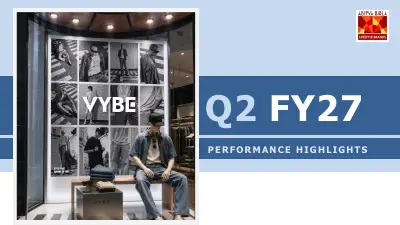
actually, in the stores that have put VYBE, it's already at 10% of sales. Which is huge for a small 8 to 10 feet wall that we've built for VYBE.
I think it's very nice. It's doing both for us, very interestingly, Abhijeet.
It's given us some 50,000 new consumers who are in their 20s, early 20s consumers. It's built a lot of new consumers for us, but interestingly, there is a lot of our existing base also which has been able to look at this, and they've loved this merchandise.
Of course, challenge is how do we build on this Q2 next season and this next season after that. It's been a very, very exciting journey on VYBE, very, very exciting journey.
Abhijeet Kundu
Understood. Oh, great.
In the Emerging Businesses, we have seen quite a substantial margin expansion, and it has been consistent. This is primarily operating leverage, you would say?
What would be the key drivers?
Vishak Kumar
Yeah. First is, of course, operating leverage.
Second is discount reduction. Third is store-level operating leverage with double-digit like-for-like, the percentage store costs also do come down.
All of those are working together for this. Having said that, I think there is more to come in this space.
I think we are only getting started here, this should be more growth and more profitable growth in times to come, Abhijeet.
Abhijeet Kundu
Right. What would be the targeted margins like in this business over a period of say two years?
Sky is the
Vishak Kumar
limit, Abhijeet. Eventually, let's say a brand like Reebok has to get to similar numbers as the other brands.
There is, of course, a small royalty number which has to be taken away from that, but other than that, it'll come to that. Innerwear, once the business scales up stronger and it gets to that number that it has to, I think the upsides are very significant after that, right?
Because there's a lot of leverage that you can then take on from there, right from selling expenses, overheads, all of that leverage then starts coming in very nicely. I think, yeah, we are fairly well-placed in this side of business.
Abhijeet Kundu
Understood. Great, Vishak.
Congrats and all the best. Hey, thanks.
Vishak Kumar
Thank you so much.
Operator
Thank you. Participants to ask a question, please press * and 1.
Next question is from the line of Mohd Haris from YES Securities. Please go ahead.
Mohd Haris
Yeah. Sir, thank you for the opportunity.
I just wanted to ask if you can define small town stores, like which are the cities you might be referring to in your presentation, and in these cities or towns, is the performance consistent across brands or is there specific brands which do well there? That's the first question.
Thank you.
Vishak Kumar
Yeah. Hi, Mohammad.
Thanks for the question. In our definition, we've made a long list of towns potentially which are small town.
That list is about 2,500 towns. These are broadly indicated by a population less than 1.5 lakh, okay?
I can't give you a very sharp definition because we've, in that sense, gone case-to-case, town-by-town, etc., but broadly, if you were to look at it, pop strata-wise it is below 1.5 lakh population towns. It is little different state-by-state.
There are states where you also have the town being a feeder to nearby smaller markets, etc. That also is there.
Some towns where the town is self-contained. Is that your question, or you had something more, Mohammad?
Mohd Haris
That's it. The brands which you would say, is it consistent, the performance by brands across these towns?
Vishak Kumar
I think so. While our drive in these towns is primarily Peter England, about half of the stores that we have in small town India is Peter England stores.
That's the brand with which we drive into a lot of smaller town markets. As based on Peter England performance, it allows us to gauge the attractiveness of the town and to scale up other brands as relevant.
Mohd Haris
Right, right. This would be like...
The
Vishak Kumar
last one year has been quite exciting in small town. The consumption has been quite strong, and we've been continuing to add stores and grow like-for-like as well, double-digit like-for-like in these markets over a sustained period of time.
Mohd Haris
Sir, this would be around close to 20% of sales, as you mentioned in last quarter, is it?
Vishak Kumar
No, no, no, it's not so much. It's a much smaller component of our sales.
It's in single-digit share, about 5%, 6% of our overall share with these small towns.
Mohd Haris
Okay. Sir, I had this one more question.
Considering the portfolio that we have, what is the type of products that mostly gets sold more during the festive or wedding season? Because ours is a more formal, with a mix of casual, kind of a portfolio, right?
Vishak Kumar
Mohammad, we have four large usage occasions that we address, okay? There is the wedding segment, which you spoke about, and in the wedding segment, while all clothes are bought and sold, there is a very strong suits and blazer business that we have during that period, okay?
Then there is business of formals, which is typical pant, shirts, suits, blazers, formal shoes, etc., which is there. Then there is casual wear, okay, which is the everyday wear, the kind of clothes that you hang around with.
Increasingly, even to work, lot of people are wearing smart casual wear, etc. Then there is fourth, which is athleisure and activewear.
We are strong in each of these segments, Mohammad, and of course, at different times of the year, different segments play up stronger. There is a wedding calendar which gives you a strong business in four, five months of the year.
There are other months of the year where there are other segments which grow even stronger. In that sense, it's useful to have a portfolio which addresses all these segments.
Mohd Haris
Understood, sir. Understood.
Thank you. Thank you.
Vishak Kumar
Thank you. Thank you, Mohammad.
Thanks. Yeah.
Operator
Thank you. Next question is from the line of Rajiv Bharati from Nuvama.
Please go ahead.
Rajiv Bharati
Yeah. Good afternoon, sir.
Thanks for the opportunity. Sir, on Reebok, first of all, can you give what is the channel mix and, in terms of on the EBO side, what is the throughput number here per store?
Vishak Kumar
Okay. First, I'll answer your broader question, okay?
We operate across all places where consumers want us to be, which is exclusive stores. We have 250 of those, a little more than 250 of those stores already.
We operate from department stores. We are fairly strong in e-commerce, and of course, we are also there in multi-brand trade.
I can't tell you per store throughputs, etc., but just to tell you that our typical store is about 1,000 to 1,100 square feet, and they are profitable businesses by themselves, which is how we've been able to expand steadily. We see a runway for being able to put up many more stores.
I think we'll end the year with 300-plus stores in Reebok.
Operator
Sorry to interrupt, Mr. Rajiv.
May I ask you to please be a little louder? We are unable to hear you, sir.
Rajiv Bharati
Sure. Sure.
Can you help with the Lifestyle Brands pre-Ind AS margin? I just want to understand that let's say this 5%, 6% LFL number which you talked about in Q2 and H1, how does the pre-Ind AS margin look like for the Lifestyle Brands?
Vishak Kumar
Look, all I can say is, and I was answering an earlier question, that the pre-Ind AS has also expanded, but we don't share this in a quarter-quarter discussion, Rajiv. We've shared this once a year in the past, right?
We'll do that.
Rajiv Bharati
To just add that here, when we do this, this was the same question Sameer asked, that on a six-monthly basis, the cash flow number, if you adjust it from the EBITDA, there's actually on a six-month basis also a margin decline. While we have seen on a reported basis, you have shown operating leverage, one I was assuming that why the margins have been declining, and what is the source of...
No,
Vishak Kumar
no, no, Rajiv, I don't know where you're picking up margin decline. Margin has expanded.
You'll have to help me understand where you got that. We've actually expanded margins.
Rajiv Bharati
In the cash flow in the CFF, you have repayment of lease liability, including interest, right? We adjusted from the reported EBITDA.
For example, for the six-months basis, that is ₹406 crore put together.
Vishak Kumar
We are... Just one second.
I'm just putting that sheet up on my screen so that I can see it. One second.
Ashish Dikshit
Vishak, if I can just come in.
Vishak Kumar
Ashish.
Ashish Dikshit
Rajiv, this is not the correct way. I think there is a fair approximation that you're making, but this is not the correct calculation for trying to get to pre-Ind AS margin.
There are a lot of store openings and closures that happen at different points in the quarter, and therefore the adjustments for that on Ind AS vary. This straightforward calculation that you and earlier someone did is not the correct way to calculate, and which is why there's the difference.
As Vishak is saying, pre-Ind AS margin we don't report because otherwise two sets of numbers keep coming up, and you're constantly clarifying it. Fair to say the margin at all levels has improved, pre-Ind AS, post-Ind AS, as you can see.
We'll report it probably once a year just to reconcile this for
Rajiv Bharati
accountants. That's why I was asking the first question that if you're on the Reebok side, in particular, it's largely a franchise-driven network, and it's e-com heavy was my sense from your earlier, let's say, concalls.
Where is this lovely leverage coming from? Because the fixed cost is not sitting on your book.
Vishak Kumar
Let me answer that, Rajiv. Rajiv, let me answer that.
There are three, four kinds of leverage that we get. There is, of course, the leverage on the overall fixed cost, which is on overheads and advertising.
There's also leverage at a per store throughput level, which also results in both selling expense reductions and discount reductions. Even in a variable model, when your discounts come down in a business, you will get the benefit of that in your EBITDA margin expansion.
That is broadly how the overall expansion in margin has happened on Reebok.
Rajiv Bharati
Sure. Maybe I'll take this offline.
Thanks. Thanks a lot.
Vishak Kumar
Yeah. Thanks, Rajiv.
Thanks for this.
Operator
Thank you. Participants to ask a question, please press * and 1.
Next question is from the line of Parth Shah from Bernstein SG. Please go ahead.
Parth Shah
Hi. Congratulation on a good set of numbers, and thanks for taking my questions.
Firstly, on the channel updates that you share, I've seen the last couple of quarters, there's been 20%-plus growth on e-commerce, but this quarter was a little bit slower at 12%. Any color there on what's happening and how we expect that to grow overall?
Vishak Kumar
Yeah. Our e-com business is a combination of a marketplace and a B2B business.
The more important thing for us to look at it is what is the secondary sales from the partner to the consumer, which has been a healthy double-digit over the entire H1 period. Some of this is the build-up sometimes of primary sales to then pre-season, pre-event that they do, etc.
That is what will explain the highs and lows between quarters. By and large, if you ask me, we've been at a healthy double-digit through the H1 in terms of secondary sales offtakes.
Parth Shah
Just a follow-up on that. Over the year, you're saying we would expect this to come up, right?
Like in 3Q and as the festive period comes
Vishak Kumar
in? Come up as in, will it come up to Q1 level?
No. Will it stay in broadly H1 level?
Yes.
Parth Shah
Got it. Got it.
Got it. Thanks.
The next question, we've obviously added casual and athleisure a lot more to the mix, right? Just any color on how the growth is going across these segments, wedding, formal versus casual, athleisure for us across the brands?
Vishak Kumar
It's a fair question. H1 especially, in fact, Q2 was a lot of casual lines growing because there's very little of wedding in Q2.
Most of the growth is actually coming from casual lines, athleisure, etc. In fact, we launched VYBE in Peter England, which is a fantastic response.
We've launched Motorsport as a line in Louis Philippe, which has again had a very, very strong response. Across brands, we've got a unicorn line of sport from Van Heusen, which has again had a fantastic response.
Across brands, we've done a lot of innovative products which have driven the casual growth in the quarter. Having said that, is that the way every quarter will be?
No. I think Q3 will be more wedding-heavy, and hence suits and blazers and categories like that will grow faster in this quarter.
Parth Shah
Got it. Just a small follow-up on that.
At a overall level over let's say the near to medium term, do we expect casual to be contributing more to the overall mix versus formal and wedding?
Vishak Kumar
It already does. At an we are close to 51-49 or 49-51.
We are in that zone. Quarter by different quarters have that differently.
Is this a trend or is this current story? It's current story.
If casual doubles, good for us. If formal doubles, good for us.
If athleisure doubles, good for us. I think we have assortments which address different consumer needs.
By definition, we are in the business of fashion, which will keep changing. We have to have the ability to be able to create relevant products for consumers at different points of time.
Already in that sense, we we have that. In fact, there is some of it is reverse in brands like Allen Solly, where we are fairly largely casual-driven, but now there is a very nice range of very modern formals, very nice expressions, modern formal, modern fabrics, blends of cotton and nylon, very nice products which are there.
There the trend is actually the other way. I think this is something which will be there in in fashion business, to be where consumers want to be in terms of fashion trends.
To answer your question, we're already in that sense half-and-half.
Parth Shah
Got it. Thanks.
Wish you a happy Diwali. Thank you.
Vishak Kumar
Hey, thank you so much. Wish you the same.
Thank you.
Operator
Thank you. Participants to ask a question, please press * and 1.
Next question is from the line of Shreya Baheti from Anand Rathi Institutional Equities. Please go ahead.
Shreya Baheti
Hello, sir. Sir, I just wanted to know that, sir, gross store additions for H1 FY27 were around 180+, while net additions were around 86.
Closures were somewhere around 90 to 100 stores. Sir, will this closure pace continue in H2 also?
Also, sir, can you give the net store counts for Lifestyle Brands only for the quarter?
Vishak Kumar
Okay. Shreya, let me take one question at a time from you.
You're right. I think we have had a 90-odd store net expansion for H1, okay, which means that about 90-odd stores would have closed from the gross 180.
H2 would be lesser than that, but it won't be zero. There will always be some store closures.
A lot of our store closures, Shreya, are when we move to a better location in the same market, or when we move to a bigger location in the same market. While it look like closure, actually it is moving to a sweet spot location or to a bigger store, so that process will continue.
Also, every once in a while, there will be some locations which become irrelevant, and you have to let go of those locations, so that again continues. Sorry, there was another question that you had.
Lifestyle separately, I think we'll have to put that together, Shreya, for you. Maybe give that to you separately.
All I can say is our expansion was fairly consistent across brands. We had a fairly strong expansion in Louis Philippe, Van Heusen, Allen Solly, Peter England, Reebok.
Across the board, we had a fairly consistent expansion growth.
Shreya Baheti
Understood, sir. Sir, just one more question.
Innerwear business has been performing well for us, so, sir, when can we expect the business to break even?
Vishak Kumar
To break even? Sorry, we've already shown you at least it depends on which level break-even are you asking.
At a Ind AS EBITDA level, you just saw the 6.5% EBITDA for the quarter, okay, 6.8% for the quarter, right, which is up from 1.5% in Q2 last year. That is the kind of swing.
I think, to one of the earlier questions, this is something which will only keep strengthening itself, okay, and this is a business which has to grow and be profitable. That's the way we see it.
I don't know, you're not seeing those numbers, Shreya?
Shreya Baheti
Sir, I was just asking for the innerwear business only.
Vishak Kumar
Oh, you're asking for the innerwear business. I think again, innerwear business has made very good strides, okay, and we are fairly close to that, and I had also in an earlier call said that we would have one profitable quarter in this year.
We'll hold ourselves to that. We are pushing ourselves very hard to be able to deliver that, and then, of course, the kind of scale that we get and we grow is exciting times ahead there.
Shreya Baheti
Sir. Understood.
Vishak Kumar
Thank you, sir.
Shreya Baheti
Thank you. Thank you, Shreya.
Operator
Thank you. Next question is from the line of Kunal Bhatia from Dalal & Broacha.
Please go ahead.
Kunal Bhatia
Yeah. Hi, sir.
Thanks for the opportunity. Sir, you did mention that currently the smaller towns are contributing around 5% to 6%-odd in our revenues.
Could you just elaborate a bit more what is our strategy going forward on expanding in the smaller towns? You've also mentioned the kind of smaller towns we're working at.
This 5% would reach how much, say, by the next two to three years? Also in terms of the strategy there, would it be more only Peter England-led, or we are also looking at other formats to expand more in these areas?
Vishak Kumar
See, I'll tell you, while we report small town separately, we would chase metro opportunity, we would chase Middle India opportunity, we will chase small town opportunity, right? It's just that in recent times, small towns have also had potential to be able to put up stores, which was not there earlier, and hence it got called out separately.
To answer your question, we don't even have a target of growing this faster or any differently from the rest of the country. It's just that there is a market opportunity.
We have to make the most of it, this we will put up stores. Like you rightly asked, another speaker had asked, large part of this expansion is Peter England-driven, but there are markets where other brands also do well, we will put up wherever those markets are relevant.
It's another of our growth pillars, it's not as if Middle India will not, Tier 2, Tier 1, metro, each of these we have targets in every town population, every kind of town classification, we would grow that. Will five become will 5% to 6% become 6% to 7% maybe?
Will it become 10%? No.
That's not the way we would have to expand network, and our pipeline is also like that. If you look at our network, our pipeline will actually still be very metro-heavy or Tier 1, Tier 2-heavy.
Small towns, they look more visible because of the fact that there wasn't business there earlier, and hence you're seeing it separately.
Kunal Bhatia
Right, right. Sir, just one clarification on the gross margin end.
You mentioned that some part of the price increase was due to inflation. How about in Q3, has the inflation gone up, or how is it, and how much of that is already covered with this 6% price increase?
Vishak Kumar
Yeah. When I had said 6%, it was largely for Q3, in fact, because in Q2, there was a mix of old inventory and new inventory which was getting created.
Old inventory of which was carried forward from previous quarters wouldn't have had that price hike, it was a composite. In Q3 is where you will see the full effect of that in terms of price increases.
Okay.
Kunal Bhatia
Okay. Fine, sir.
Thank you.
Vishak Kumar
Is that okay, Kunal? Yeah.
Thanks, Kunal.
Kunal Bhatia
Thank you, sir.
Operator
Thank you. Participants to ask a question, please press * and 1.
Next question is from the line of Deepak Malhotra from Capgrow Capital Advisors. Please go ahead.
Deepak Malhotra
Hi. I've been a long-term investor in actually both the companies, which is ABFRL and ABLBL.
What I see that since the rights issue of 2020, both the companies have invested almost ₹9,000 crore. Today, while I have combined sales of about ₹20,000 crore, I'm still loss-making in ABFRL and making some profit in ABLBL.
Now, when I also look at the market cap of the two combined companies even today, that itself is only ₹13,500 crore. That's one observation.
My second part of the question is actually on the growth, what we just commented about, 11% to 12% is what you're targeting, while when we set up the journey, we were basically targeting 15%. Now, if we dwell a little further there and compare it vis-a-vis the peers, then in the Lifestyle business, while you've reported 9% for the current quarter, when we look at the other peers, whether it is Raymonds, Arvind Fashions, the numbers are much higher.
If I look at even a Trent, where the business model is slightly different, the number is much higher. Even a newer entrant, again, which is maybe not strictly comparable, which is House of Rare, the number is much superior.
When I look at the other segment, which is the Emerging segment, yes, I think the numbers at 27% does seem quite good, but when again I compare it with the others, where the strategy is going further there in terms of our...
Operator
I'm sorry to interrupt you, Mr. Malhotra.
May I request you to please be a bit louder?
Deepak Malhotra
Okay. What I'm trying to say is, given that I'm an investor basically again in the company for the next five years, and also what we have seen in terms of setting our targets, my question is really to understand, where are we really in this journey?
Thank you.
Ashish Dikshit
Thank you, Mr. Malhotra.
Since this is call for ABLBL quarterly results, I'll keep it limited to that. As Vishak had said, when we started the journey for ABLBL, we had indicated 12% to 13% kind of revenue growth.
We are quite close to that. We'll, of course, as we said, aspire for closer to 15%, and I think that journey will sort of play out over a period of time.
Some of our retail expansion has now started in a more earnest manner. You've seen the first sign of it in first half of this year.
We believe the journey is pretty much, as far as our business is concerned, on a very steady wicket, growing early double-digit, hopefully will get to mid double-digits, profitability strong and has been consistent over a period of time. The portfolio is diversified, channel mix is in line with how the market is evolving, and we think over a period of time we'll be able to show sustained performance over a much longer period of time to deliver the numbers.
Operator
Thank you. Participants who wish to ask a question, please press * and 1.
Anyone who wishes to ask a question may please press * and 1 now. Ladies and gentlemen, as there are no further questions, on behalf of the management, we thank all participants for joining us.
In case of any other further queries, you may please get in touch with Amit Dwivedi. You may now disconnect your lines.
Thank you.